
GRADING OF MATERIALS Asphalt Grading Systems Asphalt is

- Slides: 11
GRADING OF MATERIALS
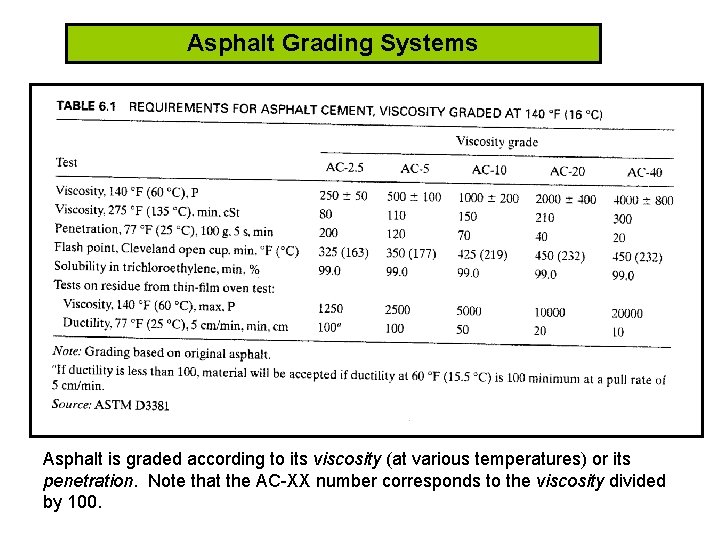
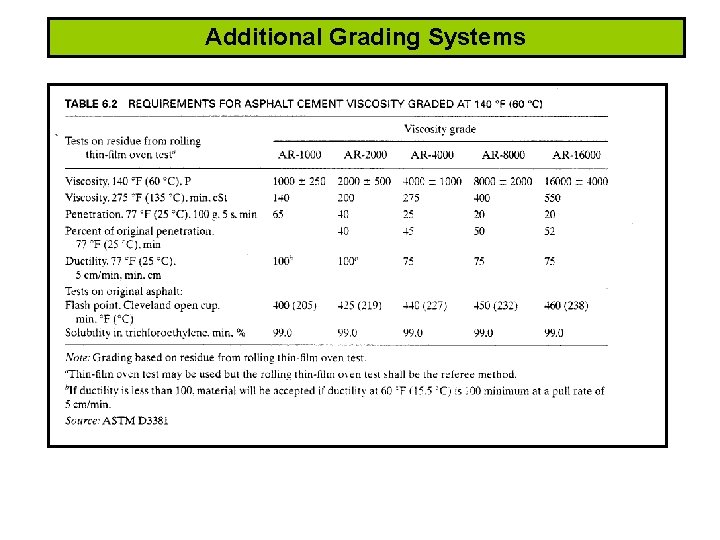
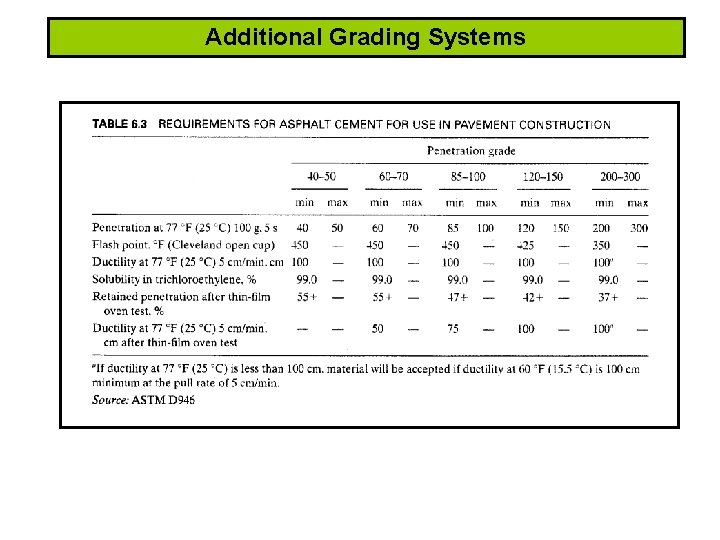
Asphalt Grading Systems Asphalt is graded according to its viscosity (at various temperatures) or its penetration. Note that the AC-XX number corresponds to the viscosity divided by 100.
Additional Grading Systems
Additional Grading Systems
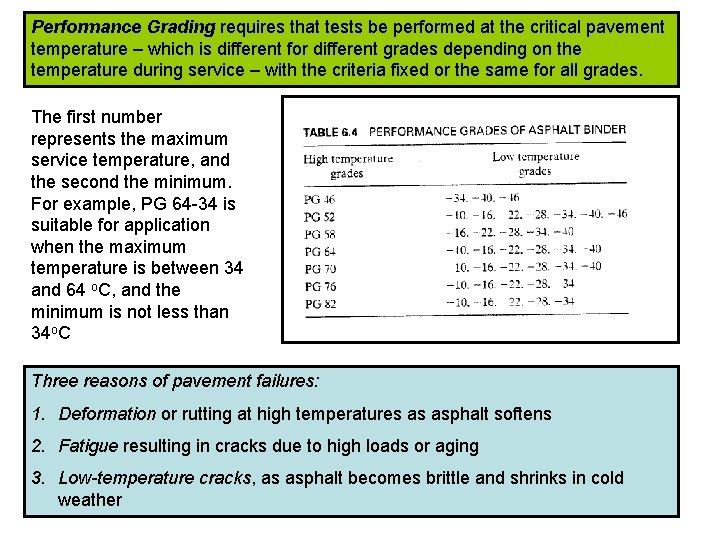
Performance Grading requires that tests be performed at the critical pavement temperature – which is different for different grades depending on the temperature during service – with the criteria fixed or the same for all grades. The first number represents the maximum service temperature, and the second the minimum. For example, PG 64 -34 is suitable for application when the maximum temperature is between 34 and 64 o. C, and the minimum is not less than 34 o. C Three reasons of pavement failures: 1. Deformation or rutting at high temperatures as asphalt softens 2. Fatigue resulting in cracks due to high loads or aging 3. Low-temperature cracks, as asphalt becomes brittle and shrinks in cold weather
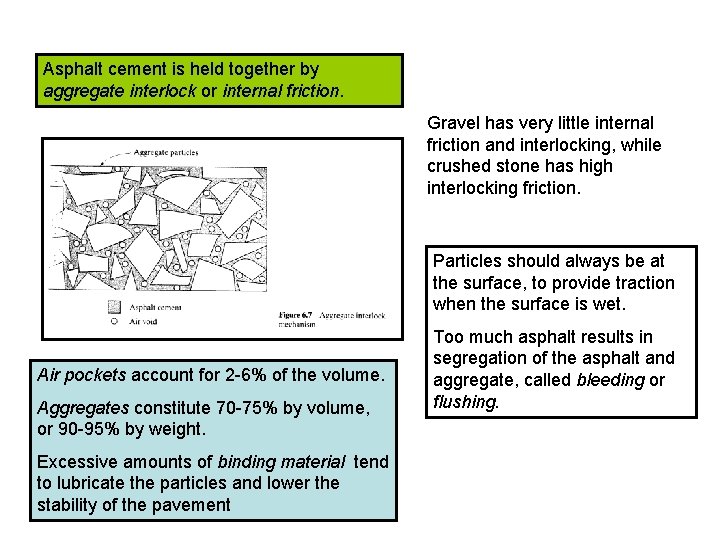
Asphalt cement is held together by aggregate interlock or internal friction. Gravel has very little internal friction and interlocking, while crushed stone has high interlocking friction. Particles should always be at the surface, to provide traction when the surface is wet. Air pockets account for 2 -6% of the volume. Aggregates constitute 70 -75% by volume, or 90 -95% by weight. Excessive amounts of binding material tend to lubricate the particles and lower the stability of the pavement Too much asphalt results in segregation of the asphalt and aggregate, called bleeding or flushing.
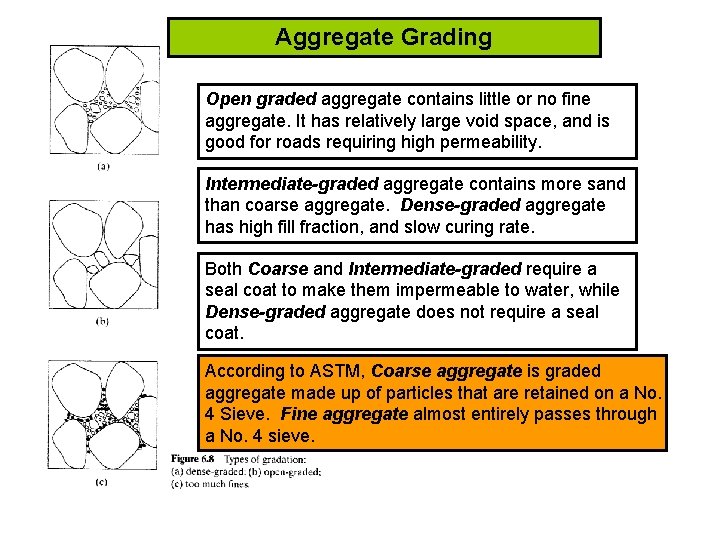
Aggregate Grading Open graded aggregate contains little or no fine aggregate. It has relatively large void space, and is good for roads requiring high permeability. Intermediate-graded aggregate contains more sand than coarse aggregate. Dense-graded aggregate has high fill fraction, and slow curing rate. Both Coarse and Intermediate-graded require a seal coat to make them impermeable to water, while Dense-graded aggregate does not require a seal coat. According to ASTM, Coarse aggregate is graded aggregate made up of particles that are retained on a No. 4 Sieve. Fine aggregate almost entirely passes through a No. 4 sieve.
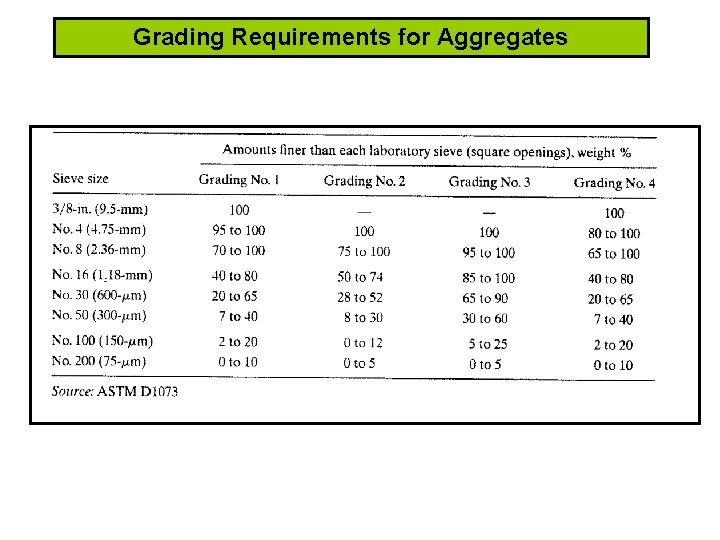
Grading Requirements for Aggregates
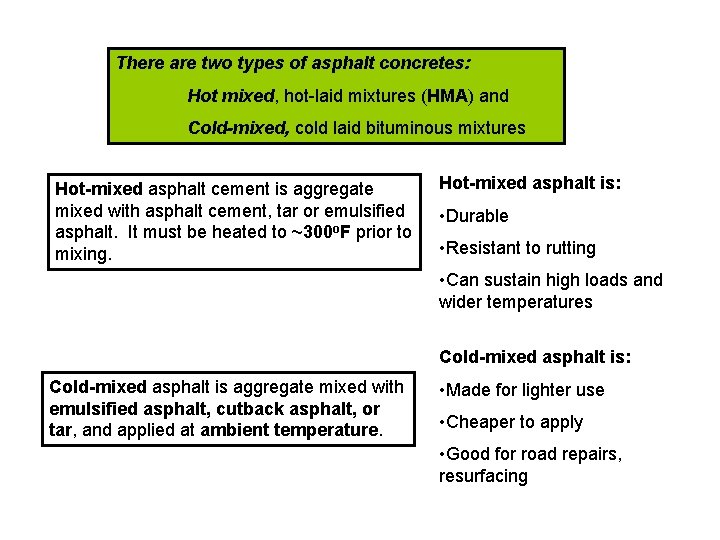
There are two types of asphalt concretes: Hot mixed, hot-laid mixtures (HMA) and Cold-mixed, cold laid bituminous mixtures Hot-mixed asphalt cement is aggregate mixed with asphalt cement, tar or emulsified asphalt. It must be heated to ~300 o. F prior to mixing. Hot-mixed asphalt is: • Durable • Resistant to rutting • Can sustain high loads and wider temperatures Cold-mixed asphalt is: Cold-mixed asphalt is aggregate mixed with emulsified asphalt, cutback asphalt, or tar, and applied at ambient temperature. • Made for lighter use • Cheaper to apply • Good for road repairs, resurfacing
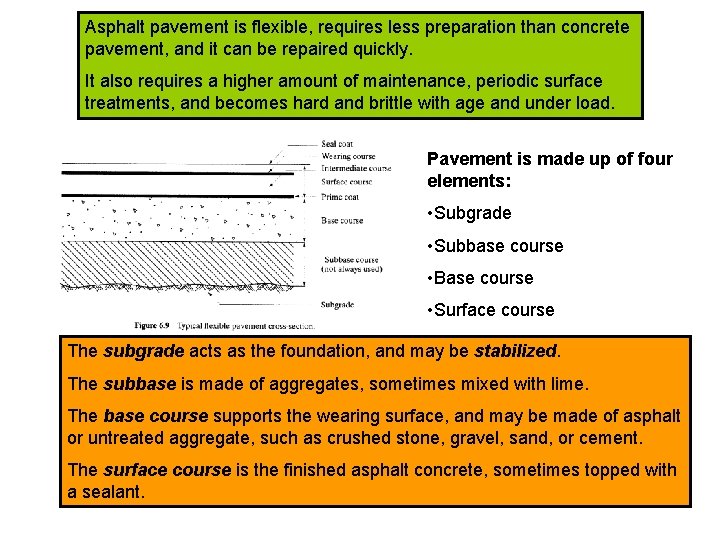
Asphalt pavement is flexible, requires less preparation than concrete pavement, and it can be repaired quickly. It also requires a higher amount of maintenance, periodic surface treatments, and becomes hard and brittle with age and under load. Pavement is made up of four elements: • Subgrade • Subbase course • Base course • Surface course The subgrade acts as the foundation, and may be stabilized. The subbase is made of aggregates, sometimes mixed with lime. The base course supports the wearing surface, and may be made of asphalt or untreated aggregate, such as crushed stone, gravel, sand, or cement. The surface course is the finished asphalt concrete, sometimes topped with a sealant.
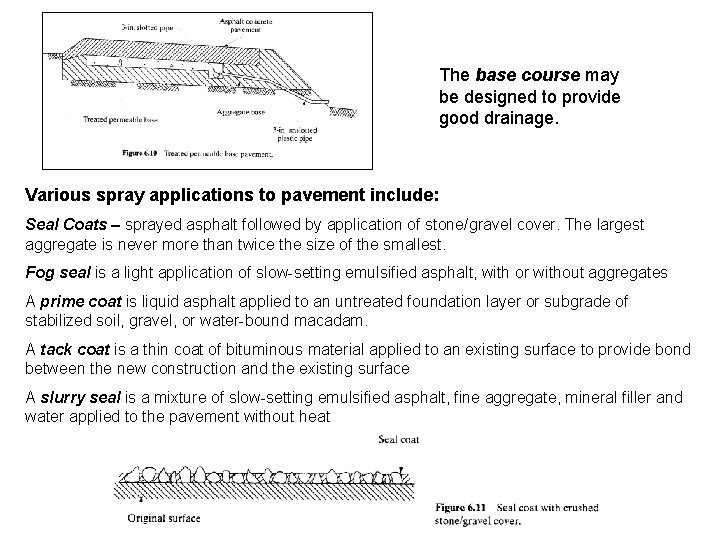
The base course may be designed to provide good drainage. Various spray applications to pavement include: Seal Coats – sprayed asphalt followed by application of stone/gravel cover. The largest aggregate is never more than twice the size of the smallest. Fog seal is a light application of slow-setting emulsified asphalt, with or without aggregates A prime coat is liquid asphalt applied to an untreated foundation layer or subgrade of stabilized soil, gravel, or water-bound macadam. A tack coat is a thin coat of bituminous material applied to an existing surface to provide bond between the new construction and the existing surface A slurry seal is a mixture of slow-setting emulsified asphalt, fine aggregate, mineral filler and water applied to the pavement without heat