
Grading is Teaching Using Effective Assessment Practices in
- Slides: 21
Grading is Teaching: Using Effective Assessment Practices in Online Courses Bridget Arend University of Denver
Why is assessment important?
“Will this be on the test? ”
Importance of assessment o Students typically concentrate their efforts on whatever content or cognitive skills they believe will be tested (Black & William, 1998; Bull & Mc. Kenna, 2004, Shepard, 2000) o Different forms of assessment encourage different types of learning (Gipps, 1994; Hynd et al. , 2000; Mc. Keachie et al. , 1986; Pintrich, 1989) o o The form of an exam or essay question can affect how students study (Entwistle, 1996) The nature of online discussion questions influence the types of responses (Meyer, 2004)
Criticisms of HE Assessment n Classroom assessment often encourages superficial and rote learning (Black & William, 1998) n Grading is over-emphasized while learning is under-emphasized (Assessment Reform Group, 1999) n Higher education instructors do not give priority to providing feedback to students on their learning (Cross, 1988)
The Big Lesson From the Literature: Assessment for learning rather than assessment of learning
Are online assessment practices different?
Dissertation Study o o Site = CCCOnline Two phase, mixed-method design Phase I/Quantitative = 60 courses across disciplines o o Surveys of 411 students and 51 instructors 60 course observations Phase II/Qualitative = follow up of 9 courses o o Email/phone interviews with 29 students and 8 instructors 9 course observations
Assessment Practices Summative and Formative Assessment
Summative Assessment o Thomas Angelo’s framework of AAHE’s 9 Principles of Good Practice for Assessing Student Learning (1992) Principle #2 n n Use multiple methods Assess multiple dimensions Use multiple assessors Assess over time
Study Findings A “typical” online course: o o 29 assignments using 5 different methods Students use a variety of learning strategies 65% use non-graded assignments, No peer/group work Assignments due 10 out of 15 weeks
Formative Assessment o o Non-graded assignments What makes formative assessment successful? n n Frequent and timely feedback Precise feedback Students using feedback Changing course content or teaching methods when needed
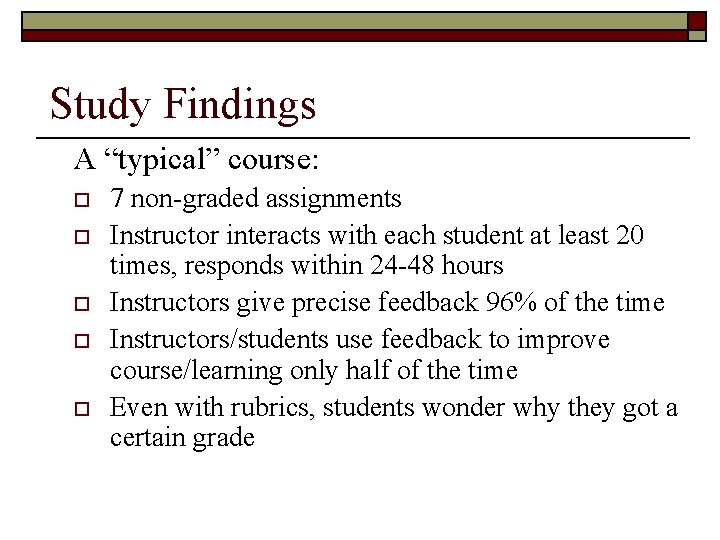
Study Findings A “typical” course: o o o 7 non-graded assignments Instructor interacts with each student at least 20 times, responds within 24 -48 hours Instructors give precise feedback 96% of the time Instructors/students use feedback to improve course/learning only half of the time Even with rubrics, students wonder why they got a certain grade
Online Assessment Worksheet Summative/Formative Assessment How do you fare? Examples?
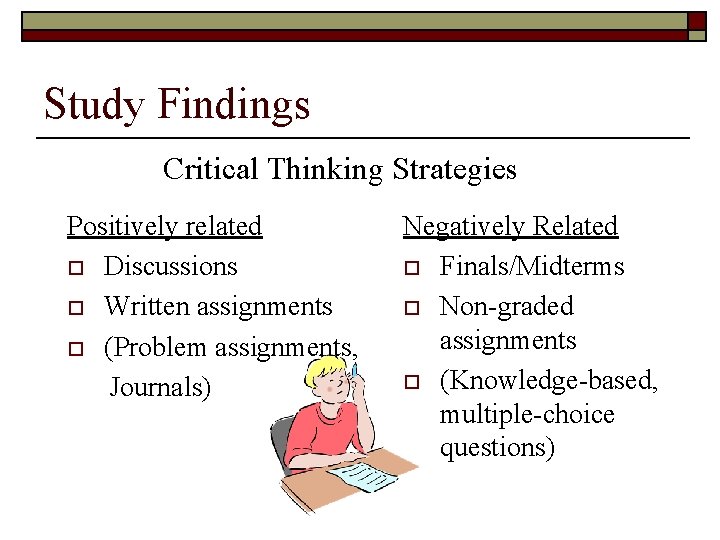
Study Findings Critical Thinking Strategies Positively related o Discussions o Written assignments o (Problem assignments, Journals) Negatively Related o Finals/Midterms o Non-graded assignments o (Knowledge-based, multiple-choice questions)
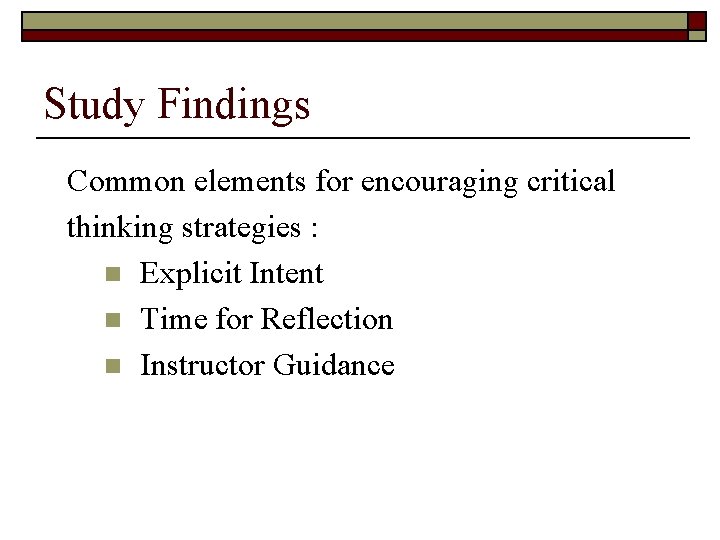
Study Findings Common elements for encouraging critical thinking strategies : n Explicit Intent n Time for Reflection n Instructor Guidance
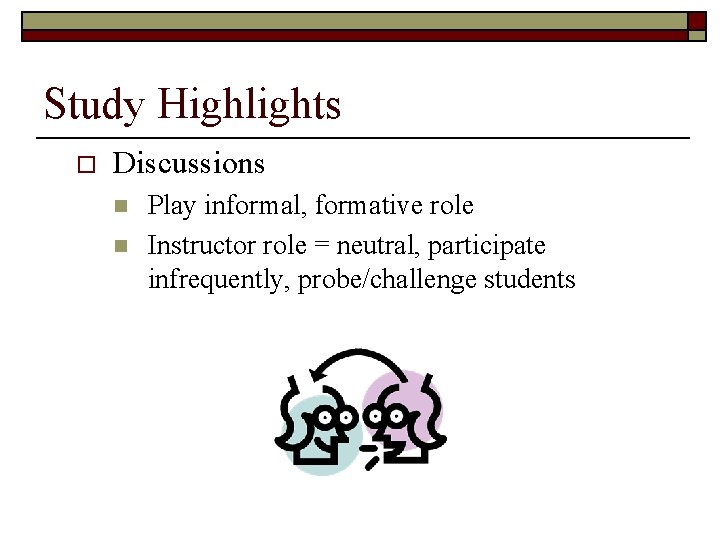
Study Highlights o Discussions n n Play informal, formative role Instructor role = neutral, participate infrequently, probe/challenge students
Study Highlights o Knowledge-Based, Multiple-Choice Exams n n n Least useful for understanding student knowledge Instructors use as discipline tool or because they are supposed to Has evolved from summative to formative role
Online Assessment Worksheet Encouraging Critical Thinking How do you fare? Examples?
Take-aways
Thank you! Bridget Arend University of Denver bridget. arend@du. edu