
GRADIENT ALGORITHMS for COMMON LYAPUNOV FUNCTIONS Daniel Liberzon
GRADIENT ALGORITHMS for COMMON LYAPUNOV FUNCTIONS Daniel Liberzon Univ. of Illinois at Urbana-Champaign, U. S. A. Roberto Tempo IEIIT-CNR, Politecnico di Torino, Italy CDC ’ 03
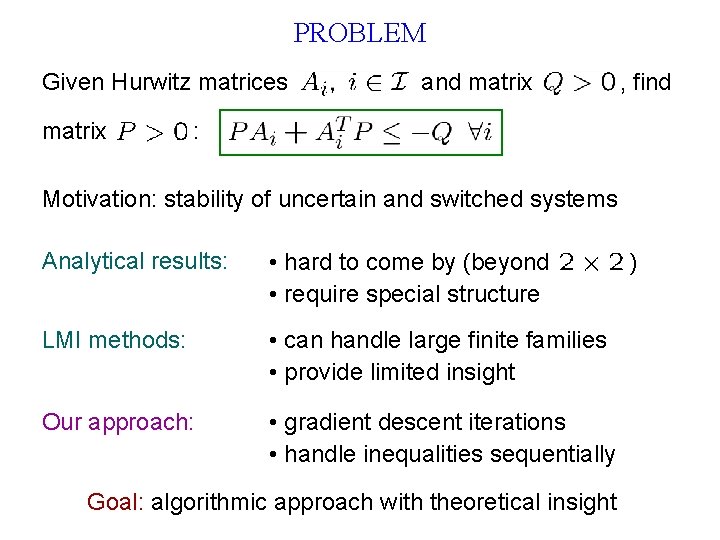
PROBLEM Given Hurwitz matrices matrix and matrix , find : Motivation: stability of uncertain and switched systems Analytical results: • hard to come by (beyond • require special structure LMI methods: • can handle large finite families • provide limited insight Our approach: • gradient descent iterations • handle inequalities sequentially Goal: algorithmic approach with theoretical insight )
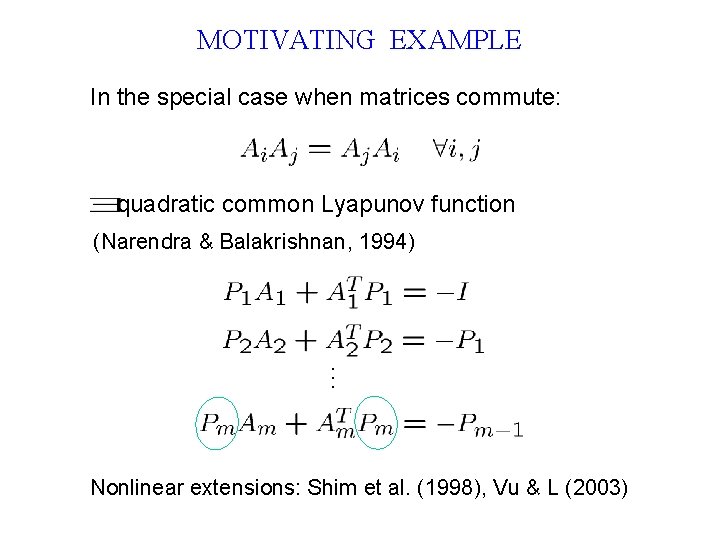
MOTIVATING EXAMPLE In the special case when matrices commute: quadratic common Lyapunov function (Narendra & Balakrishnan, 1994) . . . Nonlinear extensions: Shim et al. (1998), Vu & L (2003)
ITERATIVE ALGORITHMS: PRIOR WORK Algebraic inequalities: Agmon, Motzkin, Schoenberg (1954) Polyak (1964) Yakubovich (1966) Matrix inequalities: Polyak & Tempo (2001) Calafiore & Polyak (2001)
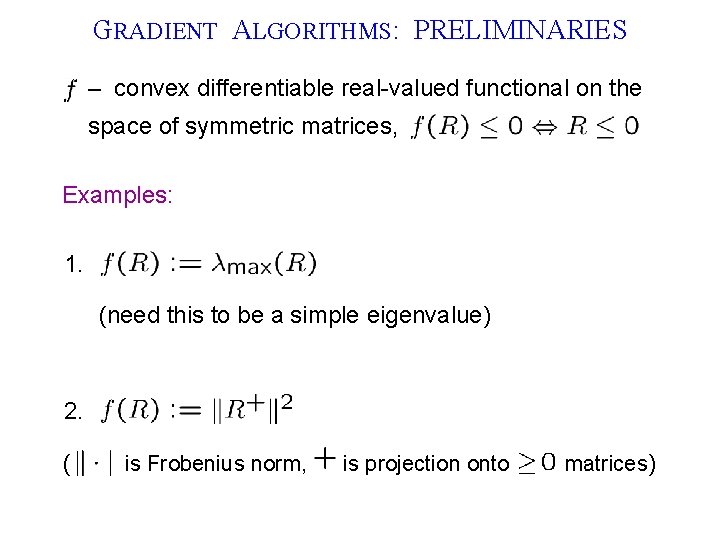
GRADIENT ALGORITHMS: PRELIMINARIES – convex differentiable real-valued functional on the space of symmetric matrices, Examples: 1. (need this to be a simple eigenvalue) 2. ( is Frobenius norm, is projection onto matrices)
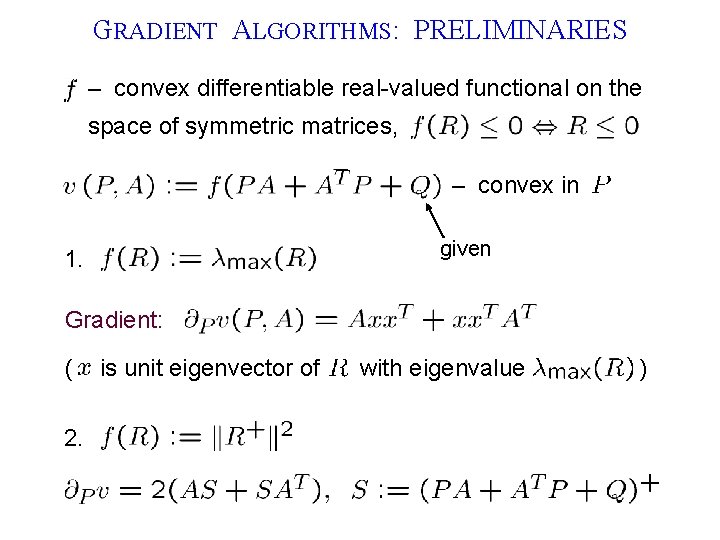
GRADIENT ALGORITHMS: PRELIMINARIES – convex differentiable real-valued functional on the space of symmetric matrices, – convex in given 1. Gradient: ( 2. is unit eigenvector of with eigenvalue )
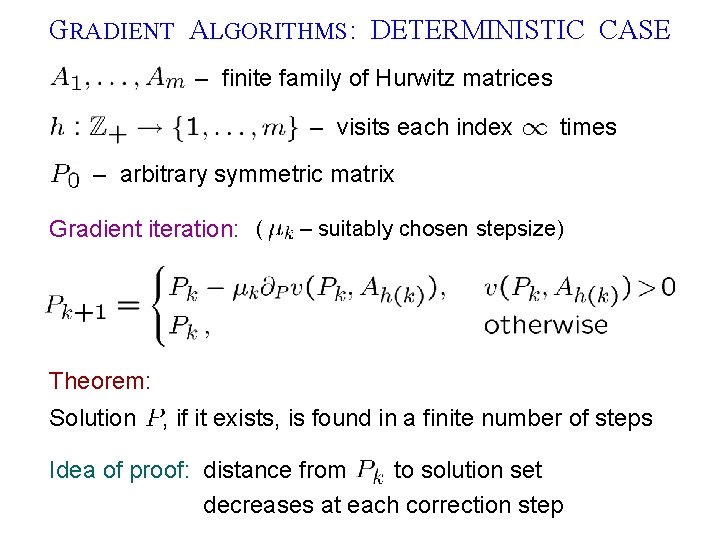
GRADIENT ALGORITHMS: DETERMINISTIC CASE – finite family of Hurwitz matrices – visits each index times – arbitrary symmetric matrix Gradient iteration: ( – suitably chosen stepsize) Theorem: Solution , if it exists, is found in a finite number of steps Idea of proof: distance from to solution set decreases at each correction step
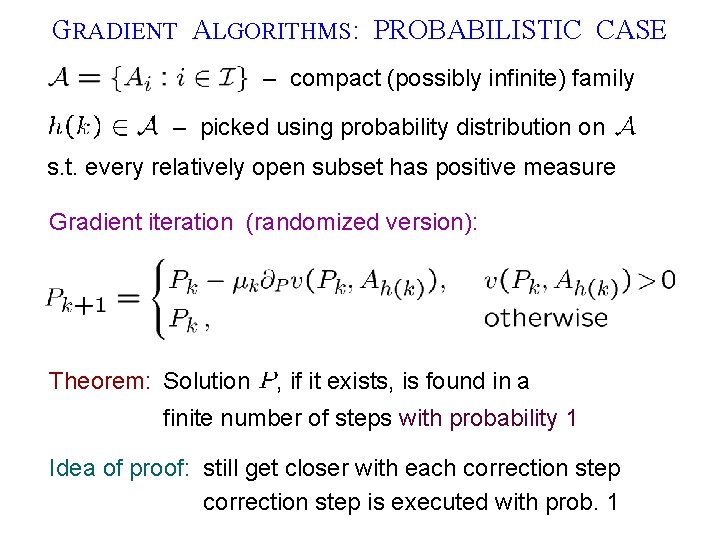
GRADIENT ALGORITHMS: PROBABILISTIC CASE – compact (possibly infinite) family – picked using probability distribution on s. t. every relatively open subset has positive measure Gradient iteration (randomized version): Theorem: Solution , if it exists, is found in a finite number of steps with probability 1 Idea of proof: still get closer with each correction step is executed with prob. 1
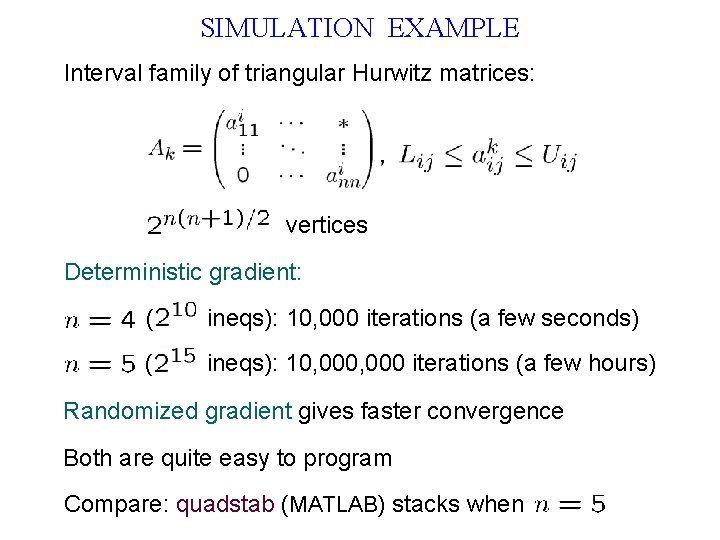
SIMULATION EXAMPLE Interval family of triangular Hurwitz matrices: vertices Deterministic gradient: ( ineqs): 10, 000 iterations (a few seconds) ( ineqs): 10, 000 iterations (a few hours) Randomized gradient gives faster convergence Both are quite easy to program Compare: quadstab (MATLAB) stacks when
CONCLUSIONS Contribution: • Gradient iteration algorithms for solving simultaneous Lyapunov matrix inequalities • Deterministic convergence for finite families, probabilistic convergence for infinite families Open issues: • performance comparison of different methods • addressing existence of solutions • optimal schedule of iterations • additional requirements on solution
- Slides: 10