
Grades 2 12 Writing Collection Overview 2019 2020
- Slides: 17
Grades 2– 12 Writing Collection Overview 2019 -2020 Texas Education Agency Student Assessment Division 1
Disclaimer • These slides have been prepared by the Student Assessment Division of the Texas Education Agency. • If any slide is amended or revised for local use, please remove the TEA logo and TEA footer at the bottom of the slide. You may have to use the slide master to remove TEA logo and TEA footer. 2
Grades 2– 12 Writing Assessment Approach • Raters assemble a collection of each student’s writing from a variety of content areas. • Raters base the English writing proficiency ratings on the contents of the collections. • Additional classroom observations are not used. TEA 3
Goal in Assembling Writing Collections To make sure the collections portray the students’ overall English language writing proficiency TEA 4
Writing Activities TELPAS writing samples should be taken from authentic classroom activities grounded in • content area TEKS • ELPS TEA 5
February 10, 2020 • Writing assigned on or after February 10, 2020 may be considered. • Writing samples may continue to be gathered until the date designated by the district as the deadline for completing the collections in order to submit the ratings. TEA 6
Samples Required • At least 5 total samples are required in each collection. • In each collection there must be - at least 1 writing sample that elicits the use of past tense - at least 2 writing samples from math, science, or social studies TEA 7
Some Eligible Types of Writing • Descriptive writing on a familiar topic • Writing about a familiar process • Writing that elicits the use of past tense • Personal narratives and reflective pieces • Expository and other extended writing from language arts classes • Expository or procedural writing from science, math, and social studies classes TEA 8
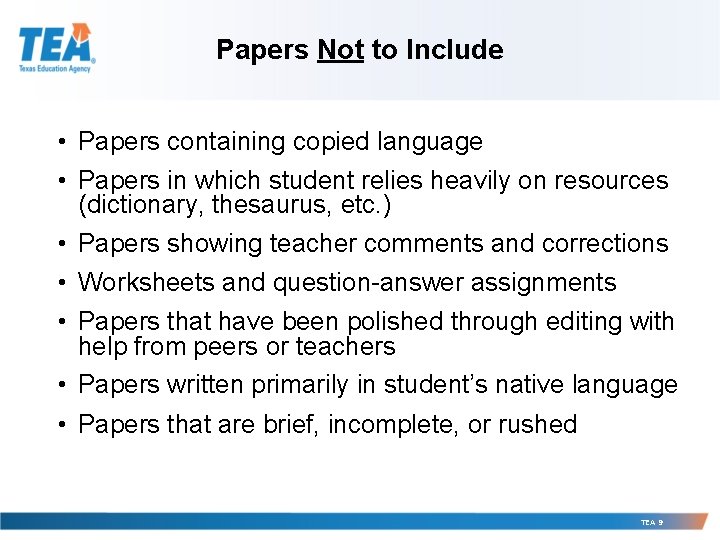
Papers Not to Include • Papers containing copied language • Papers in which student relies heavily on resources (dictionary, thesaurus, etc. ) • Papers showing teacher comments and corrections • Worksheets and question-answer assignments • Papers that have been polished through editing with help from peers or teachers • Papers written primarily in student’s native language • Papers that are brief, incomplete, or rushed TEA 9
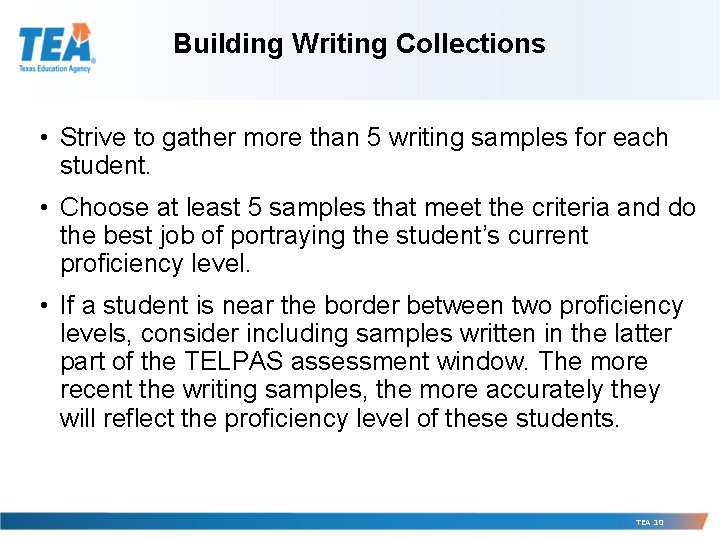
Building Writing Collections • Strive to gather more than 5 writing samples for each student. • Choose at least 5 samples that meet the criteria and do the best job of portraying the student’s current proficiency level. • If a student is near the border between two proficiency levels, consider including samples written in the latter part of the TELPAS assessment window. The more recent the writing samples, the more accurately they will reflect the proficiency level of these students. TEA 10
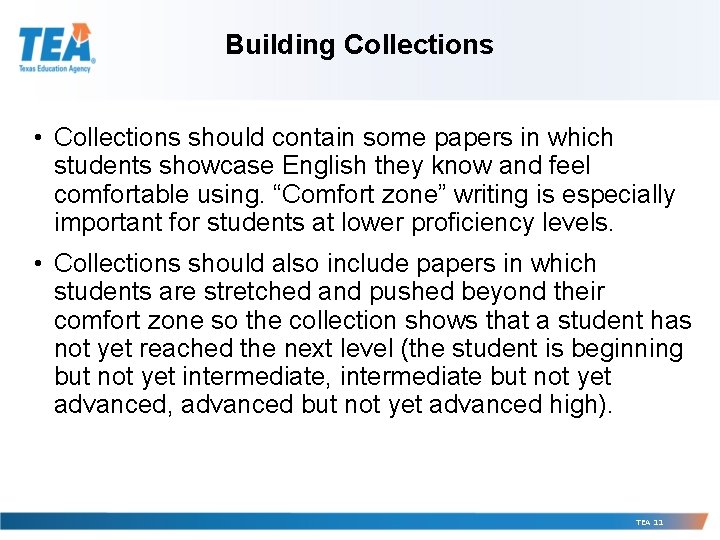
Building Collections • Collections should contain some papers in which students showcase English they know and feel comfortable using. “Comfort zone” writing is especially important for students at lower proficiency levels. • Collections should also include papers in which students are stretched and pushed beyond their comfort zone so the collection shows that a student has not yet reached the next level (the student is beginning but not yet intermediate, intermediate but not yet advanced, advanced but not yet advanced high). TEA 11
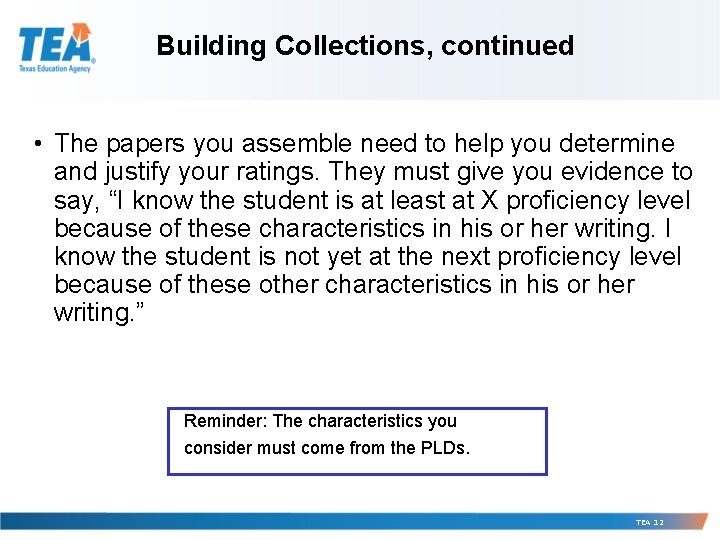
Building Collections, continued • The papers you assemble need to help you determine and justify your ratings. They must give you evidence to say, “I know the student is at least at X proficiency level because of these characteristics in his or her writing. I know the student is not yet at the next proficiency level because of these other characteristics in his or her writing. ” Reminder: The characteristics you consider must come from the PLDs. TEA 12
Beginning Level • The ELPS require ELs of all proficiency levels to learn to write in English. • It is not acceptable for writing collections of students at the beginning level to include samples written primarily in the native language. Such samples do not provide evidence of English writing proficiency. • Writing tasks of these students should be adapted to their needs. Their writing in English will likely be formulaic or memorized, include recently practiced vocabulary, lack detail, etc. TEA 13
Summarizing Tips • Students who are capable of expressing themselves in English in a detailed, extended way should do so. Do not include brief responses from students who know enough English to respond to writing tasks in extended ways. • In other words, consider students’ Englishlanguage proficiency levels in determining whether papers are too brief to be included. TEA 14
Summarizing Tips, continued • Build writing collections that have a balance of writing from language arts and other core content areas. • Collections should show what the student knows and can do as well as what the student struggles with in second language acquisition. • Remember, build the collections to portray the student’s overall ability to communicate in writing in English. TEA 15
Verification of Collection Contents Campuses follow procedures outlined in the TELPAS Rater Manual to ensure that the writing collections are assembled correctly and include the necessary number and types of writing. TEA 16
Resources with More Details § District and Campus Coordinator Resources § Updated annually and available in the fall from TEA’s Student Assessment website § TELPAS Rater Manual § Updated annually and available in late fall from TEA’s Student Assessment website § Will be available only online § Online course titled Assembling and Verifying Grades 2– 12 Writing Collections § Available online January 13 in the TELPAS Online Training Center TEA 17