
Graded Exercises Authentication Cristina Onete mariacristina oneteirisa fr
- Slides: 8
Graded Exercises & Authentication Cristina Onete maria-cristina. onete@irisa. fr Rennes, 23/10/2014
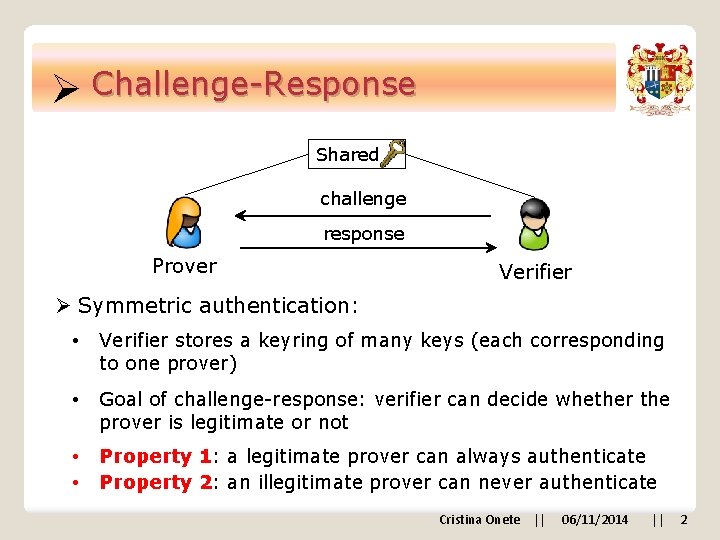
Ø Challenge-Response Shared challenge response Prover Verifier Ø Symmetric authentication: • Verifier stores a keyring of many keys (each corresponding to one prover) • Goal of challenge-response: verifier can decide whether the prover is legitimate or not • • Property 1: a legitimate prover can always authenticate Property 2: an illegitimate prover can never authenticate Cristina Onete || 06/11/2014 || 2
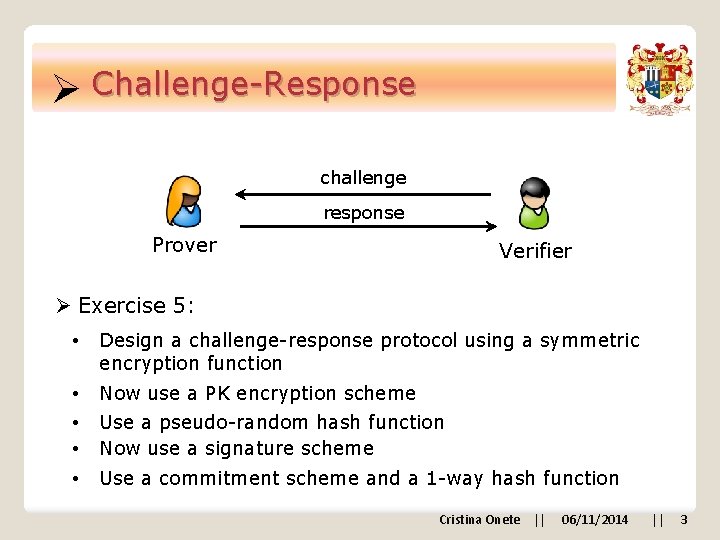
Ø Challenge-Response challenge response Prover Verifier Ø Exercise 5: • Design a challenge-response protocol using a symmetric encryption function • • • Now use a PK encryption scheme Use a pseudo-random hash function Now use a signature scheme • Use a commitment scheme and a 1 -way hash function Cristina Onete || 06/11/2014 || 3
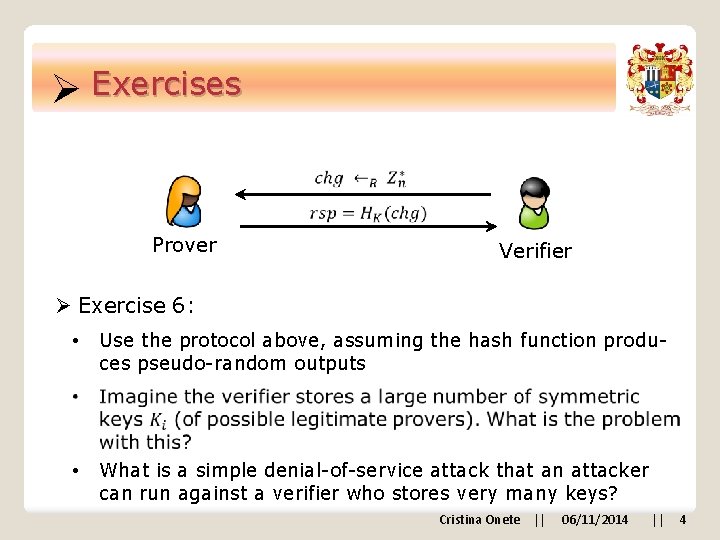
Ø Exercises Prover Verifier Ø Exercise 6: • Use the protocol above, assuming the hash function produces pseudo-random outputs • What is a simple denial-of-service attack that an attacker can run against a verifier who stores very many keys? Cristina Onete || 06/11/2014 || 4
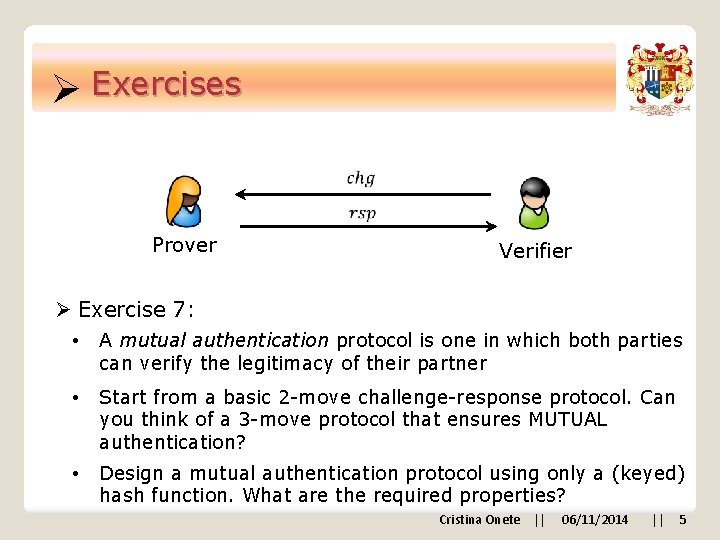
Ø Exercises Prover Verifier Ø Exercise 7: • A mutual authentication protocol is one in which both parties can verify the legitimacy of their partner • Start from a basic 2 -move challenge-response protocol. Can you think of a 3 -move protocol that ensures MUTUAL authentication? • Design a mutual authentication protocol using only a (keyed) hash function. What are the required properties? Cristina Onete || 06/11/2014 || 5
Ø Exercise 8: the age game Ø One of your friends, a girl, asks you to guess her age Ø You know the penalty for guessing she is too old: she’ll kick you and punch you, and probably then kill you Ø So you say: I bet you I know your age. But you have to give me your ID card to check it. If it’s right, I will prove to you that I knew your age. If I am wrong, I’m buying you flowers, chocolates, and an expensive dinner • Use a commitment scheme. The idea is that you want to be able to prove that your guess was right (if the number you guessed is at most her age – as you will see from her ID) or withold any information about your guess (if you guessed wrongly). That way, she will at least not know how old you thought she was Cristina Onete || 06/11/2014 || 6
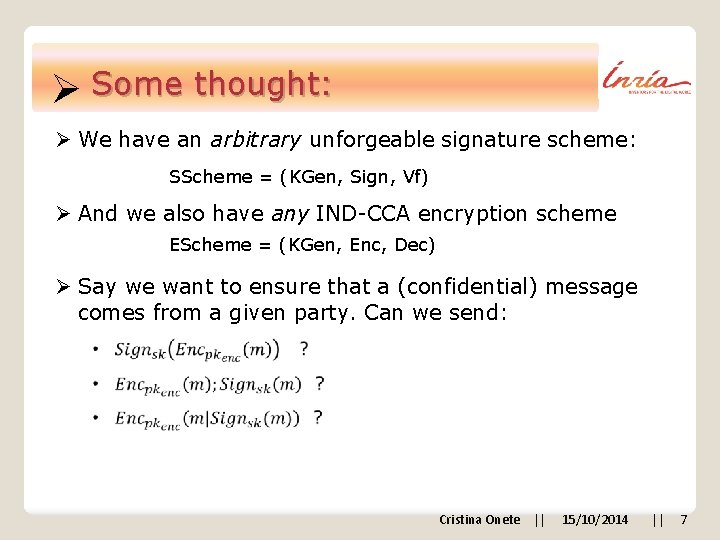
Ø Some thought: Ø We have an arbitrary unforgeable signature scheme: SScheme = (KGen, Sign, Vf) Ø And we also have any IND-CCA encryption scheme EScheme = (KGen, Enc, Dec) Ø Say we want to ensure that a (confidential) message comes from a given party. Can we send: Cristina Onete || 15/10/2014 || 7
Thanks! CIDRE