
Graded Approach Applications in Nuclear Research Reactors Yasser

- Slides: 26
Graded Approach Applications in Nuclear Research Reactors Yasser E. Tawfik, Ph. D ETRR-2 Complex - RPF International Conference on Research Reactors: Safe Management and Effective Utilization Vienna, 16 -20 Nov. 2015
Graded Approach • A graded approach is applicable to all various stages of a research reactor’s lifetime (site selection, site evaluation, design, construction, commissioning, operation, and decommissioning). • The IAEA Safety guide (SSG-22) presented recommendations on the graded approach to application of safety requirements for research reactors. In these applications a graded approach is only used in determining the scope and level of detail of the safety assessment carried out in a particular state for any particular facility or activity.
Graded Approach (cont. ) Objectives of the Graded Approach • The objective of the graded approach is to adjust application of the safety requirements for analysis, evaluation and documentation to the potential hazards associated with the reactor facilities. • The desired effect of applying the graded approach is that resources will be used more efficiently and produce maximum benefit. • The graded approach should be used to eliminate unproductive or unnecessary features or activities.
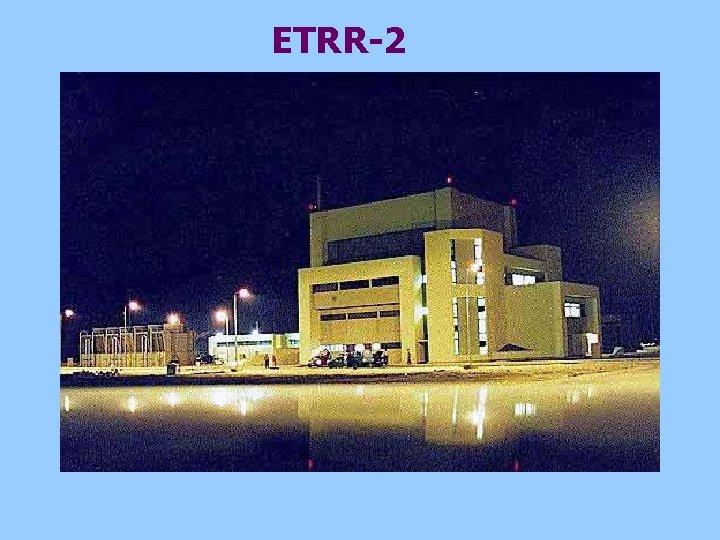
Graded approach applications in ETRR-2 reactor ETRR-2 is a multipurpose reactor, 22 MW, open pool type reactor with a maximum thermal neutron flux of 3. 7 x 10¹⁴ n cm-2 s-1. The reactor was designed, provided, constructed, and commissioned through the international cooperation with INVAP- Argentina. The followings are two typical applications of graded approach; • Application of grading to QA during ETRR 2 construction • Application of grading to maintenance, periodic testing, and inspection at ETRR-2.
ETRR-2
Application of grading to QA during ETRR-2 construction
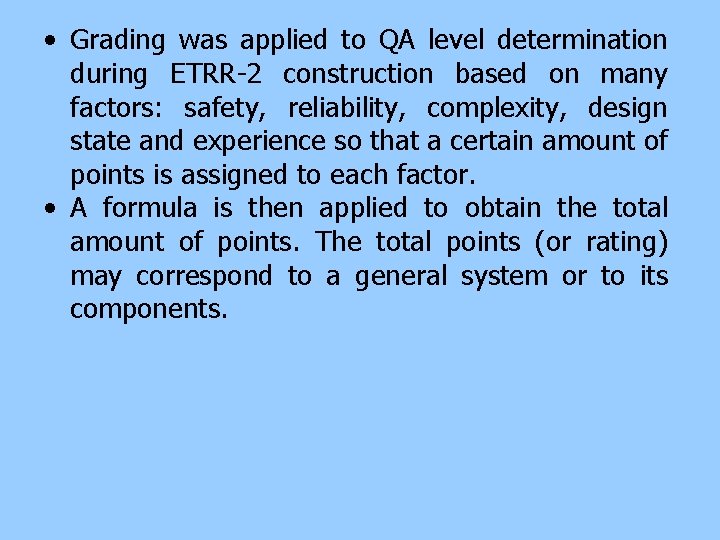
• Grading was applied to QA level determination during ETRR-2 construction based on many factors: safety, reliability, complexity, design state and experience so that a certain amount of points is assigned to each factor. • A formula is then applied to obtain the total amount of points. The total points (or rating) may correspond to a general system or to its components.
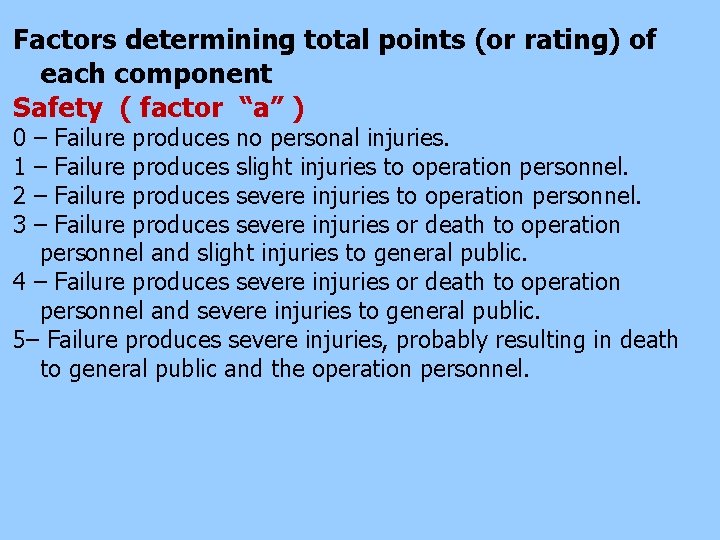
Factors determining total points (or rating) of each component Safety ( factor “a” ) 0 – Failure produces no personal injuries. 1 – Failure produces slight injuries to operation personnel. 2 – Failure produces severe injuries to operation personnel. 3 – Failure produces severe injuries or death to operation personnel and slight injuries to general public. 4 – Failure produces severe injuries or death to operation personnel and severe injuries to general public. 5– Failure produces severe injuries, probably resulting in death to general public and the operation personnel.
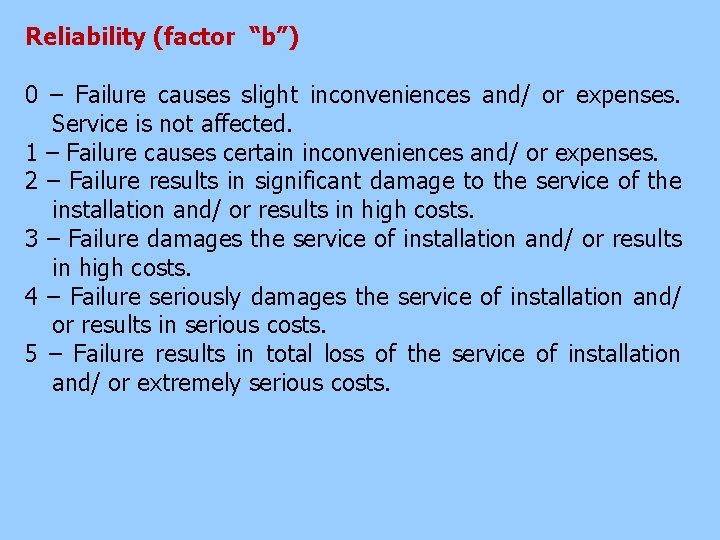
Reliability (factor “b”) 0 – Failure causes slight inconveniences and/ or expenses. Service is not affected. 1 – Failure causes certain inconveniences and/ or expenses. 2 – Failure results in significant damage to the service of the installation and/ or results in high costs. 3 – Failure damages the service of installation and/ or results in high costs. 4 – Failure seriously damages the service of installation and/ or results in serious costs. 5 – Failure results in total loss of the service of installation and/ or extremely serious costs.
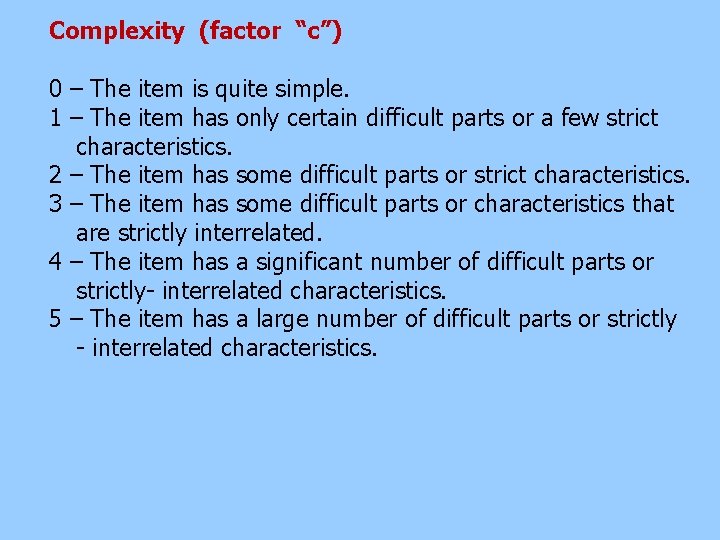
Complexity (factor “c”) 0 – The item is quite simple. 1 – The item has only certain difficult parts or a few strict characteristics. 2 – The item has some difficult parts or strict characteristics. 3 – The item has some difficult parts or characteristics that are strictly interrelated. 4 – The item has a significant number of difficult parts or strictly- interrelated characteristics. 5 – The item has a large number of difficult parts or strictly - interrelated characteristics.
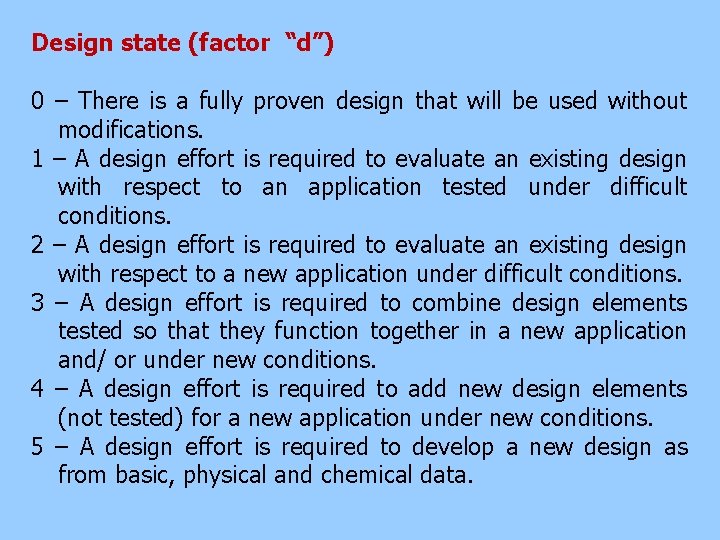
Design state (factor “d”) 0 – There is a fully proven design that will be used without modifications. 1 – A design effort is required to evaluate an existing design with respect to an application tested under difficult conditions. 2 – A design effort is required to evaluate an existing design with respect to a new application under difficult conditions. 3 – A design effort is required to combine design elements tested so that they function together in a new application and/ or under new conditions. 4 – A design effort is required to add new design elements (not tested) for a new application under new conditions. 5 – A design effort is required to develop a new design as from basic, physical and chemical data.
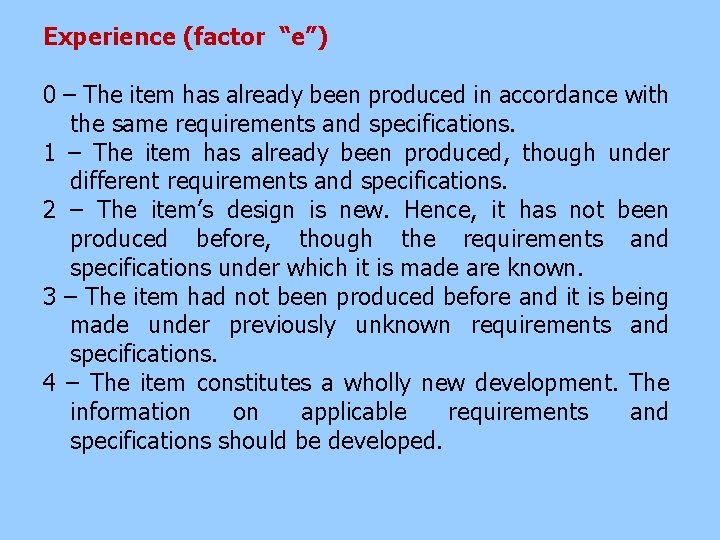
Experience (factor “e”) 0 – The item has already been produced in accordance with the same requirements and specifications. 1 – The item has already been produced, though under different requirements and specifications. 2 – The item’s design is new. Hence, it has not been produced before, though the requirements and specifications under which it is made are known. 3 – The item had not been produced before and it is being made under previously unknown requirements and specifications. 4 – The item constitutes a wholly new development. The information on applicable requirements and specifications should be developed.
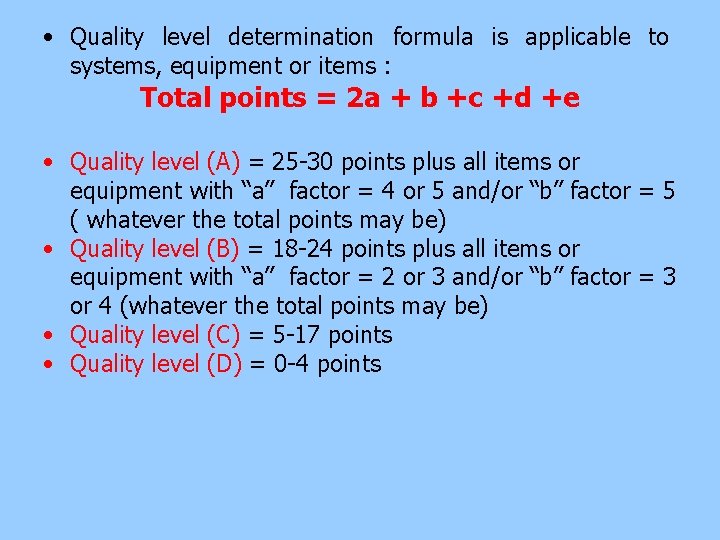
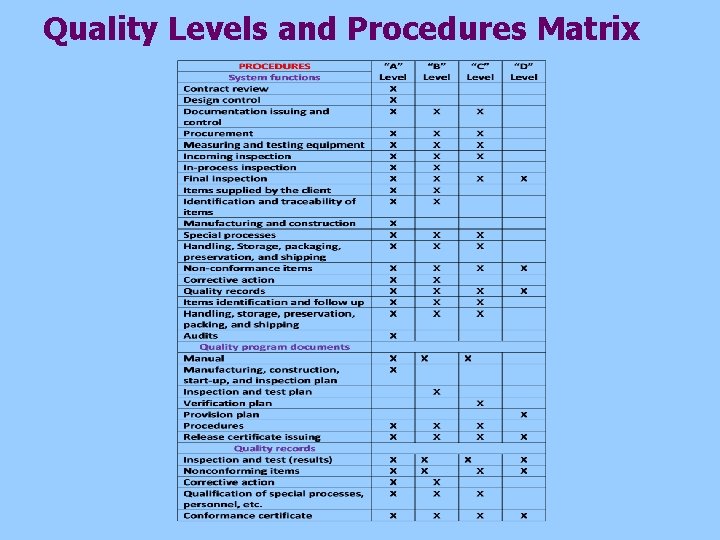
• Quality level determination formula is applicable to systems, equipment or items : Total points = 2 a + b +c +d +e • Quality level (A) = 25 -30 points plus all items or equipment with “a” factor = 4 or 5 and/or “b” factor = 5 ( whatever the total points may be) • Quality level (B) = 18 -24 points plus all items or equipment with “a” factor = 2 or 3 and/or “b” factor = 3 or 4 (whatever the total points may be) • Quality level (C) = 5 -17 points • Quality level (D) = 0 -4 points
Quality Levels and Procedures Matrix
Application of grading to maintenance, periodic testing, and inspection in ETRR-2
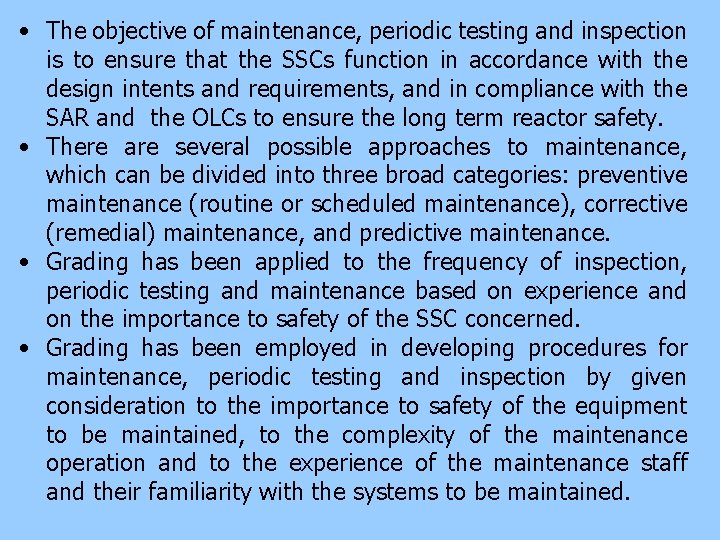
• The objective of maintenance, periodic testing and inspection is to ensure that the SSCs function in accordance with the design intents and requirements, and in compliance with the SAR and the OLCs to ensure the long term reactor safety. • There are several possible approaches to maintenance, which can be divided into three broad categories: preventive maintenance (routine or scheduled maintenance), corrective (remedial) maintenance, and predictive maintenance. • Grading has been applied to the frequency of inspection, periodic testing and maintenance based on experience and on the importance to safety of the SSC concerned. • Grading has been employed in developing procedures for maintenance, periodic testing and inspection by given consideration to the importance to safety of the equipment to be maintained, to the complexity of the maintenance operation and to the experience of the maintenance staff and their familiarity with the systems to be maintained.
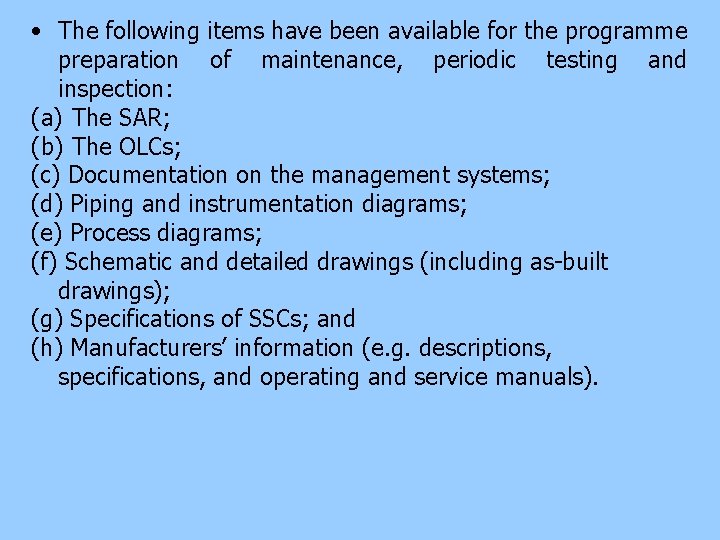
• The following items have been available for the programme preparation of maintenance, periodic testing and inspection: (a) The SAR; (b) The OLCs; (c) Documentation on the management systems; (d) Piping and instrumentation diagrams; (e) Process diagrams; (f) Schematic and detailed drawings (including as-built drawings); (g) Specifications of SSCs; and (h) Manufacturers’ information (e. g. descriptions, specifications, and operating and service manuals).
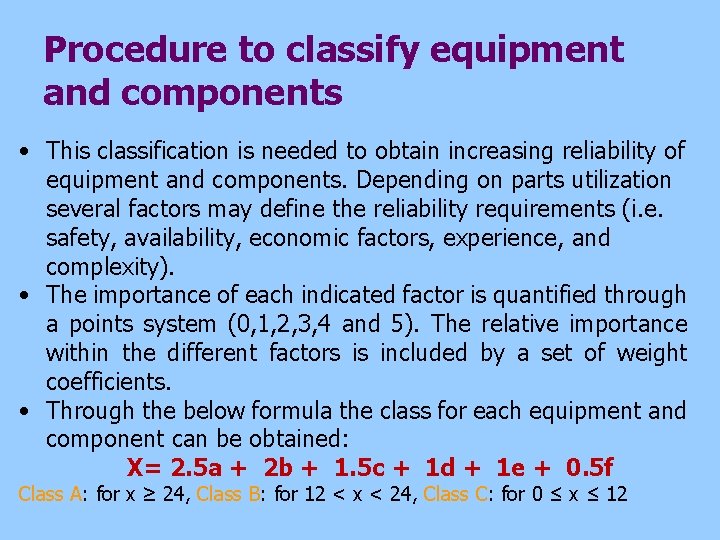
Procedure to classify equipment and components • This classification is needed to obtain increasing reliability of equipment and components. Depending on parts utilization several factors may define the reliability requirements (i. e. safety, availability, economic factors, experience, and complexity). • The importance of each indicated factor is quantified through a points system (0, 1, 2, 3, 4 and 5). The relative importance within the different factors is included by a set of weight coefficients. • Through the below formula the class for each equipment and component can be obtained: X= 2. 5 a + 2 b + 1. 5 c + 1 d + 1 e + 0. 5 f Class A: for x ≥ 24, Class B: for 12 < x < 24, Class C: for 0 ≤ x ≤ 12
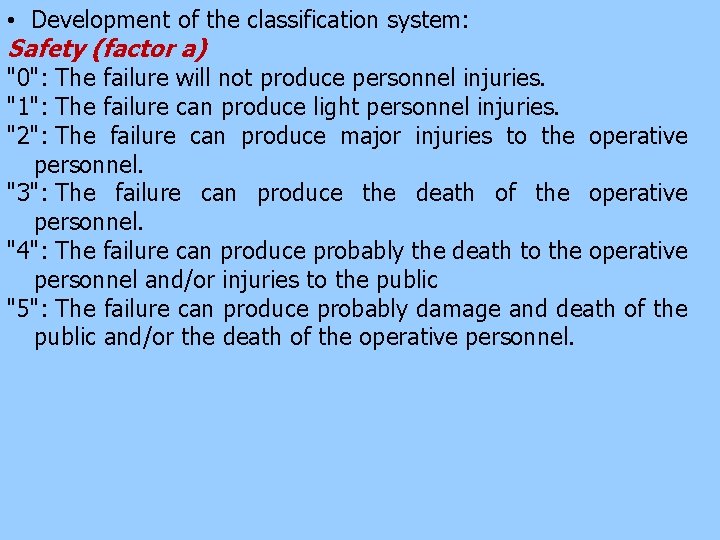
• Development of the classification system: Safety (factor a) "0": The failure will not produce personnel injuries. "1": The failure can produce light personnel injuries. "2": The failure can produce major injuries to the operative personnel. "3": The failure can produce the death of the operative personnel. "4": The failure can produce probably the death to the operative personnel and/or injuries to the public "5": The failure can produce probably damage and death of the public and/or the death of the operative personnel.
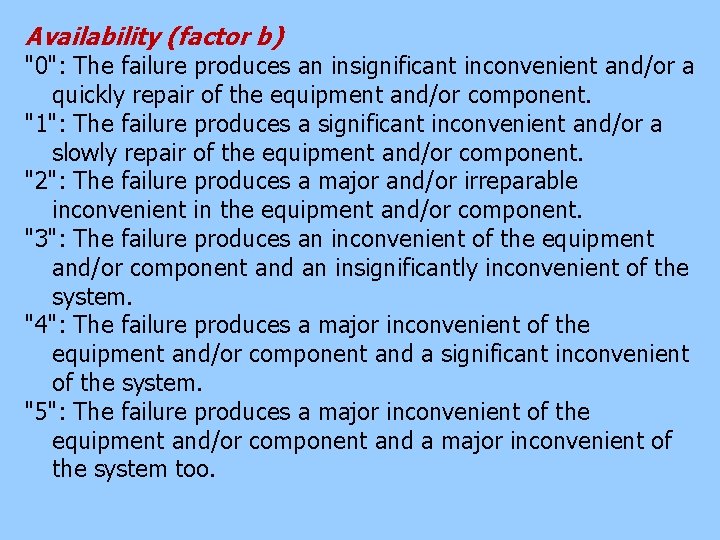
Availability (factor b) "0": The failure produces an insignificant inconvenient and/or a quickly repair of the equipment and/or component. "1": The failure produces a significant inconvenient and/or a slowly repair of the equipment and/or component. "2": The failure produces a major and/or irreparable inconvenient in the equipment and/or component. "3": The failure produces an inconvenient of the equipment and/or component and an insignificantly inconvenient of the system. "4": The failure produces a major inconvenient of the equipment and/or component and a significant inconvenient of the system. "5": The failure produces a major inconvenient of the equipment and/or component and a major inconvenient of the system too.
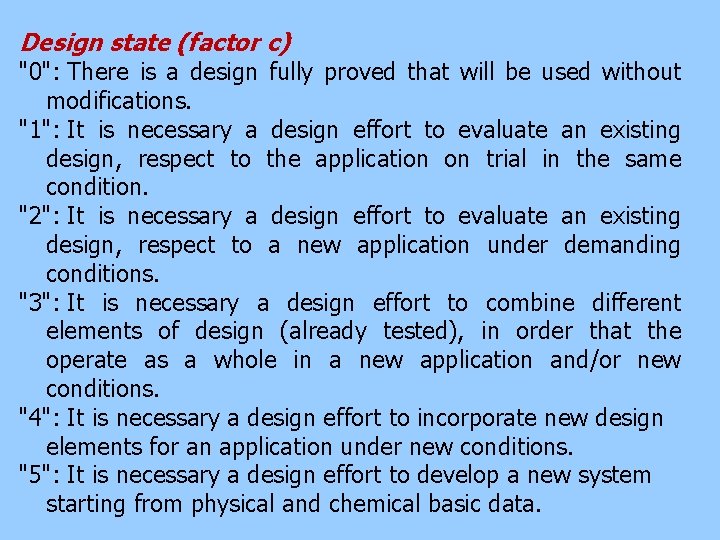
Design state (factor c) "0": There is a design fully proved that will be used without modifications. "1": It is necessary a design effort to evaluate an existing design, respect to the application on trial in the same condition. "2": It is necessary a design effort to evaluate an existing design, respect to a new application under demanding conditions. "3": It is necessary a design effort to combine different elements of design (already tested), in order that the operate as a whole in a new application and/or new conditions. "4": It is necessary a design effort to incorporate new design elements for an application under new conditions. "5": It is necessary a design effort to develop a new system starting from physical and chemical basic data.
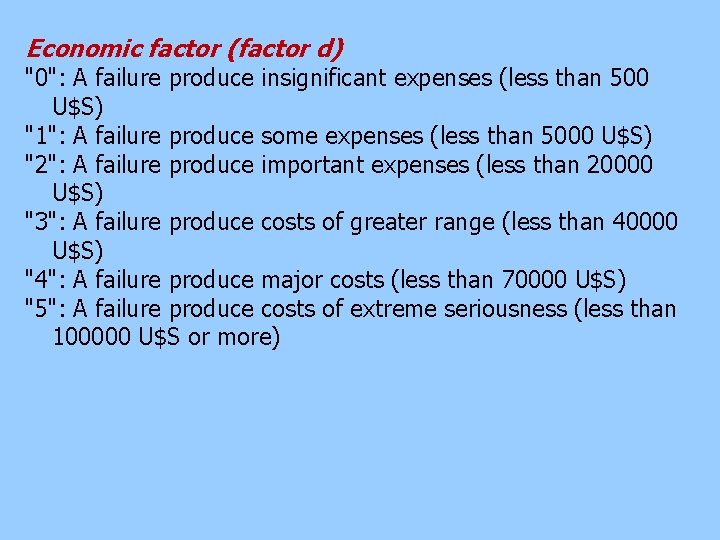
Economic factor (factor d) "0": A failure produce insignificant expenses (less than 500 U$S) "1": A failure produce some expenses (less than 5000 U$S) "2": A failure produce important expenses (less than 20000 U$S) "3": A failure produce costs of greater range (less than 40000 U$S) "4": A failure produce major costs (less than 70000 U$S) "5": A failure produce costs of extreme seriousness (less than 100000 U$S or more)
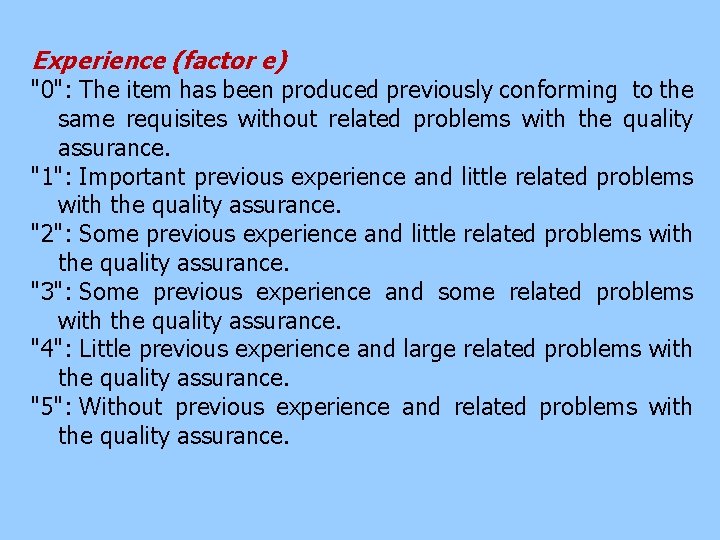
Experience (factor e) "0": The item has been produced previously conforming to the same requisites without related problems with the quality assurance. "1": Important previous experience and little related problems with the quality assurance. "2": Some previous experience and little related problems with the quality assurance. "3": Some previous experience and some related problems with the quality assurance. "4": Little previous experience and large related problems with the quality assurance. "5": Without previous experience and related problems with the quality assurance.
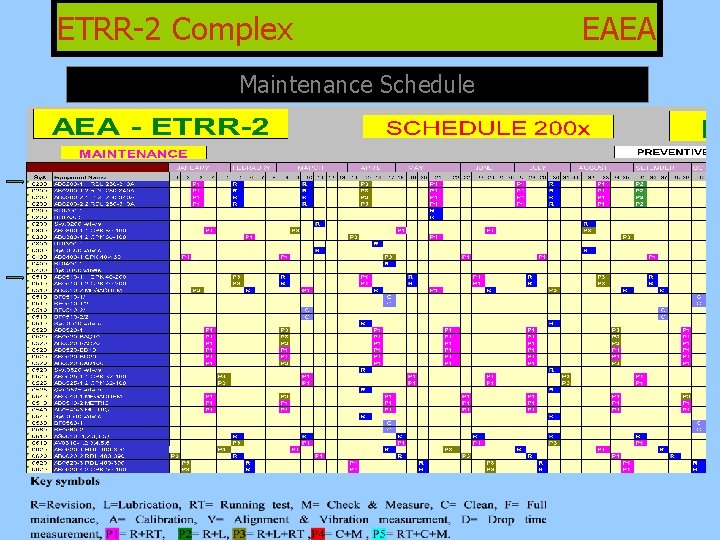
• The sequence of the preventive maintenance programme for the 52 weeks per year was developed according to this classification. An example of the PM schedule of the mechanical and electrical components is shown in below figure.
ETRR-2 Complex EAEA Maintenance Schedule
THANK YOU …