
Grade PreAssessment for Quarter 2 Reading Informational Text




- Slides: 26
Grade Pre-Assessment for Quarter 2 Reading Informational Text
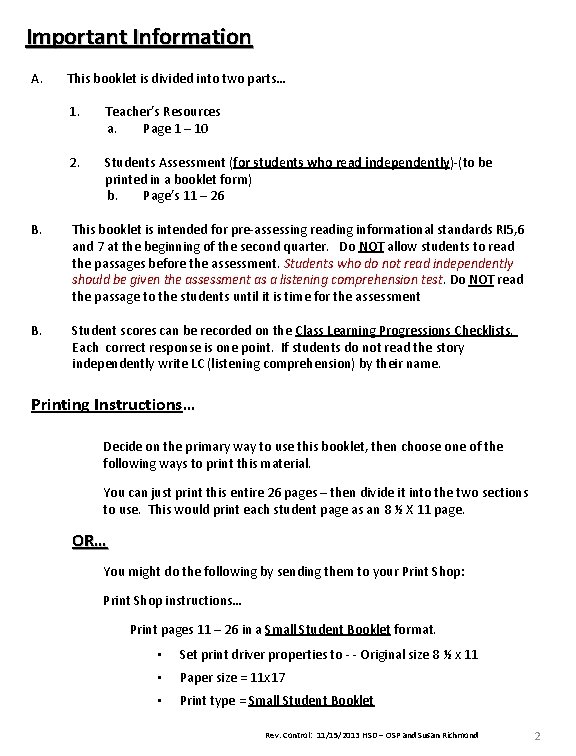
Important Information A. This booklet is divided into two parts… 1. Teacher’s Resources a. Page 1 – 10 2. Students Assessment (for students who read independently)-(to be printed in a booklet form) b. Page’s 11 – 26 B. This booklet is intended for pre-assessing reading informational standards RI 5, 6 and 7 at the beginning of the second quarter. Do NOT allow students to read the passages before the assessment. Students who do not read independently should be given the assessment as a listening comprehension test. Do NOT read the passage to the students until it is time for the assessment B. Student scores can be recorded on the Class Learning Progressions Checklists. Each correct response is one point. If students do not read the story independently write LC (listening comprehension) by their name. Printing Instructions… Decide on the primary way to use this booklet, then choose one of the following ways to print this material. You can just print this entire 26 pages – then divide it into the two sections to use. This would print each student page as an 8 ½ X 11 page. OR… You might do the following by sending them to your Print Shop: Print Shop instructions… Print pages 11 – 26 in a Small Student Booklet format. • Set print driver properties to - - Original size 8 ½ x 11 • Paper size = 11 x 17 • Print type = Small Student Booklet Rev. Control: 11/15/2013 HSD – OSP and Susan Richmond 2
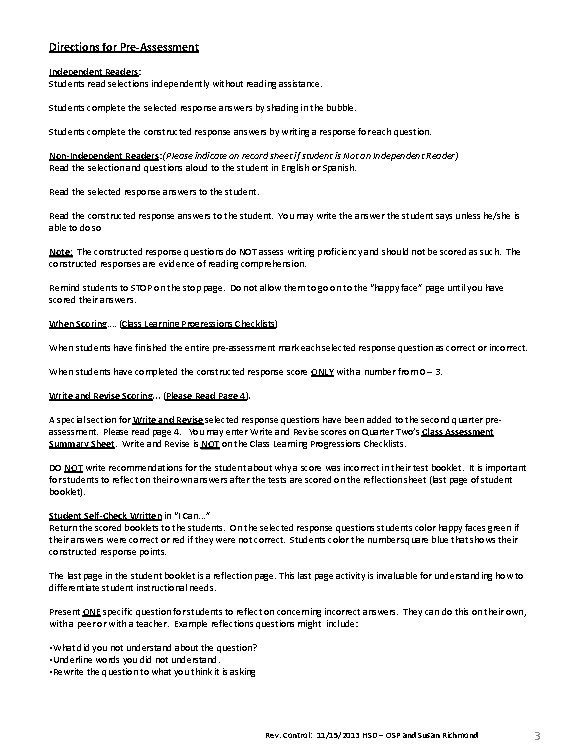
Directions for Pre-Assessment Independent Readers: Students read selections independently without reading assistance. Students complete the selected response answers by shading in the bubble. Students complete the constructed response answers by writing a response for each question. Non-Independent Readers: (Please indicate on record sheet if student is Not an Independent Reader) Read the selection and questions aloud to the student in English or Spanish. Read the selected response answers to the student. Read the constructed response answers to the student. You may write the answer the student says unless he/she is able to do so Note: The constructed response questions do NOT assess writing proficiency and should not be scored as such. The Note: constructed responses are evidence of reading comprehension. Remind students to STOP on the stop page. Do not allow them to go on to the “happy face” page until you have scored their answers. When Scoring. . (Class Learning Progressions Checklists) When students have finished the entire pre-assessment mark each selected response question as correct or incorrect. When students have completed the constructed response score ONLY with a number from 0 – 3. Write and Revise Scoring. . . (Please Read Page 4). A special section for Write and Revise selected response questions have been added to the second quarter preassessment. Please read page 4. You may enter Write and Revise scores on Quarter Two’s Class Assessment Summary Sheet. Write and Revise is NOT on the Class Learning Progressions Checklists. DO NOT write recommendations for the student about why a score was incorrect in their test booklet. It is important for students to reflect on their own answers after the tests are scored on the reflection sheet (last page of student booklet). Student Self-Check Written in “I Can. . . ” Return the scored booklets to the students. On the selected response questions students color happy faces green if their answers were correct or red if they were not correct. Students color the number square blue that shows their constructed response points. The last page in the student booklet is a reflection page. This last page activity is invaluable for understanding how to differentiate student instructional needs. Present ONE specific question for students to reflect on concerning incorrect answers. They can do this on their own, with a peer or with a teacher. Example reflections questions might include: • What did you not understand about the question? • Underline words you did not understand. • Rewrite the question to what you think it is asking Rev. Control: 11/15/2013 HSD – OSP and Susan Richmond 3
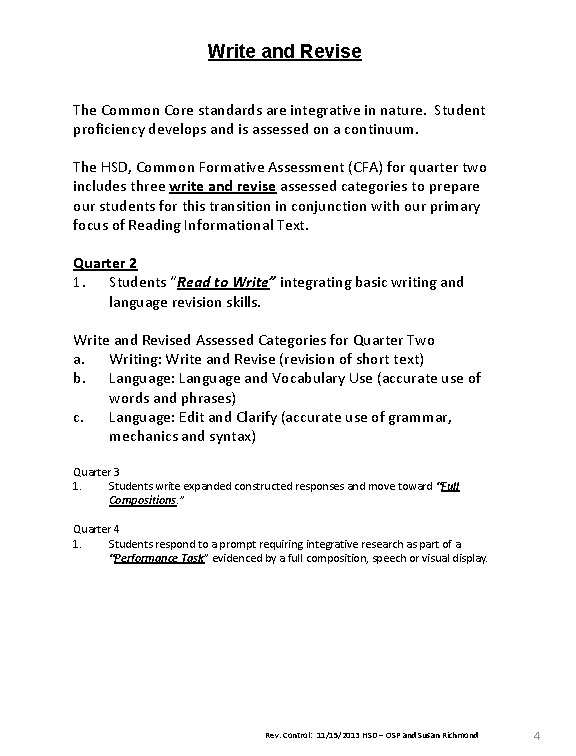
Write and Revise The Common Core standards are integrative in nature. Student proficiency develops and is assessed on a continuum. The HSD, Common Formative Assessment (CFA) for quarter two includes three write and revise assessed categories to prepare our students for this transition in conjunction with our primary focus of Reading Informational Text. Quarter 2 1. Students “Read to Write” integrating basic writing and language revision skills. Write and Revised Assessed Categories for Quarter Two a. Writing: Write and Revise (revision of short text) b. Language: Language and Vocabulary Use (accurate use of words and phrases) c. Language: Edit and Clarify (accurate use of grammar, mechanics and syntax) Quarter 3 1. Students write expanded constructed responses and move toward “Full Compositions. ” Quarter 4 1. Students respond to a prompt requiring integrative research as part of a “Performance Task” evidenced by a full composition, speech or visual display. Rev. Control: 11/15/2013 HSD – OSP and Susan Richmond 4
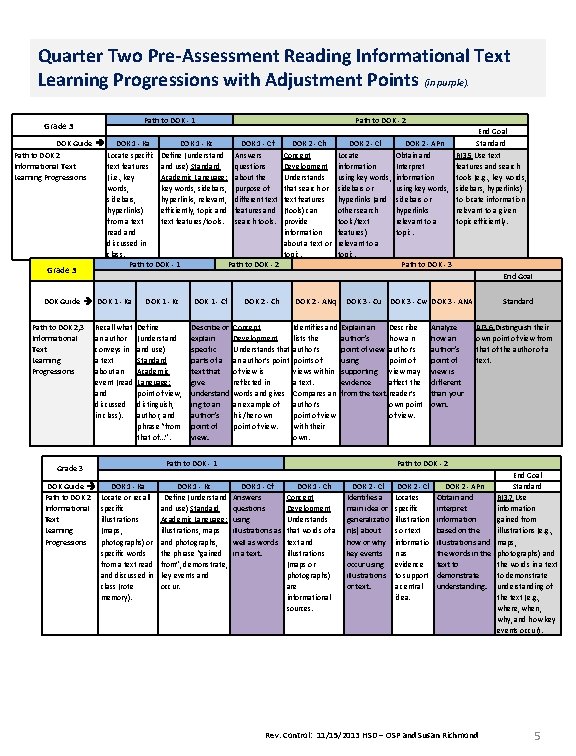
Quarter Two Pre-Assessment Reading Informational Text Learning Progressions with Adjustment Points (in purple). Path to DOK - 1 Path to DOK - 2 End Goal Grade 3 DOK Guide Path to DOK 2 Informational Text Learning Progressions DOK 1 - Ka Grade 3 DOK 1 - Cf DOK 2 - Ch Concept Development Understands that search or text features (tools) can provide information about a text or topic. DOK 2 - Cl DOK 2 - APn Locate Obtain and information Interpret using key words, information sidebars or using key words, hyperlinks (and sidebars or other search hyperlinks tools/text relevant to a features) topic. relevant to a topic. Path to DOK - 3 Standard RI 3. 5 Use text features and search tools (e. g. , key words, sidebars, hyperlinks) to locate information relevant to a given topic efficiently. End Goal DOK Guide DOK 1 - Ka Path to DOK 2, 3 Informational Text Learning Progressions DOK 1 - Kc Locate specific Define (understand Answers text features and use) Standard questions (i. e. , key Academic Language: about the words, key words, sidebars, purpose of sidebars, hyperlinks, relevant, different text hyperlinks) efficiently, topic and features and from a text features/tools. search tools. read and discussed in class. Path to DOK - 2 Path to DOK - 1 Recall what an author conveys in a text about an event (read and discussed in class). DOK 1 - Kc DOK 1 - Cf Define (understand use) Standard Academic Language: point of view, distinguish, author, and phrase “from that of. . . ”. Describe or explain specific parts of a text that give understand ing to an author’s point of view. DOK 2 - ANq DOK 3 - Cu DOK 1 - Ka Locate or recall specific illustrations (maps, photographs) or specific words from a text read and discussed in class (rote memory). DOK 3 - Cw DOK 3 - ANA Concept Identifies and Explain an Describe Development lists the author’s how a n Understands that author’s point of view author’s an author’s points of using point of of view is views within supporting view may reflected in a text. evidence affect the words and gives Compares an from the text. reader’s an example of author’s own point his/her own point of view. with their own. Path to DOK - 1 Grade 3 DOK Guide Path to DOK 2 Informational Text Learning Progressions DOK 2 - Ch Analyze how an author’s point of view is different than your own. Standard RI 3. 6 Distinguish their own point of view from that of the author of a text. Path to DOK - 2 DOK 1 - Kc DOK 1 - Cf Define (understand Answers and use) Standard questions Academic Language: using illustrations, maps illustrations as and photographs, well as words the phrase “gained in a text. from”, demonstrate, key events and occur. DOK 1 - Ch Concept Development Understands that words of a text and illustrations (maps or photographs) are informational sources. DOK 2 - Cl Identifies a main idea or generalizatio n(s) about how or why key events occur using illustrations or text. DOK 2 - Cl Locates specific illustration s or text informatio n as evidence to support a central idea. DOK 2 - APn Obtain and interpret information based on the illustrations and the words in the text to demonstrate understanding. Rev. Control: 11/15/2013 HSD – OSP and Susan Richmond End Goal Standard RI 3. 7 Use information gained from illustrations (e. g. , maps, photographs) and the words in a text to demonstrate understanding of the text (e. g. , where, when, why, and how key events occur). 5
Scoring Directions: For students who read independently, record student pre-assessment selected response scores on Class Learning Progressions Checklists (below) for instructional adjustments. Students who do not read independently should have LC written by their name to indicate the story was read to them. The second quarter CFA score can be recorded in the last column as a comprehensive score. Class Learning Progressions Checklist (for pre-assessments) Grade 3 Sample DOK Guide Path to DOK 2 Informational Text Learning Progressions Path to DOK - 1 Path to DOK - 2 End Goal DOK 1 - Ka DOK 1 - Kc DOK 1 - Cf DOK 2 - Ch Locate specific text features (i. e. , key words, sidebars, hyperlinks) from a text read and discussed in class. Define (understand use) Standard Academic Language: key words, sidebars, hyperlinks, relevant, efficiently, topic and text features/tools. Answers questions about the purpose of different text features and search tools. Concept Development Understands that search or text features (tools) can provide information about a text or topic. DOK 2 - Cl DOK 2 - APn Locate Obtain and information Interpret using key words, information sidebars or using key words, hyperlinks (and sidebars or other search hyperlinks tools/text relevant to a features) topic. relevant to a topic. Standard RI 3. 5 Use text features and search tools (e. g. , key words, sidebars, hyperlinks) to locate information relevant to a given topic efficiently. Assessment Summary Sheet (for Pre-Assessment and CFA) Rev. Control: 11/15/2013 HSD – OSP and Susan Richmond 6
SBAC Reading Assessment Constructed Response General Template 3 The response: • gives essential elements of a complete interpretation of the prompt • addresses many aspects of the task and provides sufficient relevant evidence to support development • is focused and organized, consistently addressing the purpose, audience, and task • includes sentences of varied length and structure 2 The response: • gives some of the elements of an interpretation of the prompt • addresses some aspects of the task and provides some evidence to support development • has a focus but lacks strong organization and inconsistently addresses the purpose, audience, and task • includes sentences of somewhat varied length and structure 1 The response: • gives minimal elements of an interpretation of the prompt • addresses few aspects of the task and provides little relevant evidence to support development • lacks focus and organization and generally does not address the purpose, audience, and task • includes sentences with little variety in length and structure 0 The response does not meet any of the criteria. Short Constructed Response Short constructed response sample questions are designed to assess CCLS reading standards. These are single questions that ask students to respond to a prompt or question by stating their answer and providing textual evidence to support their answer. The goal of the short response questions is to require students to “succinctly show” their ability to comprehend text. In responding to these questions, students will be expected to write in complete sentences. Rev. Control: 11/15/2013 HSD – OSP and Susan Richmond 7
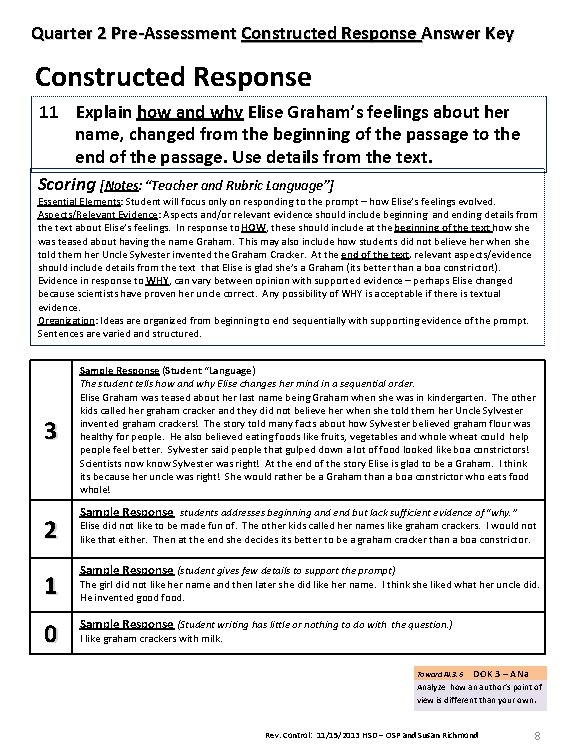
Quarter 2 Pre-Assessment Constructed Response Answer Key Constructed Response 11 Explain how and why Elise Graham’s feelings about her name, changed from the beginning of the passage to the end of the passage. Use details from the text. Scoring [Notes: “Teacher and Rubric Language”] Essential Elements: Student will focus only on responding to the prompt – how Elise’s feelings evolved. Aspects/Relevant Evidence: Aspects and/or relevant evidence should include beginning and ending details from the text about Elise’s feelings. In response to HOW, these should include at the beginning of the text how she was teased about having the name Graham. This may also include how students did not believe her when she told them her Uncle Sylvester invented the Graham Cracker. At the end of the text, relevant aspects/evidence should include details from the text that Elise is glad she’s a Graham (its better than a boa constrictor!). Evidence in response to WHY, can vary between opinion with supported evidence – perhaps Elise changed because scientists have proven her uncle correct. Any possibility of WHY is acceptable if there is textual evidence. Organization: Ideas are organized from beginning to end sequentially with supporting evidence of the prompt. Sentences are varied and structured. 3 2 1 0 Sample Response (Student “Language) The student tells how and why Elise changes her mind in a sequential order. Elise Graham was teased about her last name being Graham when she was in kindergarten. The other kids called her graham cracker and they did not believe her when she told them her Uncle Sylvester invented graham crackers! The story told many facts about how Sylvester believed graham flour was healthy for people. He also believed eating foods like fruits, vegetables and whole wheat could help people feel better. Sylvester said people that gulped down a lot of food looked like boa constrictors! Scientists now know Sylvester was right! At the end of the story Elise is glad to be a Graham. I think its because her uncle was right! She would rather be a Graham than a boa constrictor who eats food whole! Sample Response students addresses beginning and end but lack sufficient evidence of “why. ” Elise did not like to be made fun of. The other kids called her names like graham crackers. I would not like that either. Then at the end she decides its better to be a graham cracker than a boa constrictor. Sample Response (student gives few details to support the prompt) The girl did not like her name and then later she did like her name. I think she liked what her uncle did. He invented good food. Sample Response (Student writing has little or nothing to do with the question. ) I like graham crackers with milk. Toward RI. 3. 6 DOK 3 – ANa Analyze how an author’s point of view is different than your own. Rev. Control: 11/15/2013 HSD – OSP and Susan Richmond 8
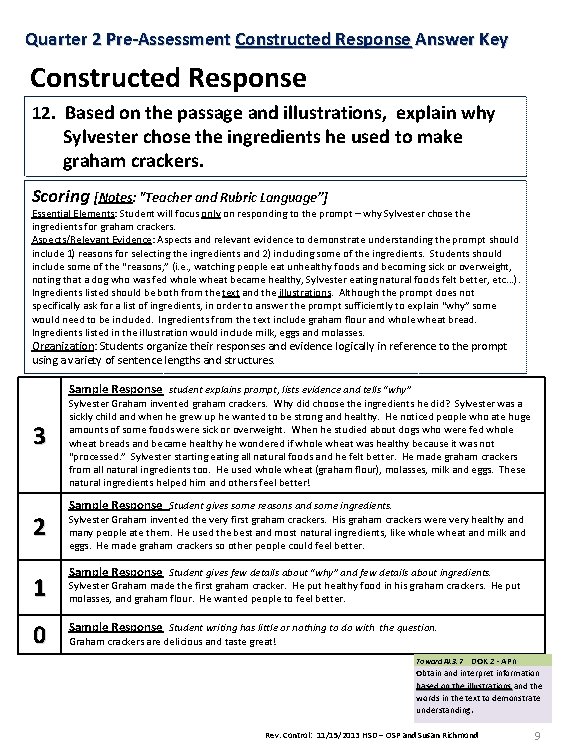
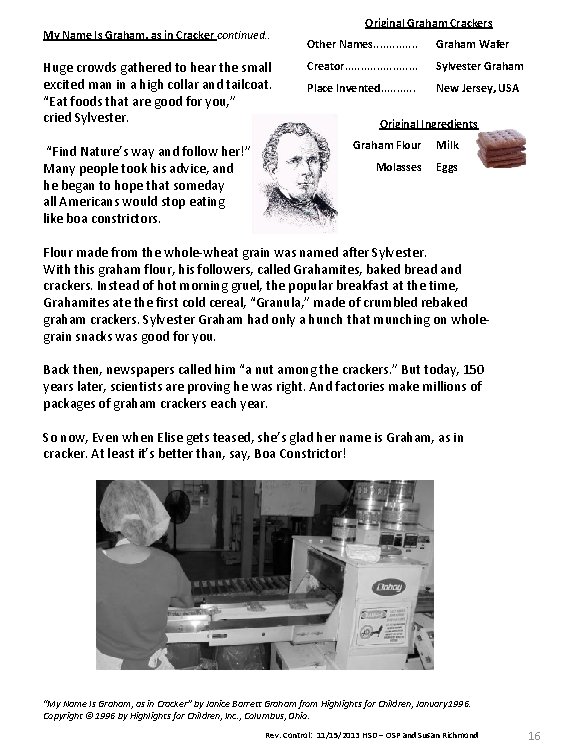
Quarter 2 Pre-Assessment Constructed Response Answer Key Constructed Response 12. Based on the passage and illustrations, explain why Sylvester chose the ingredients he used to make graham crackers. Scoring [Notes: "Teacher and Rubric Language”] Essential Elements: Student will focus only on responding to the prompt – why Sylvester chose the ingredients for graham crackers. Aspects/Relevant Evidence: Aspects and relevant evidence to demonstrate understanding the prompt should include 1) reasons for selecting the ingredients and 2) including some of the ingredients. Students should include some of the “reasons, ” (i. e. , watching people eat unhealthy foods and becoming sick or overweight, noting that a dog who was fed whole wheat became healthy, Sylvester eating natural foods felt better, etc. . . ). Ingredients listed should be both from the text and the illustrations. Although the prompt does not specifically ask for a list of ingredients, in order to answer the prompt sufficiently to explain “why” some would need to be included. Ingredients from the text include graham flour and whole wheat bread. Ingredients listed in the illustration would include milk, eggs and molasses. Organization: Students organize their responses and evidence logically in reference to the prompt using a variety of sentence lengths and structures. Sample Response student explains prompt, lists evidence and tells “why” 3 2 1 0 Sylvester Graham invented graham crackers. Why did choose the ingredients he did? Sylvester was a sickly child and when he grew up he wanted to be strong and healthy. He noticed people who ate huge amounts of some foods were sick or overweight. When he studied about dogs who were fed whole wheat breads and became healthy he wondered if whole wheat was healthy because it was not “processed. ” Sylvester starting eating all natural foods and he felt better. He made graham crackers from all natural ingredients too. He used whole wheat (graham flour), molasses, milk and eggs. These natural ingredients helped him and others feel better! Sample Response Student gives some reasons and some ingredients. Sylvester Graham invented the very first graham crackers. His graham crackers were very healthy and many people ate them. He used the best and most natural ingredients, like whole wheat and milk and eggs. He made graham crackers so other people could feel better. Sample Response Student gives few details about “why” and few details about ingredients. Sylvester Graham made the first graham cracker. He put healthy food in his graham crackers. He put molasses, and graham flour. He wanted people to feel better. Sample Response Student writing has little or nothing to do with the question. Graham crackers are delicious and taste great! DOK 2 - APn Obtain and interpret information based on the illustrations and the words in the text to demonstrate understanding. Toward RI. 3. 7 Rev. Control: 11/15/2013 HSD – OSP and Susan Richmond 9
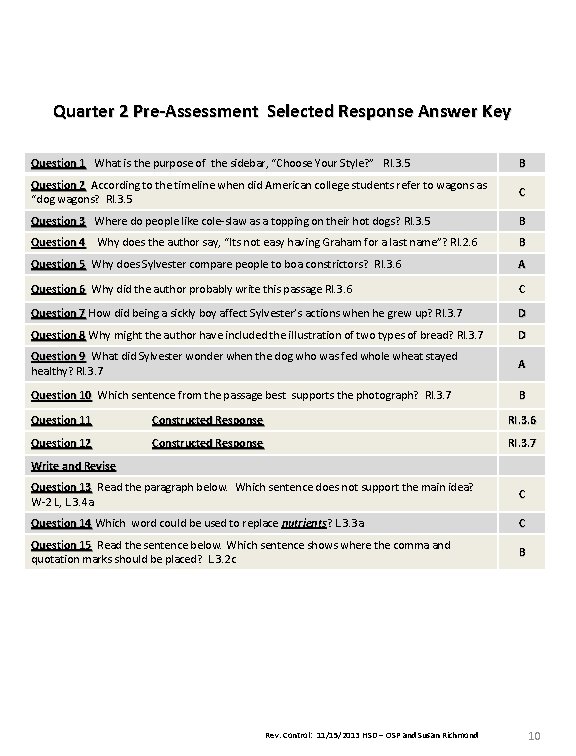
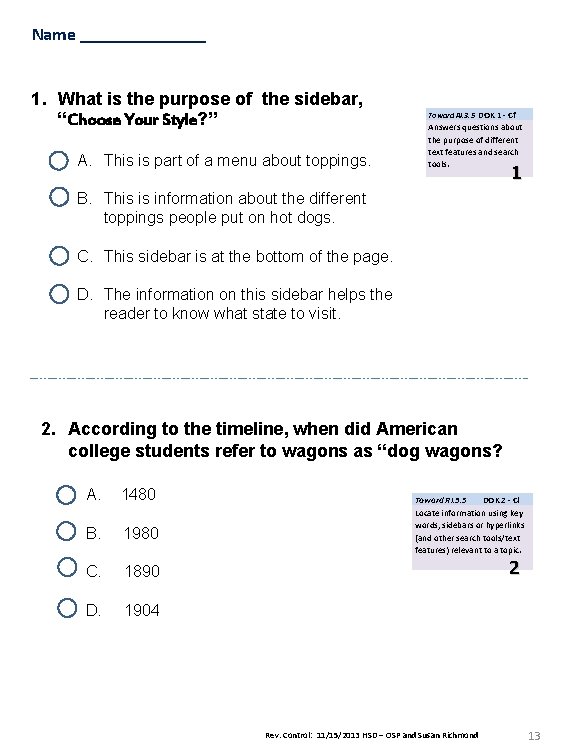
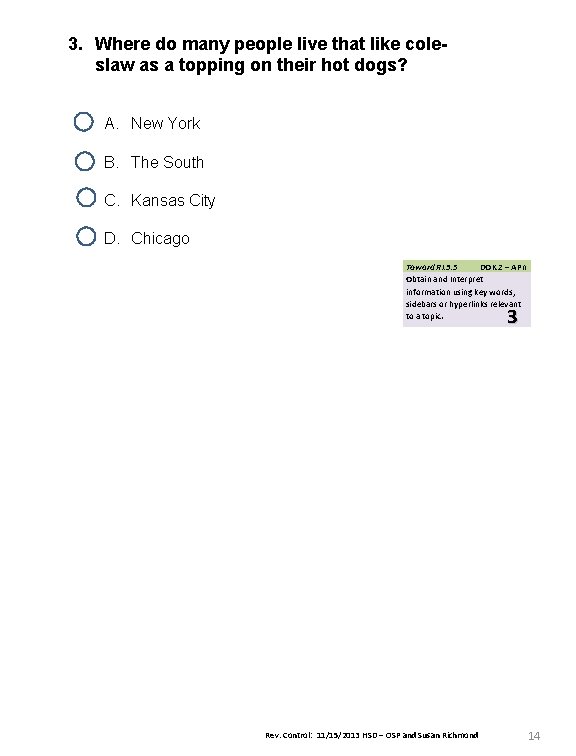
Quarter 2 Pre-Assessment Selected Response Answer Key Question 1 What is the purpose of the sidebar, “Choose Your Style? ” RI. 3. 5 B Question 2 According to the timeline when did American college students refer to wagons as “dog wagons? RI. 3. 5 C Question 3 Where do people like cole-slaw as a topping on their hot dogs? RI. 3. 5 B Question 4 Why does the author say, “Its not easy having Graham for a last name”? RI. 2. 6 B Question 5 Why does Sylvester compare people to boa constrictors? RI. 3. 6 A Question 6 Why did the author probably write this passage RI. 3. 6 C Question 7 How did being a sickly boy affect Sylvester’s actions when he grew up? RI. 3. 7 D Question 8 Why might the author have included the illustration of two types of bread? RI. 3. 7 D Question 9 What did Sylvester wonder when the dog who was fed whole wheat stayed 9 healthy? RI. 3. 7 A Question 10 Which sentence from the passage best supports the photograph? RI. 3. 7 B Question 11 Constructed Response RI. 3. 6 Question 12 Constructed Response RI. 3. 7 Write and Revise Question 13 Read the paragraph below. Which sentence does not support the main idea? W-2 L, L. 3. 4 a C Question 14 Which word could be used to replace nutrients? L. 3. 3 a 14 C Question 15 Read the sentence below. Which sentence shows where the comma and quotation marks should be placed? L. 3. 2 c B Rev. Control: 11/15/2013 HSD – OSP and Susan Richmond 10
Grade Pre-Assessment for Quarter 2 Reading Informational Text Name __________ Rev. Control: 11/15/2013 HSD – OSP and Susan Richmond 11
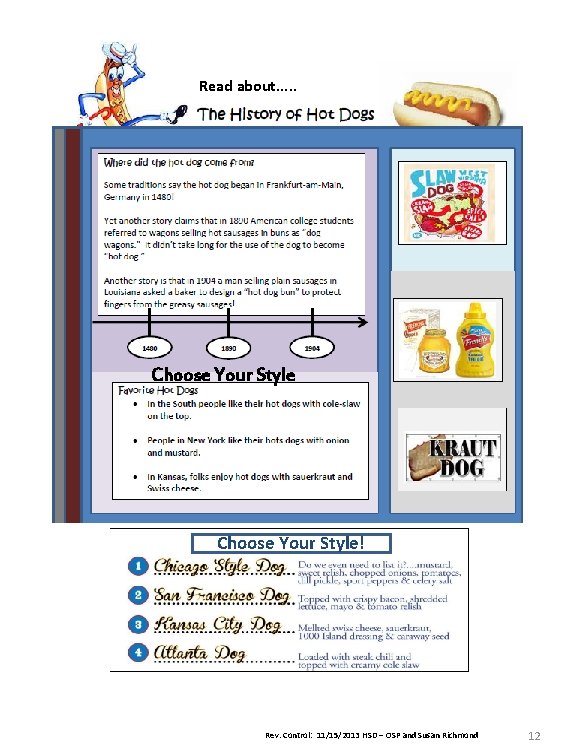
Read about. . . Choose Your Style! Rev. Control: 11/15/2013 HSD – OSP and Susan Richmond 12
Name _______ 1. What is the purpose of the sidebar, “Choose Your Style? ” A. This is part of a menu about toppings. Toward RI. 3. 5 DOK 1 - Cf Answers questions about the purpose of different text features and search tools. 1 B. This is information about the different toppings people put on hot dogs. C. This sidebar is at the bottom of the page. D. The information on this sidebar helps the reader to know what state to visit. 2. According to the timeline, when did American college students refer to wagons as “dog wagons? A. 1480 B. 1980 C. 1890 D. 1904 Toward RI. 3. 5 DOK 2 - Cl Locate information using key words, sidebars or hyperlinks (and other search tools/text features) relevant to a topic. 2 Rev. Control: 11/15/2013 HSD – OSP and Susan Richmond 13
3. Where do many people live that like coleslaw as a topping on their hot dogs? A. New York B. The South C. Kansas City D. Chicago Toward RI. 3. 5 DOK 2 – APn Obtain and Interpret information using key words, sidebars or hyperlinks relevant to a topic. 3 Rev. Control: 11/15/2013 HSD – OSP and Susan Richmond 14
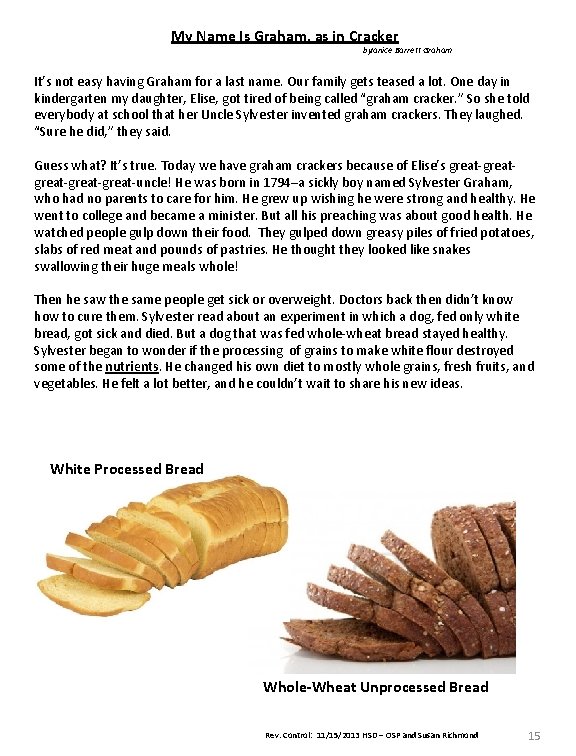
My Name Is Graham, as in Cracker by. Janice Barrett Graham It’s not easy having Graham for a last name. Our family gets teased a lot. One day in kindergarten my daughter, Elise, got tired of being called “graham cracker. ” So she told everybody at school that her Uncle Sylvester invented graham crackers. They laughed. “Sure he did, ” they said. Guess what? It’s true. Today we have graham crackers because of Elise’s great-great-great-uncle! He was born in 1794–a sickly boy named Sylvester Graham, who had no parents to care for him. He grew up wishing he were strong and healthy. He went to college and became a minister. But all his preaching was about good health. He watched people gulp down their food. They gulped down greasy piles of fried potatoes, slabs of red meat and pounds of pastries. He thought they looked like snakes swallowing their huge meals whole! Then he saw the same people get sick or overweight. Doctors back then didn’t know how to cure them. Sylvester read about an experiment in which a dog, fed only white bread, got sick and died. But a dog that was fed whole-wheat bread stayed healthy. Sylvester began to wonder if the processing of grains to make white flour destroyed some of the nutrients. He changed his own diet to mostly whole grains, fresh fruits, and vegetables. He felt a lot better, and he couldn’t wait to share his new ideas. White Processed Bread Whole-Wheat Unprocessed Bread Rev. Control: 11/15/2013 HSD – OSP and Susan Richmond 15
My Name Is Graham, as in Cracker continued. . Huge crowds gathered to hear the small excited man in a high collar and tailcoat. “Eat foods that are good for you, ” cried Sylvester. “Find Nature’s way and follow her!” Many people took his advice, and he began to hope that someday all Americans would stop eating like boa constrictors. Original Graham Crackers Other Names. . . Graham Wafer Creator. . . Sylvester Graham Place Invented. . . New Jersey, USA Original Ingredients Graham Flour Milk Molasses Eggs Flour made from the whole-wheat grain was named after Sylvester. With this graham flour, his followers, called Grahamites, baked bread and crackers. Instead of hot morning gruel, the popular breakfast at the time, Grahamites ate the first cold cereal, “Granula, ” made of crumbled rebaked graham crackers. Sylvester Graham had only a hunch that munching on wholegrain snacks was good for you. Back then, newspapers called him “a nut among the crackers. ” But today, 150 years later, scientists are proving he was right. And factories make millions of packages of graham crackers each year. So now, Even when Elise gets teased, she’s glad her name is Graham, as in cracker. At least it’s better than, say, Boa Constrictor! “My Name Is Graham, as in Cracker” by Janice Barrett Graham from Highlights for Children, January 1996. Copyright © 1996 by Highlights for Children, Inc. , Columbus, Ohio. Rev. Control: 11/15/2013 HSD – OSP and Susan Richmond 16
4. Why does the author say, “It’s not easy having Graham for a last name”? A. Graham is a very unusual name. B. Her family gets teased a lot. C. The author’s daughter was tired of everyone calling her “graham cracker. ” D. Her Uncle Sylvester invented graham crackers. Toward RI. 3. 6 DOK 1 - Cf Describe or explain specific parts of a text that give understanding to an author’s point of view. 4 5. Why does Sylvester compare people to boa constrictors? A. When people gulped down food Sylvester thought “they looked like snakes swallowing a huge meal whole. ” B. People were sick or overweight and doctors did not know how to cure them. C. Boa constrictors eat huge meals whole. D. Sylvester wondered if boa constrictors ate a lot of red meat. Toward RI. 3. 6 DOK 3 – Cu Explain an author’s point of view using supporting evidence from the text. 5 Rev. Control: 11/15/2013 HSD – OSP and Susan Richmond 17
6. Why did the author probably write this passage? A. The author wanted to explain why having the name of Graham was not fun. B. The author wanted to persuade people to eat graham crackers. C. The author wanted to provide readers with some history about how graham crackers really got their name. D. The author wanted to describe the importance of eating graham crackers to stay healthy. DOK 3 – ANa Analyze how an author’s point of view is different than your own. Toward RI. 3. 6 6 7. How did being a sickly boy affect Sylvester’s actions when he grew up? A. People called him names. B. Sylvester was sick when he grew up too. C. He hoped people would stop eating like boa constrictors. D. He grew up preaching about good health. Toward RI. 3. 7 DOK 1 - Cf Answers questions using illustrations as well as words in a text. 7 Rev. Control: 11/15/2013 HSD – OSP and Susan Richmond 18
8. Why might the author have included the illustration of two kinds of bread? A. The author might have wanted to describe the kinds of bread in the story. B. The author might have wanted to show a picture of the kinds of bread people eat. C. The author wanted people to eat both types of bread. Toward RI. 3. 7 DOK 2 - Cl Identifies a main idea or generalization(s) about how or why key events occur using illustrations or text. D. The author might have wanted the readers to be able to see the two kinds of bread the dogs were fed. 8 9. What did Sylvester wonder when the dog who was fed whole wheat stayed healthy? A. Sylvester wondered if the processing of grains to make white flour destroyed some of the nutrients. B. Sylvester wanted to know what kinds of foods he should eat to stay healthy. C. He wondered why the dogs were fed two different kinds of bread. D. Sylvester wanted to know why people kept eating greasy foods. Toward RI. 3. 7 DOK 2 - APn Obtain and interpret information based on the illustrations and the words in the text to demonstrate understanding. Rev. Control: 11/15/2013 HSD – OSP and Susan Richmond 9 19
10. Which sentence from the passage best supports the photograph? A. “With this graham flour, his followers, called Grahamites, baked bread and crackers. ” B. “And factories make millions of packages of graham crackers each year. ” C. “But today, 150 years later, scientists are proving he was right. ” D. “Flour made from the whole-wheat grain was named after Sylvester. ” Toward RI. 3. 7 DOK 2 - APn Obtain and interpret information based on the illustrations and the words in the text to demonstrate understanding. 10 11. Explain how and why Elise Graham’s feelings about her name changed from the beginning of the passage to the end of the passage. Use details from the text. Rev. Control: 11/15/2013 HSD – OSP and Susan Richmond 20
12. Based on the passage and illustrations, explain why Sylvester chose the ingredients he used to make graham crackers. Rev. Control: 11/15/2013 HSD – OSP and Susan Richmond 21
13. Read the paragraph below. (Write and Revise W. 2 -L. 3. 4 a) Sylvester Graham wanted others to be healthy. When he grew up he preached about eating healthy foods. He wanted a dog. He told people to eat fruit, vegetables and whole grains. Which sentence does not support the main idea of the paragraph? A. Sylvester Graham wanted others to be healthy. B. When he grew up he preached about eating healthy foods. C. He wanted a dog. D. He told people to eat fruit, vegetables and whole grains. 14. Sylvester began to wonder if the processing of grains to make white flour destroyed some of the nutrients. (Write and Revise L. 3. 3. a) Which word could be used to replace nutrients? A. wheat B. health C. vitamins D. taste Rev. Control: 11/15/2013 HSD – OSP and Susan Richmond 22
15. Read the sentence below. (Write and Revise L. 3. 2 c) Sylvester said Eat foods that are good for you. Which sentence shows where the comma and quotation marks should be placed? A. “Sylvester, said Eat foods that are good for you. ” B. Sylvester said, “Eat foods that are good for you. ” C. Sylvester “said Eat foods, that are good for you. ” D. Sylvester said “Eat foods that are, good for you. ” Rev. Control: 11/15/2013 HSD – OSP and Susan Richmond 23
STOP Close your books and wait for instructions! Rev. Control: 11/15/2013 HSD – OSP and Susan Richmond 24
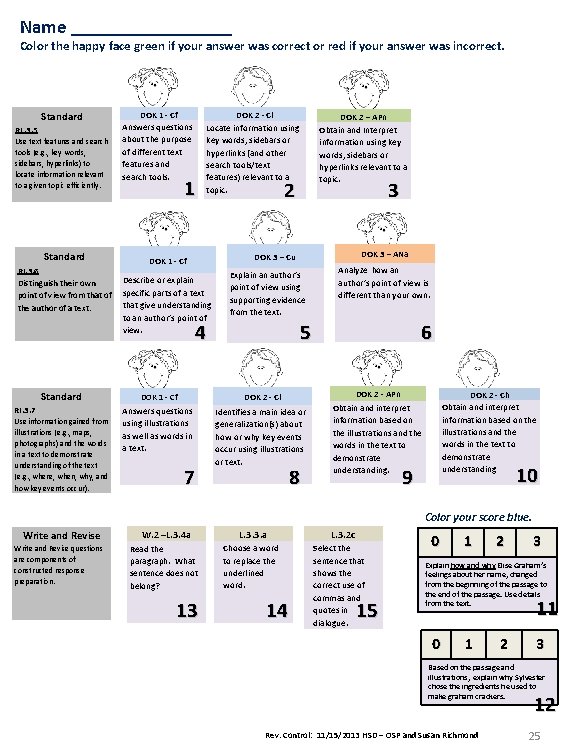
Name _________ Color the happy face green if your answer was correct or red if your answer was incorrect. Standard RL. 3. 5 Use text features and search tools (e. g. , key words, sidebars, hyperlinks) to locate information relevant to a given topic efficiently. Standard DOK 1 - Cf Answers questions about the purpose of different text features and search tools. 1 DOK 2 - Cl Locate information using key words, sidebars or hyperlinks (and other search tools/text features) relevant to a topic. 2 Use information gained from illustrations (e. g. , maps, photographs) and the words in a text to demonstrate understanding of the text (e. g. , where, when, why, and how key events occur). DOK 3 – ANa Explain an author’s point of view using supporting evidence from the text. 4 RI. 3. 7 3 DOK 3 – Cu DOK 1 - Cf RI. 3. 6 Describe or explain Distinguish their own point of view from that of specific parts of a text that give understanding the author of a text. to an author’s point of view. Standard DOK 2 – APn Obtain and Interpret information using key words, sidebars or hyperlinks relevant to a topic. DOK 1 - Cf Answers questions using illustrations as well as words in a text. 7 Analyze how an author’s point of view is different than your own. 6 5 DOK 2 - Cl DOK 2 - APn Identifies a main idea or generalization(s) about how or why key events occur using illustrations or text. Obtain and interpret information based on the illustrations and the words in the text to demonstrate understanding. 8 DOK 2 - Ch Obtain and interpret information based on the illustrations and the words in the text to demonstrate understanding 10 9 Color your score blue. Write and Revise questions are components of constructed response preparation. W. 2 –L. 3. 4 a L. 3. 3. a Read the paragraph. What sentence does not belong? Choose a word to replace the underlined word. 13 14 L. 3. 2 c Select the sentence that shows the correct use of commas and quotes in dialogue. 15 0 1 2 3 Explain how and why Elise Graham’s feelings about her name, changed from the beginning of the passage to the end of the passage. Use details from the text. 11 0 1 2 3 Based on the passage and illustrations, explain why Sylvester chose the ingredients he used to make graham crackers. 12 Rev. Control: 11/15/2013 HSD – OSP and Susan Richmond 25
1 2 3 4 5 6 7 8 9 10 11 12 Rev. Control: 11/15/2013 HSD – OSP and Susan Richmond 26