
Grade K Quarter Three 2014 15 CFA Reading

- Slides: 28
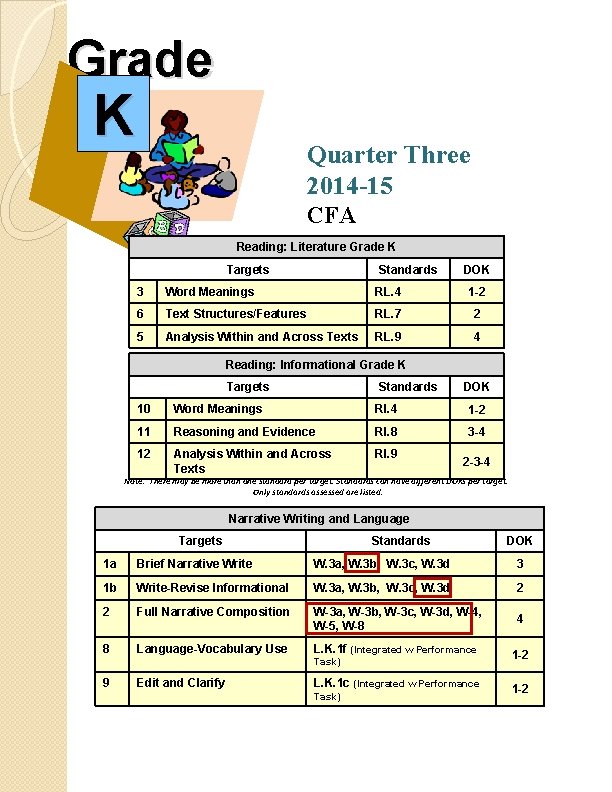
Grade K Quarter Three 2014 -15 CFA Reading: Literature Grade K Targets Standards DOK 3 Word Meanings RL. 4 1 -2 6 Text Structures/Features RL. 7 2 5 Analysis Within and Across Texts RL. 9 4 Reading: Informational Grade K Targets Standards DOK 10 Word Meanings RI. 4 1 -2 11 Reasoning and Evidence RI. 8 3 -4 12 Analysis Within and Across Texts RI. 9 2 -3 -4 Note: There may be more than one standard per target. Standards can have different DOKs per target. Only standards assessed are listed. Narrative Writing and Language Targets Standards DOK 1 a Brief Narrative Write W. 3 a, W. 3 b, W. 3 c, W. 3 d 3 1 b Write-Revise Informational W. 3 a, W. 3 b, W. 3 c, W. 3 d 2 2 Full Narrative Composition W-3 a, W-3 b, W-3 c, W-3 d, W-4, W-5, W-8 4 8 Language-Vocabulary Use L. K. 1 f (Integrated w Performance 1 -2 Task) 9 Edit and Clarify L. K. 1 c (Integrated w Performance Task) 1 -2
Quarter Three English Language Arts Common Formative Assessments 2014 -2015 Team Members and Writers This assessment was developed working backwards by identifying the deep understanding of the two passages. Key Ideas were identified to support constructed responses and key details were aligned with the selected response questions. All questions support students’ background knowledge of a central insight or message. Deborah Alvarado Berta Lule Judy Ramer Christina Orozco Alfonso Lule Jill Russo Linda Benson Sandy Maines Sharon Carlson Maritza Dash Gina Mc. Lain Anne Berg Heather Giard Nicole Thoen Aliceson Brandt Translator: Zaida Rosa Translator: Patricia Thank you to all of those who reviewed and edited and a special appreciation to Vicki Daniels and her amazing editing skills and our “in-house” writer Ginger Jay. Rev. Control: 01/20/2015 HSD – OSP and Susan Richmond 2
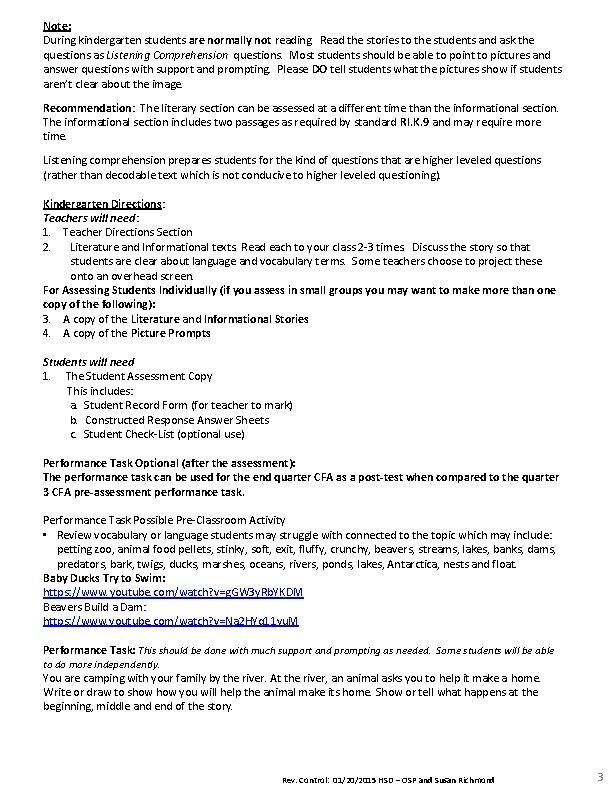
Note: During kindergarten students are normally not reading. Read the stories to the students and ask the questions as Listening Comprehension questions. Most students should be able to point to pictures and answer questions with support and prompting. Please DO tell students what the pictures show if students aren’t clear about the image. Recommendation: The literary section can be assessed at a different time than the informational section. The informational section includes two passages as required by standard RI. K. 9 and may require more time. Listening comprehension prepares students for the kind of questions that are higher leveled questions (rather than decodable text which is not conducive to higher leveled questioning). Kindergarten Directions: Teachers will need: 1. Teacher Directions Section 2. Literature and Informational texts. Read each to your class 2 -3 times. Discuss the story so that students are clear about language and vocabulary terms. Some teachers choose to project these onto an overhead screen. For Assessing Students Individually (if you assess in small groups you may want to make more than one copy of the following): 3. A copy of the Literature and Informational Stories 4. A copy of the Picture Prompts Students will need 1. The Student Assessment Copy This includes: a. Student Record Form (for teacher to mark) b. Constructed Response Answer Sheets c. Student Check-List (optional use) Performance Task Optional (after the assessment): The performance task can be used for the end quarter CFA as a post-test when compared to the quarter 3 CFA pre-assessment performance task. Performance Task Possible Pre-Classroom Activity • Review vocabulary or language students may struggle with connected to the topic which may include: petting zoo, animal food pellets, stinky, soft, exit, fluffy, crunchy, beavers, streams, lakes, banks, dams, predators, bark, twigs, ducks, marshes, oceans, rivers, ponds, lakes, Antarctica, nests and float. Baby Ducks Try to Swim: https: //www. youtube. com/watch? v=g. GW 3 y. Rb. YKDM Beavers Build a Dam: https: //www. youtube. com/watch? v=Na 2 HYq 11 yu. M Performance Task: This should be done with much support and prompting as needed. Some students will be able to do more independently. You are camping with your family by the river. At the river, an animal asks you to help it make a home. Write or draw to show you will help the animal make its home. Show or tell what happens at the beginning, middle and end of the story. Rev. Control: 01/20/2015 HSD – OSP and Susan Richmond 3
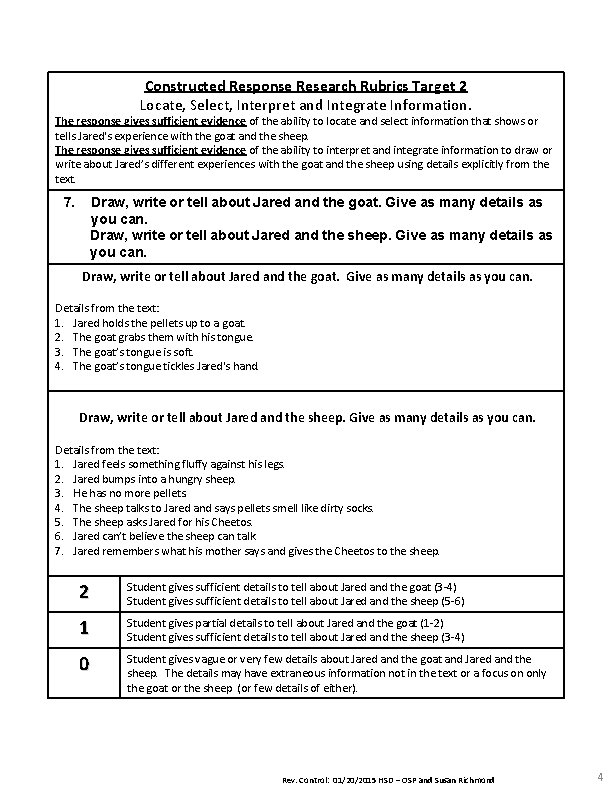
Constructed Response Research Rubrics Target 2 Locate, Select, Interpret and Integrate Information. The response gives sufficient evidence of the ability to locate and select information that shows or tells Jared's experience with the goat and the sheep. The response gives sufficient evidence of the ability to interpret and integrate information to draw or write about Jared’s different experiences with the goat and the sheep using details explicitly from the text. 7. Draw, write or tell about Jared and the goat. Give as many details as you can. Draw, write or tell about Jared and the sheep. Give as many details as you can. Draw, write or tell about Jared and the goat. Give as many details as you can. Details from the text: 1. Jared holds the pellets up to a goat. 2. The goat grabs them with his tongue. 3. The goat’s tongue is soft. 4. The goat’s tongue tickles Jared's hand. Draw, write or tell about Jared and the sheep. Give as many details as you can. Details from the text: 1. Jared feels something fluffy against his legs. 2. Jared bumps into a hungry sheep. 3. He has no more pellets. 4. The sheep talks to Jared and says pellets smell like dirty socks. 5. The sheep asks Jared for his Cheetos. 6. Jared can’t believe the sheep can talk. 7. Jared remembers what his mother says and gives the Cheetos to the sheep. 2 Student gives sufficient details to tell about Jared and the goat (3 -4) Student gives sufficient details to tell about Jared and the sheep (5 -6) 1 Student gives partial details to tell about Jared and the goat (1 -2) Student gives sufficient details to tell about Jared and the sheep (3 -4) 0 Student gives vague or very few details about Jared and the goat and Jared and the sheep. The details may have extraneous information not in the text or a focus on only the goat or the sheep (or few details of either). Rev. Control: 01/20/2015 HSD – OSP and Susan Richmond 4
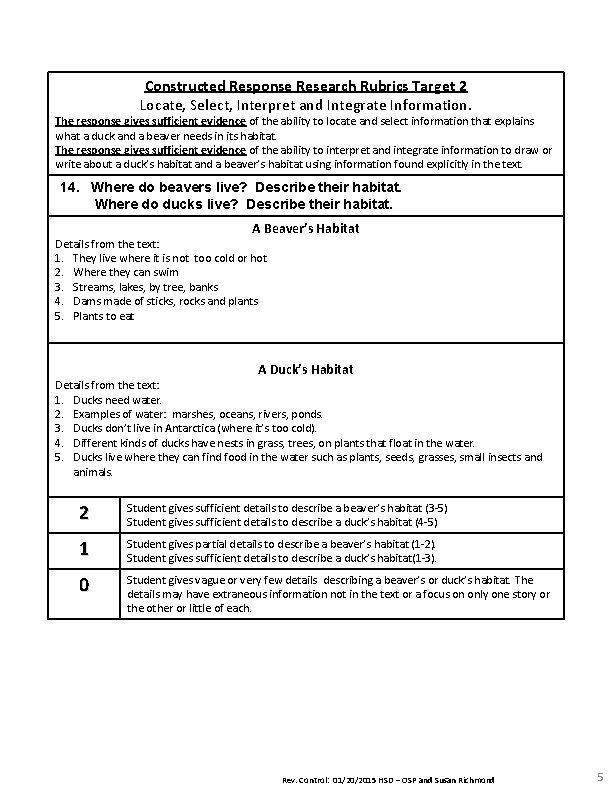
Constructed Response Research Rubrics Target 2 Locate, Select, Interpret and Integrate Information. The response gives sufficient evidence of the ability to locate and select information that explains what a duck and a beaver needs in its habitat. The response gives sufficient evidence of the ability to interpret and integrate information to draw or write about a duck’s habitat and a beaver’s habitat using information found explicitly in the text. 14. Where do beavers live? Describe their habitat. Where do ducks live? Describe their habitat. A Beaver’s Habitat Details from the text: 1. They live where it is not too cold or hot 2. Where they can swim 3. Streams, lakes, by tree, banks 4. Dams made of sticks, rocks and plants 5. Plants to eat A Duck’s Habitat Details from the text: 1. Ducks need water. 2. Examples of water: marshes, oceans, rivers, ponds. 3. Ducks don’t live in Antarctica (where it’s too cold). 4. Different kinds of ducks have nests in grass, trees, on plants that float in the water. 5. Ducks live where they can find food in the water such as plants, seeds, grasses, small insects and animals. 2 Student gives sufficient details to describe a beaver’s habitat (3 -5) Student gives sufficient details to describe a duck’s habitat (4 -5) 1 Student gives partial details to describe a beaver’s habitat (1 -2). Student gives sufficient details to describe a duck’s habitat(1 -3). 0 Student gives vague or very few details describing a beaver’s or duck’s habitat. The details may have extraneous information not in the text or a focus on only one story or the other or little of each. Rev. Control: 01/20/2015 HSD – OSP and Susan Richmond 5
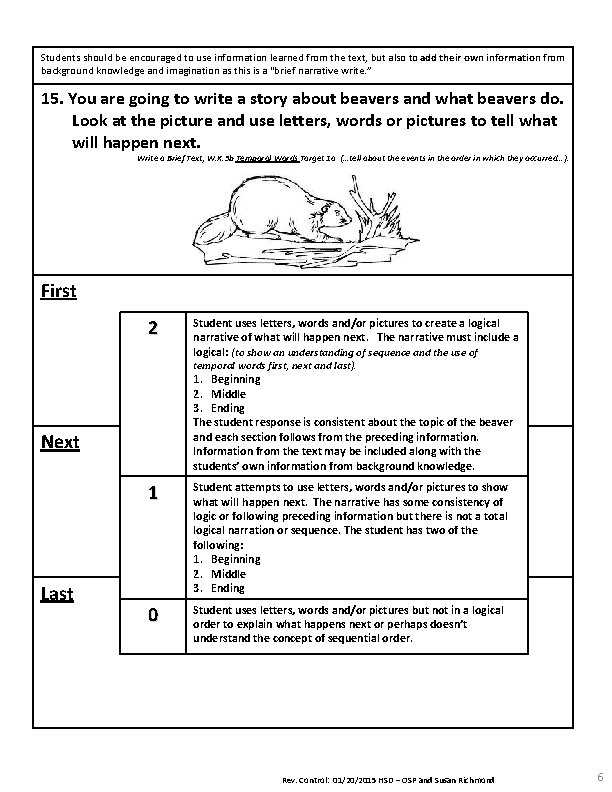
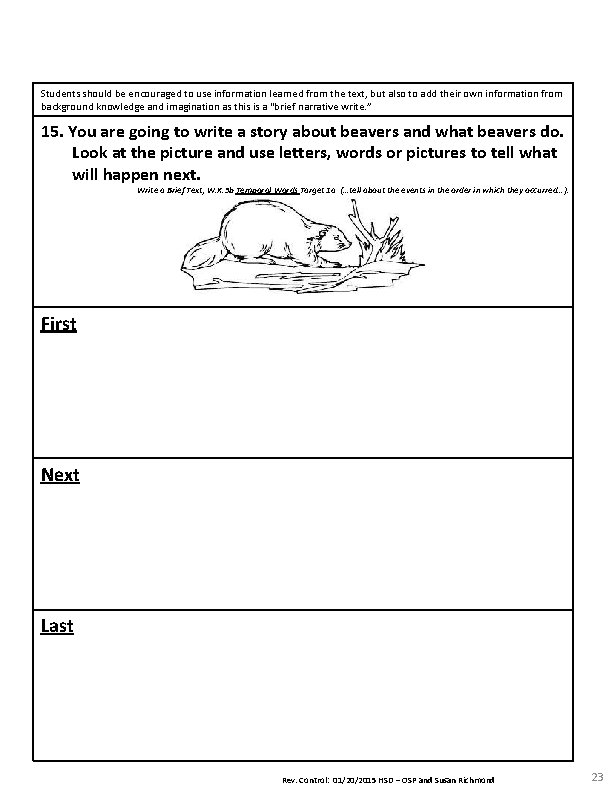
Students should be encouraged to use information learned from the text, but also to add their own information from background knowledge and imagination as this is a “brief narrative write. ” 15. You are going to write a story about beavers and what beavers do. Look at the picture and use letters, words or pictures to tell what will happen next. Write a Brief Text, W. K. 3 b Temporal Words Target 1 a (…tell about the events in the order in which they occurred…). First 2 Student uses letters, words and/or pictures to create a logical narrative of what will happen next. The narrative must include a logical: (to show an understanding of sequence and the use of temporal words first, next and last). 1. Beginning 2. Middle 3. Ending The student response is consistent about the topic of the beaver and each section follows from the preceding information. Information from the text may be included along with the students’ own information from background knowledge. Next Last 1 Student attempts to use letters, words and/or pictures to show what will happen next. The narrative has some consistency of logic or following preceding information but there is not a total logical narration or sequence. The student has two of the following: 1. Beginning 2. Middle 3. Ending 0 Student uses letters, words and/or pictures but not in a logical order to explain what happens next or perhaps doesn’t understand the concept of sequential order. Rev. Control: 01/20/2015 HSD – OSP and Susan Richmond 6
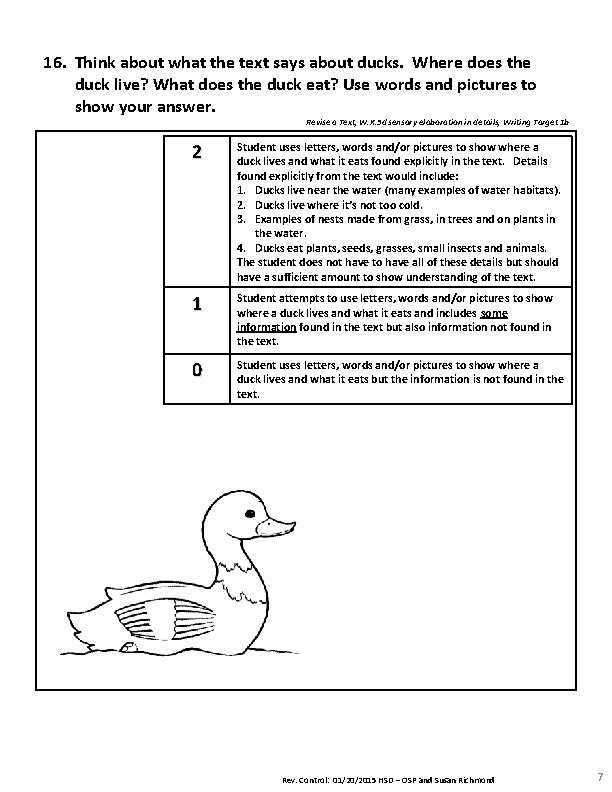
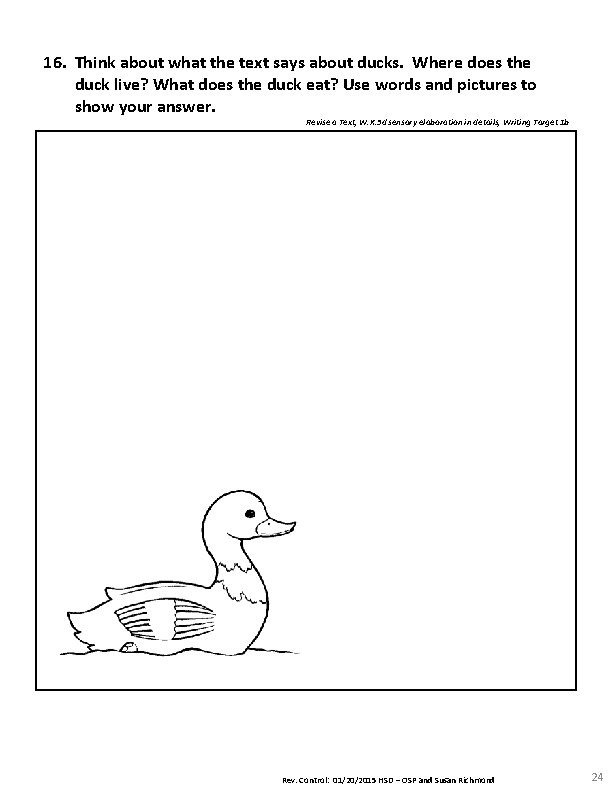
16. Think about what the text says about ducks. Where does the duck live? What does the duck eat? Use words and pictures to show your answer. Revise a Text, W. K. 3 d sensory elaboration in details, Writing Target 1 b 2 Student uses letters, words and/or pictures to show where a duck lives and what it eats found explicitly in the text. Details found explicitly from the text would include: 1. Ducks live near the water (many examples of water habitats). 2. Ducks live where it’s not too cold. 3. Examples of nests made from grass, in trees and on plants in the water. 4. Ducks eat plants, seeds, grasses, small insects and animals. The student does not have to have all of these details but should have a sufficient amount to show understanding of the text. 1 Student attempts to use letters, words and/or pictures to show where a duck lives and what it eats and includes some information found in the text but also information not found in the text. 0 Student uses letters, words and/or pictures to show where a duck lives and what it eats but the information is not found in the text. Rev. Control: 01/20/2015 HSD – OSP and Susan Richmond 7
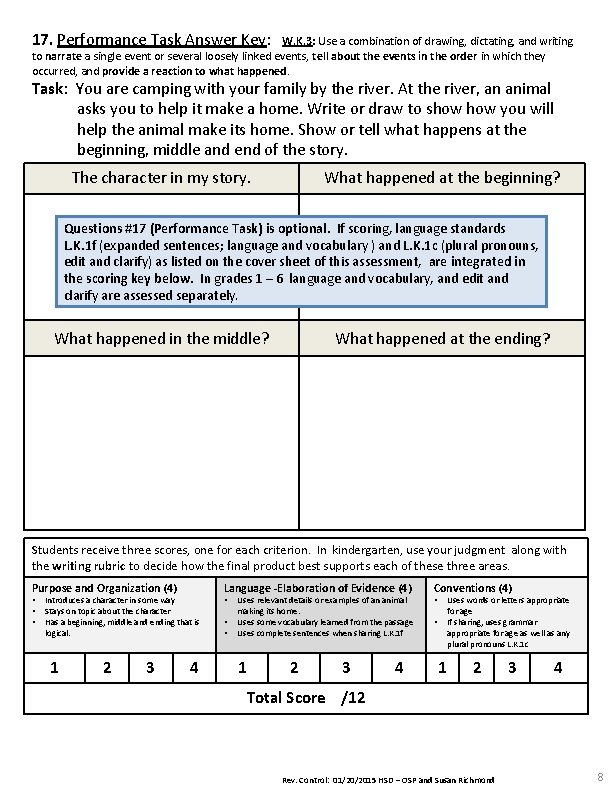
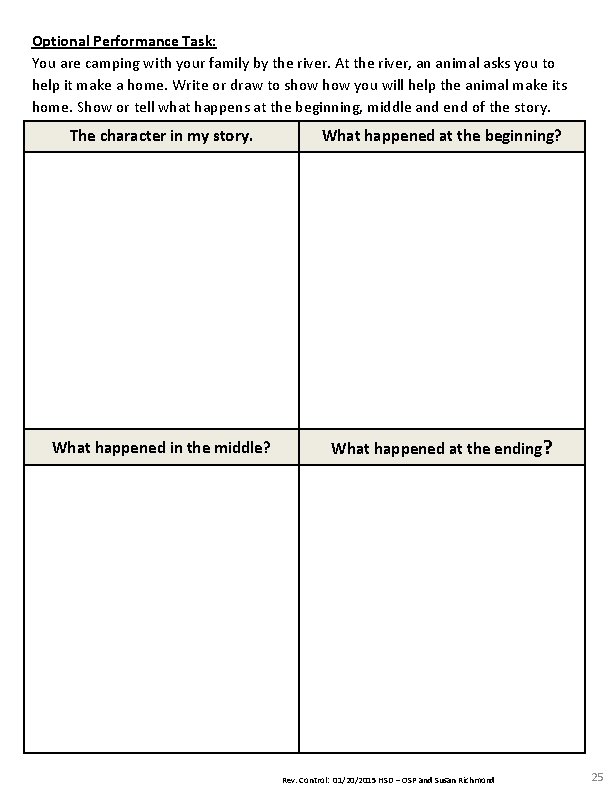
17. Performance Task Answer Key: W. K. 3: Use a combination of drawing, dictating, and writing to narrate a single event or several loosely linked events, tell about the events in the order in which they occurred, and provide a reaction to what happened. Task: You are camping with your family by the river. At the river, an animal asks you to help it make a home. Write or draw to show you will help the animal make its home. Show or tell what happens at the beginning, middle and end of the story. The character in my story. What happened at the beginning? Questions #17 (Performance Task) is optional. If scoring, language standards L. K. 1 f (expanded sentences; language and vocabulary ) and L. K. 1 c (plural pronouns, edit and clarify) as listed on the cover sheet of this assessment, are integrated in the scoring key below. In grades 1 – 6 language and vocabulary, and edit and clarify are assessed separately. What happened in the middle? What happened at the ending? Students receive three scores, one for each criterion. In kindergarten, use your judgment along with the writing rubric to decide how the final product best supports each of these three areas. Purpose and Organization (4) • • • Introduces a character in some way Stays on topic about the character Has a beginning, middle and ending that is logical. 1 2 3 4 Language -Elaboration of Evidence (4) Conventions (4) • • Uses relevant details or examples of an animal making its home. Uses some vocabulary learned from the passage Uses complete sentences when sharing L. K. 1 f 1 2 3 4 • Uses words or letters appropriate for age If sharing, uses grammar appropriate for age as well as any plural pronouns L. K. 1 c 1 2 3 4 Total Score /12 Rev. Control: 01/20/2015 HSD – OSP and Susan Richmond 8
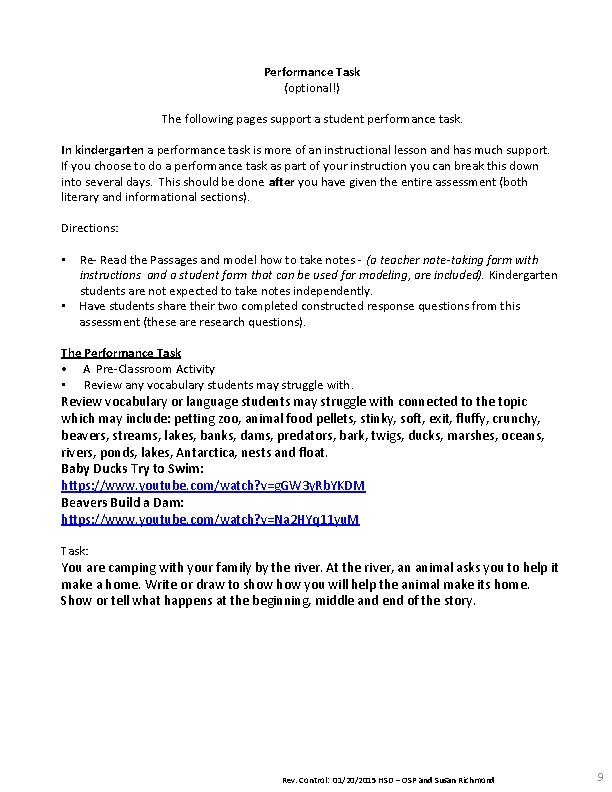
Performance Task (optional!) The following pages support a student performance task. In kindergarten a performance task is more of an instructional lesson and has much support. If you choose to do a performance task as part of your instruction you can break this down into several days. This should be done after you have given the entire assessment (both literary and informational sections). Directions: • • Re- Read the Passages and model how to take notes - (a teacher note-taking form with instructions and a student form that can be used for modeling, are included). Kindergarten students are not expected to take notes independently. Have students share their two completed constructed response questions from this assessment (these are research questions). The Performance Task • A Pre-Classroom Activity • Review any vocabulary students may struggle with. Review vocabulary or language students may struggle with connected to the topic which may include: petting zoo, animal food pellets, stinky, soft, exit, fluffy, crunchy, beavers, streams, lakes, banks, dams, predators, bark, twigs, ducks, marshes, oceans, rivers, ponds, lakes, Antarctica, nests and float. Baby Ducks Try to Swim: https: //www. youtube. com/watch? v=g. GW 3 y. Rb. YKDM Beavers Build a Dam: https: //www. youtube. com/watch? v=Na 2 HYq 11 yu. M Task: You are camping with your family by the river. At the river, an animal asks you to help it make a home. Write or draw to show you will help the animal make its home. Show or tell what happens at the beginning, middle and end of the story. Rev. Control: 01/20/2015 HSD – OSP and Susan Richmond 9
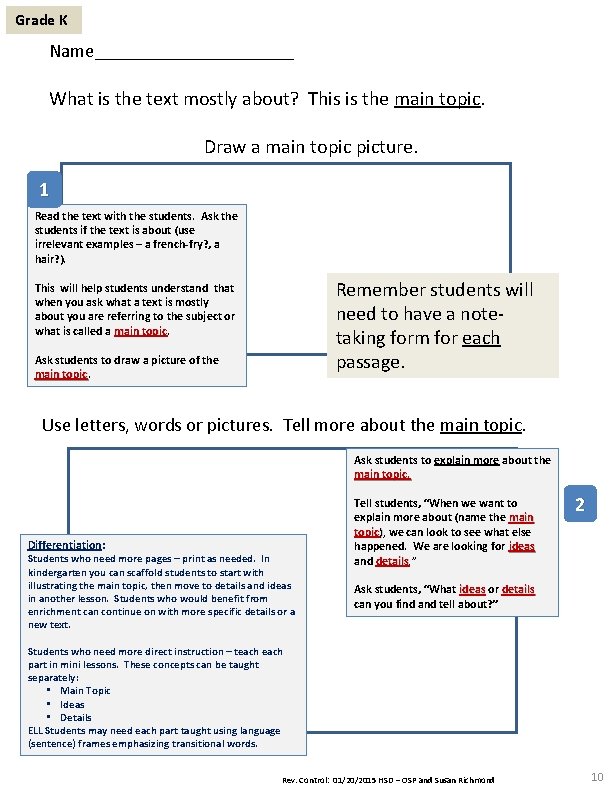
Grade K Name___________ What is the text mostly about? This is the main topic. Draw a main topic picture. 1 Read the text with the students. Ask the students if the text is about (use irrelevant examples – a french-fry? , a hair? ). Remember students will need to have a notetaking form for each passage. This will help students understand that when you ask what a text is mostly about you are referring to the subject or what is called a main topic Ask students to draw a picture of the main topic Use letters, words or pictures. Tell more about the main topic. Ask students to explain more about the main topic. Differentiation: Students who need more pages – print as needed. In kindergarten you can scaffold students to start with illustrating the main topic, then move to details and ideas in another lesson. Students who would benefit from enrichment can continue on with more specific details or a new text. Tell students, “When we want to explain more about (name the main topic), we can look to see what else happened. We are looking for ideas and details. ” details 2 Ask students, “What ideas or details can you find and tell about? ” Students who need more direct instruction – teach part in mini lessons. These concepts can be taught separately: • Main Topic • Ideas • Details ELL Students may need each part taught using language (sentence) frames emphasizing transitional words. Rev. Control: 01/20/2015 HSD – OSP and Susan Richmond 10
Grade K Name___________ What is the text mostly about? This is the main topic. Draw a main topic picture. Use letters, words or pictures. Tell more about the main topic. Rev. Control: 01/20/2015 HSD – OSP and Susan Richmond 11
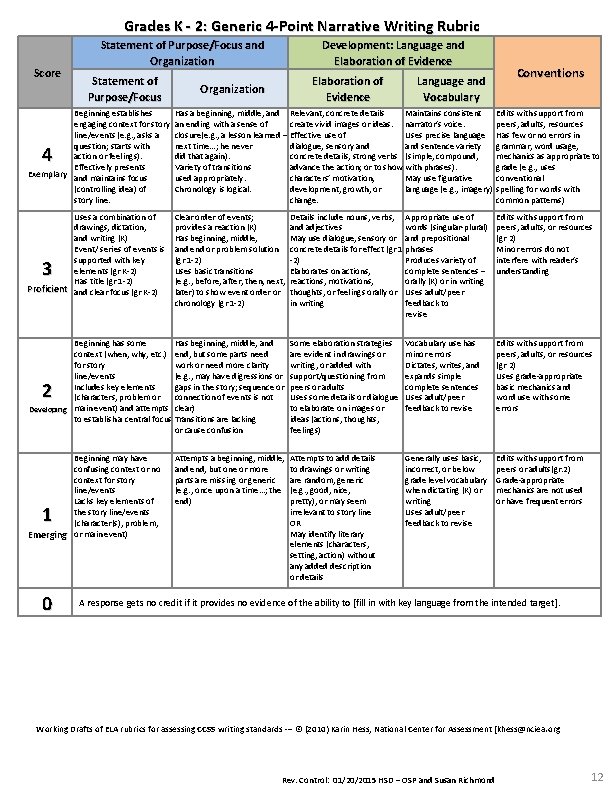
Grades K - 2: Generic 4 -Point Narrative Writing Rubric Score Statement of Purpose/Focus and Organization Statement of Purpose/Focus Development: Language and Elaboration of Evidence Organization Language and Vocabulary Conventions Beginning establishes engaging context for story line/events (e. g. , asks a question; starts with action or feelings). Effectively presents Exemplary and maintains focus (controlling idea) of story line. Has a beginning, middle, and an ending with a sense of closure(e. g. , a lesson learned – next time…; he never did that again). Variety of transitions used appropriately. Chronology is logical. Relevant, concrete details Maintains consistent create vivid images or ideas. narrator’s voice. Effective use of Uses precise language dialogue, sensory and sentence variety concrete details, strong verbs (simple, compound, advance the action; or to show with phrases). characters’ motivation, May use figurative development, growth, or language (e. g. , imagery) change. Edits with support from peers, adults, resources Has few or no errors in grammar, word usage, mechanics as appropriate to grade (e. g. , uses conventional spelling for words with common patterns) Uses a combination of drawings, dictation, and writing (K) Event/ series of events is supported with key elements (gr K-2) Has title (gr 1 -2) Proficient and clear focus (gr K-2) Clear order of events; provides a reaction (K) Has beginning, middle, and end or problem solution (gr 1 -2) Uses basic transitions (e. g. , before, after, then, next, later) to show event order or chronology (gr 1 -2) Details include nouns, verbs, Appropriate use of and adjectives words (singular-plural) May use dialogue, sensory or and prepositional concrete details for effect (gr 1 phrases -2) Produces variety of Elaborates on actions, complete sentences – reactions, motivations, orally (K) or in writing thoughts, or feelings orally or Uses adult/peer in writing feedback to revise Edits with support from peers, adults, or resources (gr 2) Minor errors do not interfere with reader’s understanding Beginning has some context (when, why, etc. ) for story line/events Includes key elements (characters, problem or Developing main event) and attempts to establish a central focus Has beginning, middle, and end, but some parts need work or need more clarity (e. g. , may have digressions or gaps in the story; sequence or connection of events is not clear) Transitions are lacking or cause confusion Some elaboration strategies are evident in drawings or writing, or added with support/questioning from peers or adults Uses some details or dialogue to elaborate on images or ideas (actions, thoughts, feelings) Vocabulary use has minor errors Dictates, writes, and expands simple complete sentences Uses adult/peer feedback to revise Edits with support from peers, adults, or resources (gr 2) Uses grade-appropriate basic mechanics and word use with some errors Beginning may have confusing context or no context for story line/events Lacks key elements of the story line/events (character(s), problem, Emerging or main event) Attempts a beginning, middle, and end, but one or more parts are missing or generic (e. g. , once upon a time…; the end) Attempts to add details to drawings or writing are random, generic (e. g. , good, nice, pretty), or may seem irrelevant to story line OR May identify literary elements (characters, setting, action) without any added description or details Generally uses basic, incorrect, or below grade level vocabulary when dictating (K) or writing Uses adult/peer feedback to revise Edits with support from peers or adults(gr. 2) Grade-appropriate mechanics are not used or have frequent errors 4 3 2 1 0 A response gets no credit if it provides no evidence of the ability to [fill in with key language from the intended target]. Working Drafts of ELA rubrics for assessing CCSS writing standards --- © (2010) Karin Hess, National Center for Assessment [khess@nciea. org Rev. Control: 01/20/2015 HSD – OSP and Susan Richmond 12
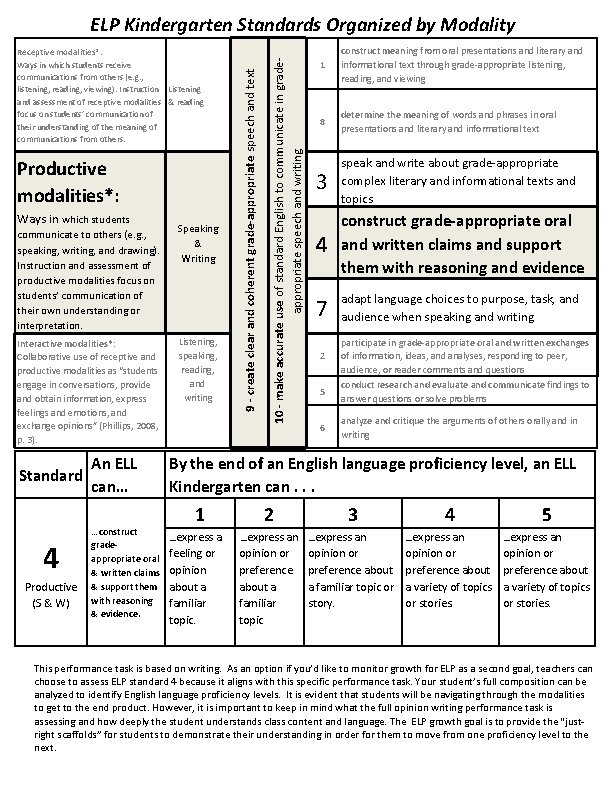
Productive modalities*: Ways in which students communicate to others (e. g. , speaking, writing, and drawing). Instruction and assessment of productive modalities focus on students’ communication of their own understanding or interpretation. Interactive modalities*: Collaborative use of receptive and productive modalities as “students engage in conversations, provide and obtain information, express feelings and emotions, and exchange opinions” (Phillips, 2008, p. 3). Standard An ELL can… Speaking & Writing Listening, speaking, reading, and writing Productive (S & W) 1 construct meaning from oral presentations and literary and informational text through grade-appropriate listening, reading, and viewing 8 determine the meaning of words and phrases in oral presentations and literary and informational text 3 speak and write about grade-appropriate complex literary and informational texts and topics 4 construct grade-appropriate oral and written claims and support them with reasoning and evidence 7 adapt language choices to purpose, task, and audience when speaking and writing 2 participate in grade-appropriate oral and written exchanges of information, ideas, and analyses, responding to peer, audience, or reader comments and questions 5 conduct research and evaluate and communicate findings to answer questions or solve problems 6 analyze and critique the arguments of others orally and in writing By the end of an English language proficiency level, an ELL Kindergarten can. . . 1 4 10 - make accurate use of standard English to communicate in gradeappropriate speech and writing Receptive modalities*: Ways in which students receive communications from others (e. g. , listening, reading, viewing). Instruction Listening and assessment of receptive modalities & reading focus on students’ communication of their understanding of the meaning of communications from others. 9 - create clear and coherent grade-appropriate speech and text ELP Kindergarten Standards Organized by Modality …construct …express a gradeappropriate oral feeling or & written claims opinion & support them about a with reasoning familiar & evidence. topic. 2 3 4 5 …express an opinion or preference about a familiar topic opinion or preference about a variety of topics or stories. opinion or preference about a familiar topic or story. This performance task is based on writing. As an option if you’d like to monitor growth for ELP as a second goal, teachers can choose to assess ELP standard 4 because it aligns with this specific performance task. Your student’s full composition can be analyzed to identify English language proficiency levels. It is evident that students will be navigating through the modalities to get to the end product. However, it is important to keep in mind what the full opinion writing performance task is assessing and how deeply the student understands class content and language. The ELP growth goal is to provide the “justright scaffolds” for students to demonstrate their understanding in order for them to move from one proficiency level to the next.
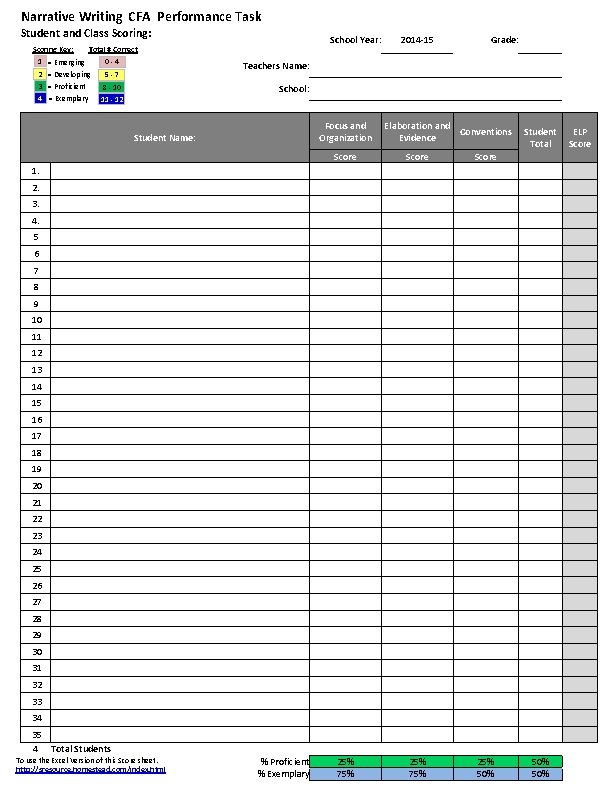
Narrative Writing CFA Performance Task Student and Class Scoring: Scoring Key: Total # Correct 1 = Emerging 0 -4 2 = Developing 3 = Proficient 4 = Exemplary 5 -7 8 - 10 School Year: 2014 -15 Grade: Teachers Name: School: 11 - 12 Focus and Organization Student Name: Score Elaboration and Conventions Evidence Score Student Total Score 1. 2. 3. 4. 5 0 6 0 7 0 8 0 9 0 10 0 11 0 12 0 13 0 14 0 15 0 16 0 17 0 18 0 19 0 20 0 21 0 22 0 23 0 24 0 25 0 26 0 27 0 28 0 29 0 30 0 31 0 32 0 33 0 34 0 35 4 Total Students 0 To use the Excel Version of this Score sheet. http: //sresource. homestead. com/index. html % Proficient % Exemplary 25% 75% 25% 50% 50% ELP Score
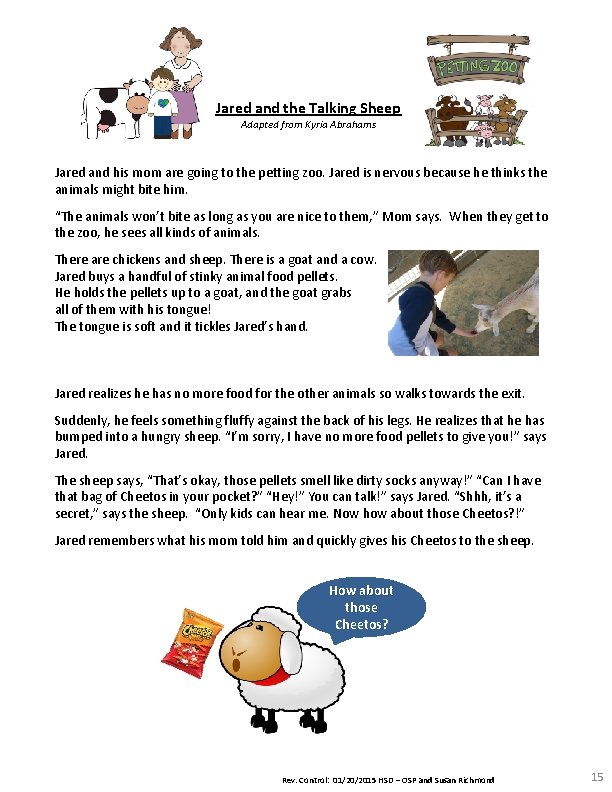
Jared and the Talking Sheep Adapted from Kyria Abrahams Jared and his mom are going to the petting zoo. Jared is nervous because he thinks the animals might bite him. “The animals won’t bite as long as you are nice to them, ” Mom says. When they get to the zoo, he sees all kinds of animals. There are chickens and sheep. There is a goat and a cow. Jared buys a handful of stinky animal food pellets. He holds the pellets up to a goat, and the goat grabs all of them with his tongue! The tongue is soft and it tickles Jared’s hand. Jared realizes he has no more food for the other animals so walks towards the exit. Suddenly, he feels something fluffy against the back of his legs. He realizes that he has bumped into a hungry sheep. “I’m sorry, I have no more food pellets to give you!” says Jared. The sheep says, “That’s okay, those pellets smell like dirty socks anyway!” “Can I have that bag of Cheetos in your pocket? ” “Hey!” You can talk!” says Jared. “Shhh, it’s a secret, ” says the sheep. “Only kids can hear me. Now how about those Cheetos? !” Jared remembers what his mom told him and quickly gives his Cheetos to the sheep. How about those Cheetos? Rev. Control: 01/20/2015 HSD – OSP and Susan Richmond 15
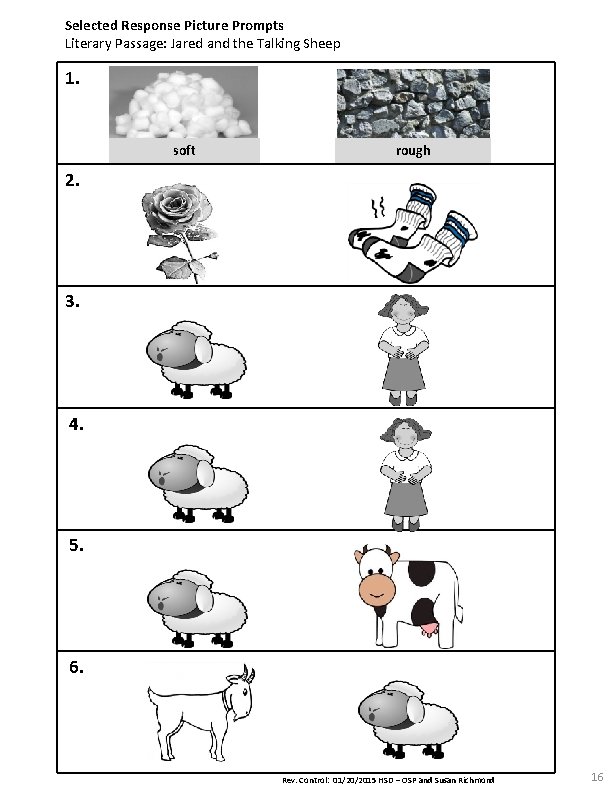
Selected Response Picture Prompts Literary Passage: Jared and the Talking Sheep 1. soft rough 2. 3. 4. 5. 6. Rev. Control: 01/20/2015 HSD – OSP and Susan Richmond 16
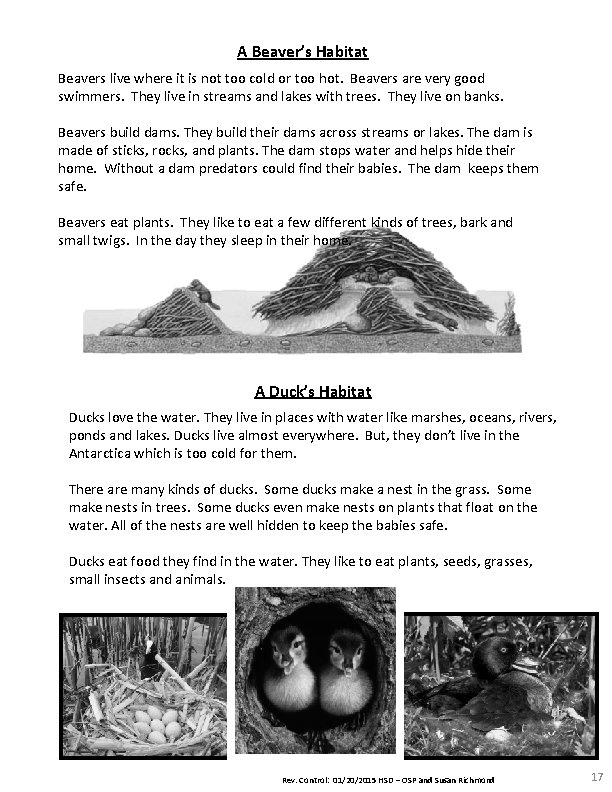
A Beaver’s Habitat Beavers live where it is not too cold or too hot. Beavers are very good swimmers. They live in streams and lakes with trees. They live on banks. Beavers build dams. They build their dams across streams or lakes. The dam is made of sticks, rocks, and plants. The dam stops water and helps hide their home. Without a dam predators could find their babies. The dam keeps them safe. Beavers eat plants. They like to eat a few different kinds of trees, bark and small twigs. In the day they sleep in their home. A Duck’s Habitat Ducks love the water. They live in places with water like marshes, oceans, rivers, ponds and lakes. Ducks live almost everywhere. But, they don’t live in the Antarctica which is too cold for them. There are many kinds of ducks. Some ducks make a nest in the grass. Some make nests in trees. Some ducks even make nests on plants that float on the water. All of the nests are well hidden to keep the babies safe. Ducks eat food they find in the water. They like to eat plants, seeds, grasses, small insects and animals. Rev. Control: 01/20/2015 HSD – OSP and Susan Richmond 17
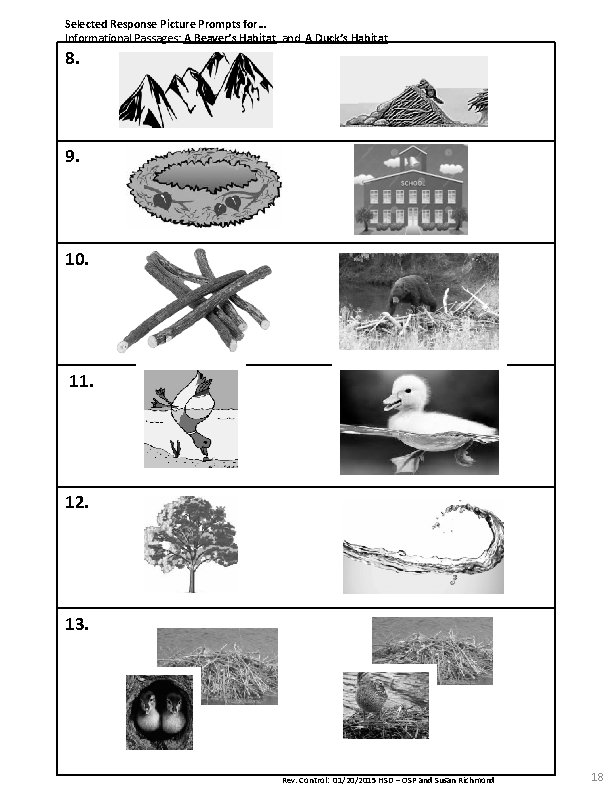
Selected Response Picture Prompts for… Informational Passages: A Beaver’s Habitat and A Duck’s Habitat 8. 9. 10. 11. 12. 13. Rev. Control: 01/20/2015 HSD – OSP and Susan Richmond 18
Grade K Quarter Three 2014 -15 ELA CFAssessment Student Copy Student Name ____________
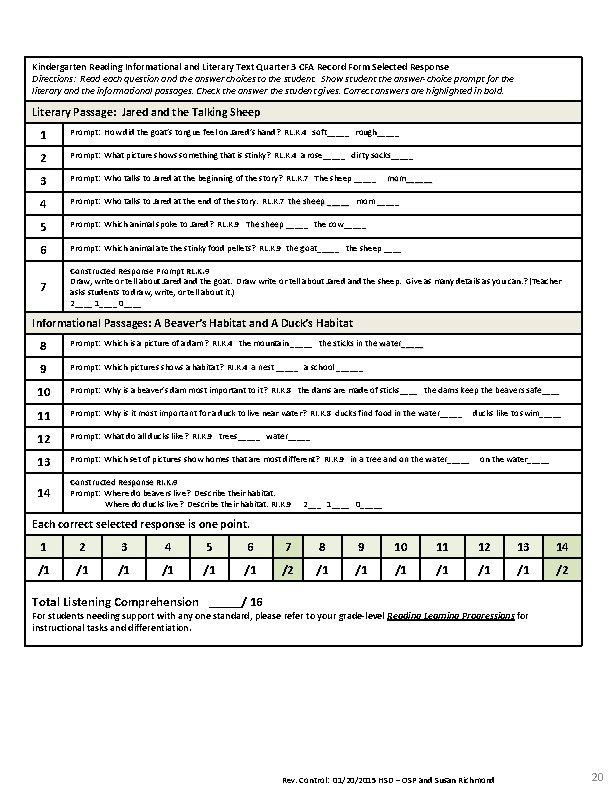
Kindergarten Reading Informational and Literary Text Quarter 3 CFA Record Form Selected Response Directions: Read each question and the answer choices to the student. Show student the answer-choice prompt for the literary and the informational passages. Check the answer the student gives. Correct answers are highlighted in bold. Literary Passage: Jared and the Talking Sheep 1 Prompt: How did the goat’s tongue feel on Jared’s hand? RL. K. 4 soft_____ rough_____ 2 Prompt: What picture shows something that is stinky? RL. K. 4 a rose_____ dirty socks_____ 3 Prompt: Who talks to Jared at the beginning of the story? RL. K. 7 The sheep _____ 4 Prompt: Who talks to Jared at the end of the story. RL. K. 7 the sheep _____ mom _____ 5 Prompt: Which animal spoke to Jared? RL. K. 9 The sheep _____ the cow_____ 6 Prompt: Which animal ate the stinky food pellets? RL. K. 9 the goat_____ the sheep ____ 7 Constructed Response Prompt RL. K. 9 Draw, write or tell about Jared and the goat. Draw write or tell about Jared and the sheep. Give as many details as you can. ? (Teacher asks students to draw, write, or tell about it. ) 2____ 1____ 0____ mom______ Informational Passages: A Beaver’s Habitat and A Duck’s Habitat 8 Prompt: Which is a picture of a dam? RI. K. 4 the mountain _____ the sticks in the water_____ 9 Prompt: Which pictures shows a habitat? RI. K. 4 a nest _____ a school ______ 10 Prompt: Why is a beaver’s dam most important to it? RI. K. 8 the dams are made of sticks____ the dams keep the beavers safe____ 11 Prompt: Why is it most important for a duck to live near water? RI. K. 8 ducks find food in the water_____ 12 Prompt: What do all ducks like? RI. K. 9 trees_____ water_____ 13 Prompt: Which set of pictures show homes that are most different? RI. K. 9 in a tree and on the water_____ 14 Constructed Response RI. K. 9 Prompt: Where do beavers live? Describe their habitat. Where do ducks live? Describe their habitat. RI. K. 9 ducks like to swim_____ on the water_____ 2___ 1____ 0_____ Each correct selected response is one point. 1 2 3 4 5 6 7 8 9 10 11 12 13 14 /1 /1 /1 /2 Total Listening Comprehension _____/ 16 For students needing support with any one standard, please refer to your grade-level Reading Learning Progressions for instructional tasks and differentiation. Rev. Control: 01/20/2015 HSD – OSP and Susan Richmond 20
7. Draw, write or tell about Jared and the goat. Draw, write or tell about Jared and the sheep. Draw, write or tell about Jared and the goat. Use as many details as you can. Draw, write or tell about Jared and the sheep. Use as many details as you can. Rev. Control: 01/20/2015 HSD – OSP and Susan Richmond 21
14. Where do beavers live? Describe their habitat. Where do ducks live? Describe their habitat. A Beaver’s Habitat A Duck’s Habitat Rev. Control: 01/20/2015 HSD – OSP and Susan Richmond 22
Students should be encouraged to use information learned from the text, but also to add their own information from background knowledge and imagination as this is a “brief narrative write. ” 15. You are going to write a story about beavers and what beavers do. Look at the picture and use letters, words or pictures to tell what will happen next. Write a Brief Text, W. K. 3 b Temporal Words Target 1 a (…tell about the events in the order in which they occurred…). First Next Last Rev. Control: 01/20/2015 HSD – OSP and Susan Richmond 23
16. Think about what the text says about ducks. Where does the duck live? What does the duck eat? Use words and pictures to show your answer. Revise a Text, W. K. 3 d sensory elaboration in details, Writing Target 1 b Rev. Control: 01/20/2015 HSD – OSP and Susan Richmond 24
Optional Performance Task: You are camping with your family by the river. At the river, an animal asks you to help it make a home. Write or draw to show you will help the animal make its home. Show or tell what happens at the beginning, middle and end of the story. The character in my story. What happened at the beginning? What happened in the middle? What happened at the ending? Rev. Control: 01/20/2015 HSD – OSP and Susan Richmond 25
STOP Close your books and wait for instructions! Rev. Control: 01/20/2015 HSD – OSP and Susan Richmond 26
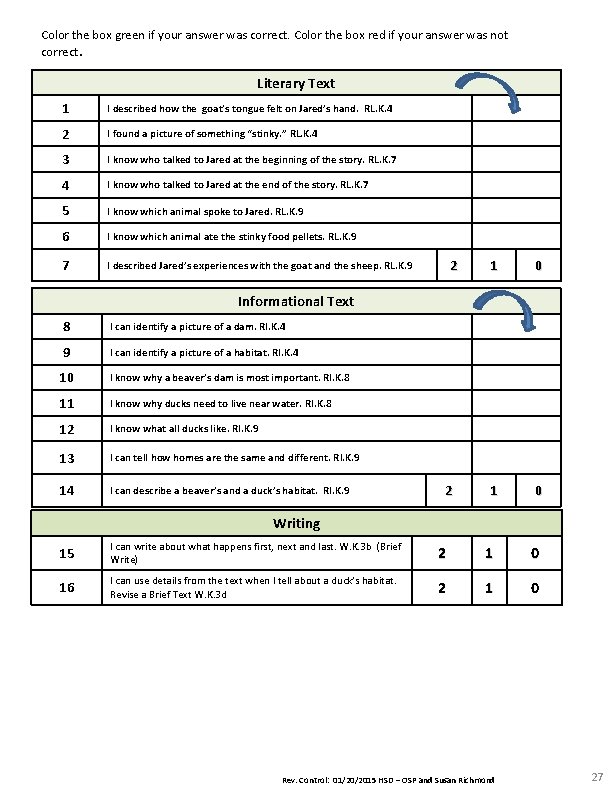
Color the box green if your answer was correct. Color the box red if your answer was not correct. Literary Text 1 I described how the goat’s tongue felt on Jared’s hand. RL. K. 4 2 I found a picture of something “stinky. ” RL. K. 4 3 I know who talked to Jared at the beginning of the story. RL. K. 7 4 I know who talked to Jared at the end of the story. RL. K. 7 5 I know which animal spoke to Jared. RL. K. 9 6 I know which animal ate the stinky food pellets. RL. K. 9 7 I described Jared’s experiences with the goat and the sheep. RL. K. 9 2 1 0 Informational Text 8 I can identify a picture of a dam. RI. K. 4 9 I can identify a picture of a habitat. RI. K. 4 10 I know why a beaver’s dam is most important. RI. K. 8 11 I know why ducks need to live near water. RI. K. 8 12 I know what all ducks like. RI. K. 9 13 I can tell how homes are the same and different. RI. K. 9 14 I can describe a beaver’s and a duck’s habitat. RI. K. 9 2 Writing 15 I can write about what happens first, next and last. W. K. 3 b (Brief Write) 2 1 0 16 I can use details from the text when I tell about a duck’s habitat. Revise a Brief Text W. K. 3 d 2 1 0 Rev. Control: 01/20/2015 HSD – OSP and Susan Richmond 27
Reflection Page 1 st minute Something I did well on…. 2 nd Minute Something that was new to me or I need more practice with… 3 rd Minute Something I don’t understand…. Rev. Control: 01/20/2015 HSD – OSP and Susan Richmond 28