
Grade 7 Unit 4 Topic 4 Forces Loads

- Slides: 28
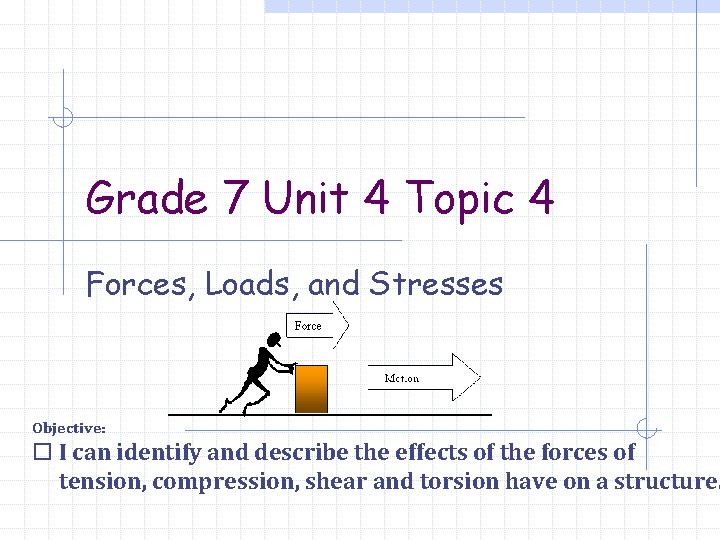
Grade 7 Unit 4 Topic 4 Forces, Loads, and Stresses Objective: I can identify and describe the effects of the forces of tension, compression, shear and torsion have on a structure.
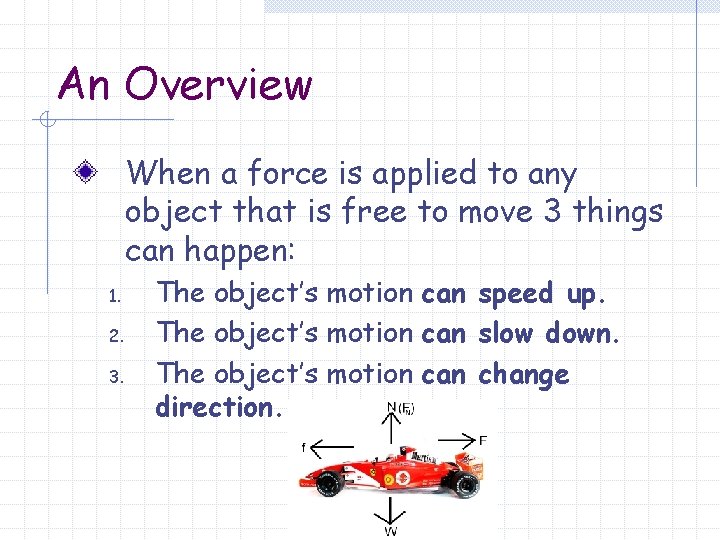
An Overview When a force is applied to any object that is free to move 3 things can happen: 1. 2. 3. The object’s motion can speed up. The object’s motion can slow down. The object’s motion can change direction.
We can group all the forces that act upon a structure in 2 groups: internal and external. Engineers must understand external and internal forces to prevent structural failure due to these forces.
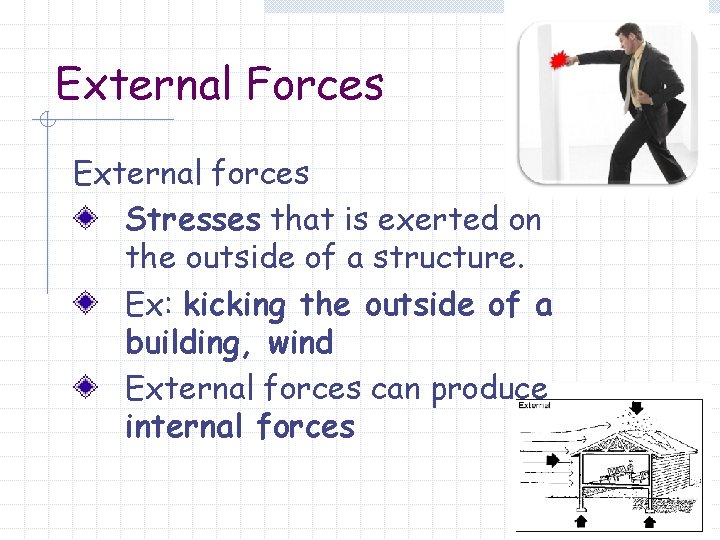
External Forces External forces Stresses that is exerted on the outside of a structure. Ex: kicking the outside of a building, wind External forces can produce internal forces
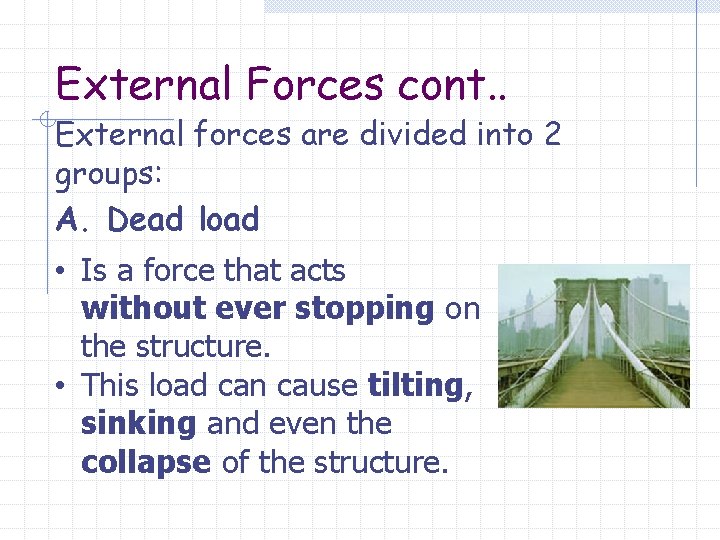
External Forces cont. . External forces are divided into 2 groups: A. Dead load • Is a force that acts without ever stopping on the structure. • This load can cause tilting, sinking and even the collapse of the structure.
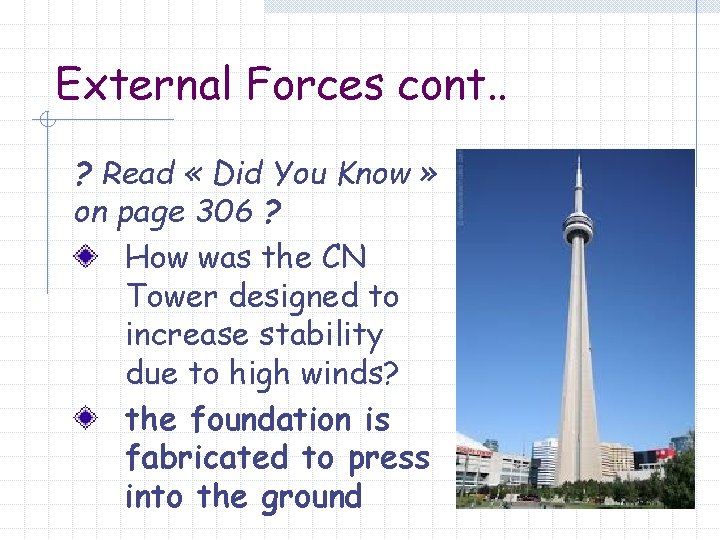
External Forces cont. . ? Read « Did You Know » on page 306 ? How was the CN Tower designed to increase stability due to high winds? the foundation is fabricated to press into the ground
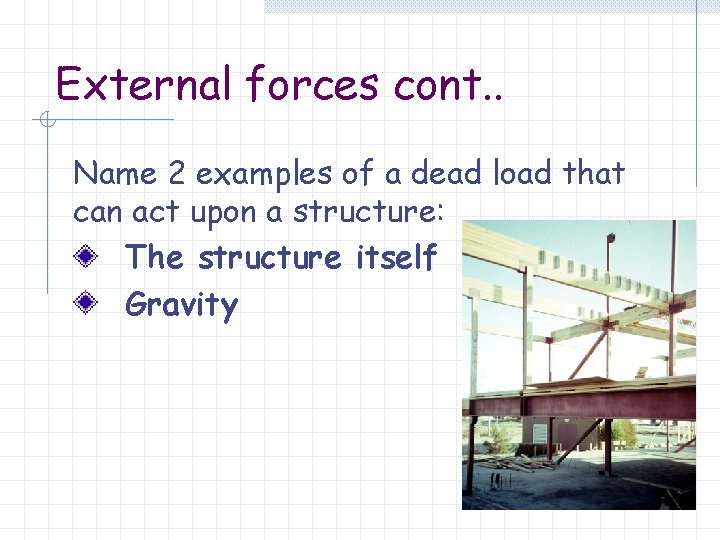
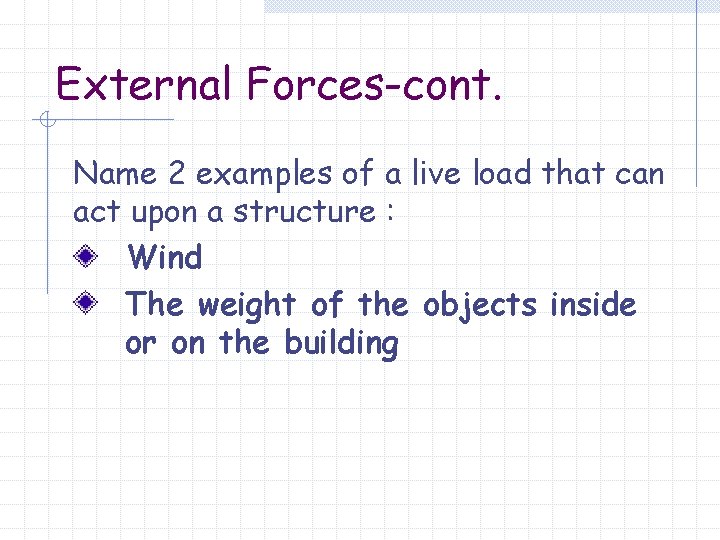
External forces cont. . Name 2 examples of a dead load that can act upon a structure: The structure itself Gravity
External Forces cont. . B. Live load is a force that changes and reacts to a structure but does not come from the actual structure. Normally structures are constructed to resist 2 or 3 big forces that are not planned for. Why? Security margin
External Forces-cont. Name 2 examples of a live load that can act upon a structure : Wind The weight of the objects inside or on the building
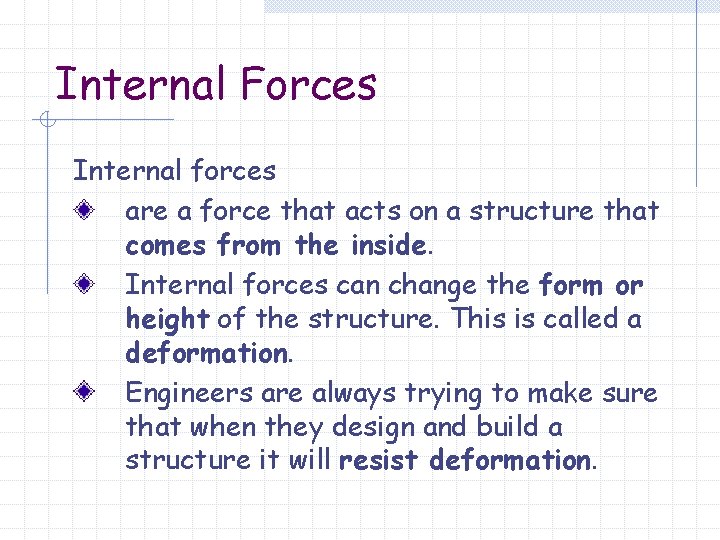
Internal Forces Internal forces are a force that acts on a structure that comes from the inside. Internal forces can change the form or height of the structure. This is called a deformation. Engineers are always trying to make sure that when they design and build a structure it will resist deformation.
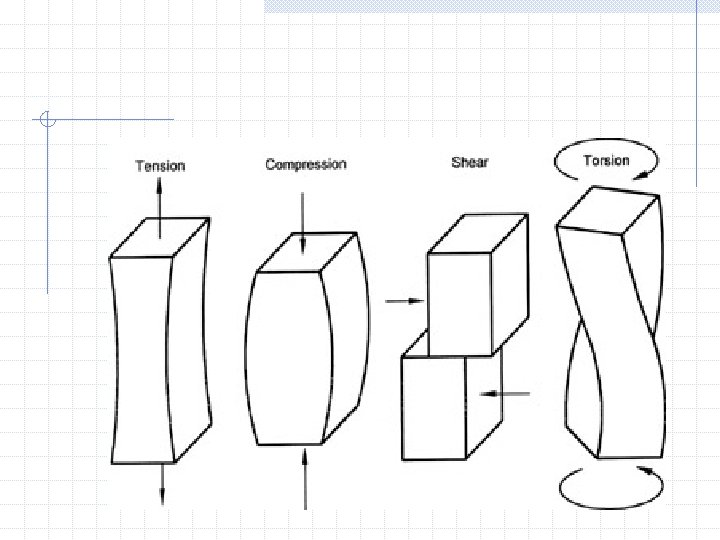
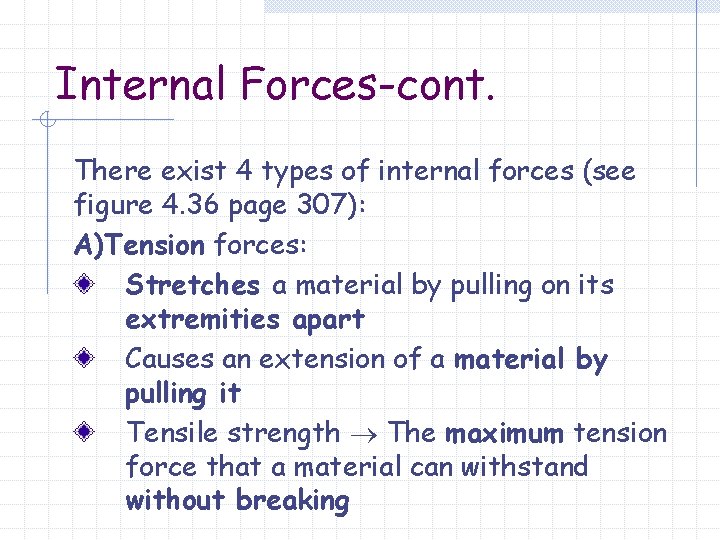
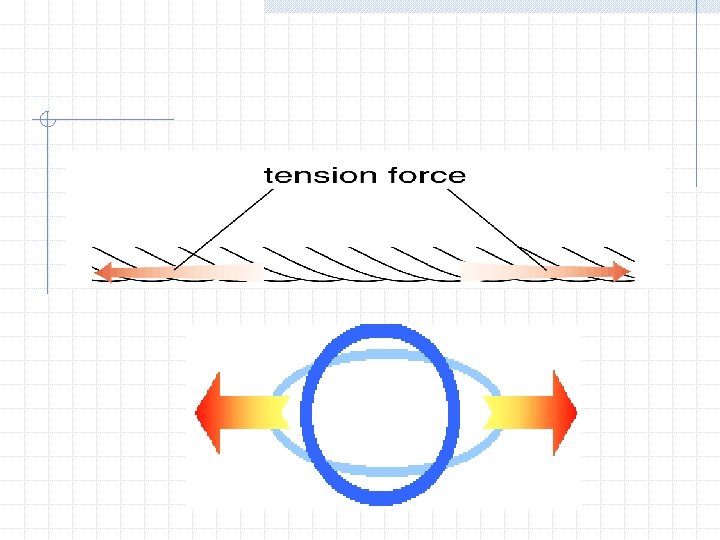
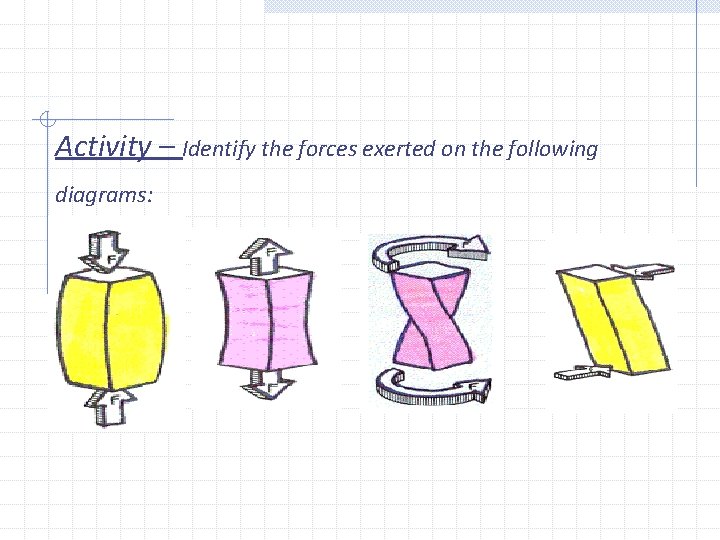
Internal Forces-cont. There exist 4 types of internal forces (see figure 4. 36 page 307): A)Tension forces: Stretches a material by pulling on its extremities apart Causes an extension of a material by pulling it Tensile strength The maximum tension force that a material can withstand without breaking
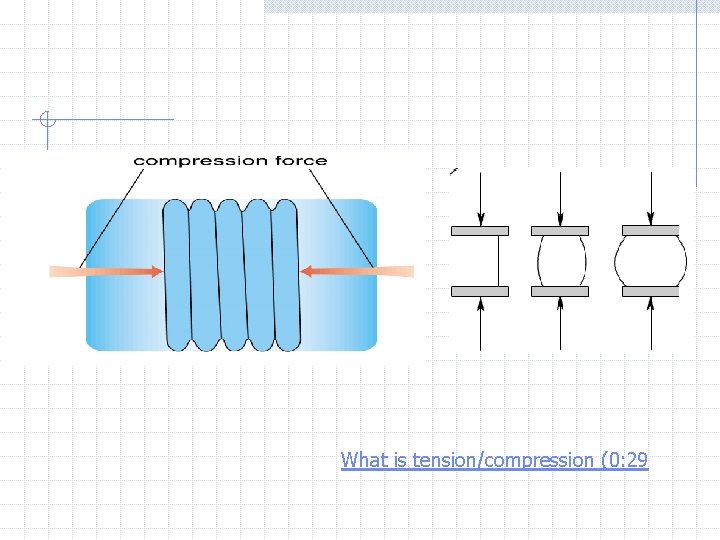
Internal Forces-cont. B) Compression forces: Crushes a material when its pressed Exerts a pressure or pushes two objects together Compressive strength Maximum compression force that a material can support without becoming deformed or breaking
What is tension/compression (0: 29
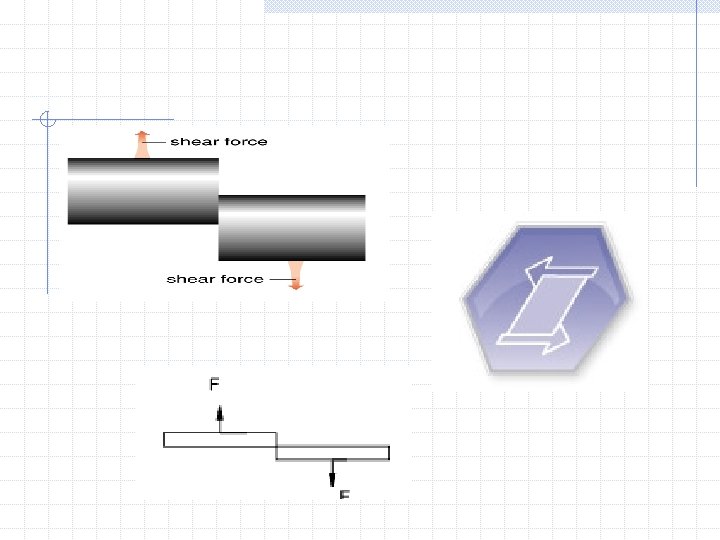
Internal Forces-cont. C) Shear forces: Folds a material or rips it by acting on several parts of a material at the same time in opposite directions. Acts like scissors by applying forces in opposite directions. Shear strength Maximum shear force a material can support without ripping.
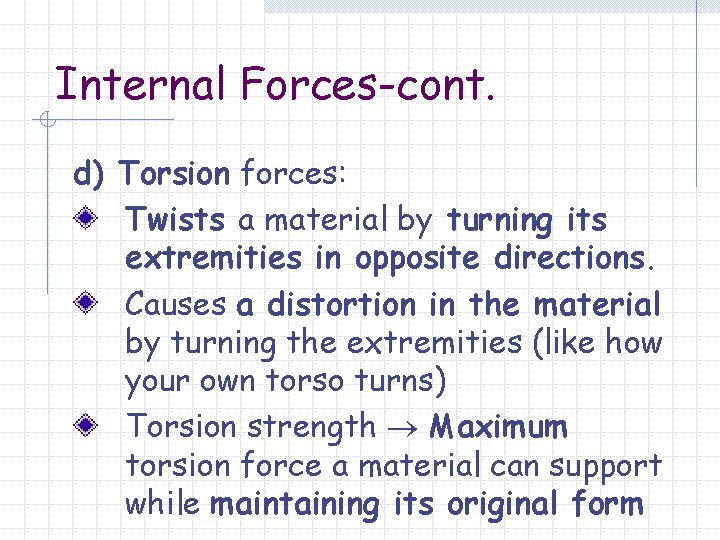
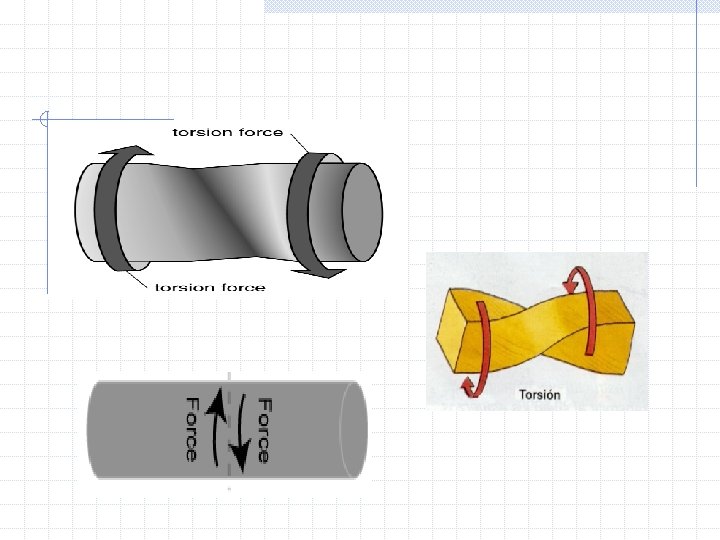
Internal Forces-cont. d) Torsion forces: Twists a material by turning its extremities in opposite directions. Causes a distortion in the material by turning the extremities (like how your own torso turns) Torsion strength Maximum torsion force a material can support while maintaining its original form
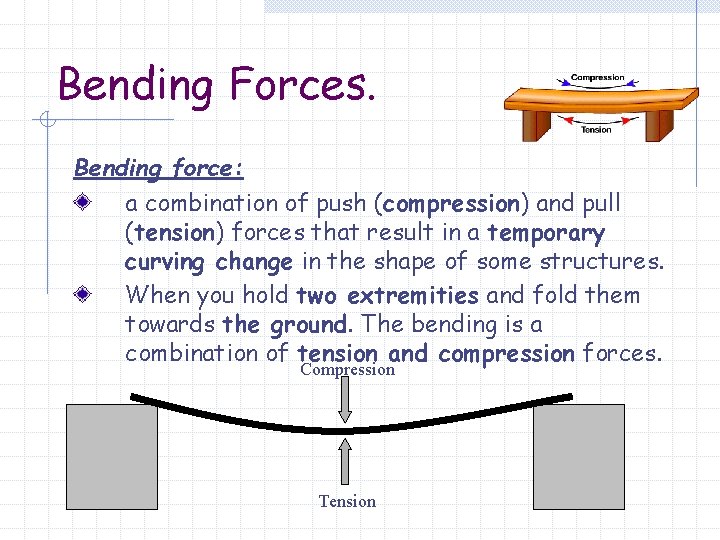
Bending Forces. Bending force: a combination of push (compression) and pull (tension) forces that result in a temporary curving change in the shape of some structures. When you hold two extremities and fold them towards the ground. The bending is a combination of tension and compression forces. Compression Tension
Activity – Identify the forces exerted on the following diagrams:
Deformations A deformation represents all the changes in form or position of a structure caused by internal forces. We can detect if a structure has undergone damages by thoroughly checking a structure for signs of deformations. Observing a fence, for example, we can determine if it tilts or if it sinks; we can obtain more precise information on the degree of inclination using a level or a square. These instruments can help determine if a large structure was damaged by events such as earthquakes.
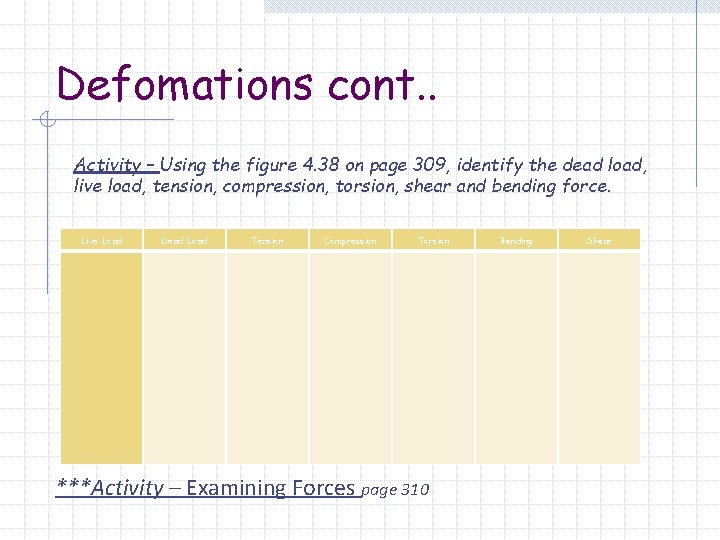
Defomations cont. . Activity – Using the figure 4. 38 on page 309, identify the dead load, live load, tension, compression, torsion, shear and bending force. Live Load Dead Load Tension Compression Torsion ***Activity – Examining Forces page 310 Bending Shear
Did You Know? ? Read « Did You Know on page 313 ? What is the strongest material known? If a strand had the same diameter as its radius, what could stop it? Scientists are currently using genetic engineering to develop bacteria containing the gene for spider silk, so that large quantities could be produced.
Smart Material: Spider Silk – You. Tube
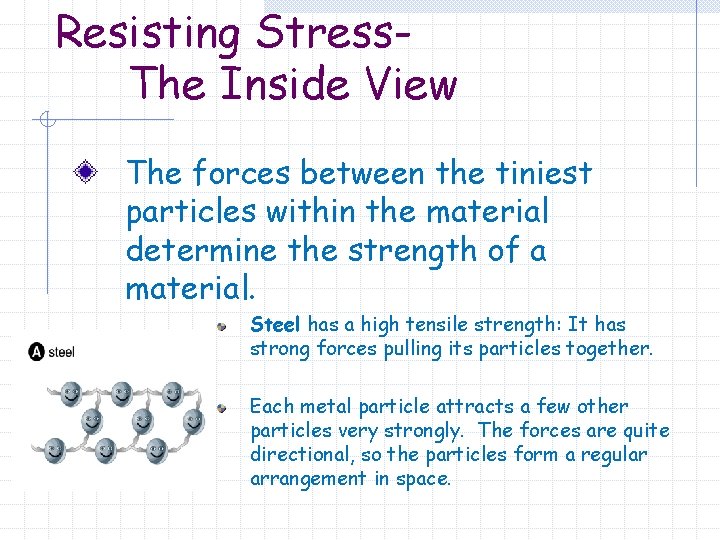
Resisting Stress. The Inside View The forces between the tiniest particles within the material determine the strength of a material. Steel has a high tensile strength: It has strong forces pulling its particles together. Each metal particle attracts a few other particles very strongly. The forces are quite directional, so the particles form a regular arrangement in space.
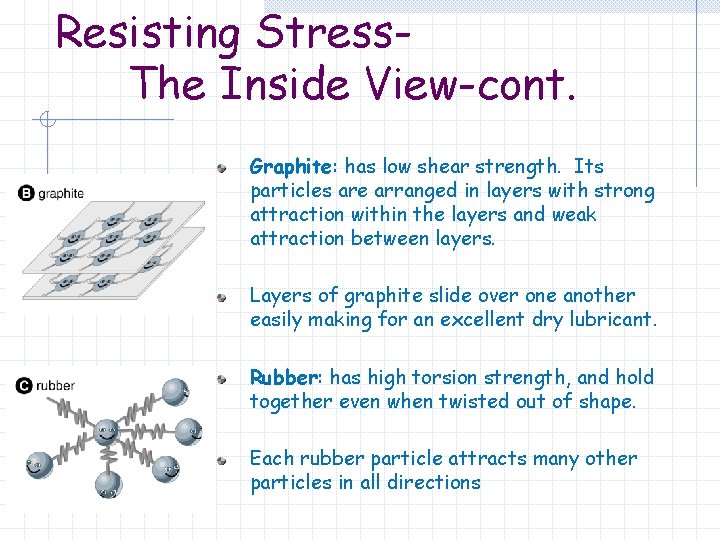
Resisting Stress. The Inside View-cont. Graphite: has low shear strength. Its particles are arranged in layers with strong attraction within the layers and weak attraction between layers. Layers of graphite slide over one another easily making for an excellent dry lubricant. Rubber: has high torsion strength, and hold together even when twisted out of shape. Each rubber particle attracts many other particles in all directions
Review of topic 4 page 314 #1, 2, 3, 4, 5