Grade 7 Social Studies Empowerment Chapter 1 n



- Slides: 20
Grade 7 Social Studies Empowerment
Chapter 1
n n The theme for this year’s Social Studies book is Empowerment – the ability to make choices and make changes to the world around them
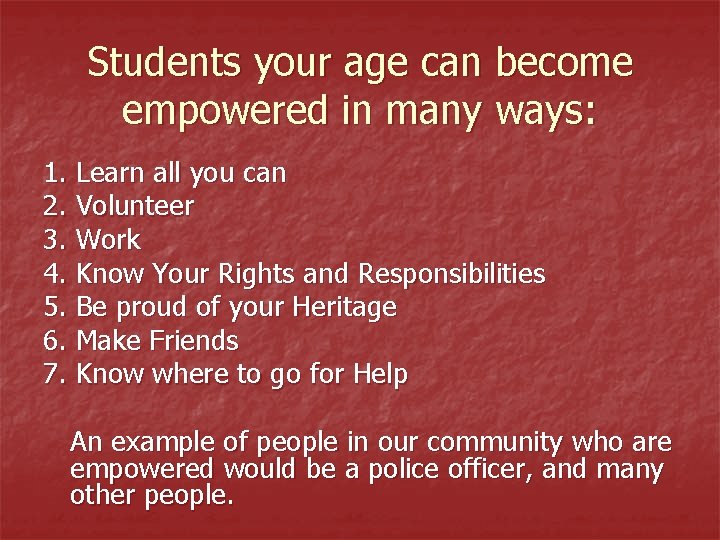
Students your age can become empowered in many ways: 1. Learn all you can 2. Volunteer 3. Work 4. Know Your Rights and Responsibilities 5. Be proud of your Heritage 6. Make Friends 7. Know where to go for Help An example of people in our community who are empowered would be a police officer, and many other people.
The book is broken down into 5 types of Empowerment 1. Economic Empowerment – having enough wealth to take care of your needs 2. Political Empowerment – having a say in the way things are organized and how decisions are made
3. Cultural Empowerment – being free to practice your culture 4. Societal Empowerment - all members of society being treated fairly and equally 5. National Empowerment – a nation having the power to make the decisions for itself
Vocabulary n n n Authority – gives a person the right to make decisions in a certain situation Constitution – a set of rules that a government must follow Disempowered – believe they have little control over their lives
n n An example of someone who is disempowered was the "Home Children" Home Children – children that came from England to Canada without the parents or any adults.
What was supposed to happen to Home Children?
What was supposed to happen to Home Children n The Home Children were supposed to be adopted or indentured – would stay with a family and work with them
What really happened to Home Children?
What really happened to Home Children n Some children had good experiences, others had terrible experiences
Unit 2 – Economies in History
Chapter 2
n n The purpose of an economic system is to answer 3 questions: What goods and services do people want and need? How can we produce theses goods and services? How will we distribute them?
The three Types of Economies in this unit are: 1) Pre-Industrial Economy – consisted of food and handmade goods 2) Industrial Economies – an economy that uses manufacturing technologies. 3) Post-Industrial Economy – Information services (phones, computers, etc) and manufactured goods
Economies of the First Nations and Inuit Economies n n n Time immemorial - for as long as anyone can remember from the stories passed on by elders. Economies of the First Nations and Inuit Economies depend on the natural resources available in the region. Aboriginal- "living in a land from earliest times" – in other words the first people of a region.
Three Groups of Aboriginal People in Canada n n n The Inuit – mostly in Quebec and Labrador, (where the climate is too cold for trees to grow) First Nations – First peoples of the rest of the land that is now Canada; includes Mikmaq, Maliseet, Passamaquoddy, and Innu Metis – The children of either Inuit or First Nations women and European Traders.
All Inuit and First Nations societies have similar beliefs about the use of land natural resources. They believe: n people and nature are not separate n people are part of a natural system that includes all of nature n The land is seen as the source of life, and must be used wisely to ensure survival for future generations. n Respect and prayer is used to show give thanks for the resources.