
Grade 7 Academic Skills Sarah Dunsford Rundle College
- Slides: 26
Grade 7 Academic Skills Sarah Dunsford Rundle College 2009 -2010
Agenda Starting Junior High School Academic Tips and Strategies Studying & Homework Learning Styles Tests
Starting Junior High School Student Concerns: Academic Concerns: Getting to class Lockers No recess Peer pressure Older students Keeping up with work New grading procedures Harder tests Extra help & tutoring
Student Expectations The 5 Ps Be Prompt Be Prepared Be Polite & a Positive Participant Be Productive Be a Problem Solver Respect & Responsibility Value yourself Respect everybody Honour others ideas Offer help Be responsible with property & belongings
Things That Help Small Class Size Extra Time Homeroom Teacher Extracurricular Activities Student Services Parents Frame of Mind Whether you believe you will succeed or not succeed…you’re right!
The Role of Your Parents Family involvement is important! Show your work Listen to suggestions… … then you decide! Help with homework Study partners
Homework? No, STUDYING! The 5 Ws of Studying Who? You! What? Finish homework, review, organize, research, larger projects, study for tests. When? 10 minutes per grade every weekday! Where? Not the bedroom, good lighting, quiet, free from distractions. Why? Building habits. How? . . Pg. 33
Taking Good Notes Organization. Focus on main ideas and supporting details. Use margins to write down key ideas.
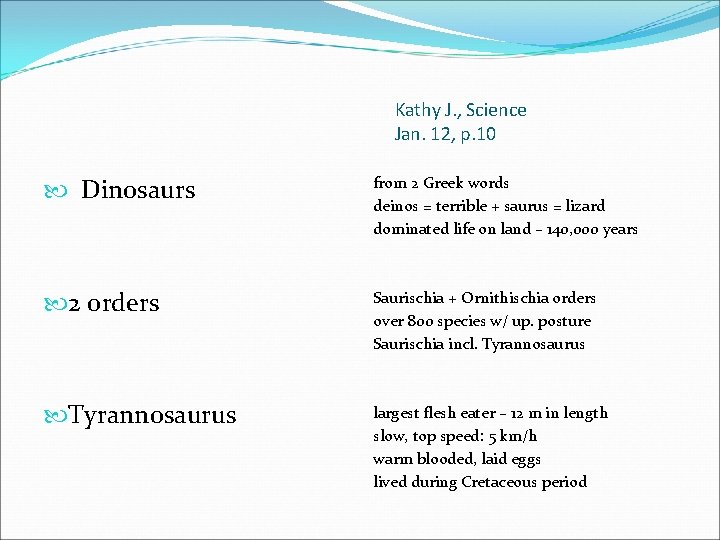
Kathy J. , Science Jan. 12, p. 10 Dinosaurs from 2 Greek words deinos = terrible + saurus = lizard dominated life on land – 140, 000 years 2 orders Saurischia + Ornithischia orders over 800 species w/ up. posture Saurischia incl. Tyrannosaurus largest flesh eater – 12 m in length slow, top speed: 5 km/h warm blooded, laid eggs lived during Cretaceous period
Get Organized • • Agenda. No loose papers anywhere. Routine. Stay one step ahead.
Time Management Weekly planning. Keep up with work. Break up large projects. Plan for sabotage. Pg. 34 Multiple short sessions > one long session!
Learning Styles Visual – “seeing” Auditory – “hearing” Kinesthetic – “doing” Helps you find the BEST way to study Pg. 35 -36
Setting Goals Do not set goals based on your marks! Can't control them. You can control: Homework completion. Hours worked. Perfect attendance. Pg. 32 Extra help. Example: “My goal is to study one hour a night this week for my math test. ” Weekly Study Planner Sheet – pg 34
Review classes. You can tell what will be on the test if the teacher: says something more than once writes material on the board pauses to review notes asks questions of the class says, "This will be on the test!"
Preparing for Tests Understanding vs. memorizing. Reading a textbook isn't studying. The key is structuring. Activity: Create a Study Sheet for the 7 Step Strategy Remember: Go through each step outlined Take out key words Write out steps in order Pg. 20 -21
The 7 Step Strategy Key words or phrases Biggest mistake is approach Key is retention Retention = comprehension, understanding material Ticket to retention is structuring “Make material your own” 7 Step System 1. Unit outline 2. Use your study guide & text 3. Highlight headings 4. Table of Contents (TOC) 5. Highlight content 6. Add to TOC 7. Study core document
Study Cycles Study everything the first time. Re-study what you don't know well. Repeat until you're confident with it all
More on Study Strategies The 10 Minutes Memory Boost – pg 22 Visual Thinking Strategies – pg 23 -24 Study in Same Mode – pg 25
Test Taking Strategies Be positive. Cycling Through Test – pg 25 Scan, Easy, Harder, Final Universal Test Taking Plan –pg 30 Brain dumping! Read instructions, format, weighting Write on the test. Review careless mistakes.
Multiple Choice Strategy Analyze information. Cover response, read question. Read again, identify key words. Re-word question. Think of correct answer. Uncover response, read one by one: Cross out if incorrect. Leave it if it might be correct. Choose response. Pg. 27
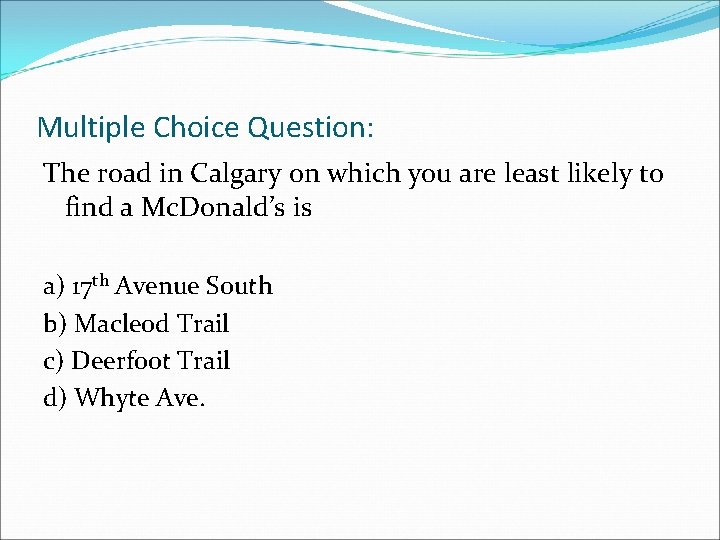
Multiple Choice Question: The road in Calgary on which you are least likely to find a Mc. Donald’s is a) 17 th Avenue South b) Macleod Trail c) Deerfoot Trail d) Whyte Ave.
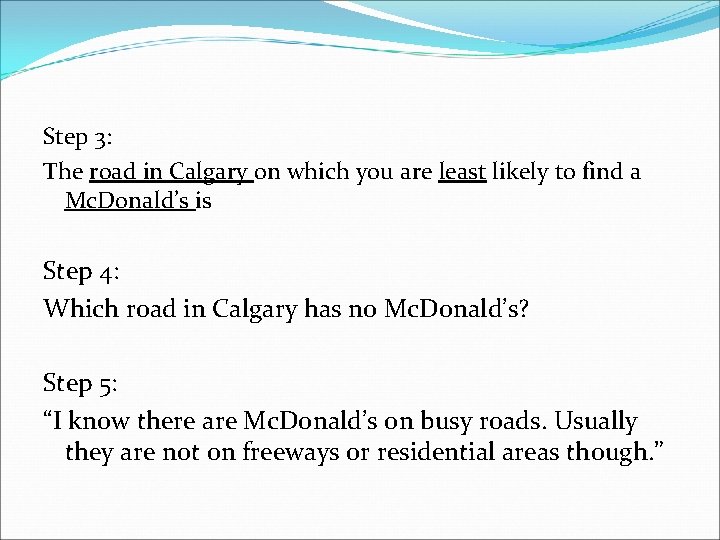
Step 3: The road in Calgary on which you are least likely to find a Mc. Donald’s is Step 4: Which road in Calgary has no Mc. Donald’s? Step 5: “I know there are Mc. Donald’s on busy roads. Usually they are not on freeways or residential areas though. ”
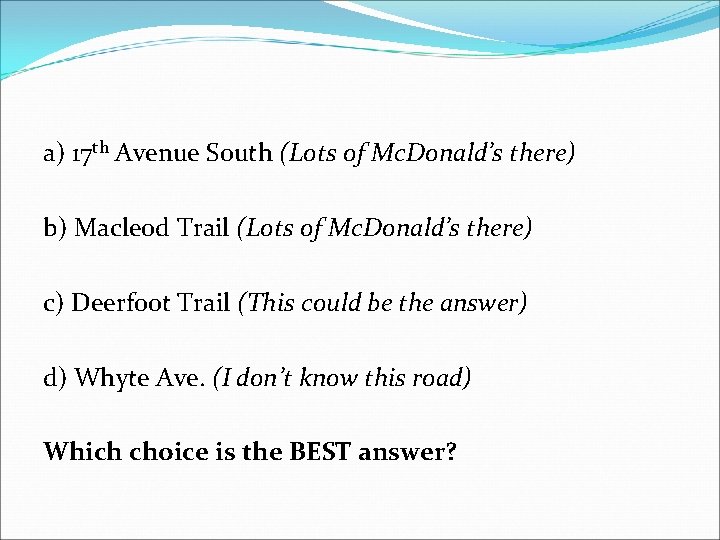
a) 17 th Avenue South (Lots of Mc. Donald’s there) b) Macleod Trail (Lots of Mc. Donald’s there) c) Deerfoot Trail (This could be the answer) d) Whyte Ave. (I don’t know this road) Which choice is the BEST answer?
Various Formats Written response Short answer Long answer Essays True and False Pg. 29
Take Care of Yourself Feed Your Brain Get Rest Cope with Stress Deal with Test Anxiety Balance Studying with Fun Avoid Procrastination Positive Self Talk
Good Luck!