
Grade 5 Persuasive Writing Reasons Explanations Conclusions Lets




- Slides: 26
Grade 5 Persuasive Writing Reasons, Explanations & Conclusions
Let’s Review! In the last lesson you learned that persuasive comes from the word persuade and that to persuade is to convince. When you write something persuasive you are trying to convince someone. A persuasive essay is an opinion.
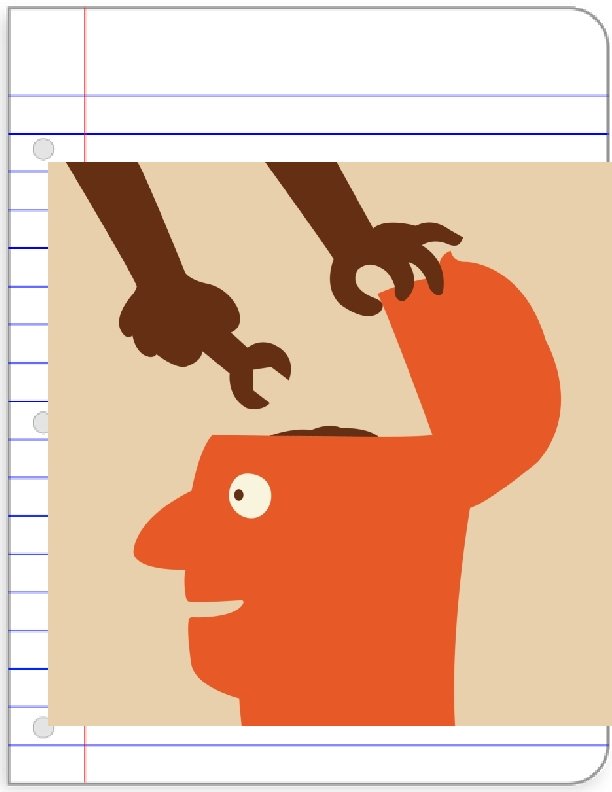
You learned that are different reasons to try to persuade someone. • One reason is to get the person to agree with you. • Another reason is to try to get the person to change his or her mind.
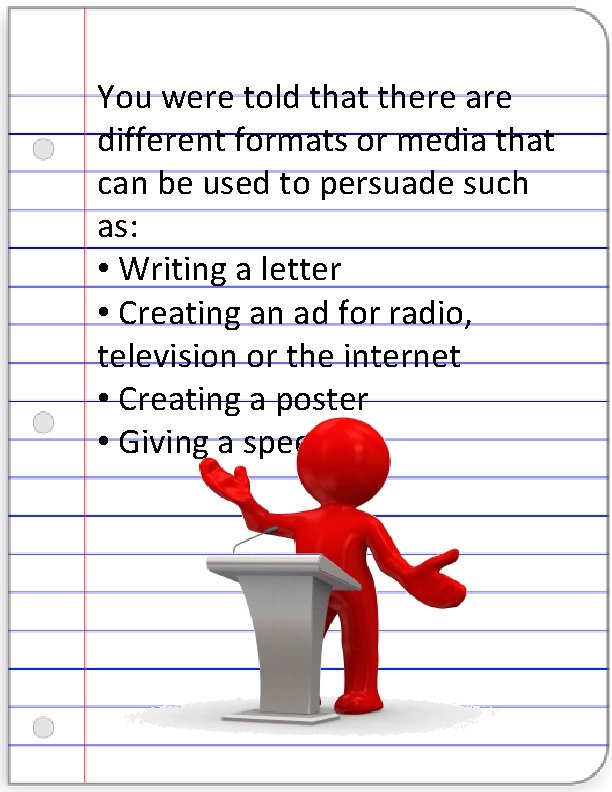
You were told that there are different formats or media that can be used to persuade such as: • Writing a letter • Creating an ad for radio, television or the internet • Creating a poster • Giving a speech
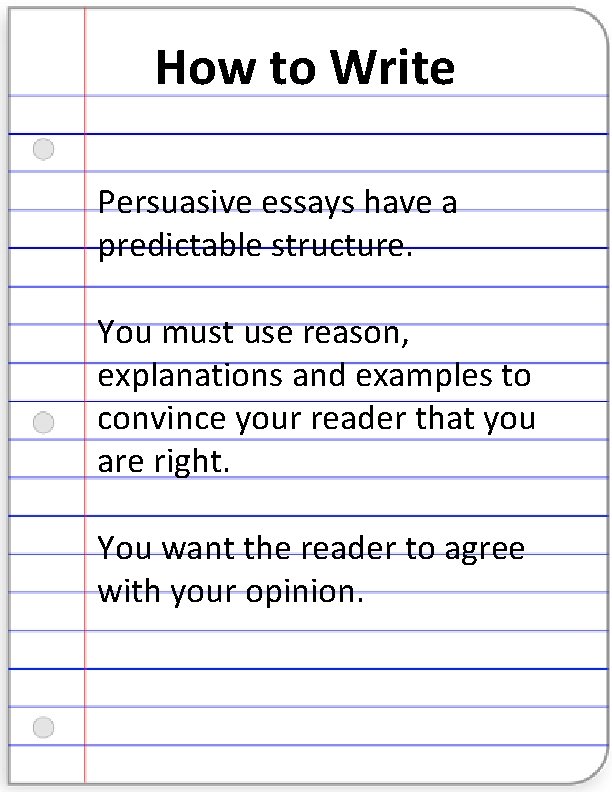
How to Write Persuasive essays have a predictable structure. You must use reason, explanations and examples to convince your reader that you are right. You want the reader to agree with your opinion.
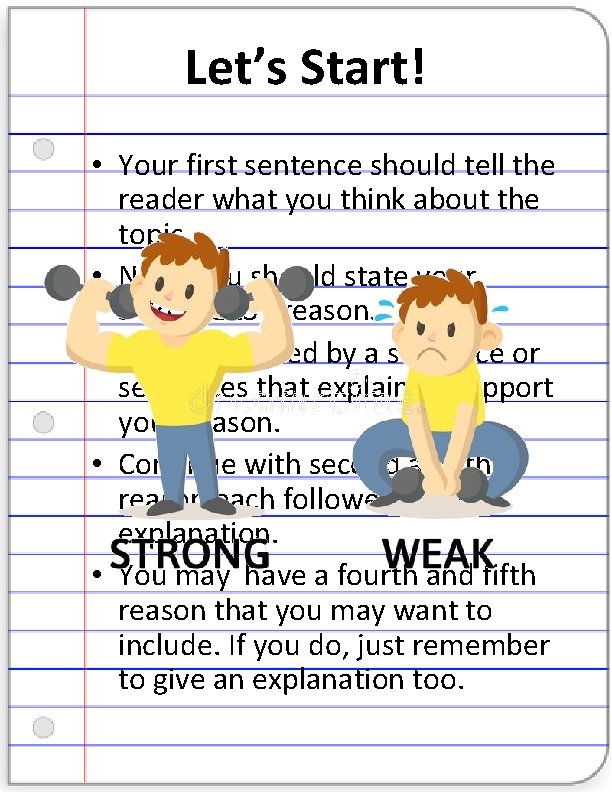
Let’s Start! • Your first sentence should tell the reader what you think about the topic. • Next, you should state your STRONGEST reason. • This is followed by a sentence or sentences that explain or support your reason. • Continue with second and third reason each followed by an explanation. • You may have a fourth and fifth reason that you may want to include. If you do, just remember to give an explanation too.
• You should end your writing by stating your opinion again. • The best persuasive essays have good reasons supported by explanations for them.
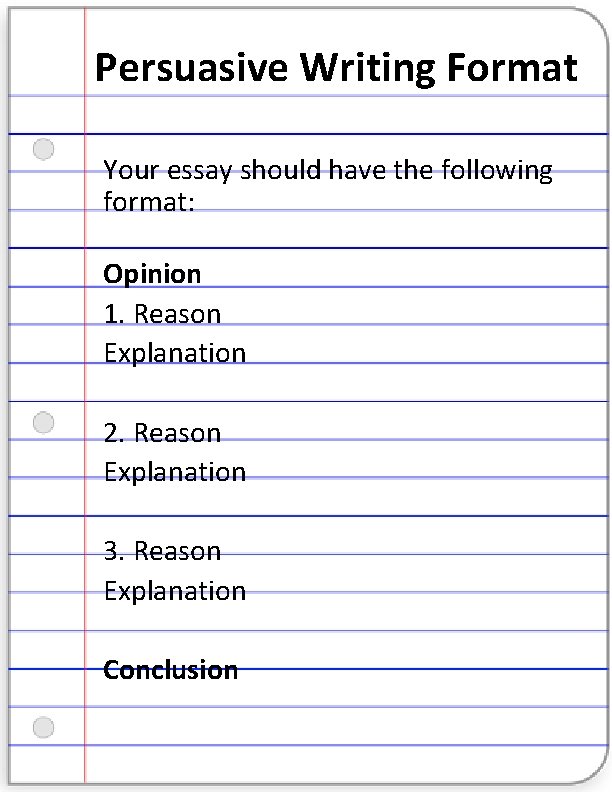
Persuasive Writing Format Your essay should have the following format: Opinion 1. Reason Explanation 2. Reason Explanation 3. Reason Explanation Conclusion
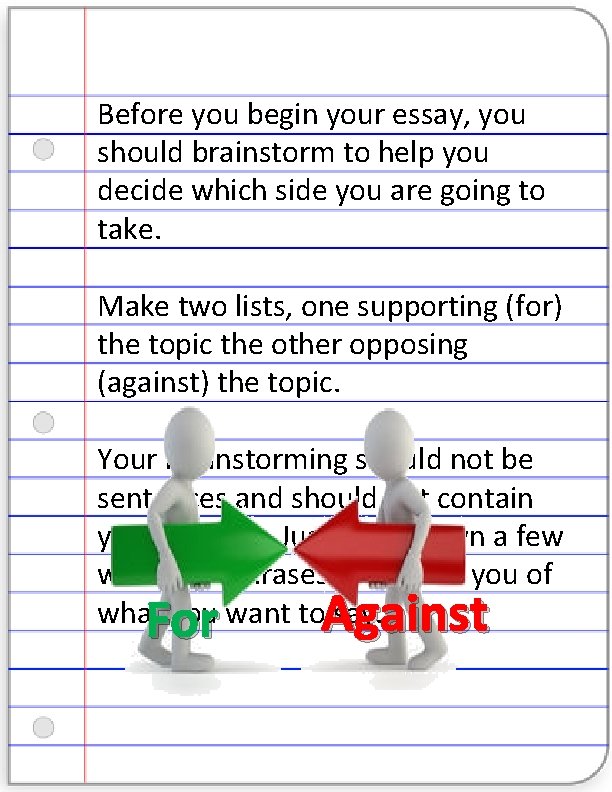
Before you begin your essay, you should brainstorm to help you decide which side you are going to take. Make two lists, one supporting (for) the topic the other opposing (against) the topic. Your brainstorming should not be sentences and should not contain your reasons. Just write down a few words or phrases to remind you of what you want to say. For Against
Lets’ Brainstorm! Let’s take a look at our topic from last lesson: The school day should end at five o’clock and not three o’clock. Points for Teaching time Better grades Activities Extra help National GPA
The school day should end at five o’clock and not three o’clock. Points against day too long walk in dark hungry no family time no time for teachers Brainstorming is an important step in any form of writing. You need to know what you are going to write about before you begin to write.
Let’s look at the reason teaching time. The explanation for this reason could look like this. A longer school day would give teachers more time to teach. So much of teachers’ time is taken up by other activities that have nothing to do with instruction. When this happens, students lose valuable teaching time.
Let’s look at the reason day too long. The explanation for this reason could look like this. Many students walk to school and must get up early so that they can get to school on time. Extending the day would make the day too long for these students. These students are tired by three o’clock and need to go home to rest.
Once you have given an explanation for each reason ‘for’ and ‘against’ the topic, it is time for you to decide which side you are going to write on. You want to choose the side that has the most reasons for which you can give a good explanation. If you cannot find a good explanation for at least three of the reasons that you listed for one of the sides, then that is not the side that you should write on. Choose the side that you feel confident that you can give a good explanation for at least three of the reasons given. REMEMBER:
This of course, is provided that you have been given a choice. Sometimes, you may be asked to write a persuasive essay and may not be given the choice to write for or against. In any case, you are still going to follow the format of brainstorming for reasons, and then writing an explanation for each reason. When you write your explanation to write it in a different way than the way you wrote your reason. REMEMBER:
Make sure to read your reasons and explanations. Do the explanations make sense with the reason? Does the explanation make it easier to understand the reason? If not, then rewrite the explanation. Next, look at you reasons and explanation pairs. Which one is the strongest? Put a 1 beside that pair. Which pair is the next strongest? Put a 2 beside that pair and put a 3 beside the next pair. The numbers that you put beside your reason and explanation pairs will determine the order in which they will be written.
You should always begin a persuasive essay with your strongest reason. You want to capture the reader’s attention and hold it. If you begin with a weak reason the reader may not be interested in reading any further. Each reason and explanation pair should be the beginning of a new paragraph. So, don’t forget to indent. You may need to use more than one sentence to complete your explanation REMEMBER:
A persuasive essay has a predictable format: REMEMBER: 1. Opening / Closing Opinion 2. Reasons with explanations 3. Organizing words Your opening sentence gives your opinion. You may begin with the words “I think that the school day should be extended from three o'clock to five o’clock ”, or you may choose a different wording for your opening sentence. Such as: “Extending the school day from three o’clock to five o’clock would be a benefit to students. ”
Another part of the format of a persuasive essay are the organizing words. Beginning words and phrases such as those that appear below should be used in the first sentence with your first reason. First To begin with My first reason is For starters The most important reason The main reason
Words and phrases such as those that appear below should be used in your second paragraph: Second Next My next reason Another reason Secondly Your third reason could begin with word or phrases such as: Third Also consider My third reason Another point I would like to make
Use words or phrases as listed below to end your essay: Finally In conclusion In closing In conclusion To sum it up Beginning Middle Ending Signal to the reader that you are done by either stating your opinion again or ask the reader for his/her opinion.
An ending for our topic might be: In conclusion, I think that extending the school day until five o’clock is not a good idea. OR Finally, don’t you think that a six hours is long enough for a child to spend in school?
As with any writing that you do, you need to check your essay for sentence structure, grammar, spelling and punctuation errors. Reread your writing to see if it makes sense to you. If it does not sound right to you, then consider rewriting it. And please, make sure that your writing is neat and can be easily read.
Now Watch This!
Acknowledgments Images downloaded from Google Images Video from Youtube Videos