
GRADE 5 MODULE 1 UNIT 3 LESSON 1



- Slides: 99
GRADE 5, MODULE 1: UNIT 3, LESSON 1 Narrative as Theater, Part 1: What is Readers Theater?
Learning Targets I can define readers theater I can define the purpose of readers theater • I can participate in readers theater • I can identify how a readers theater script differs from a novel • •
• For Unit 3 you will be thinking about why authors make the choices they do to engage their readers/listeners
Look back at the Human Rights Challenges Chart from Unit 2 of Esperanza Rising Think-Pair-Share -make connections between the chart and the novel As you know Esperanza Rising is a narrative. Reading narratives helps us understand the human experience. Often themes of novels relate to issues in the real world. We have been connecting themes of Esperanza Rising to the ideas in the UDHR, an informal text.
- In this unit, we will keep making connections to themes related to human rights. But we are going to learn about another type of narrative, called a script. - A script is used when actors/actresses perform a play, movie, or radio show. - I am going to show you some scripts, and we are going to read them. By the end of the day you will be clear about what a script is, and how it is different from a novel. - We will start thinking about why an author would choose one instead of the other.
We will be reading narrative scripts over the next few days, and eventually you will be working in groups to write your own scripts about scenes from Esperanza Rising that relate to the UDHR.
I Notice/I Wonder Anchor Chart “American Heroes” script. Read through the script quickly, then turn and talk to a partner about what they “notice” Whole Class Share Now discuss what you “wonder”
You just got to look quickly at the narrative script called “American Heroes”. Later today, we will actually get to participate in Readers Theater using this script.
Work Time: Defining Readers Theater Definitions sheet. Read and discuss…. With a partner restate definition in your own words Add any additions to the I Notice/I Wonder Chart
Today you are just going to try Readers Theater a bit. Readers You Theater Rubric will be working in groups of four. Each student will get a role. Your first job is to highlight your lines Next, take several minutes to practice your scripts. Lastly, you will perform your skit for the class.
Closing/Assessment v Now that you have participated in a Readers Theater, what would you like to add to the I Notice side of the chart? v Can we cross out any of the I Wonder statements, because we have answers to those questions? v What needs to be added to the I Wonder Column of the Anchor Chart?
Homework Explain Readers Theater to someone at home. Tell that person what you will be doing in class during this unit.
Module 1, Unit 3, Lesson 2 Narratives as Theater Esperanza Rising: from Novel to Script
Learning Targets I can participate in a Readers Theater based on Esperanza Rising. I can participate in a discussion with my peers. I can compare and contrast a novel and a script. I can share my opinion about different types of narratives.
Review Readers Theater Rubric Remember to identify individual roles and highlight each role in a different color
Readers Theater: Pam Munoz Ryan’s script for Esperanza Rising You will be working in groups of 5 Distribute scripts to each group and 5 different colored markers Prepare: Determine who will read each role. Highlight individual roles Practice: Practice lines with group members, refer to Readers Theater Rubric Preform: Each group will perform their script, this time the audience will provide feedback, based on rubric
Read Aloud: Selections from the Novel Esperanza Rising Readers Theater Still in groups, novel Esperanza Rising Passages Read “Now from the novel Esperanza Rising 2 to 3 of the recommended selections you are going to read aloud passages from the novel Esperanza Rising. As you read aloud and listen to your group, think about how the novel sounds similar to and different from Readers Theater scripts you just performed. ”
Discussion: Compare and Contrast the Script and the Novel Still in groups, discuss how the script of Esperanza Rising was the same and how it was different from the novel when read aloud I Notice/I Wonder anchor chart. Share with your group similarities and differences of the script to the novel
Closing and Assessment Exit Ticket On a note card write a response to the question: Which narrative format do you like better, a novel or a script, and why?
GRADE 5, MODULE 1: UNIT 3, LESSON 3 Readers Theater and the UDHR
Learning Targets • I can summarize key articles of the UDHR and passages from Esperanza Rising, and “American Heros. ” • I can participate in a discussion with my peers. • I can share my opinion about the effectiveness of the narrative dialogue.
Today we will begin connecting the UDHR to themes in Readers Theater Scripts
Today we are going to review the UDHR themes we have been studying in this module, in order to help us make connections between the UDHR themes and the narrative Readers Theater scripts we have been reading. Review and discuss the UDHR note-catcher in groups of four or five Each group member will get: “American Heroes” scripts (1 -4) and one of the Readers Theater: “Esperanza Rising” scripts
Annotating Text Review Model annotating one of the scripts, “Now you are going to locate the connections between the UDHR Themes we have studied and the Reader Theater scripts titled “American Heroes” and Esperanza Rising. ” Read aloud the first line of the script: “Lawyer: Ramona, your husband, Sixto Ramona, left this house and all of its contents to you and your daughter. You will also receive the yearly income from the grapes. As you know, it is not customary to leave land to women and since Luis is his brother, Sixto left the land to him. ”
Why should we underline that last sentence? “Think aloud: “ I understand this sentence because I think this is a good example of the UDHR Article 17, “…. everyone has the right to own property…” “Now I am going to make a note next to this sentence by writing UDHR 17, and explain why I think this sentence is an example of that article by writing, Mama can’t own property because she is a woman. ”
Connecting the UDHR to themes in Readers Theater Scripts Think and then talk: “ Do you agree or disagree with my connection? Why or why not? ” Go through the rest of the script and identify connections between the scripts and the UDHR. You should make at least 1 or 2 connections per script. Talk as a group about your connections
The Role of Narration in Readers Theater Students highlight all Narrator lines in script Narrator Discussion Questions sheet Discuss each question with your group members and the write a response on your own sheets. Share answers
Closing and Assessment Critique of the Narration in Esperanza Rising and American Heroes Readers Theater Scripts Write your comments directly on the scripts you have on your tables. Independently write: q. One Praise q. One Question, and q. One Suggest for each script
Module 1, Unit 3, Lesson 4 MID-UNIT ASSESSMENT: EVALUATING A NOVEL VERSUS A SCRIPT
Learning Targets I can describe the similarities and differences between a novel and a script I can describe the connections between the UDHR and a script or a novel I can describe the author’s motivations for creating a script I can share my opinions about a novel and a script
Academic Vocabulary evaluate- means to examine something more closely to judge it: to think about its strengths and weaknesses Turn and talk to a partner about times you have been “evaluated” or have gotten to evaluate something Today you will be evaluating two types of narrative writing: a novel and a script
Academic Vocabulary Venn diagram: graphic organizer used to help compare (identify similarities) and contrast (differences) a novel to a script Turn and talk to check for understanding of citing evidence compare contrast evaluate
Mid-Unit Assessment: Evaluating a Novel versus a Script
Closing and Self Assessment Thumbs-up, -sideways, -down, to signal how well you did meeting these targets……… I can describe the similarities and differences between a novel and a script I can describe the connections between the UDHR and a script or a novel I can describe the author’s motivations for creating a script I can share my opinions about a novel and a script
Self Assessment Turn and talk with a partner What is something you did well on the assessment? Be specific What is something that was hard for you to do? Be specific
GRADE 5, MODULE 1: UNIT 3, LESSON 5 Identifying Theme: Connecting Passages From Esperanza Rising To Human Rights
Learning Targets • I can summarize key articles of the UDHR from previous learning • I can summarize key passages from Esperanza Rising from Previous learning • I can identify passages of Esperanza Rising that relate to specific articles of the UDHR • I can justify my reasons for selecting specific passages from Esperanza Rising.
Opening: Learning Targets Discuss Long-Term Learning Targets • I can determine a theme based on details in the text • I can summarize a literary text • I can recall relevant experiences or summaries • I can document what I learn about a topic by sorting evidence into categories Review terms recall … remember from previous learning categorize … sort or classify Discuss prefix…. . re- … again
Opening: Review of Previous Learning: UDHR Note- Catcher and Poems for Two Voices Display anchor chart Human Rights Challenges in Esperanza Rising from Unit 2 “Today is exciting because you will really begin planning your own Readers Theater script. To help think about this we will need to look over the notes from all we have been learning in this module. Let’s look at our summaries of the UDHR articles, from Unit 1, as well as our Poems for Two Voices and our anchor chart Human Rights Challenges in Esperanza Rising Which UDHR articles were you able to connect to the human rights challenges faced by the characters in the novel when you created these poems? ”
Opening: Review of Previous Learning: UDHR Note- Catcher and Poems for Two Voices Today we are going to narrow our focus of the UDHR, in order to start identifying and categorizing passages for the creation of your own Readers Theater scripts, based on the novel Esperanza Rising
Work Time: Narrowing our Focus on the UDHR “ We have been studying 11 UDHR articles, but now we are going to narrow our focus to 5 of those articles. On your UDHR note-catchers, place a star next to UDHR Articles 2, 14, 16, 17, and 25. ” After marking the articles, ask several students to share the summaries they already have for each of the 5 articles. UDHR category cards. Cut apart along the lines and put your name at the top of each one, so each student has 5 cards.
Work Time: Group Work: Categorizing Passages from Esperanza Rising related to the UDHR Each of you will have a copy of the page Evidence Strips from Esperanza Rising: Display a copy the strips as well as a copy of the UDHR category cards. Tell students that they are going to do something similar to an activity they did in Unit 1, when they looked at specific evidence from a firsthand human rights account and connected it to articles in the UDHR. I am going to start by reading the first passage from Esperanza Rising, then I am going to review my UDHR category card, and think about which of the 5 UDHR categories this passage belongs in.
Work Time: Group Work: Categorizing Passages from Esperanza Rising related to the UDHR Read through all the remaining passages silently once. Then cut the passages into individual strips. Which passages belong in which categories and why? “Which “What passages relate to which articles of the UDHR? ” is your evidence? ”
Work Time: Group Work: Categorizing Passages from Esperanza Rising related to the UDHR Glue each passage on to the UDHR category card that best connects to the passage, based on their group discussion. Remember, you have to justify your thinking.
Closing: Justifying Passage Selection “Were any of the passages difficult to categorize< If so, why? ” Now that you have had a chance to think and talk, you are ready to write. Fill in the sentence frames at the bottom of each of your UDHR category cards, in order to justify (give a reason) why you placed passages in certain categories.
Closing: Assessment Exit Ticket Index card, write the following information on the card: Name Rank order( first, second, third choice) of the UDHR Articles 2, 14, 16, 17, and 25 that they are most interested in focusing on for their Readers Theater script. The names of at least 5 other students she/he would like to work with on writing the Readers Theater script and why
MODULE 1: UNIT 3, LESSON 6 Launching Readers Theater Groups: Identifying Passages From Esperanza Rising For Reader Theater That Connect to The UDHR
Learning Targets • I can choose an article from the UDHR to focus on for my readers theater • I can determine additional passages I may need in order to develop a script on a single theme • I can engage in a discussion with my peers • I can evaluate how well the passages I selected reflect themes of the UDHR.
Work Time: Teacher Modeling: Combining Text Passages for a Script UDHR category card sample for article 2 “I have chosen to focus on Article 2 , Everyone is entitled to the same rights and freedoms…. Regardless of sex [male or female] In the last session, I pasted passages onto my category card, and now I am going back into the text of Esperanza Rising to identify additional passages I think are good examples of how the character Mama has faced human rights challenges because she is a woman. The passages I selected are not in the same chapter, but they are related to the UDHR theme”
Work Time: Teacher Modeling: Combining Text Passages for a Script pp. 46 -47 from Esperanza Rising “ I am going to read each paragraph and use a sticky note to mark which paragraphs or lines of dialogue I think relates to the UDHR theme I chose. “This is the section I placed a sticky note on, because I am only looking for passages that show the challenges Mama faces because she is a woman and cannot own property. ”
You will be using the passages you already identified, on the UDHR category cards that you created in Lesson 5, and now you will work with your groups to locate additional passages from other pages/chapters in the book.
Work Time: Launching Readers Theater Groups Group assignment and sticky notes Return relevant UDHR category card from Lesson 5
Esperanza Rising Focus Passages Read the pages listed on the handout that they think are related to their UDHR theme, pausing at the end of each paragraph/line of dialogue to briefly discuss with your group members whether the paragraphs/lines are related to their theme, and why.
Then… When you locate a paragraph/line in the text you think is related to your theme, mark it with a sticky note and make a short annotation on the sticky note justifying why the passage is related to their UDHR theme (e. g. , “shows people from Oklahoma treated better than those from Mexico, ” etc. ).
Group Exit Ticket
Module 1, Unit 3, Lesson 7
Learning Targets I can narrow my text selection, related to a theme. I can write an introduction to my script. I can justify my selection of text.
Readers Theater: I Notice/I Wonder anchor chart (from Lesson 1). From Novel to Script: Narrowing Text.
UDHR category card sample Today we are going to work on narrowing our text selections, for a narrative script. We will also add the passages that we marked with sticky notes to our UDHR category cards. I am going to model this for you with the sample I have displayed. First, I am going to reread the UDHR article I am focusing on.
Look at the lines I highlighted related to my UDHR theme. I highlighted these lines because they all show Mama’s rights are challenged because she is a woman. The uncles take over the family business, Tío Luis tells her it is his property, and he threatens Mama by telling her he can make her life very difficult.
Now that I have narrowed my text by highlighting the parts of lines I want to use for my script, I am going to add the passages I found in the book during Lesson 6. I need to keep in mind that I want to narrow the text I selected, and it needs to relate to my UDHR article.
Pages 46– 47 of Esperanza Rising In the last lesson, I decided this paragraph of dialogue connects to my UDHR article, but it is too long. I am only going to write down the parts of this paragraph that I think are strongly related to my UDHR focus.
UDHR category card sample
Group Norms You will be working in these groups for the next week.
Task 1 Turn and talk to review the word narrow in this context (as discussed in the Opening). First look at their category cards, with lines of narration and dialogue already pasted. As a group, you will read through each line and highlight the part(s) that relate most strongly to their UDHR focus. Then you will reread the passages they placed sticky notes on in the novel to determine which part(s) connect with your UDHR theme (no full paragraphs, just the most strongly related lines of text, as was modeled). Write those lines of text on their UDHR category card.
Task 2 You will each be responsible for creating a Readers Theater script, so you will need to divide the passages selected among the group members. Mark the lines by writing your initials next to the text on your UDHR category card
Task 3 Decide as a group how to put your lines in order. “What would your audience need to know first, in order to understand what is happening in this scene? ” “What should go next? ” “When in time is this happening? ”
Debrief “What did you find challenging about narrowing the text? ” “How did you decide what text to keep for your script? ” “How did you determine the sequence of the lines you highlighted and wrote onto your category cards? ”
Module 1, Unit 3, Lesson 8
Learning Targets I I can write a draft of my script. can use peer feedback to make decisions about how to improve my script.
Drafting SAMPLE 1 SAMPLE 2 SAMPLE 3 - Narrator
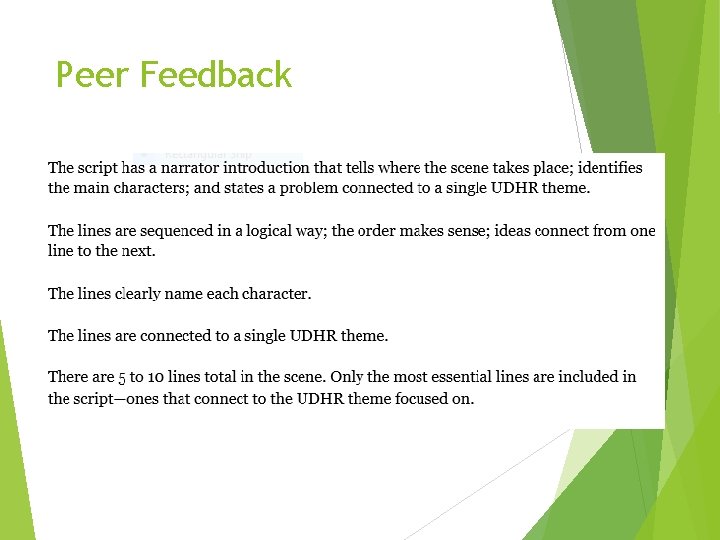
Peer Feedback
Module 1, Unit 3, Lesson 9 END OF UNIT ASSESSMENT: INDIVIDUAL SECTIONS OF READERS THEATER SCRIPT
Learning Targets I can write a title for my script. I can act out the title of my script so my peers can guess it. I can use narrative techniques to write a complete section of my group’s Readers Theater script.
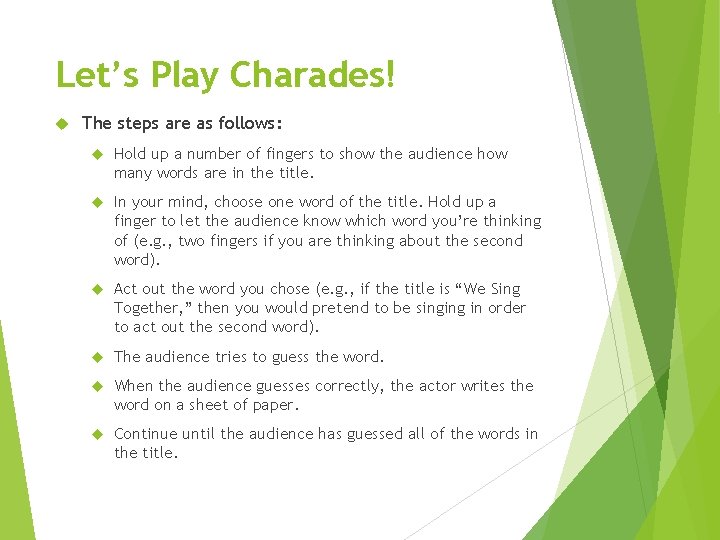
Let’s Play Charades! The steps are as follows: Hold up a number of fingers to show the audience how many words are in the title. In your mind, choose one word of the title. Hold up a finger to let the audience know which word you’re thinking of (e. g. , two fingers if you are thinking about the second word). Act out the word you chose (e. g. , if the title is “We Sing Together, ” then you would pretend to be singing in order to act out the second word). The audience tries to guess the word. When the audience guesses correctly, the actor writes the word on a sheet of paper. Continue until the audience has guessed all of the words in the title.
Example The script I wrote in the last lesson was about the uncles taking the ranch land away from Mama, and I focused my script on UDHR Article 17, which states that everyone has the right to own property. Therefore, in order to make a connection between my script and the UDHR, I am going to title my script ‘The Uncles Take Mama’s Land. ’ I made this my title because I think it shows what my script is mostly about and will help my audience understand how my script connects to the UDHR.
Model The Uncles Take Mama’s Land
Group Task Chose a title
On-Demand End of Unit Assessment Today you are going to write final copies. End of Unit Assessment: On-demand Readers Theater scripts (25 minutes)
Self Assessment Look over your script and check off the things you included on the ondemand handout
Quick Write How well do you think you used dialogue and descriptive language to show the characters’ reactions to human rights challenges? Be specific
Module 1, Unit 3, Lesson 10
Learning Targets I can revise my script, based on feedback. I can create a script with a logical sequence. I can add appropriate transitional words and phrases to a script.
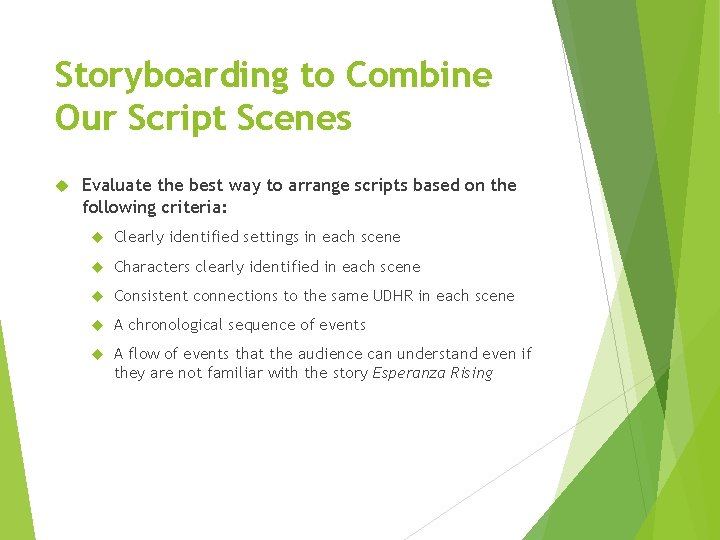
Storyboarding to Combine Our Script Scenes Evaluate the best way to arrange scripts based on the following criteria: Clearly identified settings in each scene Characters clearly identified in each scene Consistent connections to the same UDHR in each scene A chronological sequence of events A flow of events that the audience can understand even if they are not familiar with the story Esperanza Rising
Group Script Sequence notecatcher
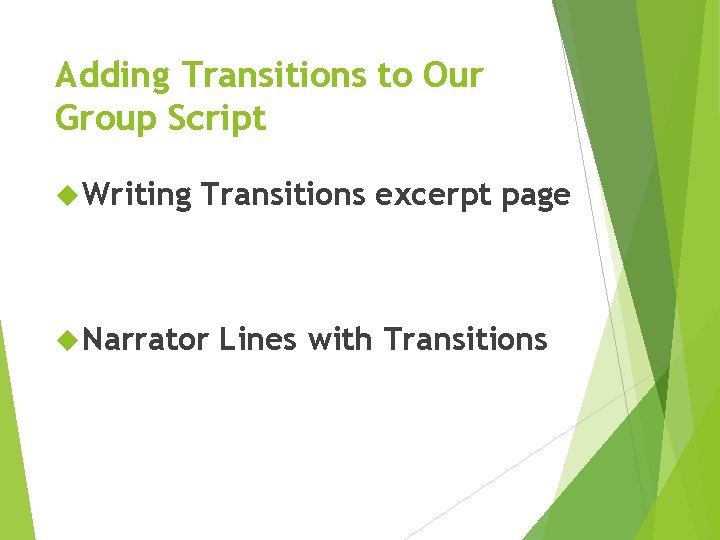
Adding Transitions to Our Group Script Writing Transitions excerpt page Narrator Lines with Transitions
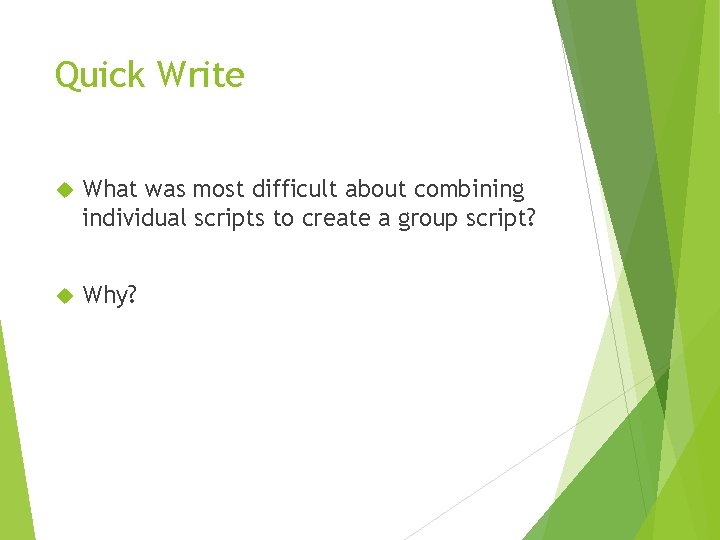
Quick Write What was most difficult about combining individual scripts to create a group script? Why?
Module 1, Unit 3, Lesson 11
Learning Targets I can revise my script with my group. I can write a conclusion to my script that relates directly to my UDHR article with my group. I can choose visuals that contribute to my audience’s understanding of the characters, setting, problem, and/or mood of the play. I can practice performing a script.
Read through the written feedback on their transitions Revise your scripts to include: Words and phrases that show the characters’ actions, thoughts, and feelings Words and phrases to clearly identify the setting Words/phrases from the UDHR your group is focusing on Words and phrases that make clear transitions between events and scenes
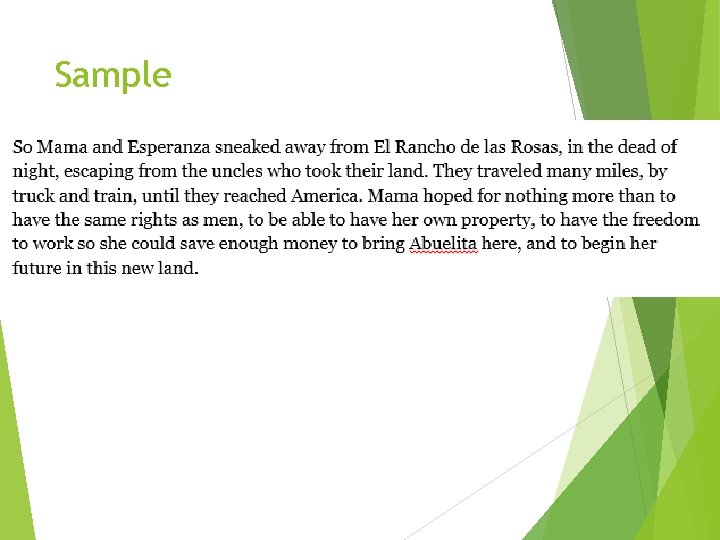
Writing a Group Conclusion The purpose of a conclusion is to summarize the events of a narrative and to draw the audience’s attention to theme of the narrative. The conclusion your group writes will need to summarize the narrative by describing the challenge(s) your characters faced and connect back to the UDHR theme you focused on. Here’s an example.
Sample
How does the conclusion describe the challenges the characters faced? How does it relate back to my UDHR theme?
Practicing and Peer Feedback Readers Theater rubric
Module 1, Unit 3, Lesson 12
Learning Targets I can revise the conclusion of a script for a performance. I can practice to refine my performance, based on feedback. I can speak clearly and with expression for a performance. I can perform my Readers Theater script for an audience.
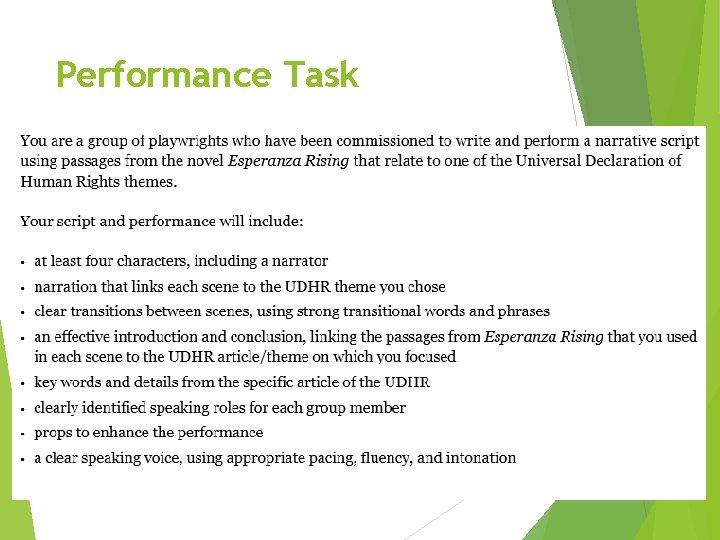
Performance Task
Readers Theater Performance
Self-Assessment Readers Theater Rubric