
Grade 3 Writing Assessment Targets Narrative Writing Assessment
- Slides: 8
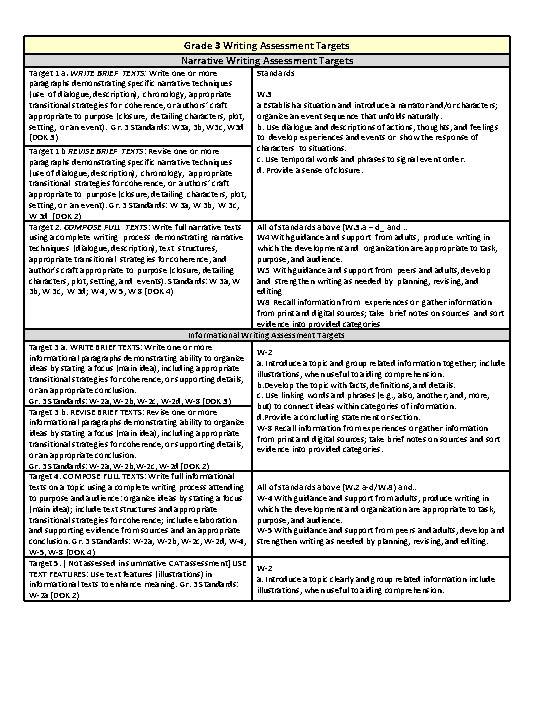
Grade 3 Writing Assessment Targets Narrative Writing Assessment Targets Target 1 a. WRITE BRIEF TEXTS: Write one or more paragraphs demonstrating specific narrative techniques (use of dialogue, description), chronology, appropriate transitional strategies for coherence, or authors’ craft appropriate to purpose (closure, detailing characters, plot, setting, or an event). Gr. 3 Standards: W 3 a, 3 b, W 3 c, W 3 d (DOK 3) Target 1 b REVISE BRIEF TEXTS: Revise one or more paragraphs demonstrating specific narrative techniques (use of dialogue, description), chronology, appropriate transitional strategies for coherence, or authors’ craft appropriate to purpose (closure, detailing characters, plot, setting, or an event). Gr. 3 Standards: W 3 a, W 3 b, W 3 c, W 3 d (DOK 2) Target 2. COMPOSE FULL TEXTS: Write full narrative texts using a complete writing process demonstrating narrative techniques (dialogue, description), text structures, appropriate transitional strategies for coherence, and author’s craft appropriate to purpose (closure, detailing characters, plot, setting, and events). Standards: W 3 a, W 3 b, W 3 c, W 3 d; W 4, W 5, W 8 (DOK 4) Standards W. 3 a Establish a situation and introduce a narrator and/or characters; organize an event sequence that unfolds naturally. b. Use dialogue and descriptions of actions, thoughts, and feelings to develop experiences and events or show the response of characters to situations. c. Use temporal words and phrases to signal event order. d. Provide a sense of closure. All of standards above (W. 3. a – d_ and … W 4 With guidance and support from adults, produce writing in which the development and organization are appropriate to task, purpose, and audience. W 5 With guidance and support from peers and adults, develop and strengthen writing as needed by planning, revising, and editing W 8 Recall information from experiences or gather information from print and digital sources; take brief notes on sources and sort evidence into provided categories Informational Writing Assessment Targets Target 3 a. WRITE BRIEF TEXTS: Write one or more W-2 informational paragraphs demonstrating ability to organize a. Introduce a topic and group related information together; include ideas by stating a focus (main idea), including appropriate illustrations, when useful to aiding comprehension. transitional strategies for coherence, or supporting details, b. Develop the topic with facts, definitions, and details. or an appropriate conclusion. c. Use linking words and phrases (e. g. , also, another, and, more, Gr. 3 Standards: W-2 a, W-2 b, W-2 c, W-2 d, W-8 (DOK 3) but) to connect ideas within categories of information. Target 3 b. REVISE BRIEF TEXTS: Revise one or more d. Provide a concluding statement or section. informational paragraphs demonstrating ability to organize W-8 Recall information from experiences or gather information ideas by stating a focus (main idea), including appropriate from print and digital sources; take brief notes on sources and sort transitional strategies for coherence, or supporting details, evidence into provided categories. or an appropriate conclusion. Gr. 3 Standards: W-2 a, W-2 b, W-2 c, W-2 d (DOK 2) Target 4. COMPOSE FULL TEXTS: Write full informational texts on a topic using a complete writing process attending All of standards above (W. 2 a-d/W. 8) and… to purpose and audience: organize ideas by stating a focus W-4 With guidance and support from adults, produce writing in (main idea); include text structures and appropriate which the development and organization are appropriate to task, transitional strategies for coherence; include elaboration purpose, and audience. and supporting evidence from sources and an appropriate W-5 With guidance and support from peers and adults, develop and conclusion. Gr. 3 Standards: W-2 a, W-2 b, W-2 c, W-2 d, W-4, strengthen writing as needed by planning, revising, and editing. W-5, W-8 (DOK 4) Target 5. [ Not assessed in summative CAT assessment] USE W-2 TEXT FEATURES: Use text features (illustrations) in a. Introduce a topic clearly and group related information include informational texts to enhance meaning. Gr. 3 Standards: illustrations, when useful to aiding comprehension. W-2 a (DOK 2)
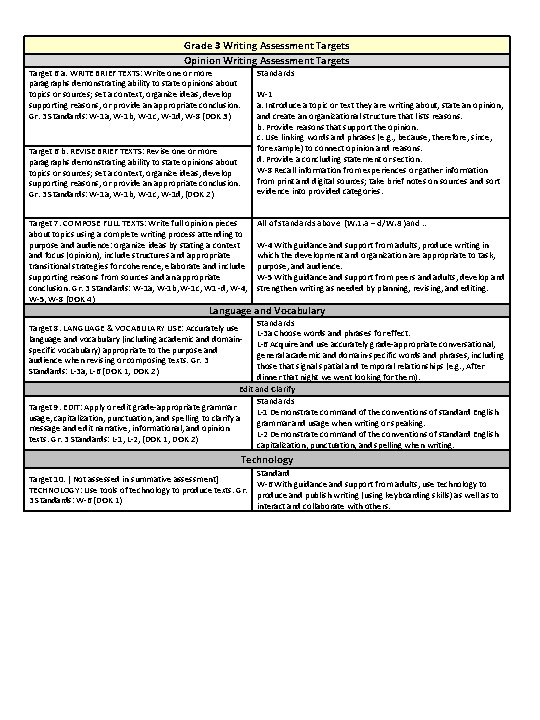
Grade 3 Writing Assessment Targets Opinion Writing Assessment Targets Target 6 a. WRITE BRIEF TEXTS: Write one or more paragraphs demonstrating ability to state opinions about topics or sources; set a context, organize ideas, develop supporting reasons, or provide an appropriate conclusion. Gr. 3 Standards: W-1 a, W-1 b, W-1 c, W-1 d, W-8 (DOK 3) Standards W-1 a. Introduce a topic or text they are writing about, state an opinion, and create an organizational structure that lists reasons. b. Provide reasons that support the opinion. c. Use linking words and phrases (e. g. , because, therefore, since, for example) to connect opinion and reasons. d. Provide a concluding statement or section. W-8 Recall information from experiences or gather information from print and digital sources; take brief notes on sources and sort evidence into provided categories. Target 6 b. REVISE BRIEF TEXTS: Revise one or more paragraphs demonstrating ability to state opinions about topics or sources; set a context, organize ideas, develop supporting reasons, or provide an appropriate conclusion. Gr. 3 Standards: W-1 a, W-1 b, W-1 c, W-1 d, (DOK 2) Target 7. COMPOSE FULL TEXTS: Write full opinion pieces about topics using a complete writing process attending to purpose and audience: organize ideas by stating a context and focus (opinion), include structures and appropriate transitional strategies for coherence, elaborate and include supporting reasons from sources and an appropriate conclusion. Gr. 3 Standards: W-1 a, W-1 b, W-1 c, W 1 -d, W-4, W-5, W-8 (DOK 4) All of standards above (W. 1. a – d/W. 8 )and … W-4 With guidance and support from adults, produce writing in which the development and organization are appropriate to task, purpose, and audience. W-5 With guidance and support from peers and adults, develop and strengthen writing as needed by planning, revising, and editing. Language and Vocabulary Standards L-3 a Choose words and phrases for effect. L-6 Acquire and use accurately grade-appropriate conversational, general academic and domain-specific words and phrases, including those that signal spatial and temporal relationships (e. g. , After dinner that night we went looking for them). Edit and Clarify Standards Target 9. EDIT: Apply or edit grade-appropriate grammar L-1 Demonstrate command of the conventions of standard English usage, capitalization, punctuation, and spelling to clarify a grammar and usage when writing or speaking. message and edit narrative, informational, and opinion L-2 Demonstrate command of the conventions of standard English texts. Gr. 3 Standards: L-1, L-2, (DOK 1, DOK 2) capitalization, punctuation, and spelling when writing. Target 8. LANGUAGE & VOCABULARY USE: Accurately use language and vocabulary (including academic and domainspecific vocabulary) appropriate to the purpose and audience when revising or composing texts. Gr. 3 Standards: L-3 a, L-6 (DOK 1, DOK 2) Technology Target 10. [ Not assessed in summative assessment] TECHNOLOGY: Use tools of technology to produce texts. Gr. 3 Standards: W-6 (DOK 1) Standard W-6 With guidance and support from adults, use technology to produce and publish writing (using keyboarding skills) as well as to interact and collaborate with others.
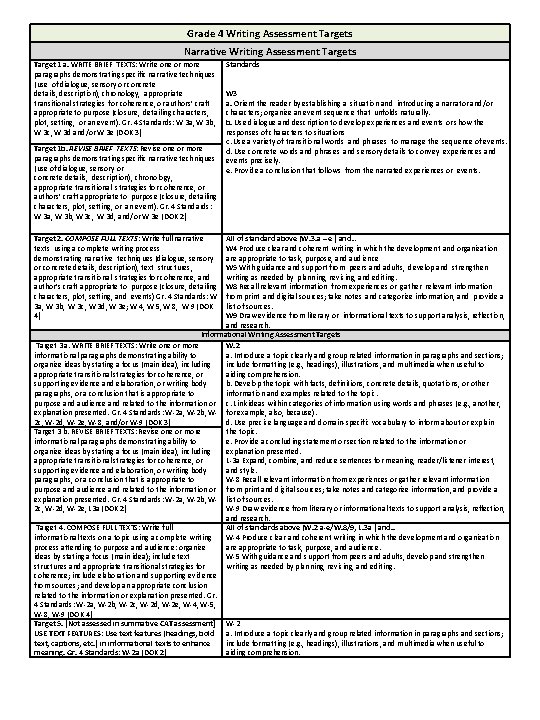
Grade 4 Writing Assessment Targets Narrative Writing Assessment Targets Target 1 a. WRITE BRIEF TEXTS: Write one or more paragraphs demonstrating specific narrative techniques (use of dialogue, sensory or concrete details, description), chronology, appropriate transitional strategies for coherence, or authors’ craft appropriate to purpose (closure, detailing characters, plot, setting, or an event). Gr. 4 Standards: W 3 a, W 3 b, W 3 c, W 3 d and/or W 3 e (DOK 3) Target 1 b. REVISE BRIEF TEXTS: Revise one or more paragraphs demonstrating specific narrative techniques (use of dialogue, sensory or concrete details, description), chronology, appropriate transitional strategies for coherence, or authors’ craft appropriate to purpose (closure, detailing characters, plot, setting, or an event). Gr. 4 Standards: W 3 a, W 3 b, W 3 c, W 3 d, and/or W 3 e (DOK 2) Target 2. COMPOSE FULL TEXTS: Write full narrative texts using a complete writing process demonstrating narrative techniques (dialogue, sensory or concrete details, description), text structures, appropriate transitional strategies for coherence, and author’s craft appropriate to purpose (closure, detailing characters, plot, setting, and events) Gr. 4 Standards: W 3 a, W 3 b, W 3 c, W 3 d, W 3 e; W 4, W 5, W 8, W 9 (DOK 4) Standards W 3 a. Orient the reader by establishing a situation and introducing a narrator and/or characters; organize an event sequence that unfolds naturally. b. Use dialogue and description to develop experiences and events or show the responses of characters to situations c. Use a variety of transitional words and phrases to manage the sequence of events. d. Use concrete words and phrases and sensory details to convey experiences and events precisely. e. Provide a conclusion that follows from the narrated experiences or events. All of standard above (W. 3. a – e ) and… W 4 Produce clear and coherent writing in which the development and organization are appropriate to task, purpose, and audience W 5 With guidance and support from peers and adults, develop and strengthen writing as needed by planning, revising, and editing. W 8 Recall relevant information from experiences or gather relevant information from print and digital sources; take notes and categorize information, and provide a list of sources. W 9 Draw evidence from literary or informational texts to support analysis, reflection, and research. Informational Writing Assessment Targets Target 3 a. WRITE BRIEF TEXTS: Write one or more W. 2 informational paragraphs demonstrating ability to a. Introduce a topic clearly and group related information in paragraphs and sections; organize ideas by stating a focus (main idea), including include formatting (e. g. , headings), illustrations, and multimedia when useful to appropriate transitional strategies for coherence, or aiding comprehension. supporting evidence and elaboration, or writing body b. Develop the topic with facts, definitions, concrete details, quotations, or other paragraphs, or a conclusion that is appropriate to information and examples related to the topic. purpose and audience and related to the information or c. Link ideas within categories of information using words and phrases (e. g. , another, explanation presented. Gr. 4 Standards: W-2 a, W-2 b, W- for example, also, because). 2 c, W-2 d, W-2 e, W-8, and/or W-9 (DOK 3) d. Use precise language and domain-specific vocabulary to inform about or explain the topic. Target 3 b. REVISE BRIEF TEXTS: Revise one or more e. Provide a concluding statement or section related to the information or informational paragraphs demonstrating ability to explanation presented. organize ideas by stating a focus (main idea), including L-3 a Expand, combine, and reduce sentences for meaning, reader/listener interest, appropriate transitional strategies for coherence, or and style. supporting evidence and elaboration, or writing body paragraphs, or a conclusion that is appropriate to W-8 Recall relevant information from experiences or gather relevant information purpose and audience and related to the information or from print and digital sources; take notes and categorize information, and provide a explanation presented. Gr. 4 Standards: W-2 a, W-2 b, W- list of sources. 2 c, W-2 d, W-2 e, L 3 a (DOK 2) W-9 Draw evidence from literary or informational texts to support analysis, reflection, and research. Target 4. COMPOSE FULL TEXTS: Write full All of standards above (W. 2 a-e/W. 8/9, L. 3 a ) and… informational texts on a topic using a complete writing W-4 Produce clear and coherent writing in which the development and organization process attending to purpose and audience: organize are appropriate to task, purpose, and audience. ideas by stating a focus (main idea); include text W-5 With guidance and support from peers and adults, develop and strengthen structures and appropriate transitional strategies for writing as needed by planning, revising, and editing. coherence; include elaboration and supporting evidence from sources; and develop an appropriate conclusion related to the information or explanation presented. Gr. 4 Standards: W-2 a, W-2 b, W-2 c, W-2 d, W-2 e, W-4, W-5, W-8, W-9 (DOK 4) Target 5. [Not assessed in summative CAT assessment] W-2 USE TEXT FEATURES: Use text features (headings, bold a. Introduce a topic clearly and group related information in paragraphs and sections; text, captions, etc. ) in informational texts to enhance include formatting (e. g. , headings), illustrations, and multimedia when useful to meaning. Gr. 4 Standards: W-2 a (DOK 2) aiding comprehension.
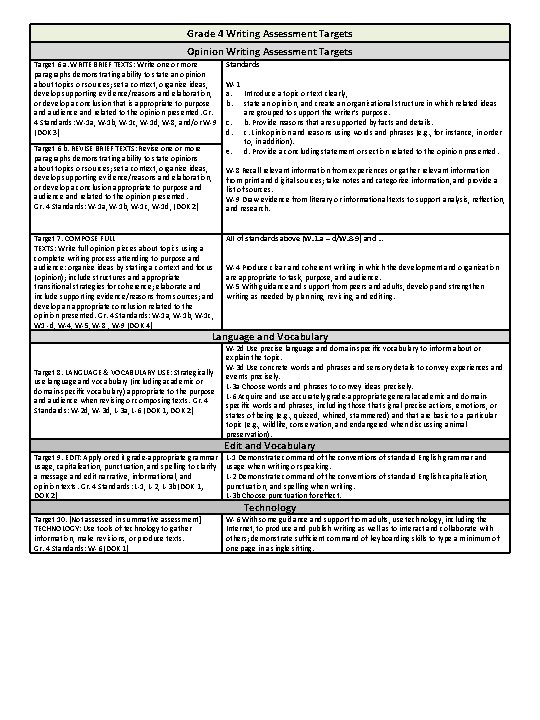
Grade 4 Writing Assessment Targets Opinion Writing Assessment Targets Target 6 a. WRITE BRIEF TEXTS: Write one or more paragraphs demonstrating ability to state an opinion about topics or sources; set a context, organize ideas, develop supporting evidence/reasons and elaboration, or develop a conclusion that is appropriate to purpose and audience and related to the opinion presented. Gr. 4 Standards: W-1 a, W-1 b, W-1 c, W-1 d, W-8, and/or W-9 (DOK 3) Standards Target 6 b. REVISE BRIEF TEXTS: Revise one or more paragraphs demonstrating ability to state opinions about topics or sources; set a context, organize ideas, develop supporting evidence/reasons and elaboration, or develop a conclusion appropriate to purpose and audience and related to the opinion presented. Gr. 4 Standards: W-1 a, W-1 b, W-1 c, W-1 d, (DOK 2) e. Target 7. COMPOSE FULL TEXTS: Write full opinion pieces about topics using a complete writing process attending to purpose and audience: organize ideas by stating a context and focus (opinion); include structures and appropriate transitional strategies for coherence; elaborate and include supporting evidence/reasons from sources; and develop an appropriate conclusion related to the opinion presented. Gr. 4 Standards: W-1 a, W-1 b, W-1 c, W 1 -d, W-4, W-5, W-8 , W-9 (DOK 4) All of standards above (W. 1. a – d/W. 8 -9) and … W-1 a. b. c. d. Introduce a topic or text clearly, state an opinion, and create an organizational structure in which related ideas are grouped to support the writer’s purpose. b. Provide reasons that are supported by facts and details. c. Link opinion and reasons using words and phrases (e. g. , for instance, in order to, in addition). d. Provide a concluding statement or section related to the opinion presented. W-8 Recall relevant information from experiences or gather relevant information from print and digital sources; take notes and categorize information, and provide a list of sources. W-9 Draw evidence from literary or informational texts to support analysis, reflection, and research. W-4 Produce clear and coherent writing in which the development and organization are appropriate to task, purpose, and audience. W-5 With guidance and support from peers and adults, develop and strengthen writing as needed by planning, revising, and editing. Language and Vocabulary Target 8. LANGUAGE & VOCABULARY USE: Strategically use language and vocabulary (including academic or domain-specific vocabulary) appropriate to the purpose and audience when revising or composing texts. Gr. 4 Standards: W-2 d, W-3 d, L-3 a, L-6 (DOK 1, DOK 2) Target 9. EDIT: Apply or edit grade-appropriate grammar usage, capitalization, punctuation, and spelling to clarify a message and edit narrative, informational, and opinion texts. Gr. 4 Standards: L-1, L-2, L-3 b (DOK 1, DOK 2) W-2 d Use precise language and domain-specific vocabulary to inform about or explain the topic. W-3 d Use concrete words and phrases and sensory details to convey experiences and events precisely. L-3 a Choose words and phrases to convey ideas precisely. L-6 Acquire and use accurately grade-appropriate general academic and domainspecific words and phrases, including those that signal precise actions, emotions, or states of being (e. g. , quizzed, whined, stammered) and that are basic to a particular topic (e. g. , wildlife, conservation, and endangered when discussing animal preservation). Edit and Vocabulary L-1 Demonstrate command of the conventions of standard English grammar and usage when writing or speaking. L-2 Demonstrate command of the conventions of standard English capitalization, punctuation, and spelling when writing. L-3 b Choose punctuation for effect. Technology Target 10. [Not assessed in summative assessment] TECHNOLOGY: Use tools of technology to gather information, make revisions, or produce texts. Gr. 4 Standards: W-6 (DOK 1) W-6 With some guidance and support from adults, use technology, including the Internet, to produce and publish writing as well as to interact and collaborate with others; demonstrate sufficient command of keyboarding skills to type a minimum of one page in a single sitting.
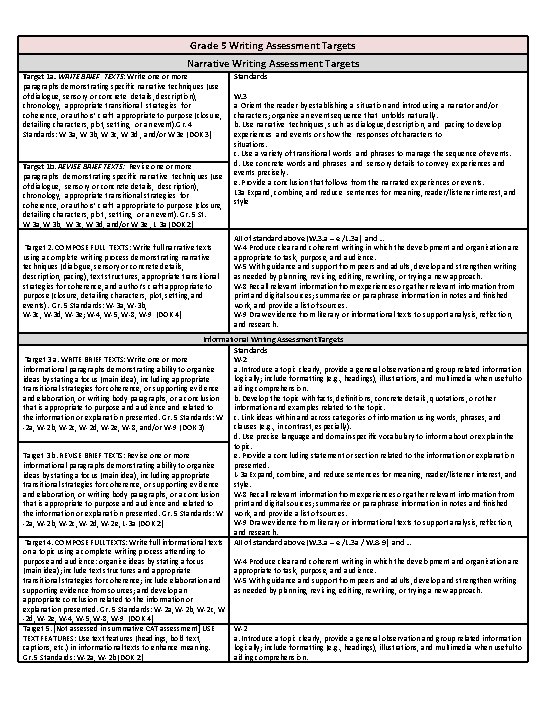
Grade 5 Writing Assessment Targets Narrative Writing Assessment Targets Target 1 a. WRITE BRIEF TEXTS: Write one or more paragraphs demonstrating specific narrative techniques (use of dialogue, sensory or concrete details, description), chronology, appropriate transitional strategies for coherence, or authors’ craft appropriate to purpose (closure, detailing characters, plot, setting, or an event). Gr. 4 Standards: W 3 a, W 3 b, W 3 c, W 3 d , and/or W 3 e (DOK 3) Target 1 b. REVISE BRIEF TEXTS: Revise one or more paragraphs demonstrating specific narrative techniques (use of dialogue, sensory or concrete details, description), chronology, appropriate transitional strategies for coherence, or authors’ craft appropriate to purpose (closure, detailing characters, plot , setting, or an event). Gr. 5 St. W 3 a, W 3 b, W 3 c, W 3 d, and/or W 3 e , L 3 a (DOK 2) Target 2. COMPOSE FULL TEXTS: Write full narrative texts using a complete writing process demonstrating narrative techniques (dialogue, sensory or concrete details, description, pacing), text structures, appropriate transitional strategies for coherence, and author’s craft appropriate to purpose (closure, detailing characters, plot, setting, and events). Gr. 5 Standards: W-3 a, W-3 b, W-3 c, W-3 d, W-3 e; W-4, W-5, W-8, W-9 (DOK 4) Standards W. 3 a Orient the reader by establishing a situation and introducing a narrator and/or characters; organize an event sequence that unfolds naturally. b. Use narrative techniques, such as dialogue, description, and pacing to develop experiences and events or show the responses of characters to situations. c. Use a variety of transitional words and phrases to manage the sequence of events. d. Use concrete words and phrases and sensory details to convey experiences and events precisely. e. Provide a conclusion that follows from the narrated experiences or events. L 3 a Expand, combine, and reduce sentences for meaning, reader/listener interest, and style All of standard above (W. 3. a – e /L. 3 a) and … W-4 Produce clear and coherent writing in which the development and organization are appropriate to task, purpose, and audience. W-5 With guidance and support from peers and adults, develop and strengthen writing as needed by planning, revising, editing, rewriting, or trying a new approach. W-8 Recall relevant information from experiences or gather relevant information from print and digital sources; summarize or paraphrase information in notes and finished work, and provide a list of sources. W-9 Draw evidence from literary or informational texts to support analysis, reflection, and research. Informational Writing Assessment Targets Standards W-2 Target 3 a. WRITE BRIEF TEXTS: Write one or more a. Introduce a topic clearly, provide a general observation and group related informational paragraphs demonstrating ability to organize logically; include formatting (e. g. , headings), illustrations, and multimedia when useful to ideas by stating a focus (main idea), including appropriate aiding comprehension. transitional strategies for coherence, or supporting evidence b. Develop the topic with facts, definitions, concrete details, quotations, or other and elaboration, or writing body paragraphs, or a conclusion information and examples related to the topic. that is appropriate to purpose and audience and related to the information or explanation presented. Gr. 5 Standards: W c. Link ideas within and across categories of information using words, phrases, and clauses (e. g. , in contrast, especially). -2 a, W-2 b, W-2 c, W-2 d, W-2 e, W-8, and/or W-9 (DOK 3) d. Use precise language and domain-specific vocabulary to inform about or explain the topic. e. Provide a concluding statement or section related to the information or explanation Target 3 b. REVISE BRIEF TEXTS: Revise one or more presented. informational paragraphs demonstrating ability to organize L-3 a Expand, combine, and reduce sentences for meaning, reader/listener interest, and ideas by stating a focus (main idea), including appropriate style. transitional strategies for coherence, or supporting evidence W-8 Recall relevant information from experiences or gather relevant information from and elaboration, or writing body paragraphs, or a conclusion print and digital sources; summarize or paraphrase information in notes and finished that is appropriate to purpose and audience and related to the information or explanation presented. Gr. 5 Standards: W work, and provide a list of sources. W-9 Draw evidence from literary or informational texts to support analysis, reflection, -2 a, W-2 b, W-2 c, W-2 d, W-2 e, L-3 a (DOK 2) and research. Target 4. COMPOSE FULLTEXTS: Write full informational texts All of standard above (W. 3. a – e /L. 3 a / W. 8 -9) and … on a topic using a complete writing process attending to purpose and audience: organize ideas by stating a focus W-4 Produce clear and coherent writing in which the development and organization are (main idea); include text structures and appropriate to task, purpose, and audience. transitional strategies for coherence; include elaboration and W-5 With guidance and support from peers and adults, develop and strengthen writing supporting evidence from sources; and develop an as needed by planning, revising, editing, rewriting, or trying a new approach. appropriate conclusion related to the information or explanation presented. Gr. 5 Standards: W-2 a, W-2 b, W-2 c, W -2 d, W-2 e, W-4, W-5, W-8, W-9 (DOK 4) Target 5. [Not assessed in summative CAT assessment] USE W-2 TEXT FEATURES: Use text features (headings, bold text, a. Introduce a topic clearly, provide a general observation and group related information captions, etc. ) in informational texts to enhance meaning. logically; include formatting (e. g. , headings), illustrations, and multimedia when useful to Gr. 5 Standards: W-2 a, W-2 b (DOK 2) aiding comprehension.
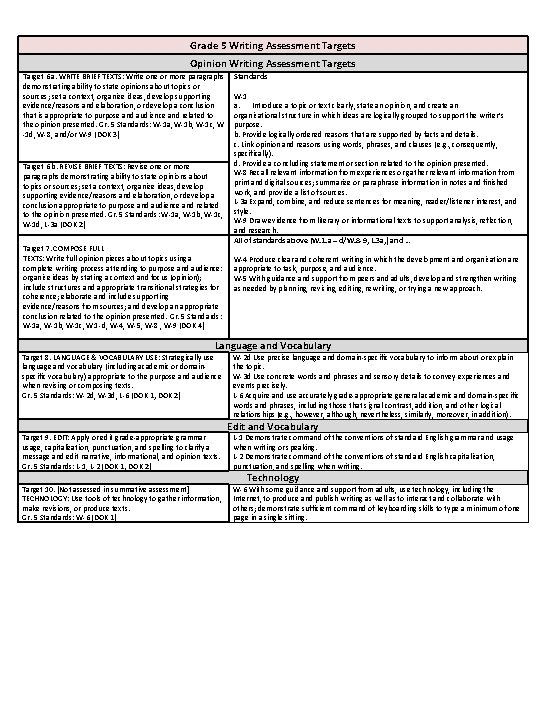
Grade 5 Writing Assessment Targets Opinion Writing Assessment Targets Target 6 a. WRITE BRIEF TEXTS: Write one or more paragraphs demonstrating ability to state opinions about topics or sources; set a context, organize ideas, develop supporting evidence/reasons and elaboration, or develop a conclusion that is appropriate to purpose and audience and related to the opinion presented. Gr. 5 Standards: W-1 a, W-1 b, W-1 c, W -1 d, W-8, and/or W-9 (DOK 3) Target 6 b. REVISE BRIEF TEXTS: Revise one or more paragraphs demonstrating ability to state opinions about topics or sources; set a context, organize ideas, develop supporting evidence/reasons and elaboration, or develop a conclusion appropriate to purpose and audience and related to the opinion presented. Gr. 5 Standards: W-1 a, W-1 b, W-1 c, W-1 d, L-3 a (DOK 2) Target 7. COMPOSE FULL TEXTS: Write full opinion pieces about topics using a complete writing process attending to purpose and audience: organize ideas by stating a context and focus (opinion); include structures and appropriate transitional strategies for coherence; elaborate and include supporting evidence/reasons from sources; and develop an appropriate conclusion related to the opinion presented. Gr. 5 Standards: W-1 a, W-1 b, W-1 c, W 1 -d, W-4, W-5, W-8 , W-9 (DOK 4) Standards W-1 a. Introduce a topic or text clearly, state an opinion, and create an organizational structure in which ideas are logically grouped to support the writer’s purpose. b. Provide logically ordered reasons that are supported by facts and details. c. Link opinion and reasons using words, phrases, and clauses (e. g. , consequently, specifically). d. Provide a concluding statement or section related to the opinion presented. W-8 Recall relevant information from experiences or gather relevant information from print and digital sources; summarize or paraphrase information in notes and finished work, and provide a list of sources. L-3 a Expand, combine, and reduce sentences for meaning, reader/listener interest, and style. W-9 Draw evidence from literary or informational texts to support analysis, reflection, and research. All of standards above (W. 1. a – d/W. 8 -9, L. 3 a, ) and … W-4 Produce clear and coherent writing in which the development and organization are appropriate to task, purpose, and audience. W-5 With guidance and support from peers and adults, develop and strengthen writing as needed by planning, revising, editing, rewriting, or trying a new approach. Language and Vocabulary Target 8. LANGUAGE & VOCABULARY USE: Strategically use language and vocabulary (including academic or domainspecific vocabulary) appropriate to the purpose and audience when revising or composing texts. Gr. 5 Standards: W-2 d, W-3 d, L-6 (DOK 1, DOK 2) Target 9. EDIT: Apply or edit grade-appropriate grammar usage, capitalization, punctuation, and spelling to clarify a message and edit narrative, informational, and opinion texts. Gr. 5 Standards: L-1, L-2 (DOK 1, DOK 2) Target 10. [Not assessed in summative assessment] TECHNOLOGY: Use tools of technology to gather information, make revisions, or produce texts. Gr. 5 Standards: W-6 (DOK 1) W-2 d Use precise language and domain-specific vocabulary to inform about or explain the topic. W-3 d Use concrete words and phrases and sensory details to convey experiences and events precisely. L-6 Acquire and use accurately grade-appropriate general academic and domain-specific words and phrases, including those that signal contrast, addition, and other logical relationships (e. g. , however, although, nevertheless, similarly, moreover, in addition). Edit and Vocabulary L-1 Demonstrate command of the conventions of standard English grammar and usage when writing or speaking. L-2 Demonstrate command of the conventions of standard English capitalization, punctuation, and spelling when writing. Technology W-6 With some guidance and support from adults, use technology, including the Internet, to produce and publish writing as well as to interact and collaborate with others; demonstrate sufficient command of keyboarding skills to type a minimum of one page in a single sitting.
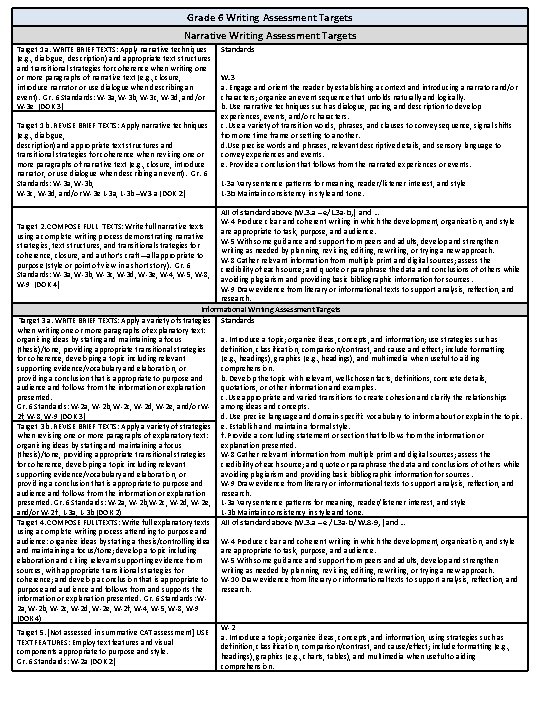
Grade 6 Writing Assessment Targets Narrative Writing Assessment Targets Target 1 a. WRITE BRIEF TEXTS: Apply narrative techniques (e. g. , dialogue, description) and appropriate text structures and transitional strategies for coherence when writing one or more paragraphs of narrative text (e. g. , closure, introduce narrator or use dialogue when describing an event). Gr. 6 Standards: W-3 a, W-3 b, W-3 c, W-3 d, and/or W-3 e (DOK 3) Target 1 b. REVISE BRIEF TEXTS: Apply narrative techniques (e. g. , dialogue, description) and appropriate text structures and transitional strategies for coherence when revising one or more paragraphs of narrative text (e. g. , closure, introduce narrator, or use dialogue when describing an event). Gr. 6 Standards: W-3 a, W-3 b, W-3 c, W-3 d, and/or W-3 e L-3 a, L-3 b –W 3 -a (DOK 2) Standards W. 3 a. Engage and orient the reader by establishing a context and introducing a narrator and/or characters; organize an event sequence that unfolds naturally and logically. b. Use narrative techniques such as dialogue, pacing, and description to develop experiences, events, and/or characters. c. Use a variety of transition words, phrases, and clauses to convey sequence, signal shifts from one time frame or setting to another. d. Use precise words and phrases, relevant descriptive details, and sensory language to convey experiences and events. e. Provide a conclusion that follows from the narrated experiences or events. L-3 a Vary sentence patterns for meaning, reader/listener interest, and style L-3 b Maintain consistency in style and tone. All of standard above (W. 3. a – e/L. 3 a-b, ) and … W-4 Produce clear and coherent writing in which the development, organization, and style Target 2. COMPOSE FULL TEXTS: Write full narrative texts are appropriate to task, purpose, and audience. using a complete writing process demonstrating narrative W-5 With some guidance and support from peers and adults, develop and strengthen strategies, text structures, and transitional strategies for writing as needed by planning, revising, editing, rewriting, or trying a new approach. coherence, closure, and author’s craft—all appropriate to W-8 Gather relevant information from multiple print and digital sources; assess the purpose (style or point of view in a short story). Gr. 6 credibility of each source; and quote or paraphrase the data and conclusions of others while Standards: W-3 a, W-3 b, W-3 c, W-3 d, W-3 e, W-4, W-5, W-8, avoiding plagiarism and providing basic bibliographic information for sources. W-9 (DOK 4) W-9 Draw evidence from literary or informational texts to support analysis, reflection, and research. Informational Writing Assessment Targets Target 3 a. WRITE BRIEF TEXTS: Apply a variety of strategies Standards when writing one or more paragraphs of explanatory text: organizing ideas by stating and maintaining a focus a. Introduce a topic; organize ideas, concepts, and information; use strategies such as (thesis)/tone, providing appropriate transitional strategies definition, classification, comparison/contrast, and cause and effect; include formatting for coherence, developing a topic including relevant (e. g. , headings), graphics (e. g. , headings), and multimedia when useful to aiding supporting evidence/vocabulary and elaboration, or comprehension. providing a conclusion that is appropriate to purpose and b. Develop the topic with relevant, well-chosen facts, definitions, concrete details, audience and follows from the information or explanation quotations, or other information and examples. presented. c. Use appropriate and varied transitions to create cohesion and clarify the relationships Gr. 6 Standards: W-2 a, W-2 b, W-2 c, W-2 d, W-2 e, and/or W- among ideas and concepts. 2 f, W-8, W-9 (DOK 3) d. Use precise language and domain-specific vocabulary to inform about or explain the topic. Target 3 b. REVISE BRIEF TEXTS: Apply a variety of strategies e. Establish and maintain a formal style. f. Provide a concluding statement or section that follows from the information or when revising one or more paragraphs of explanatory text: explanation presented. organizing ideas by stating and maintaining a focus W-8 Gather relevant information from multiple print and digital sources; assess the (thesis)/tone, providing appropriate transitional strategies credibility of each source; and quote or paraphrase the data and conclusions of others while for coherence, developing a topic including relevant avoiding plagiarism and providing basic bibliographic information for sources. supporting evidence/vocabulary and elaboration, or W-9 Draw evidence from literary or informational texts to support analysis, reflection, and providing a conclusion that is appropriate to purpose and audience and follows from the information or explanation research. presented. Gr. 6 Standards: W-2 a, W-2 b, W-2 c, W-2 d, W-2 e, L-3 a Vary sentence patterns for meaning, reader/listener interest, and style and/or W-2 f , L-3 a, L-3 b (DOK 2) L-3 b Maintain consistency in style and tone. Target 4. COMPOSE FULLTEXTS: Write full explanatory texts All of standard above (W. 3. a – e /L. 3 a-b/ W. 8 -9, ) and … using a complete writing process attending to purpose and audience: organize ideas by stating a thesis/controlling idea W-4 Produce clear and coherent writing in which the development, organization, and style and maintaining a focus/tone; develop a topic including are appropriate to task, purpose, and audience. elaboration and citing relevant supporting evidence from W-5 With some guidance and support from peers and adults, develop and strengthen sources, with appropriate transitional strategies for writing as needed by planning, revising, editing, rewriting, or trying a new approach. coherence; and develop a conclusion that is appropriate to W-10 Draw evidence from literary or informational texts to support analysis, reflection, and purpose and audience and follows from and supports the research. information or explanation presented. Gr. 6 Standards: W 2 a, W-2 b, W-2 c, W-2 d, W-2 e, W-2 f, W-4, W-5, W-8, W-9 (DOK 4) W-2 Target 5. [Not assessed in summative CAT assessment] USE a. Introduce a topic; organize ideas, concepts, and information, using strategies such as TEXT FEATURES: Employ text features and visual definition, classification, comparison/contrast, and cause/effect; include formatting (e. g. , components appropriate to purpose and style. headings), graphics (e. g. , charts, tables), and multimedia when useful to aiding Gr. 6 Standards: W-2 a (DOK 2) comprehension.
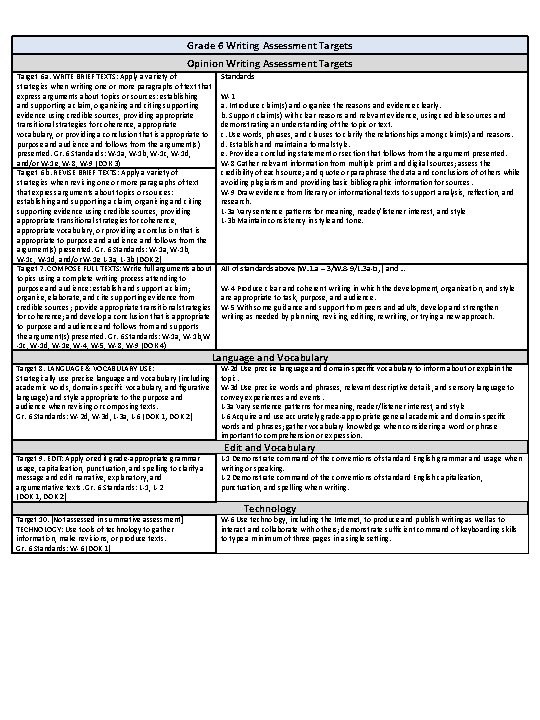
Grade 6 Writing Assessment Targets Opinion Writing Assessment Targets Target 6 a. WRITE BRIEF TEXTS: Apply a variety of strategies when writing one or more paragraphs of text that express arguments about topics or sources: establishing and supporting a claim, organizing and citing supporting evidence using credible sources, providing appropriate transitional strategies for coherence, appropriate vocabulary, or providing a conclusion that is appropriate to purpose and audience and follows from the argument(s) presented. Gr. 6 Standards: W-1 a, W-1 b, W-1 c, W-1 d, and/or W-1 e, W-8, W-9 (DOK 3) Target 6 b. REVISE BRIEF TEXTS: Apply a variety of strategies when revising one or more paragraphs of text that express arguments about topics or sources: establishing and supporting a claim, organizing and citing supporting evidence using credible sources, providing appropriate transitional strategies for coherence, appropriate vocabulary, or providing a conclusion that is appropriate to purpose and audience and follows from the argument(s) presented. Gr. 6 Standards: W-1 a, W-1 b, W-1 c, W-1 d, and/or W-1 e L-3 a, L-3 b (DOK 2) Target 7. COMPOSE FULL TEXTS: Write full arguments about topics using a complete writing process attending to purpose and audience: establish and support a claim; organize, elaborate, and cite supporting evidence from credible sources; provide appropriate transitional strategies for coherence; and develop a conclusion that is appropriate to purpose and audience and follows from and supports the argument(s) presented. Gr. 6 Standards: W-1 a, W-1 b, W -1 c, W-1 d, W-1 e, W-4, W-5, W-8, W-9 (DOK 4) Standards Target 8. LANGUAGE & VOCABULARY USE: Strategically use precise language and vocabulary (including academic words, domain-specific vocabulary, and figurative language) and style appropriate to the purpose and audience when revising or composing texts. Gr. 6 Standards: W-2 d, W-3 d, L-3 a, L-6 (DOK 1, DOK 2) W-2 d Use precise language and domain-specific vocabulary to inform about or explain the topic. W-3 d Use precise words and phrases, relevant descriptive details, and sensory language to convey experiences and events. L-3 a Vary sentence patterns for meaning, reader/listener interest, and style L-6 Acquire and use accurately grade-appropriate general academic and domain-specific words and phrases; gather vocabulary knowledge when considering a word or phrase important to comprehension or expression. W-1 a. Introduce claim(s) and organize the reasons and evidence clearly. b. Support claim(s) with clear reasons and relevant evidence, using credible sources and demonstrating an understanding of the topic or text. c. Use words, phrases, and clauses to clarify the relationships among claim(s) and reasons. d. Establish and maintain a formal style. e. Provide a concluding statement or section that follows from the argument presented. W-8 Gather relevant information from multiple print and digital sources; assess the credibility of each source; and quote or paraphrase the data and conclusions of others while avoiding plagiarism and providing basic bibliographic information for sources. W-9 Draw evidence from literary or informational texts to support analysis, reflection, and research. L-3 a Vary sentence patterns for meaning, reader/listener interest, and style L-3 b Maintain consistency in style and tone. All of standards above (W. 1. a – 3/W. 8 -9/L. 3 a-b, ) and … W-4 Produce clear and coherent writing in which the development, organization, and style are appropriate to task, purpose, and audience. W-5 With some guidance and support from peers and adults, develop and strengthen writing as needed by planning, revising, editing, rewriting, or trying a new approach. Language and Vocabulary Edit and Vocabulary Target 9. EDIT: Apply or edit grade-appropriate grammar usage, capitalization, punctuation, and spelling to clarify a message and edit narrative, explanatory, and argumentative texts. Gr. 6 Standards: L-1, L-2 (DOK 1, DOK 2) L-1 Demonstrate command of the conventions of standard English grammar and usage when writing or speaking. L-2 Demonstrate command of the conventions of standard English capitalization, punctuation, and spelling when writing. Target 10. [Not assessed in summative assessment] TECHNOLOGY: Use tools of technology to gather information, make revisions, or produce texts. Gr. 6 Standards: W-6 (DOK 1) W-6 Use technology, including the Internet, to produce and publish writing as well as to interact and collaborate with others; demonstrate sufficient command of keyboarding skills to type a minimum of three pages in a single setting. Technology