
Grade 12 Mechanics Unit 1 Momentum and impulse
- Slides: 18
Grade 12 Mechanics Unit 1: Momentum and impulse
1. 1 Momentum Definition The momentum of an object is the product of the object’s mass and velocity.
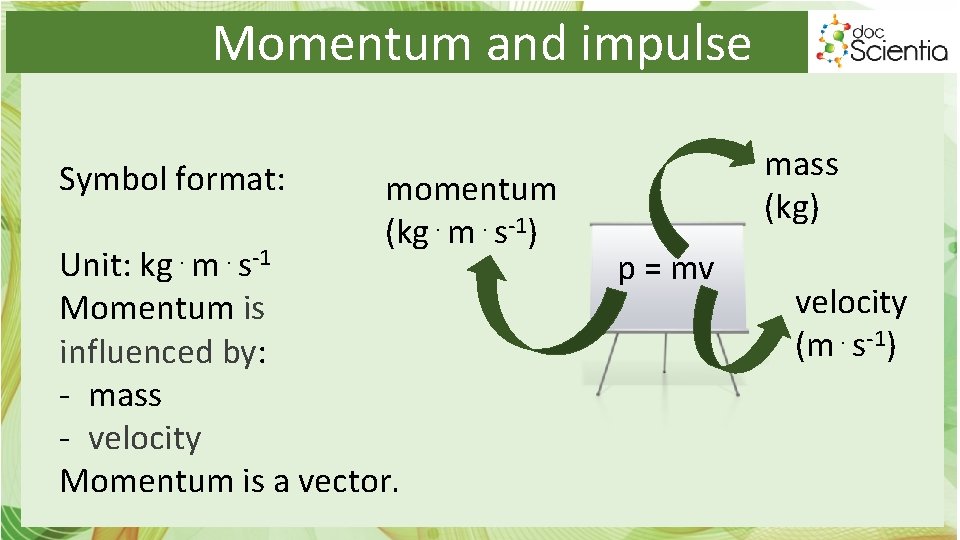
Momentum and impulse Symbol format: momentum (kg⋅m⋅s-1) Unit: kg⋅m⋅s-1 Momentum is influenced by: - mass - velocity Momentum is a vector. mass (kg) p = mv velocity (m⋅s-1)
Example 1. A car has a mass of 800 kg and moves at a velocity of 40 m⋅s-1 west. What is the momentum of the car? p = mv = 800 × 40 = 32 000 kg⋅m⋅s-1 west
Example 2. A soccer ball with a mass of 420 g is kicked at a velocity of 20 m⋅s-1 toward the goal. Calculate the momentum of the ball. p = mv = 0, 42 × 20 (Remember to convert mass to kg. ) = 8, 4 kg⋅m⋅s-1 in the original direction
Momentum and impulse 1. 2 Change in momentum Changes when the velocity of the object changes.
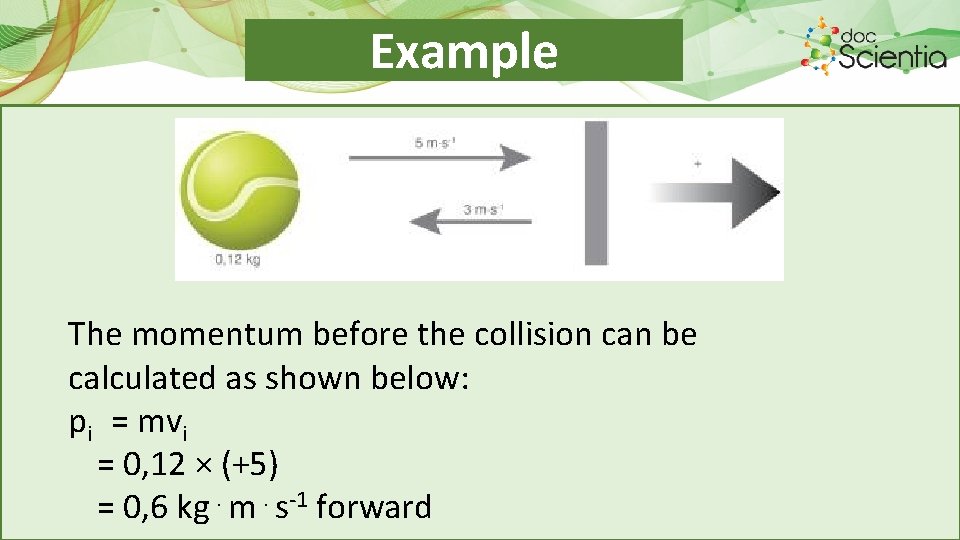
Example A tennis ball with a mass of 0, 12 kg, is hit and moves towards a wall at a velocity of 5 m⋅s-1. This velocity is referred to as the initial velocity (vi) of the ball, just before contact with the wall and its direction is chosen as positive. When the ball hits the racket (collision), the velocity of the ball changes to 3 m⋅s-1 in the opposite direction. This velocity is referred to as the final velocity (vf) of the ball, just after contact with the wall and its direction is chosen as negative.
Example The momentum before the collision can be calculated as shown below: pi = mvi = 0, 12 × (+5) = 0, 6 kg⋅m⋅s-1 forward
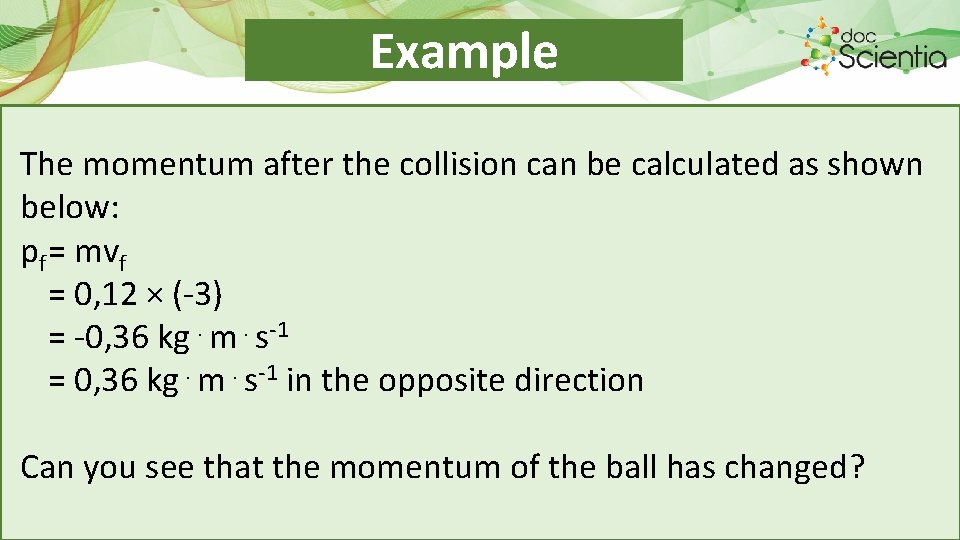
Example The momentum after the collision can be calculated as shown below: pf = mvf = 0, 12 × (-3) = -0, 36 kg⋅m⋅s-1 = 0, 36 kg⋅m⋅s-1 in the opposite direction Can you see that the momentum of the ball has changed?
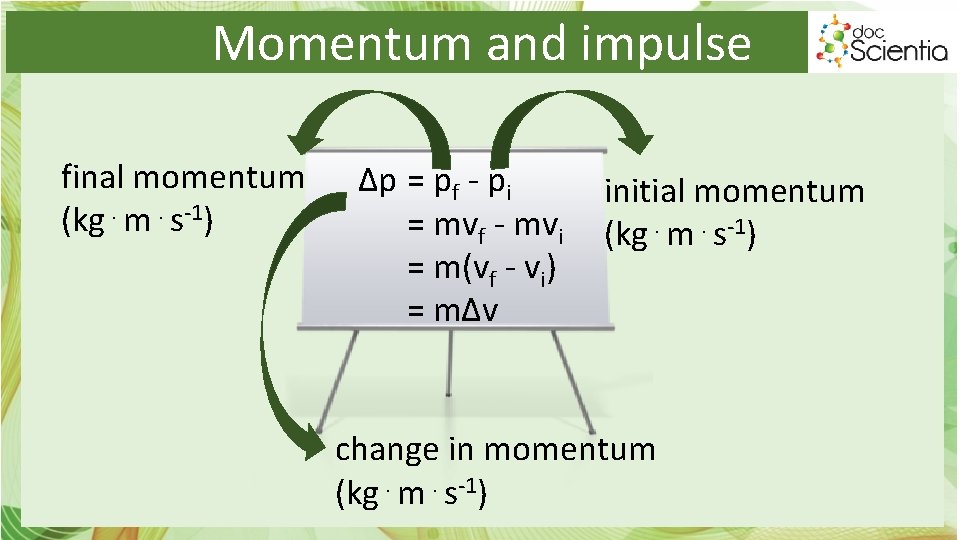
Momentum and impulse final momentum (kg⋅m⋅s-1) ∆p = pf - pi = mvf - mvi = m(vf - vi) = m∆v initial momentum (kg⋅m⋅s-1) change in momentum (kg⋅m⋅s-1)
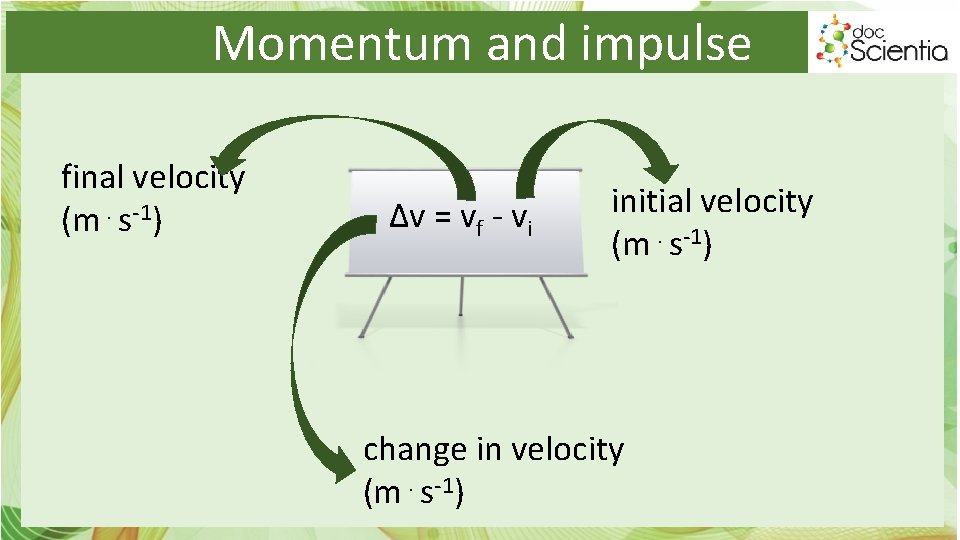
Momentum and impulse final velocity (m⋅s-1) ∆v = vf - vi initial velocity (m⋅s-1) change in velocity (m⋅s-1)
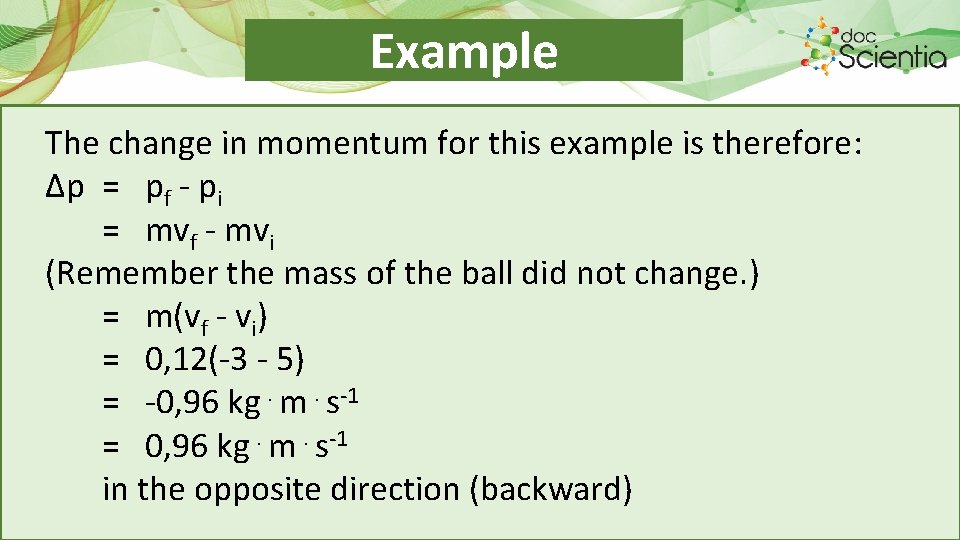
Example The change in momentum for this example is therefore: ∆p = pf - pi = mvf - mvi (Remember the mass of the ball did not change. ) = m(vf - vi) = 0, 12(-3 - 5) = -0, 96 kg⋅m⋅s-1 = 0, 96 kg⋅m⋅s-1 in the opposite direction (backward)
Quick facts Remember to choose one direction as positive
Momentum and impulse Change in momentum can be caused by • Change in mass. • Increasing velocity. • Decreasing velocity. • Change in direction of motion.
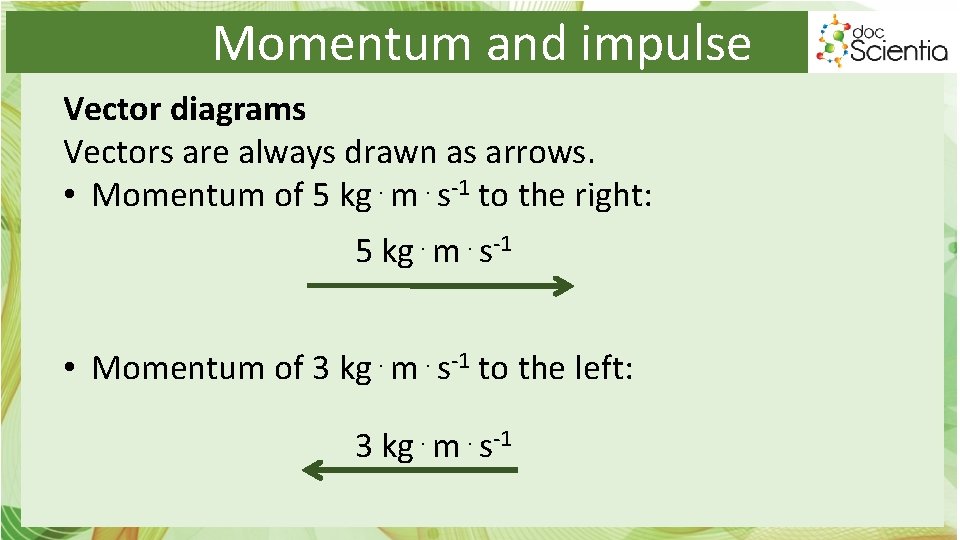
Momentum and impulse Vector diagrams Vectors are always drawn as arrows. • Momentum of 5 kg⋅m⋅s-1 to the right: 5 kg⋅m⋅s-1 • Momentum of 3 kg⋅m⋅s-1 to the left: 3 kg⋅m⋅s-1
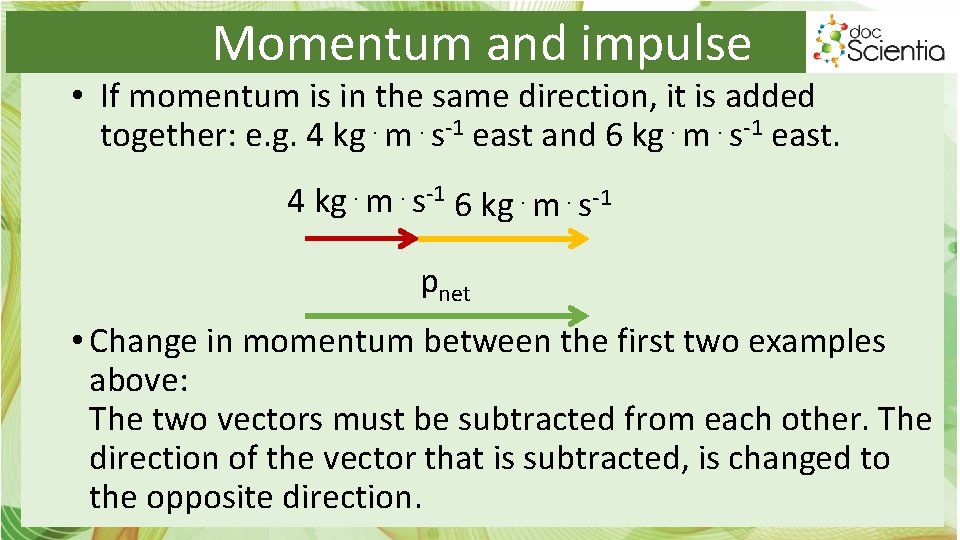
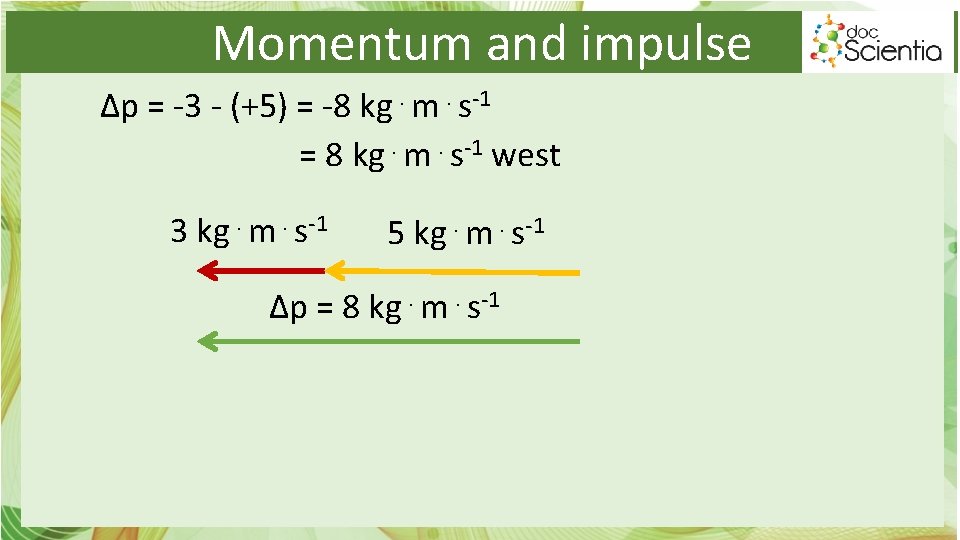
Momentum and impulse • If momentum is in the same direction, it is added together: e. g. 4 kg⋅m⋅s-1 east and 6 kg⋅m⋅s-1 east. 4 kg⋅m⋅s-1 6 kg⋅m⋅s-1 pnet • Change in momentum between the first two examples above: The two vectors must be subtracted from each other. The direction of the vector that is subtracted, is changed to the opposite direction.
Momentum and impulse Δp = -3 - (+5) = -8 kg⋅m⋅s-1 = 8 kg⋅m⋅s-1 west 3 kg⋅m⋅s-1 5 kg⋅m⋅s-1 Δp = 8 kg⋅m⋅s-1
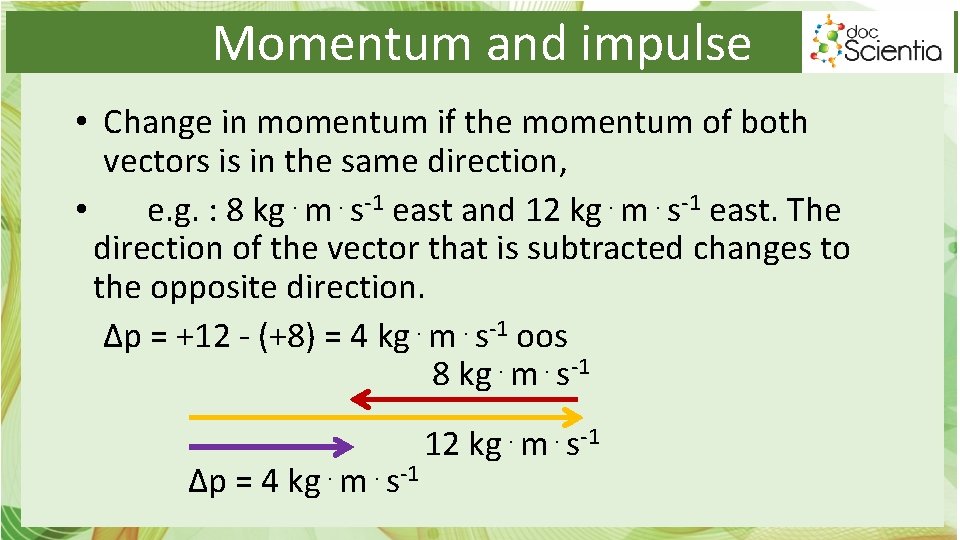
Momentum and impulse • Change in momentum if the momentum of both vectors is in the same direction, • e. g. : 8 kg⋅m⋅s-1 east and 12 kg⋅m⋅s-1 east. The direction of the vector that is subtracted changes to the opposite direction. Δp = +12 - (+8) = 4 kg⋅m⋅s-1 oos 8 kg⋅m⋅s-1 Δp = 4 kg⋅m⋅s-1 12 kg⋅m⋅s-1