
GRADE 11 POETRY EATING POETRY Mark Strand 1
- Slides: 15
GRADE 11 POETRY • EATING POETRY • Mark Strand 1
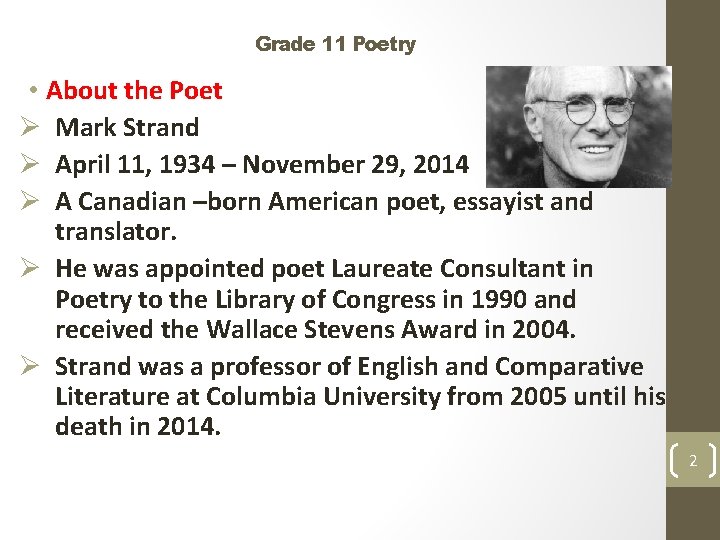
Grade 11 Poetry • About the Poet Ø Mark Strand Ø April 11, 1934 – November 29, 2014 Ø A Canadian –born American poet, essayist and translator. Ø He was appointed poet Laureate Consultant in Poetry to the Library of Congress in 1990 and received the Wallace Stevens Award in 2004. Ø Strand was a professor of English and Comparative Literature at Columbia University from 2005 until his death in 2014. 2
Grade 11 Poetry • About the poem Ø The poem opens with the speaker eating poetry while ink runs from the corners of his mouth. ØA librarian spots him and doesn’t understand what she’s seeing. ØAfter all the poems are eaten, a bunch of dogs star coming up the stairs while their eyeballs roll and their legs “burn like brush. ” ØThe librarian starts to stamp her feet and weep because she doesn’t understand. ØThe speaker then licks her hand she screams. He snarls and barks at her. ØThen he romps with joy in the “bookish dark. ” 3
Grade 11 Poetry • Analysis (1) ØTheme: Ø Happiness Ø Versions of reality – One person’s joy might be another person’s nightmare. Ø Transformation of self into different social situations Ø The lack of social skills of the academic. ØStructure: Ø 6 Stanzas, 3 lines each. ØRhyme: Ø Free verse ØTone: Ø Dry 4
Grade 11 Poetry ØLiterary devices Ø The most prevalent literary device in this poem is metaphor. Metaphor is when a poet describes an idea that is a comparison; in this case poems are compared to food. You cannot literally eat poetry. Instead, Strand is arguing that the reading of a poem is a sensory experience just like eating. Ø For instance, in line one … • Ink runs from the corners of my mouth. (line 1) • You do not literally have ink running down the corners of your mouth, because you are not literary eating poetry. What an image though! Ø That leads us to the second literary device, imagery. Imagery is very descriptive language at appeals to your five senses of taste, touch, smell, hearing and sight. In addition to the visual image in line 1, we have this auditory sense in line 17. • I snarl at her and bark, (line 17) • The experience of eating poetry transforms the speaker, another metaphor. He is carefree and sensory, like a dog. Think about it: dogs do not stop and think, they live by their senses and get overwhelmed by them, as described in line 18. • I romp with joy in the bookish dark. (line 18) Ø A third literary device is the use of rhyme. Rhyme is when the ends of words have the same sounds. This is used in the last two lines I showed you, where “bark” and “dark” rhyme. The rhyme makes a connection between the two words and reinforces the joyful idea. 5 • All of these devices enhance the poem by making it whimsical and fun. We laugh at the metaphor of eating a book, and the image of the speaker as a dog. We can almost sing the poem from the rhyme. We enjoy poetry as much as the speaker does!
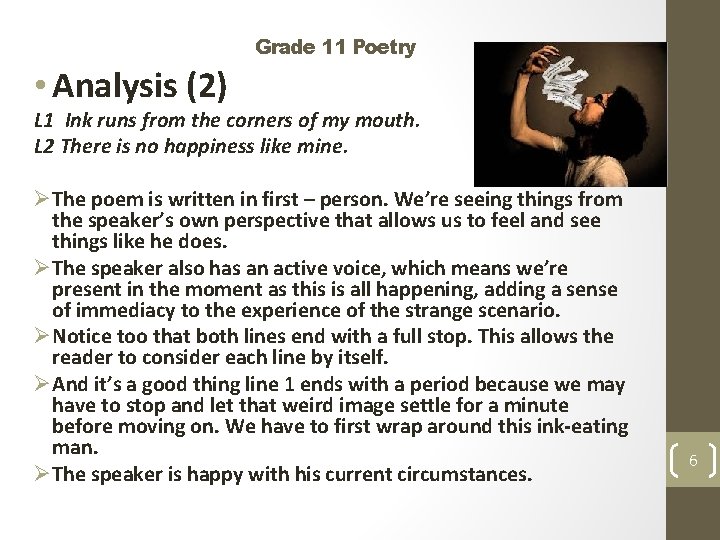
Grade 11 Poetry • Analysis (2) L 1 Ink runs from the corners of my mouth. L 2 There is no happiness like mine. ØThe poem is written in first – person. We’re seeing things from the speaker’s own perspective that allows us to feel and see things like he does. ØThe speaker also has an active voice, which means we’re present in the moment as this is all happening, adding a sense of immediacy to the experience of the strange scenario. ØNotice too that both lines end with a full stop. This allows the reader to consider each line by itself. ØAnd it’s a good thing line 1 ends with a period because we may have to stop and let that weird image settle for a minute before moving on. We have to first wrap around this ink-eating man. ØThe speaker is happy with his current circumstances. 6
Grade 11 Poetry • Analysis (3) ØThe speaker reveals where the ink is coming from. ØThe full stop allows the reader time to consider the image. ØThere is a confessional element, the speaker is letting us in on this embarrassing yet delightful activity of “eating poetry”. ØThe speaker reveals his guilty pleasure with a dry tone, in a matter – of – fact way. ØThe speaker isn’t trying to suggest that he’s using figurative language, he is literally eating poetry. ØXylophagia is a condition involving the consumption of paper and form of eating disorder known as pica. 7
Grade 11 Poetry • Analysis (4) L 4 The librarian does not believe what she sees. ØThe librarian’s disbelief proves that this is really happening. ØAllegory: “eating” of poetry is symbolic of the personal enjoyment of anything. ØSo, the librarian here looks to be representative of those outside parties that witness such ecstatic enjoyment and just can’t understand it themselves. And they can’t understand it because they’re not the ones experiencing it. 8
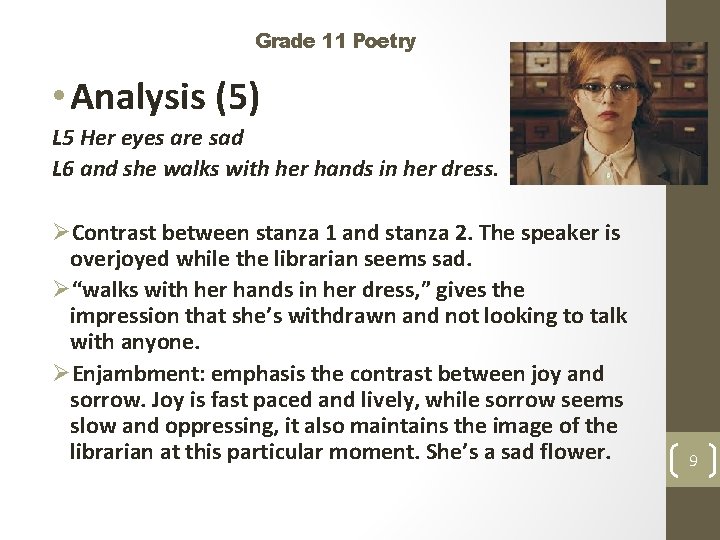
Grade 11 Poetry • Analysis (5) L 5 Her eyes are sad L 6 and she walks with her hands in her dress. ØContrast between stanza 1 and stanza 2. The speaker is overjoyed while the librarian seems sad. Ø“walks with her hands in her dress, ” gives the impression that she’s withdrawn and not looking to talk with anyone. ØEnjambment: emphasis the contrast between joy and sorrow. Joy is fast paced and lively, while sorrow seems slow and oppressing, it also maintains the image of the librarian at this particular moment. She’s a sad flower. 9
Grade 11 Poetry • Analysis (6) L 7 The poems are gone L 8 The light is dim. ØAllegory : the lights symbolically refer to that joyous moment the speaker just had while eating poetry. ØWe can’t make those joyous moments last forever and, once they’re over, the lights go “dim” again. ØEach line here is separated by a full stop, which allows for consideration of what is said. ØThe speaker is feeling a bit disappointed after eating the poems. 10
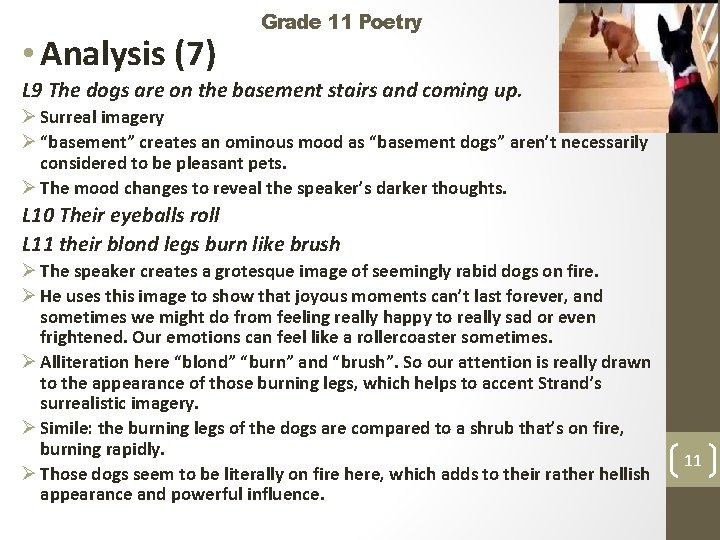
• Analysis (7) Grade 11 Poetry L 9 The dogs are on the basement stairs and coming up. Ø Surreal imagery Ø “basement” creates an ominous mood as “basement dogs” aren’t necessarily considered to be pleasant pets. Ø The mood changes to reveal the speaker’s darker thoughts. L 10 Their eyeballs roll L 11 their blond legs burn like brush Ø The speaker creates a grotesque image of seemingly rabid dogs on fire. Ø He uses this image to show that joyous moments can’t last forever, and sometimes we might do from feeling really happy to really sad or even frightened. Our emotions can feel like a rollercoaster sometimes. Ø Alliteration here “blond” “burn” and “brush”. So our attention is really drawn to the appearance of those burning legs, which helps to accent Strand’s surrealistic imagery. Ø Simile: the burning legs of the dogs are compared to a shrub that’s on fire, burning rapidly. Ø Those dogs seem to be literally on fire here, which adds to their rather hellish appearance and powerful influence. 11
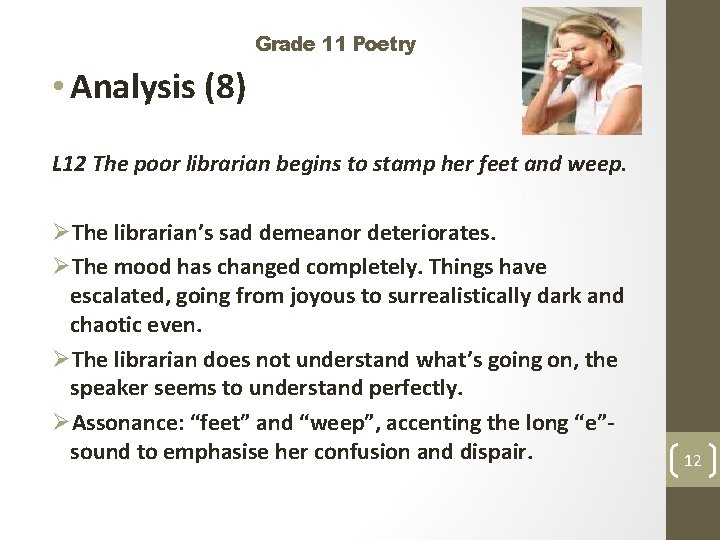
Grade 11 Poetry • Analysis (8) L 12 The poor librarian begins to stamp her feet and weep. ØThe librarian’s sad demeanor deteriorates. ØThe mood has changed completely. Things have escalated, going from joyous to surrealistically dark and chaotic even. ØThe librarian does not understand what’s going on, the speaker seems to understand perfectly. ØAssonance: “feet” and “weep”, accenting the long “e”sound to emphasise her confusion and dispair. 12
Grade 11 Poetry • Analysis (9) L 13 She does not understand ØAllegory: Besides being an outsider, the librarian is also a symbol of the types of people who study things, but who don’t really experience the real world that’s around them. L 14 When I get on my knees and lick her hand, L 15 she screams. ØThe speaker (in his own imagination) transforms into one of the dogs, licking the librarian’s hand. ØJoy and darkness are being portrayed in a constant state of flux, with one transitioning into the other. Those who aren’t part of the immediate experience, like the librarian, are unable to understand also a little frightened by what they see from an outsider’s perspective. ØThis can also refer to transformations that can occur for the individual reading poetry. 13
Grade 11 Poetry • Analysis (10) L 16 I am a new man. L 17 I snarl at her and bark. ØA transformation has indeed occurred : “I am a new man. ” ØHowever the speaker is still a “man” even if he’s barking, licking, and snarling at the librarian. ØThe speaker is not bothered by this sudden transformation, he embraces it. ØIf we think about personal experiences in a more general sense, we understand these things, those changes inevitably become part of who he/she is. But for those outside of the experience, those changes often don’t make sense and can be a bit frightening even. ØSince the speaker seems to feel comfortable with these changes, he doesn’t want anyone spoiling it for him, so he “snarl[s]” and “bark[s]”. 14
Grade 11 Poetry • Analysis (11) L 18 I romp with joy in the bookish dark. ØAfter all is said and done, the speaker is pleased with transformation. ØThe couplet: Strand ends this poem with the end rhyme of “bark” and “dark”. That annunciates the joy the speaker is feeling, despite all the barking and “dark” ØThe dark is “bookish”, which gives it an intellectual flair, reaffirms the earlier image of educated people who are ill – adapted to the real world. ØThe speaker is equally comfortable in the dark, as he is in the “real world”. Thanks to Mrs. Joeye Booysen (Vryburger H/s) 15