
GRADE 10 CHEMISTRY TOPIC MULTIVALENT METALS AND POLYATOMIC
- Slides: 22
GRADE 10: CHEMISTRY TOPIC: MULTIVALENT METALS AND POLYATOMIC IONS Date: Thursday, March 21 st, 2013
PUZZLERS Courtesy of Mr. Luoma
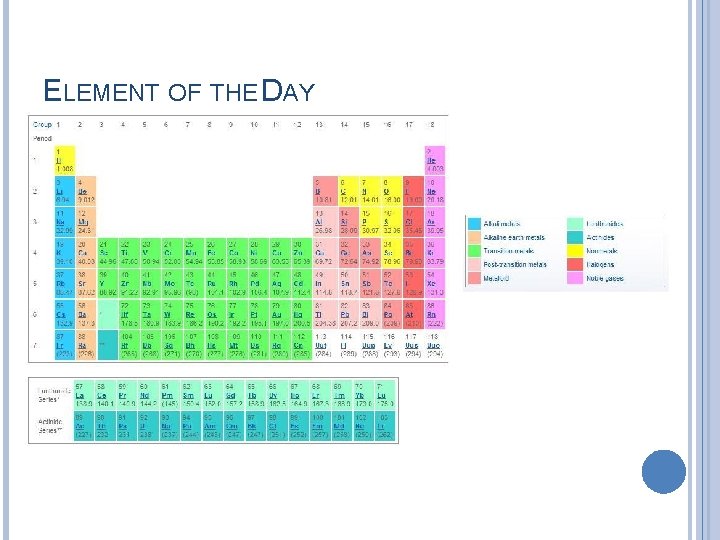
ELEMENT OF THE DAY
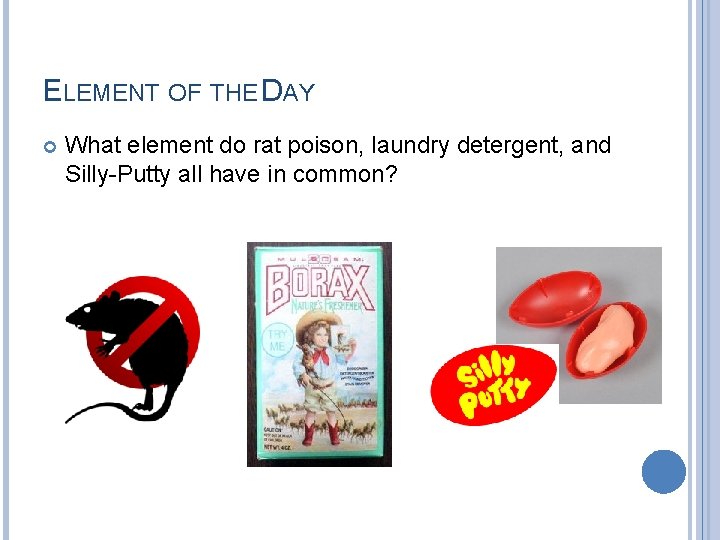
ELEMENT OF THE DAY What element do rat poison, laundry detergent, and Silly-Putty all have in common?
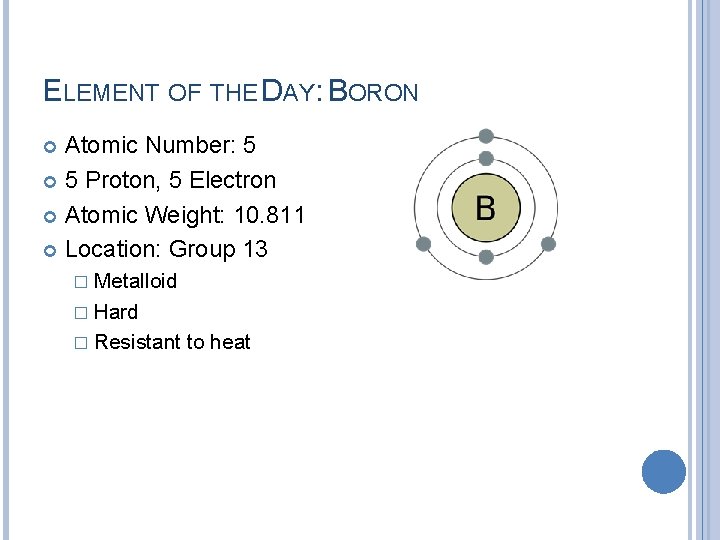
ELEMENT OF THE DAY: BORON Atomic Number: 5 5 Proton, 5 Electron Atomic Weight: 10. 811 Location: Group 13 � Metalloid � Hard � Resistant to heat
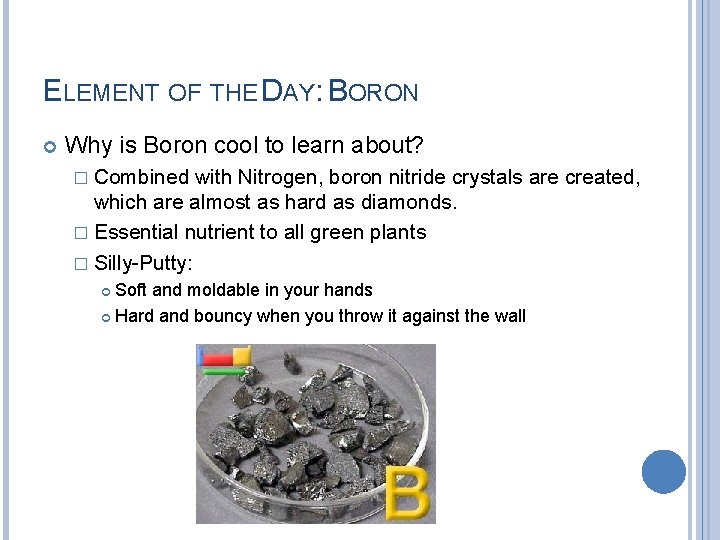
ELEMENT OF THE DAY: BORON Why is Boron cool to learn about? � Combined with Nitrogen, boron nitride crystals are created, which are almost as hard as diamonds. � Essential nutrient to all green plants � Silly-Putty: Soft and moldable in your hands Hard and bouncy when you throw it against the wall
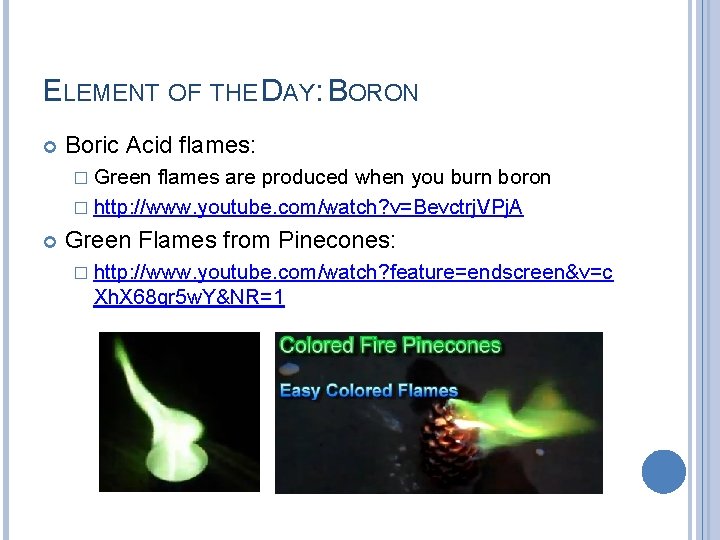
ELEMENT OF THE DAY: BORON Boric Acid flames: � Green flames are produced when you burn boron � http: //www. youtube. com/watch? v=Bevctrj. VPj. A Green Flames from Pinecones: � http: //www. youtube. com/watch? feature=endscreen&v=c Xh. X 68 qr 5 w. Y&NR=1
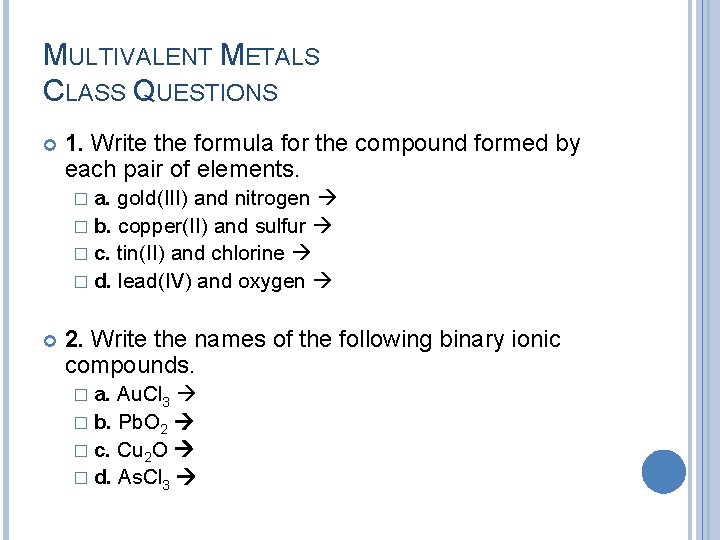
MULTIVALENT METALS CLASS QUESTIONS 1. Write the formula for the compound formed by each pair of elements. � a. gold(III) and nitrogen � b. copper(II) and sulfur � c. tin(II) and chlorine � d. lead(IV) and oxygen 2. Write the names of the following binary ionic compounds. � a. Au. Cl 3 � b. Pb. O 2 � c. Cu 2 O � d. As. Cl 3
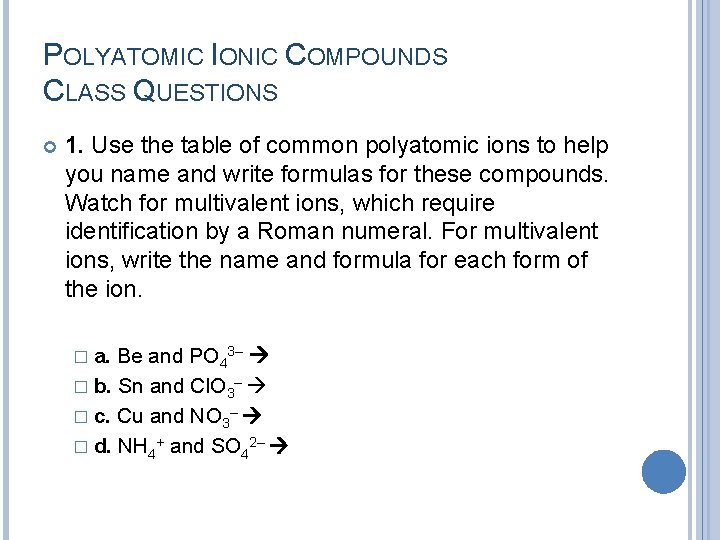
POLYATOMIC IONIC COMPOUNDS CLASS QUESTIONS 1. Use the table of common polyatomic ions to help you name and write formulas for these compounds. Watch for multivalent ions, which require identification by a Roman numeral. For multivalent ions, write the name and formula for each form of the ion. � a. Be and PO 43– � b. Sn and Cl. O 3– � c. Cu and NO 3– � d. NH 4+ and SO 42–
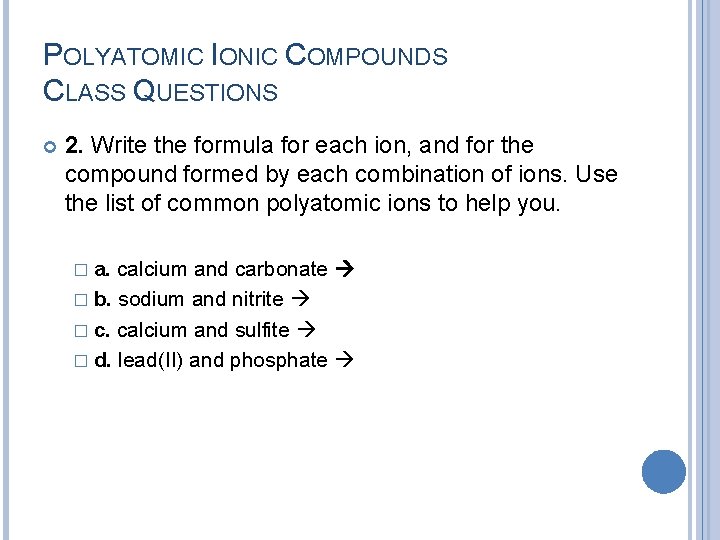
POLYATOMIC IONIC COMPOUNDS CLASS QUESTIONS 2. Write the formula for each ion, and for the compound formed by each combination of ions. Use the list of common polyatomic ions to help you. � a. calcium and carbonate � b. sodium and nitrite � c. calcium and sulfite � d. lead(II) and phosphate
IONIC COMPOUNDS WORKSHEET Complete the Ionic Compounds Worksheet � Binary Ionic Compounds � Multivalent Metals � Polyatomic Ionic Compounds We will check the answers together in class Make note of which questions you were having difficulty with ASK Questions if you are having difficulties!! A blank sheet with answers is posted on the website: � http: //lcsgrade 10 chemistry. weebly. com/
BINGO – BINARY IONIC COMPOUNDS REVIEW (IF TIME) See Binary Ionic Compounds Review Powerpoint
SUPPORTING DOCUMENTS ON Science 10 Textbook � Pages: 146 -150 Chapter 4 Power Point for ON Science 10 � Slides: 23 -26 Chapter 4 Notebook - none Websites: none
HOMEWORK ON Science 10 Textbook � Page Questions: 9, 10 � Page #: 150 #151 Try Questions: 1 -8 � Read - “Ionic Compounds at Home”
HOMEWORK ANSWERS Pg. 150 9. � a. binary, Ni 2 O 3 � b. binary, Cu. I 2 � c. binary, Sn 3 N 4 � d. binary, Cr. Br 2 � e. binary, Fe. P � f. neither, Li. HCO 3 � g. ternary, K 2 SO 4 � h. ternary, (NH 4)3 P � i. ternary, Ba(NO 3)2 � j. binary, Co 3(PO 4)2
HOMEWORK ANSWERS Pg. 150 10. � a. gold(III) chloride � b. tin phosphide � c. chromium oxide � d. nitrogen sulphide � e. ammonium sulphide � f. calcium fluoride � g. iron(II) sulfite � h. magnesium phosphate
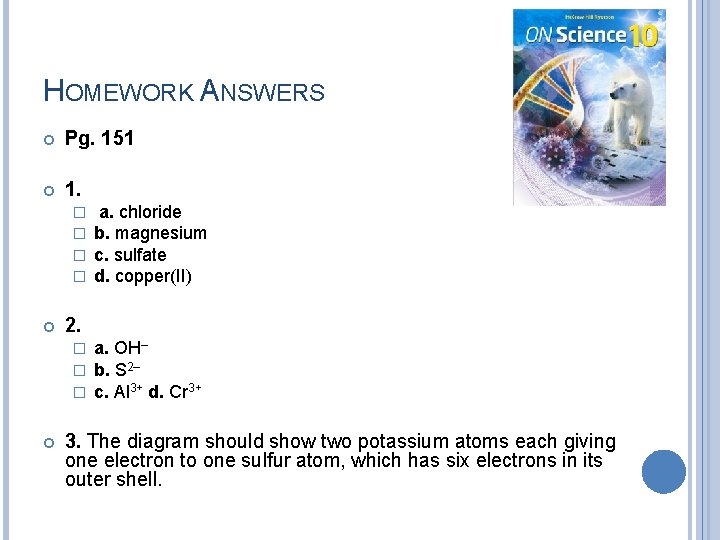
HOMEWORK ANSWERS Pg. 151 1. � � 2. � � � a. chloride b. magnesium c. sulfate d. copper(II) a. OH– b. S 2– c. Al 3+ d. Cr 3+ 3. The diagram should show two potassium atoms each giving one electron to one sulfur atom, which has six electrons in its outer shell.
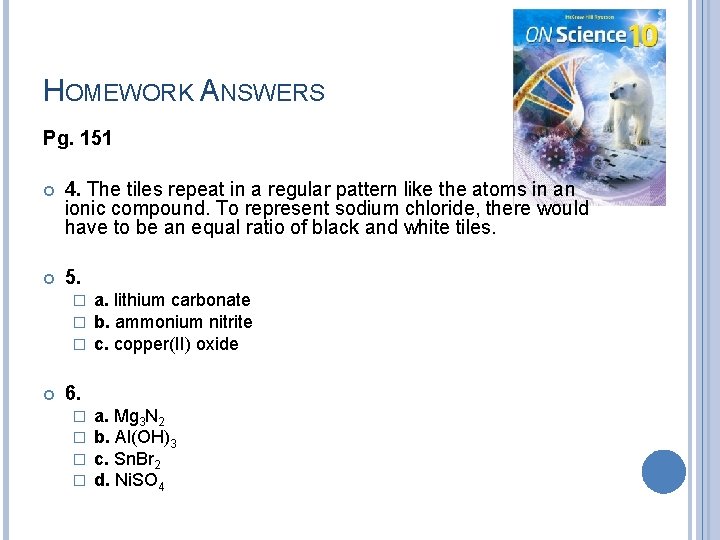
HOMEWORK ANSWERS Pg. 151 4. The tiles repeat in a regular pattern like the atoms in an ionic compound. To represent sodium chloride, there would have to be an equal ratio of black and white tiles. 5. � � � a. lithium carbonate b. ammonium nitrite c. copper(II) oxide 6. � � a. Mg 3 N 2 b. Al(OH)3 c. Sn. Br 2 d. Ni. SO 4
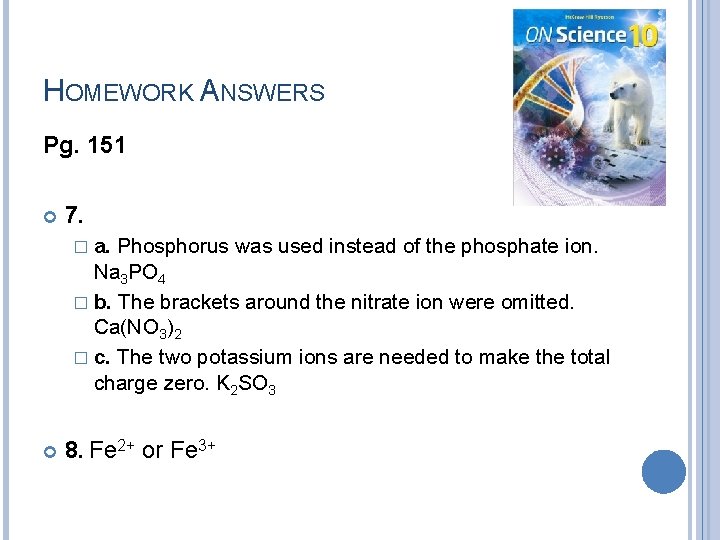
HOMEWORK ANSWERS Pg. 151 7. � a. Phosphorus was used instead of the phosphate ion. Na 3 PO 4 � b. The brackets around the nitrate ion were omitted. Ca(NO 3)2 � c. The two potassium ions are needed to make the total charge zero. K 2 SO 3 8. Fe 2+ or Fe 3+
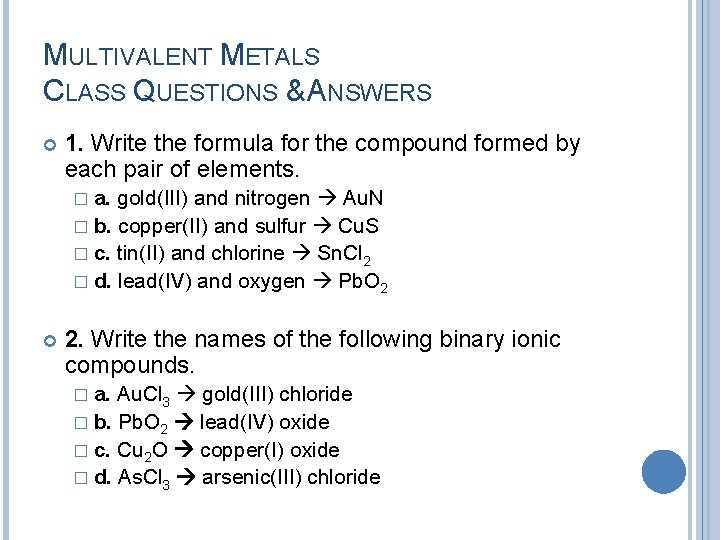
MULTIVALENT METALS CLASS QUESTIONS & ANSWERS 1. Write the formula for the compound formed by each pair of elements. � a. gold(III) and nitrogen Au. N � b. copper(II) and sulfur Cu. S � c. tin(II) and chlorine Sn. Cl 2 � d. lead(IV) and oxygen Pb. O 2 2. Write the names of the following binary ionic compounds. � a. Au. Cl 3 gold(III) chloride � b. Pb. O 2 lead(IV) oxide � c. Cu 2 O copper(I) oxide � d. As. Cl 3 arsenic(III) chloride
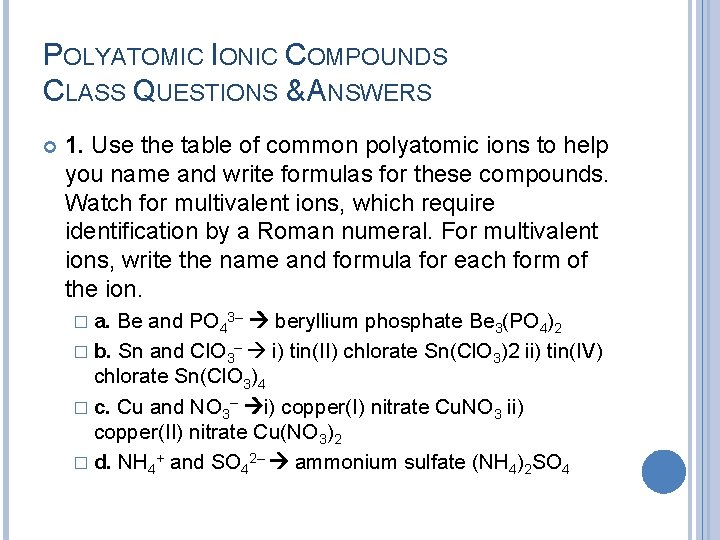
POLYATOMIC IONIC COMPOUNDS CLASS QUESTIONS & ANSWERS 1. Use the table of common polyatomic ions to help you name and write formulas for these compounds. Watch for multivalent ions, which require identification by a Roman numeral. For multivalent ions, write the name and formula for each form of the ion. � a. Be and PO 43– beryllium phosphate Be 3(PO 4)2 � b. Sn and Cl. O 3– i) tin(II) chlorate Sn(Cl. O 3)2 ii) tin(IV) chlorate Sn(Cl. O 3)4 � c. Cu and NO 3– i) copper(I) nitrate Cu. NO 3 ii) copper(II) nitrate Cu(NO 3)2 � d. NH 4+ and SO 42– ammonium sulfate (NH 4)2 SO 4
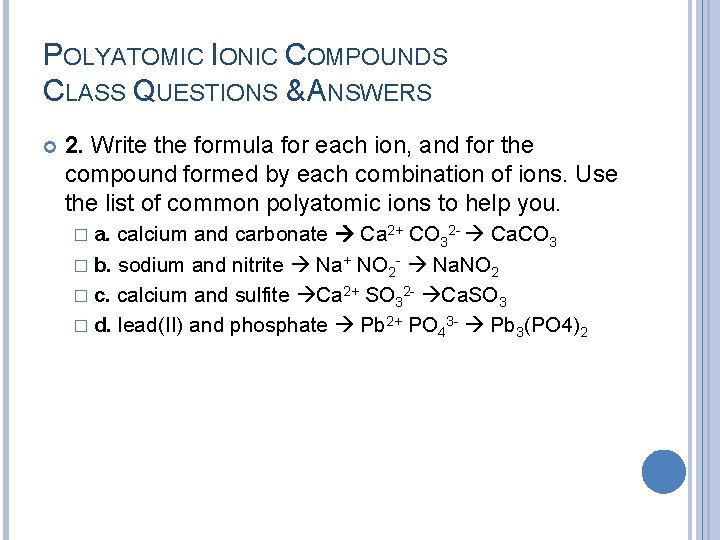
POLYATOMIC IONIC COMPOUNDS CLASS QUESTIONS & ANSWERS 2. Write the formula for each ion, and for the compound formed by each combination of ions. Use the list of common polyatomic ions to help you. � a. calcium and carbonate Ca 2+ CO 32 - Ca. CO 3 � b. sodium and nitrite Na+ NO 2 - Na. NO 2 � c. calcium and sulfite Ca 2+ SO 32 - Ca. SO 3 � d. lead(II) and phosphate Pb 2+ PO 43 - Pb 3(PO 4)2