
Grade 1 Math Operations Algebraic Thinking I CAN
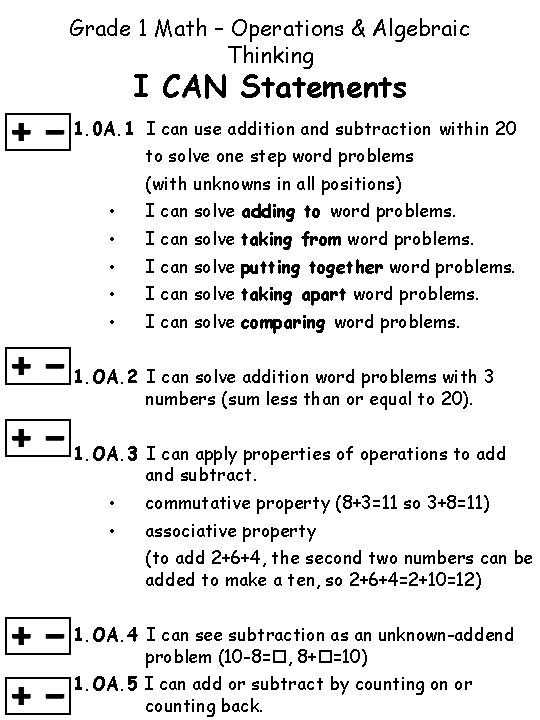
Grade 1 Math – Operations & Algebraic Thinking I CAN Statements 1. 0 A. 1 I can use addition and subtraction within 20 to solve one step word problems (with unknowns in all positions) • • • I can solve adding to word problems. I can solve taking from word problems. I can solve putting together word problems. I can solve taking apart word problems. I can solve comparing word problems. 1. OA. 2 I can solve addition word problems with 3 numbers (sum less than or equal to 20). 1. OA. 3 I can apply properties of operations to add and subtract. • • commutative property (8+3=11 so 3+8=11) associative property (to add 2+6+4, the second two numbers can be added to make a ten, so 2+6+4=2+10=12) 1. OA. 4 I can see subtraction as an unknown-addend problem (10 -8= , 8+ =10) 1. OA. 5 I can add or subtract by counting on or counting back.
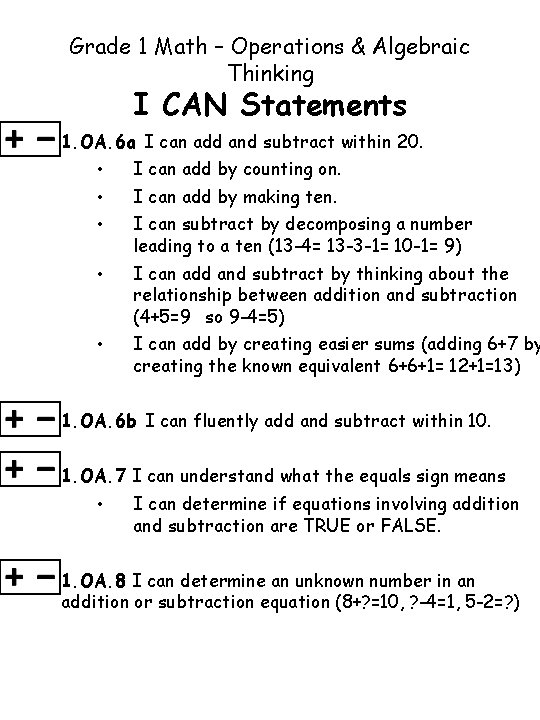
Grade 1 Math – Operations & Algebraic Thinking I CAN Statements 1. OA. 6 a I can add and subtract within 20. • • • I can add by counting on. • I can add and subtract by thinking about the relationship between addition and subtraction (4+5=9 so 9 -4=5) • I can add by creating easier sums (adding 6+7 by creating the known equivalent 6+6+1= 12+1=13) I can add by making ten. I can subtract by decomposing a number leading to a ten (13 -4= 13 -3 -1= 10 -1= 9) 1. OA. 6 b I can fluently add and subtract within 10. 1. OA. 7 I can understand what the equals sign means • I can determine if equations involving addition and subtraction are TRUE or FALSE. 1. OA. 8 I can determine an unknown number in an addition or subtraction equation (8+? =10, ? -4=1, 5 -2=? )
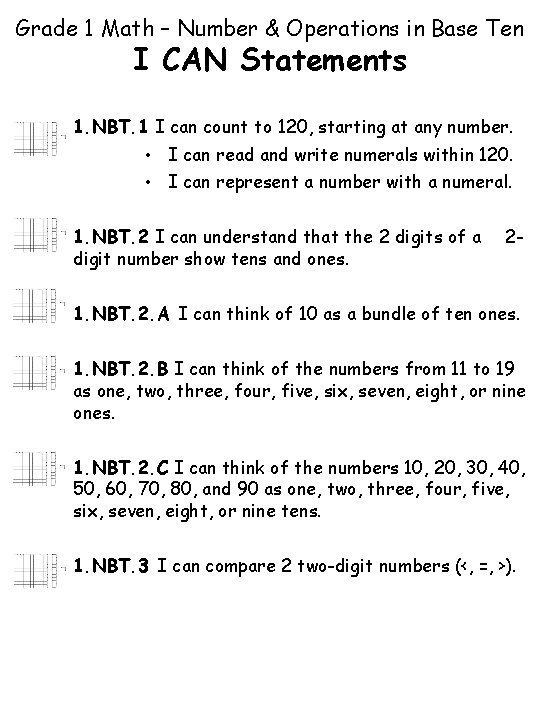
Grade 1 Math – Number & Operations in Base Ten I CAN Statements 1. NBT. 1 I can count to 120, starting at any number. • I can read and write numerals within 120. • I can represent a number with a numeral. 1. NBT. 2 I can understand that the 2 digits of a digit number show tens and ones. 2 - 1. NBT. 2. A I can think of 10 as a bundle of ten ones. 1. NBT. 2. B I can think of the numbers from 11 to 19 as one, two, three, four, five, six, seven, eight, or nine ones. 1. NBT. 2. C I can think of the numbers 10, 20, 30, 40, 50, 60, 70, 80, and 90 as one, two, three, four, five, six, seven, eight, or nine tens. 1. NBT. 3 I can compare 2 two-digit numbers (<, =, >).
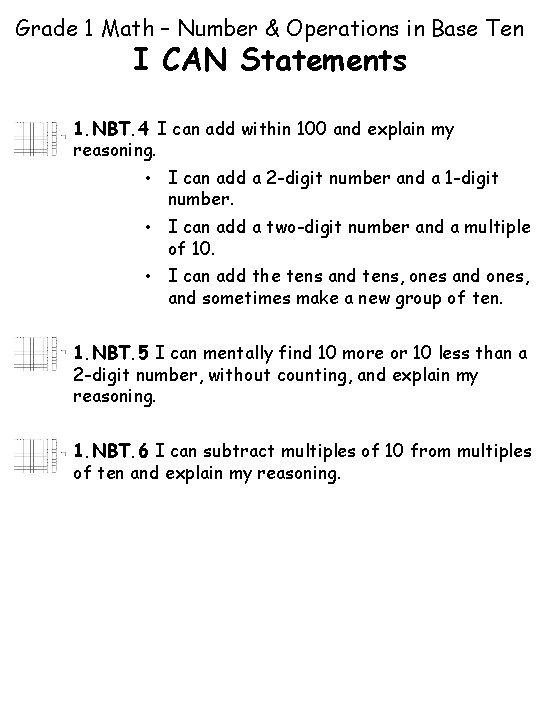
Grade 1 Math – Number & Operations in Base Ten I CAN Statements 1. NBT. 4 I can add within 100 and explain my reasoning. • I can add a 2 -digit number and a 1 -digit number. • I can add a two-digit number and a multiple of 10. • I can add the tens and tens, ones and ones, and sometimes make a new group of ten. 1. NBT. 5 I can mentally find 10 more or 10 less than a 2 -digit number, without counting, and explain my reasoning. 1. NBT. 6 I can subtract multiples of 10 from multiples of ten and explain my reasoning.
Grade 1 Math – Measurement & Data I CAN Statements 1. MD. 1 I can order 3 objects by length and compare the lengths of two objects indirectly by using a third objec 1. MD. A. 2 I can write the length of an object to the nearest unit with no gaps or overlaps. 1. MD. 3 a I can tell and write time in hours and half-hours using analog and digital clocks. • I can understand the terms “o’clock” and “half past”. 1. MD. 3 b I can recognize and identify coins (penny, nickel, dime, quarter) and their value and use the cent symbol (¢) appropriately. 1. MD. 3 c I can count a mixed collection of dimes and pennie and determine the cent value (up to 100 cents). 1. MD. 4 I can organize, represent, and interpret data with up to 3 categories. • I can ask and answer questions about the total number of data points, how many in each category, and how many more or less are in one category than in another
Grade 1 Math – Geometry I CAN Statements 1. G. 1 I can distinguish between defining attributes (ex. triangles are closed, 3 -sided shapes) and nondefining attributes (ex. color, size). • I can build and/or draw shapes to possess defining attributes. 1. G. 2 I can put 2 D shapes (rectangles, squares, trapezoids, triangles, half-circles, and quarter-circles) together to make a bigger shape. • I can put 3 D shapes together (cubes, right rectangular prisms, right circular cones, and right circular cylinders) to make a bigger shape. 1. G. A. 3 I can divide circles and rectangles into two and four equal parts. • I can name equal parts with the words halves, fourths, and quarters. • I can describe a whole shape as two halves, or fourths.
Thank you for purchasing my product! Credits: New York State Next Generation Standards © Copyright 2017. All rights reserved. This product is not sponsored or endorsed by the New York State Next Generation Mathematics Learning Standards.
- Slides: 7