
Gradational Processes breaking down of the lithosphere Weathering
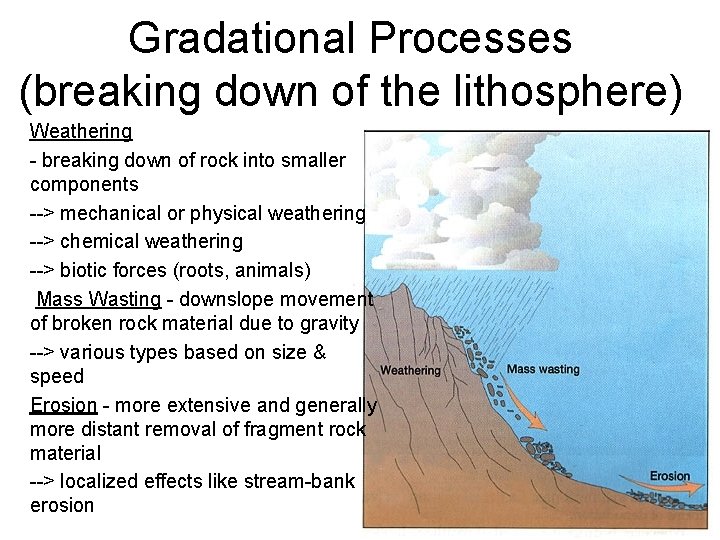
Gradational Processes (breaking down of the lithosphere) Weathering - breaking down of rock into smaller components --> mechanical or physical weathering --> chemical weathering --> biotic forces (roots, animals) Mass Wasting - downslope movement of broken rock material due to gravity --> various types based on size & speed Erosion - more extensive and generally more distant removal of fragment rock material --> localized effects like stream-bank erosion

Conceptual Water Budget Hydrological Cycle

Soil Creep

Tree Affected by Soil Creep

Soil Creep (Mass Wasting) • Block Slide Diagram Forest Road 19, Oregon

Soil Creep (Mass Wasting) • Slump or Rotational Slide (left) • Slump, Panoche Hills, California (right) • Moosehide: Slide or Slump?

Soil Creep • The concrete columns in the hillside saved the roadbed but did not hold the soil. Plastic sheeting (foreground), meant to keep water out, was not maintained.
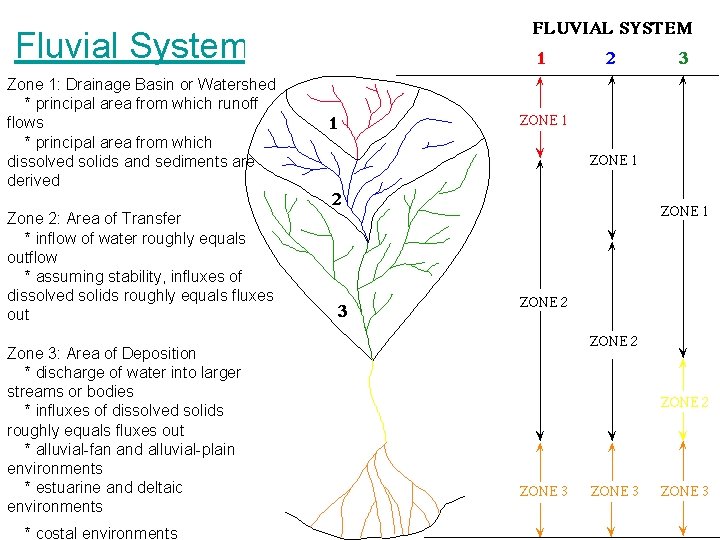
Fluvial System Zone 1: Drainage Basin or Watershed * principal area from which runoff flows * principal area from which dissolved solids and sediments are derived Zone 2: Area of Transfer * inflow of water roughly equals outflow * assuming stability, influxes of dissolved solids roughly equals fluxes out Zone 3: Area of Deposition * discharge of water into larger streams or bodies * influxes of dissolved solids roughly equals fluxes out * alluvial-fan and alluvial-plain environments * estuarine and deltaic environments * costal environments
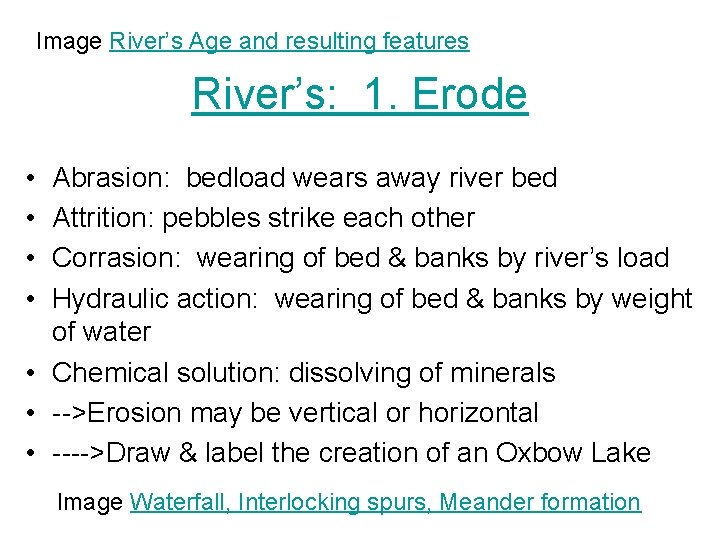
Image River’s Age and resulting features River’s: 1. Erode • • Abrasion: bedload wears away river bed Attrition: pebbles strike each other Corrasion: wearing of bed & banks by river’s load Hydraulic action: wearing of bed & banks by weight of water • Chemical solution: dissolving of minerals • -->Erosion may be vertical or horizontal • ---->Draw & label the creation of an Oxbow Lake Image Waterfall, Interlocking spurs, Meander formation

River’s: 2. Transport • TRACTION: drags bedload • SUSPENSION: of light sediments (eg. Silt) • SOLUTION: dissolved chemicals

River’s 3. Deposit • Deposition is simply the laying down of sediments. SLIDESHOW REVIEW OF RIVERS

Types of drainage systems (geomorphology) • • • Dendritic drainage system Parallel drainage system Trellis drainage system Rectangular drainage system Radial drainage system Deranged drainage system Images of drainage systems

Alluvial Fan • Alluvial fans are fanshaped deposits of water-transported material (alluvium). They typically form at the base of topographic features where there is a marked break in slope.

Alluvial Fan - Death Valley, CA.
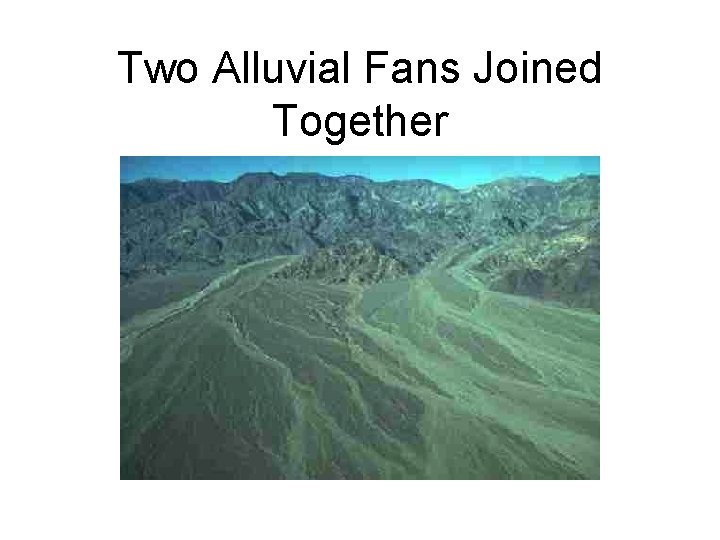
Two Alluvial Fans Joined Together

River Deltas • An accumulation of sediment at the mouth of a river extending beyond the trend of the adjacent coast is called a delta. Deltas vary greatly in both size and shape, but they all require that more sediment is deposited at the river mouth than can be carried away by coastal processes.

River Delta - Arcuate - Nile, Egypt Herodotus the great historian used this term for the Nile river delta because the sediment deposit at its mouth had the shape of upper-case Greek letter Delta: Δ.
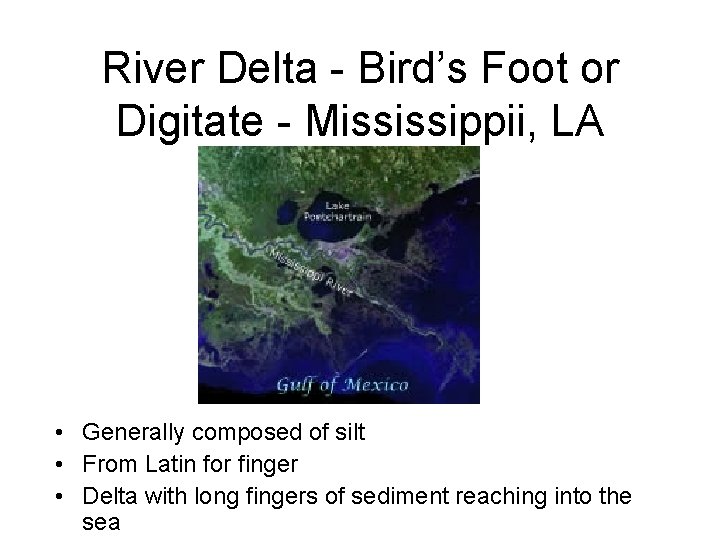
River Delta - Bird’s Foot or Digitate - Mississippii, LA • Generally composed of silt • From Latin for finger • Delta with long fingers of sediment reaching into the sea
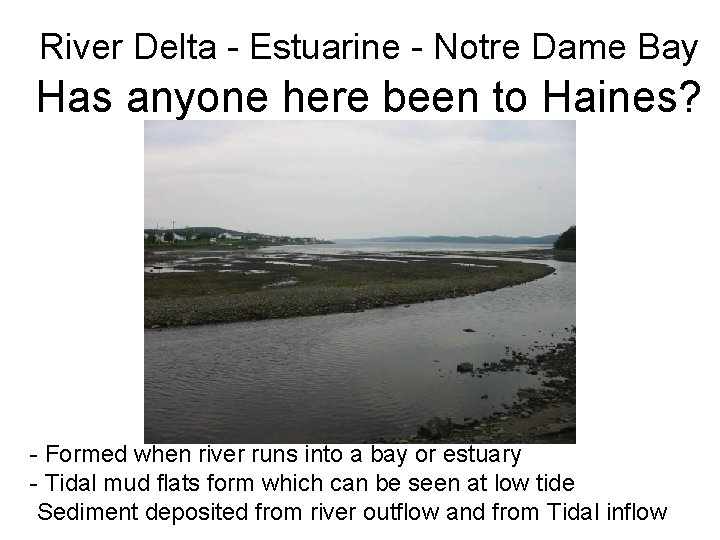
River Delta - Estuarine - Notre Dame Bay Has anyone here been to Haines? - Formed when river runs into a bay or estuary - Tidal mud flats form which can be seen at low tide Sediment deposited from river outflow and from Tidal inflow

With the aid of a labeled diagram, explain the formation of a scree/talus slope. • INCLUDE THE TERMS: – Scree/Talus – Weathering – Temperature Changes (exfoliation) – Frost Action – Deposition – Angular/Rounded
- Slides: 20