
GR How Did Greek Playwrights Use Tragedy To


- Slides: 40
GRΣΣΚ How Did Greek Playwrights Use Tragedy To Communicate Important Truths About Human Beings and the World?
Ask Yourself WHAT IS A TRAGEDY?
DID YOU SAY Tragedy is anything that is very sad.
Tragedy is a Genre of literature What other genres can you think of? Genres are similar to SOME OF the categories at the video store. But many of those are not literary genres Literary Genres include Comedy, Tragi. Comedy, The Novel, Epic Poetry, The Short Story, etc…
The Genre of Tragedy is Defined Mainly by the Tragic Hero. This is a person of ordinary but good character who suffers a “fall” or reversal of fortune. The important thing is that the tragic hero’s fall cannot be due to external factors; it must be the result of some tragic flaw (or hamartia) within himself.
The Tragic Flaw, or Hamartia The Tragic Flaw is NOT a Bad Quality. Rather, it is usually a strength, a good quality that the Tragic Hero possesses in excess or that he relies on too much. Sometimes, the tragic flaw is some sort of blindness.
The Tragic Flaw Do Romeo and Juliet have a tragic flaw? Or are their deaths due primarily to external factors?
Protagonist-Antagonist A Tragedy has a main character, referred to as the Protagonist--specifically a character undergoing a dramatic change of fortune, or peripeteia. Literally, the word protagonist means “first or chief actor. ” The antagonist is the character who is opposed to the main character. This is not usually his enemy, but someone who presents obstacles to the protagonist.
Technically… Today, a tragedy could be a play or a work of poetry or prose fiction which centers on the story of a tragic hero. However, when we use the word Tragedy in its technical, literary sense, we are usually talking about plays. The genre of tragedy is still defined mainly by a small number of plays which were written in Athens about 2, 500 years ago.
ARISTOTLE’S POETICS Aristotle's Poetics is the most influential analysis of tragedy and most of our ideas about it come from this little text— even though few of his “principles” apply to literature written even in his own time. The Poetics dates from about 335 BCE. It is a philosophical analysis of what Aristotle calls 'poetry‘, which he uses to mean “imitations” through the use of writing. Imitations of what? Of actions. Aristotle breaks down “poetry” into different genres, which he analyzes using his typical method of the four causes. The poetics seems to be incomplete and most of the short text deals with tragedy.
Tragedy and the Polis (City-State) In Athens and other Greek City-States all citizens were required to attend the annual festival of Dionysius in early Spring—a contest among three playwrights, who presented their works on three successive days. Each playwright would prepare three tragedies, plus an unrelated concluding comic piece called a satyr play.
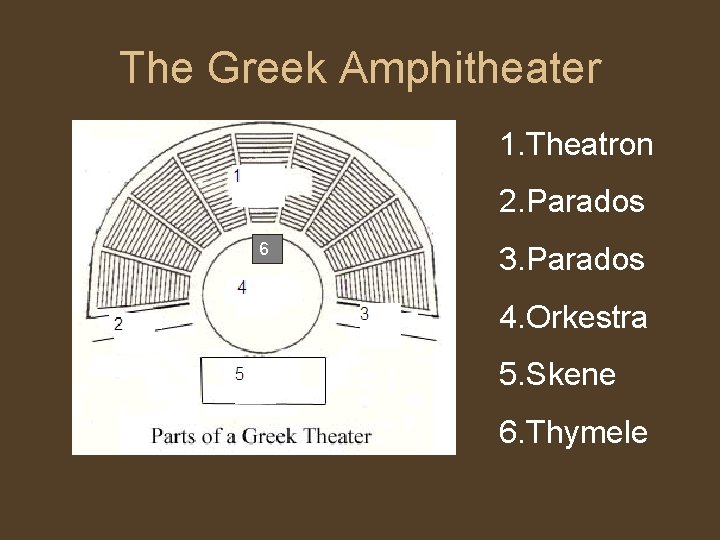
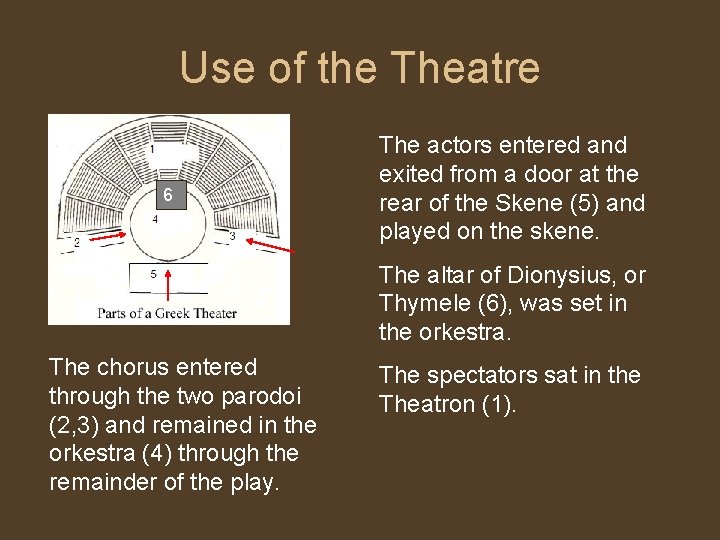
The Greek Amphitheater 1. Theatron 2. Parados 6 3. Parados 4. Orkestra 5. Skene 6. Thymele
The Greek Amphitheater
The Greek Amphitheater
The Festival of Dionysius The plays performed at the Festival of Dionysius had to be based upon the Greek myths. Although the playwrights were expected to be creative in retelling the stories, they were not permitted to change the main points of the story. The citizens all knew these stories very well.
Etymology (Word Origin) Our word Tragedy comes from the Classical Greek τραγωδία, "song for the goat" This may point to the origin of Tragedy in very old religious festivals or competitions where a goat was sacrificed, or where a goat was presented as a prize to writer or actors of the best play.
Origins of Tragedy The earliest Tragedy probably grew out of chants and dances called dithyrambs, which honored the god Dionysus.
Dithyrambs These drunken, ecstatic performances were said to have been created by the satyrs, half-goat beings who surrounded Dionysus in his revelry. We don’t have any direct evidence; however, the dithyrambs were probably performed by large choruses of male dancers moving in step and chanting.
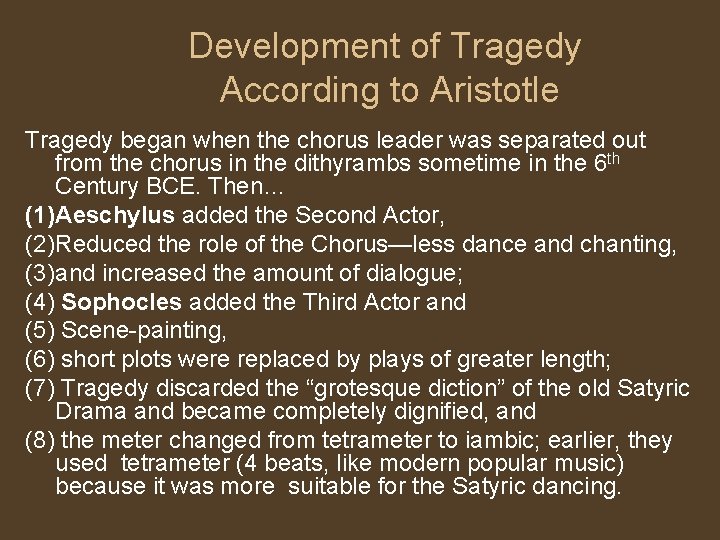
Development of Tragedy According to Aristotle Tragedy began when the chorus leader was separated out from the chorus in the dithyrambs sometime in the 6 th Century BCE. Then… (1)Aeschylus added the Second Actor, (2)Reduced the role of the Chorus—less dance and chanting, (3)and increased the amount of dialogue; (4) Sophocles added the Third Actor and (5) Scene-painting, (6) short plots were replaced by plays of greater length; (7) Tragedy discarded the “grotesque diction” of the old Satyric Drama and became completely dignified, and (8) the meter changed from tetrameter to iambic; earlier, they used tetrameter (4 beats, like modern popular music) because it was more suitable for the Satyric dancing.
The Structure of Greek Tragedy By the time of Sophocles, who was a contemporary of Plato, Greek Tragedy had a definite structure in which the chorus and the individual actors alternated. At times, there was some interaction between the chorus and the actors, but the actors did not appear in the Odes, or chorus sections.
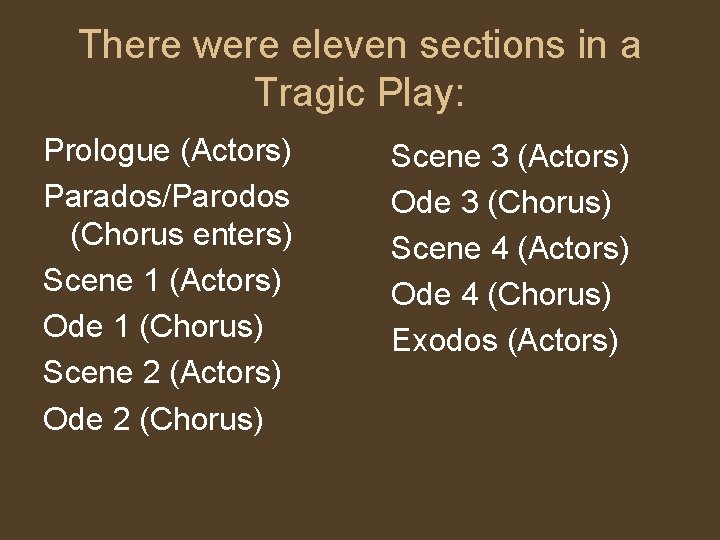
There were eleven sections in a Tragic Play: Prologue (Actors) Parados/Parodos (Chorus enters) Scene 1 (Actors) Ode 1 (Chorus) Scene 2 (Actors) Ode 2 (Chorus) Scene 3 (Actors) Ode 3 (Chorus) Scene 4 (Actors) Ode 4 (Chorus) Exodos (Actors)
The Chorus: Strophe and Antistrophe There is some dispute about the way that the chorus performed. The choral speeches are divided into strophes and antistrophes. Probably, the chorus danced in alternating directions while reciting their lines: strophe, antistrophe
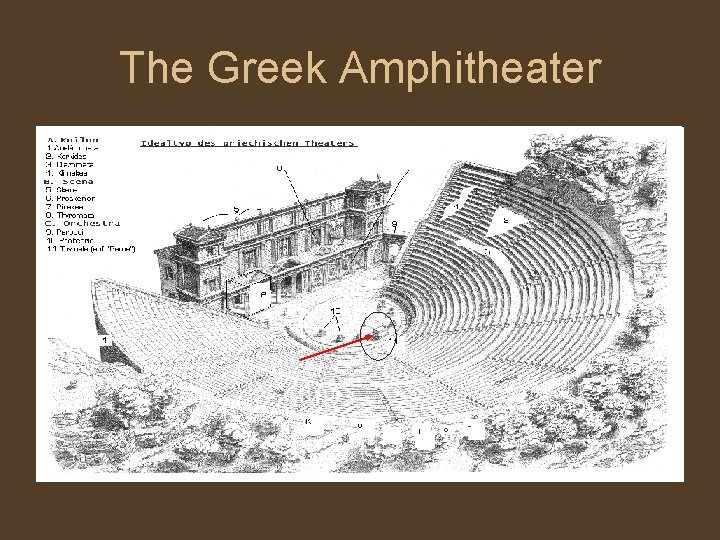
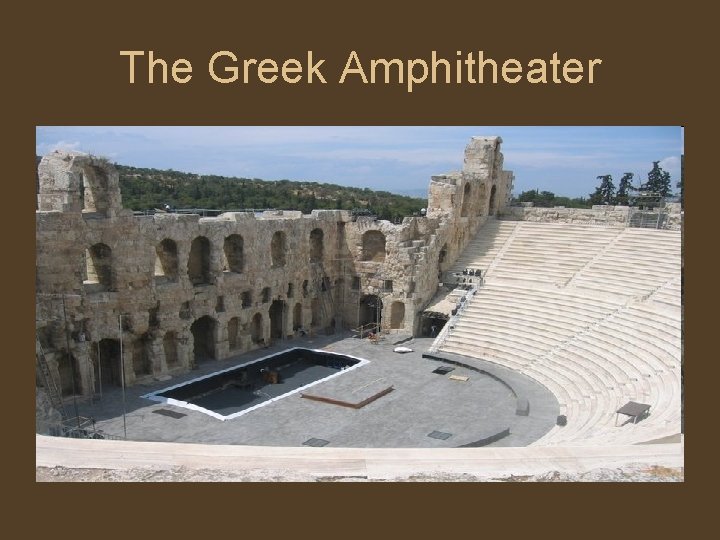
Use of the Theatre 6 The actors entered and exited from a door at the rear of the Skene (5) and played on the skene. The altar of Dionysius, or Thymele (6), was set in the orkestra. The chorus entered through the two parodoi (2, 3) and remained in the orkestra (4) through the remainder of the play. The spectators sat in the Theatron (1).
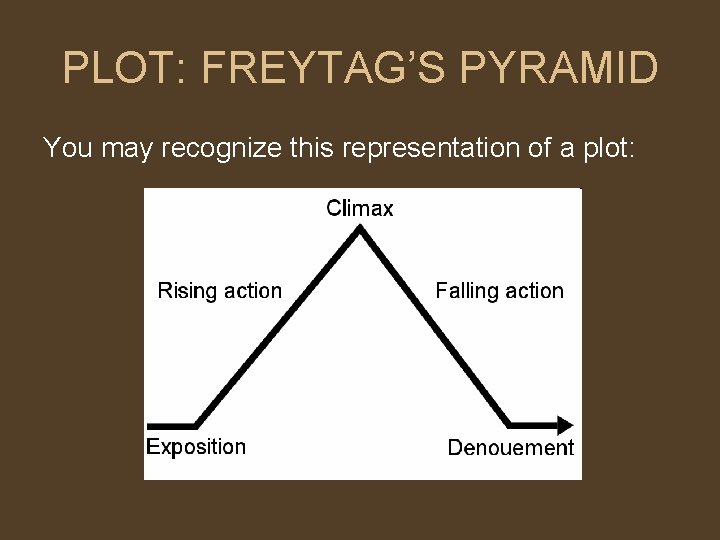
PLOT: FREYTAG’S PYRAMID You may recognize this representation of a plot:
PLOT: PERIPETEIA Aristotle’s terms from the Poetics a. Reversal or PERIPETEIA (Also spelled peripetea, Greek for "sudden change"): The sudden reversal of fortune in a story, play, or any narrative in which there is an observable change in direction. In tragedy, this is often a change from stability and happiness toward the destruction or downfall of the protagonist.
PLOT: ANAGNORISIS (Recogntion) AH – NAG – NO – REE - CEASE b. Discovery or ANAGNORISIS: (Greek for "recognition"): Aristotle uses this term in the Poetics to describe the moment of tragic recognition, in which the protagonist realizes some important fact or insight, especially a truth about himself, human nature, or his situation.
PLOT: ANAGNORISIS • Aristotle argues that the ideal moment for anagnorisis in a tragedy is the moment of peripeteia, the reversal of fortune. Sometimes the moment of tragic recognition is found within a single line of text, in which the tragic hero admits to his lack of insight or asserts the new truth he recognizes. This passage is often called the "line of tragic recognition. "
PLOT: CATASTROPHE c. Change of Fortune or CATASTROPHE: The "turning (strophe) downward (cata)" of the plot in a classical tragedy. By tradition, the catastrophe occurs in the fourth act of the play after the climax. d. Scene of Suffering. “The Scene of Suffering is a destructive or painful action, such as death on the stage, bodily agony, wounds, and the like. ” (Poetics 1. XI)
PLOT: CATHARSIS e. CATHARSIS: An emotional discharge that brings about a moral or spiritual renewal or welcome relief from tension and anxiety. The audience experiences the catharsis as a result of experiencing the tragic plot.
PLOT: CATHARSIS • According to Aristotle, catharsis is the distinguishing feature and the ultimate purpose of any tragic artistic work. He writes in his Poetics (c. 350 BCE): "Tragedy is an imitation of an action that is serious, complete, and of a certain magnitude; . . . through pity [eleos] and fear [phobos] effecting the proper purgation [catharsis] of these emotions" (Book 6. 2).
PLOT: CATHARSIS • In his works prior to Poetics, Aristotle had used the term catharsis purely in its medical sense (usually referring to the evacuation of the katamenia—the menstrual fluid or other reproductive material). Here, however, he employs it as a medical metaphor. F. L. Lucas maintains, therefore, that purification and cleansing are not proper translations for catharsis; that it should rather be rendered as purgation. "It is the human soul that is purged of its excessive passions. "[3]
Tragedy and Suffering All Tragedy is about human suffering.
Tragedy and Suffering Tragedy is training in accepting the limits of human life and the inevitability of suffering. According to Aristotle, the purpose of Tragedy in the Greek city-states was to effect an emotional catharsis in the audience--to purge pity and fear. These two emotions prevent people from doing their duty as citizens--specifically, the duties of killing and dying in war and serving as jurors who must punish criminals.
Tragedy and Truth Tragedy is connected both to the development of the individual and to the unity of the community. Tragedies focus on the individual, represented by the tragic hero. But tragedies also use the display of suffering to show the limits of the individual. This emphasizes and strengthens the community.
Additional Topics Related to Greek Tragedy and Oedipus Tyranos What is Dramatic Irony and why is it important in Oedipus the King?
The Unities: Action, Time, and Place. According to Aristotle an effective Tragedy had to focus on a single action, as opposed to the whole life of a person. Aristotle used the term episodic to refer to plays that were not unified on a single action, but had many episodes united by a single character. Notice, he did not call for unity of character.
The Unities: Action, Time, and Place. The unity of time is generally understood to mean that the events of a play should take place in real time, or at most should be compressed events from a single day.
The Unities: Action, Time, and Place. Unity of Place is what it sounds like: Aristotle argued that the events of the play should take place in a single place—such as in front of the palace of Thebes.
Discussion How is the definition of Greek Tragedy different from the way we use the word Tragedy in everyday speech?
Discussion Why did the ancient Athenians require citizens to attend Tragic plays?