
GPU programming Dr Bernhard Kainz 1 Overview Next
GPU programming Dr. Bernhard Kainz 1
Overview Next week Dr Bernhard Kainz This week • About myself • Motivation • GPU hardware and system architecture • GPU programming languages • GPU programming paradigms • Pitfalls and best practice • Reduction and tiling examples • State-of-the-art applications 2
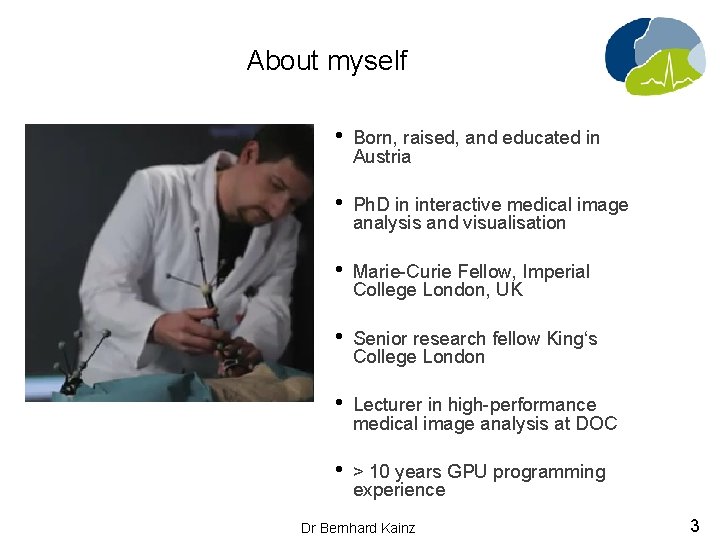
About myself • Born, raised, and educated in Austria • Ph. D in interactive medical image analysis and visualisation • Marie-Curie Fellow, Imperial College London, UK • Senior research fellow King‘s College London • Lecturer in high-performance medical image analysis at DOC • > 10 years GPU programming experience Dr Bernhard Kainz 3

History 4
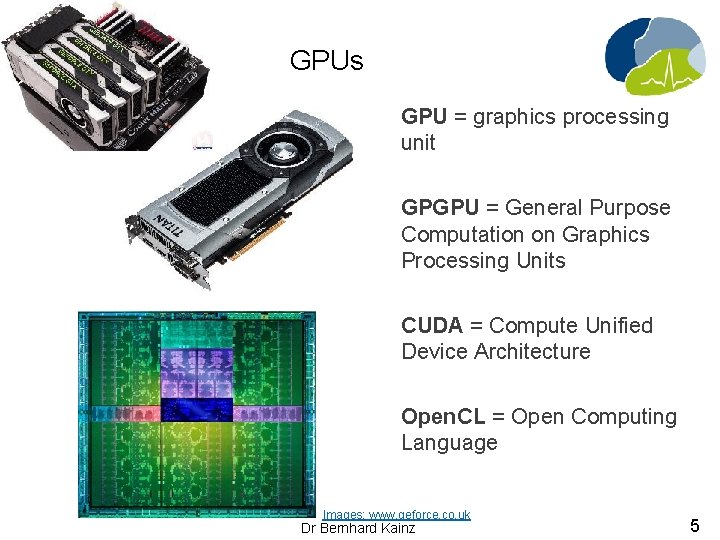
GPUs GPU = graphics processing unit GPGPU = General Purpose Computation on Graphics Processing Units CUDA = Compute Unified Device Architecture Open. CL = Open Computing Language Images: www. geforce. co. uk Dr Bernhard Kainz 5
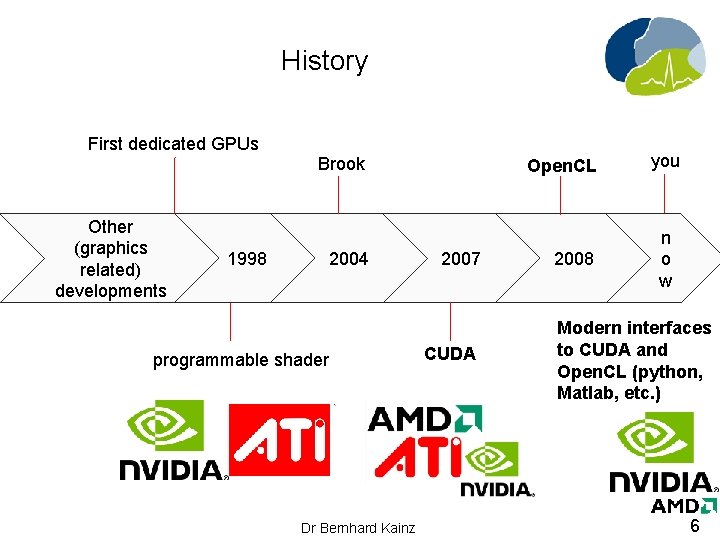
History First dedicated GPUs Other (graphics related) developments 1998 Brook 2004 programmable shader Dr Bernhard Kainz Open. CL 2007 CUDA 2008 you n o w Modern interfaces to CUDA and Open. CL (python, Matlab, etc. ) 6

Why GPUs became popular http: //www. computerhistory. org/timeline/graphics-games/ Dr Bernhard Kainz 7
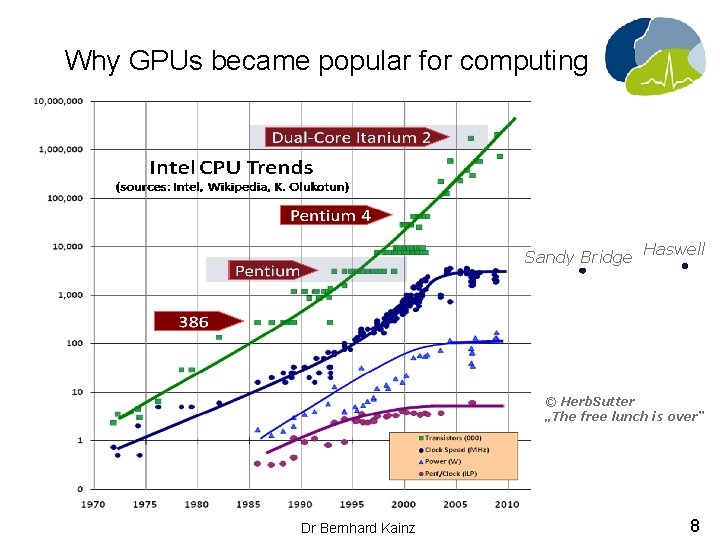
Why GPUs became popular for computing Sandy Bridge Haswell © Herb. Sutter „The free lunch is over“ Dr Bernhard Kainz 8
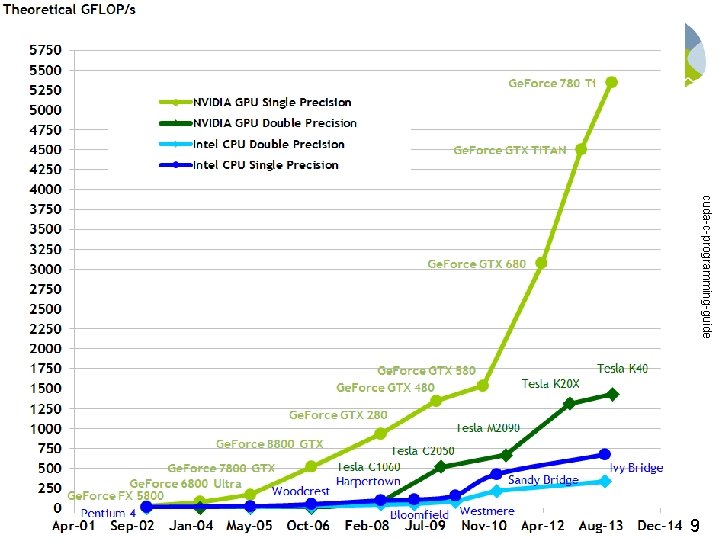
cuda-c-programming-guide 9 Dr Bernhard Kainz
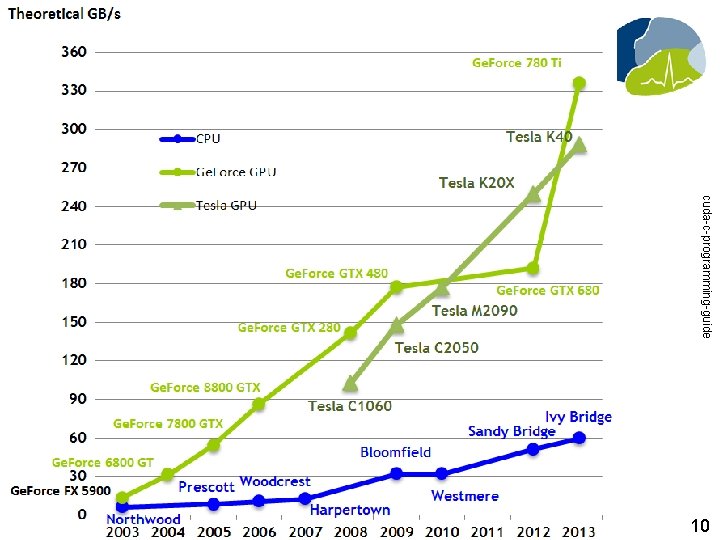
cuda-c-programming-guide 10 Dr Bernhard Kainz

Motivation 11
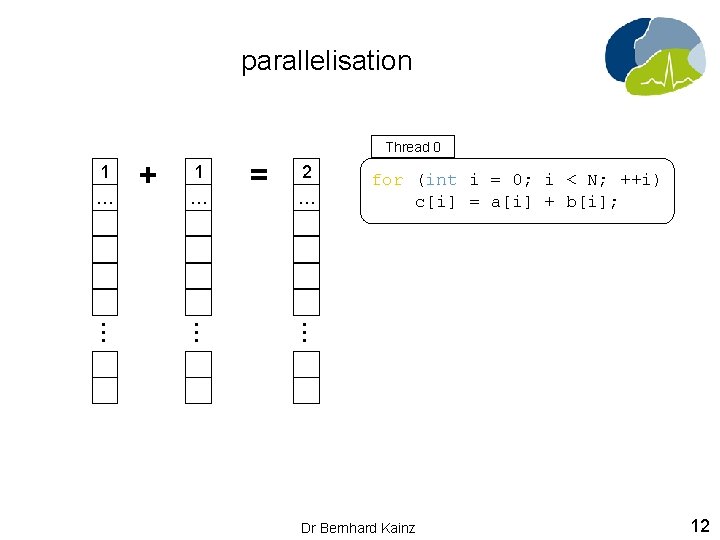
parallelisation Thread 0 1 … + 1 … = 2 … for (int i = 0; i < N; ++i) c[i] = a[i] + b[i]; … … … Dr Bernhard Kainz 12
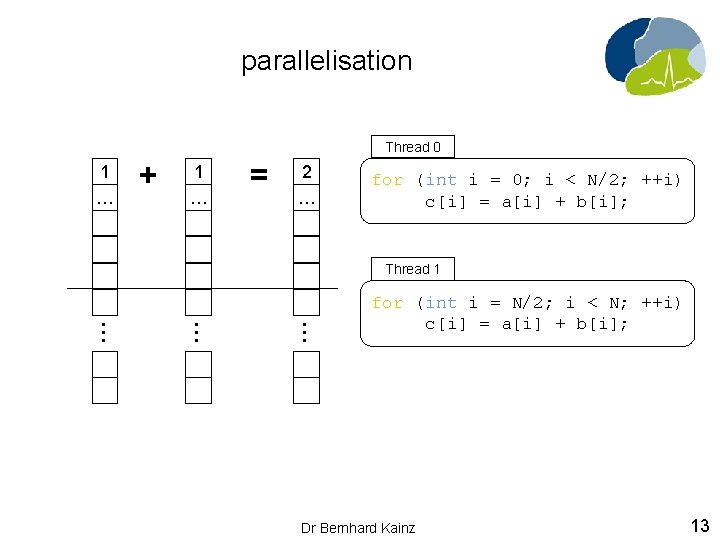
parallelisation Thread 0 1 … + 1 … = 2 … for (int i = 0; i < N/2; ++i) c[i] = a[i] + b[i]; Thread 1 … … … for (int i = N/2; i < N; ++i) c[i] = a[i] + b[i]; Dr Bernhard Kainz 13

parallelisation Thread 0 1 … + 1 … = 2 … for (int i = 0; i < N/3; ++i) c[i] = a[i] + b[i]; Thread 1 … … … for (int i = N/3; i < 2*N/3; ++i) c[i] = a[i] + b[i]; Thread 2 for (int i = 2*N/3; i < N; ++i) c[i] = a[i] + b[i]; Dr Bernhard Kainz 14
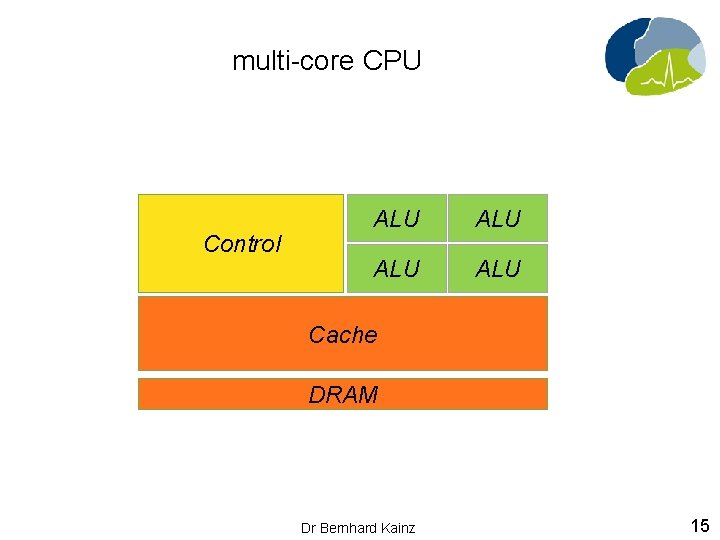
multi-core CPU Control ALU ALU Cache DRAM Dr Bernhard Kainz 15
![parallelisation 1 … + 1 … = 2 … c[0] c[1] c[2] c[3] c[4]](http://slidetodoc.com/presentation_image_h/cc7057e7111c09aa99a107712b05dccf/image-16.jpg "parallelisation 1 … + 1 … = 2 … c[0] c[1] c[2] c[3] c[4]")
parallelisation 1 … + 1 … = 2 … c[0] c[1] c[2] c[3] c[4] c[5] = = = a[0] a[1] a[2] a[3] a[4] a[5] + + + b[0]; b[1]; b[2]; b[3]; b[4]; b[5]; … … … c[N-1] = a[N-1] + b[N-1]; c[N] = a[N] + b[N]; Dr Bernhard Kainz 16

multi-core GPU DRAM Dr Bernhard Kainz 17

Terminology 18
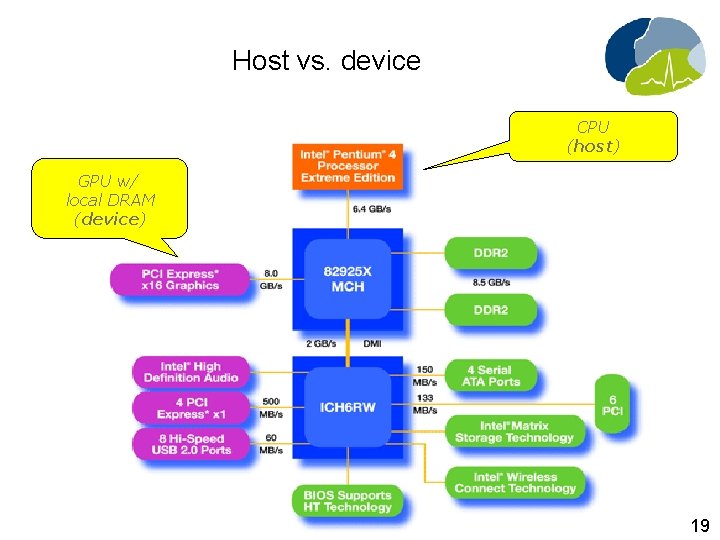
Host vs. device CPU (host) GPU w/ local DRAM (device) Dr Bernhard Kainz 19

multi-core GPU current schematic Nvidia Maxwell architecture Dr Bernhard Kainz 20
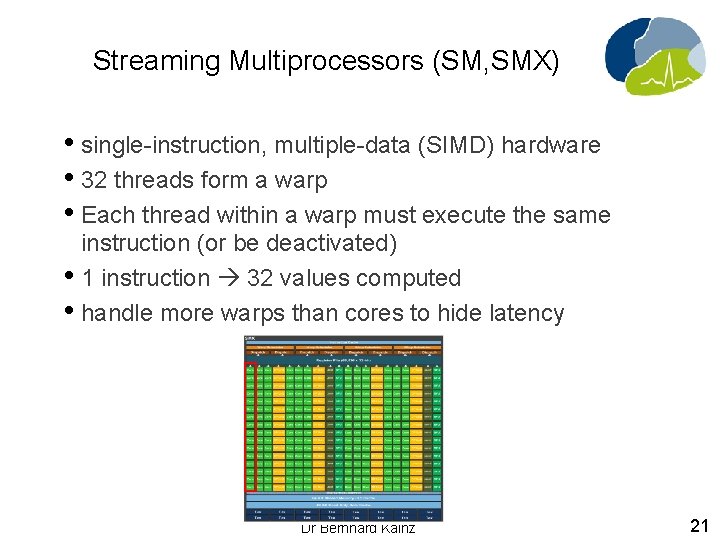
Streaming Multiprocessors (SM, SMX) • single-instruction, multiple-data (SIMD) hardware • 32 threads form a warp • Each thread within a warp must execute the same instruction (or be deactivated) • 1 instruction 32 values computed • handle more warps than cores to hide latency Dr Bernhard Kainz 21
Differences CPU-GPU • Threading resources - Host currently ~32 concurrent threads Device: smallest executable unit of parallelism: “Warp”: 32 thread 768 -1024 active threads per multiprocessor Device with 30 multiprocessors: > 30. 000 active threads Devices can hold billions of threads - Host: heavyweight entities, context switch expensive Device: lightweight threads If the GPU processor must wait for one warp of threads, it simply begins executing work on another Warp. • Threads • Memory - Host: equally accessible to all code Device: divided virtually and physically into different types Dr Bernhard Kainz 22
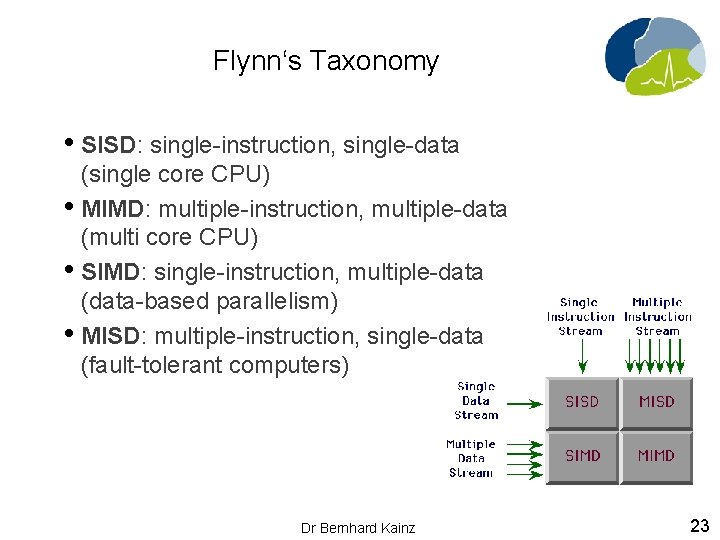
Flynn‘s Taxonomy • SISD: single-instruction, single-data (single core CPU) • MIMD: multiple-instruction, multiple-data (multi core CPU) • SIMD: single-instruction, multiple-data (data-based parallelism) • MISD: multiple-instruction, single-data (fault-tolerant computers) Dr Bernhard Kainz 23
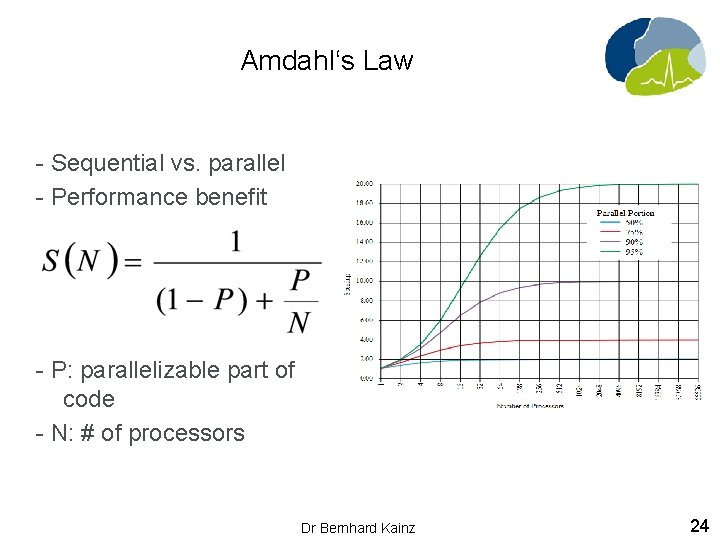
Amdahl‘s Law - Sequential vs. parallel - Performance benefit - P: parallelizable part of code - N: # of processors Dr Bernhard Kainz 24
SM Warp Scheduling - SM hardware implements zero overhead Warp scheduling - Warps whose next instruction has its operands ready for consumption are eligible for execution Eligible Warps are selected for execution on a prioritized scheduling policy All threads in a Warp execute the same instruction when selected - Currently: ready-queue and memory access score- boarding Thread and warp scheduling are active topics of research! Dr Bernhard Kainz 25
Programming GPUs 26
Programming languages • Open. CL (Open Computing Language): - Open. CL is an open, royalty-free, standard for crossplatform, parallel programming of modern processors An Apple initiative approved by Intel, Nvidia, AMD, etc. Specified by the Khronos group (same as Open. GL) It intends to unify the access to heterogeneous hardware accelerators - - CPUs (Intel i 7, …) GPUs (Nvidia GTX & Tesla, AMD/ATI 58 xx, …) What’s the difference to other languages? - Portability over Nvidia, ATI, S 3… platforms + CPUs Slow or no implementation of new/special hardware features Dr Bernhard Kainz 27
Programming languages • CUDA: - “Compute Unified Device Architecture” - - Nvidia GPUs only! Open source announcement Does not provide CPU fallback NVIDIA CUDA Forums – 26, 893 topics - AMD Open. CL Forums – 4, 038 topics - Stackoverflow CUDA Tag – 1, 709 tags - Stackoverflow Open. CL Tag – 564 tags - Raw math libraries in NVIDIA CUDA - CUBLAS, CUFFT, CULA, Magma new hardware features immediately available! Dr Bernhard Kainz 28
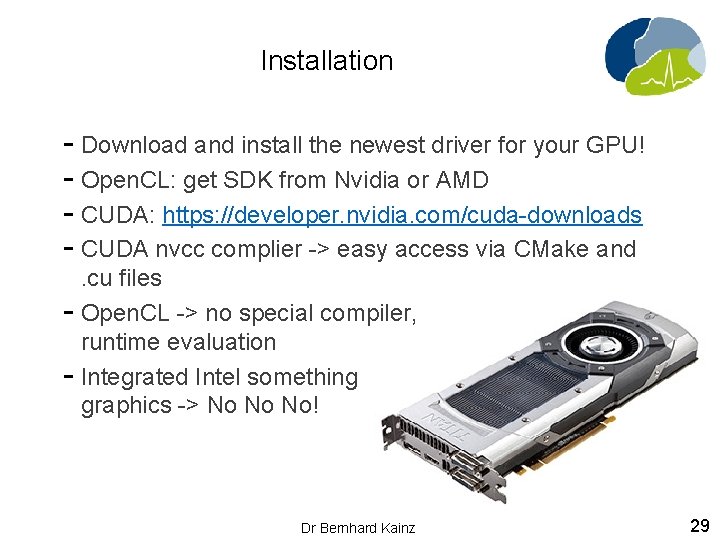
Installation - Download and install the newest driver for your GPU! - Open. CL: get SDK from Nvidia or AMD - CUDA: https: //developer. nvidia. com/cuda-downloads - CUDA nvcc complier -> easy access via CMake and - . cu files Open. CL -> no special compiler, runtime evaluation Integrated Intel something graphics -> No No No! Dr Bernhard Kainz 29
Writing parallel code • Current GPUs have > 3000 cores (GTX TITAN, Tesla K 80 etc. ) • Need more threads than cores (warp scheduler) • Writing different code for 10000 threads / 300 warps? Single-program, multiple-data (SPMD = SIMDI) model - Write one program that is executed by all threads Dr Bernhard Kainz 30
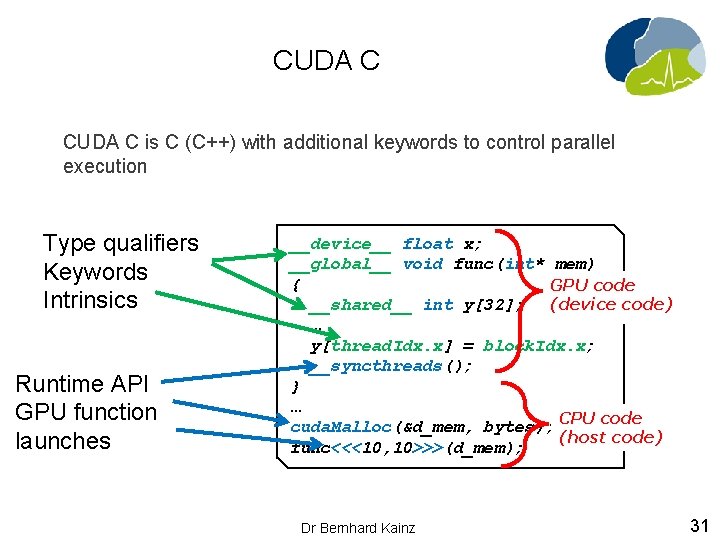
CUDA C is C (C++) with additional keywords to control parallel execution Type qualifiers Keywords Intrinsics Runtime API GPU function launches __device__ float x; __global__ void func(int* mem) { GPU code __shared__ (device code) __shared__ int y[32]; __constant__ … __device__ thread. Idx y[thread. Idx. x] = block. Idx. x; __syncthreads() block. Idx __any() __syncthreads(); } cuda. Set. Device cuda. Malloc … cuda. Malloc(&d_mem, bytes); CPU code (host code) func<<<10, 10>>>(d_mem); Dr Bernhard Kainz 31
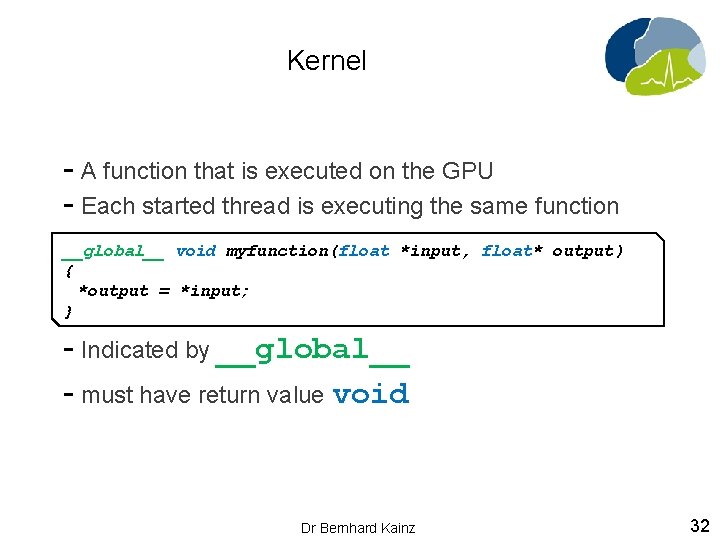
Kernel - A function that is executed on the GPU - Each started thread is executing the same function __global__ void myfunction(float *input, float* output) { *output = *input; } - Indicated by __global__ - must have return value void Dr Bernhard Kainz 32
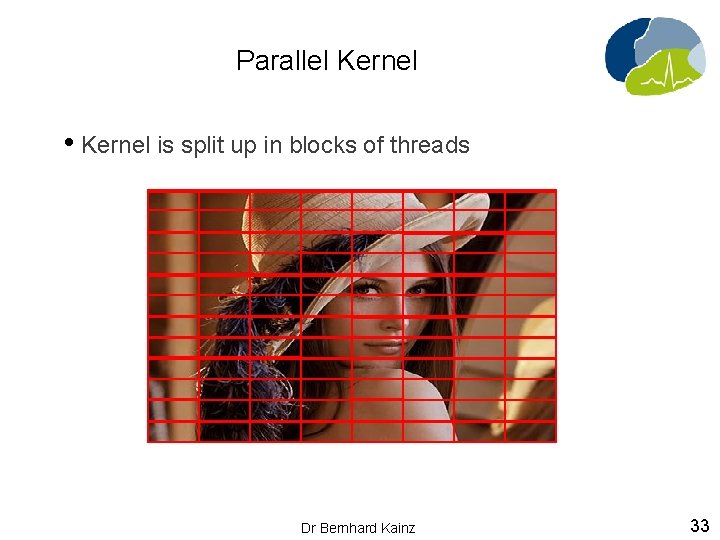
Parallel Kernel • Kernel is split up in blocks of threads Dr Bernhard Kainz 33
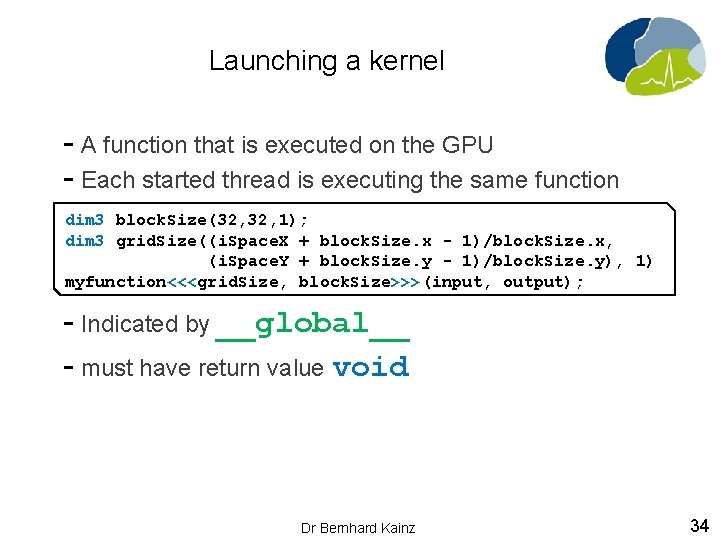
Launching a kernel - A function that is executed on the GPU - Each started thread is executing the same function dim 3 block. Size(32, 1); dim 3 grid. Size((i. Space. X + block. Size. x - 1)/block. Size. x, (i. Space. Y + block. Size. y - 1)/block. Size. y), 1) myfunction<<<grid. Size, block. Size>>>(input, output); - Indicated by __global__ - must have return value void Dr Bernhard Kainz 34
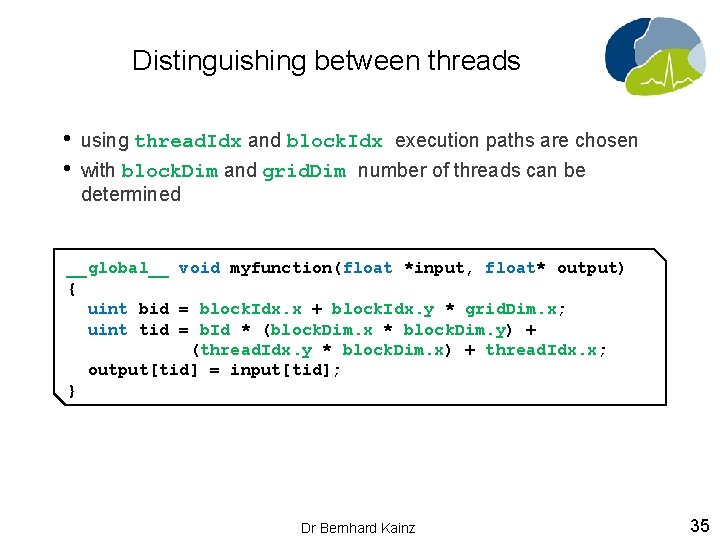
Distinguishing between threads • • using thread. Idx and block. Idx execution paths are chosen with block. Dim and grid. Dim number of threads can be determined __global__ void myfunction(float *input, float* output) { uint bid = block. Idx. x + block. Idx. y * grid. Dim. x; uint tid = b. Id * (block. Dim. x * block. Dim. y) + (thread. Idx. y * block. Dim. x) + thread. Idx. x; output[tid] = input[tid]; } Dr Bernhard Kainz 35
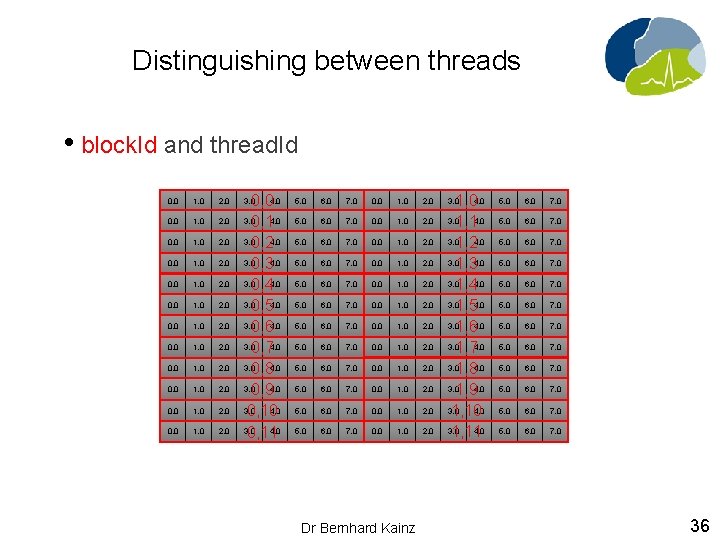
Distinguishing between threads • block. Id and thread. Id 5, 0 6, 0 7, 0 2, 0 3, 0 0, 0 1, 0 0, 04, 0 2, 0 1, 0 0, 0 3, 0 0, 0 1, 0 2, 0 3, 0 5, 0 6, 0 7, 0 2, 1 3, 10, 14, 0 0, 1 1, 1 1, 0 0, 0 1, 0 2, 0 3, 0 5, 0 6, 0 7, 0 0, 2 1, 2 2, 2 3, 20, 24, 0 0, 0 1, 0 0, 1 1, 1 2, 1 3, 1 0, 3 1, 3 2, 3 3, 30, 34, 0 0, 0 1, 0 2, 0 3, 0 5, 0 6, 0 7, 0 0, 1 1, 1 0, 0 1, 0 2, 0 3, 0 5, 0 6, 0 7, 0 0, 0 1, 0 2, 0 3, 0 0, 0 1, 00, 44, 0 0, 0 1, 0 0, 2 1, 2 2, 2 3, 2 1, 1 2, 1 3, 1 0, 0 1, 0 2, 0 3, 0 4, 0 5, 0 6, 0 7, 0 0, 1 1, 1 2, 1 3, 10, 50, 1 1, 1 0, 1 1, 1 0, 2 1, 2 2, 2 3, 20, 64, 0 0, 0 1, 0 2, 0 3, 0 5, 0 6, 0 7, 0 0, 0 1, 0 2, 3 1, 3 0, 3 3, 3 0, 3 1, 3 2, 3 3, 3 0, 0 1, 0 2, 0 3, 0 5, 0 6, 0 7, 0 0, 1 1, 1 0, 74, 0 0, 0 1, 0 2, 0 3, 0 5, 0 6, 0 7, 0 0, 0 1, 00, 84, 0 0, 0 1, 0 0, 4 1, 4 2, 4 3, 4 1, 1 2, 1 3, 1 0, 1 1, 1 2, 1 3, 1 0, 0 1, 0 2, 0 3, 0 4, 0 5, 0 6, 0 7, 0 0, 1 1, 10, 90, 1 1, 2 0, 2 1, 2 2, 2 3, 2 0, 0 1, 0 2, 0 3, 0 4, 0 5, 0 6, 0 7, 0 0, 0 1, 0 0, 10 0, 5 1, 5 2, 5 3, 5 0, 3 1, 3 2, 3 3, 3 0, 1 1, 1 0, 0 1, 0 2, 0 3, 0 4, 0 5, 0 6, 0 7, 0 0, 1 1, 1 0, 11 0, 0 1, 0 2, 0 0, 0 3, 0 1, 0 5, 0 6, 0 7, 0 2, 0 3, 0 0, 0 1, 04, 0 6, 0 5, 0 7, 0 0, 0 1, 0 2, 0 3, 0 5, 0 6, 0 7, 0 2, 1 3, 11, 14, 0 2, 1 3, 1 0, 1 1, 1 3, 0 2, 0 0, 0 1, 0 2, 0 3, 0 5, 0 6, 0 7, 0 0, 2 1, 2 2, 2 3, 21, 24, 0 0, 2 1, 2 2, 2 3, 2 0, 0 1, 0 4, 1 5, 13, 0 6, 15, 0 7, 17, 0 0, 3 1, 3 2, 3 3, 31, 34, 0 0, 0 1, 0 2, 0 6, 0 0, 3 1, 3 2, 3 3, 3 0, 1 1, 1 0, 0 1, 0 2, 0 3, 0 5, 0 6, 0 7, 0 0, 0 1, 0 2, 0 3, 0 0, 0 1, 01, 44, 0 0, 0 1, 0 6, 2 7, 2 4, 2 5, 2 0, 0 1, 0 2, 0 3, 0 5, 0 6, 0 7, 0 0, 1 1, 1 2, 1 3, 11, 54, 0 2, 1 3, 1 0, 1 1, 1 3, 1 2, 1 0, 2 1, 2 2, 2 3, 21, 64, 0 0, 2 1, 2 2, 2 3, 2 0, 0 1, 0 2, 0 3, 0 5, 0 6, 0 7, 0 0, 0 1, 0 5, 3 4, 3 6, 3 7, 3 0, 3 1, 3 2, 3 3, 31, 74, 0 0, 3 1, 3 2, 3 3, 3 0, 0 1, 0 2, 0 3, 0 5, 0 6, 0 7, 0 0, 1 1, 1 0, 0 1, 0 2, 0 3, 0 5, 0 6, 0 7, 0 0, 0 1, 01, 84, 0 0, 0 1, 0 5, 4 6, 4 7, 4 4, 4 0, 1 1, 1 2, 1 3, 1 0, 0 1, 0 2, 0 3, 0 4, 0 5, 0 6, 0 7, 0 0, 1 1, 11, 90, 1 1, 1 2, 2 3, 2 0, 2 1, 2 2, 2 3, 2 0, 0 1, 0 2, 0 3, 0 4, 0 5, 0 6, 0 7, 0 0, 0 1, 10 4, 5 5, 5 6, 5 7, 5 0, 3 1, 3 2, 3 3, 3 0, 1 1, 1 0, 0 1, 0 2, 0 3, 0 4, 0 5, 0 6, 0 7, 0 0, 1 1, 11 0, 0 1, 0 Dr Bernhard Kainz 2, 0 0, 0 3, 0 1, 0 36
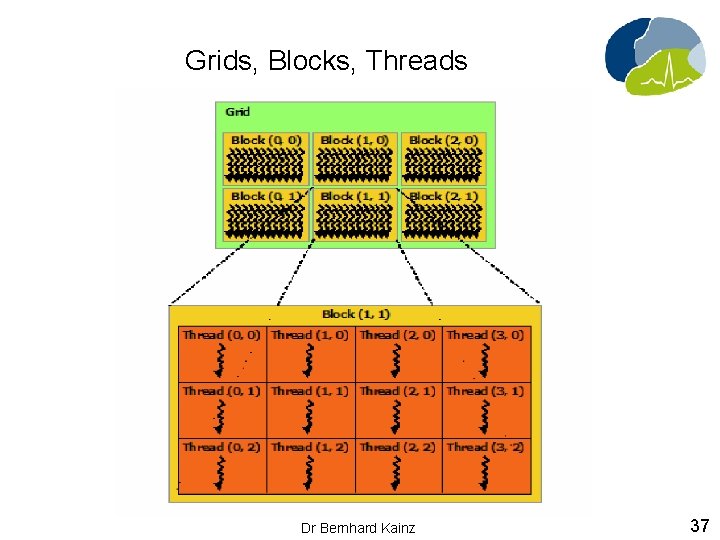
Grids, Blocks, Threads Dr Bernhard Kainz 37
Blocks • Threads within one block… - are executed together - can be synchronized - can communicate efficiently - share the same local cache can work on a goal cooperatively Dr Bernhard Kainz 38
Blocks • Threads of different blocks… - may be executed one after another - cannot synchronize on each other - can only communicate inefficiently should work independently of other blocks Dr Bernhard Kainz 39
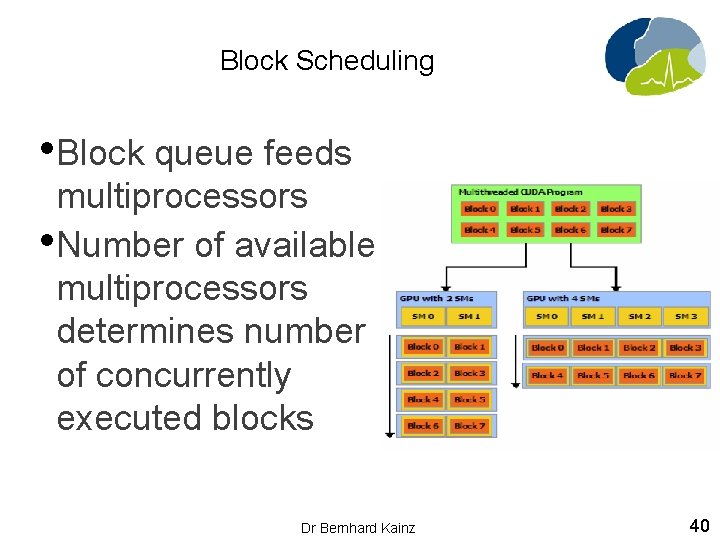
Block Scheduling • Block queue feeds multiprocessors • Number of available multiprocessors determines number of concurrently executed blocks Dr Bernhard Kainz 40
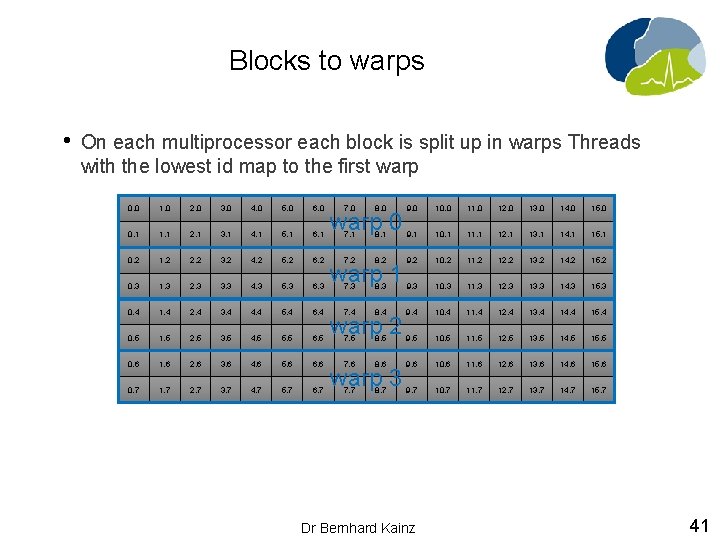
Blocks to warps • On each multiprocessor each block is split up in warps Threads with the lowest id map to the first warp 0, 0 1, 0 2, 0 3, 0 4, 0 5, 0 6, 0 0, 1 1, 1 2, 1 3, 1 4, 1 5, 1 6, 1 0, 2 1, 2 2, 2 3, 2 4, 2 5, 2 6, 2 0, 3 1, 3 2, 3 3, 3 4, 3 5, 3 6, 3 0, 4 1, 4 2, 4 3, 4 4, 4 5, 4 6, 4 0, 5 1, 5 2, 5 3, 5 4, 5 5, 5 6, 5 0, 6 1, 6 2, 6 3, 6 4, 6 5, 6 6, 6 0, 7 1, 7 2, 7 3, 7 4, 7 5, 7 6, 7 7, 0 8, 0 9, 0 10, 0 11, 0 12, 0 13, 0 14, 0 15, 0 7, 1 8, 1 9, 1 10, 1 11, 1 12, 1 13, 1 14, 1 15, 1 7, 2 8, 2 9, 2 10, 2 11, 2 12, 2 13, 2 14, 2 15, 2 7, 3 8, 3 9, 3 10, 3 11, 3 12, 3 13, 3 14, 3 15, 3 7, 4 8, 4 9, 4 10, 4 11, 4 12, 4 13, 4 14, 4 15, 4 7, 5 8, 5 9, 5 10, 5 11, 5 12, 5 13, 5 14, 5 15, 5 7, 6 8, 6 9, 6 10, 6 11, 6 12, 6 13, 6 14, 6 15, 6 7, 7 8, 7 9, 7 10, 7 11, 7 12, 7 13, 7 14, 7 15, 7 warp 0 warp 1 warp 2 warp 3 Dr Bernhard Kainz 41
Where to start • CUDA programming guide: • https: //docs. nvidia. com/cuda-c-programming-guide/ Open. CL http: //www. nvidia. com/content/cudazone/download/opencl /nvidia_opencl_programmingguide. pdf http: //developer. amd. com/tools-and-sdks/opencl-zone/ Dr Bernhard Kainz 42
GPU programming Dr. Bernhard Kainz 43
- Slides: 43