
GPU Hardware and CUDA Programming Martin Burtscher Department
GPU Hardware and CUDA Programming Martin Burtscher Department of Computer Science
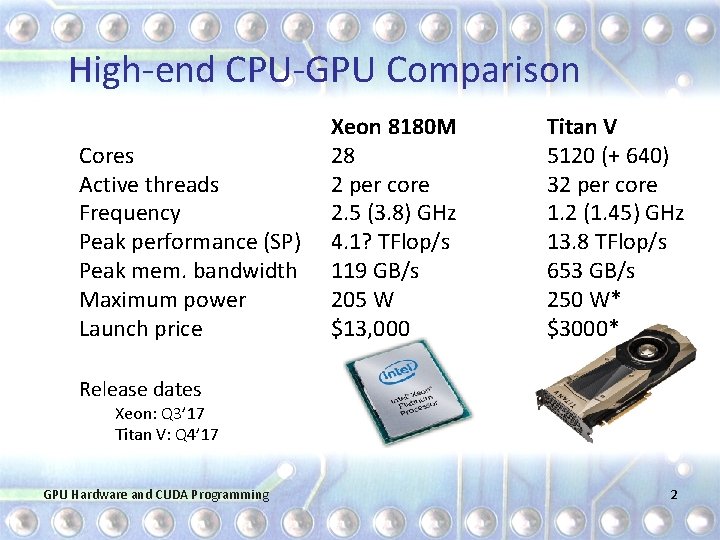
High-end CPU-GPU Comparison Cores Active threads Frequency Peak performance (SP) Peak mem. bandwidth Maximum power Launch price Xeon 8180 M 28 2 per core 2. 5 (3. 8) GHz 4. 1? TFlop/s 119 GB/s 205 W $13, 000 Titan V 5120 (+ 640) 32 per core 1. 2 (1. 45) GHz 13. 8 TFlop/s 653 GB/s 250 W* $3000* Release dates Xeon: Q 3’ 17 Titan V: Q 4’ 17 GPU Hardware and CUDA Programming 2
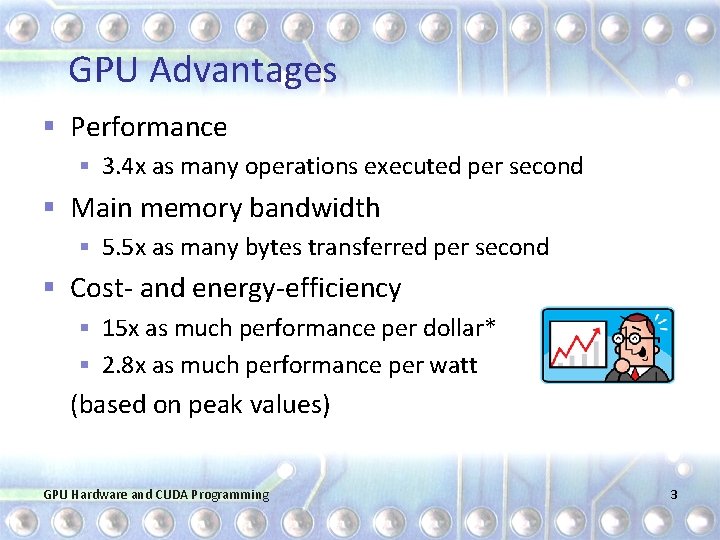
GPU Advantages § Performance § 3. 4 x as many operations executed per second § Main memory bandwidth § 5. 5 x as many bytes transferred per second § Cost- and energy-efficiency § 15 x as much performance per dollar* § 2. 8 x as much performance per watt (based on peak values) GPU Hardware and CUDA Programming 3
GPU Disadvantages § Clearly, we should be using GPUs all the time § So why aren’t we? § GPUs can only execute some types of code fast § Need lots of data parallelism, data reuse, & regularity § GPUs are harder to program and tune than CPUs § Mostly because of their architecture § Fewer tools and libraries exist GPU Hardware and CUDA Programming 4
Outline § § Introduction CUDA basics Programming model and architecture Implementation challenges GPU Hardware and CUDA Programming 5
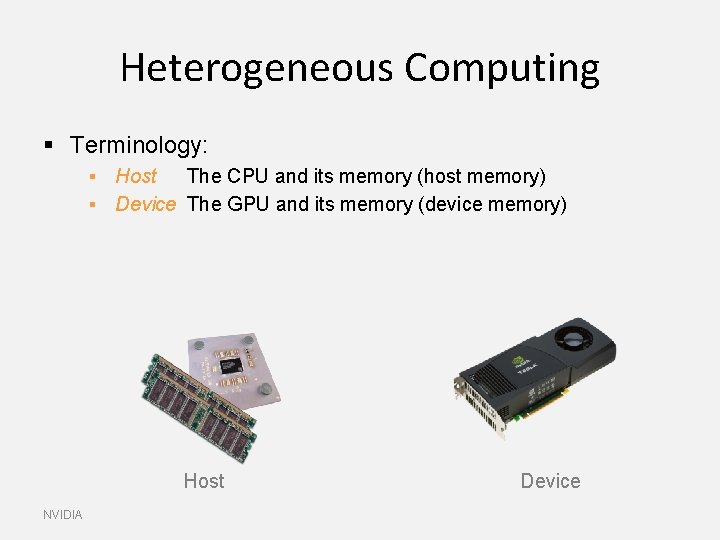
Heterogeneous Computing § Terminology: Host The CPU and its memory (host memory) § Device The GPU and its memory (device memory) § Host NVIDIA Device
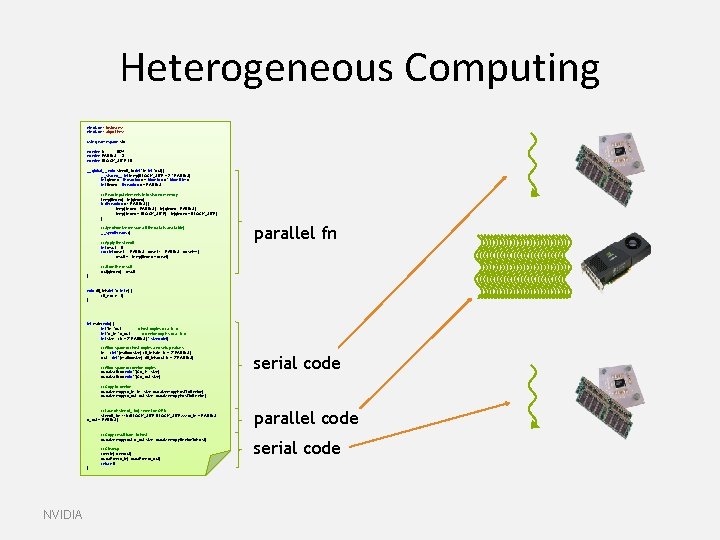
Heterogeneous Computing #include <iostream> #include <algorithm> using namespace std; #define N 1024 #define RADIUS 3 #define BLOCK_SIZE 16 __global__ void stencil_1 d(int *in, int *out) { __shared__ int temp[BLOCK_SIZE + 2 * RADIUS]; int gindex = thread. Idx. x + block. Idx. x * block. Dim. x; int lindex = thread. Idx. x + RADIUS; // Read input elements into shared memory temp[lindex] = in[gindex]; if (thread. Idx. x < RADIUS) { temp[lindex - RADIUS] = in[gindex - RADIUS]; temp[lindex + BLOCK_SIZE] = in[gindex + BLOCK_SIZE]; } // Synchronize (ensure all the data is available) __syncthreads(); // Apply the stencil int result = 0; for (int offset = -RADIUS ; offset <= RADIUS ; offset++) result += temp[lindex + offset]; parallel fn // Store the result out[gindex] = result; } void fill_ints(int *x, int n) { fill_n(x, n, 1); } int main(void) { int *in, *out; // host copies of a, b, c int *d_in, *d_out; // device copies of a, b, c int size = (N + 2*RADIUS) * sizeof(int); // Alloc space for host copies and setup values in = (int *)malloc(size); fill_ints(in, N + 2*RADIUS); out = (int *)malloc(size); fill_ints(out, N + 2*RADIUS); // Alloc space for device copies cuda. Malloc((void **)&d_in, size); cuda. Malloc((void **)&d_out, size); serial code // Copy to device cuda. Memcpy(d_in, size, cuda. Memcpy. Host. To. Device); cuda. Memcpy(d_out, size, cuda. Memcpy. Host. To. Device); // Launch stencil_1 d() kernel on GPU stencil_1 d<<<N/BLOCK_SIZE, BLOCK_SIZE>>>(d_in + RADIUS, d_out + RADIUS); // Copy result back to host cuda. Memcpy(out, d_out, size, cuda. Memcpy. Device. To. Host); // Cleanup free(in); free(out); cuda. Free(d_in); cuda. Free(d_out); return 0; } NVIDIA parallel code serial code
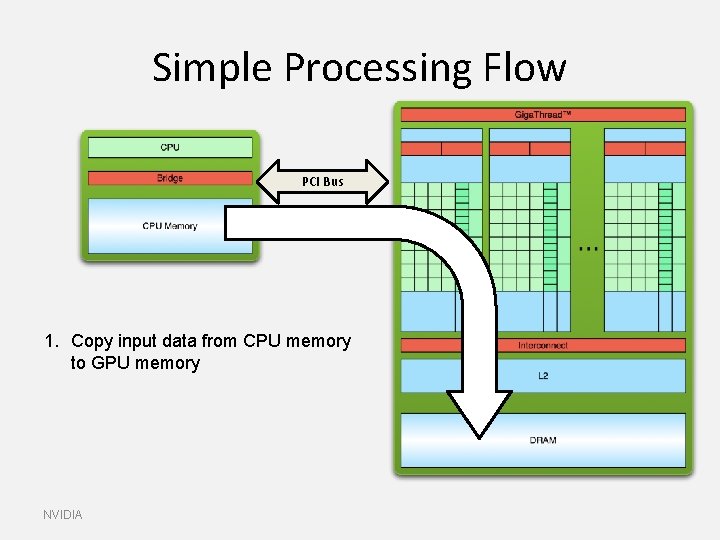
Simple Processing Flow PCI Bus 1. Copy input data from CPU memory to GPU memory NVIDIA
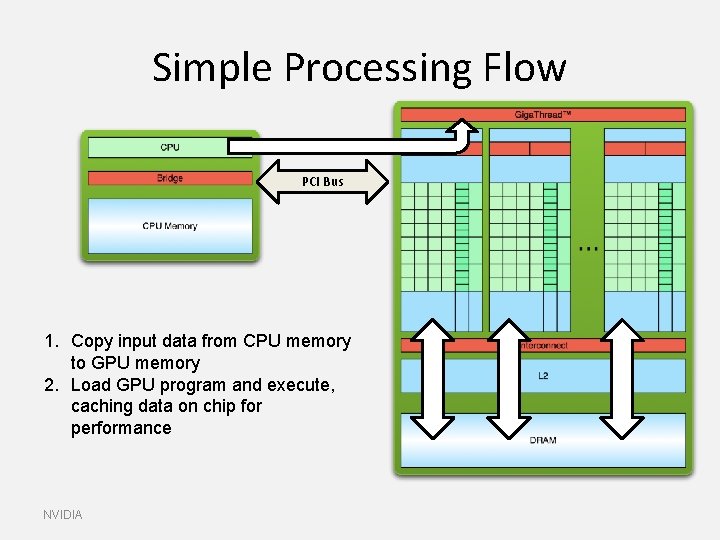
Simple Processing Flow PCI Bus 1. Copy input data from CPU memory to GPU memory 2. Load GPU program and execute, caching data on chip for performance NVIDIA
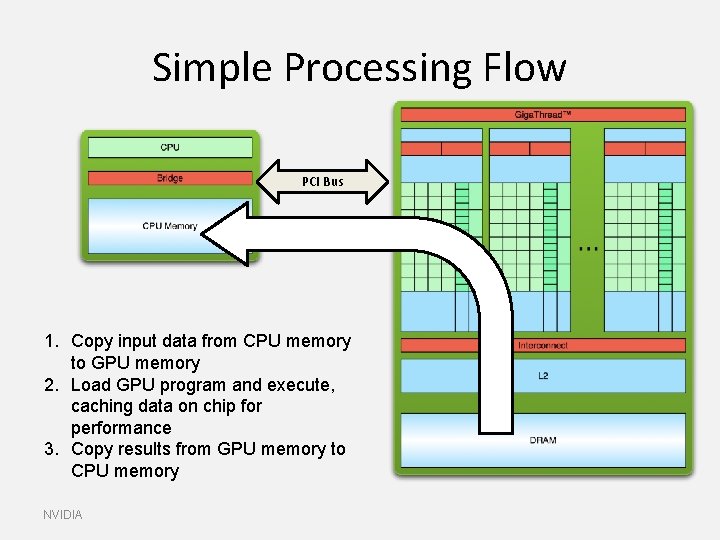
Simple Processing Flow PCI Bus 1. Copy input data from CPU memory to GPU memory 2. Load GPU program and execute, caching data on chip for performance 3. Copy results from GPU memory to CPU memory NVIDIA
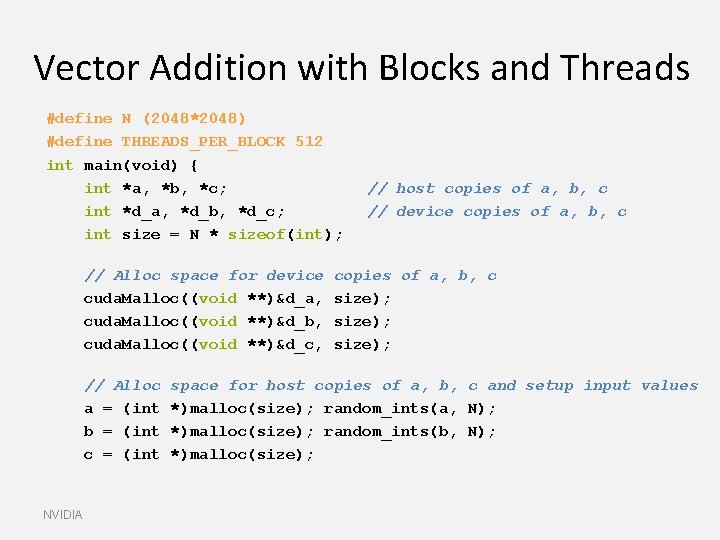
Vector Addition with Blocks and Threads #define N (2048*2048) #define THREADS_PER_BLOCK 512 int main(void) { int *a, *b, *c; int *d_a, *d_b, *d_c; int size = N * sizeof(int); // Alloc space for device cuda. Malloc((void **)&d_a, cuda. Malloc((void **)&d_b, cuda. Malloc((void **)&d_c, // Alloc a = (int b = (int c = (int NVIDIA // host copies of a, b, c // device copies of a, b, c size); space for host copies of a, b, c and setup input values *)malloc(size); random_ints(a, N); *)malloc(size); random_ints(b, N); *)malloc(size);
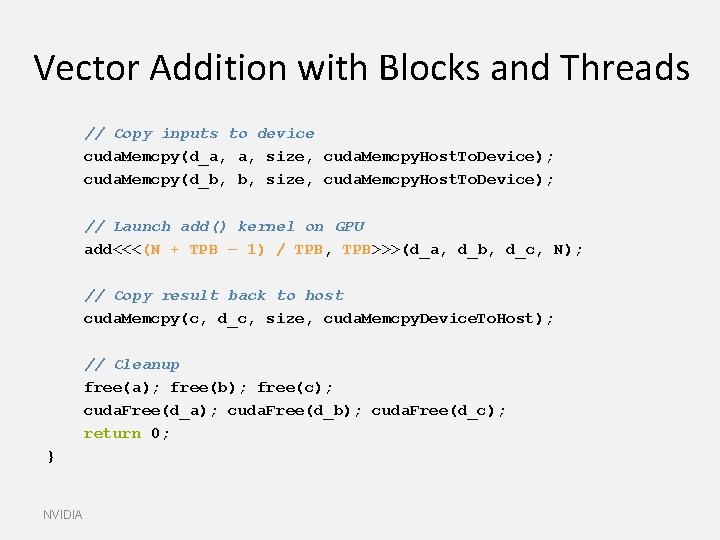
Vector Addition with Blocks and Threads // Copy inputs to device cuda. Memcpy(d_a, a, size, cuda. Memcpy. Host. To. Device); cuda. Memcpy(d_b, b, size, cuda. Memcpy. Host. To. Device); // Launch add() kernel on GPU add<<<(N + TPB – 1) / TPB, TPB>>>(d_a, d_b, d_c, N); // Copy result back to host cuda. Memcpy(c, d_c, size, cuda. Memcpy. Device. To. Host); // Cleanup free(a); free(b); free(c); cuda. Free(d_a); cuda. Free(d_b); cuda. Free(d_c); return 0; } NVIDIA
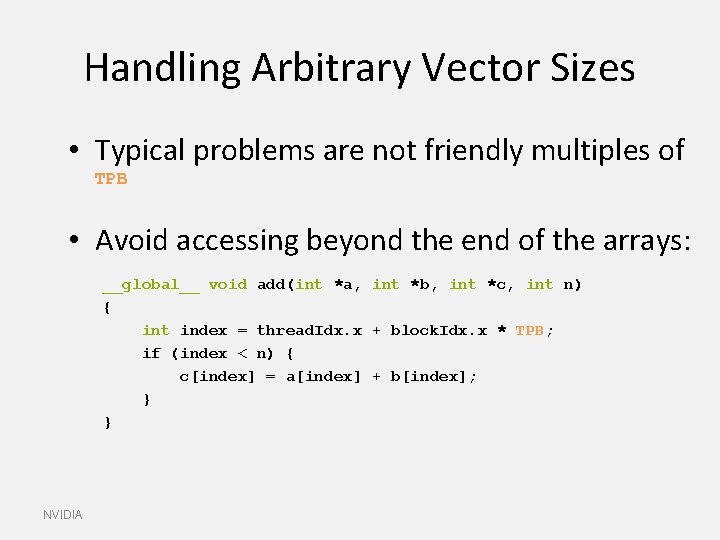
Handling Arbitrary Vector Sizes • Typical problems are not friendly multiples of TPB • Avoid accessing beyond the end of the arrays: __global__ void add(int *a, int *b, int *c, int n) { int index = thread. Idx. x + block. Idx. x * TPB; if (index < n) { c[index] = a[index] + b[index]; } } NVIDIA
Outline § § Introduction CUDA basics Programming model and architecture Implementation challenges GPU Hardware and CUDA Programming 14
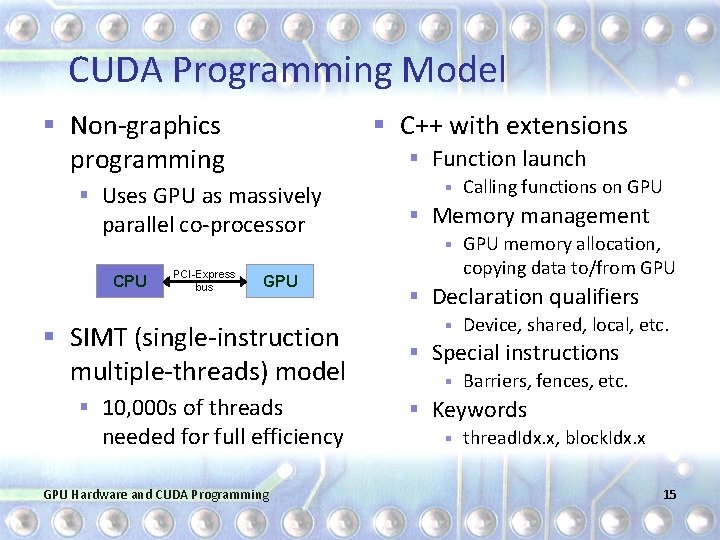
CUDA Programming Model § Non-graphics programming § C++ with extensions § Function launch § Uses GPU as massively parallel co-processor CPU PCI-Express bus GPU § SIMT (single-instruction multiple-threads) model § 10, 000 s of threads needed for full efficiency GPU Hardware and CUDA Programming § Calling functions on GPU § Memory management § GPU memory allocation, copying data to/from GPU § Declaration qualifiers § Device, shared, local, etc. § Special instructions § Barriers, fences, etc. § Keywords § thread. Idx. x, block. Idx. x 15
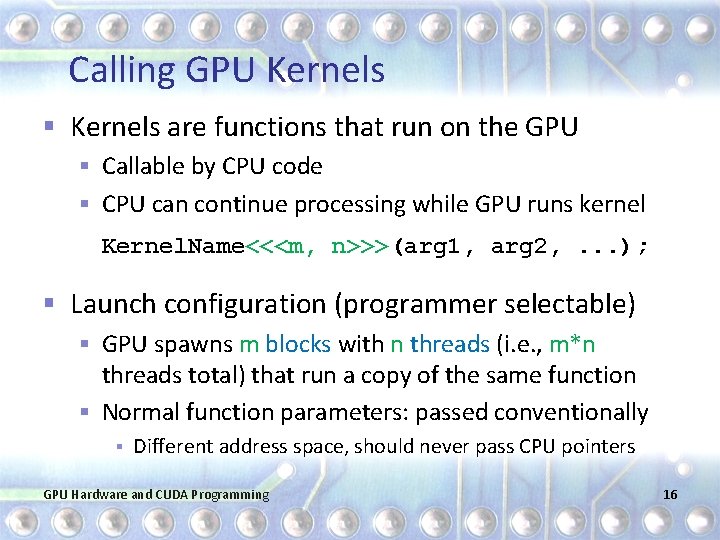
Calling GPU Kernels § Kernels are functions that run on the GPU § Callable by CPU code § CPU can continue processing while GPU runs kernel Kernel. Name<<<m, n>>>(arg 1, arg 2, . . . ); § Launch configuration (programmer selectable) § GPU spawns m blocks with n threads (i. e. , m*n threads total) that run a copy of the same function § Normal function parameters: passed conventionally § Different address space, should never pass CPU pointers GPU Hardware and CUDA Programming 16
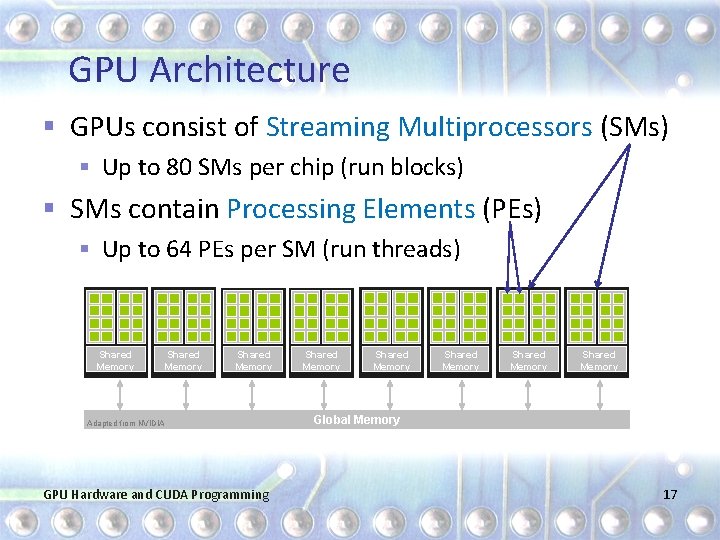
GPU Architecture § GPUs consist of Streaming Multiprocessors (SMs) § Up to 80 SMs per chip (run blocks) § SMs contain Processing Elements (PEs) § Up to 64 PEs per SM (run threads) Shared Memory Adapted from NVIDIA GPU Hardware and CUDA Programming Shared Memory Shared Memory Global Memory 17
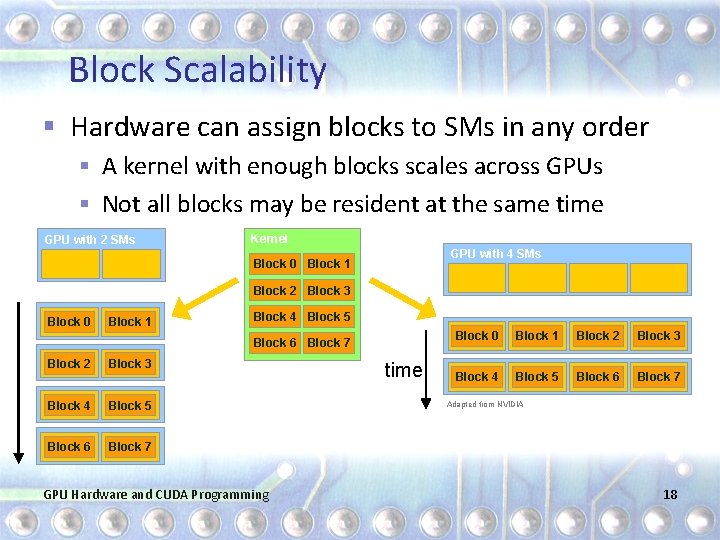
Block Scalability § Hardware can assign blocks to SMs in any order § A kernel with enough blocks scales across GPUs § Not all blocks may be resident at the same time GPU with 2 SMs Kernel GPU with 4 SMs Block 0 Block 1 Block 2 Block 3 Block 0 Block 1 Block 4 Block 5 Block 6 Block 7 Block 2 Block 3 Block 4 Block 5 Block 6 Block 7 GPU Hardware and CUDA Programming time Block 0 Block 1 Block 2 Block 3 Block 4 Block 5 Block 6 Block 7 Adapted from NVIDIA 18
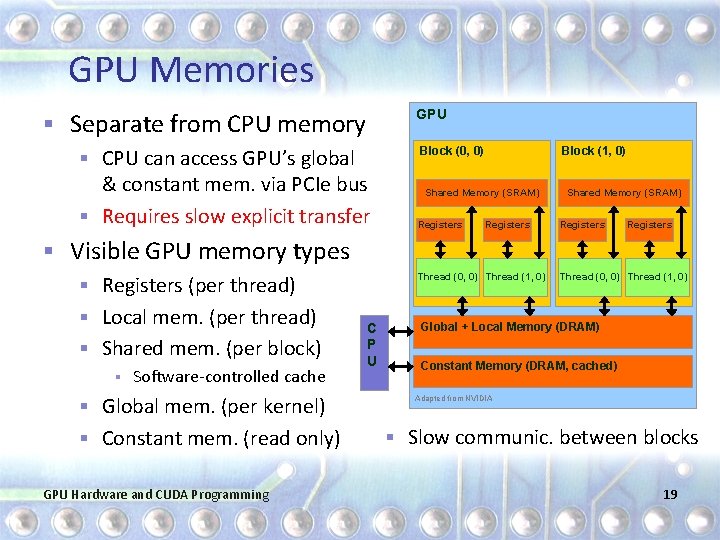
GPU Memories GPU § Separate from CPU memory § CPU can access GPU’s global Block (0, 0) & constant mem. via PCIe bus § Requires slow explicit transfer Block (1, 0) Shared Memory (SRAM) Registers § Visible GPU memory types Thread (0, 0) Thread (1, 0) § Registers (per thread) § Local mem. (per thread) § Shared mem. (per block) § Software-controlled cache § Global mem. (per kernel) § Constant mem. (read only) GPU Hardware and CUDA Programming C P U Thread (0, 0) Thread (1, 0) Global + Local Memory (DRAM) Constant Memory (DRAM, cached) Adapted from NVIDIA § Slow communic. between blocks 19
SM Internals § Caches § Software-controlled shared memory § Hardware-controlled incoherent L 1 data cache § Synchronization support § Fast hardware barrier within block (__syncthreads()) § Fence instructions: enforce ordering on mem. ops. § Special operations § Thread voting (warp-based reduction operations) GPU Hardware and CUDA Programming 20
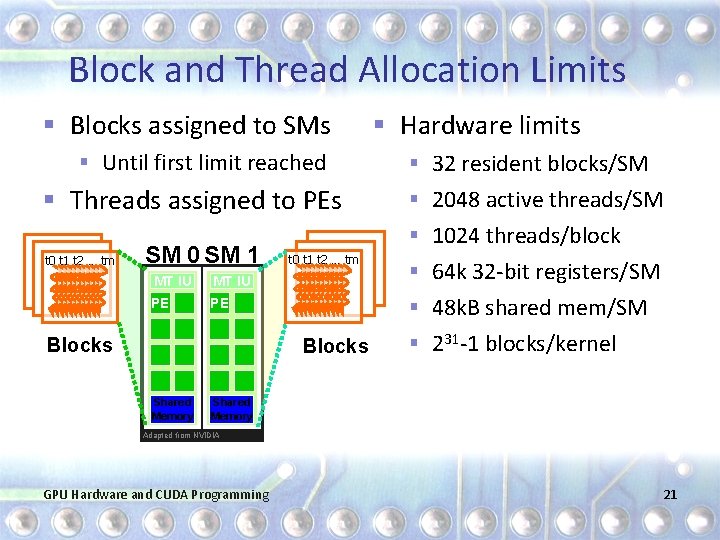
Block and Thread Allocation Limits § Blocks assigned to SMs § Until first limit reached § Threads assigned to PEs t 0 t 1 t 2 … tm SM 0 SM 1 MT IU PE PE Blocks § 32 resident blocks/SM § 2048 active threads/SM § 1024 threads/block t 0 t 1 t 2 … tm § 64 k 32 -bit registers/SM § 48 k. B shared mem/SM Blocks Shared Memory § Hardware limits § 231 -1 blocks/kernel Shared Memory Adapted from NVIDIA GPU Hardware and CUDA Programming 21
Warp-based Execution § 32 contiguous threads form a warp § Execute same instruction in same cycle (or disabled) § Warps are scheduled out-of-order with respect to each other to hide latencies § Thread divergence § Some threads in warp jump to different PC than others § Hardware runs subsets of warp until they re-converge § Results in reduction of parallelism (performance loss) GPU Hardware and CUDA Programming 22
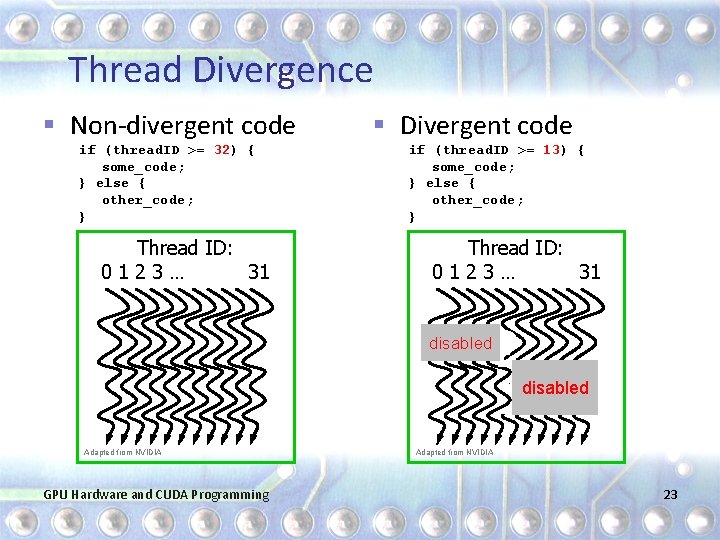
Thread Divergence § Non-divergent code if (thread. ID >= 32) { some_code; } else { other_code; } Thread ID: 0123… 31 § Divergent code if (thread. ID >= 13) { some_code; } else { other_code; } Thread ID: 0123… 31 disabled Adapted from NVIDIA GPU Hardware and CUDA Programming Adapted from NVIDIA 23
Parallel Memory Accesses § Coalesced main memory access § HW tries to combine multiple memory accesses of same warp into a single coalesced access § All accesses to the same 128 -byte aligned 128 -byte cache block are combined into a single transaction § Up to 32 x faster § Bank-conflict-free shared memory access § 32 independent banks § No superword alignment or contiguity requirements § 32 different banks + one-word broadcast each GPU Hardware and CUDA Programming 24
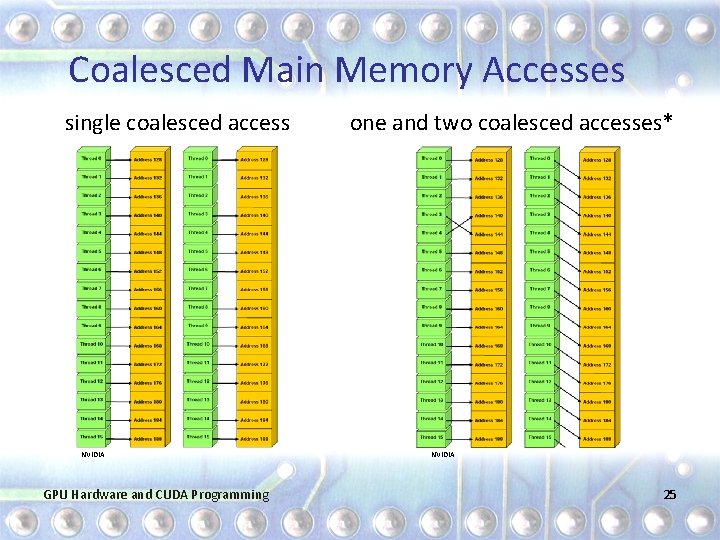
Coalesced Main Memory Accesses single coalesced access NVIDIA GPU Hardware and CUDA Programming one and two coalesced accesses* NVIDIA 25
Outline § § Introduction CUDA basics Programming model and architecture Implementation challenges GPU Hardware and CUDA Programming 26
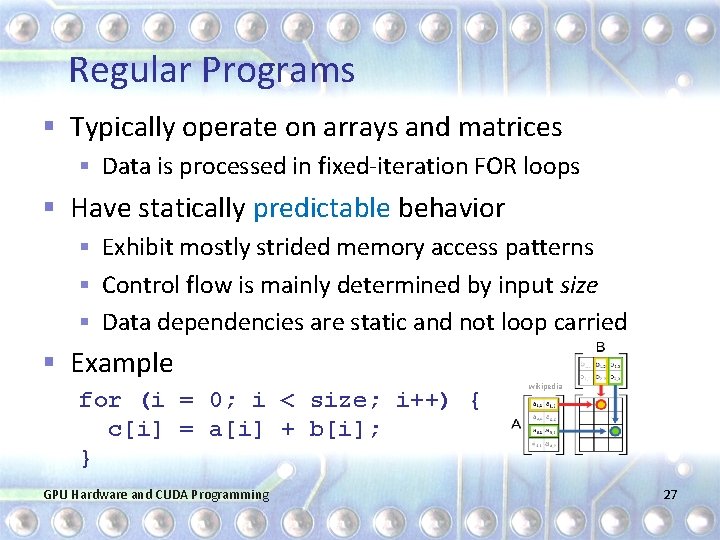
Regular Programs § Typically operate on arrays and matrices § Data is processed in fixed-iteration FOR loops § Have statically predictable behavior § Exhibit mostly strided memory access patterns § Control flow is mainly determined by input size § Data dependencies are static and not loop carried § Example for (i = 0; i < size; i++) { c[i] = a[i] + b[i]; } GPU Hardware and CUDA Programming wikipedia 27
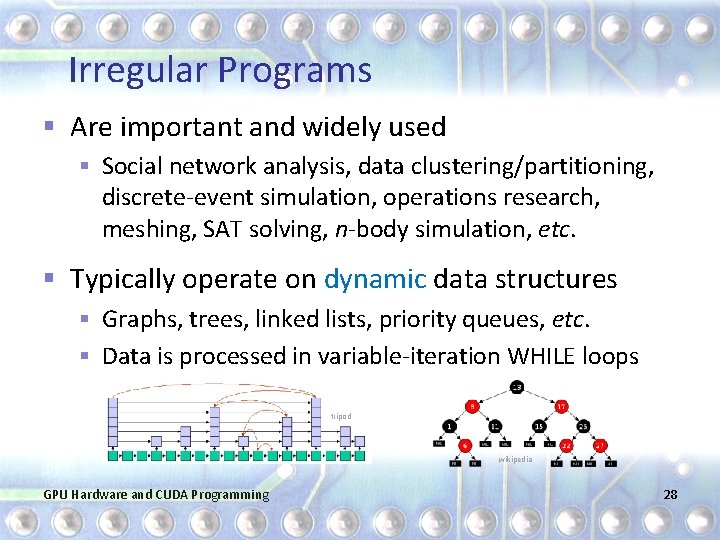
Irregular Programs § Are important and widely used § Social network analysis, data clustering/partitioning, discrete-event simulation, operations research, meshing, SAT solving, n-body simulation, etc. § Typically operate on dynamic data structures § Graphs, trees, linked lists, priority queues, etc. § Data is processed in variable-iteration WHILE loops tripod wikipedia GPU Hardware and CUDA Programming 28
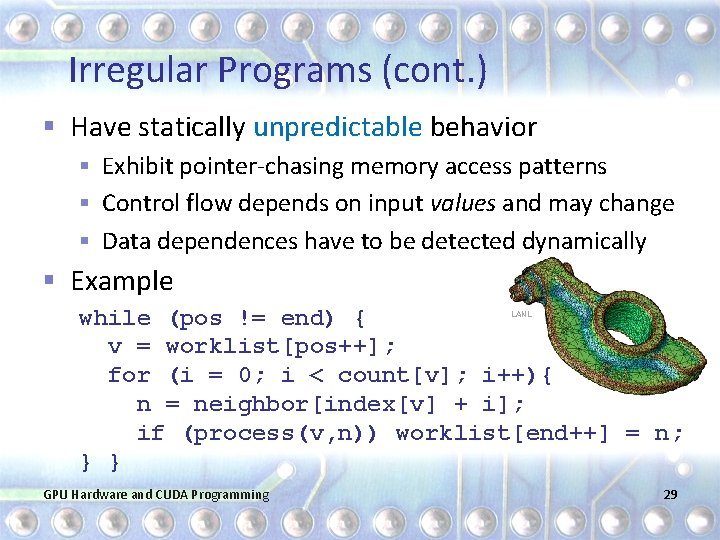
Irregular Programs (cont. ) § Have statically unpredictable behavior § Exhibit pointer-chasing memory access patterns § Control flow depends on input values and may change § Data dependences have to be detected dynamically § Example while (pos != end) { v = worklist[pos++]; for (i = 0; i < count[v]; i++){ n = neighbor[index[v] + i]; if (process(v, n)) worklist[end++] = n; } } LANL GPU Hardware and CUDA Programming 29
Mapping (Ir-)Regular Code to GPUs § Many regular codes are easy to port to GPUs § E. g. , matrix codes executing many ops/word Dense matrix operations (level 2 and 3 BLAS) § Stencil codes (PDE solvers) § LLNL § Many irregular codes are difficult to port to GPUs § E. g. , data-dependent graph codes Sparse graph operations (DMR, DES) § Tree operations (BST) § FSU GPU Hardware and CUDA Programming 30
GPU Implementation Challenges § Indirect and irregular memory accesses § Little or no coalescing [low bandwidth] § Memory-bound pointer chasing § Little locality and computation [exposed latency] § Dynamically changing irregular control flow § Thread divergence [loss of parallelism] § Input dependent and changing data parallelism § Load imbalance [loss of parallelism] GPU Hardware and CUDA Programming 31
- Slides: 31