
GPSGNSS Fundamentals and Field Mapping NRS 524 University
- Slides: 42
GPS/GNSS Fundamentals and Field Mapping NRS 524 University of Rhode Island January 27, 2020 Dennis Skidds National Park Service CIK 016, URI Kingston, RI (401) 874 -4305 dennis_skidds@nps. gov 1
Fundamentals 1. Why, Who, and How 2. Sources of Positional Error 3. Reducing Positional Error 4. Features and Attributes 5. Documentation and Archiving 2
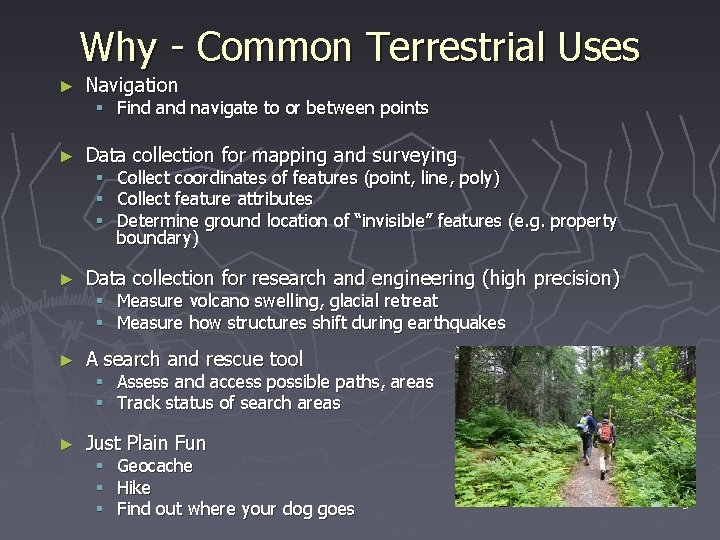
Why - Common Terrestrial Uses ► Navigation ► Data collection for mapping and surveying § Find and navigate to or between points § § § Collect coordinates of features (point, line, poly) Collect feature attributes Determine ground location of “invisible” features (e. g. property boundary) ► Data collection for research and engineering (high precision) ► A search and rescue tool ► Just Plain Fun § Measure volcano swelling, glacial retreat § Measure how structures shift during earthquakes § Assess and access possible paths, areas § Track status of search areas § § § Geocache Hike Find out where your dog goes 3
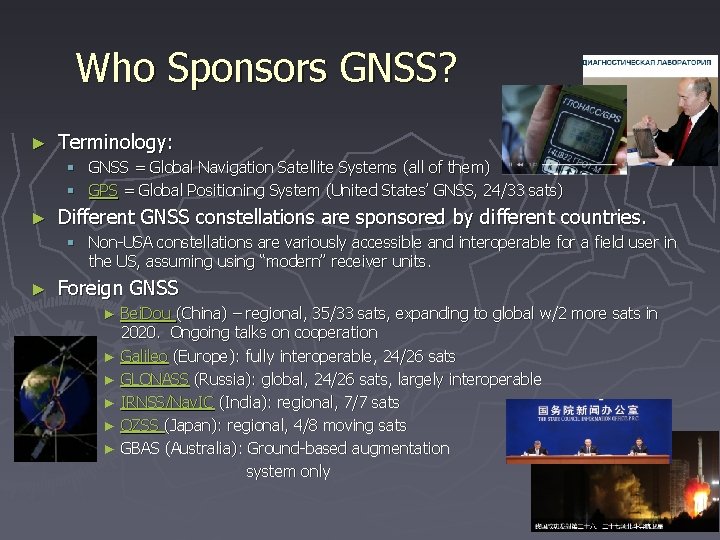
Who Sponsors GNSS? ► Terminology: § GNSS = Global Navigation Satellite Systems (all of them) § GPS = Global Positioning System (United States’ GNSS, 24/33 sats) ► Different GNSS constellations are sponsored by different countries. § Non-USA constellations are variously accessible and interoperable for a field user in the US, assuming using “modern” receiver units. ► Foreign GNSS Bei. Dou (China) – regional, 35/33 sats, expanding to global w/2 more sats in 2020. Ongoing talks on cooperation ► Galileo (Europe): fully interoperable, 24/26 sats ► GLONASS (Russia): global, 24/26 sats, largely interoperable ► IRNSS/Nav. IC (India): regional, 7/7 sats ► QZSS (Japan): regional, 4/8 moving sats ► GBAS (Australia): Ground-based augmentation system only ►
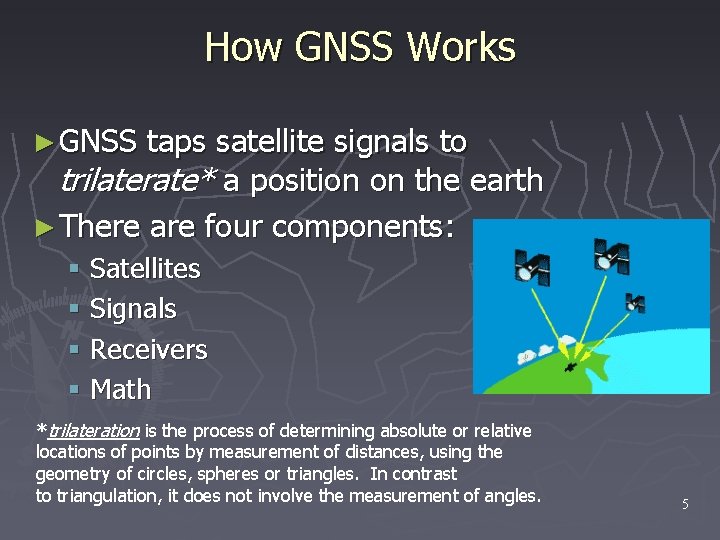
How GNSS Works ► GNSS taps satellite signals to trilaterate* a position on the earth ► There are four components: § Satellites § Signals § Receivers § Math *trilateration is the process of determining absolute or relative locations of points by measurement of distances, using the geometry of circles, spheres or triangles. In contrast to triangulation, it does not involve the measurement of angles. 5
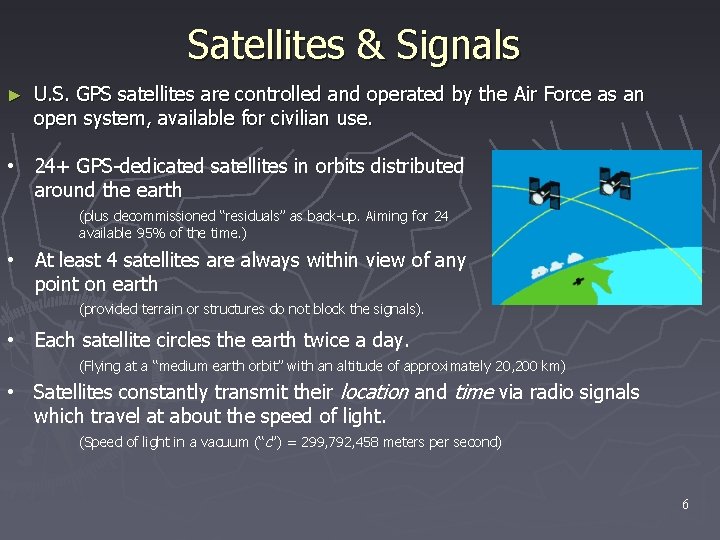
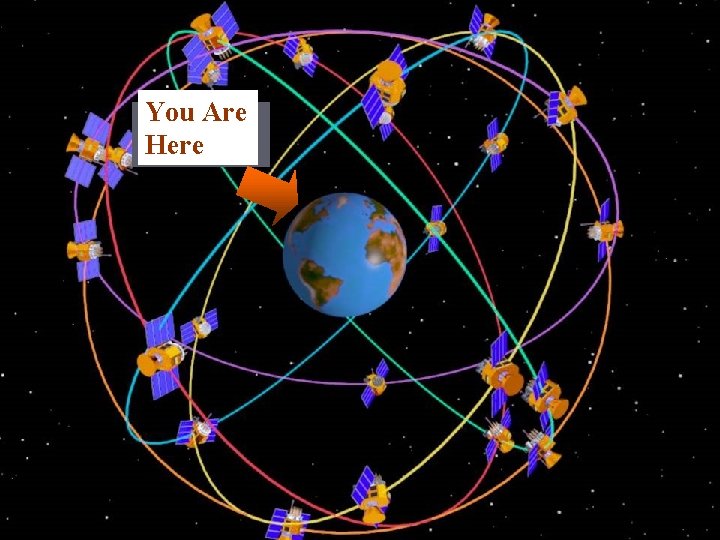
Satellites & Signals ► U. S. GPS satellites are controlled and operated by the Air Force as an open system, available for civilian use. • 24+ GPS-dedicated satellites in orbits distributed around the earth (plus decommissioned “residuals” as back-up. Aiming for 24 available 95% of the time. ) • At least 4 satellites are always within view of any point on earth (provided terrain or structures do not block the signals). • Each satellite circles the earth twice a day. (Flying at a “medium earth orbit” with an altitude of approximately 20, 200 km) • Satellites constantly transmit their location and time via radio signals which travel at about the speed of light. (Speed of light in a vacuum (“c”) = 299, 792, 458 meters per second) 6
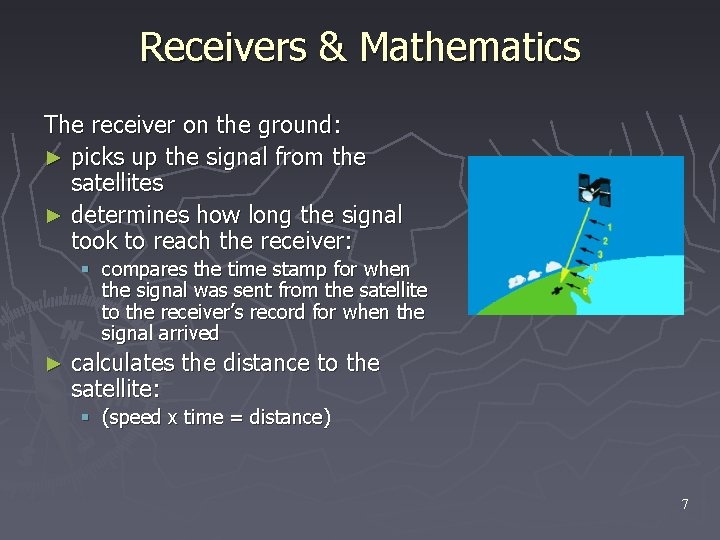
Receivers & Mathematics The receiver on the ground: ► picks up the signal from the satellites ► determines how long the signal took to reach the receiver: § compares the time stamp for when the signal was sent from the satellite to the receiver’s record for when the signal arrived ► calculates the distance to the satellite: § (speed x time = distance) 7
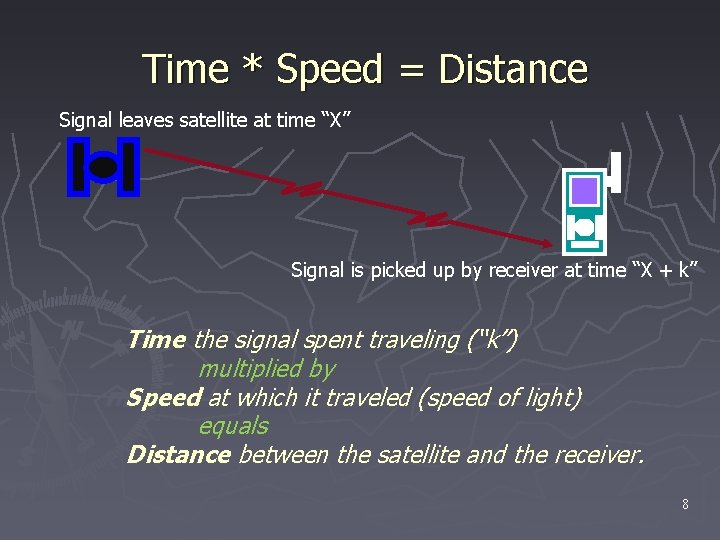
Time * Speed = Distance Signal leaves satellite at time “X” Signal is picked up by receiver at time “X + k” Time the signal spent traveling (“k”) multiplied by Speed at which it traveled (speed of light) equals Distance between the satellite and the receiver. 8
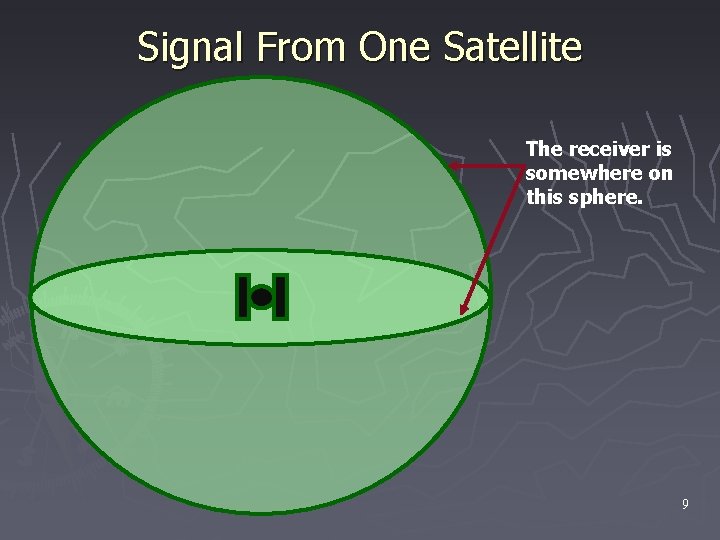
Signal From One Satellite The receiver is somewhere on this sphere. 9
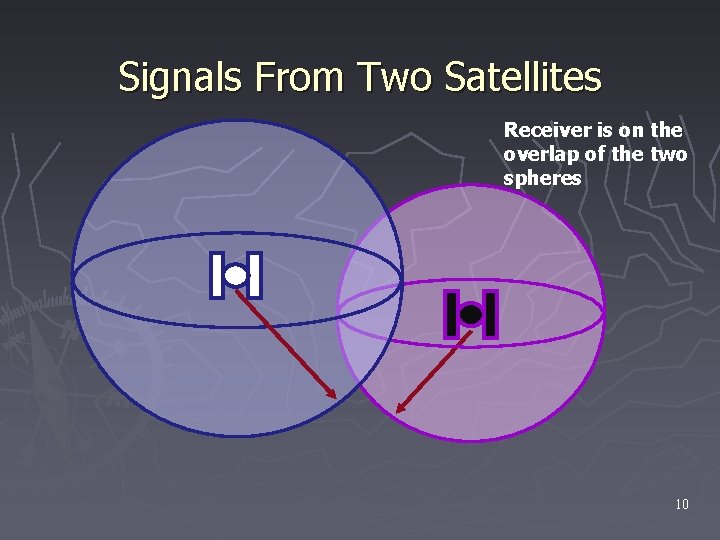
Signals From Two Satellites Receiver is on the overlap of the two spheres 10
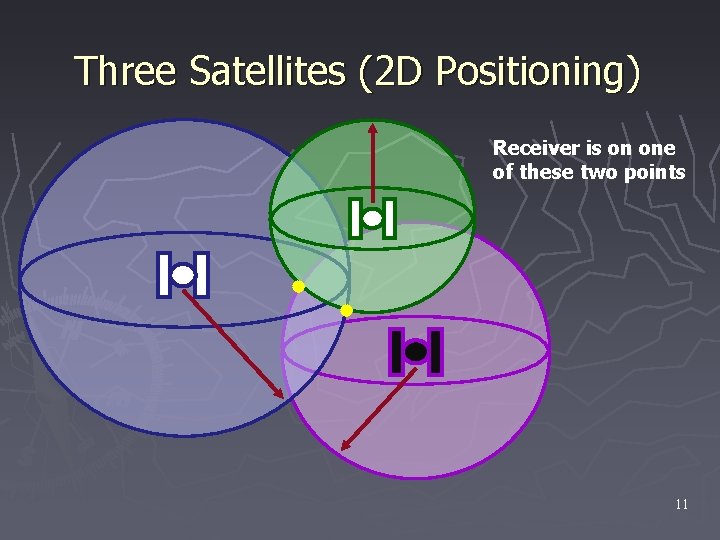
Three Satellites (2 D Positioning) Receiver is on one of these two points 11
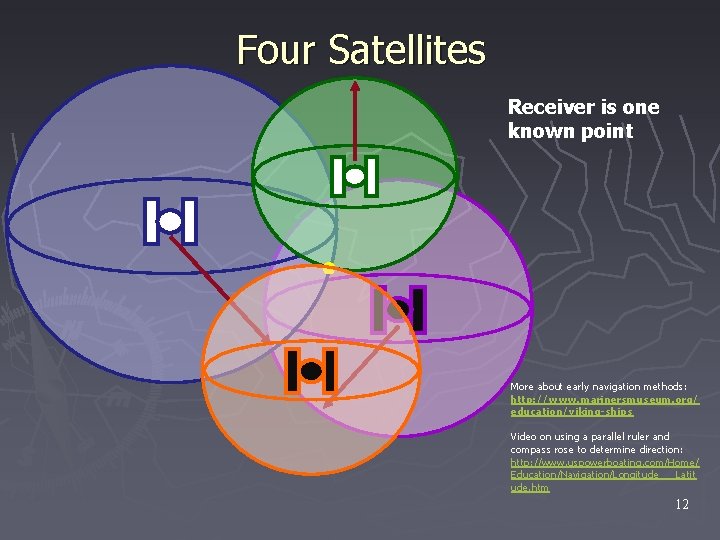
Four Satellites Receiver is one known point More about early navigation methods: http: //www. marinersmuseum. org/ education/viking-ships Video on using a parallel ruler and compass rose to determine direction: http: //www. uspowerboating. com/Home/ Education/Navigation/Longitude___Latit ude. htm 12
GPS Fundamentals 1. How & Why GPS Works 2. Sources of Positional Error 3. Reducing Positional Error 4. Features and Attributes 5. Documentation and Archiving 13
2. Sources of Positional Error a. Internal System Error b. Selective Availability c. Signal Interference d. Satellite Geometry e. User Innocence 14
2. Sources of Positional Error a. Internal System Error ► Satellite clock errors ► Orbital deviations These errors affect the values used in the equation Time * Speed = Distance 15
2. Sources of Positional Error b. Selective Availability ► Inaccuracy introduced to the US system by the US Department of Defense for national security purposes ► Signals from the satellites are deliberately mistimed ► Results in average error of 30 meters, but can be as high as 200 meters ► Set to zero on May 1, 2000, to support commercial use of GPS, but could be ramped up again…. 16
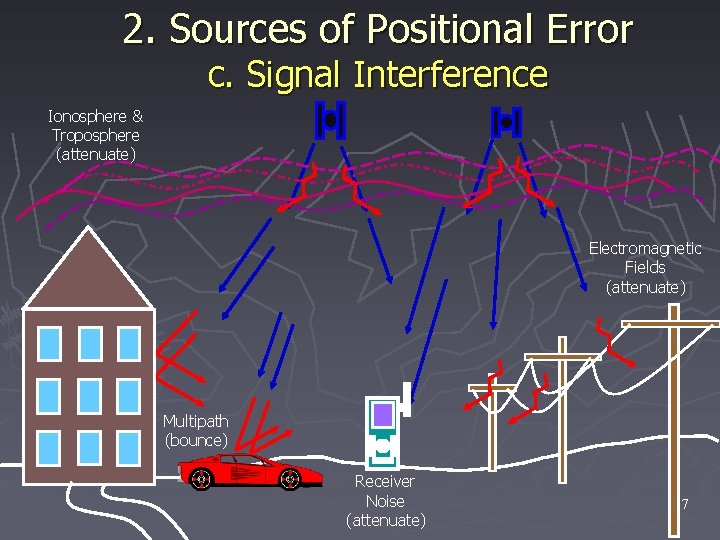
2. Sources of Positional Error c. Signal Interference Ionosphere & Troposphere (attenuate) Electromagnetic Fields (attenuate) Multipath (bounce) Receiver Noise (attenuate) 17
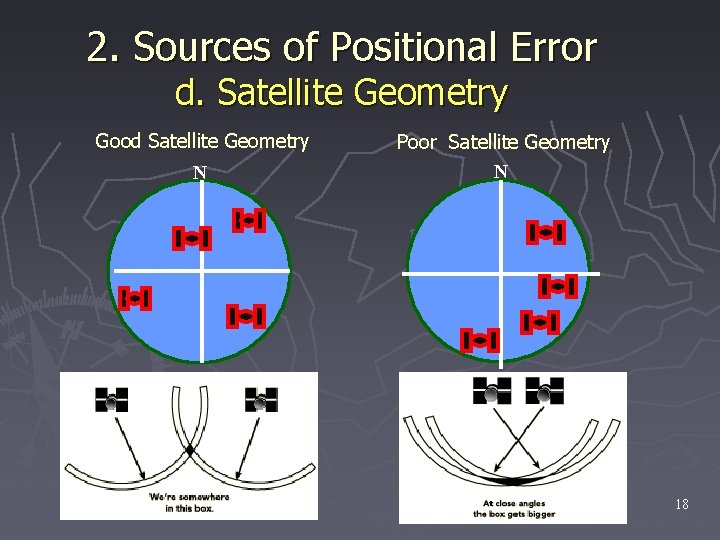
2. Sources of Positional Error d. Satellite Geometry Good Satellite Geometry N Poor Satellite Geometry N 18
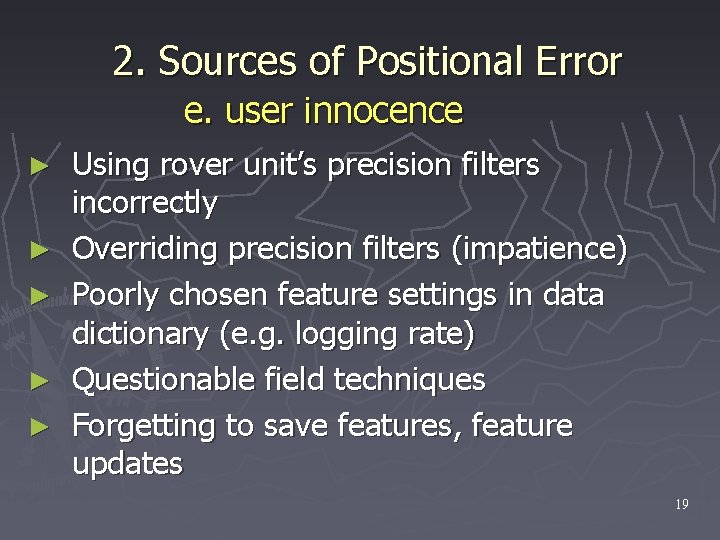
2. Sources of Positional Error e. user innocence ► ► ► Using rover unit’s precision filters incorrectly Overriding precision filters (impatience) Poorly chosen feature settings in data dictionary (e. g. logging rate) Questionable field techniques Forgetting to save features, feature updates 19
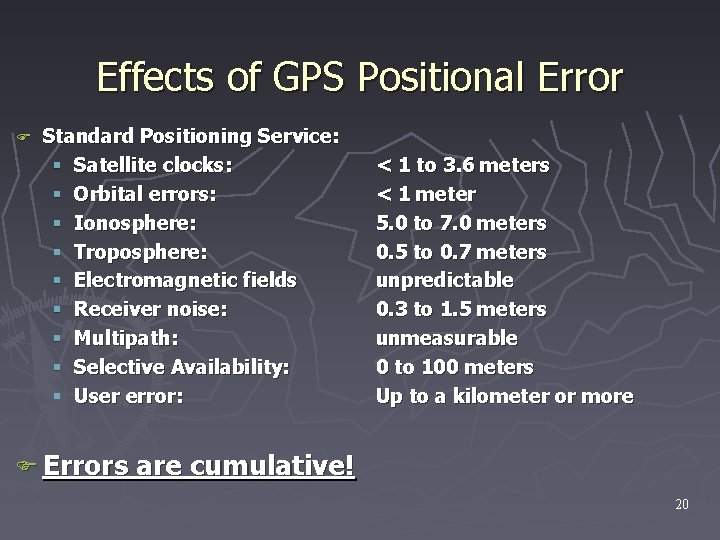
Effects of GPS Positional Error F Standard Positioning Service: § Satellite clocks: § Orbital errors: § Ionosphere: § Troposphere: § Electromagnetic fields § Receiver noise: § Multipath: § Selective Availability: § User error: F Errors < 1 to 3. 6 meters < 1 meter 5. 0 to 7. 0 meters 0. 5 to 0. 7 meters unpredictable 0. 3 to 1. 5 meters unmeasurable 0 to 100 meters Up to a kilometer or more are cumulative! 20
GPS Fundamentals 1. How & Why GPS Works 2. Sources of Positional Error 3. Reducing Positional Error 4. Features and Attributes 5. Documentation and Archiving 21
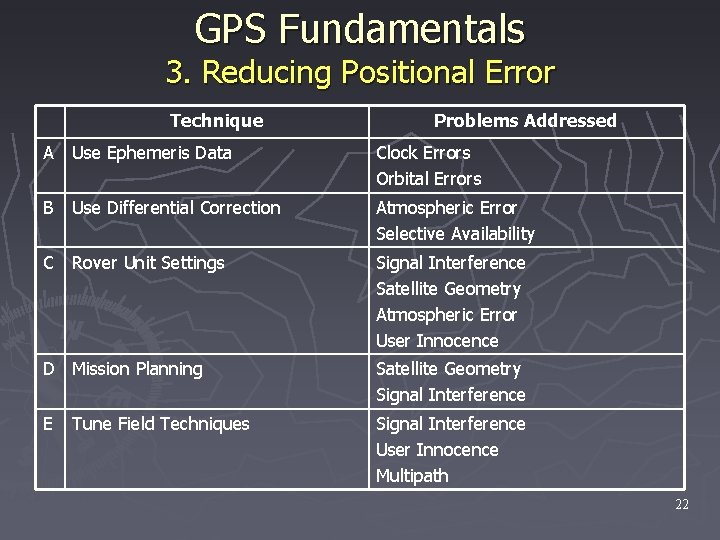
GPS Fundamentals 3. Reducing Positional Error Technique Problems Addressed A Use Ephemeris Data Clock Errors Orbital Errors B Use Differential Correction Atmospheric Error Selective Availability C Rover Unit Settings Signal Interference Satellite Geometry Atmospheric Error User Innocence D Mission Planning Satellite Geometry Signal Interference E Signal Interference User Innocence Multipath Tune Field Techniques 22
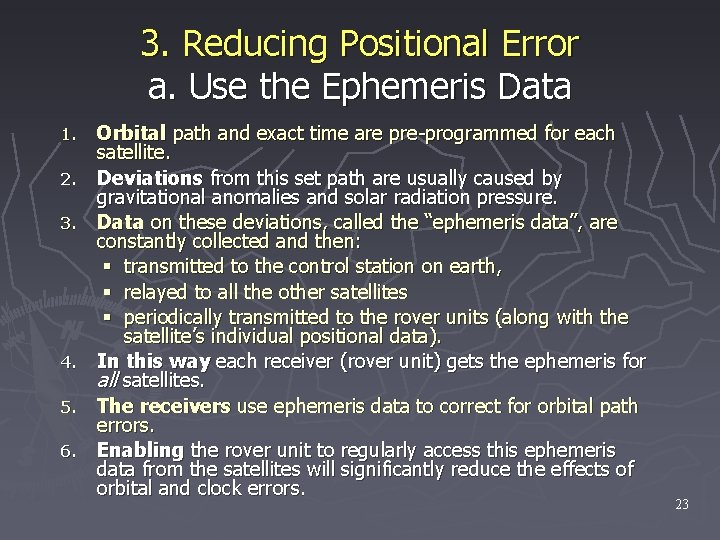
3. Reducing Positional Error a. Use the Ephemeris Data 1. 2. 3. 4. 5. 6. Orbital path and exact time are pre-programmed for each satellite. Deviations from this set path are usually caused by gravitational anomalies and solar radiation pressure. Data on these deviations, called the “ephemeris data”, are constantly collected and then: § transmitted to the control station on earth, § relayed to all the other satellites § periodically transmitted to the rover units (along with the satellite’s individual positional data). In this way each receiver (rover unit) gets the ephemeris for all satellites. The receivers use ephemeris data to correct for orbital path errors. Enabling the rover unit to regularly access this ephemeris data from the satellites will significantly reduce the effects of orbital and clock errors. 23
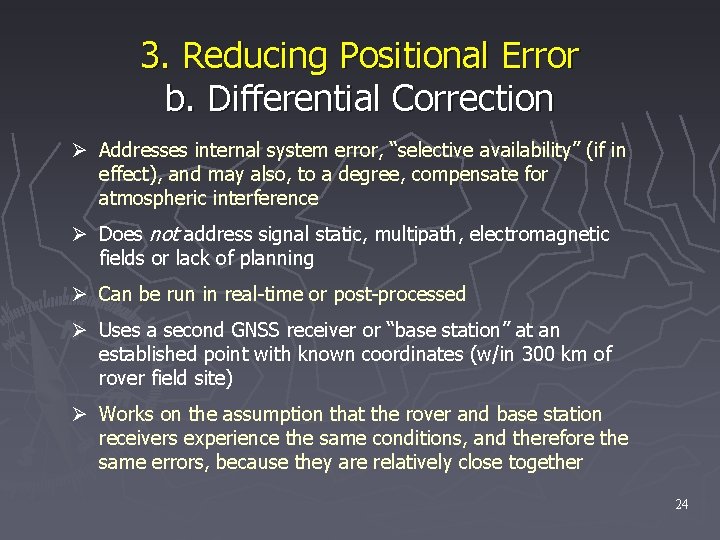
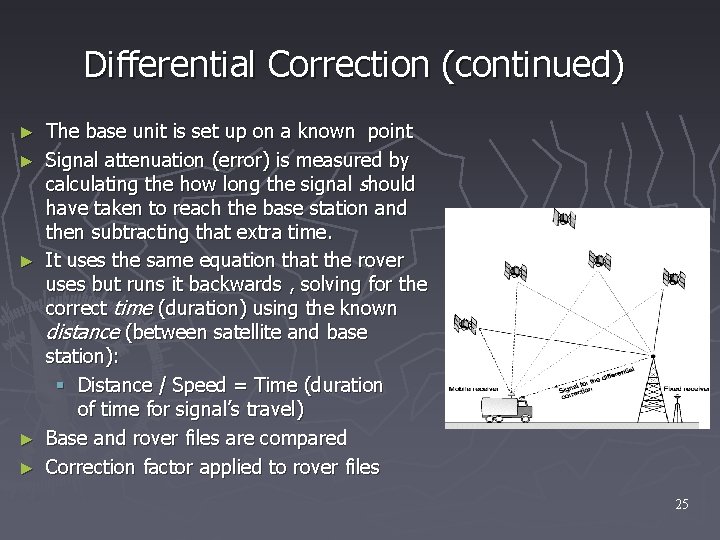
3. Reducing Positional Error b. Differential Correction Ø Addresses internal system error, “selective availability” (if in effect), and may also, to a degree, compensate for atmospheric interference Ø Does not address signal static, multipath, electromagnetic fields or lack of planning Ø Can be run in real-time or post-processed Ø Uses a second GNSS receiver or “base station” at an established point with known coordinates (w/in 300 km of rover field site) Ø Works on the assumption that the rover and base station receivers experience the same conditions, and therefore the same errors, because they are relatively close together 24
Differential Correction (continued) ► ► ► The base unit is set up on a known point Signal attenuation (error) is measured by calculating the how long the signal should have taken to reach the base station and then subtracting that extra time. It uses the same equation that the rover uses but runs it backwards , solving for the correct time (duration) using the known distance (between satellite and base station): § Distance / Speed = Time (duration of time for signal’s travel) Base and rover files are compared Correction factor applied to rover files 25
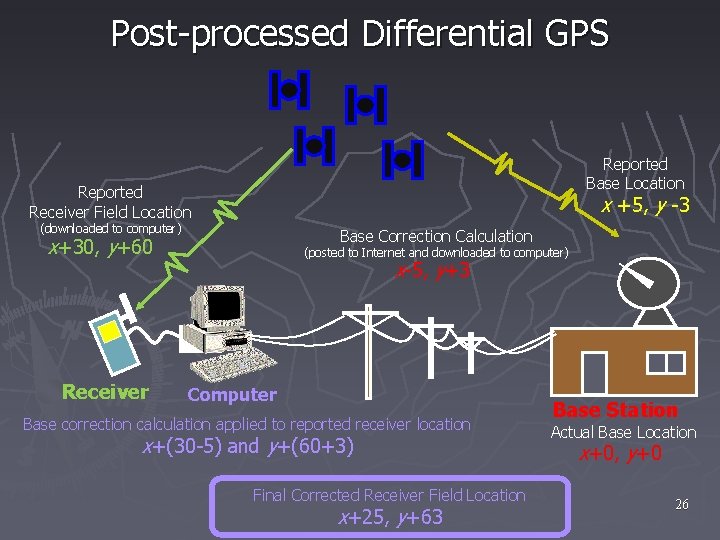
Post-processed Differential GPS Reported Base Location Reported Receiver Field Location x +5, y -3 (downloaded to computer) Base Correction Calculation x+30, y+60 Receiver (posted to Internet and downloaded to computer) x-5, y+3 Computer Base correction calculation applied to reported receiver location x+(30 -5) and y+(60+3) Final Corrected Receiver Field Location x+25, y+63 Base Station Actual Base Location x+0, y+0 26
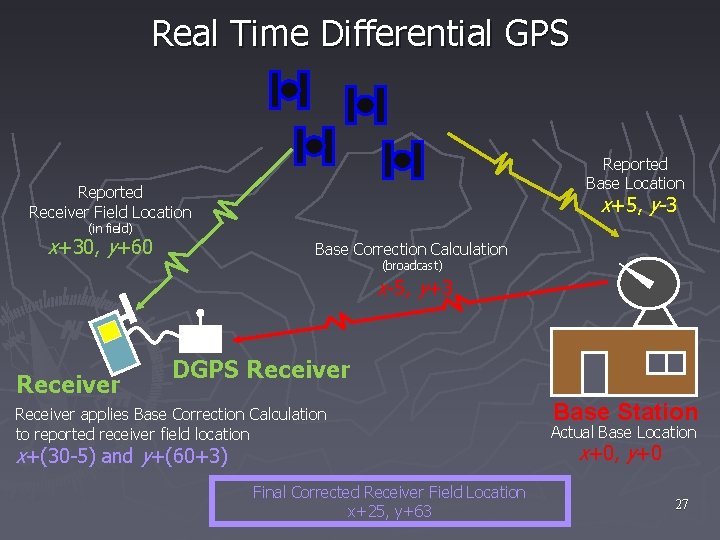
Real Time Differential GPS Reported Base Location Reported Receiver Field Location x+5, y-3 (in field) x+30, y+60 Base Correction Calculation (broadcast) x-5, y+3 Receiver DGPS Receiver applies Base Correction Calculation to reported receiver field location x+(30 -5) and y+(60+3) Final Corrected Receiver Field Location x+25, y+63 Base Station Actual Base Location x+0, y+0 27
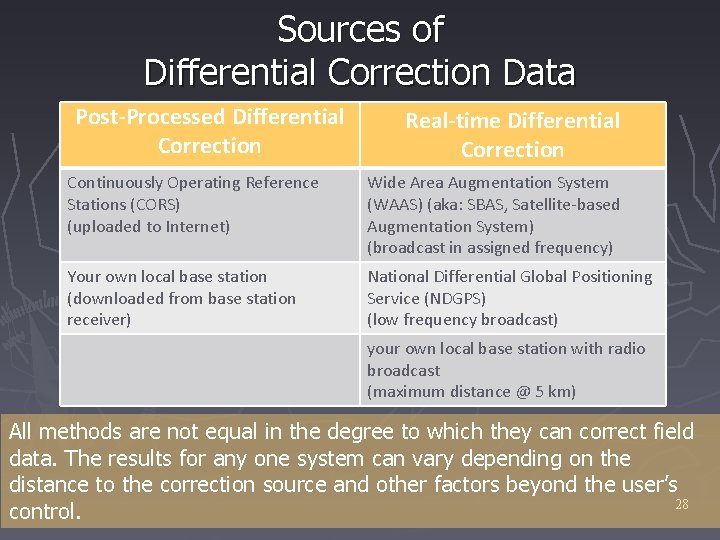
Sources of Differential Correction Data Post-Processed Differential Correction Real-time Differential Correction Continuously Operating Reference Stations (CORS) (uploaded to Internet) Wide Area Augmentation System (WAAS) (aka: SBAS, Satellite-based Augmentation System) (broadcast in assigned frequency) Your own local base station (downloaded from base station receiver) National Differential Global Positioning Service (NDGPS) (low frequency broadcast) your own local base station with radio broadcast (maximum distance @ 5 km) All methods are not equal in the degree to which they can correct field data. The results for any one system can vary depending on the distance to the correction source and other factors beyond the user’s 28 control.
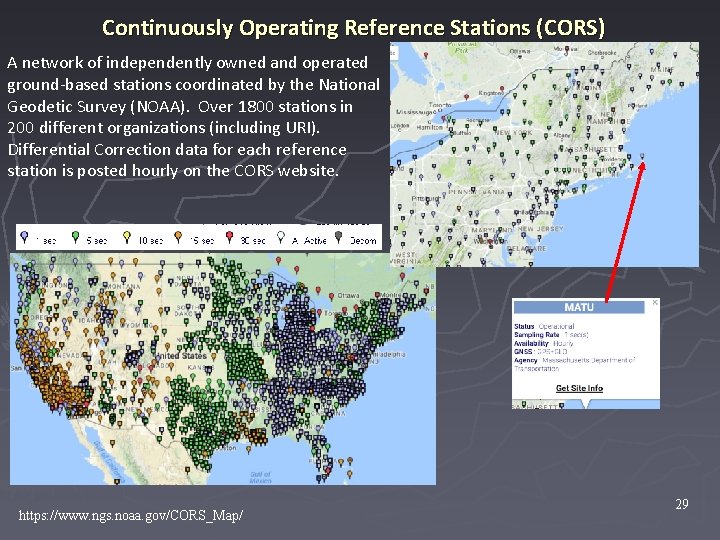
Continuously Operating Reference Stations (CORS) A network of independently owned and operated ground-based stations coordinated by the National Geodetic Survey (NOAA). Over 1800 stations in 200 different organizations (including URI). Differential Correction data for each reference station is posted hourly on the CORS website. https: //www. ngs. noaa. gov/CORS_Map/ 29
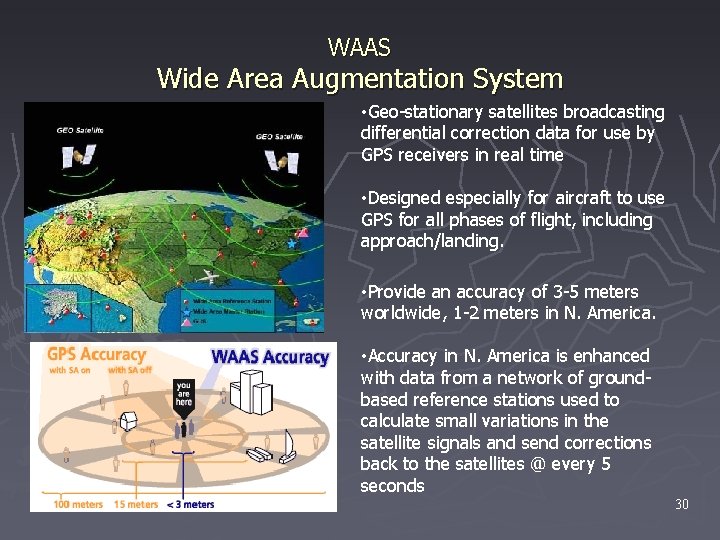
WAAS Wide Area Augmentation System • Geo-stationary satellites broadcasting differential correction data for use by GPS receivers in real time • Designed especially for aircraft to use GPS for all phases of flight, including approach/landing. • Provide an accuracy of 3 -5 meters worldwide, 1 -2 meters in N. America. • Accuracy in N. America is enhanced with data from a network of groundbased reference stations used to calculate small variations in the satellite signals and send corrections back to the satellites @ every 5 seconds 30
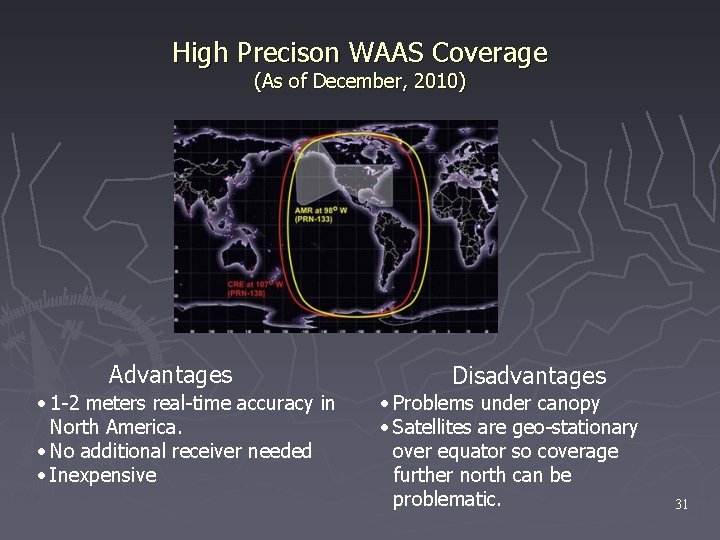
High Precison WAAS Coverage (As of December, 2010) Advantages • 1 -2 meters real-time accuracy in North America. • No additional receiver needed • Inexpensive Disadvantages • Problems under canopy • Satellites are geo-stationary over equator so coverage further north can be problematic. 31
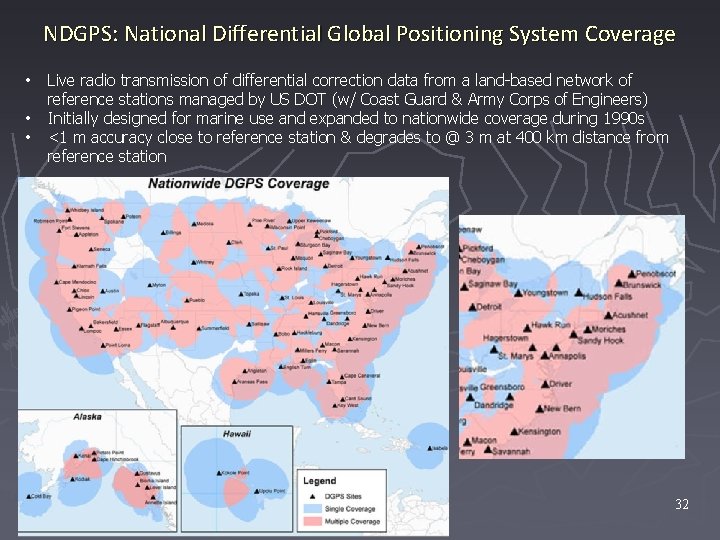
NDGPS: National Differential Global Positioning System Coverage • • • Live radio transmission of differential correction data from a land-based network of reference stations managed by US DOT (w/ Coast Guard & Army Corps of Engineers) Initially designed for marine use and expanded to nationwide coverage during 1990 s <1 m accuracy close to reference station & degrades to @ 3 m at 400 km distance from reference station 32
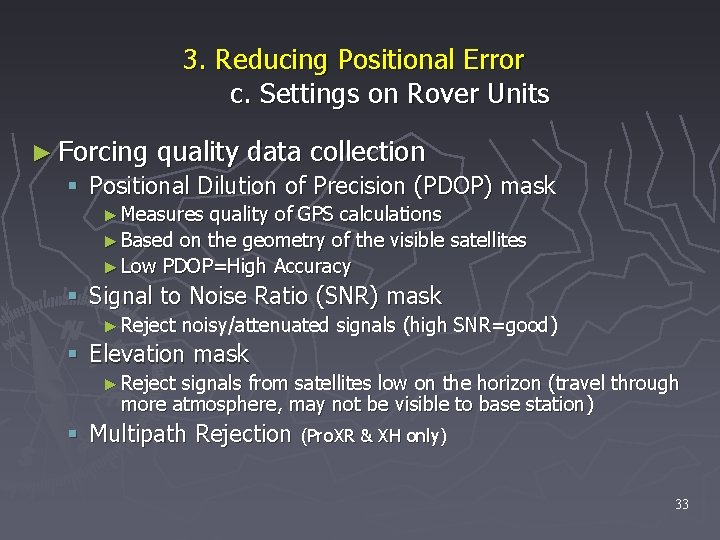
3. Reducing Positional Error c. Settings on Rover Units ► Forcing quality data collection § Positional Dilution of Precision (PDOP) mask ► Measures quality of GPS calculations ► Based on the geometry of the visible satellites ► Low PDOP=High Accuracy § Signal to Noise Ratio (SNR) mask ► Reject noisy/attenuated signals (high SNR=good) § Elevation mask ► Reject signals from satellites low on the horizon (travel through more atmosphere, may not be visible to base station) § Multipath Rejection (Pro. XR & XH only) 33
3. Reducing Positional Error d. Mission Planning ► Mission Planning focuses on figuring out where the satellites will be at specific times. This tells you where and when you can be most effective at collecting data. With ephemeris data you can calculate times and locations of desirable PDOP values as well as how features like mountains or buildings may affect satellite visibility. 34
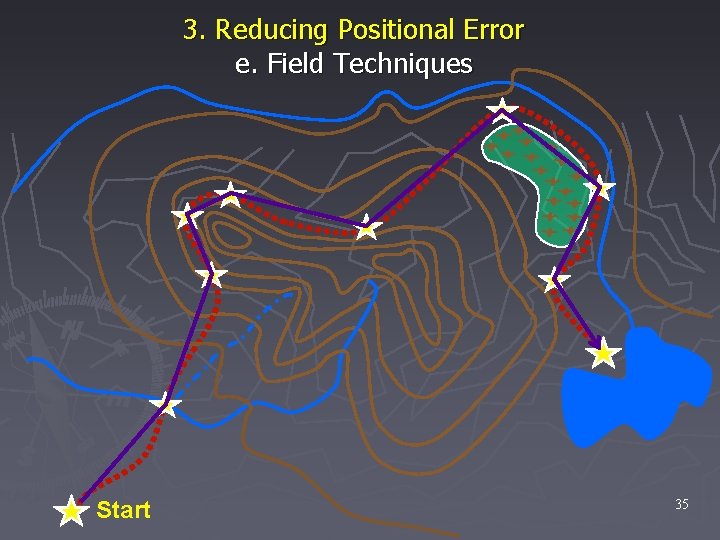
3. Reducing Positional Error e. Field Techniques Start 35
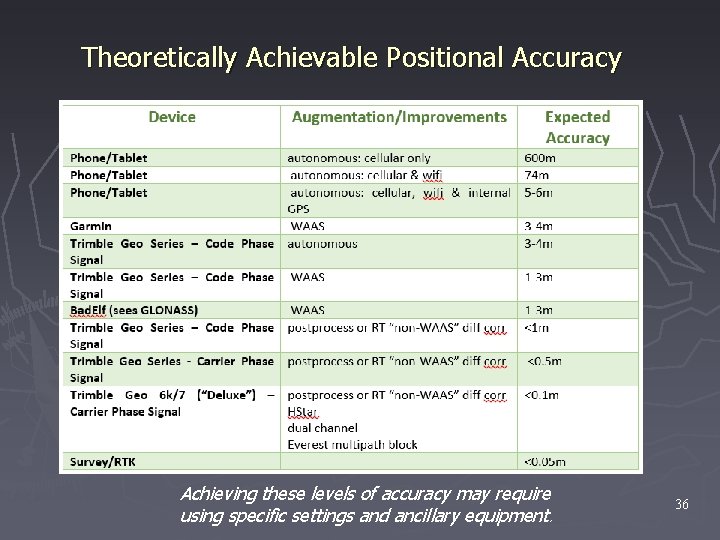
Theoretically Achievable Positional Accuracy Achieving these levels of accuracy may require using specific settings and ancillary equipment. 36
Positional Accuracy: Theoretically Achievable vs Practical • • Equipment cost Training Setup, planning time Precision/accuracy needed 37
GPS Fundamentals 1. How & Why GPS Works 2. Sources of Positional Error 3. Reducing Positional Error 4. Features and Attributes 5. Documentation and Archiving 38
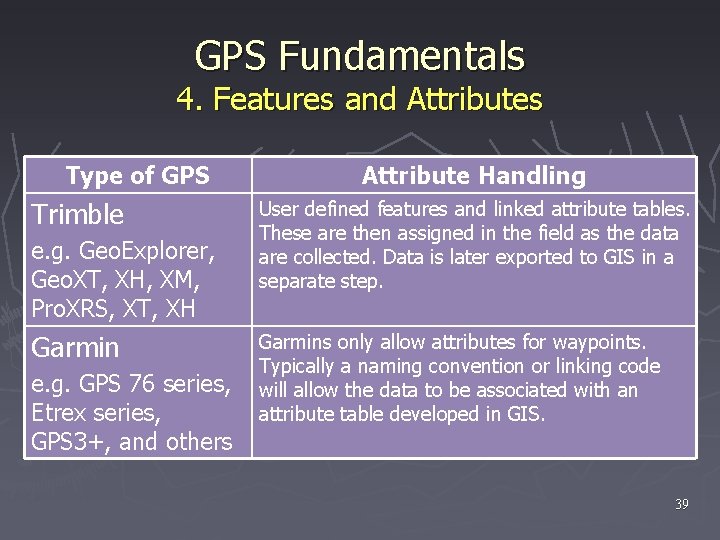
GPS Fundamentals 4. Features and Attributes Type of GPS Trimble e. g. Geo. Explorer, Geo. XT, XH, XM, Pro. XRS, XT, XH Garmin e. g. GPS 76 series, Etrex series, GPS 3+, and others Attribute Handling User defined features and linked attribute tables. These are then assigned in the field as the data are collected. Data is later exported to GIS in a separate step. Garmins only allow attributes for waypoints. Typically a naming convention or linking code will allow the data to be associated with an attribute table developed in GIS. 39
GPS Fundamentals 1. How & Why GPS Works 2. Sources of Positional Error 3. Reducing Positional Error 4. Features and Attributes 5. Documentation and Archiving 40
GPS Fundamentals 5. Data Documentation & Management A GNSS user’s responsibilities include: § Documenting data quality and processing steps in field notes, data dictionary § Backing up, archiving the raw and processed data § Using documentation, along with the data themselves, to create full metadata for each final product. Remember: Without metadata the work has no long term value. 41
Youare Are You Here here 42