
GPS Total Station Basics What is GNSS Global
GPS & Total Station Basics
What is GNSS? § Global Navigation Satellite System (GNSS) – used by receivers to determine their location anywhere on earth § Satellite Systems Include – US GPS – GLONASS – Galileo (Currently not Operational)
GPS Receivers § Three general types of GPS Receivers – Navigation/Recreational (Autonomous) § 10’-50’ (3 m-15 m)H, V? – Location GPS (Differential GPS - d. GPS) § 0. 5’-10’ (0. 1 m-3 m) H, 2 -3 x more in V – Precision GPS (Real-Time Kinematic -RTK) § 0. 1’ (30 mm) or better, 3 D! § We focus on Precise GPS for Heavy & Highway applications
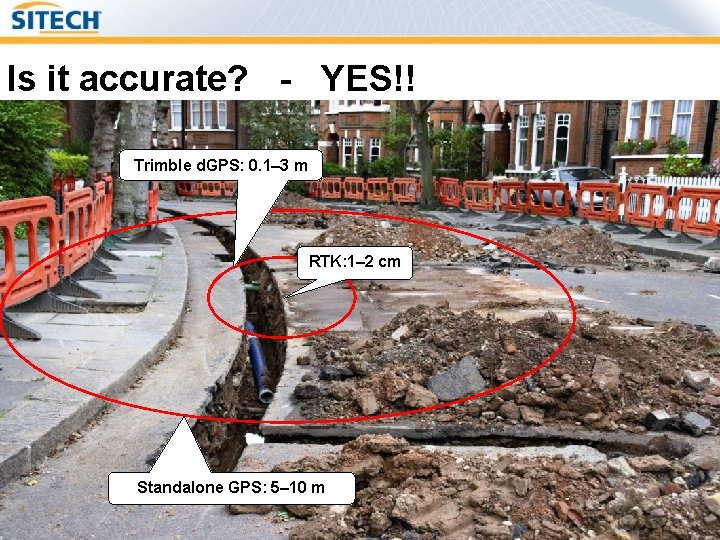
Is it accurate? - YES!! Trimble d. GPS: 0. 1– 3 m RTK: 1– 2 cm Standalone GPS: 5– 10 m
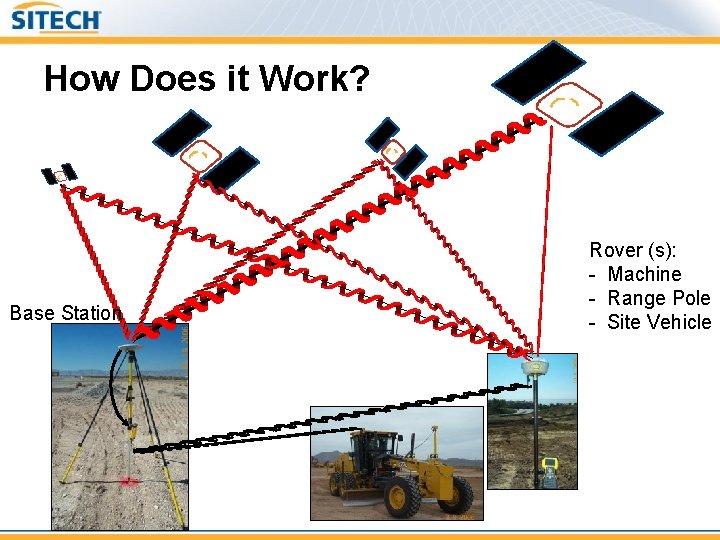
How Does it Work? Base Station Rover (s): - Machine - Range Pole - Site Vehicle
How Does it Work (explained) § The Base and Rover (s) receivers track or receive the same satellite signals AT THE SAME TIME. § The Base Station sends it’s position & observations via radio to the Rover. § Base station data and rover data are processed together in rover receiver to produce 3 D vector § Base station position + vector = rover position § Result: ALL POSITIONS @ THE ROVER (S) ARE RELATIVE TO BASE POSITION
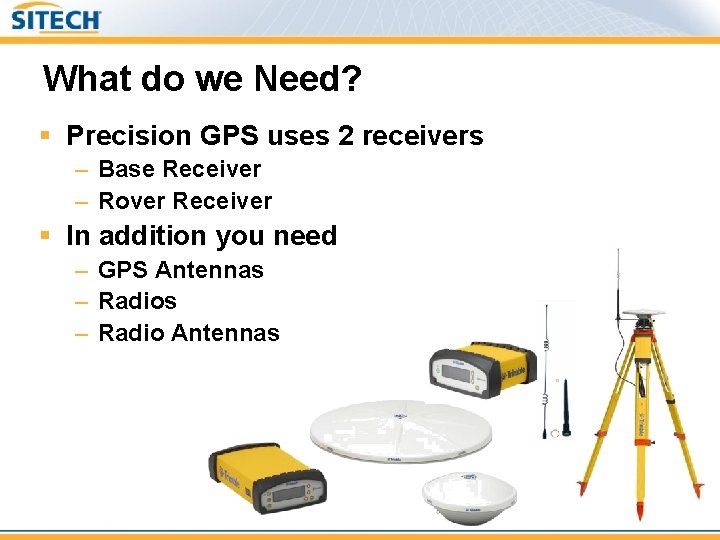
What do we Need? § Precision GPS uses 2 receivers – Base Receiver – Rover Receiver § In addition you need – GPS Antennas – Radio Antennas
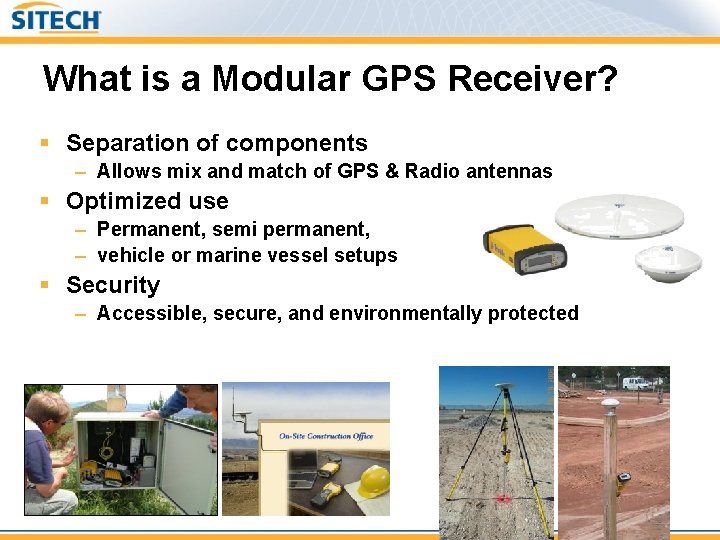
What is a Modular GPS Receiver? § Separation of components – Allows mix and match of GPS & Radio antennas § Optimized use – Permanent, semi permanent, – vehicle or marine vessel setups § Security – Accessible, secure, and environmentally protected
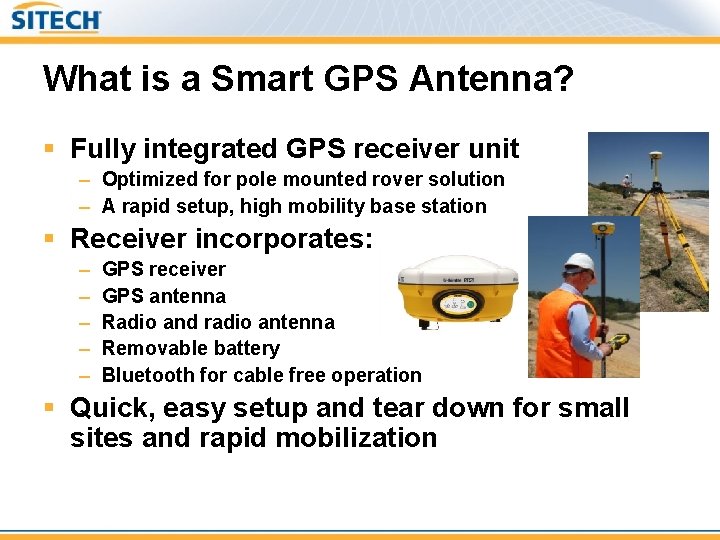
What is a Smart GPS Antenna? § Fully integrated GPS receiver unit – Optimized for pole mounted rover solution – A rapid setup, high mobility base station § Receiver incorporates: – – – GPS receiver GPS antenna Radio and radio antenna Removable battery Bluetooth for cable free operation § Quick, easy setup and tear down for small sites and rapid mobilization
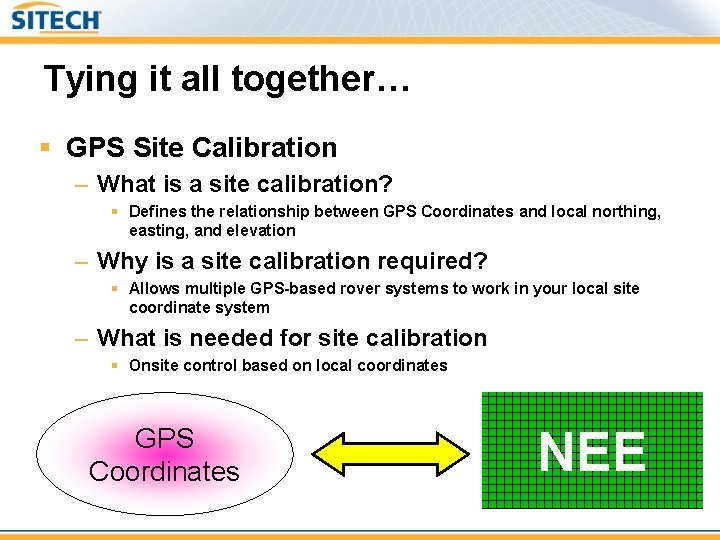
Tying it all together… § GPS Site Calibration – What is a site calibration? § Defines the relationship between GPS Coordinates and local northing, easting, and elevation – Why is a site calibration required? § Allows multiple GPS-based rover systems to work in your local site coordinate system – What is needed for site calibration § Onsite control based on local coordinates GPS Coordinates NEE
What can go wrong? § Bad Base Location – Bad base observations, bad rover corrections – Setup GPS base station antenna with 360° view of the sky. If limited try to set up with clear visibility to the equator. § Multipath – Avoid sources of multipath (deflection of the GPS signal) § Base-Rover Radio Link – Radio “Line-of-sight” – Other Radio Interference § PDOP – Position Dilution Of Precision (SV Geometry) § Human Error – Bad base position or calibration
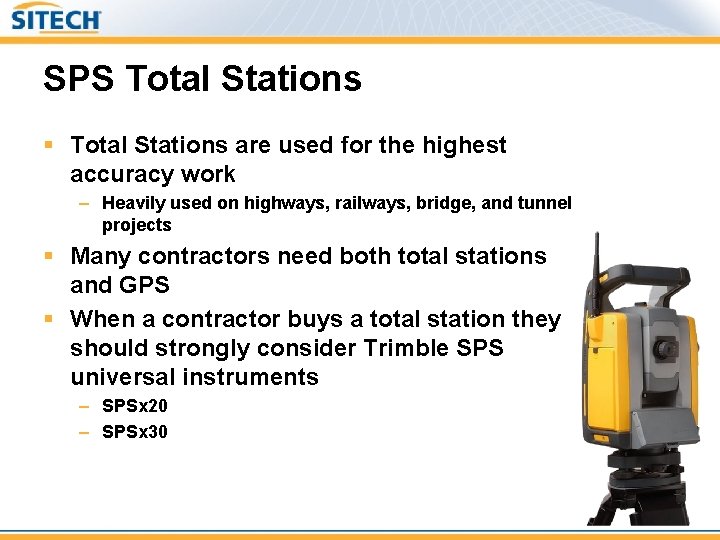
SPS Total Stations § Total Stations are used for the highest accuracy work – Heavily used on highways, railways, bridge, and tunnel projects § Many contractors need both total stations and GPS § When a contractor buys a total station they should strongly consider Trimble SPS universal instruments – SPSx 20 – SPSx 30
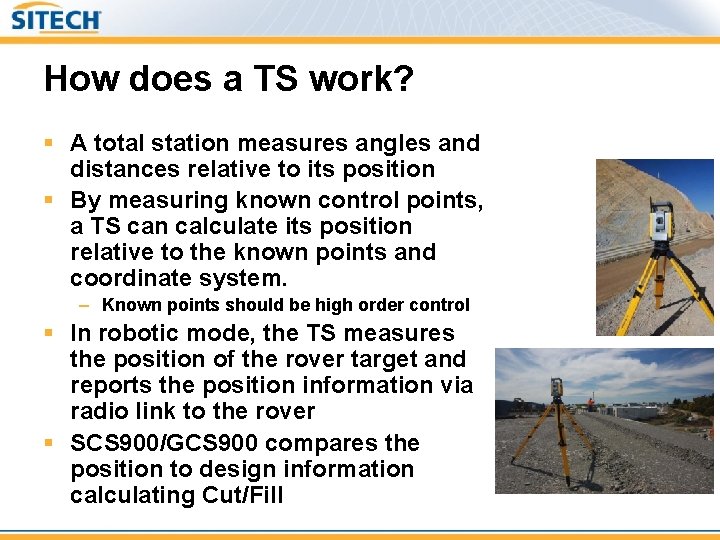
How does a TS work? § A total station measures angles and distances relative to its position § By measuring known control points, a TS can calculate its position relative to the known points and coordinate system. – Known points should be high order control § In robotic mode, the TS measures the position of the rover target and reports the position information via radio link to the rover § SCS 900/GCS 900 compares the position to design information calculating Cut/Fill
Total Station Setup § Minimum of 2 control points § Should be very accurate control § Optimally you want adequate number of control points for multiple TS Setups § Avoid setting additional control if possible § Remember TS get less accurate over distance – Optical limitations – Earth curvature – TS Setup errors compounded
Total Station Setup § 2 primary setup types – Known Control Point – TS on one known point and backsight to other – Arbitrary Location – TS setup up unknown and backsight to two know control points
TS Setup – Known Control Point § Pros – Only need a backsight to one known point to establish the position – Quicker setup as you only have to visit one other point § Cons – Restricted as to where to place the instrument – Location may be harder to set up the legs – Must measure instrument height v. Should always have another point not used in the setup for checking the setup.
TS Setup – Arbitrary Location § Pros – Freedom of where to place the instrument – Easy to set up the legs – No instrument height measurement § Cons – Must visit two known points to establish the position – Takes extra time v. Should always have another point not used in the setup for checking the setup. v. This method is used most often in construction
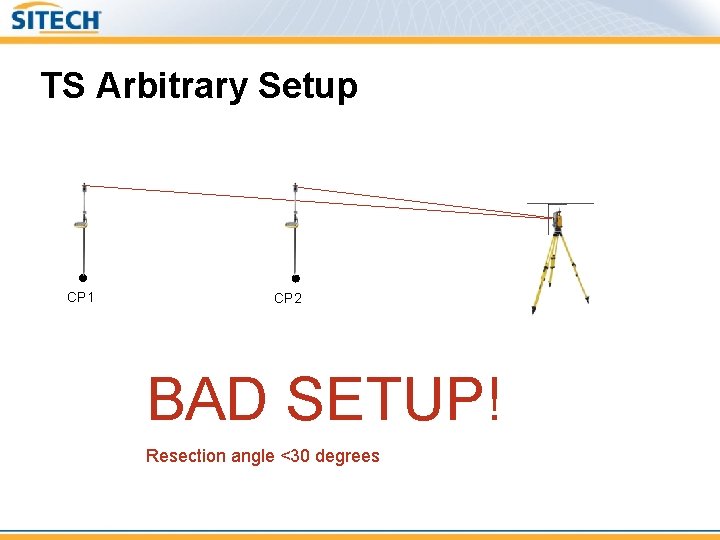
TS Arbitrary Setup CP 1 CP 2 BAD SETUP! Resection angle <30 degrees
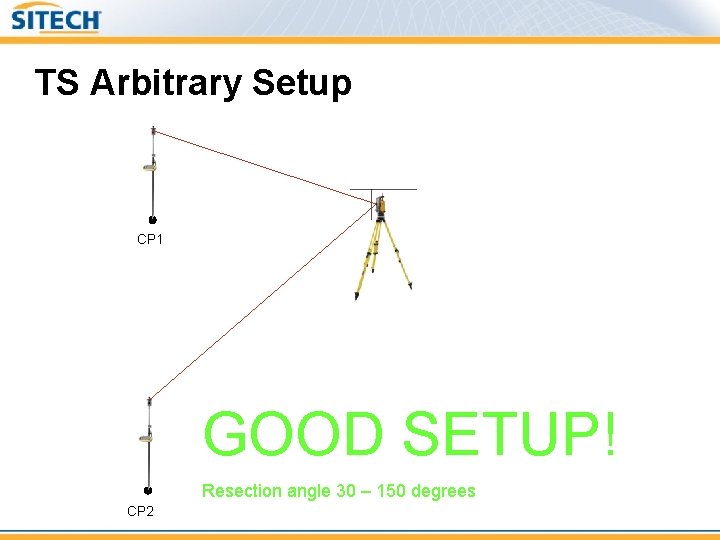
TS Arbitrary Setup CP 1 GOOD SETUP! Resection angle 30 – 150 degrees CP 2
What can go wrong? § TS out of calibration – Perform all user capable calibrations on regular basis § Bad setup – HA out of tolerance § We are chasing high accuracy. Do not accept a setup if out of tolerance, even if the point deviations are acceptable § Bad TS Location – Setup TS with clear visibility to the rover and limited potential obstructions – Do not place TS close to vibratory compacter operation § Weak tripod – You need a heavy duty tripod with sturdy top plate § Do not use aluminum
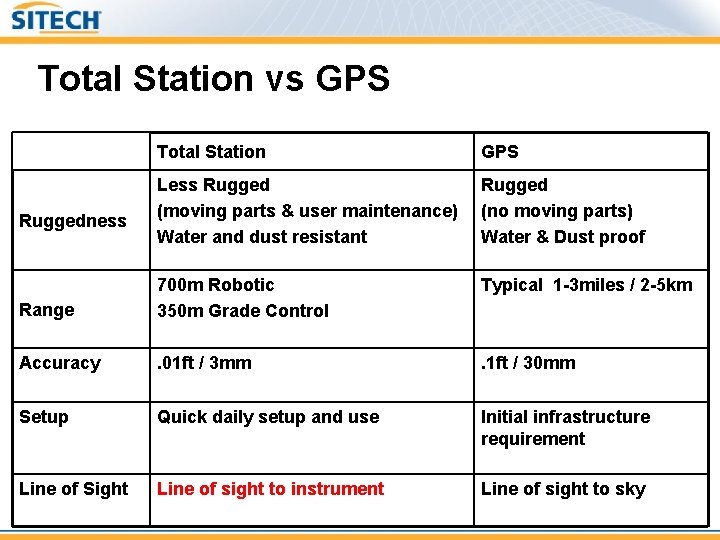
Total Station vs GPS Total Station GPS Less Rugged (moving parts & user maintenance) Water and dust resistant Rugged (no moving parts) Water & Dust proof Typical 1 -3 miles / 2 -5 km Range 700 m Robotic 350 m Grade Control Accuracy . 01 ft / 3 mm . 1 ft / 30 mm Setup Quick daily setup and use Initial infrastructure requirement Line of Sight Line of sight to instrument Line of sight to sky Ruggedness

Questions / Comments? Thank You!
- Slides: 22