
GPS Security in the Military Past Present and
- Slides: 15
GPS Security in the Military Past, Present, and Future
Some Background • the C/A code • the P(Y) code • red key and black key cryptography
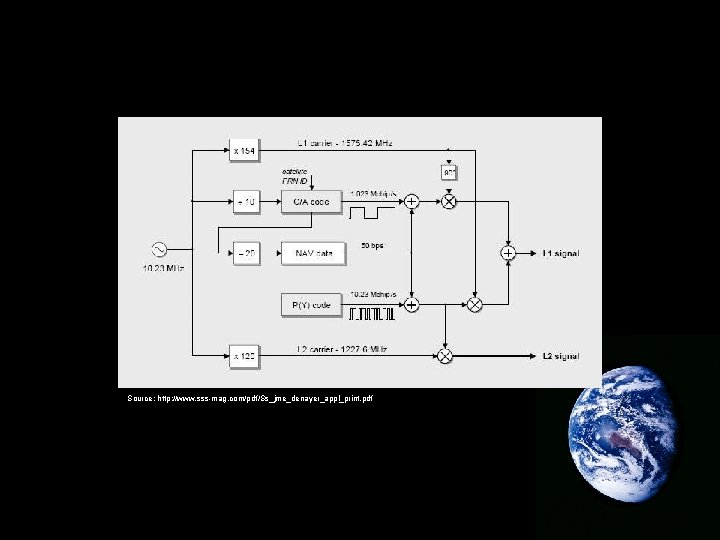
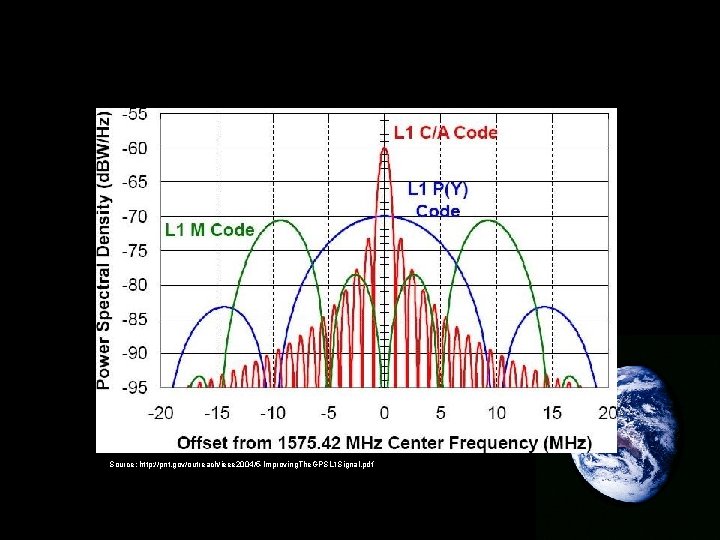
C/A (Coarse Acquisition) Code • 1023 chips (PRN code) • repeats every millisecond • used to be degraded by SA (Selective Availability) but now is subject to “spoofing” • is modulated (along with timing, ephemeris, and other almanac data – and the P(Y) code) onto the L 1 frequency (1575. 42 MHz) • carries a handover word (HOW) that aids in acquiring the P(Y) code
Source: http: //www. sss-mag. com/pdf/Ss_jme_denayer_appl_print. pdf
Source: http: //pnt. gov/outreach/ieee 2004/5 -Improving. The. GPSL 1 Signal. pdf
P(Y) Code • • P when unencrypted Y when encrypted exists on both the L 1 and L 2 frequencies the PRN repeats every week
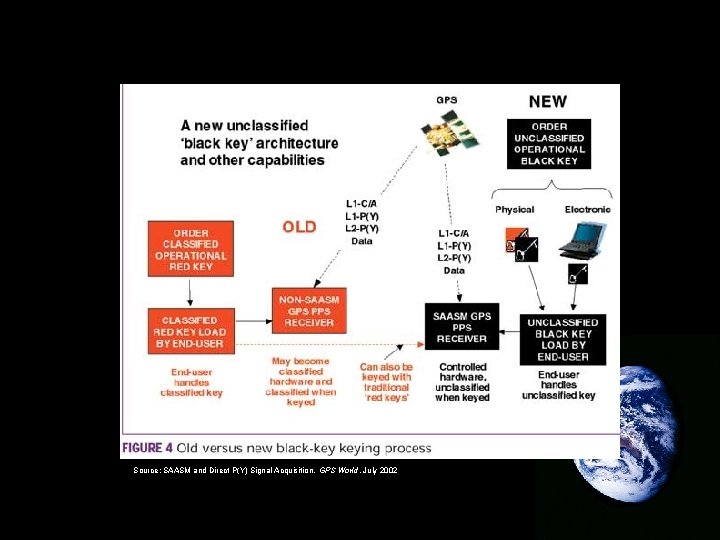
Symmetric and Asymmetric Cryptography • symmetric cryptography requires the (single) “red” key to be kept secret • asymmetric cryptography has one “black” key for encryption and another for decryption – only the decryption key need be kept secret • uses the RSA algorithm
The Past — PPS-SM (Precise Positioning Service Security Module) Features Problem red crypto-key, changed weekly or a distribution nightmare yearly used the C/A code on L 1 and a handover word (HOW) to acquire P(Y) on L 1 and L 2 military missions might require the jamming of L 1
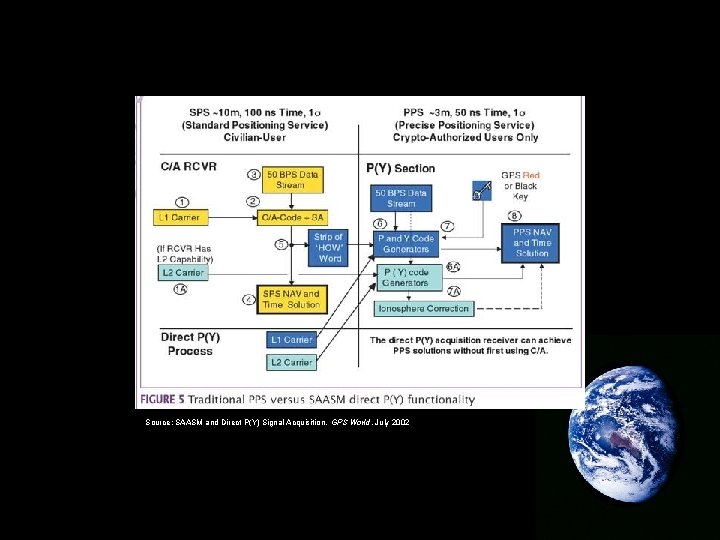
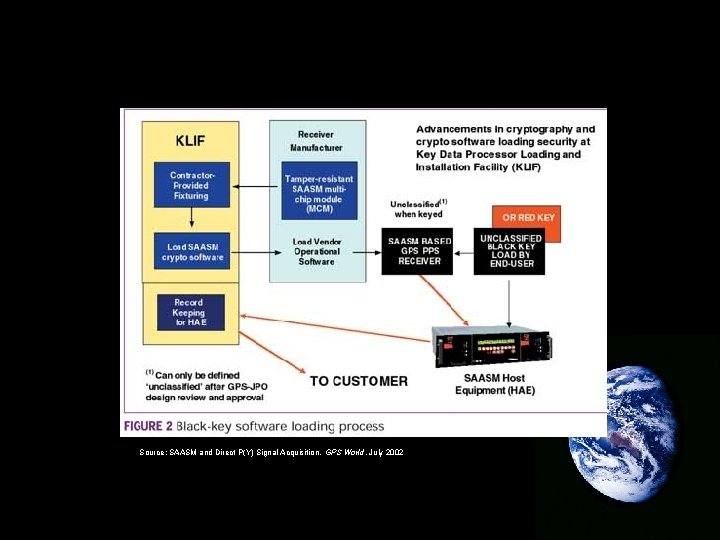
The Solution: SAASM (Selective Availability Anti-Spoofing Module) • acquires the P(Y) code directly without the C/A code • receivers equipped with SAASM must go through a rigorous security system during production • implements both symmetric and asymmetric cryptography
Source: SAASM and Direct P(Y) Signal Acquisition, GPS World, July 2002
Source: SAASM and Direct P(Y) Signal Acquisition, GPS World, July 2002
Source: SAASM and Direct P(Y) Signal Acquisition, GPS World, July 2002
The Future – The M-code and Satellite Types IIR-M II-F • IIR-M and II-F are basically equivalent in terms of military security • both will utilize the new M-code • will broadcast at a higher power level
Conclusion • as with all cryptography today, the security of GPS will only be compromised by human error or deliberate giving of information • the steps being taken try to reduce as much as possible the consequences of information leaking out
Partial Bibliography • GPS World • National Defense Magazine • GPS Signal Specification, 2 nd Edition (June 2, 1995) - (http: //www. navcen. uscg. gov/pubs/gps/sigspec/default. htm) • Overview of the GPS M Code Signal (http: //www. mitre. org/work/tech_papers_00/betz_overview/bet z_overview. pdf)