
GPRS General Packet Radio Service 1 Outline v
- Slides: 20
GPRS —General Packet Radio Service 1
Outline v. Introduction v. GPRS Applications v. GPRS normal service procedures v. GPRS Architecture v. GPRS protocol layering v. GPRS data link layer and coding schemes v. GPRS packet transfer v. Limitations of GPRS 2
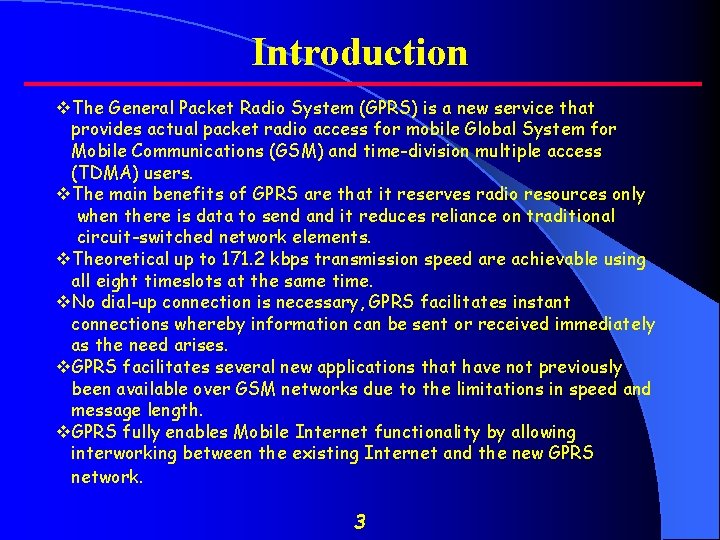
Introduction v. The General Packet Radio System (GPRS) is a new service that provides actual packet radio access for mobile Global System for Mobile Communications (GSM) and time-division multiple access (TDMA) users. v. The main benefits of GPRS are that it reserves radio resources only when there is data to send and it reduces reliance on traditional circuit-switched network elements. v. Theoretical up to 171. 2 kbps transmission speed are achievable using all eight timeslots at the same time. v. No dial-up connection is necessary, GPRS facilitates instant connections whereby information can be sent or received immediately as the need arises. v. GPRS facilitates several new applications that have not previously been available over GSM networks due to the limitations in speed and message length. v. GPRS fully enables Mobile Internet functionality by allowing interworking between the existing Internet and the new GPRS network. 3
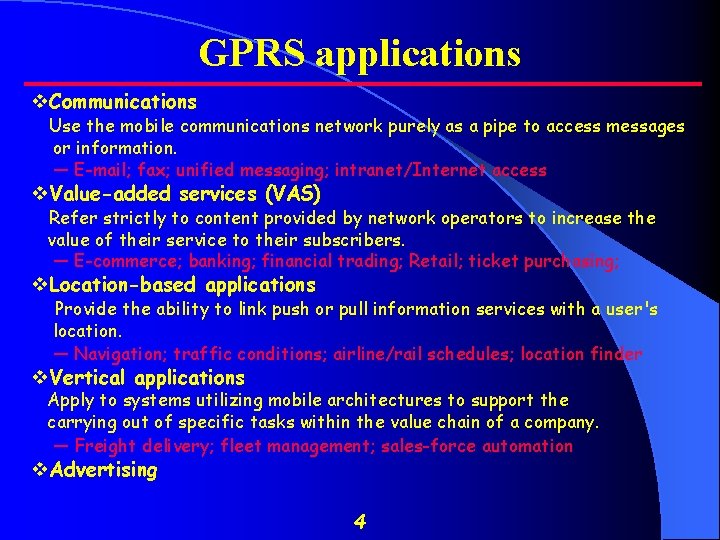
GPRS applications v. Communications Use the mobile communications network purely as a pipe to access messages or information. — E-mail; fax; unified messaging; intranet/Internet access v. Value-added services (VAS) Refer strictly to content provided by network operators to increase the value of their service to their subscribers. — E-commerce; banking; financial trading; Retail; ticket purchasing; v. Location-based applications Provide the ability to link push or pull information services with a user's location. — Navigation; traffic conditions; airline/rail schedules; location finder v. Vertical applications Apply to systems utilizing mobile architectures to support the carrying out of specific tasks within the value chain of a company. — Freight delivery; fleet management; sales-force automation v. Advertising 4
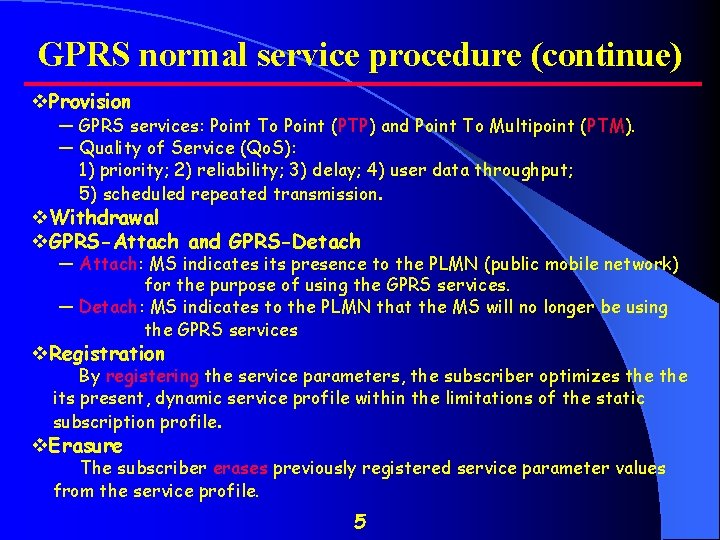
GPRS normal service procedure (continue) v. Provision — GPRS services: Point To Point (PTP) and Point To Multipoint (PTM). — Quality of Service (Qo. S): 1) priority; 2) reliability; 3) delay; 4) user data throughput; 5) scheduled repeated transmission. v. Withdrawal v. GPRS-Attach and GPRS-Detach — Attach: MS indicates its presence to the PLMN (public mobile network) for the purpose of using the GPRS services. — Detach: MS indicates to the PLMN that the MS will no longer be using the GPRS services v. Registration By registering the service parameters, the subscriber optimizes the its present, dynamic service profile within the limitations of the static subscription profile. v. Erasure The subscriber erases previously registered service parameter values from the service profile. 5
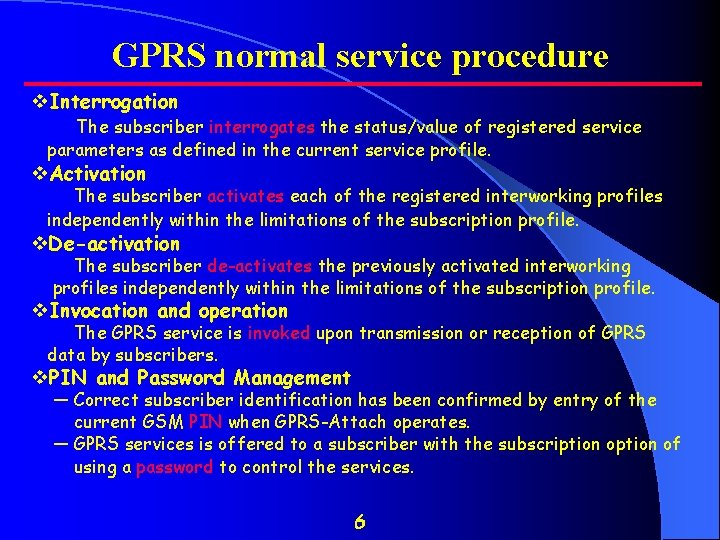
GPRS normal service procedure v. Interrogation The subscriber interrogates the status/value of registered service parameters as defined in the current service profile. v. Activation The subscriber activates each of the registered interworking profiles independently within the limitations of the subscription profile. v. De-activation The subscriber de-activates the previously activated interworking profiles independently within the limitations of the subscription profile. v. Invocation and operation The GPRS service is invoked upon transmission or reception of GPRS data by subscribers. v. PIN and Password Management — Correct subscriber identification has been confirmed by entry of the current GSM PIN when GPRS-Attach operates. — GPRS services is offered to a subscriber with the subscription of using a password to control the services. 6
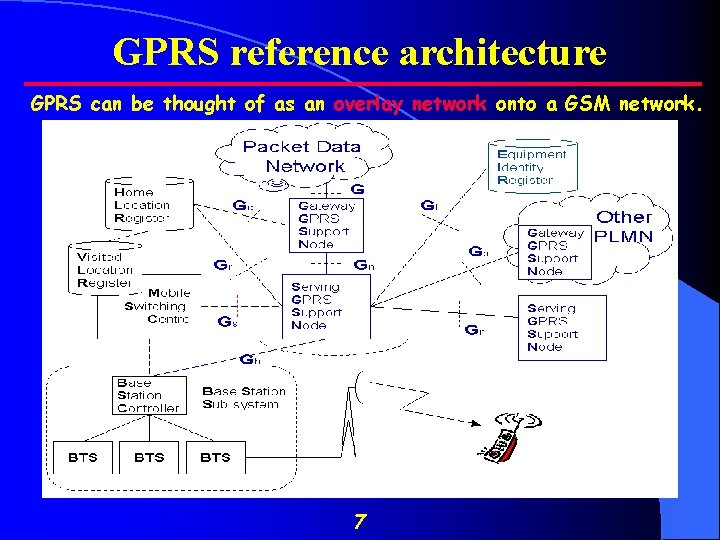
GPRS reference architecture GPRS can be thought of as an overlay network onto a GSM network. 7
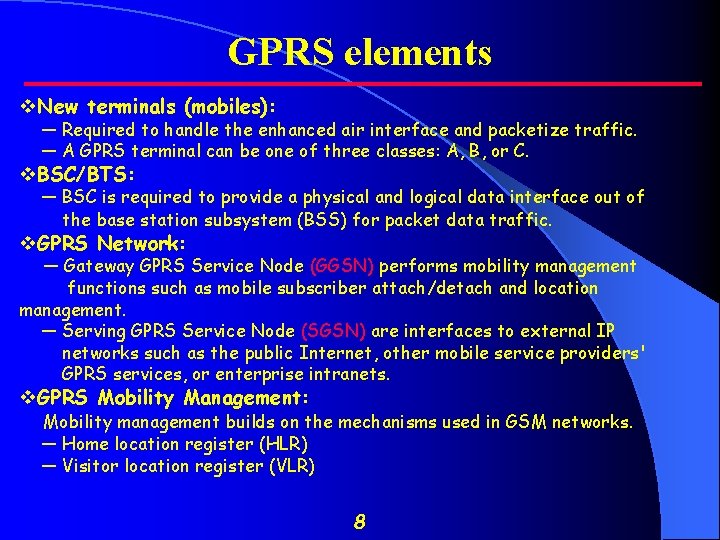
GPRS elements v. New terminals (mobiles): — Required to handle the enhanced air interface and packetize traffic. — A GPRS terminal can be one of three classes: A, B, or C. v. BSC/BTS: — BSC is required to provide a physical and logical data interface out of the base station subsystem (BSS) for packet data traffic. v. GPRS Network: — Gateway GPRS Service Node (GGSN) performs mobility management functions such as mobile subscriber attach/detach and location management. — Serving GPRS Service Node (SGSN) are interfaces to external IP networks such as the public Internet, other mobile service providers' GPRS services, or enterprise intranets. v. GPRS Mobility Management: Mobility management builds on the mechanisms used in GSM networks. — Home location register (HLR) — Visitor location register (VLR) 8
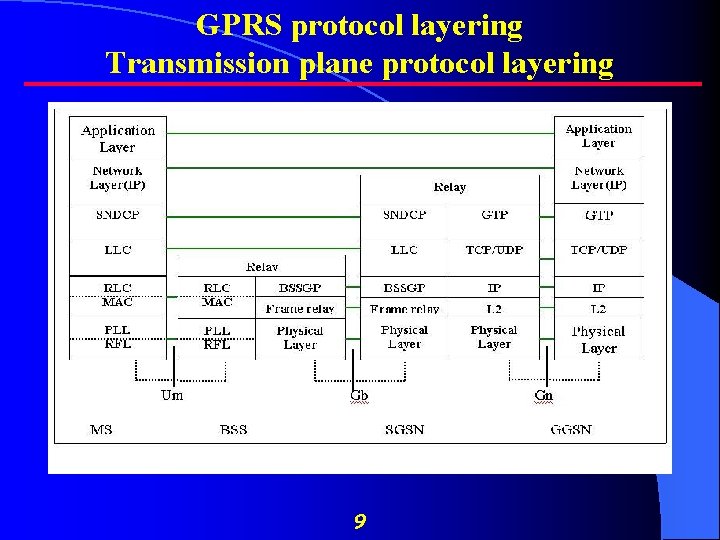
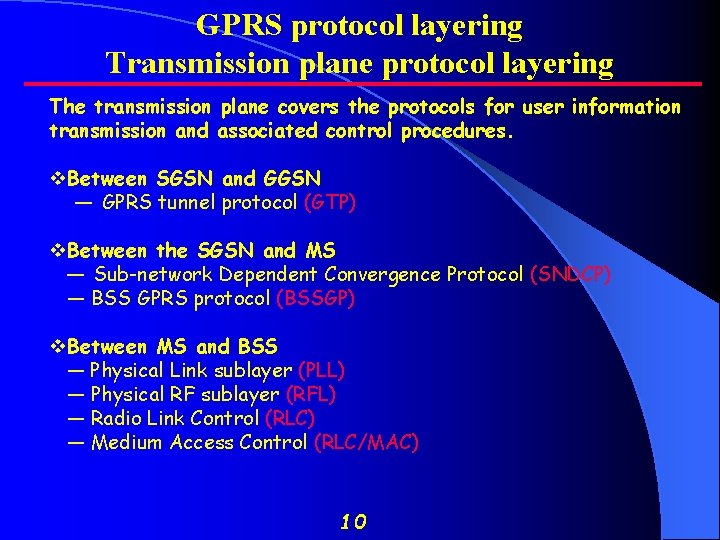
GPRS protocol layering Transmission plane protocol layering 9
GPRS protocol layering Transmission plane protocol layering The transmission plane covers the protocols for user information transmission and associated control procedures. v. Between SGSN and GGSN — GPRS tunnel protocol (GTP) v. Between the SGSN and MS — Sub-network Dependent Convergence Protocol (SNDCP) — BSS GPRS protocol (BSSGP) v. Between MS and BSS — Physical Link sublayer (PLL) — Physical RF sublayer (RFL) — Radio Link Control (RLC) — Medium Access Control (RLC/MAC) 10
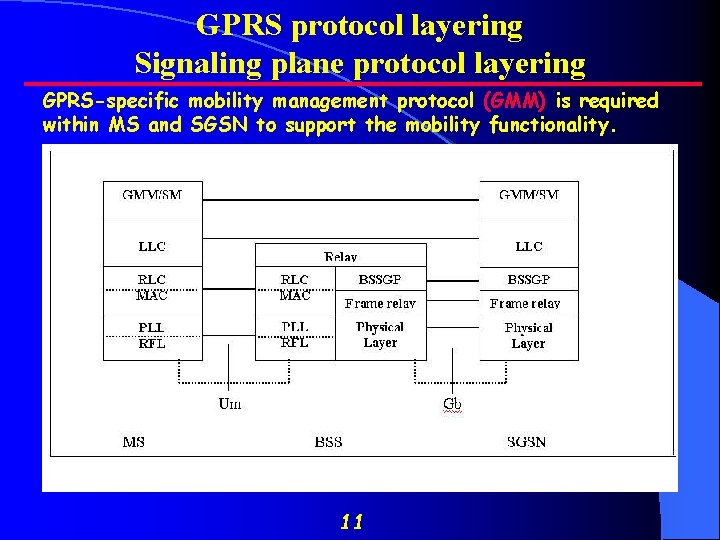
GPRS protocol layering Signaling plane protocol layering GPRS-specific mobility management protocol (GMM) is required within MS and SGSN to support the mobility functionality. 11
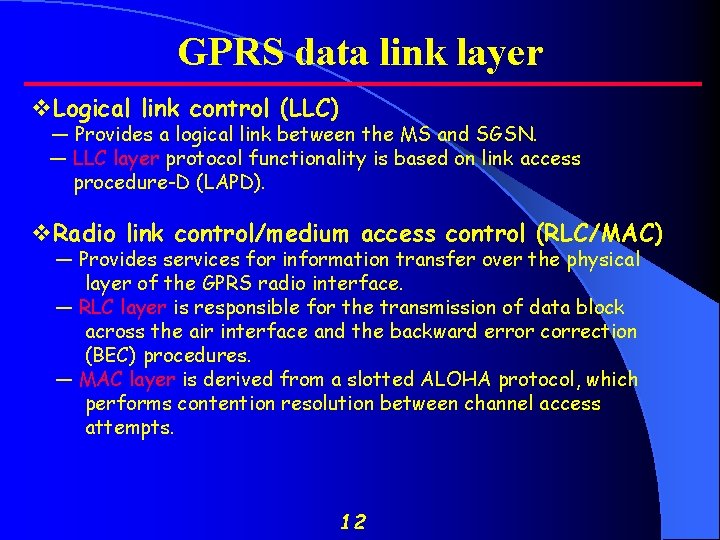
GPRS data link layer v. Logical link control (LLC) — Provides a logical link between the MS and SGSN. — LLC layer protocol functionality is based on link access procedure-D (LAPD). v. Radio link control/medium access control (RLC/MAC) — Provides services for information transfer over the physical layer of the GPRS radio interface. — RLC layer is responsible for the transmission of data block across the air interface and the backward error correction (BEC) procedures. — MAC layer is derived from a slotted ALOHA protocol, which performs contention resolution between channel access attempts. 12
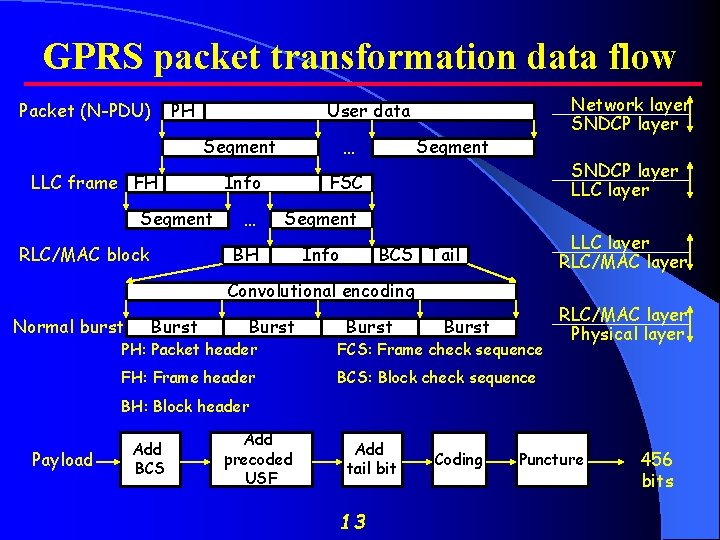
GPRS packet transformation data flow Packet (N-PDU) PH Segment … Info FSC LLC frame FH Segment RLC/MAC block Network layer SNDCP layer User data … Segment BH Info Segment SNDCP layer LLC layer RLC/MAC layer BCS Tail Convolutional encoding Normal burst Burst PH: Packet header FCS: Frame check sequence FH: Frame header BCS: Block check sequence RLC/MAC layer Physical layer BH: Block header Payload Add BCS Add precoded USF Add tail bit 13 Coding Puncture 456 bits
GPRS RLC/MAC block structure 14
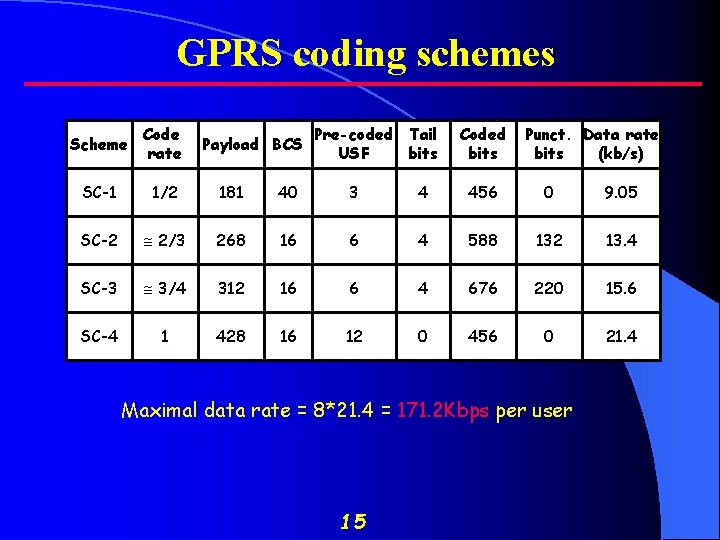
GPRS coding schemes Scheme Code rate SC-1 1/2 181 40 3 4 456 0 9. 05 SC-2 2/3 268 16 6 4 588 132 13. 4 SC-3 3/4 312 16 6 4 676 220 15. 6 SC-4 1 428 16 12 0 456 0 21. 4 Payload BCS Pre-coded Tail USF bits Coded bits Punct. Data rate bits (kb/s) Maximal data rate = 8*21. 4 = 171. 2 Kbps per user 15
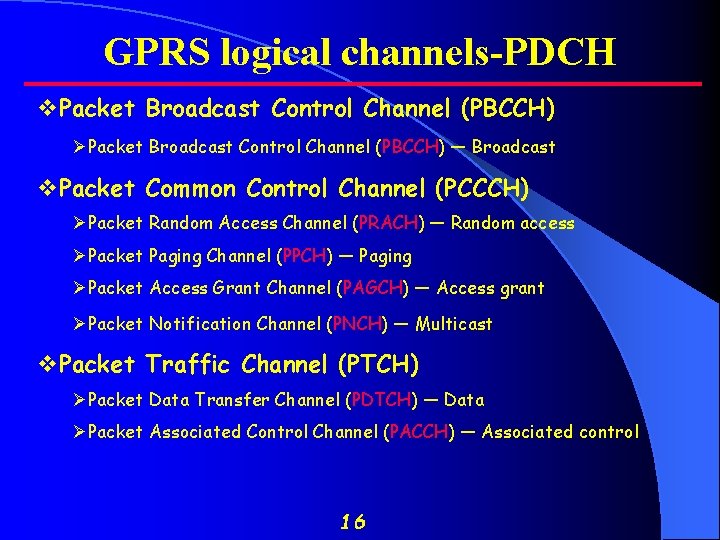
GPRS logical channels-PDCH v. Packet Broadcast Control Channel (PBCCH) ØPacket Broadcast Control Channel (PBCCH) — Broadcast v. Packet Common Control Channel (PCCCH) ØPacket Random Access Channel (PRACH) — Random access ØPacket Paging Channel (PPCH) — Paging ØPacket Access Grant Channel (PAGCH) — Access grant ØPacket Notification Channel (PNCH) — Multicast v. Packet Traffic Channel (PTCH) ØPacket Data Transfer Channel (PDTCH) — Data ØPacket Associated Control Channel (PACCH) — Associated control 16
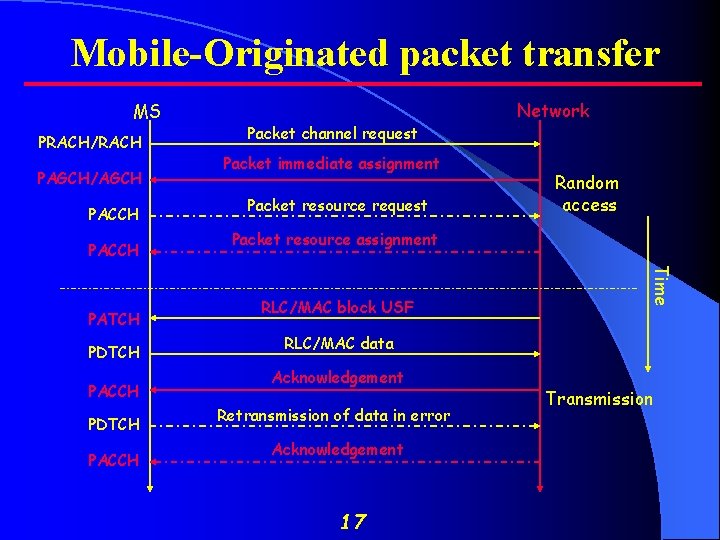
Mobile-Originated packet transfer MS PRACH/RACH PAGCH/AGCH PACCH PDTCH PACCH Packet immediate assignment Packet resource request Random access Packet resource assignment RLC/MAC block USF Time PATCH Packet channel request Network RLC/MAC data Acknowledgement Retransmission of data in error Acknowledgement 17 Transmission
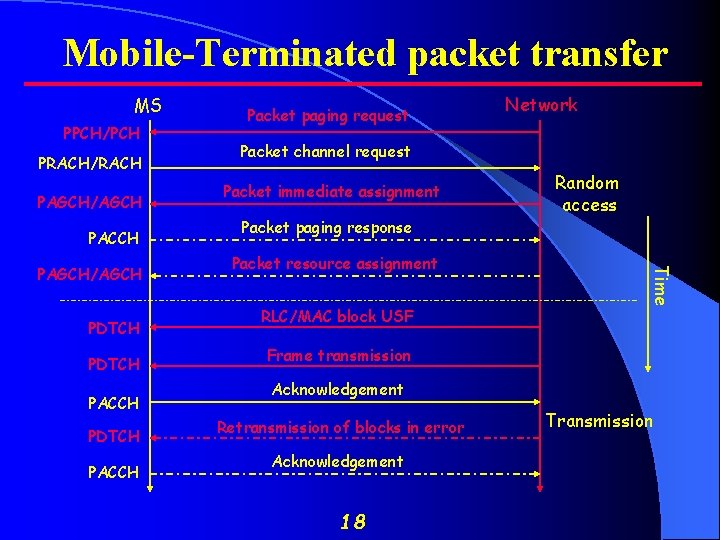
Mobile-Terminated packet transfer MS PPCH/PCH PRACH/RACH PAGCH/AGCH PACCH PDTCH PACCH Network Packet channel request Packet immediate assignment Packet paging response Packet resource assignment RLC/MAC block USF Random access Time PAGCH/AGCH Packet paging request Frame transmission Acknowledgement Retransmission of blocks in error Acknowledgement 18 Transmission
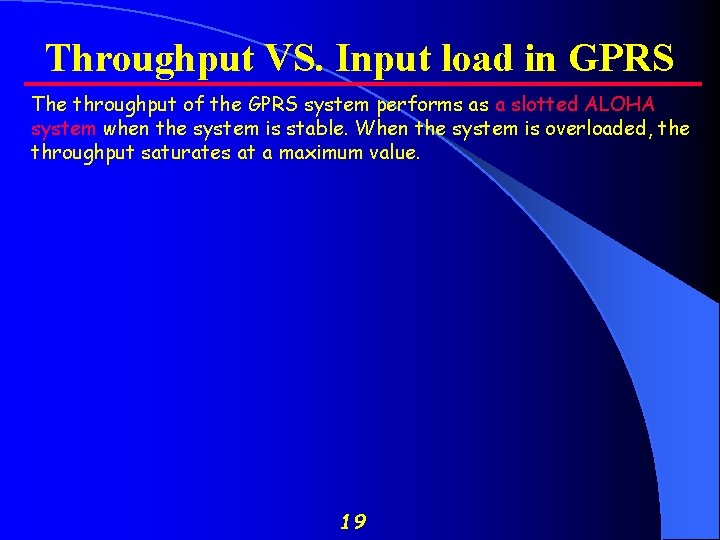
Throughput VS. Input load in GPRS The throughput of the GPRS system performs as a slotted ALOHA system when the system is stable. When the system is overloaded, the throughput saturates at a maximum value. 19
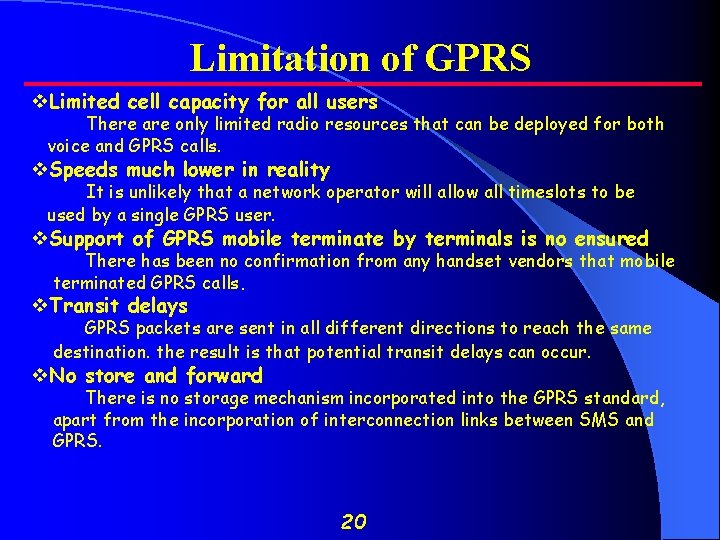
Limitation of GPRS v. Limited cell capacity for all users There are only limited radio resources that can be deployed for both voice and GPRS calls. v. Speeds much lower in reality It is unlikely that a network operator will allow all timeslots to be used by a single GPRS user. v. Support of GPRS mobile terminate by terminals is no ensured There has been no confirmation from any handset vendors that mobile terminated GPRS calls. v. Transit delays GPRS packets are sent in all different directions to reach the same destination. the result is that potential transit delays can occur. v. No store and forward There is no storage mechanism incorporated into the GPRS standard, apart from the incorporation of interconnection links between SMS and GPRS. 20