
GPGPU GeneralPurpose computation on Graphics Processing Units Mustafa
- Slides: 14
GPGPU General-Purpose computation on Graphics Processing Units Mustafa Tan Atagören 200771004 Çankaya University Department Of Computer Engineering
GPGPU We would be concentrating on, �What is GPGPU �Why GPGPU �GPU Architecture �GPGPU Computing Model �Software Environment �Future
What Is GPGPU �GPGPU(General-Purpose computation on Graphics Processing Units) �GPU typically handles computation only for computer graphics to perform computation in applications traditionally handled by the CPU �Once specially designed for computer graphics and difficult to program, today’s GPU’s are generalpurpose parallel processors with support for accessible programming languages such as C developers who port their applications to GPUs for optimized CPU applications.
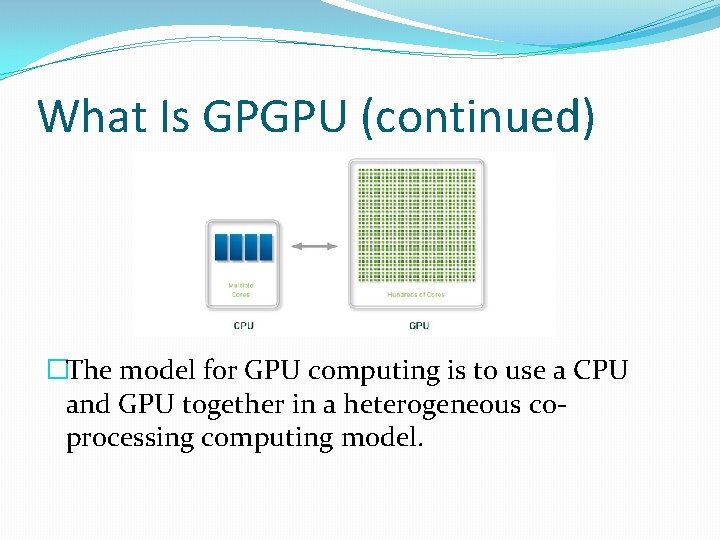
What Is GPGPU (continued) �The model for GPU computing is to use a CPU and GPU together in a heterogeneous coprocessing computing model.
Why GPGPU �Parallelism is the future of computing �The developer is tasked with launching 10 s of 1000 s of threads simultaneously. The GPU hardware manages the threads and does thread scheduling.
Why GPGPU (continued) �Computational requirements are large � GPUs must deliver an enormous amount of compute performance to satisfy the demand of complex real-time applications �Parallelism is substantial � Fortunately, the graphics pipeline is well suited for parallelism �Throughput is more important than latency � GPU implementations of the graphics pipeline prioritize throughput over latency. The human visual system operates on millisecond time scales, while operations within a modern processor take nanoseconds.
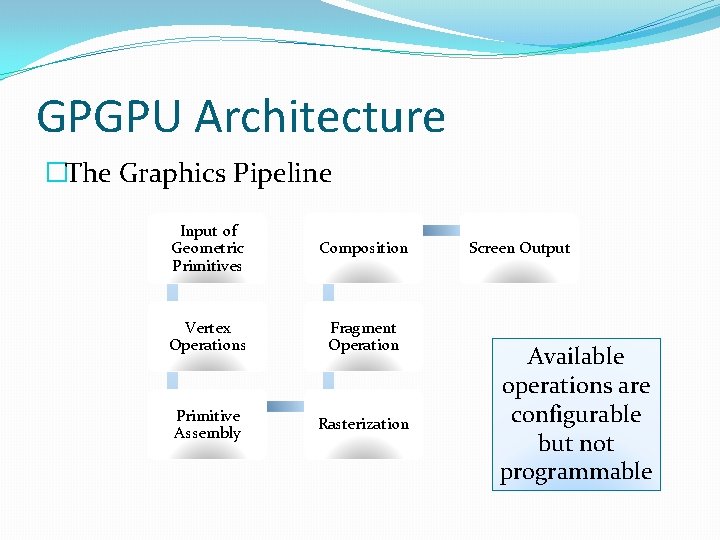
GPGPU Architecture �The Graphics Pipeline Input of Geometric Primitives Composition Vertex Operations Fragment Operation Primitive Assembly Rasterization Screen Output Available operations are configurable but not programmable
GPGPU Architecture (continued) � Vertex Operations: Each vertex must be transformed into screen space and shaded, typically through computing their interaction with the lights in the scene. Because typical scenes have tens to hundreds of thousands of vertices, and each vertex can be computed independently, this stage is well suited for parallel hardware. � Primitive Assembly: The vertices are assembled into triangles, the fundamental hardwaresupported primitive in today’s GPUs. � Rasterization: Rasterization is the process of determining which screen-space pixel locations are covered by each triangle. � Fragment Operations: Using color information from the vertices and possibly fetching additional data from globalmemory in the form of textures (images that are mapped onto surfaces), each fragment is shaded to determine its final color. � Composition: Fragments are assembled into a final image with one color per pixel, usually by keeping the closest fragment to the camera for each pixel location.
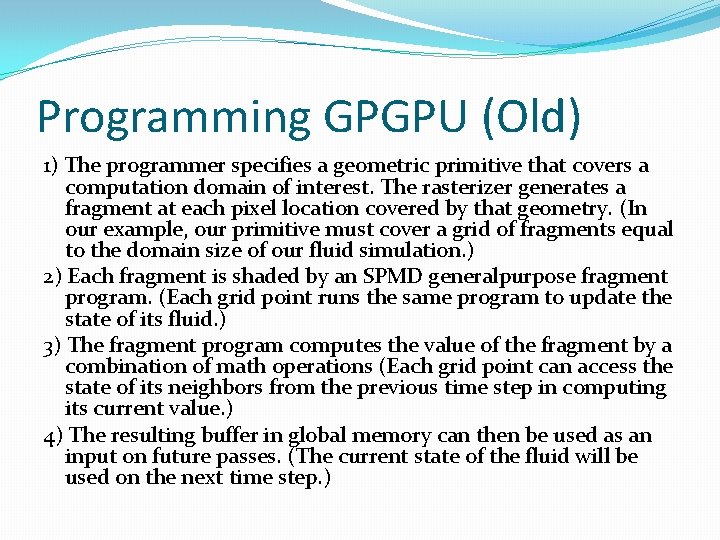
Programming GPGPU (Old) 1) The programmer specifies a geometric primitive that covers a computation domain of interest. The rasterizer generates a fragment at each pixel location covered by that geometry. (In our example, our primitive must cover a grid of fragments equal to the domain size of our fluid simulation. ) 2) Each fragment is shaded by an SPMD generalpurpose fragment program. (Each grid point runs the same program to update the state of its fluid. ) 3) The fragment program computes the value of the fragment by a combination of math operations (Each grid point can access the state of its neighbors from the previous time step in computing its current value. ) 4) The resulting buffer in global memory can then be used as an input on future passes. (The current state of the fluid will be used on the next time step. )
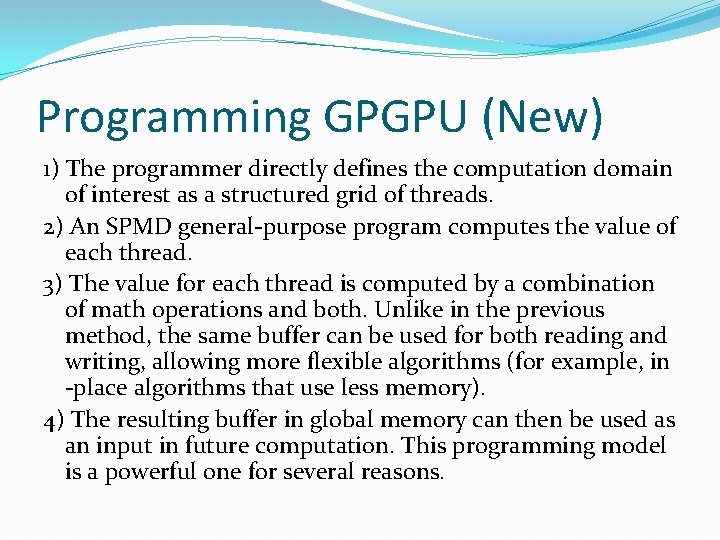
Programming GPGPU (New) 1) The programmer directly defines the computation domain of interest as a structured grid of threads. 2) An SPMD general-purpose program computes the value of each thread. 3) The value for each thread is computed by a combination of math operations and both. Unlike in the previous method, the same buffer can be used for both reading and writing, allowing more flexible algorithms (for example, in -place algorithms that use less memory). 4) The resulting buffer in global memory can then be used as an input in future computation. This programming model is a powerful one for several reasons.
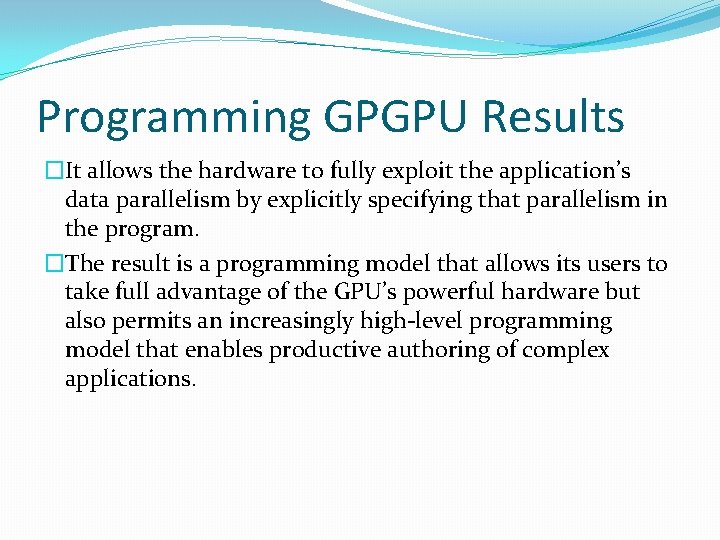
Programming GPGPU Results �It allows the hardware to fully exploit the application’s data parallelism by explicitly specifying that parallelism in the program. �The result is a programming model that allows its users to take full advantage of the GPU’s powerful hardware but also permits an increasingly high-level programming model that enables productive authoring of complex applications.
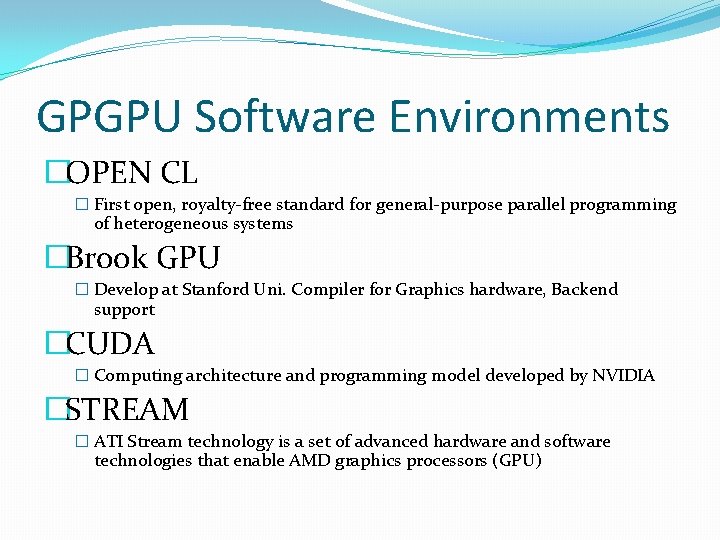
GPGPU Software Environments �OPEN CL � First open, royalty-free standard for general-purpose parallel programming of heterogeneous systems �Brook GPU � Develop at Stanford Uni. Compiler for Graphics hardware, Backend support �CUDA � Computing architecture and programming model developed by NVIDIA �STREAM � ATI Stream technology is a set of advanced hardware and software technologies that enable AMD graphics processors (GPU)
GPGPU Future �NVIDIA TESLA � Based On CUDA, C++ Support, When compared to the latest quad-core CPU, Tesla 20 -series GPU computing processors deliver equivalent performance at 1/20 th the power consumption and 1/10 th the cost. �AMD FUSION � AMD Fusion is the codename for a future next-generation microprocessor design and a product of the merger between AMD and ATI.
THANK YOU! I would also like to thank,