
GPGPU Evaluation First experiences in Napoli Silvio Pardi
- Slides: 20
GPGPU Evaluation – First experiences in Napoli Silvio Pardi S. Pardi Frascati, 2012 March 19 -23
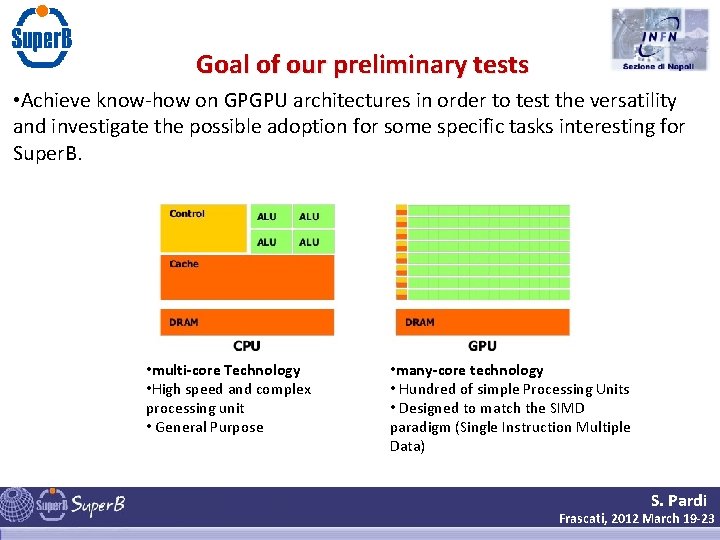
Goal of our preliminary tests • Achieve know-how on GPGPU architectures in order to test the versatility and investigate the possible adoption for some specific tasks interesting for Super. B. • multi-core Technology • High speed and complex processing unit • General Purpose • many-core technology • Hundred of simple Processing Units • Designed to match the SIMD paradigm (Single Instruction Multiple Data) S. Pardi Frascati, 2012 March 19 -23
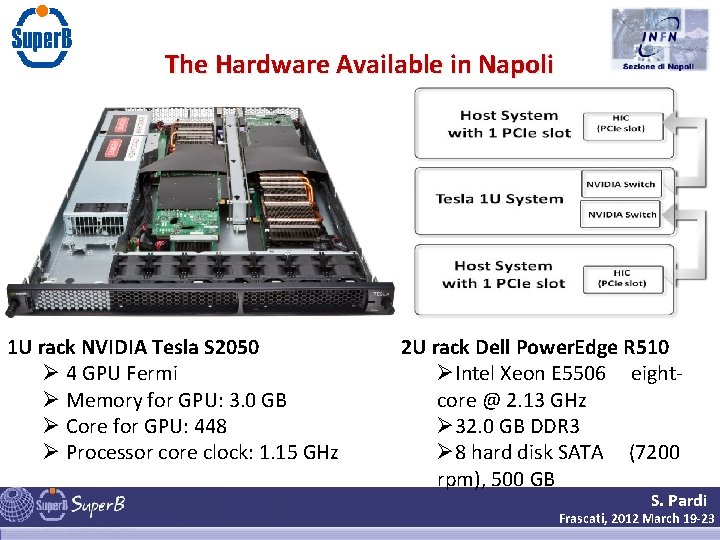
The Hardware Available in Napoli 1 U rack NVIDIA Tesla S 2050 Ø 4 GPU Fermi Ø Memory for GPU: 3. 0 GB Ø Core for GPU: 448 Ø Processor core clock: 1. 15 GHz 2 U rack Dell Power. Edge R 510 ØIntel Xeon E 5506 eightcore @ 2. 13 GHz Ø 32. 0 GB DDR 3 Ø 8 hard disk SATA (7200 rpm), 500 GB S. Pardi Frascati, 2012 March 19 -23
ENVIRONMENT • Cuda compilation tools, release 4. 0, V 0. 2. 1221 • NVIDIA-Linux-x 86_64 -270. 41. 34. run • cudatoolkit_4. 0. 17_linux_64_rhel 5. 5. run • gpucomputingsdk_4. 0. 17_linux. run S. Pardi Frascati, 2012 March 19 -23
Tuning for lazily modality removal The firsts test on the Tesla S 2050 GPU with CUDA C show a starting overhead ~2 second due the “context” creation needed by the CUDA toolkit. The context is create on demand (lazily) and deallocated when is not used. SOLUTIONS (Suggested by Davide Rossetti): 1. Before the CUDA 4, Create a dummy process always active that keeps alive the CUDA context “nvidia-smi -l 60 -f /tmp/bu. log” 2. Since CUDA ver. 4 use the -pm (persistence-mode ) option from the nvidia-smi command to activate the GPU context. S. Pardi Frascati, 2012 March 19 -23
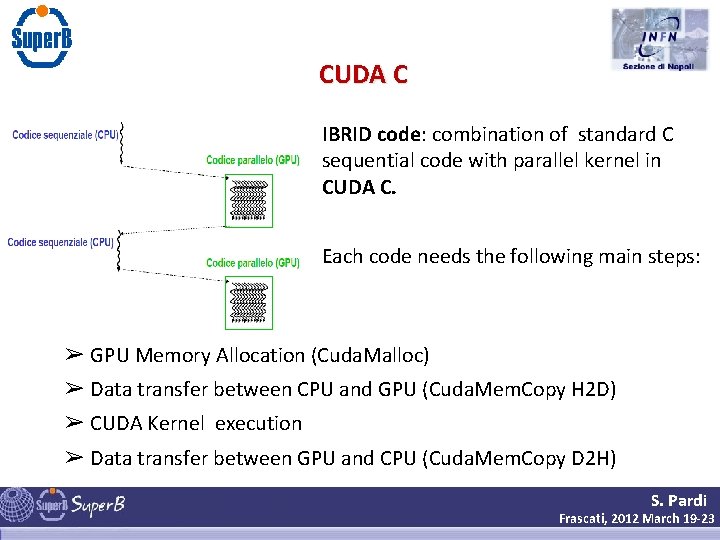
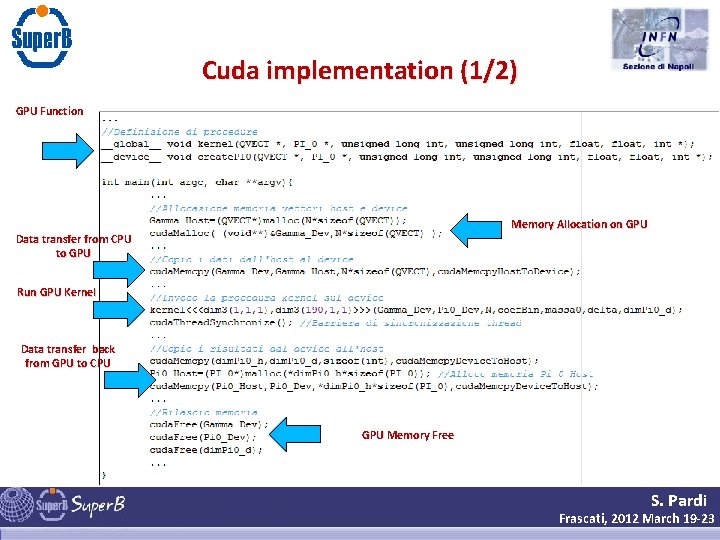
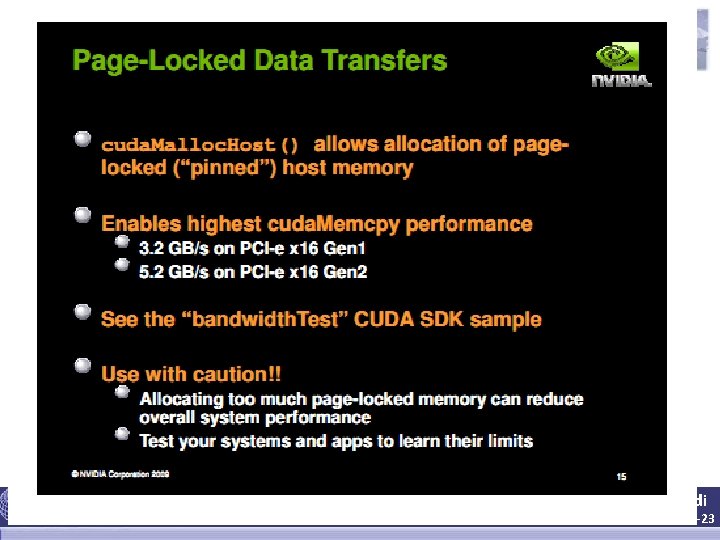
CUDA C IBRID code: combination of standard C sequential code with parallel kernel in CUDA C. Each code needs the following main steps: ➢ GPU Memory Allocation (Cuda. Malloc) ➢ Data transfer between CPU and GPU (Cuda. Mem. Copy H 2 D) ➢ CUDA Kernel execution ➢ Data transfer between GPU and CPU (Cuda. Mem. Copy D 2 H) S. Pardi Frascati, 2012 March 19 -23
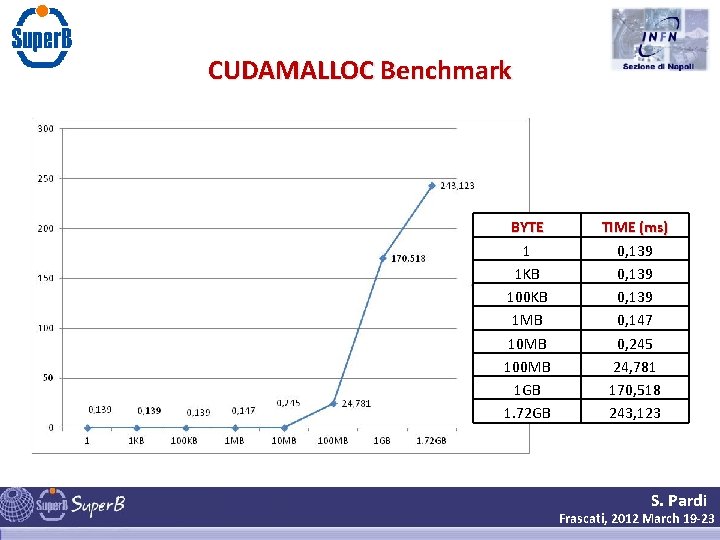
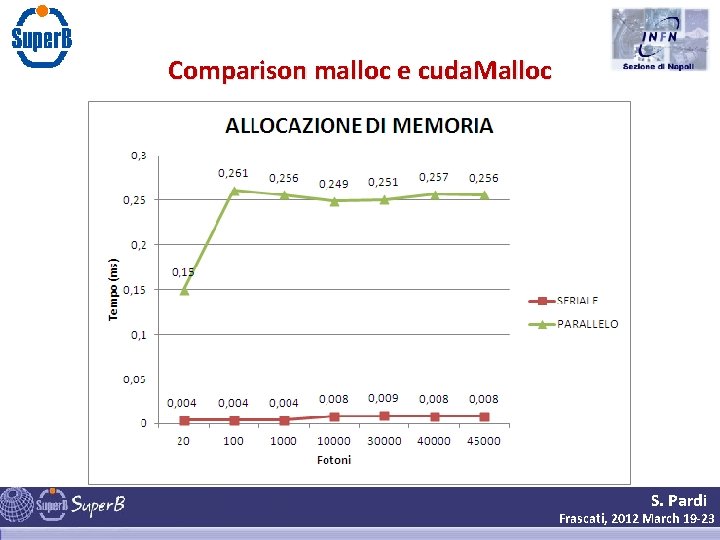
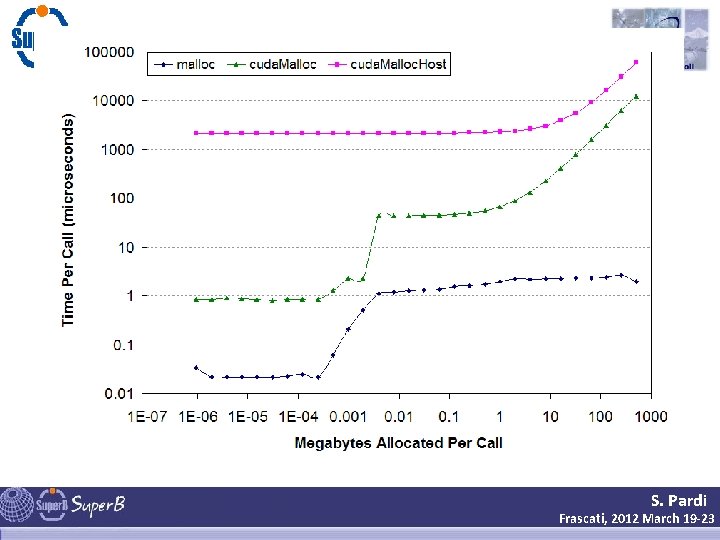
CUDAMALLOC Benchmark BYTE 1 1 KB 100 KB 1 MB 100 MB 1 GB 1. 72 GB TIME (ms) 0, 139 0, 147 0, 245 24, 781 170, 518 243, 123 S. Pardi Frascati, 2012 March 19 -23
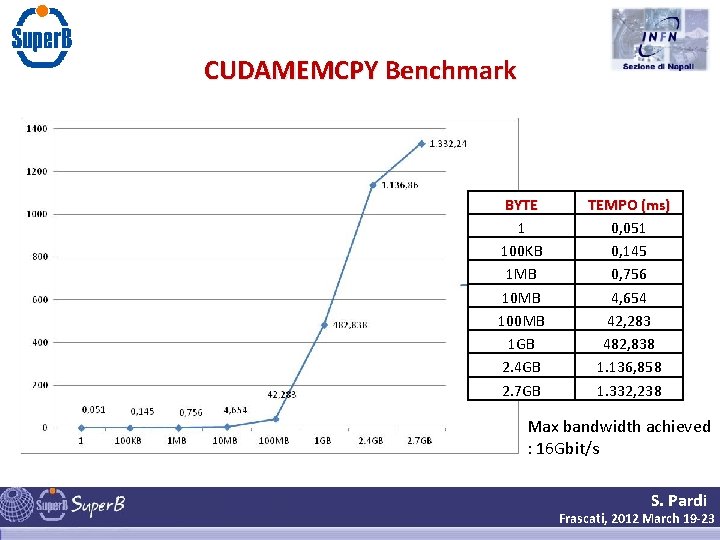
CUDAMEMCPY Benchmark BYTE 1 100 KB 1 MB 100 MB 1 GB 2. 4 GB 2. 7 GB TEMPO (ms) 0, 051 0, 145 0, 756 4, 654 42, 283 482, 838 1. 136, 858 1. 332, 238 Max bandwidth achieved : 16 Gbit/s S. Pardi Frascati, 2012 March 19 -23
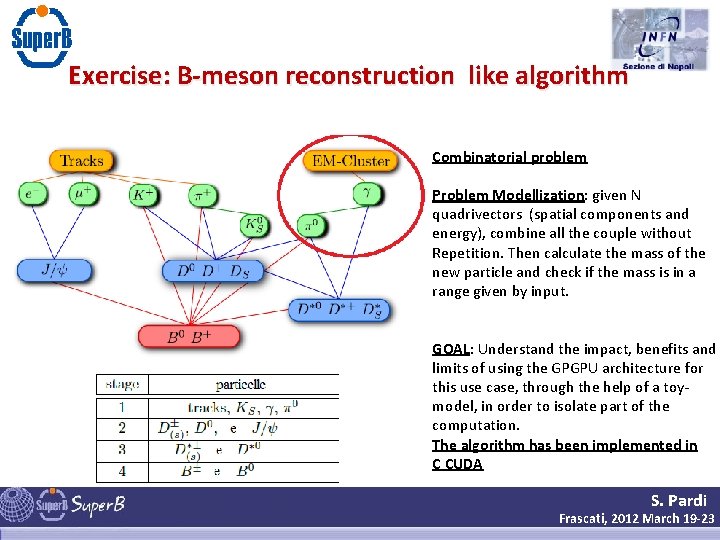
Exercise: B-meson reconstruction like algorithm Combinatorial problem Problem Modellization: given N quadrivectors (spatial components and energy), combine all the couple without Repetition. Then calculate the mass of the new particle and check if the mass is in a range given by input. GOAL: Understand the impact, benefits and limits of using the GPGPU architecture for this use case, through the help of a toymodel, in order to isolate part of the computation. The algorithm has been implemented in C CUDA S. Pardi Frascati, 2012 March 19 -23
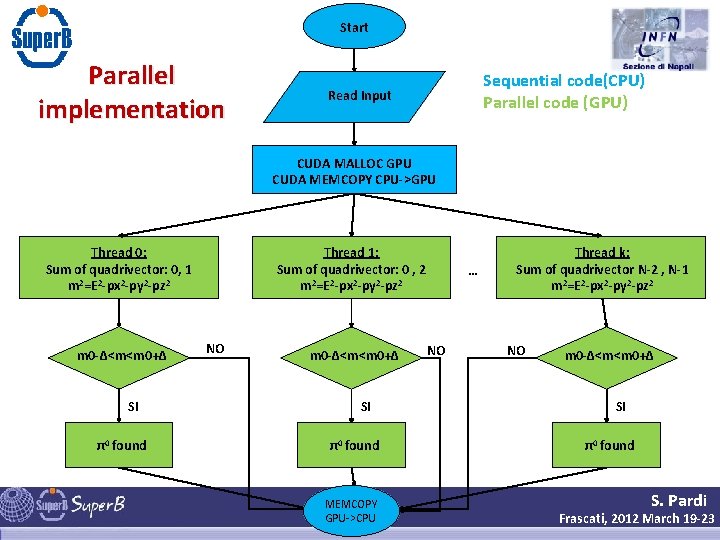
Start Parallel implementation Sequential code(CPU) Parallel code (GPU) Read Input CUDA MALLOC GPU CUDA MEMCOPY CPU->GPU Thread 0: Sum of quadrivector: 0, 1 m 2=E 2 -px 2 -py 2 -pz 2 m 0 -Δ<m<m 0+Δ SI π0 found Thread 1: Sum of quadrivector: 0 , 2 m 2=E 2 -px 2 -py 2 -pz 2 NO m 0 -Δ<m<m 0+Δ SI π0 found MEMCOPY GPU->CPU … NO Thread k: Sum of quadrivector N-2 , N-1 m 2=E 2 -px 2 -py 2 -pz 2 NO m 0 -Δ<m<m 0+Δ SI π0 found S. Pardi Frascati, 2012 March 19 -23
Cuda implementation (1/2) GPU Function Memory Allocation on GPU Data transfer from CPU to GPU Run GPU Kernel Data transfer back from GPU to CPU GPU Memory Free S. Pardi Frascati, 2012 March 19 -23
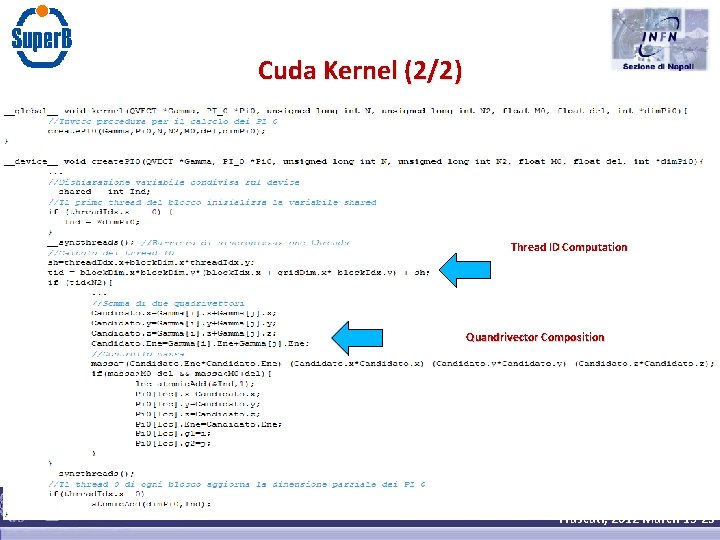
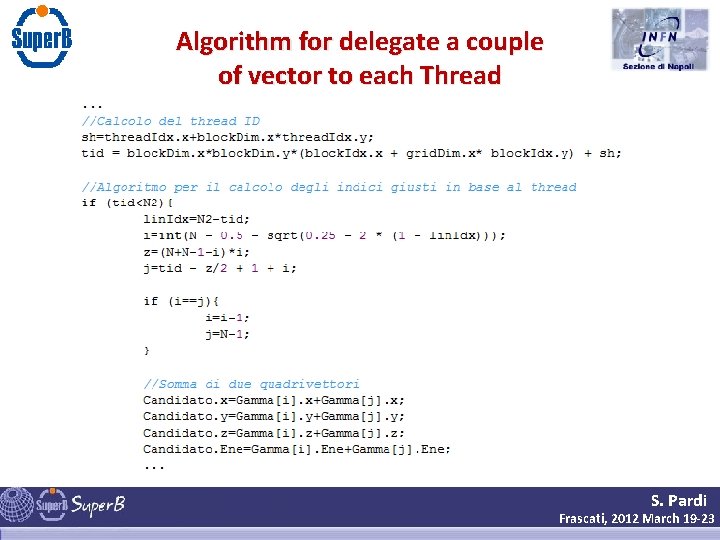
Cuda Kernel (2/2) Thread ID Computation Quandrivector Composition S. Pardi Frascati, 2012 March 19 -23
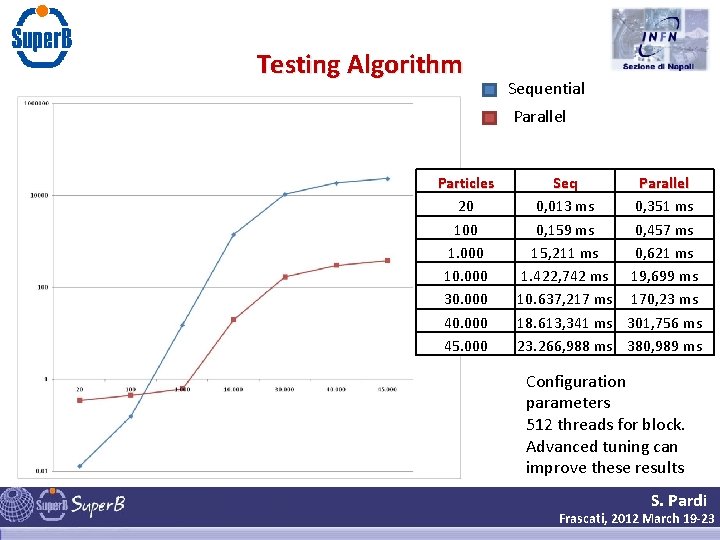
Testing Algorithm Sequential Parallel Particles 20 100 1. 000 10. 000 30. 000 45. 000 Seq Parallel 0, 013 ms 0, 351 ms 0, 159 ms 0, 457 ms 15, 211 ms 0, 621 ms 1. 422, 742 ms 19, 699 ms 10. 637, 217 ms 170, 23 ms 18. 613, 341 ms 301, 756 ms 23. 266, 988 ms 380, 989 ms Configuration parameters 512 threads for block. Advanced tuning can improve these results S. Pardi Frascati, 2012 March 19 -23
Some Ideas The first experience suggest to continue the investigation expecially in the following ways: Tuning the memory management: Investigate the possibility to Overlapping Data Transfers and Computation through Async and Stream APIs. Tuning the Grid/Block/Threads topology Consider to rearrange the algorithms in term of operations per threads. S. Pardi Frascati, 2012 March 19 -23
Conclusion In Napoli we started to test the NVIDIA GPGPU architecture and we are investigating how to port HEP code on these architectures. A first experience using a toy algorithm has show several aspects to take in account in GPU programming: • Overhead management • Memory management • Algorithm re-engineerization • Work distribution for each Thread • Block and Thread topology definition A lot of work is still due in order to achieve a full understanding of the architecture and the real benefits achievable. There are several work in progress. S. Pardi Frascati, 2012 March 19 -23
END S. Pardi Frascati, 2012 March 19 -23
Comparison malloc e cuda. Malloc S. Pardi Frascati, 2012 March 19 -23
Algorithm for delegate a couple of vector to each Thread S. Pardi Frascati, 2012 March 19 -23
S. Pardi Frascati, 2012 March 19 -23
S. Pardi Frascati, 2012 March 19 -23