
GP 1352015 Structural Design of AlQuds Open University






- Slides: 102
GP - 13/5/2015 Structural Design of Al-Quds Open University in Salfit Prepared By : Ahmed Ibrahim Saleh Hind Fuad Tbaileh Karim Abdulhakim Jawhari Submitted to : Eng. Ibrahim Arman 1
3 D Architectural Model of The Project 2
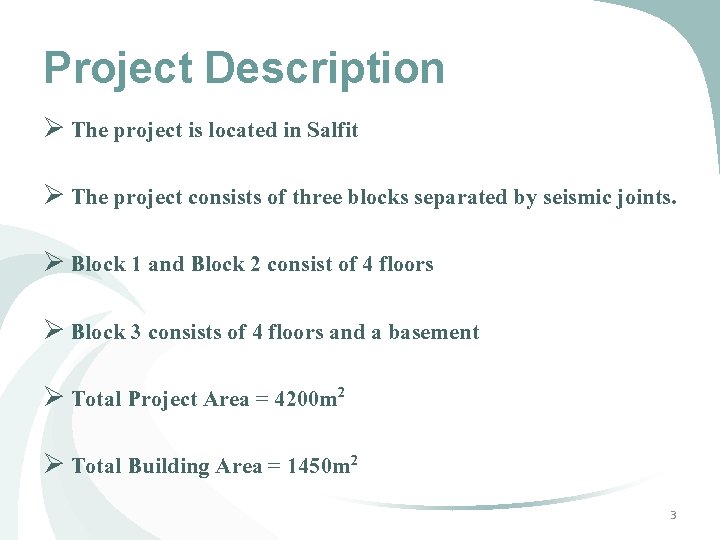
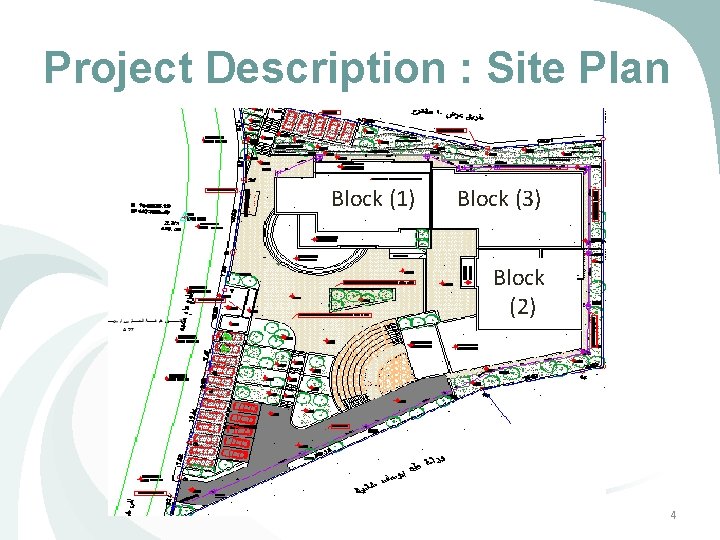
Project Description Ø The project is located in Salfit Ø The project consists of three blocks separated by seismic joints. Ø Block 1 and Block 2 consist of 4 floors Ø Block 3 consists of 4 floors and a basement Ø Total Project Area = 4200 m 2 Ø Total Building Area = 1450 m 2 3
Project Description : Site Plan Block (1) Block (3) Block (2) 4
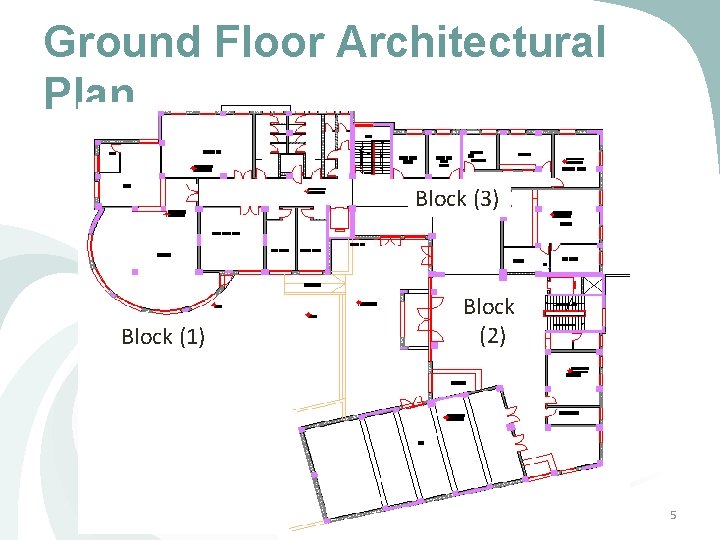
Ground Floor Architectural Plan Block (3) Block (1) Block (2) 5
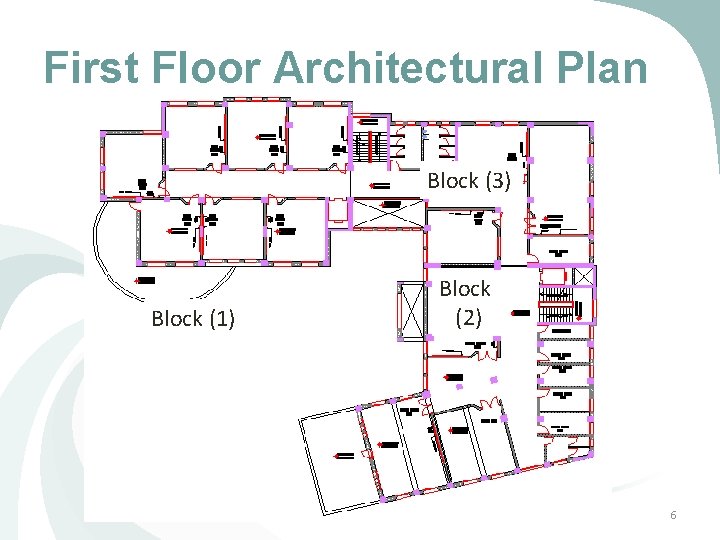
First Floor Architectural Plan Block (3) Block (1) Block (2) 6
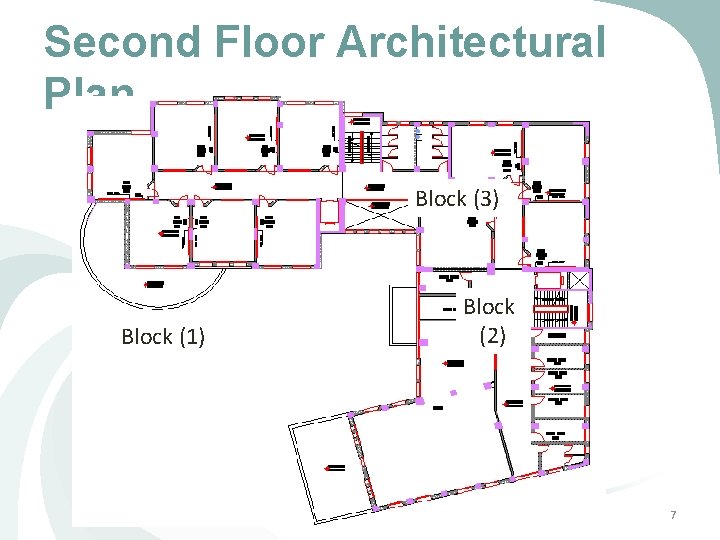
Second Floor Architectural Plan Block (3) Block (1) Block (2) 7
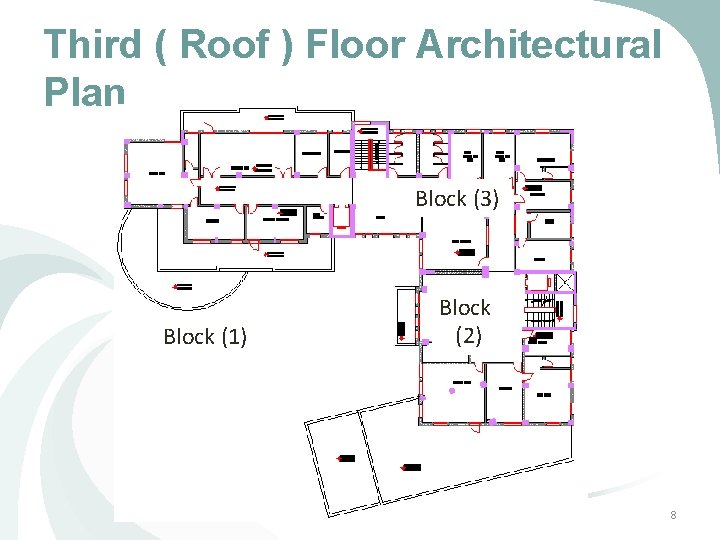
Third ( Roof ) Floor Architectural Plan Block (3) Block (1) Block (2) 8
Objectives of Graduation Project 1) To form a better knowledge about the different engineering codes such as UBC-97 and IBC-2012 regarding : Ø Earthquake Loads Ø Wind Loads 2) To make a preliminary design for the structural members in each block. 3) To analyze and design Block (1) using a 3 D structural model using the provisions of UBC-97 and IBC-2012. 4) To do a simplified comparison between the results and design obtained from UBC-97 and IBC-2012 9
The Codes Used in This Project v The Codes used in this project are the following : 1) Uniform Building Code ( UBC-97 ) for both wind and earth quake loads 2) International Building Code ( IBC-2012 ) for both wind and earth quakes 3) ASCE-7 (2010) 4) Jordanian Code 5) ACI 318 -11 and ACI 318 -95 10
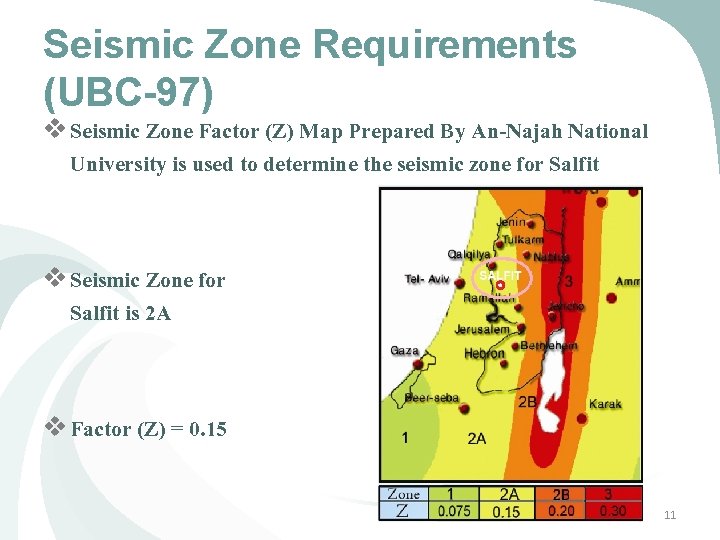
Seismic Zone Requirements (UBC-97) v Seismic Zone Factor (Z) Map Prepared By An-Najah National University is used to determine the seismic zone for Salfit v Seismic Zone for Salfit is 2 A v Factor (Z) = 0. 15 11
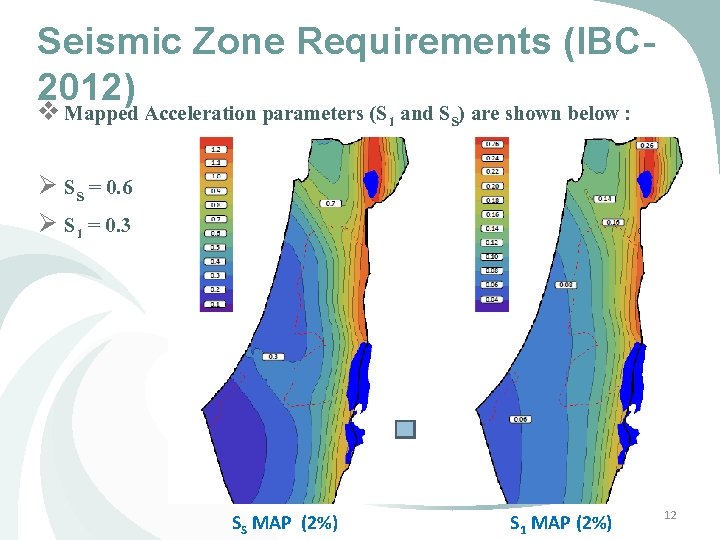
Seismic Zone Requirements (IBC 2012) v Mapped Acceleration parameters (S and S ) are shown below : 1 S Ø SS = 0. 6 Ø S 1 = 0. 3 SS MAP (2%) S 1 MAP (2%) 12
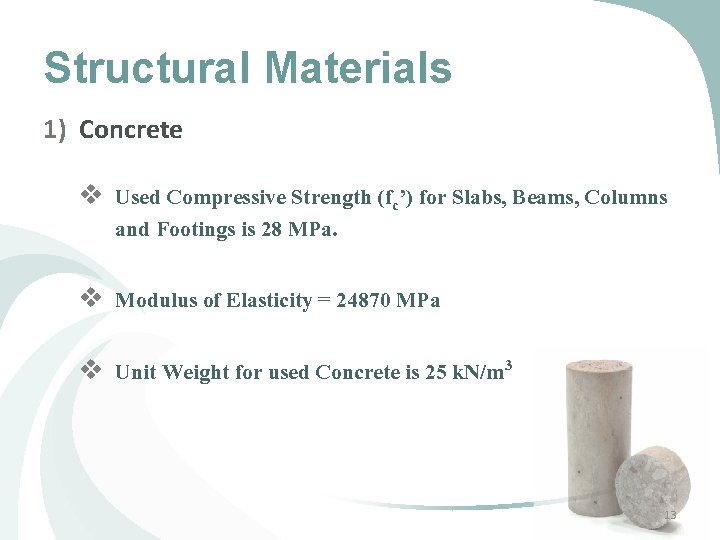
Structural Materials 1) Concrete v Used Compressive Strength (fc’) for Slabs, Beams, Columns and Footings is 28 MPa. v Modulus of Elasticity = 24870 MPa v Unit Weight for used Concrete is 25 k. N/m 3 13
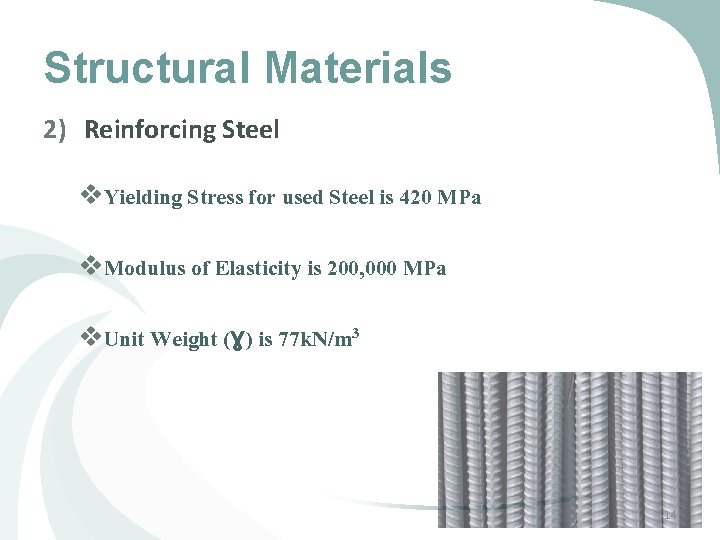
Structural Materials 2) Reinforcing Steel v. Yielding Stress for used Steel is 420 MPa v. Modulus of Elasticity is 200, 000 MPa v. Unit Weight (ɣ) is 77 k. N/m 3 14
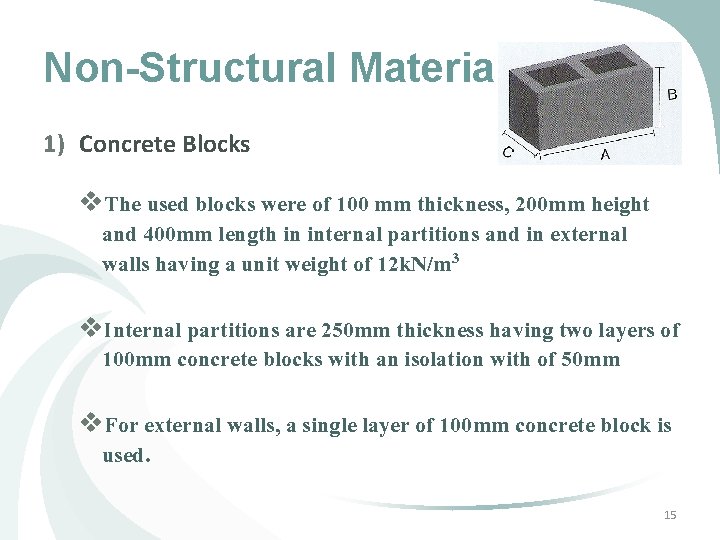
Non-Structural Materials 1) Concrete Blocks v. The used blocks were of 100 mm thickness, 200 mm height and 400 mm length in internal partitions and in external walls having a unit weight of 12 k. N/m 3 v. Internal partitions are 250 mm thickness having two layers of 100 mm concrete blocks with an isolation with of 50 mm v. For external walls, a single layer of 100 mm concrete block is used. 15
Non-Structural Materials 2) Building Stones: ØThe average density for used building stones is 2700 kg/m 3 ØThe Three main shapes of the used stones are: 1. Tobzeh Stone 2. Mufajjar Stone 3. Matabbeh Stone 16
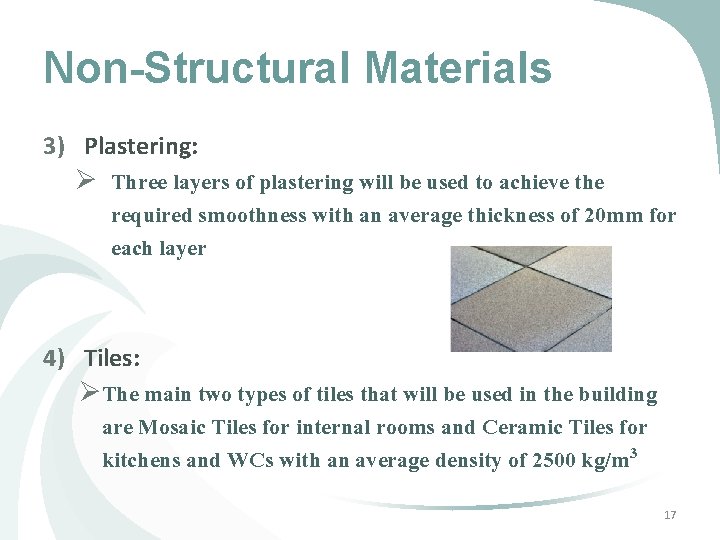
Non-Structural Materials 3) Plastering: Ø Three layers of plastering will be used to achieve the required smoothness with an average thickness of 20 mm for each layer 4) Tiles: ØThe main two types of tiles that will be used in the building are Mosaic Tiles for internal rooms and Ceramic Tiles for kitchens and WCs with an average density of 2500 kg/m 3 17
The Philosophy of Design v A 3 D Model was constructed analyzed using SAP 2000 program taking into consideration the effects of dynamic Loads v Columns and Beams were represented as line elements. v Slabs and shear walls were modeled as area elements. v The connections between the footings and the column necks were represented as pin connections. v The Ultimate Design Method (LRFD) were used in the preliminary design phase. 18
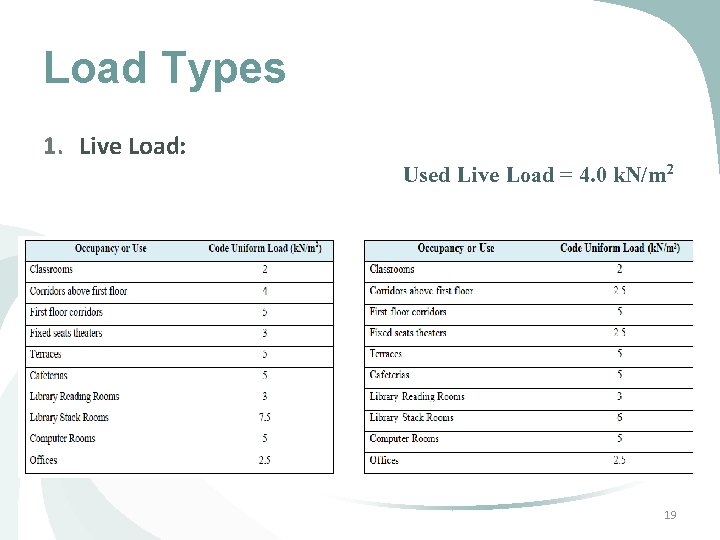
Load Types 1. Live Load: Used Live Load = 4. 0 k. N/m 2 19
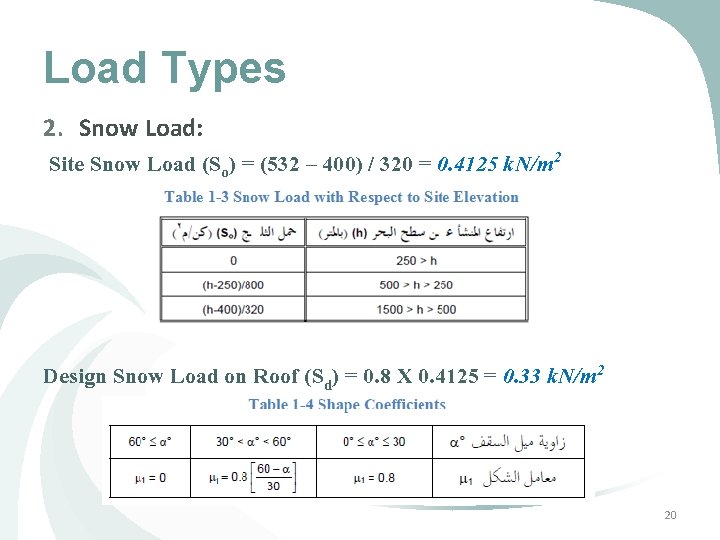
Load Types 2. Snow Load: Site Snow Load (So) = (532 – 400) / 320 = 0. 4125 k. N/m 2 Design Snow Load on Roof (Sd) = 0. 8 X 0. 4125 = 0. 33 k. N/m 2 20
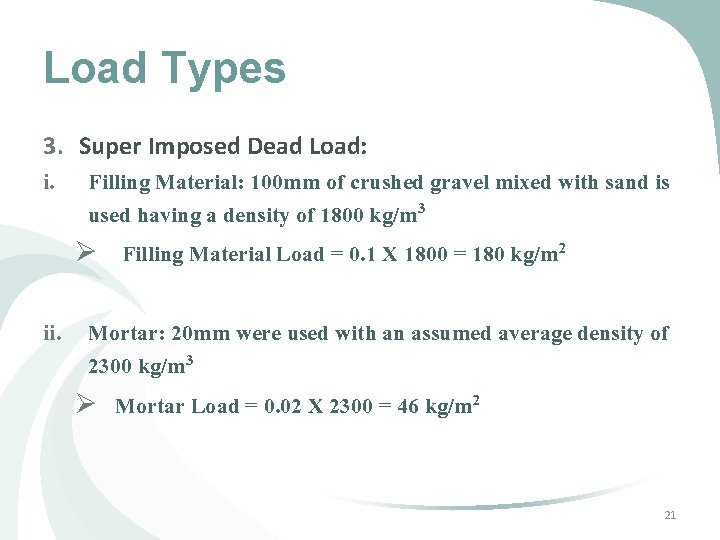
Load Types 3. Super Imposed Dead Load: i. Filling Material: 100 mm of crushed gravel mixed with sand is used having a density of 1800 kg/m 3 Ø Filling Material Load = 0. 1 X 1800 = 180 kg/m 2 ii. Mortar: 20 mm were used with an assumed average density of 2300 kg/m 3 Ø Mortar Load = 0. 02 X 2300 = 46 kg/m 2 21
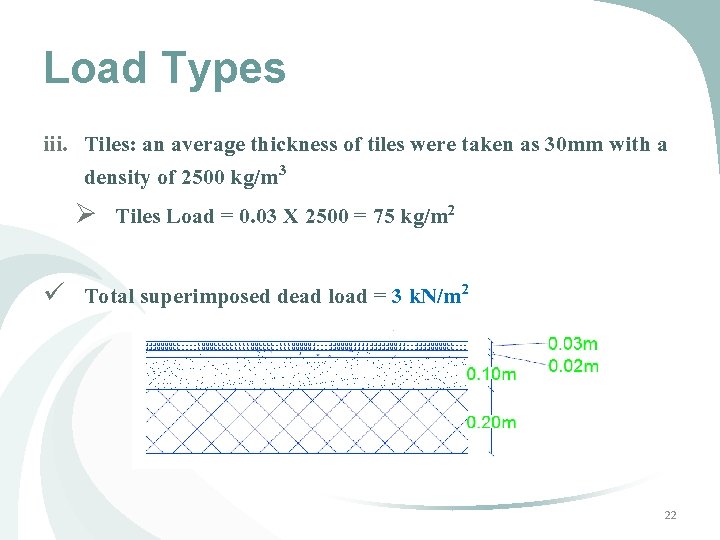
Load Types iii. Tiles: an average thickness of tiles were taken as 30 mm with a density of 2500 kg/m 3 Ø Tiles Load = 0. 03 X 2500 = 75 kg/m 2 ü Total superimposed dead load = 3 k. N/m 2 22
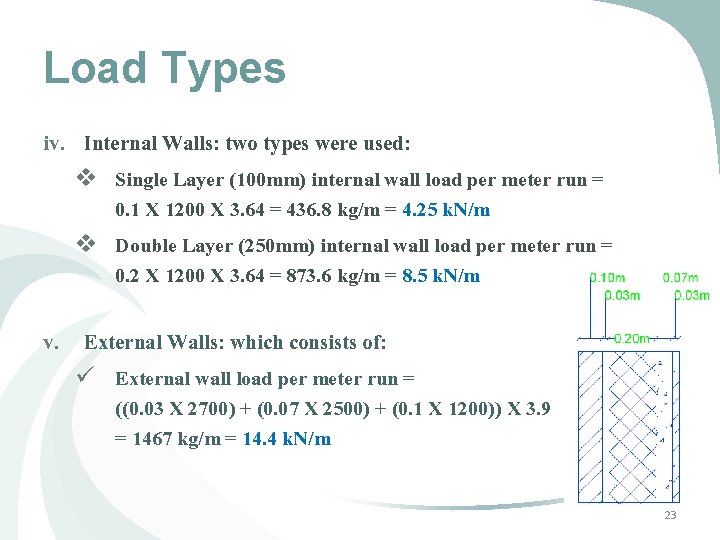
Load Types iv. Internal Walls: two types were used: v Single Layer (100 mm) internal wall load per meter run = 0. 1 X 1200 X 3. 64 = 436. 8 kg/m = 4. 25 k. N/m v Double Layer (250 mm) internal wall load per meter run = 0. 2 X 1200 X 3. 64 = 873. 6 kg/m = 8. 5 k. N/m v. External Walls: which consists of: ü External wall load per meter run = ((0. 03 X 2700) + (0. 07 X 2500) + (0. 1 X 1200)) X 3. 9 = 1467 kg/m = 14. 4 k. N/m 23
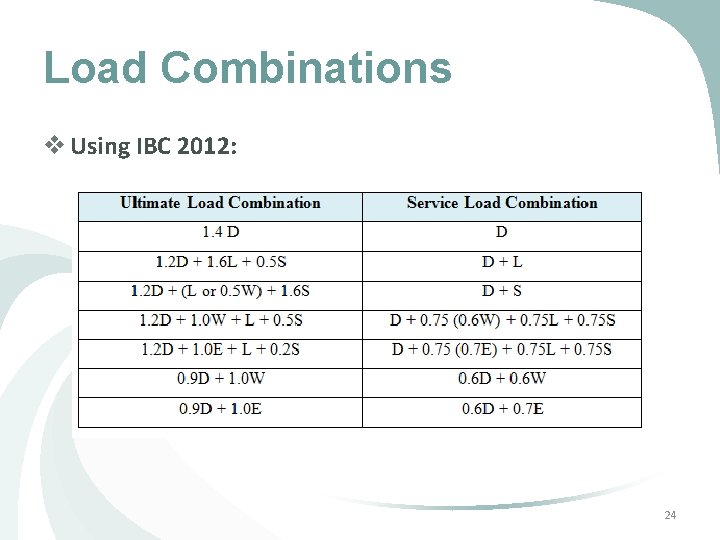
Load Combinations v Using IBC 2012: 24
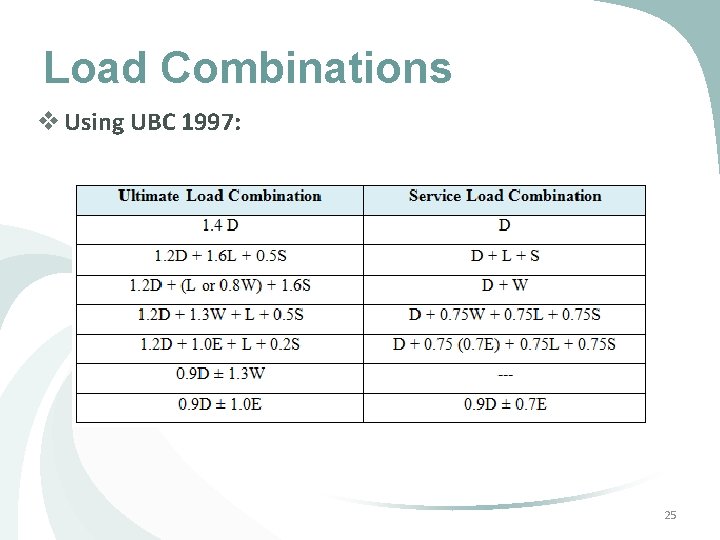
Load Combinations v Using UBC 1997: 25
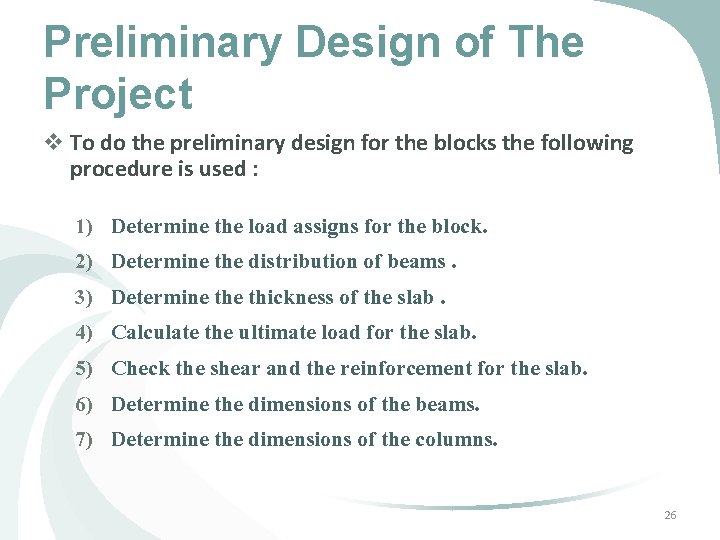
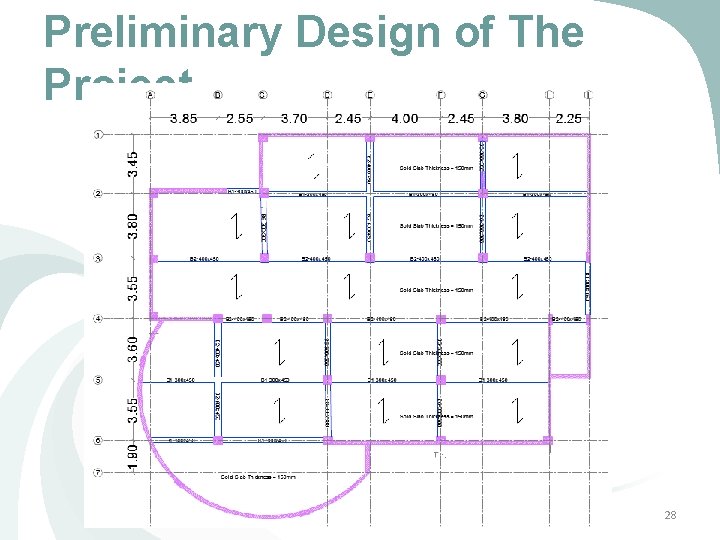
Preliminary Design of The Project v To do the preliminary design for the blocks the following procedure is used : 1) 2) 3) 4) 5) 6) 7) Determine the load assigns for the block. Determine the distribution of beams. Determine thickness of the slab. Calculate the ultimate load for the slab. Check the shear and the reinforcement for the slab. Determine the dimensions of the beams. Determine the dimensions of the columns. 26
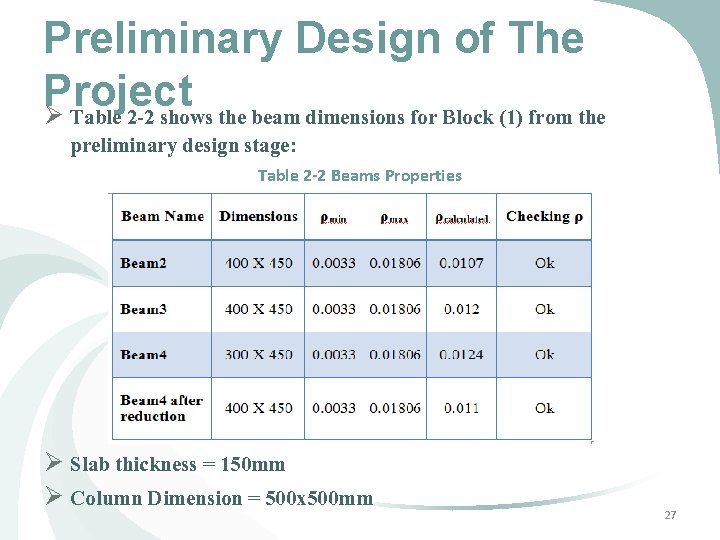
Preliminary Design of The Project Ø Table 2 -2 shows the beam dimensions for Block (1) from the preliminary design stage: Table 2 -2 Beams Properties Ø Slab thickness = 150 mm Ø Column Dimension = 500 x 500 mm 27
Preliminary Design of The Project 28
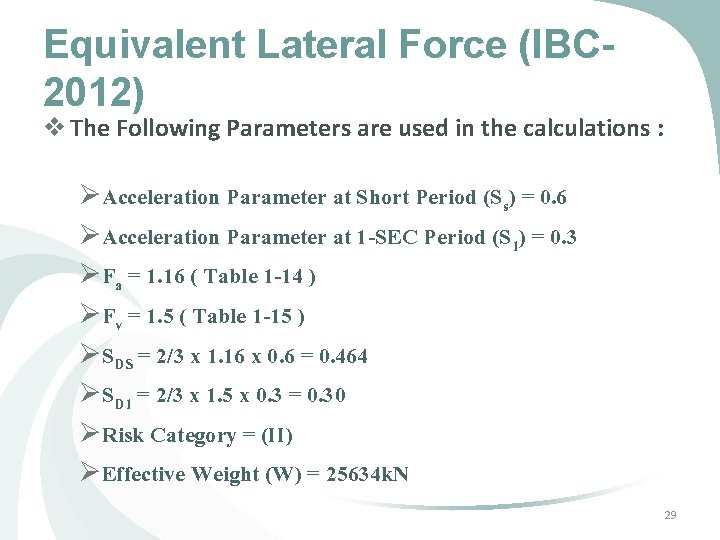
Equivalent Lateral Force (IBC 2012) v The Following Parameters are used in the calculations : ØAcceleration Parameter at Short Period (Ss) = 0. 6 ØAcceleration Parameter at 1 -SEC Period (S 1) = 0. 3 ØFa = 1. 16 ( Table 1 -14 ) ØFv = 1. 5 ( Table 1 -15 ) ØSDS = 2/3 x 1. 16 x 0. 6 = 0. 464 ØSD 1 = 2/3 x 1. 5 x 0. 3 = 0. 30 ØRisk Category = (II) ØEffective Weight (W) = 25634 k. N 29
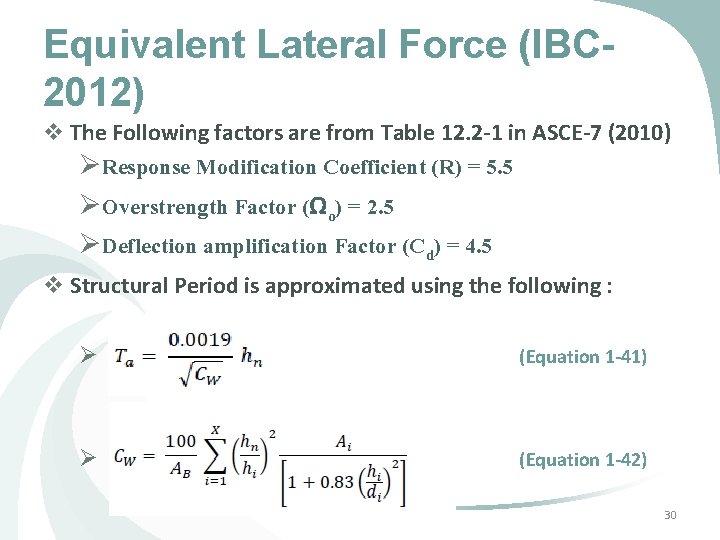
Equivalent Lateral Force (IBC 2012) v The Following factors are from Table 12. 2 -1 in ASCE-7 (2010) ØResponse Modification Coefficient (R) = 5. 5 ØOverstrength Factor (Ωo) = 2. 5 ØDeflection amplification Factor (Cd) = 4. 5 v Structural Period is approximated using the following : Ø (Equation 1 -41) Ø (Equation 1 -42) 30
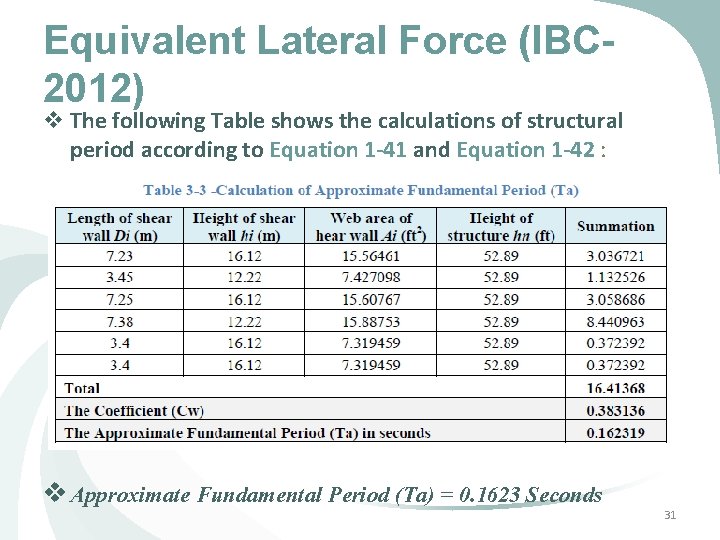
Equivalent Lateral Force (IBC 2012) v The following Table shows the calculations of structural period according to Equation 1 -41 and Equation 1 -42 : v Approximate Fundamental Period (Ta) = 0. 1623 Seconds 31
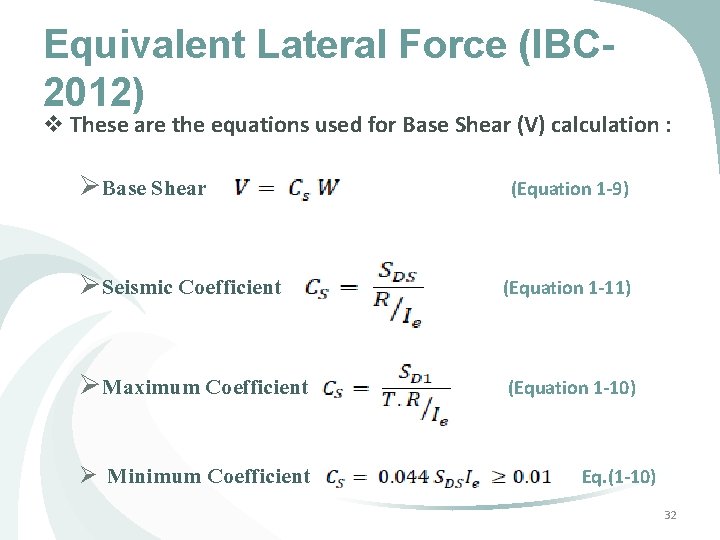
Equivalent Lateral Force (IBC 2012) v These are the equations used for Base Shear (V) calculation : ØBase Shear (Equation 1 -9) ØSeismic Coefficient (Equation 1 -11) ØMaximum Coefficient (Equation 1 -10) Ø Minimum Coefficient Eq. (1 -10) 32
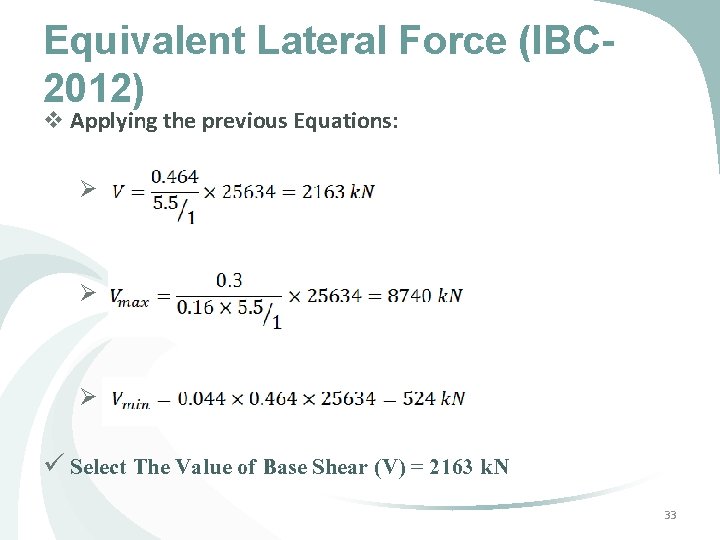
Equivalent Lateral Force (IBC 2012) v Applying the previous Equations: Ø Ø Ø ü Select The Value of Base Shear (V) = 2163 k. N 33
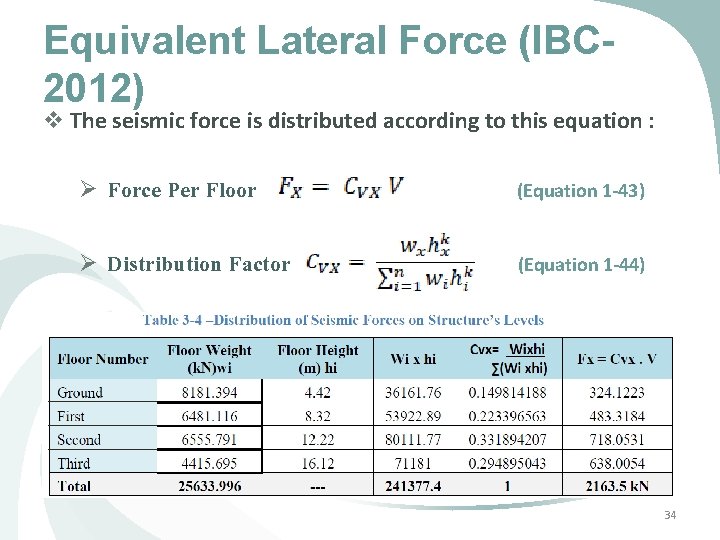
Equivalent Lateral Force (IBC 2012) v The seismic force is distributed according to this equation : Ø Force Per Floor (Equation 1 -43) Ø Distribution Factor (Equation 1 -44) 34
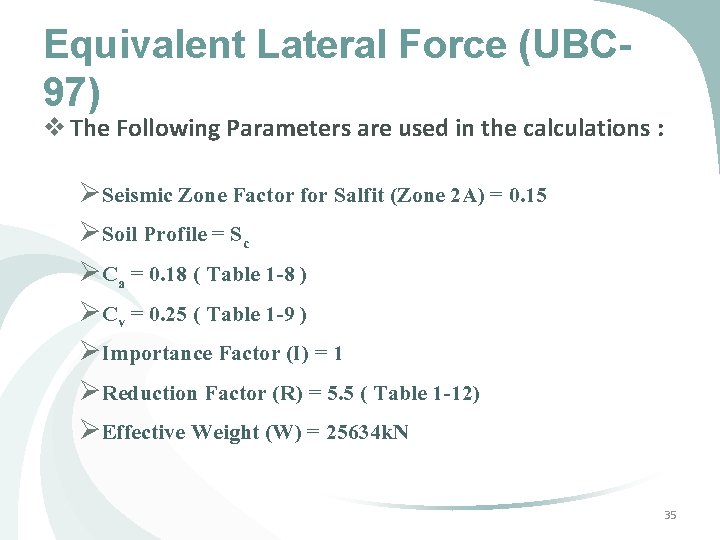
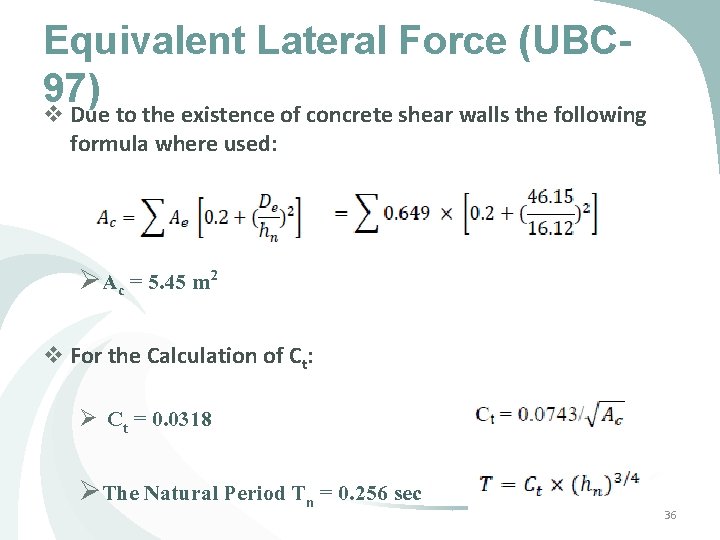
Equivalent Lateral Force (UBC 97) v The Following Parameters are used in the calculations : ØSeismic Zone Factor for Salfit (Zone 2 A) = 0. 15 ØSoil Profile = Sc ØCa = 0. 18 ( Table 1 -8 ) ØCv = 0. 25 ( Table 1 -9 ) ØImportance Factor (I) = 1 ØReduction Factor (R) = 5. 5 ( Table 1 -12) ØEffective Weight (W) = 25634 k. N 35
Equivalent Lateral Force (UBC 97) v Due to the existence of concrete shear walls the following formula where used: ØAc = 5. 45 m 2 v For the Calculation of Ct: Ø Ct = 0. 0318 ØThe Natural Period Tn = 0. 256 sec 36
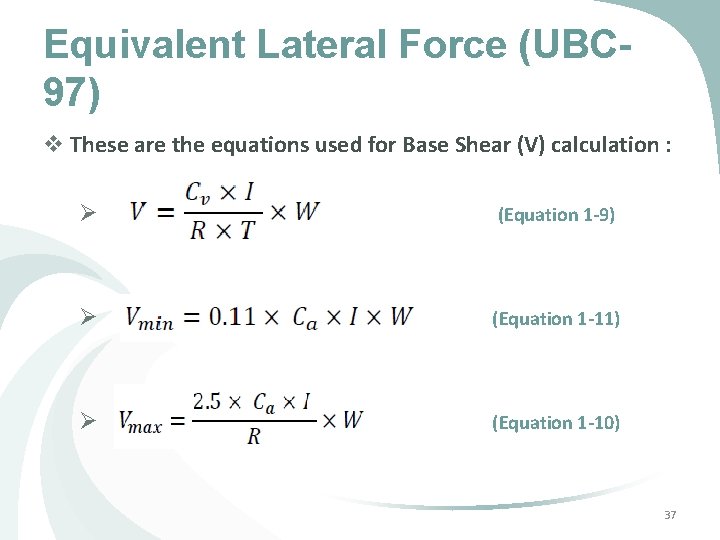
Equivalent Lateral Force (UBC 97) v These are the equations used for Base Shear (V) calculation : Ø (Equation 1 -9) Ø (Equation 1 -11) Ø (Equation 1 -10) 37
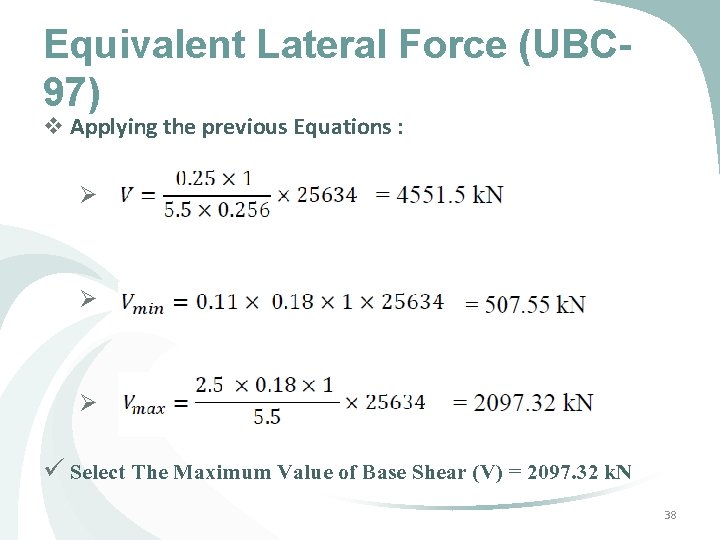
Equivalent Lateral Force (UBC 97) v Applying the previous Equations : Ø Ø Ø ü Select The Maximum Value of Base Shear (V) = 2097. 32 k. N 38
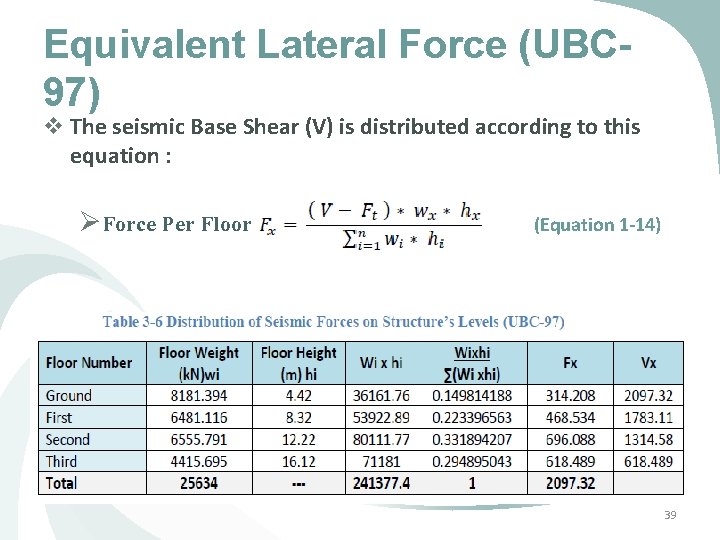
Equivalent Lateral Force (UBC 97) v The seismic Base Shear (V) is distributed according to this equation : ØForce Per Floor (Equation 1 -14) 39
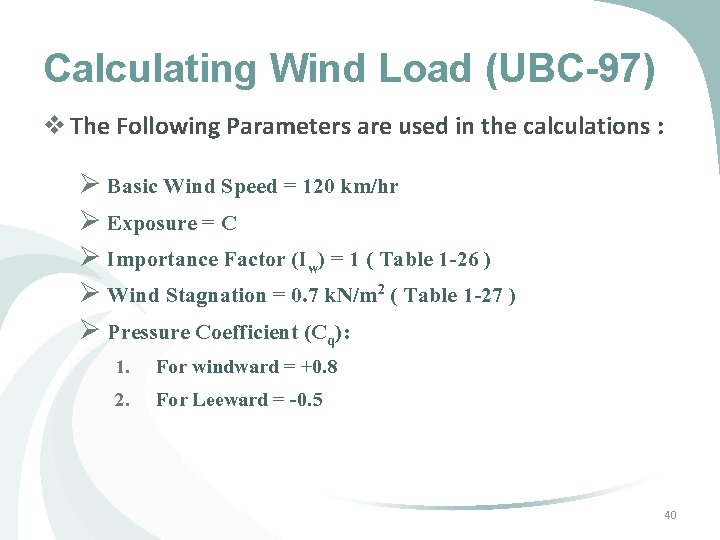
Calculating Wind Load (UBC-97) v The Following Parameters are used in the calculations : Ø Basic Wind Speed = 120 km/hr Ø Exposure = C Ø Importance Factor (Iw) = 1 ( Table 1 -26 ) Ø Wind Stagnation = 0. 7 k. N/m 2 ( Table 1 -27 ) Ø Pressure Coefficient (Cq): 1. For windward = +0. 8 2. For Leeward = -0. 5 40
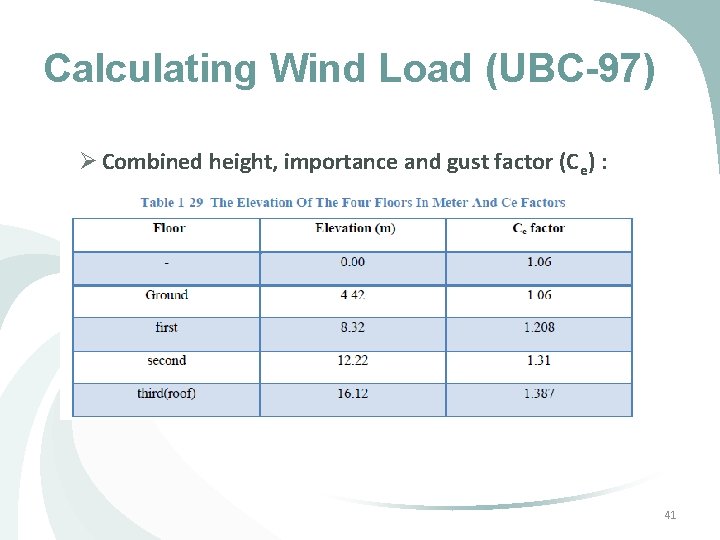
Calculating Wind Load (UBC-97) Ø Combined height, importance and gust factor (Ce) : 41
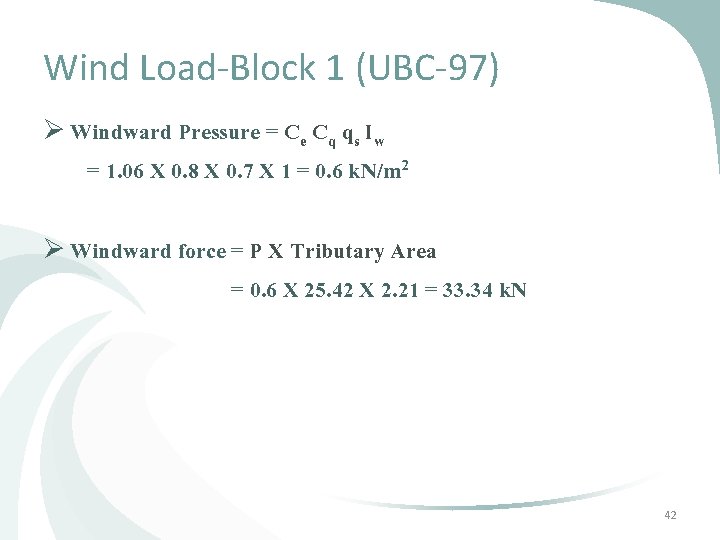
Wind Load-Block 1 (UBC-97) Ø Windward Pressure = Ce Cq qs Iw = 1. 06 X 0. 8 X 0. 7 X 1 = 0. 6 k. N/m 2 Ø Windward force = P X Tributary Area = 0. 6 X 25. 42 X 2. 21 = 33. 34 k. N 42
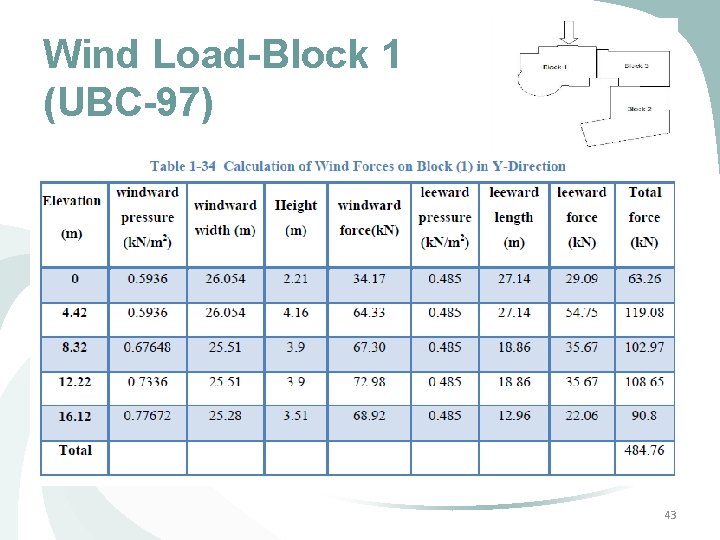
Wind Load-Block 1 (UBC-97) 43
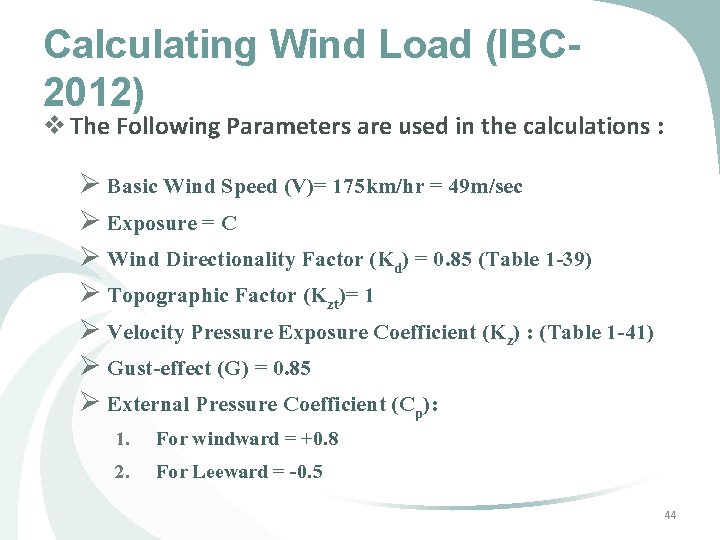
Calculating Wind Load (IBC 2012) v The Following Parameters are used in the calculations : Ø Basic Wind Speed (V)= 175 km/hr = 49 m/sec Ø Exposure = C Ø Wind Directionality Factor (Kd) = 0. 85 (Table 1 -39) Ø Topographic Factor (Kzt)= 1 Ø Velocity Pressure Exposure Coefficient (Kz) : (Table 1 -41) Ø Gust-effect (G) = 0. 85 Ø External Pressure Coefficient (Cp): 1. 2. For windward = +0. 8 For Leeward = -0. 5 44
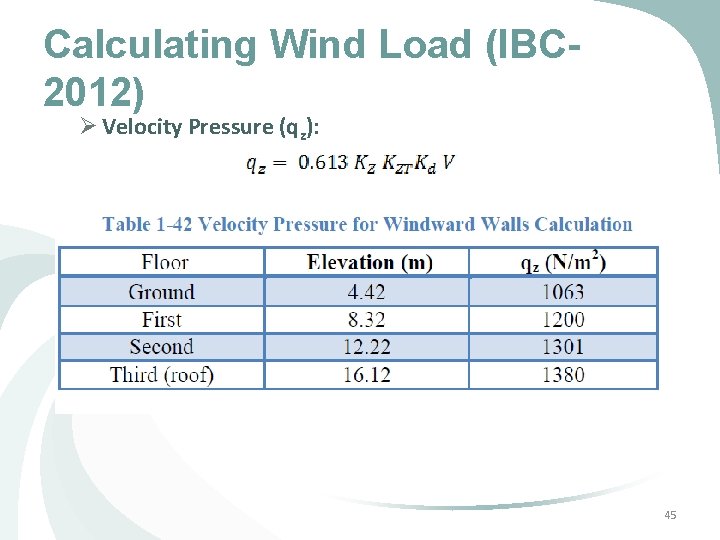
Calculating Wind Load (IBC 2012) Ø Velocity Pressure (qz): 45
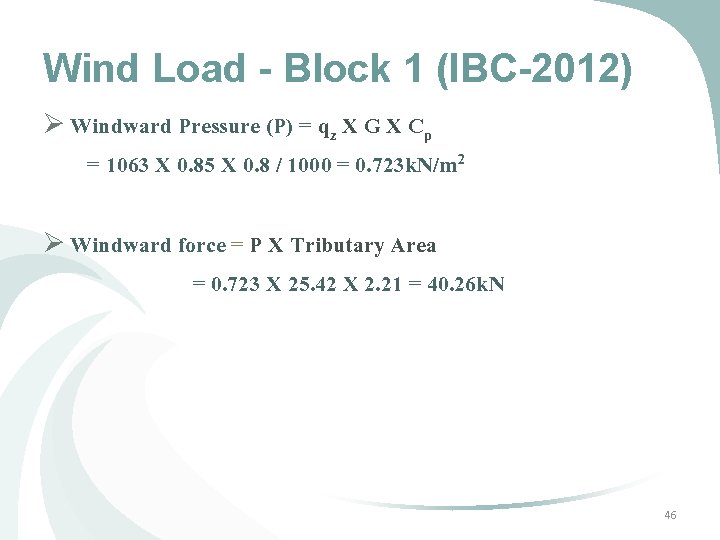
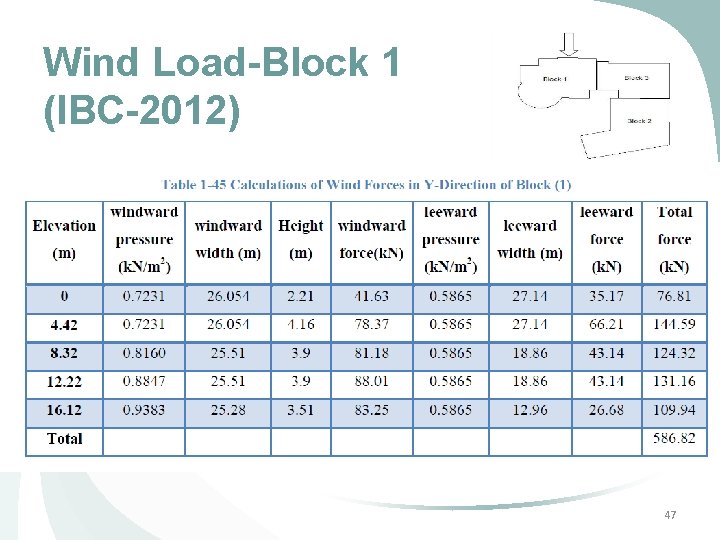
Wind Load - Block 1 (IBC-2012) Ø Windward Pressure (P) = qz X G X Cp = 1063 X 0. 85 X 0. 8 / 1000 = 0. 723 k. N/m 2 Ø Windward force = P X Tributary Area = 0. 723 X 25. 42 X 2. 21 = 40. 26 k. N 46
Wind Load-Block 1 (IBC-2012) 47
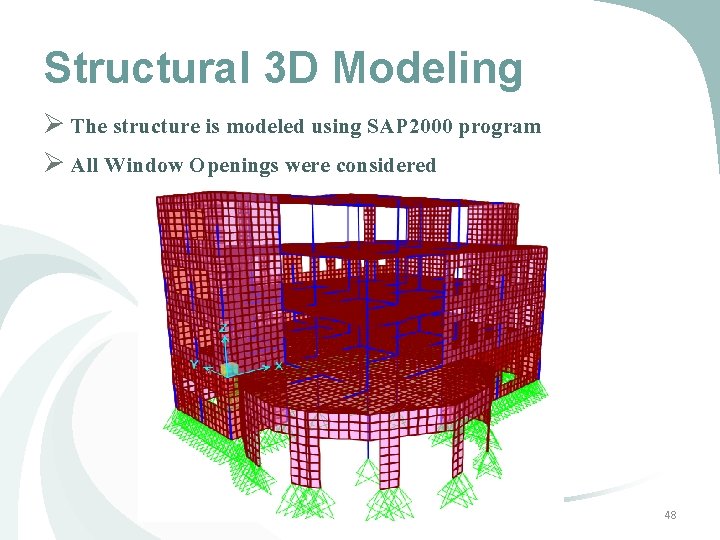
Structural 3 D Modeling Ø The structure is modeled using SAP 2000 program Ø All Window Openings were considered 48
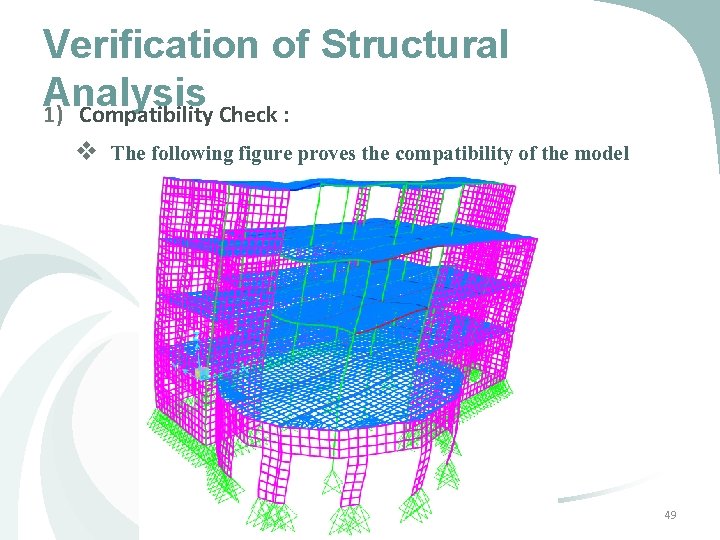
Verification of Structural Analysis 1) Compatibility Check : v The following figure proves the compatibility of the model 49
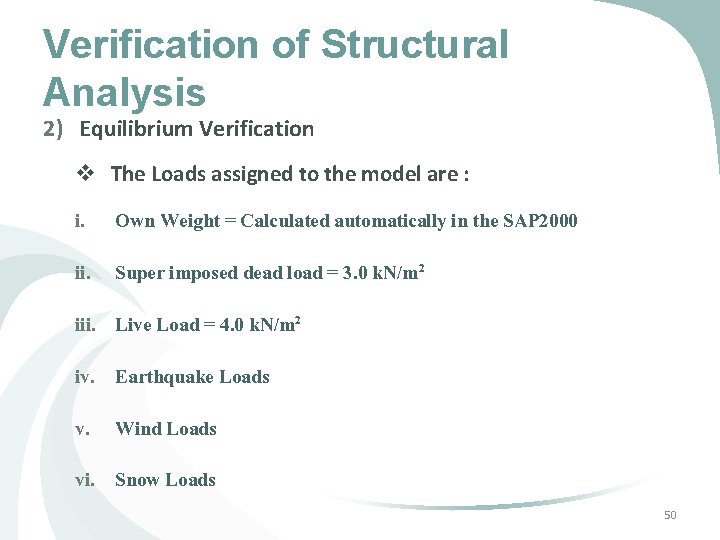
Verification of Structural Analysis 2) Equilibrium Verification v The Loads assigned to the model are : i. Own Weight = Calculated automatically in the SAP 2000 ii. Super imposed dead load = 3. 0 k. N/m 2 iii. Live Load = 4. 0 k. N/m 2 iv. Earthquake Loads v. Wind Loads vi. Snow Loads 50
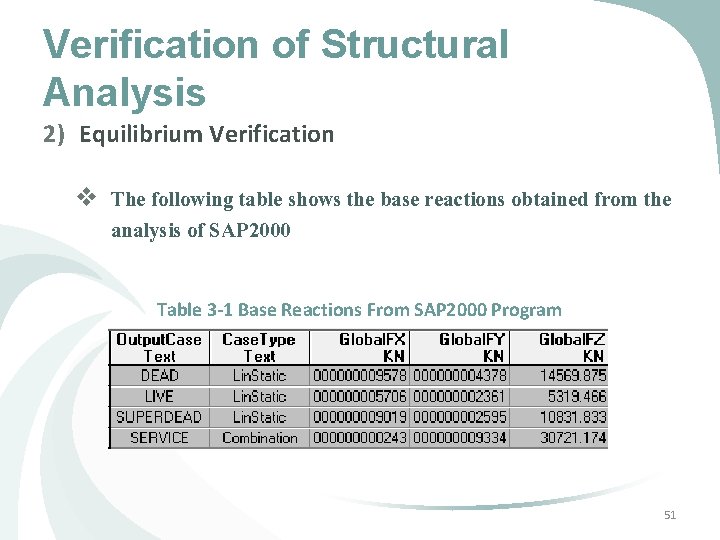
Verification of Structural Analysis 2) Equilibrium Verification v The following table shows the base reactions obtained from the analysis of SAP 2000 Table 3 -1 Base Reactions From SAP 2000 Program 51
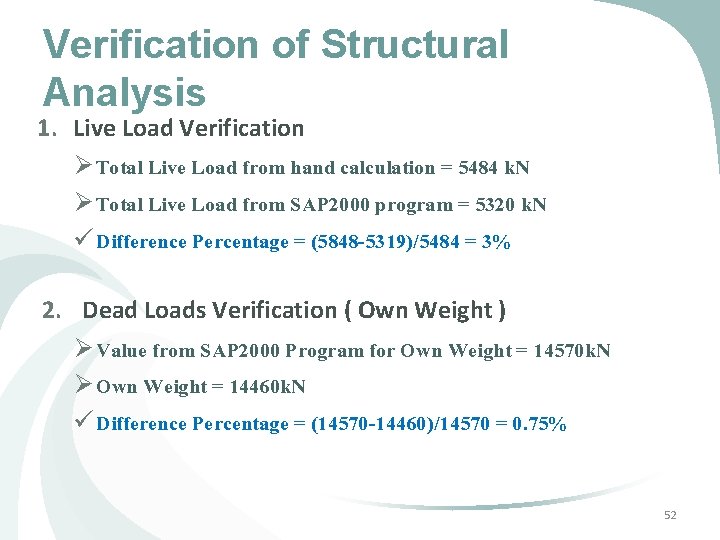
Verification of Structural Analysis 1. Live Load Verification Ø Total Live Load from hand calculation = 5484 k. N Ø Total Live Load from SAP 2000 program = 5320 k. N ü Difference Percentage = (5848 -5319)/5484 = 3% 2. Dead Loads Verification ( Own Weight ) Ø Value from SAP 2000 Program for Own Weight = 14570 k. N Ø Own Weight = 14460 k. N ü Difference Percentage = (14570 -14460)/14570 = 0. 75% 52
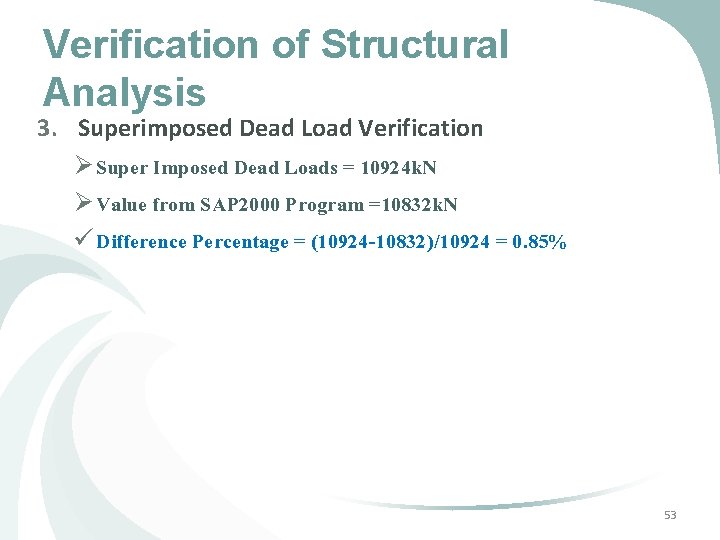
Verification of Structural Analysis 3. Superimposed Dead Load Verification Ø Super Imposed Dead Loads = 10924 k. N Ø Value from SAP 2000 Program =10832 k. N ü Difference Percentage = (10924 -10832)/10924 = 0. 85% 53
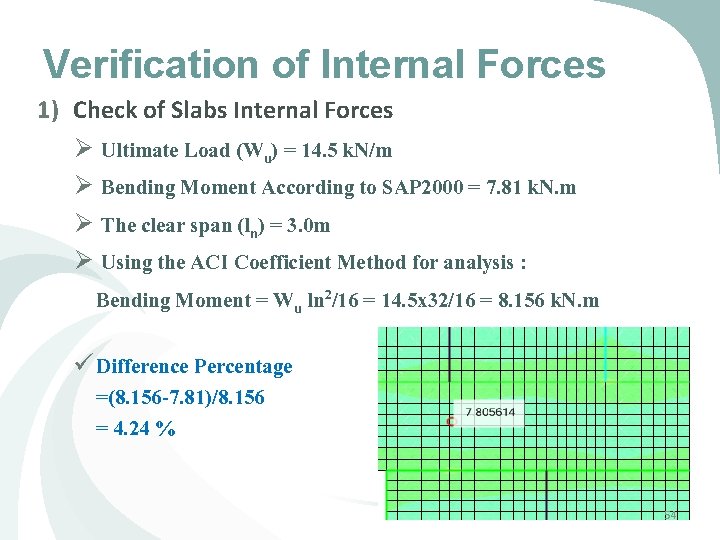
Verification of Internal Forces 1) Check of Slabs Internal Forces Ø Ultimate Load (Wu) = 14. 5 k. N/m Ø Bending Moment According to SAP 2000 = 7. 81 k. N. m Ø The clear span (ln) = 3. 0 m Ø Using the ACI Coefficient Method for analysis : Bending Moment = Wu ln 2/16 = 14. 5 x 32/16 = 8. 156 k. N. m ü Difference Percentage =(8. 156 -7. 81)/8. 156 = 4. 24 % 54
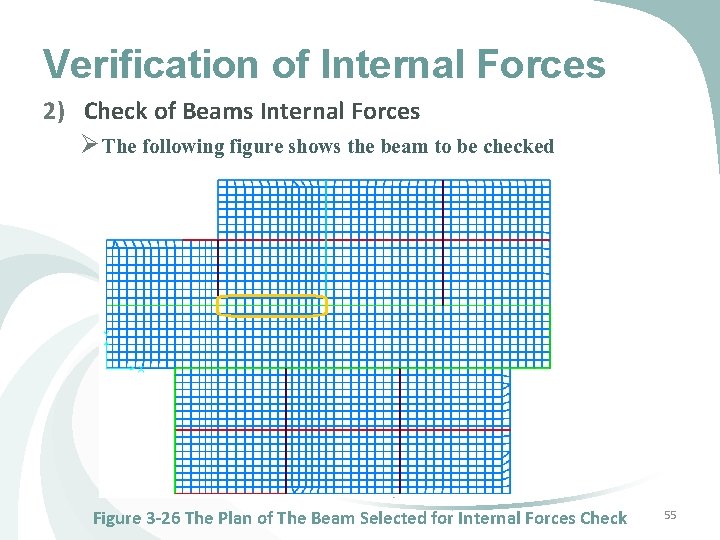
Verification of Internal Forces 2) Check of Beams Internal Forces Ø The following figure shows the beam to be checked Figure 3 -26 The Plan of The Beam Selected for Internal Forces Check 55
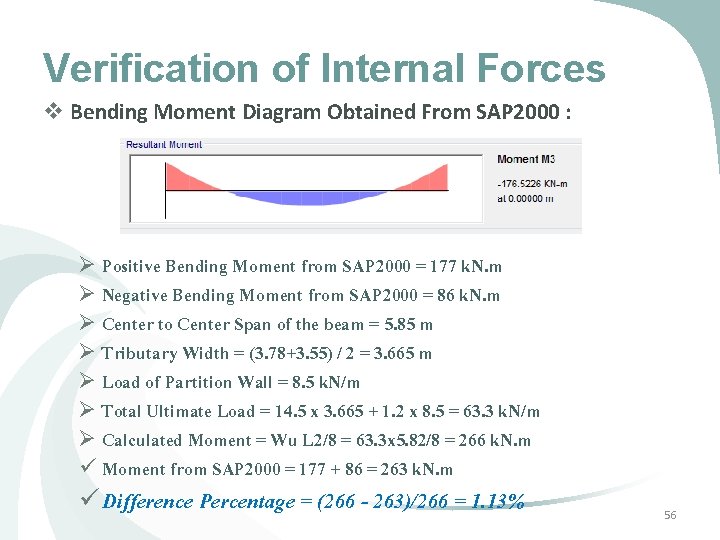
Verification of Internal Forces v Bending Moment Diagram Obtained From SAP 2000 : Ø Positive Bending Moment from SAP 2000 = 177 k. N. m Ø Negative Bending Moment from SAP 2000 = 86 k. N. m Ø Center to Center Span of the beam = 5. 85 m Ø Tributary Width = (3. 78+3. 55) / 2 = 3. 665 m Ø Load of Partition Wall = 8. 5 k. N/m Ø Total Ultimate Load = 14. 5 x 3. 665 + 1. 2 x 8. 5 = 63. 3 k. N/m Ø Calculated Moment = Wu L 2/8 = 63. 3 x 5. 82/8 = 266 k. N. m ü Moment from SAP 2000 = 177 + 86 = 263 k. N. m ü Difference Percentage = (266 - 263)/266 = 1. 13% 56
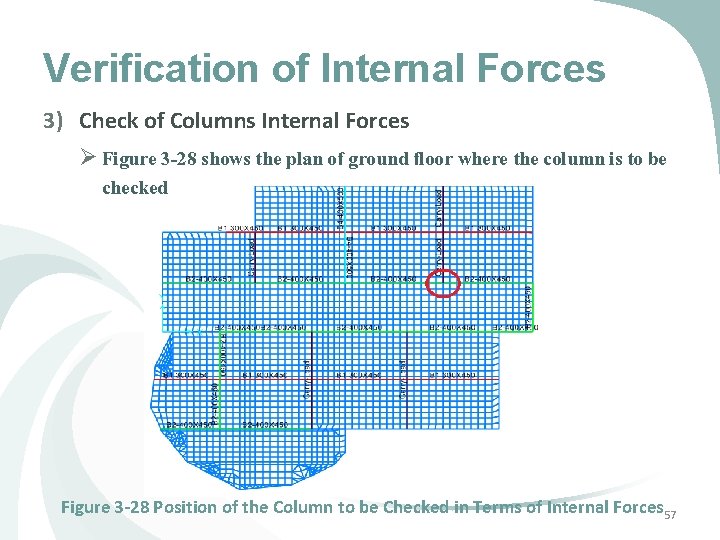
Verification of Internal Forces 3) Check of Columns Internal Forces Ø Figure 3 -28 shows the plan of ground floor where the column is to be checked Figure 3 -28 Position of the Column to be Checked in Terms of Internal Forces 57
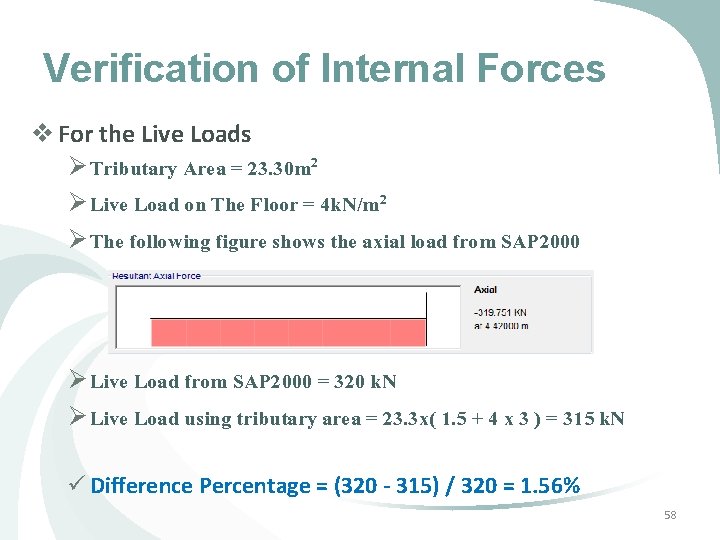
Verification of Internal Forces v For the Live Loads Ø Tributary Area = 23. 30 m 2 Ø Live Load on The Floor = 4 k. N/m 2 Ø The following figure shows the axial load from SAP 2000 Ø Live Load from SAP 2000 = 320 k. N Ø Live Load using tributary area = 23. 3 x( 1. 5 + 4 x 3 ) = 315 k. N ü Difference Percentage = (320 - 315) / 320 = 1. 56% 58
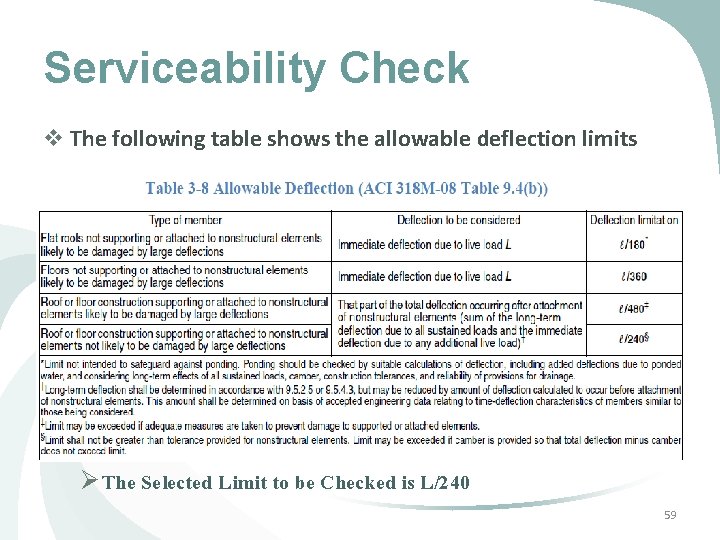
Serviceability Check v The following table shows the allowable deflection limits Ø The Selected Limit to be Checked is L/240 59
Serviceability Check v The serviceability is checked in terms of long-term deflection Ø Where λ is the time factor Ø ΔLT = Total long term deflection Ø ΔD = Immediate deflections due to dead loads Ø ΔL = Immediate deflections due to live loads Ø 25% of Live load is assumed to be sustained forever 60
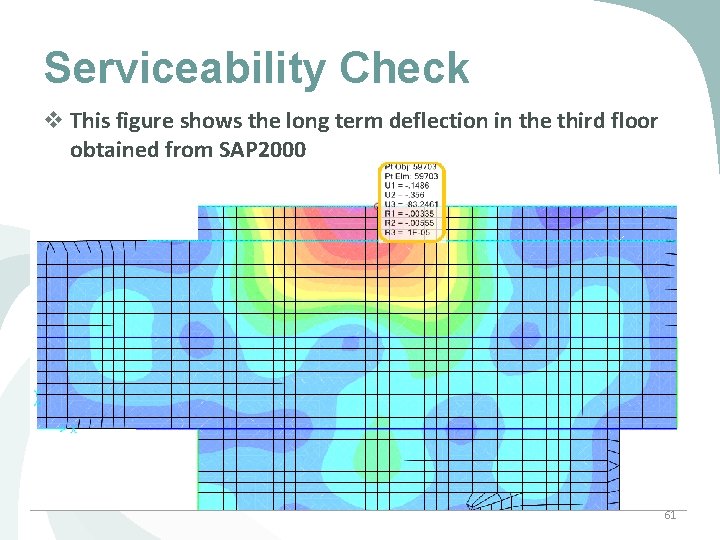
Serviceability Check v This figure shows the long term deflection in the third floor obtained from SAP 2000 61
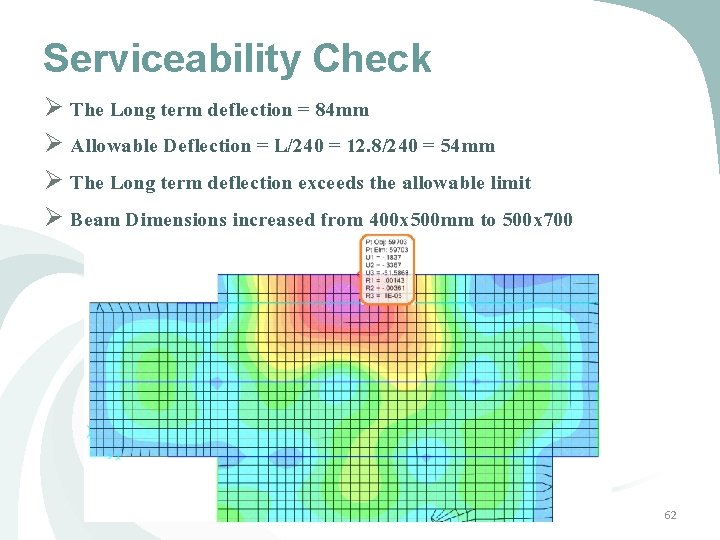
Serviceability Check Ø The Long term deflection = 84 mm Ø Allowable Deflection = L/240 = 12. 8/240 = 54 mm Ø The Long term deflection exceeds the allowable limit Ø Beam Dimensions increased from 400 x 500 mm to 500 x 700 62
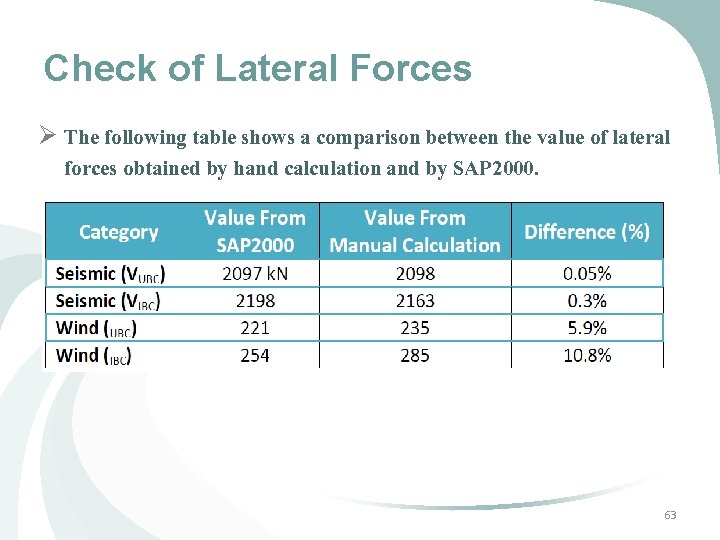
Check of Lateral Forces Ø The following table shows a comparison between the value of lateral forces obtained by hand calculation and by SAP 2000. 63
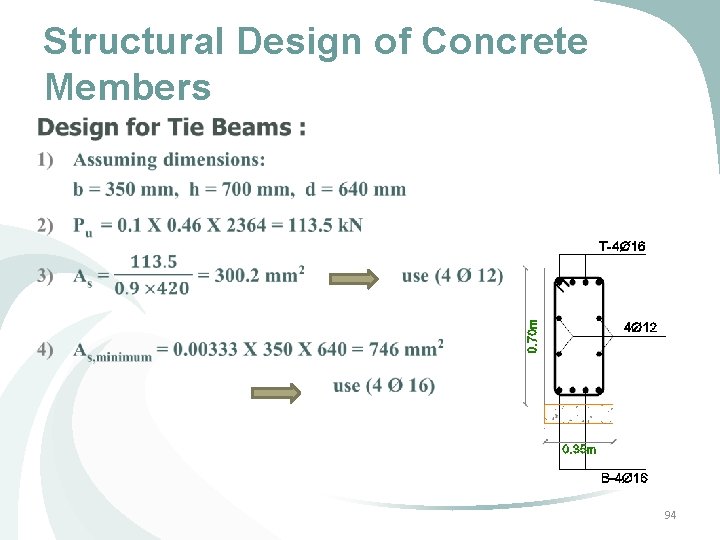
Structural Design of Concrete Members 1) The code used for design and detailing is ACI 318 -11 regarding seismic and gravity loads. 2) The structural system is Building Frame System with Special Shear Walls ( Intermediate Frames ). 3) Provisions were applied to all structural members including: Ø Ø Ø Beams Columns Shear Walls Foundations Tie Beams 64
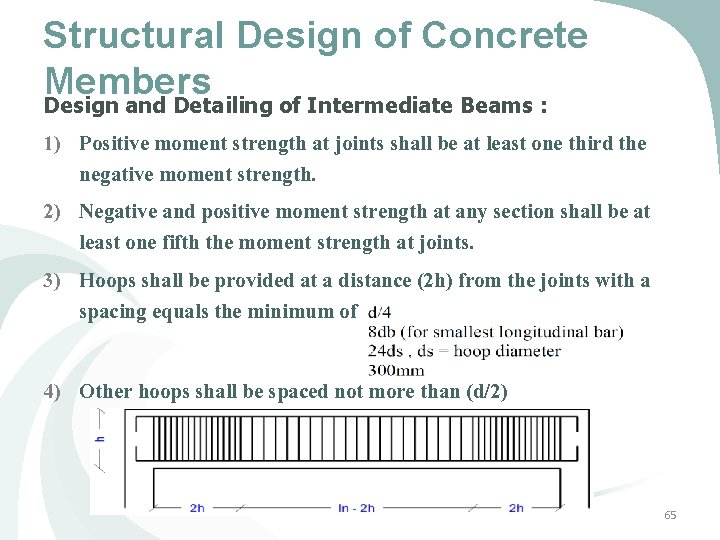
Structural Design of Concrete Members Design and Detailing of Intermediate Beams : 1) Positive moment strength at joints shall be at least one third the negative moment strength. 2) Negative and positive moment strength at any section shall be at least one fifth the moment strength at joints. 3) Hoops shall be provided at a distance (2 h) from the joints with a spacing equals the minimum of 4) Other hoops shall be spaced not more than (d/2) 65
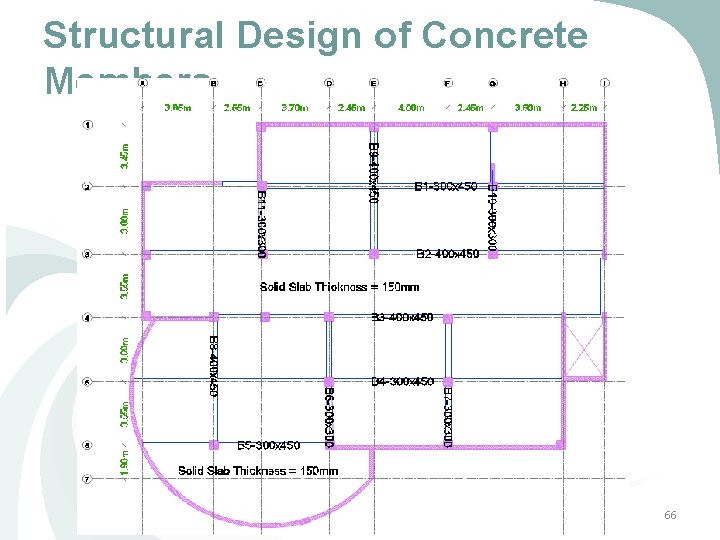
Structural Design of Concrete Members 66
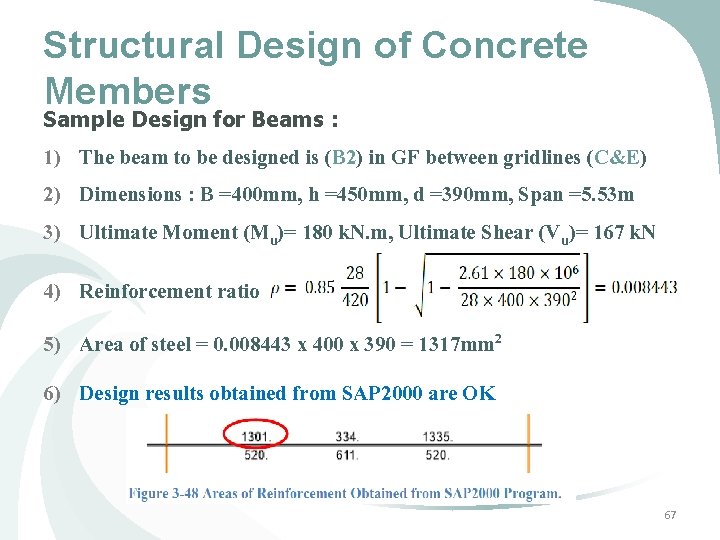
Structural Design of Concrete Members Sample Design for Beams : 1) The beam to be designed is (B 2) in GF between gridlines (C&E) 2) Dimensions : B =400 mm, h =450 mm, d =390 mm, Span =5. 53 m 3) Ultimate Moment (Mu)= 180 k. N. m, Ultimate Shear (Vu)= 167 k. N 4) Reinforcement ratio 5) Area of steel = 0. 008443 x 400 x 390 = 1317 mm 2 6) Design results obtained from SAP 2000 are OK 67
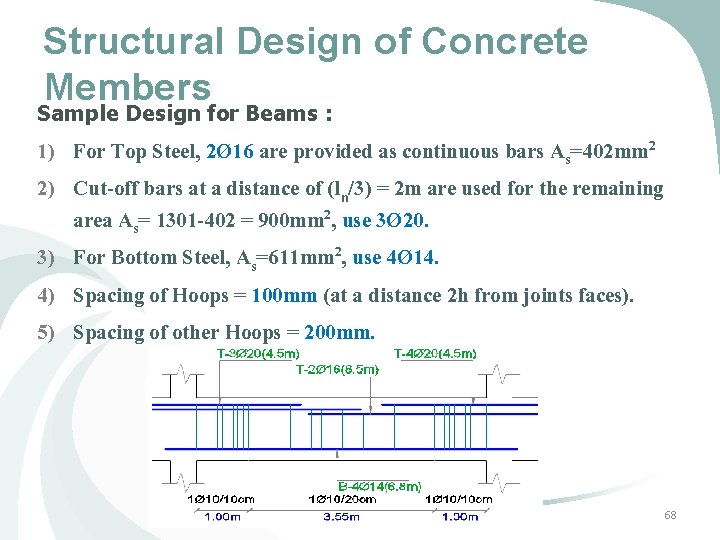
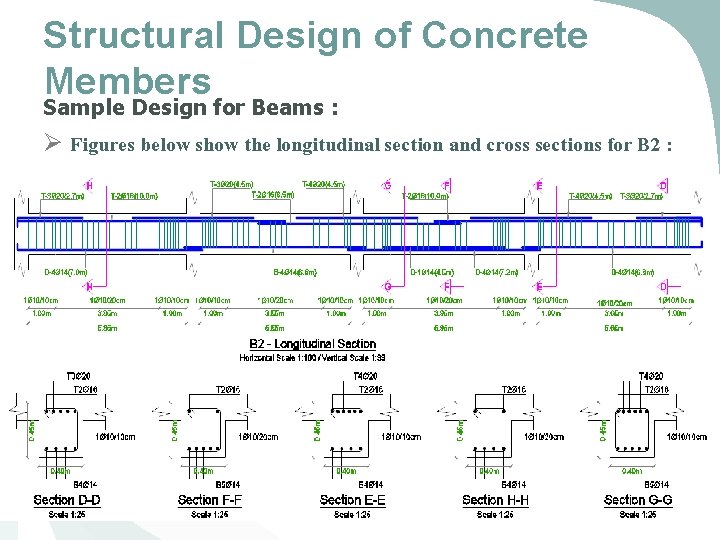
Structural Design of Concrete Members Sample Design for Beams : 1) For Top Steel, 2Ø 16 are provided as continuous bars As=402 mm 2 2) Cut-off bars at a distance of (ln/3) = 2 m are used for the remaining area As= 1301 -402 = 900 mm 2, use 3Ø 20. 3) For Bottom Steel, As=611 mm 2, use 4Ø 14. 4) Spacing of Hoops = 100 mm (at a distance 2 h from joints faces). 5) Spacing of other Hoops = 200 mm. 68
Structural Design of Concrete Members Sample Design for Beams : Ø Figures below show the longitudinal section and cross sections for B 2 : 69
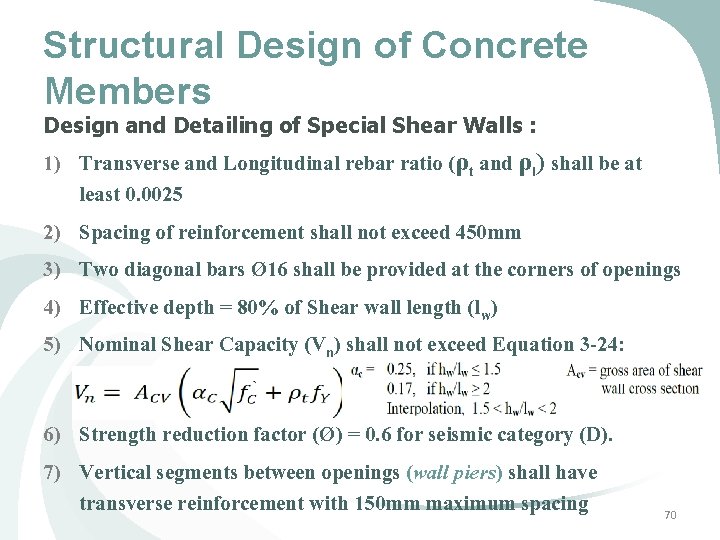
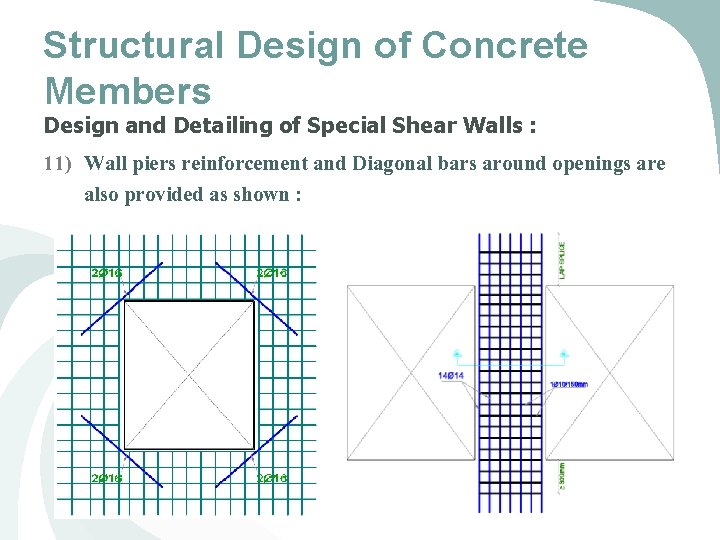
Structural Design of Concrete Members Design and Detailing of Special Shear Walls : 1) Transverse and Longitudinal rebar ratio (ρt and ρl) shall be at least 0. 0025 2) Spacing of reinforcement shall not exceed 450 mm 3) Two diagonal bars Ø 16 shall be provided at the corners of openings 4) Effective depth = 80% of Shear wall length (lw) 5) Nominal Shear Capacity (Vn) shall not exceed Equation 3 -24: 6) Strength reduction factor (Ø) = 0. 6 for seismic category (D). 7) Vertical segments between openings (wall piers) shall have transverse reinforcement with 150 mm maximum spacing 70
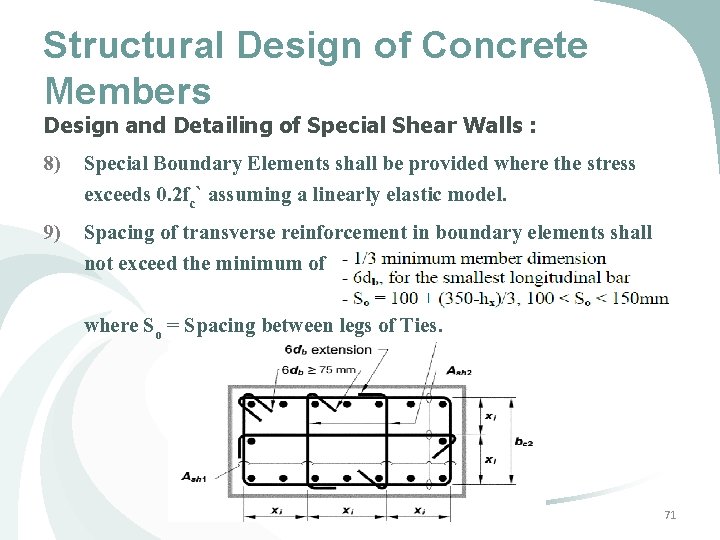
Structural Design of Concrete Members Design and Detailing of Special Shear Walls : 8) Special Boundary Elements shall be provided where the stress exceeds 0. 2 fc` assuming a linearly elastic model. 9) Spacing of transverse reinforcement in boundary elements shall not exceed the minimum of where So = Spacing between legs of Ties. 71
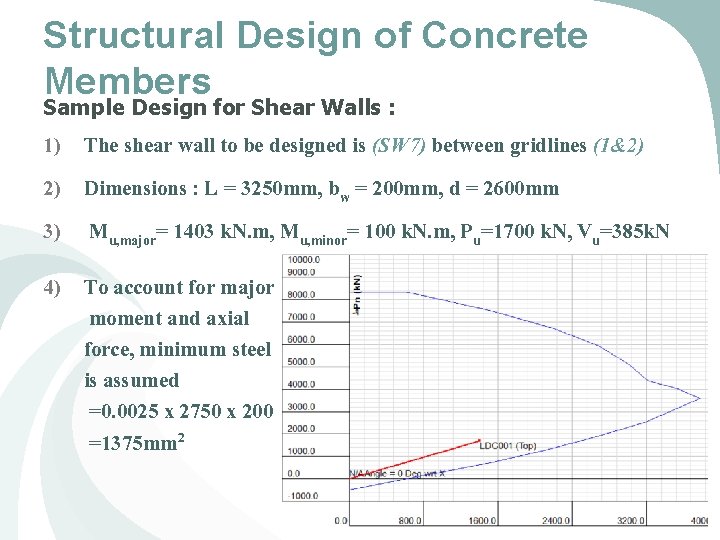
Structural Design of Concrete Members Sample Design for Shear Walls : 1) The shear wall to be designed is (SW 7) between gridlines (1&2) 2) Dimensions : L = 3250 mm, bw = 200 mm, d = 2600 mm 3) Mu, major= 1403 k. N. m, Mu, minor= 100 k. N. m, Pu=1700 k. N, Vu=385 k. N 4) To account for major moment and axial force, minimum steel is assumed =0. 0025 x 2750 x 200 =1375 mm 2 72
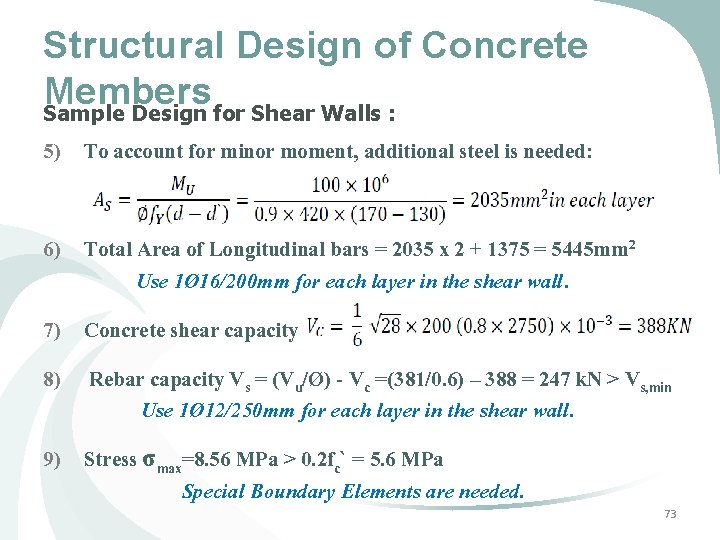
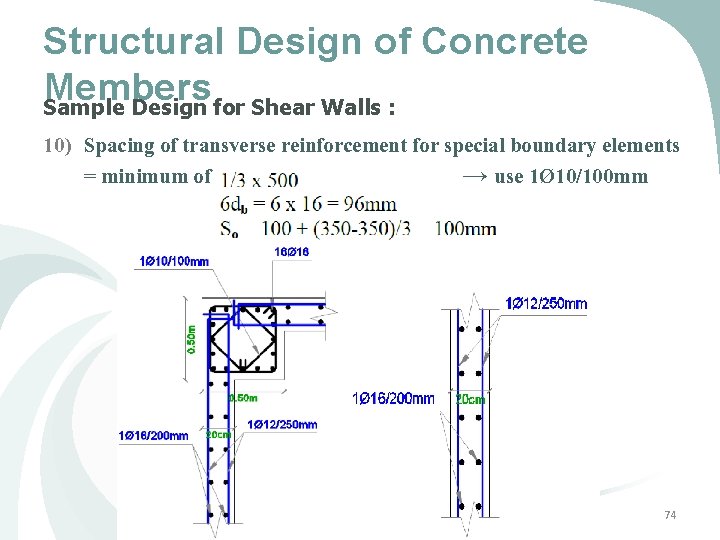
Structural Design of Concrete Members Sample Design for Shear Walls : 5) To account for minor moment, additional steel is needed: 6) Total Area of Longitudinal bars = 2035 x 2 + 1375 = 5445 mm 2 Use 1Ø 16/200 mm for each layer in the shear wall. 7) Concrete shear capacity 8) Rebar capacity Vs = (Vu/Ø) - Vc =(381/0. 6) – 388 = 247 k. N > Vs, min Use 1Ø 12/250 mm for each layer in the shear wall. 9) Stress σmax=8. 56 MPa > 0. 2 fc` = 5. 6 MPa Special Boundary Elements are needed. 73
Structural Design of Concrete Members Sample Design for Shear Walls : 10) Spacing of transverse reinforcement for special boundary elements = minimum of → use 1Ø 10/100 mm 74
Structural Design of Concrete Members Design and Detailing of Special Shear Walls : 11) Wall piers reinforcement and Diagonal bars around openings are also provided as shown : 75
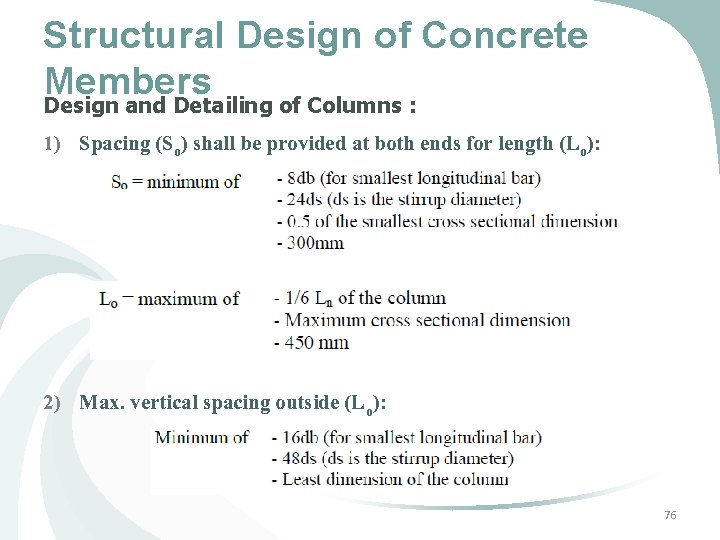
Structural Design of Concrete Members Design and Detailing of Columns : 1) Spacing (So) shall be provided at both ends for length (Lo): 2) Max. vertical spacing outside (Lo): 76
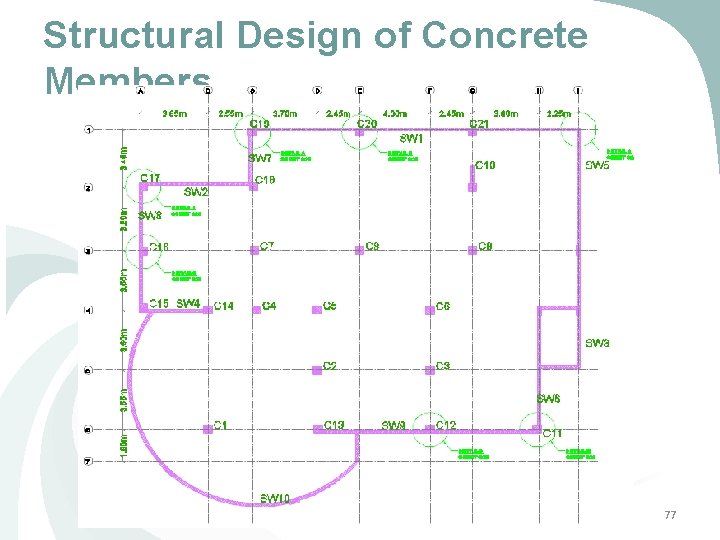
Structural Design of Concrete Members 77
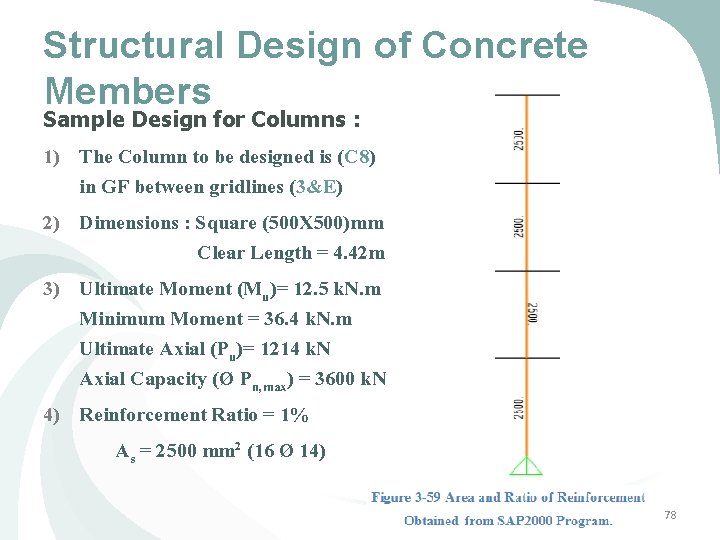
Structural Design of Concrete Members Sample Design for Columns : 1) The Column to be designed is (C 8) in GF between gridlines (3&E) 2) Dimensions : Square (500 X 500)mm Clear Length = 4. 42 m 3) Ultimate Moment (Mu)= 12. 5 k. N. m Minimum Moment = 36. 4 k. N. m Ultimate Axial (Pu)= 1214 k. N Axial Capacity (Ø Pn, max) = 3600 k. N 4) Reinforcement Ratio = 1% As = 2500 mm 2 (16 Ø 14) 78
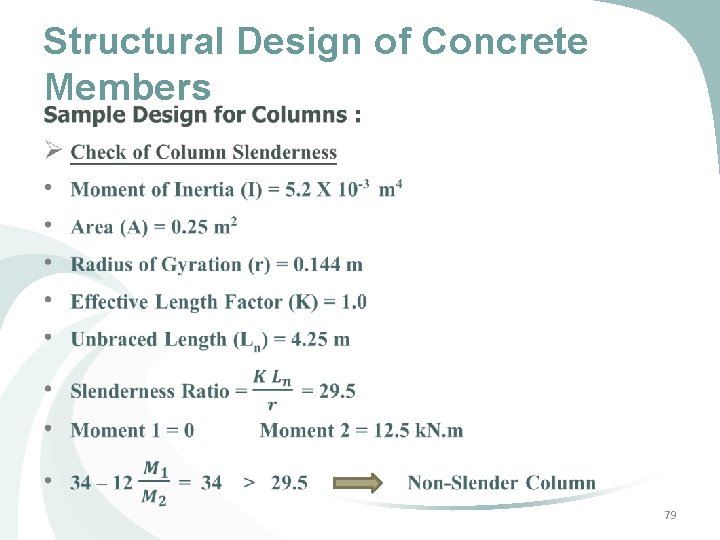
Structural Design of Concrete Members • 79
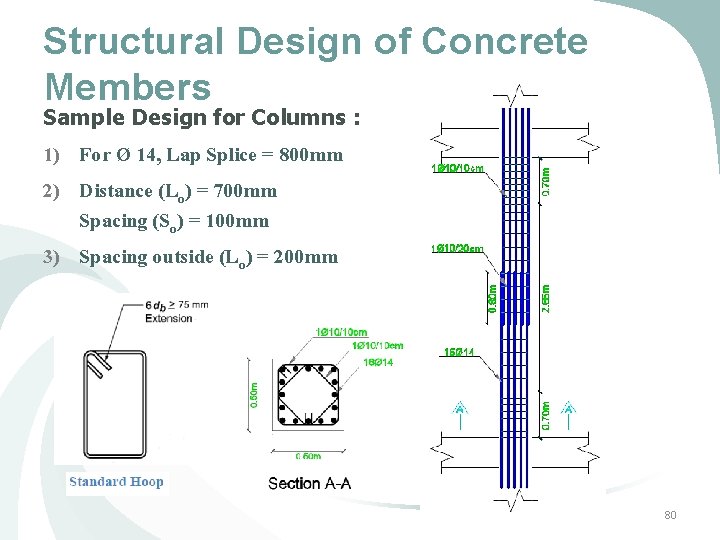
Structural Design of Concrete Members Sample Design for Columns : 1) For Ø 14, Lap Splice = 800 mm 2) Distance (Lo) = 700 mm Spacing (So) = 100 mm 3) Spacing outside (Lo) = 200 mm 80
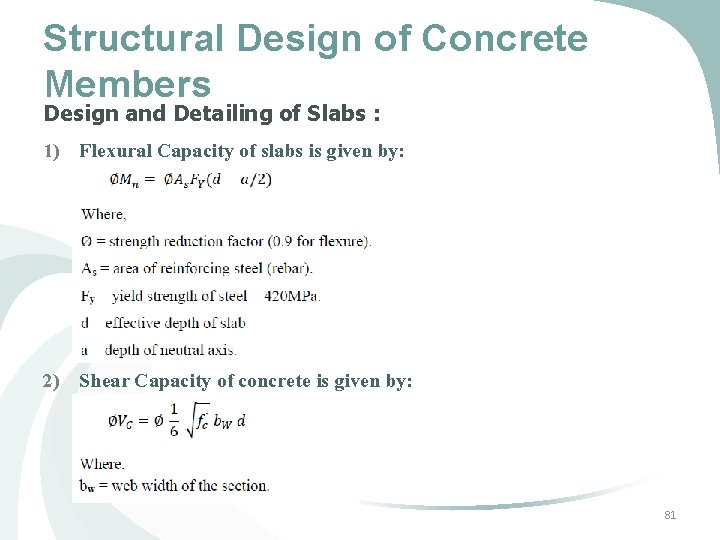
Structural Design of Concrete Members Design and Detailing of Slabs : 1) Flexural Capacity of slabs is given by: 2) Shear Capacity of concrete is given by: 81
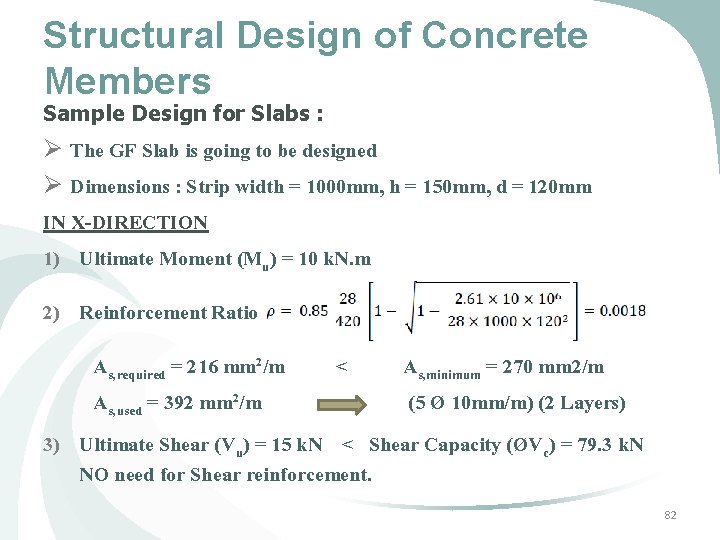
Structural Design of Concrete Members Sample Design for Slabs : Ø The GF Slab is going to be designed Ø Dimensions : Strip width = 1000 mm, h = 150 mm, d = 120 mm IN X-DIRECTION 1) Ultimate Moment (Mu) = 10 k. N. m 2) Reinforcement Ratio As, required = 216 mm 2/m As, used = 392 mm 2/m < As, minimum = 270 mm 2/m (5 Ø 10 mm/m) (2 Layers) 3) Ultimate Shear (Vu) = 15 k. N < Shear Capacity (ØVc) = 79. 3 k. N NO need for Shear reinforcement. 82
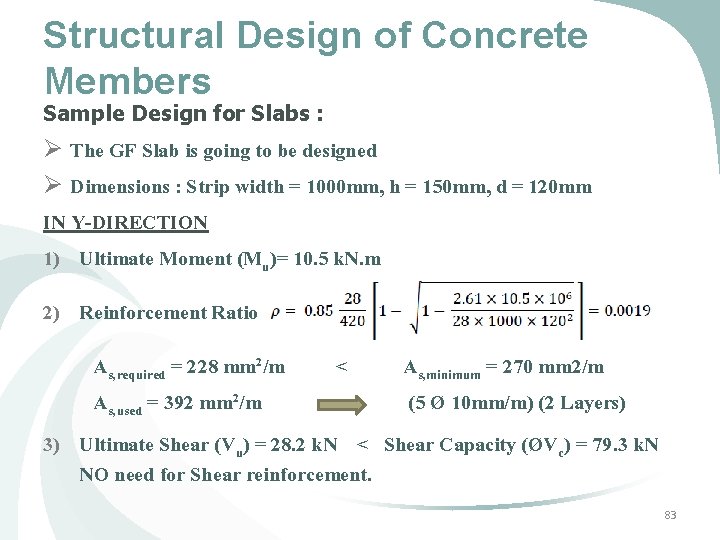
Structural Design of Concrete Members Sample Design for Slabs : Ø The GF Slab is going to be designed Ø Dimensions : Strip width = 1000 mm, h = 150 mm, d = 120 mm IN Y-DIRECTION 1) Ultimate Moment (Mu)= 10. 5 k. N. m 2) Reinforcement Ratio As, required = 228 mm 2/m As, used = 392 mm 2/m < As, minimum = 270 mm 2/m (5 Ø 10 mm/m) (2 Layers) 3) Ultimate Shear (Vu) = 28. 2 k. N < Shear Capacity (ØVc) = 79. 3 k. N NO need for Shear reinforcement. 83
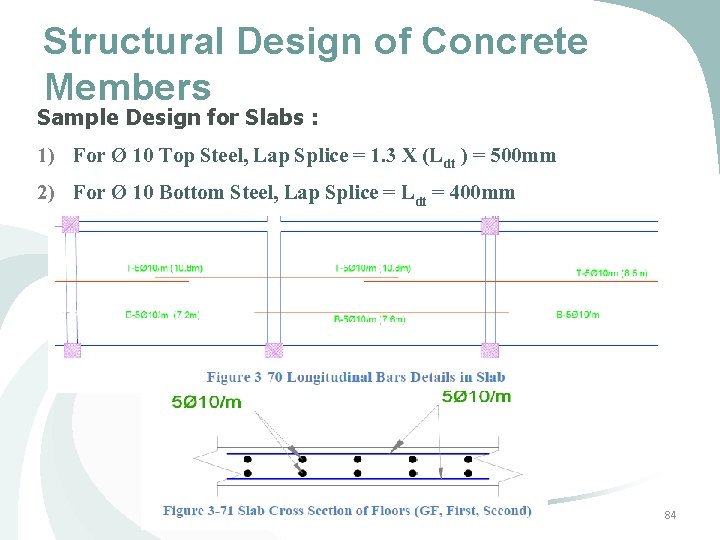
Structural Design of Concrete Members Sample Design for Slabs : 1) For Ø 10 Top Steel, Lap Splice = 1. 3 X (Ldt ) = 500 mm 2) For Ø 10 Bottom Steel, Lap Splice = Ldt = 400 mm 84
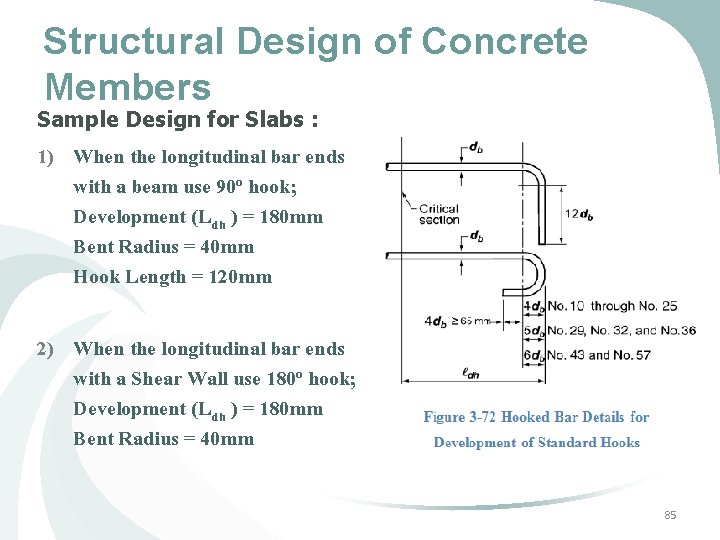
Structural Design of Concrete Members Sample Design for Slabs : 1) When the longitudinal bar ends with a beam use 90 o hook; Development (Ldh ) = 180 mm Bent Radius = 40 mm Hook Length = 120 mm 2) When the longitudinal bar ends with a Shear Wall use 180 o hook; Development (Ldh ) = 180 mm Bent Radius = 40 mm 85
Structural Design of Concrete Members Seismic Requirements For Footings: 1) The development length shall be checked at both ends of the footing using standard hook depending on the bar size. 2) The hoops of the columns shall be continued in the footing at least 300 mm from the top face of footing. 3) The clear cover below the footing shall be at least 70 mm if there is no blinding layer, and 40 mm in the case of having a blinding layer. 4) The longitudinal bars of the columns shall extend in the footing with a standard hook noticing that the extensions of the standard hook are pointed towards the center of the column in each direction. 5) Service combinations are used to determine the largest axial service load considering the earthquake effect in these combinations : → 0. 6 D + 0. 7 E → 1. 0 D + 0. 75 L + 0. 75 E → 1. 0 D + 0. 70 E 86
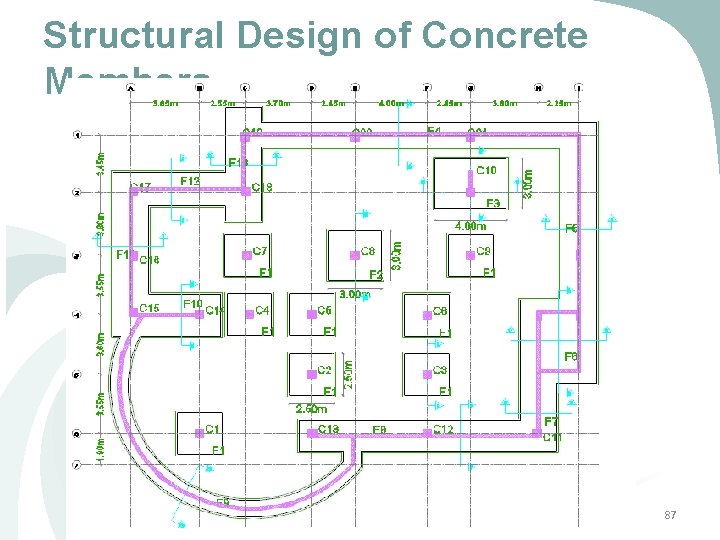
Structural Design of Concrete Members 87
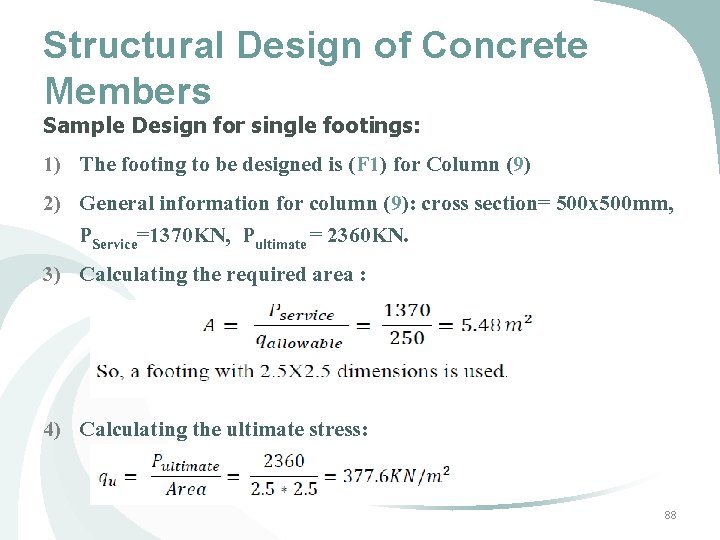
Structural Design of Concrete Members Sample Design for single footings: 1) The footing to be designed is (F 1) for Column (9) 2) General information for column (9): cross section= 500 x 500 mm, PService=1370 KN, Pultimate = 2360 KN. 3) Calculating the required area : 4) Calculating the ultimate stress: 88
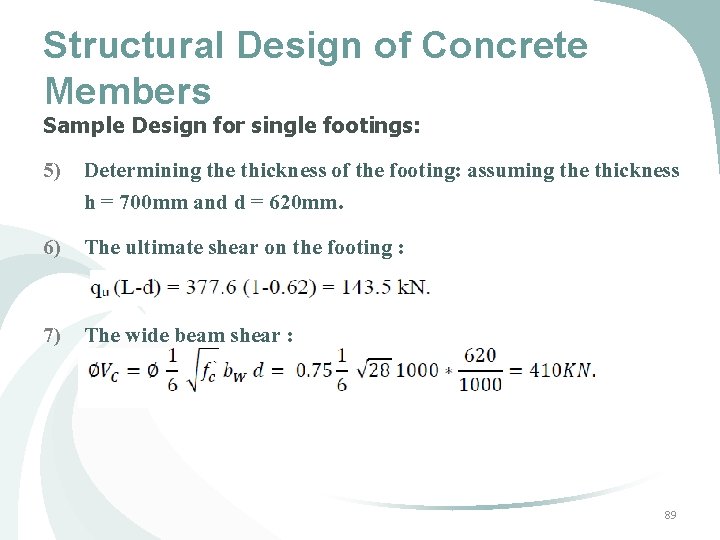
Structural Design of Concrete Members Sample Design for single footings: 5) Determining the thickness of the footing: assuming the thickness h = 700 mm and d = 620 mm. 6) The ultimate shear on the footing : 7) The wide beam shear : 89
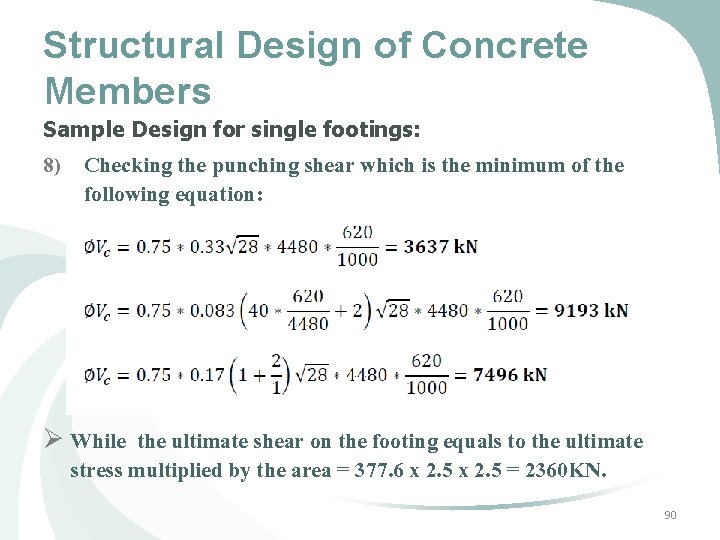
Structural Design of Concrete Members Sample Design for single footings: 8) Checking the punching shear which is the minimum of the following equation: Ø While the ultimate shear on the footing equals to the ultimate stress multiplied by the area = 377. 6 x 2. 5 = 2360 KN. 90
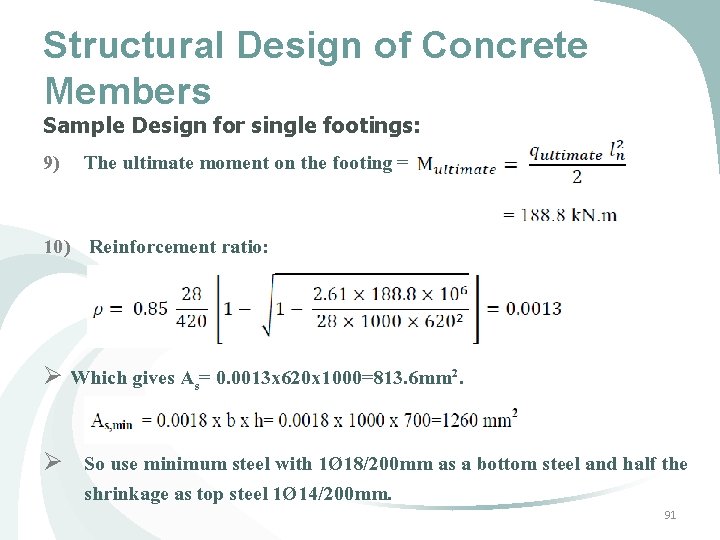
Structural Design of Concrete Members Sample Design for single footings: 9) The ultimate moment on the footing = 10) Reinforcement ratio: Ø Which gives As= 0. 0013 x 620 x 1000=813. 6 mm 2. Ø So use minimum steel with 1Ø 18/200 mm as a bottom steel and half the shrinkage as top steel 1Ø 14/200 mm. 91
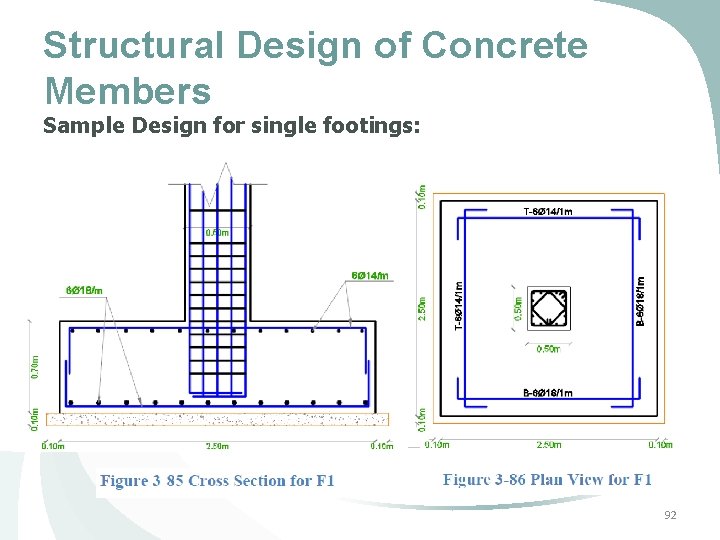
Structural Design of Concrete Members Sample Design for single footings: 92
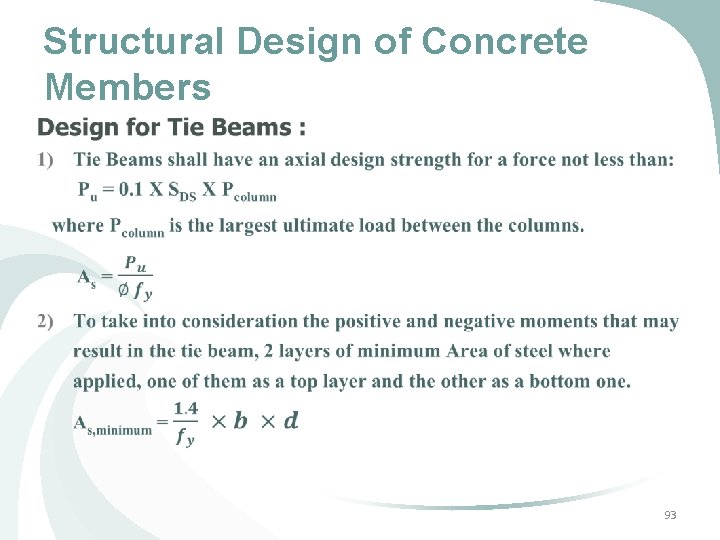
Structural Design of Concrete Members • 93
Structural Design of Concrete Members • 94
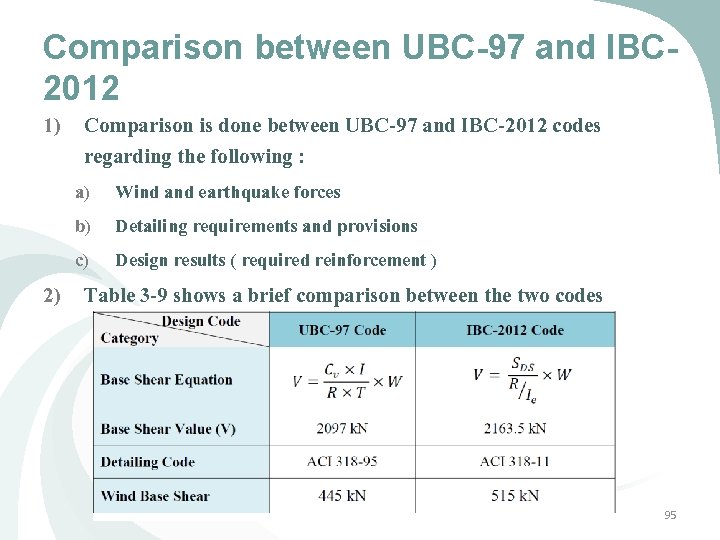
Comparison between UBC-97 and IBC 2012 1) Comparison is done between UBC-97 and IBC-2012 codes regarding the following : a) b) c) Wind and earthquake forces Detailing requirements and provisions Design results ( required reinforcement ) 2) Table 3 -9 shows a brief comparison between the two codes 95
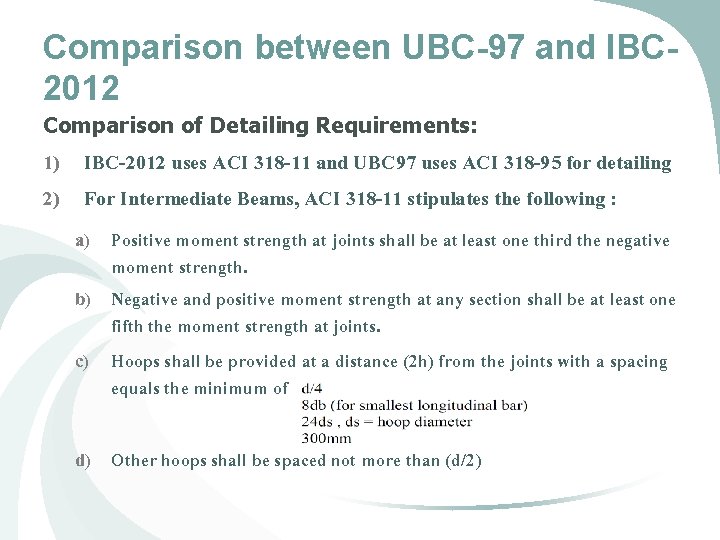
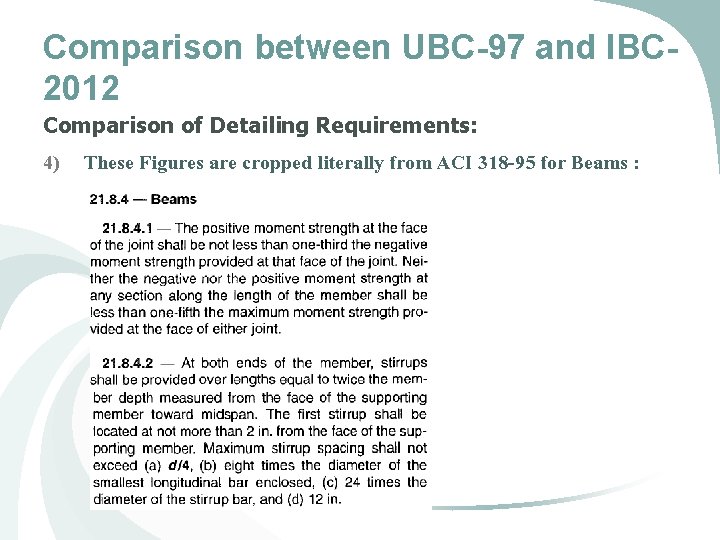
Comparison between UBC-97 and IBC 2012 Comparison of Detailing Requirements: 1) IBC-2012 uses ACI 318 -11 and UBC 97 uses ACI 318 -95 for detailing 2) For Intermediate Beams, ACI 318 -11 stipulates the following : a) Positive moment strength at joints shall be at least one third the negative moment strength. b) Negative and positive moment strength at any section shall be at least one fifth the moment strength at joints. c) Hoops shall be provided at a distance (2 h) from the joints with a spacing equals the minimum of d) Other hoops shall be spaced not more than (d/2)
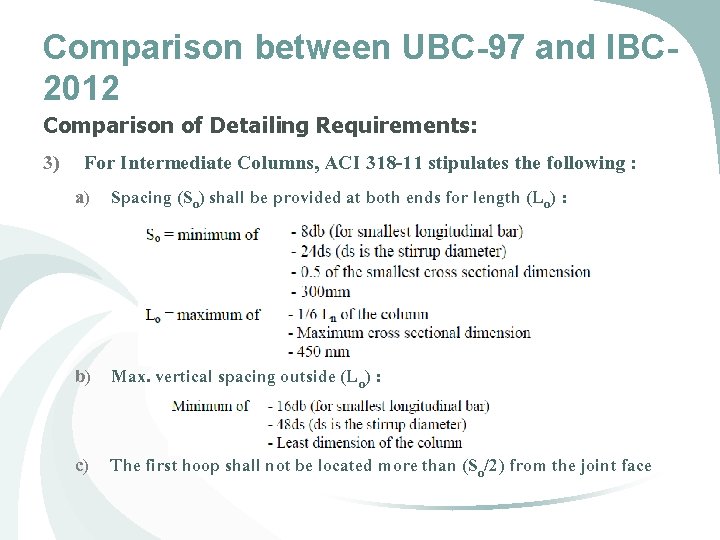
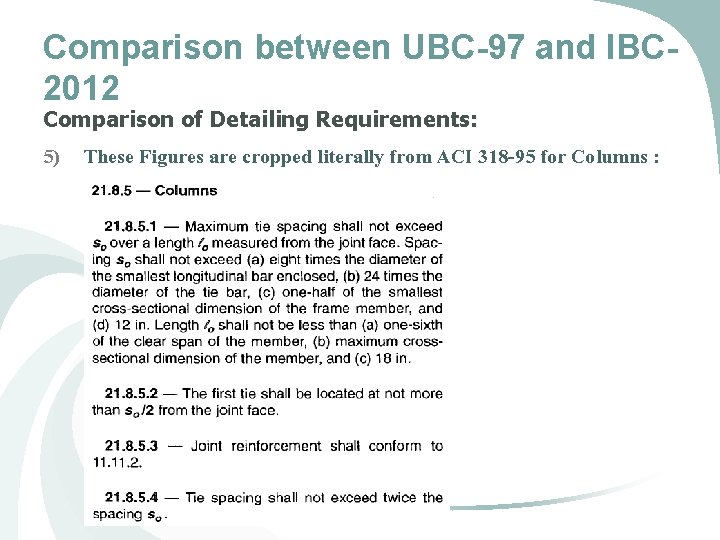
Comparison between UBC-97 and IBC 2012 Comparison of Detailing Requirements: 3) For Intermediate Columns, ACI 318 -11 stipulates the following : a) Spacing (So) shall be provided at both ends for length (Lo) : b) Max. vertical spacing outside (Lo) : c) The first hoop shall not be located more than (So/2) from the joint face
Comparison between UBC-97 and IBC 2012 Comparison of Detailing Requirements: 4) These Figures are cropped literally from ACI 318 -95 for Beams :
Comparison between UBC-97 and IBC 2012 Comparison of Detailing Requirements: 5) These Figures are cropped literally from ACI 318 -95 for Columns :
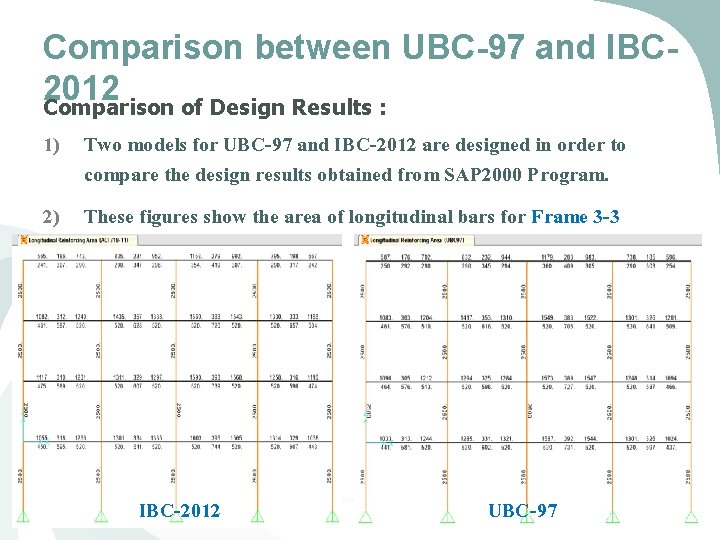
Comparison between UBC-97 and IBC 2012 Comparison of Design Results : 1) Two models for UBC-97 and IBC-2012 are designed in order to compare the design results obtained from SAP 2000 Program. 2) These figures show the area of longitudinal bars for Frame 3 -3 IBC-2012 UBC-97
Comparison between UBC-97 and IBC 2012 Discussion and Conclusion: 1) Base shear obtained from IBC-2012 is slightly larger than Base shear obtained from UBC-97 ( VIBC = 2163 k. N > VUBC = 2097 k. N ). 2) The minor difference in seismic base shear (V) between both codes will not yield a considerable difference in the results of design. 3) Detailing requirements of seismic design for both ACI 318 -11 and ACI 318 -95 are the same. 4) Both codes are applicable and yield good design results. 5) For PALESTINE, UBC-97 is still good although the probability of exceedance is 10% compared to IBC-2012 (2%) when using the local maps ( Israeli Code for SS and S 1, Seismic Zone Factor Map for Z )
The End 102