
GOVT BILASA GIRLS P G COLLEGE BILASPUR PROJECT
GOVT. BILASA GIRLS P. G. COLLEGE, BILASPUR PROJECT TOPIC DAILY CONSUMPTION OF BRASSICA FAMILY VEGETABLES AND ITS EFFECT ON HYPOTHYROIDISM • By Mrs. Pratibha Bajpai Department of Home Science
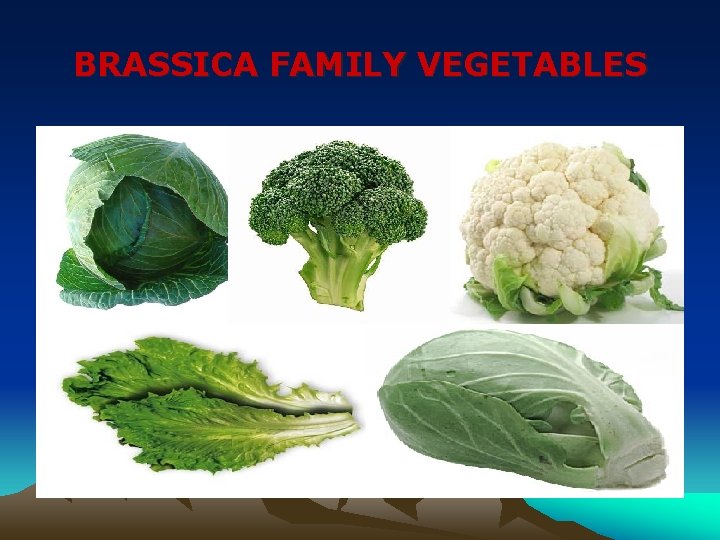
INTRODUCTION Cruciferous or Brassica vegetables are so named because they come from plants in the family known to botanists as Cruciferae or alternately, Brassicaceae. Many commonly consumed cruciferous vegetables come from the Brassica genus, including broccoli, Brussels sprouts, cabbage, cauliflower, collard greens, kale, kohlrabi, mustard, rutabaga, turnips, bok choy, and Chinese cabbage. Arugula, horse radish, wasabi, and watercress are also cruciferous vegetables. All fruits and vegetables are valuable sources of nutrients that fight disease. They are naturally low in fat, cholesterol, calories and sodium; but rich in potassium, fibre, folic acid, beta-carotene and vitamins C and K. In fact, it is estimated that cancer rates would drop 20 per cent if Canadians ate five to 10 servings of vegetables and fruit each day. And it is the brassica family that contains the highest level of diseasefighting substances per serving. It is one of the healthiest and most nutritious vegetable groups. Recent research has highlighted its strong anti-cancer benefits. Brassicas vegetables can potentially be Goitrogenic (inducing goiter formation). Goitrogens are foods which suppress thyroid function. In normals, goitrogens can induce hypothyroidism and goiter. Brassicas contain enzymes that interfere with the formation of thyroid hormone. Cooking for 30 minutes significantly reduces the amount of goitrogens and nitriles At high intake of crucifers, the goitrogens inhibit the incorporation of iodiine into thyroid hormone and also the transfer of iodine into milk by the mammary gland.
BRASSICA FAMILY VEGETABLES
Phytochemicals In Food. • Cruciferous vegetables are unique in that they are rich sources of glucosinolates, sulfur-containing compounds that impart a pungent aroma and spicy (some say bitter) taste. The hydrolysis (breakdown) of glucosinolates by a class of plant enzymes called myrosinase results in the formation of biologically active compounds, such as indoles and isothiocyanates. Myrosinase is physically separated from glucosinolates in intact plant cells. However, when cruciferous vegetables are chopped or chewed, myrosinase comes in contact with glucosinolates and catalyzes their hydrolysis. Scientists are currently interested in the potential for high intakes of cruciferous vegetables as well as several glucosinolate hydrolysis products to prevent cancer (Indole-3 -Carbinol and Isothiocyanates). Brassica vegetable components, such as indoles, isothiocyanates and dithiolthiones block various hormone actions and metabolic pathways. The most powerful phytochemical is sulforaphane, found in broccoli. Broccoli contains different substances that break down into sulforaphane when it is cut, chopped and/or chewed. Most phytochemical compounds found in the brassicas are heat stable and not lost by cooking. In some instances, their bioavailability may even increase during cooking. Cooking or processing breaks down certain chemical bonds in the vegetables and releases some phyto- chemicals, such as the indoles in broccoli. However, water-soluble vitamins like vitamin C are significantly lost with extended cooking. Only plant foods contain fibre and the brassica vegetables are excellent sources–with brussels sprouts leading the pack at over four grams per serving. North Americans rarely consume even half of the 25 -35 grams of fibre recommended per day. Insoluble fibre helps to prevent constipation and reduce colorectal cancer risk. Soluble fibre helps to reduce blood cholesterol and blood sugar, thereby reducing the risk of heart disease and diabetes. Cruciferous vegetables broccoli, Brussels sprouts, cauliflower, and cabbage contain a substance called indole-3 -carbinol (I 3 C).
Health With Brassica • • • The protective elements noted in brassica were folic acid, potassium, vitamin C and the flavonoid pigments mentioned above. It has been found that cruciferous vegetables are less likely to be eaten by people who can taste PTC due to the existence of compounds related to PTC in such vegetables. However, flavor is only one of a multitude of factors guiding food choice, and taste is only a small contributor to flavor Step 1 A goitrogen food is one that can cause decreased thyroid function by blocking iodine uptake into the thyroid. Iodine is an important mineral needed for the synthesis of thyroid hormone. Goitrogens depress thyroid function by inhibiting a protein called thyroid peroxidase, the enzyme that adds iodine to the thyroid hormone molecule. When goitrogen foods are eaten in large amounts, less thyroid hormone is produced and thyroid function drops which can result in a goiter or an underactive thyroid. Step 2 The brassica vegetables are some of the few members of the vegetable family that are associated with decreased thyroid function due to their goitrogen activity. Other vegetables not in the brassica family that can have goitrogen activity include spinach, radishes, and sweet potatoes. Even some fruits such as strawberries, pears, and peaches can cause decreased thyroid function when eaten in large amounts. Soybeans, another known goitrogen food, can also be a problem for hypothyroid sufferers. Step 3 Does this mean you shouldn't eat these foods because of their effects on the thyroid? If you have normal thyroid function, probably not. It's unlikely you'll be able to eat enough of these goitrogen foods to decrease thyroid function. On the other hand, they could be a problem for those with a history of hypothyroidism or goiter. It's more likely to be an issue with soy products and less likely with the brassica vegetables. One way to reduce the risk of decreased thyroid function when eating brassica vegetables is to cook them. Cooking vegetables deactivates the goitrogens that have a negative effect on thyroid function. Fermentation does the same thing. If you have an underactive thyroid, it's best to avoid soy products entirely. Step 4 The bottom line? Brassica vegetables are an important part of a healthful diet, but if you have a history of hypothyroidism, eat them cooked rather than raw. You'll be doing your thyroid a favor. Brassica family vegetables are said to suppress the thyroid, these are foods such as broccoli, cauliflower and cabbage. If these vegetables are cooked their suppressive effect is lessened.
Effect of goitrogens in thyroid function • Uptake into the thyroid. Iodine is an important mineral needed for the synthesis of thyroid hormone. • Goitrogens depress thyroid function by inhibiting a protein called thyroid peroxidase, the enzyme that adds iodine to the thyroid hormone molecule. When goitrogen foods are eaten in large amounts, less thyroid hormone is produced and thyroid function drops which can result in a goiter or an underactive thyroid. • Brassica family vegetables are said to suppress the thyroid, these are foods such as broccoli, cauliflower and cabbage. If these vegetables are cooked their suppressive effect is lessened. • Very high intakes of cruciferous vegetables, such as cabbage and turnips, have been found to cause hypothyroidism (insufficient thyroid hormone) in animals. Two mechanisms have been identified to explain this effect. The hydrolysis of some glucosinolates found in cruciferous vegetables (e. g. , progoitrin) may yield a compound known as goitrin, which has been found to interfere with thyroid hormone synthesis
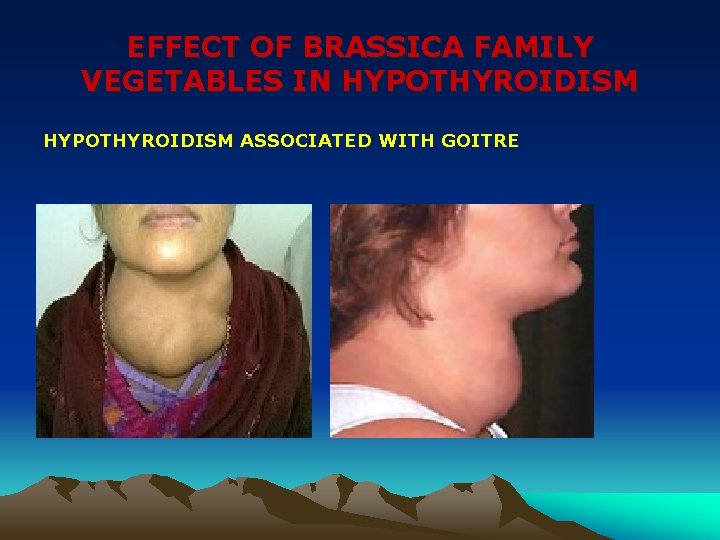
EFFECT OF BRASSICA FAMILY VEGETABLES IN HYPOTHYROIDISM ASSOCIATED WITH GOITRE
Nutrient Interactions Iodine and Thyroid Function Very high intakes of cruciferous vegetables, such as cabbage and turnips, have been found to cause hypothyroidism (insufficient thyroid hormone) in animals. Two mechanisms have been identified to explain this effect. The hydrolysis of some glucosinolates found in cruciferous vegetables (e. g. , progoitrin) may yield a compound known as goitrin, which has been found to interfere with thyroid hormone synthesis. The hydrolysis of another class of glucosinolates, known as indole glucosinolates, results in the release of thiocyanate ions, which can compete with iodine for uptake by the thyroid gland. Increased exposure to thiocyanate ions from cruciferous vegetable consumption or, more commonly, from cigarette smoking, does not appear to increase the risk of hypothyroidism unless accompanied by iodine deficiency. One study in humans found that the consumption of 150 g/day (5 oz/day) of cooked Brussels sprouts for four weeks had no adverse effects on thyroid function. Intake Recommendations • Although many organizations, including the National Cancer Institute, recommend eating a variety of fruits and vegetables daily (serving number depends on age, sex, and activity level, separate recommendations for cruciferous vegetables have not been established. Much remains to be learned regarding cruciferous vegetable consumption and cancer prevention, but the results of some epidemiological studies suggest that adults should aim for at least five weekly servings of cruciferous vegetables
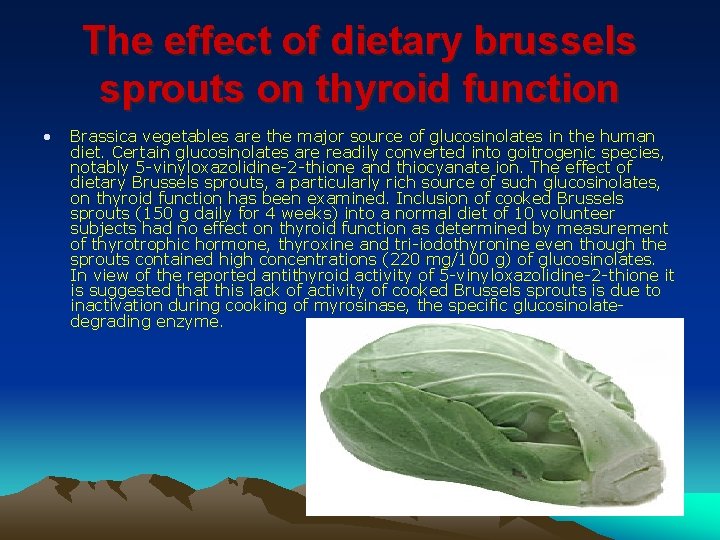
The effect of dietary brussels sprouts on thyroid function • Brassica vegetables are the major source of glucosinolates in the human diet. Certain glucosinolates are readily converted into goitrogenic species, notably 5 -vinyloxazolidine-2 -thione and thiocyanate ion. The effect of dietary Brussels sprouts, a particularly rich source of such glucosinolates, on thyroid function has been examined. Inclusion of cooked Brussels sprouts (150 g daily for 4 weeks) into a normal diet of 10 volunteer subjects had no effect on thyroid function as determined by measurement of thyrotrophic hormone, thyroxine and tri-iodothyronine even though the sprouts contained high concentrations (220 mg/100 g) of glucosinolates. In view of the reported antithyroid activity of 5 -vinyloxazolidine-2 -thione it is suggested that this lack of activity of cooked Brussels sprouts is due to inactivation during cooking of myrosinase, the specific glucosinolatedegrading enzyme.

REFERENCES • • www. xomba. com www. annecollins. com www. ithyroid. com www. ehow. com ›
- Slides: 10