
Governors Governors o Governors serve three basic purposes
Governors
Governors o Governors serve three basic purposes: o Maintain a speed selected by the operator which is within the range of the governor. o Prevent over-speed which may cause engine damage. o Limit both high and low speeds.
Governors o Generally governors are used to maintain a fixed speed not readily adjustable by the operator or to maintain a speed selected by means of a throttle control lever. o In either case, the governor protects against overspeeding.
How does it work? o If the load is removed on an operating engine, the governor immediately closes the throttle. o If the engine load is increased, the throttle will be opened to prevent engine speed form being reduced.
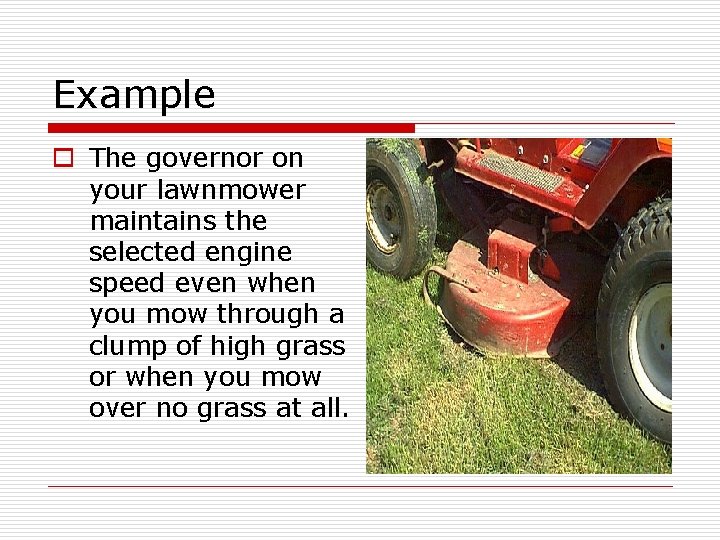
Example o The governor on your lawnmower maintains the selected engine speed even when you mow through a clump of high grass or when you mow over no grass at all.
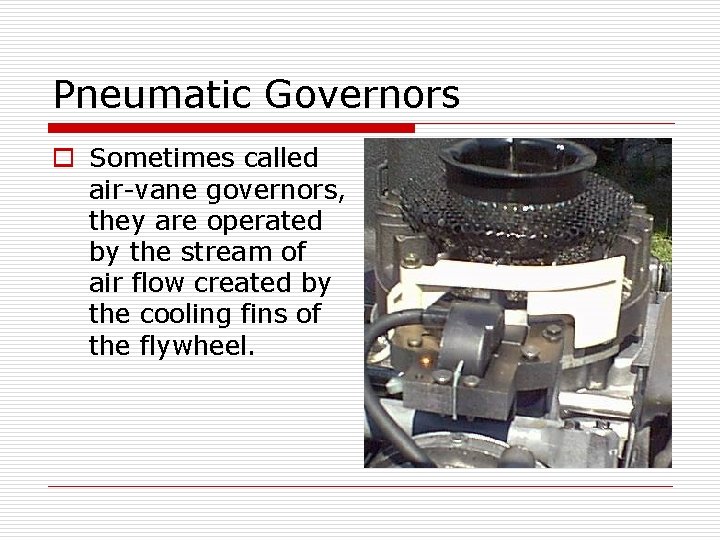
Pneumatic Governors o Sometimes called air-vane governors, they are operated by the stream of air flow created by the cooling fins of the flywheel.
Air-Vane Governor o When the engine experiences sudden increases in load, the flywheel slows causing the governor to open the throttle to maintain the desired speed. o The same is true when the engine experiences a decrease in load. The governor compensates and closes the throttle to prevent overspeeding.
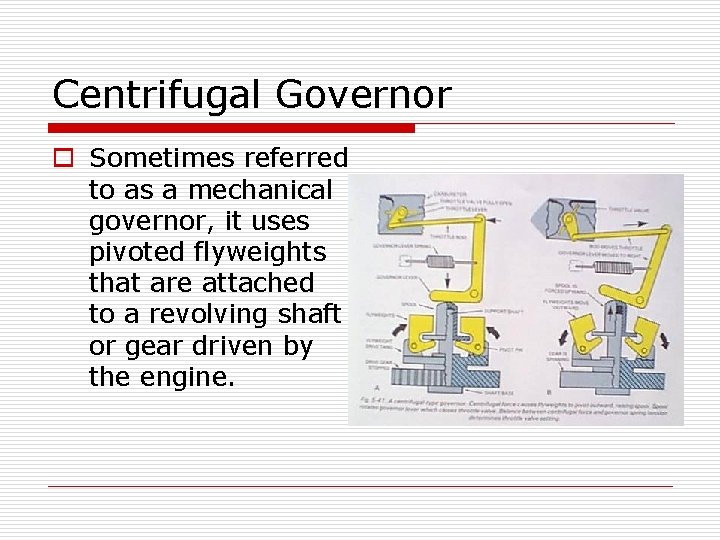
Centrifugal Governor o Sometimes referred to as a mechanical governor, it uses pivoted flyweights that are attached to a revolving shaft or gear driven by the engine.
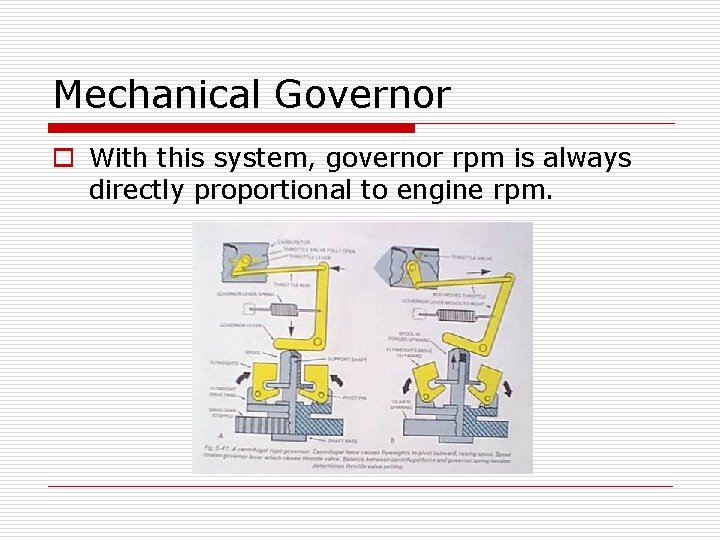
Mechanical Governor o With this system, governor rpm is always directly proportional to engine rpm.
Mechanical Governor o If the engine is subjected to a sudden load that reduces rpm, the reduction in speed lessens centrifugal force on the flyweights. o The weights move inward and lower the spool and governor lever, thus opening the throttle to maintain engine speed.
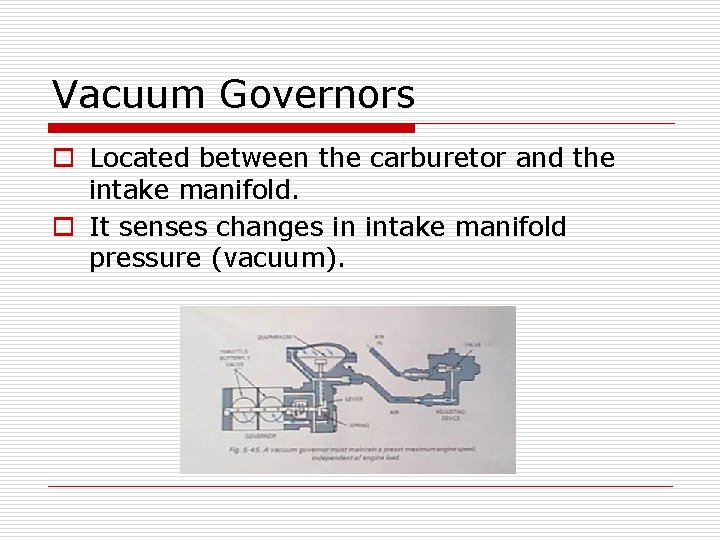
Vacuum Governors o Located between the carburetor and the intake manifold. o It senses changes in intake manifold pressure (vacuum).
Vacuum Governors o As engine speed increases or decreases the governor closes or opens the throttle respectively to control engine speed.
Hunting o Hunting is a condition whereby the engine speed fluctuate or is erratic usually when first started. o The engine speeds up and slows down over and over as the governor tries to regulate the engine speed. o This is usually caused by an improperly adjusted carburetor.
Stability o Stability is the ability to maintain a desired engine speed without fluctuating. o Instability results in hunting or oscillating due to over correction. o Excessive stability results in a deadbeat governor or one that does not correct sufficiently for load changes.
Sensitivity o Sensitivity is the percent of speed change required to produce a corrective movement of the fuel control mechanism. o High governor sensitivity will help keep the engine operating at a constant speed.
- Slides: 15