
Government Structure in Mexico President Six Year Monarch
- Slides: 11
Government Structure in Mexico
President “Six Year Monarch” l l l Elected to sexenio (6 year term) Can not run for reelection Must be 35 years old and a citizen and can not be a priest or have served in the military 6 months prior to the election If the presidency becomes vacant in the first two years, an interim president is chosen by Congress and new elections must be called. If the presidency becomes vacant in the last four years, Congress will pick a President for the remainder of the terms
Appointing Power l l May freely appoint and dismiss cabinet officials, employees of executive branch, ambassadors, consuls, members of the Supreme court. Extensive appointments provide a source of patronage for incoming administrations
Presidential Succession l l Under PRI, the president would secretly pick his successor, known as the dedazo (tap) Successors would either encompass change or continuity depending on public opinion of the current President Seen as archaic and undemocratic. Since 2000, parties have held nominating conventions to name their candidates
Legislative Branch l l l Bicameral Congress: Senate (Camara de Senadores) and lower Chamber of Deputies ( Camara de Diputados) Both are responsible for legislation and approval of presidential appointments. In practice 90% of legislation is introduced by the executive Congress meets Nov 1 - Dec 31 and then April 15 July 15. Permanent Committee (37 members ) will meet during congressional recesses.
Who is the Legislative Branch? l l l Senate was originally 64 members; two for each state. After the reforms of the ’ 90 s there are now 128 members who serve 6 year terms One of each state’s four seats will go to the party that comes in second in that state. Since 1986, the Chamber of Deputies has 500 members, 200 of which are elected through proportional representation. They serve 3 year terms and can not be reelected
Powers of Congress l l Right to pass laws, impose taxes, declare war, approve the national budget, approve treaties, ratify appointments. Each chamber has committees that discuss bills and if there is disagreement, a joint committee is appointed to draft a compromise bill
Judicial l l Judicial branch is divided into federal and state systems. Highest court is supreme court of justice. Justices are appointed for life.
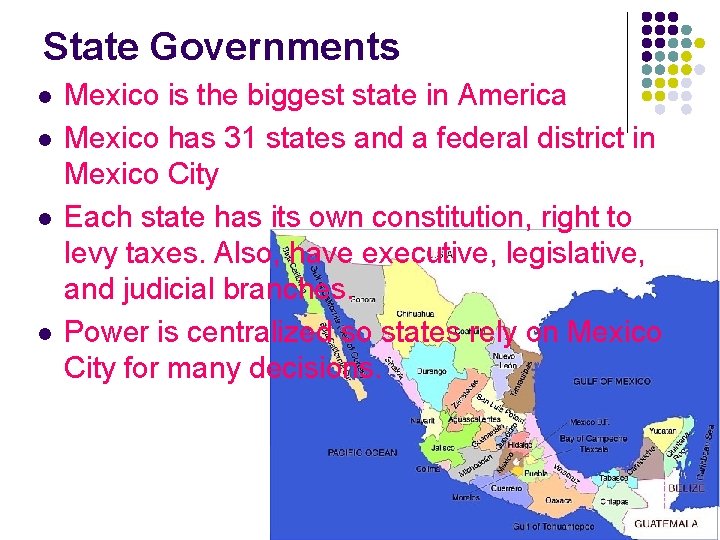
State Governments l l Mexico is the biggest state in America Mexico has 31 states and a federal district in Mexico City Each state has its own constitution, right to levy taxes. Also, have executive, legislative, and judicial branches. Power is centralized so states rely on Mexico City for many decisions.
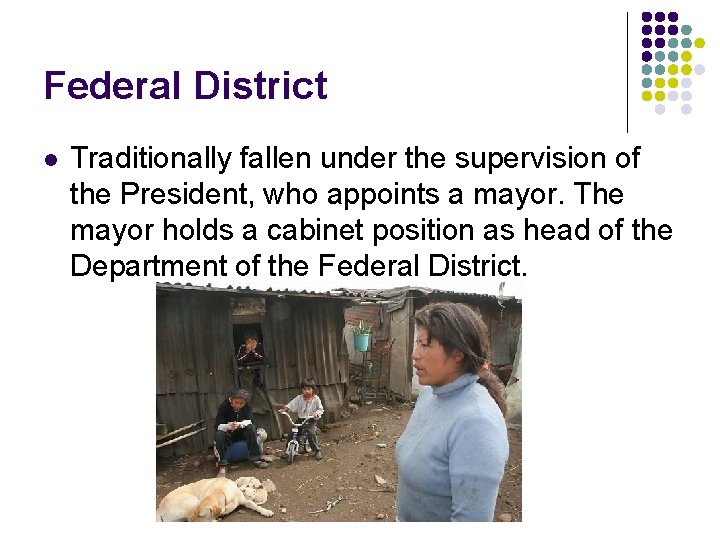
Federal District l Traditionally fallen under the supervision of the President, who appoints a mayor. The mayor holds a cabinet position as head of the Department of the Federal District.
Local Governments l Municipal governments are responsible for a variety of public services, including water, sewage, street lighting, cleaning and maintenance, public safety, traffic, supervision of slaughterhouses, maintenance of parks, and cemeteries.