
GOVERNMENT OF INDIA ACT 1935 GROUP1 Reghunath V


- Slides: 16
GOVERNMENT OF INDIA ACT 1935 GROUP-1 Reghunath V Assist Professor Dept Of Political Science NSS college Pandalam
Introduction 1, The government of India act was passed by the British parliament in August 1935 2, As a result of it’s length it was divided into two namely THE GOVERNMENT OF INDIA ACT 1935 and THE GOVERNMENT OF BURMA ACT 1935
BACKGROUND ● ● There was a growing demand for constitutional reforms in Indian leaders India’s support to Britain in the first world war also aided in British acknowledgement of the need for the inclusion of more Indians in the administration of their own country ● The act was based on : ● A)Simon commission report ● B)The recommendation of the round table conferences
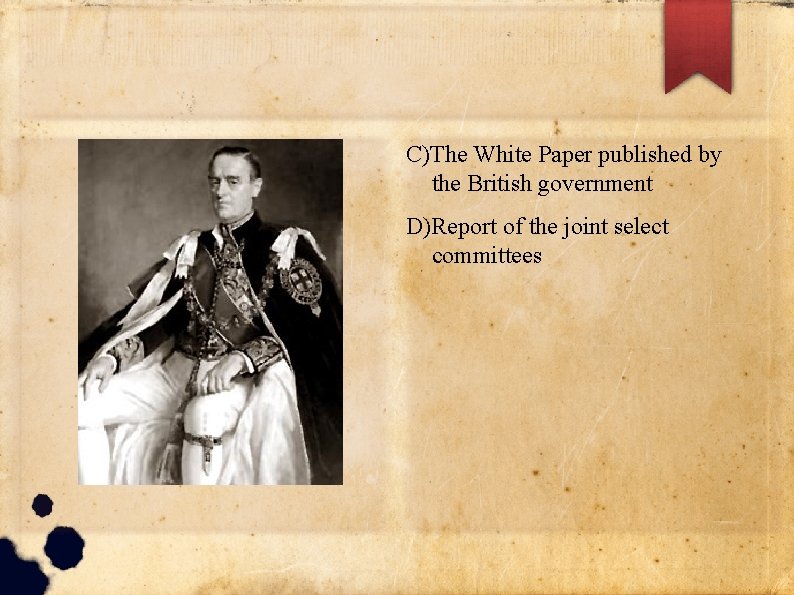
C)The White Paper published by the British government D)Report of the joint select committees
PROVISIONS ● ● Creation of an all India federation A)This federation was to consist of British India and the princely states B)The provinces in British India would have to join the federation but this was not compulsory for the princely states C)This federation never materialized because of the lack of support from the required number of princely states
● ● Division of powers A)This act divided powers between the centre and the provinces B)There were three Lists (Federal list , Provincial list , Concurrent list ) C)The Viceroy was vested with residual powers
Provincial Autonomy ● The act gave more autonomy to the provinces ● Diarchy was abolished ● The governor was the head of the executive ● There was a council of ministers to advise him. The ministers were responsible to the provincial legislature who controlled them. The legislature could also remove the ministers
. ● The governors still retained special reserve powers ● The British authorities could still suspend a provincial government
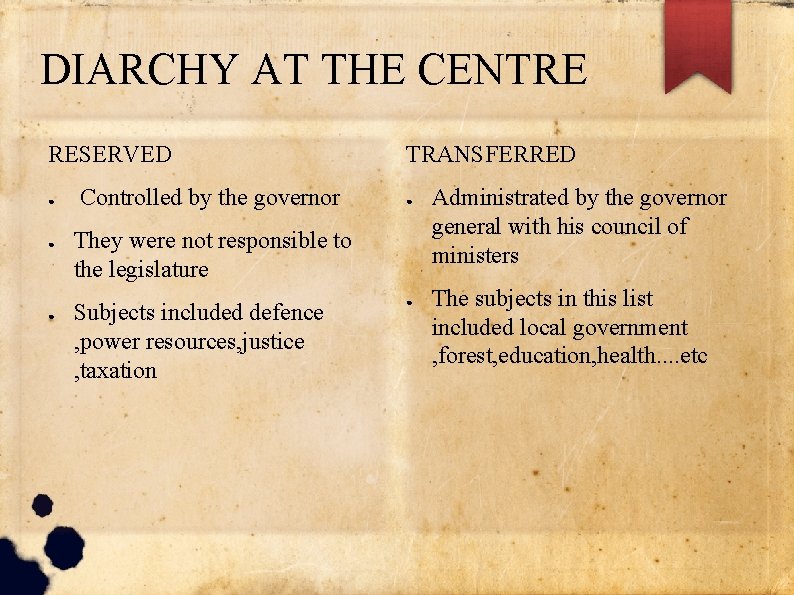
DIARCHY AT THE CENTRE RESERVED ● ● ● Controlled by the governor TRANSFERRED ● They were not responsible to the legislature Subjects included defence , power resources, justice , taxation ● Administrated by the governor general with his council of ministers The subjects in this list included local government , forest, education, health. . etc
Bicameral legislature ● The bicameral federal legislature would be established. ● The two houses were the federal assembly and the council of states ● Federal assembly had a term of five years ● In both houses there were representatives of princely states also but they were not elected
● ● There were to be separate electorates for the minorities Bicameral legislatures were introduced in some provinces , like Bengal , Madras, . . . etc
Federal Court ● ● A federal court was established at Delhi for the resolution of disputes between provinces and also between the centre and the province It was to have one chief justice and more than six judges
Indian council ● ● The Indian council was abolished The secretary of state for India would instead have a team of advisors Franchise ● ● This act introduced direct elections in India for the first time About ten per cent of the hole population acquired voting rights
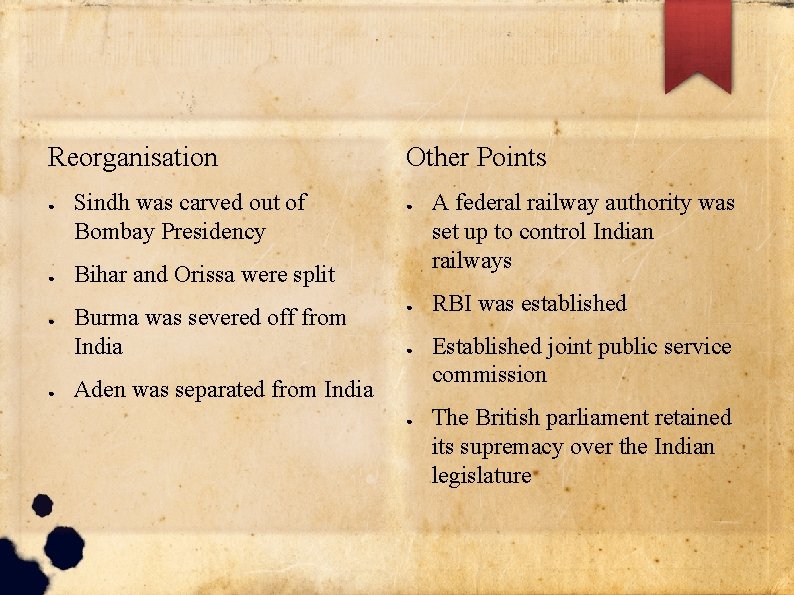
Reorganisation ● ● Sindh was carved out of Bombay Presidency Other Points ● Bihar and Orissa were split Burma was severed off from India ● ● Aden was separated from India ● A federal railway authority was set up to control Indian railways RBI was established Established joint public service commission The British parliament retained its supremacy over the Indian legislature
BIBLIOGRAPHY ● The constitutional law of India (Dr. J. N. Pandey ) ● Constitution of india(Mahindra Pal Sing) ● The landmarks in Indian legal and constitutional history(B M Gandhi)
Thanks for all viewers