
Government IntroPolitical Culture Unit One Textbook Chapter 1
Government Intro/Political Culture Unit One Textbook Chapter 1 Introduction to United States Government Coach Flu Revised 2018 -2019
Explain how the U. S. system balances liberty and order.

People follow laws because they fear punishment rather than because they want a more orderly or just society. Agree Disagree
Justice comes from the law itself rather than how it is administered, enforced or interpreted. Agree Disagree
The only reason a government should have power is because it has the support of the people. Agree Disagree
All should contribute to the common good. Agree Disagree
A strong military with a single strong leader is essential to national security. Agree Disagree
The surest path to economic prosperity is an unregulated market economy. Agree Disagree
The government’s job is to protect the weak from the strong. Agree Disagree
Government • What is government? it is an institution that makes authoritative decisions for any given society. • Thousands of state and local governments make policies that influence our every day lives. • There about 500, 000 elected officials in the united states today.
For a State (Country) to Exists • Geographic Territory: Definable boarders. • Population: People DUH! • Sovereignty: the quality of having supreme, independent authority over a geographic area, such as a territory. • Legitimate Government: a form of structured government: Democracy, dictatorship etc.
Government �What should the government do? � How the government should take part in specific areas and how they take part in it. � Some Americans believe that the government doesn’t do enough for society and others think that the government does more then enough. �What should Government do? 1. Maintaining a national defense � They have recruiters for the army , marines, navy and air force to protect our Country from foreign threats. 2. Providing public services � Our government spends billions of dollars on libraries, schools, houses, parks. � These services are for everyone's use and cant be denied to anyone. 3. Preserve order � For the government another main priority is to preserve order when there are protests of a large amount of people the government sends people to step in.
Government Cont. 4. Socialize the young • The government has the schools say the pledge of allegiance for patriotism. • They also decide what courses certain states should study. • They pay for certain education (fafsa) 5. Collect taxes • Every American citizen has to pay either to national, state, or local. • The taxes go to public services and goods. 6. Regulate the Economy • Lower taxes to promote spending • Tariffs on imports • Control interest rates • Implement monetary policy • Regulate banks • Public goods: goods such as clean air and clean water that everyone must share. • The government has a extensive impact on out lives, but we also have the same impact on our government as well.
Common American Beliefs • Political Culture: a set of attitudes and practices held by • • • a people that shapes their political behavior. It includes moral judgments, political myths, beliefs, and ideas about what makes for a good society. Liberty: To live in freedom without the intrusion of government. Egalitarianism: The concept of equal opportunity for success. (not results) Individualism: The belief that people can and do get ahead based on their own merits and hard work. Laissez-faire: an economic policy of free markets and not interference of government into the economy. Populism: being on the side of the ordinary people in the struggle against the government and the elites.
Democracy • What is democracy? (as defined by Americans) • Democracy is a system of selecting policymakers and of organizing government so that policy represents and responds to the public preferences. • The word democracy takes place among words like freedom, justice and peace.
Democracy • Direct Democracy: the people being governed gather to discuss and vote directly on decisions made by the government. This style of democracy was used by the ancient Athenians and is still used today by a few small communities in New England.
Democracy • Indirect Democracy. In this system, the people elect representatives to run the government and express their sentiments. The power in this type of democracy remains with the people but limited. • State governments are also examples of representative democracies in that elected officials act on behalf of their constituents. • In different state governments, people retain power via initiatives, referendums, and recalls. • The U. S. National Government is an example of a republic. Power between elections r rests with elected officials not the people.
Democracy • Participatory democracy: Emphasizes broad participation in politics and civil society. • Pluralist democracy: Recognizes group-based activism by nongovernmental interests striving for impact on political decision making. • Elite democracy: decisions are made by elected representatives acting as trustees. • Majoritarianism: A political theory holding that in a democracy, the government ought to do what the majority of the people want. • Majority Rule: a political principle providing that a majority usually constituted by fifty percent plus one of an organized group will have the power to make decisions binding upon the whole • Minority Rights: The majority is limited by protecting the rights of the minority from the tyranny of the majority.
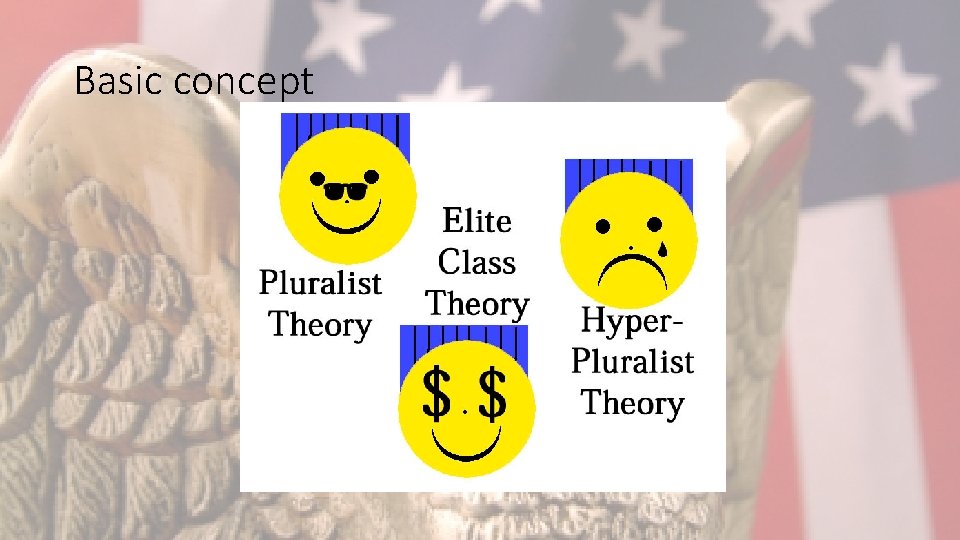
3 Theories of American Democracy �Pluralist Theory- A theory of government and policies emphasizing that politics is mainly a competition among groups, each one pressing for its own preferred policies �Groups may be trade unions, interest groups, business organizations, and any of a multitude of formal and informal coalitions �Pluralists are generally optimistic that the public interest will eventually prevail in the making of public policy through bargaining and compromise.
Theories of Interest Group Politics • Pluralism and Group Theory • • • Groups provide a key link between the people and the government. Groups compete and no one group will become too dominant. Groups play by the “rules of the game. ” Groups weak in one resource may use another. Lobbying is open to all so is not a problem.
3 Theories of American Democracy • Elitism or Class Theory- A theory of government and politics contending that societies are divided along class lines and that an upper-class elite will rule, regardless of the formal niceties of governmental organization. • The center of all theories of elite dominance is big business. • Those who are wealthy have more power.
Theories of Interest Group Politics: Pluralism • Elites and the Denial of Pluralism • Real power is held by the relatively few. • The largest corporations hold the most power. • Elite power is fortified by a system of interlocking directorates of these corporations and other institutions. • Other groups may win many minor policy battles, but elites prevail when it comes to big policy decisions. • Lobbying is a problem because it benefits the few at the expense of the many.
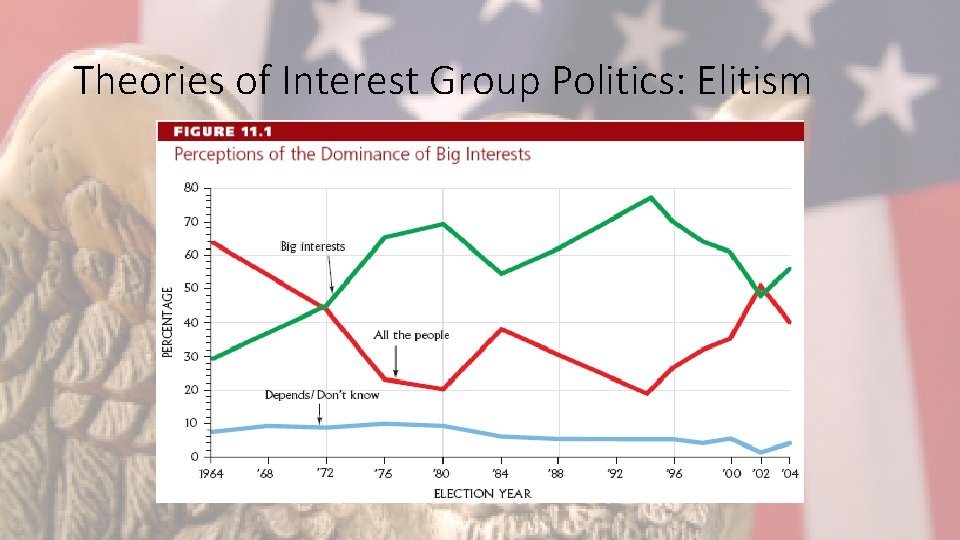
Theories of Interest Group Politics: Elitism
3 Theories of American Democracy • Hyperpluralism- Is a theory of government and politics contending that groups are so strong that government is weakened. • According to Hyperpluralism groups have become supreme and the government is their servant. • Powerful groups divide the government and its authority, government gives in to every possible interest and single-issue which ends up being very confusing and contradicting. • Creates Gridlock in government. • Policy Gridlock- A condition that occurs when no coalition is strong enough to form a majority and establish policy.
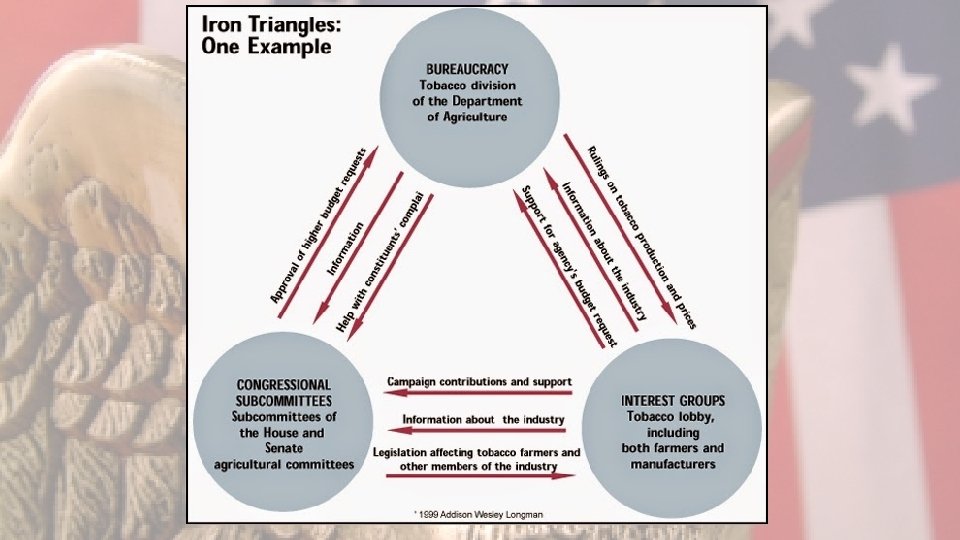
Theories of Interest Group Politics: Hyperpluralism • Sub-Governments (AKA Iron Triangles and Policy Networks) • Networks of groups that exercise a great deal of control over specific policy areas. • Consist of interest groups, government agency, and congressional committees that handle particular policies • Also known as iron triangles • The Hyperpluralist critique • Groups have become too powerful as the government tries to appease every interest. • Many subgovernments (iron triangles) aggravate the process. • Trying to please every group results in contradictory policies that are hard to understand difficult to enforce. A great example is Obamacare (The Affordable Healthcare Act)
A growing theory of American Democracy • Bureaucratic theory: The hierarchical structure and standardized procedures of modern governments allow bureaucrats, who carry out the day to day workings of government, to hold the real power over public policy. (Max Weber) • Red Tape: rules and regulations that seem unnecessary and prevent things from being done quickly and easily governmental red tape • Weber saw bureaucracy as a threat to individual freedom, in which the increasing bureaucratization of human life traps individuals in the an "iron cage" of rulebased, rational control
Basic concept
Challenges to Democracy • Increased technical expertise or complexity of issues • The elite are in command of knowledge. • Limited participation in government • Americans do not take advantage vote and participate in politics. • Universal Suffrage: The right for all adults to be able to vote for their representatives. • Escalating campaign costs • PAC’s try to get more money for campaigns and re-elections. • Diverse political interests • Each American has different interests and that influences each policy that is proposed or becomes law.
Politics �Politics- determines who we select as our governmental leaders and what policies these leaders pursue. �The famous quote from Harold D. Lasswell is “who gets what, when, and how. ” It basically covers how politics work. �People get what they want through voting, supporting, comprising, lobbying and etc. which is called political participation.
Politics �Single issue groups- that have a narrow interest, tend to dislike compromise, and often draw membership from people new to politics. They are distinguished from traditional interest groups. �Individual citizens and organized groups get involved in politics because they understand that the public policy choices made by the government affect them in a significant ways.
The Policymaking System • Is a process by which policy comes over time. Peoples interests, problems, and concerns create political issues. these issues shape policy but also it impacts people, generating more interests, problems, and concerns. • Linkage institutions- includes elections, political parties, interest groups, and the media.
The Policymaking System Cont. • Policy agenda- issues that attract the serious attention of public officials and other people involved in politics at any given point in time. • Political issue- an issue that arises when people disagree about a problem & how to fix it. • Policymaking institutions- Congress, the Presidency, Courts and the State and Federal Bureaucracy.
Policies Impact People • All the decisions that the government makes, all the laws they pass, the budget they establish, and the rules that they make is called public policy. • Types of public policy are= the social security act, food and drug administration.
Policies Impact People • Impacts of Policies: • Does it solve the problem? • Does it create more problems? • Depending on the answer, policy impacts carry the political system back to its point of origin: the concerns of people.
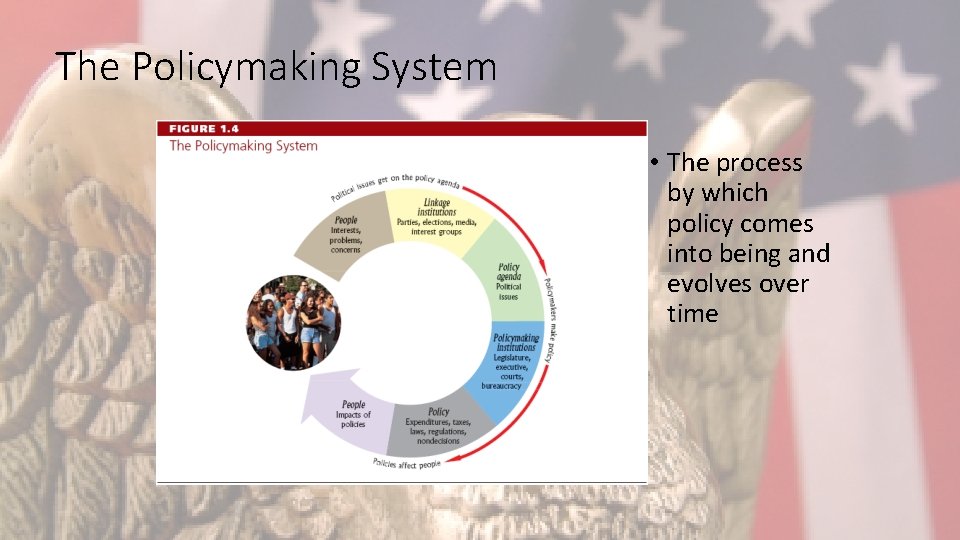
The Policymaking System • The process by which policy comes into being and evolves over time
The Policy Making Process • Policy Making Involves: • • • Individuals or groups identify a problem The problem becomes part of the policy agenda Congress passes legislation The bureaucracy implements it Feedback leads to revisions
- Slides: 37