
Government Interventions Government Intervention The Role of Government
- Slides: 20
Government Interventions
Government Intervention The Role of Government in the Market Economy Up to this point, we have examined how free markets work. A free market is one without any government control or intervention. The price and output is determined by the interactions of buyers and sellers However, not all markets are completely free. Governments tend to intervene often to influence several variables in markets for particular goods, such as: • Taxing the good to discourage consumption or raise revenues: Indirect taxes • Paying producers of the good to reduce costs or encourage the good’s production: Subsidies • Reducing the price of the good below its free market equilibrium to benefit consumers: Price Ceilings • Raising the price of a good above its free market equilibrium to benefit producers: Price Floors When governments intervene in the free market, the level of output and price that results is may NOT be the allocatively efficient level. In other words, government intervention may lead to a misallocation of society’s resources.
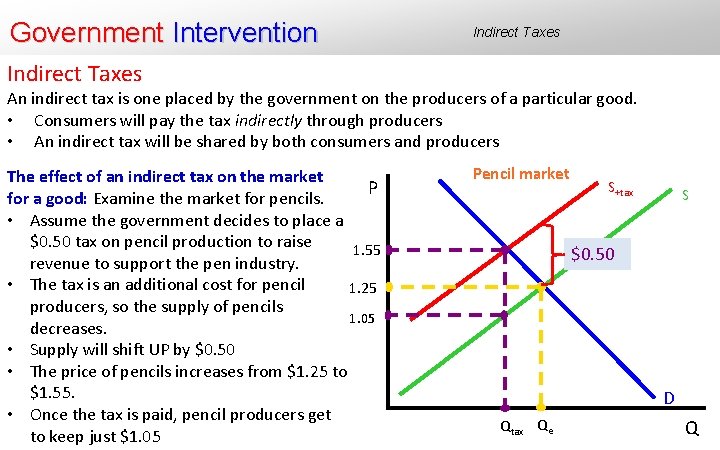
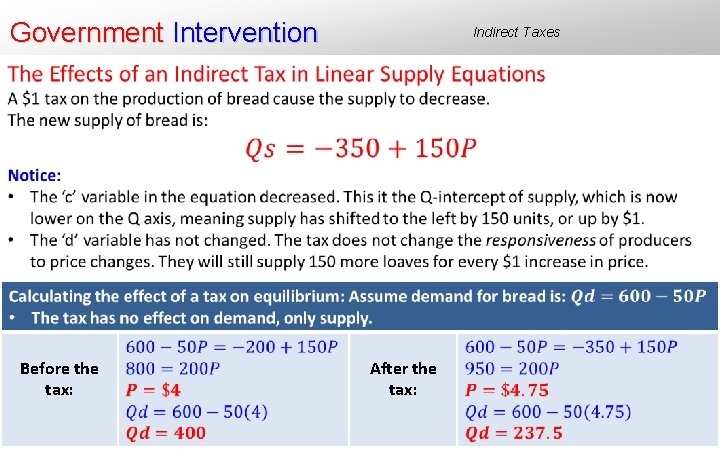
Government Intervention Indirect Taxes An indirect tax is one placed by the government on the producers of a particular good. • Consumers will pay the tax indirectly through producers • An indirect tax will be shared by both consumers and producers The effect of an indirect tax on the market P for a good: Examine the market for pencils. • Assume the government decides to place a $0. 50 tax on pencil production to raise 1. 55 revenue to support the pen industry. • The tax is an additional cost for pencil 1. 25 producers, so the supply of pencils 1. 05 decreases. • Supply will shift UP by $0. 50 • The price of pencils increases from $1. 25 to $1. 55. • Once the tax is paid, pencil producers get to keep just $1. 05 Pencil market S+tax S $0. 50 D Qtax Qe Q
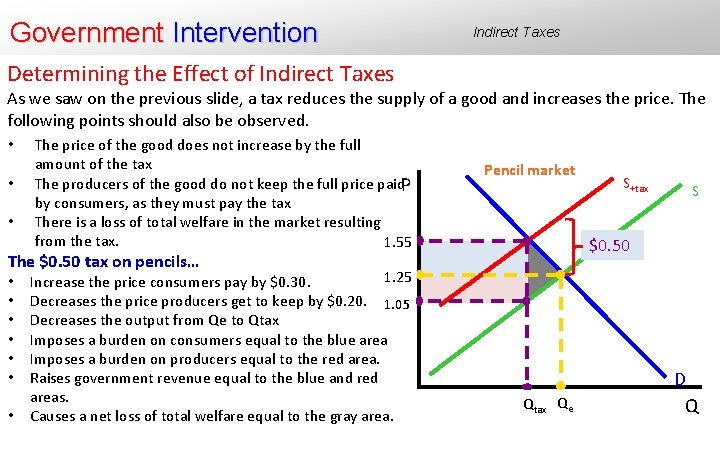
Government Intervention Indirect Taxes Determining the Effect of Indirect Taxes As we saw on the previous slide, a tax reduces the supply of a good and increases the price. The following points should also be observed. • • • The price of the good does not increase by the full amount of the tax The producers of the good do not keep the full price paid. P by consumers, as they must pay the tax There is a loss of total welfare in the market resulting from the tax. 1. 55 Pencil market • 1. 25 Increase the price consumers pay by $0. 30. Decreases the price producers get to keep by $0. 20. 1. 05 Decreases the output from Qe to Qtax Imposes a burden on consumers equal to the blue area Imposes a burden on producers equal to the red area. Raises government revenue equal to the blue and red areas. Causes a net loss of total welfare equal to the gray area. S $0. 50 The $0. 50 tax on pencils… • • • S+tax D Qtax Qe Q
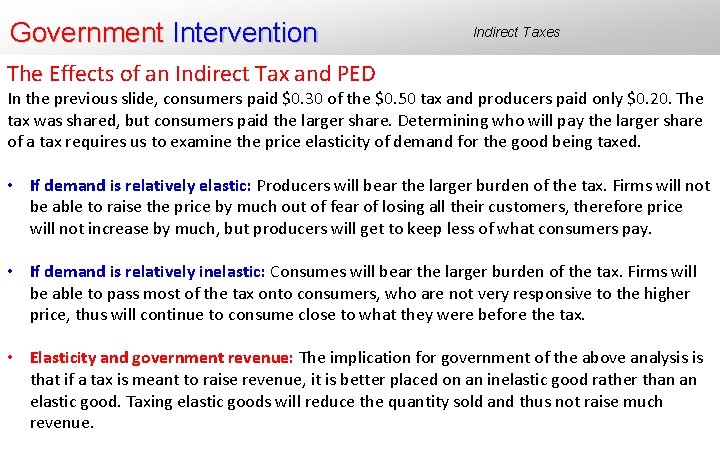
Government Intervention Indirect Taxes The Effects of an Indirect Tax and PED In the previous slide, consumers paid $0. 30 of the $0. 50 tax and producers paid only $0. 20. The tax was shared, but consumers paid the larger share. Determining who will pay the larger share of a tax requires us to examine the price elasticity of demand for the good being taxed. • If demand is relatively elastic: Producers will bear the larger burden of the tax. Firms will not be able to raise the price by much out of fear of losing all their customers, therefore price will not increase by much, but producers will get to keep less of what consumers pay. • If demand is relatively inelastic: Consumes will bear the larger burden of the tax. Firms will be able to pass most of the tax onto consumers, who are not very responsive to the higher price, thus will continue to consume close to what they were before the tax. • Elasticity and government revenue: The implication for government of the above analysis is that if a tax is meant to raise revenue, it is better placed on an inelastic good rather than an elastic good. Taxing elastic goods will reduce the quantity sold and thus not raise much revenue.
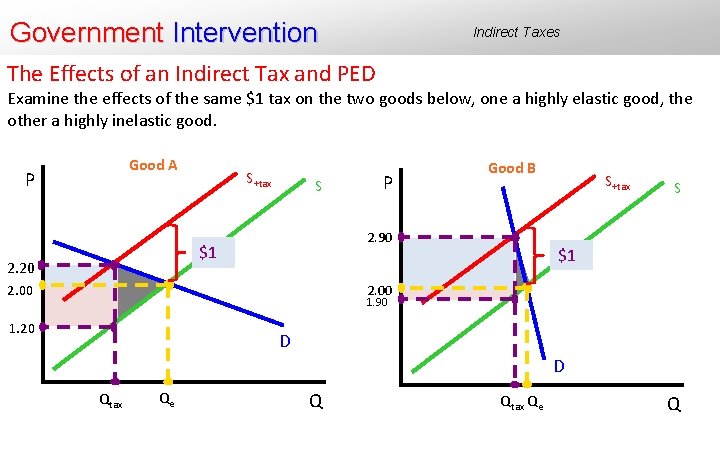
Government Intervention Indirect Taxes The Effects of an Indirect Tax and PED Examine the effects of the same $1 tax on the two goods below, one a highly elastic good, the other a highly inelastic good. Good A P S+tax S 2. 90 $1 2. 20 P Good B 2. 00 S+tax S $1 2. 00 1. 90 1. 20 D D Qtax Qe Q
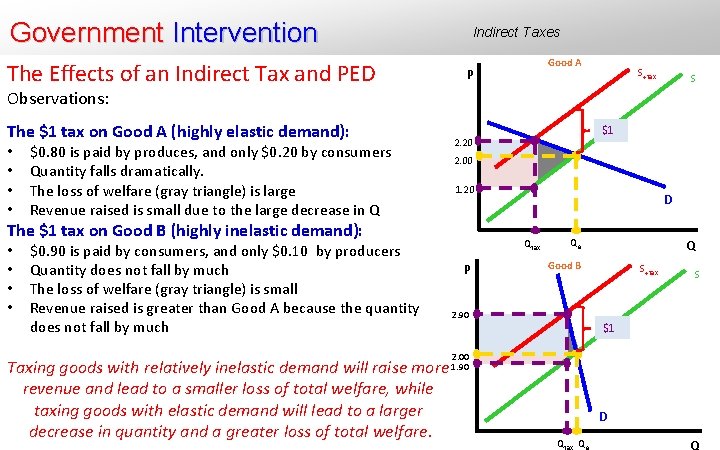
Government Intervention The Effects of an Indirect Tax and PED Indirect Taxes Good A P S+tax S Observations: The $1 tax on Good A (highly elastic demand): • • $0. 80 is paid by produces, and only $0. 20 by consumers Quantity falls dramatically. The loss of welfare (gray triangle) is large Revenue raised is small due to the large decrease in Q 2. 00 1. 20 The $1 tax on Good B (highly inelastic demand): • • $0. 90 is paid by consumers, and only $0. 10 by producers Quantity does not fall by much The loss of welfare (gray triangle) is small Revenue raised is greater than Good A because the quantity does not fall by much $1 2. 20 D Qtax P Qe Q Good B 2. 90 S+tax $1 2. 00 Taxing goods with relatively inelastic demand will raise more 1. 90 revenue and lead to a smaller loss of total welfare, while taxing goods with elastic demand will lead to a larger decrease in quantity and a greater loss of total welfare. D Qtax Qe S
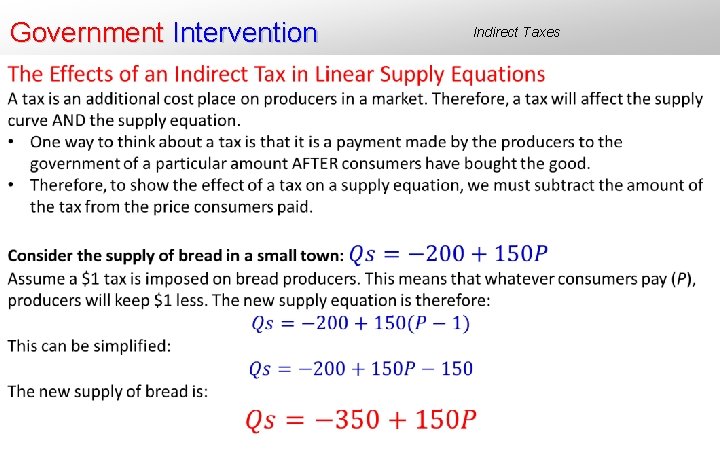
Government Intervention Indirect Taxes
Government Intervention Before the tax: Indirect Taxes After the tax:
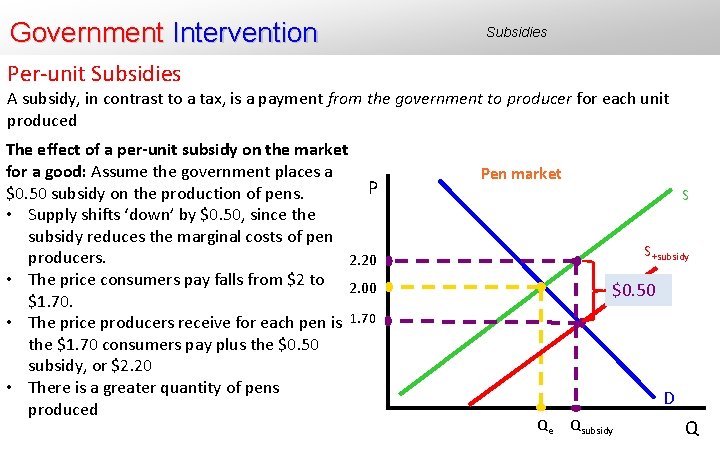
Government Intervention Subsidies Per-unit Subsidies A subsidy, in contrast to a tax, is a payment from the government to producer for each unit produced The effect of a per-unit subsidy on the market for a good: Assume the government places a P $0. 50 subsidy on the production of pens. • Supply shifts ‘down’ by $0. 50, since the subsidy reduces the marginal costs of pen producers. 2. 20 • The price consumers pay falls from $2 to 2. 00 $1. 70. • The price producers receive for each pen is 1. 70 the $1. 70 consumers pay plus the $0. 50 subsidy, or $2. 20 • There is a greater quantity of pens produced Pen market S S+subsidy $0. 50 D Qe Qsubsidy Q
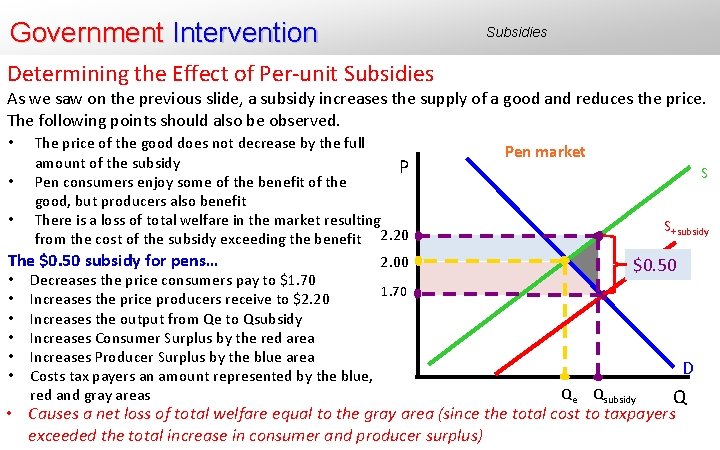
Government Intervention Subsidies Determining the Effect of Per-unit Subsidies As we saw on the previous slide, a subsidy increases the supply of a good and reduces the price. The following points should also be observed. The price of the good does not decrease by the full amount of the subsidy P • Pen consumers enjoy some of the benefit of the good, but producers also benefit • There is a loss of total welfare in the market resulting from the cost of the subsidy exceeding the benefit 2. 20 The $0. 50 subsidy for pens… 2. 00 • Decreases the price consumers pay to $1. 70 • Increases the price producers receive to $2. 20 • Increases the output from Qe to Qsubsidy • Increases Consumer Surplus by the red area • Increases Producer Surplus by the blue area • Costs tax payers an amount represented by the blue, red and gray areas • Pen market S S+subsidy $0. 50 D Qe Qsubsidy Q • Causes a net loss of total welfare equal to the gray area (since the total cost to taxpayers exceeded the total increase in consumer and producer surplus)
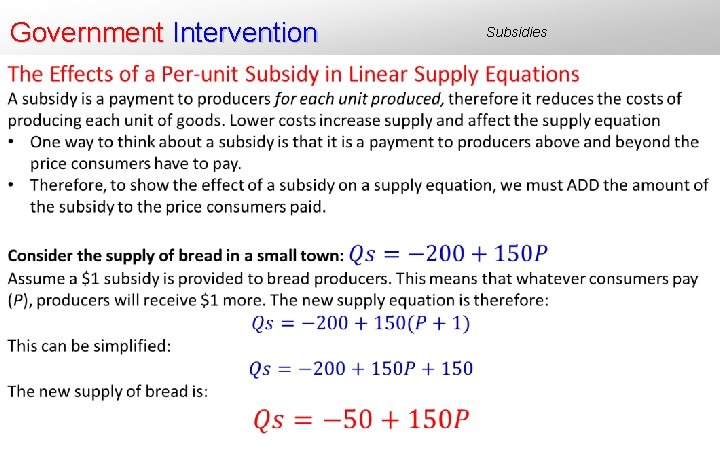
Government Intervention Subsidies
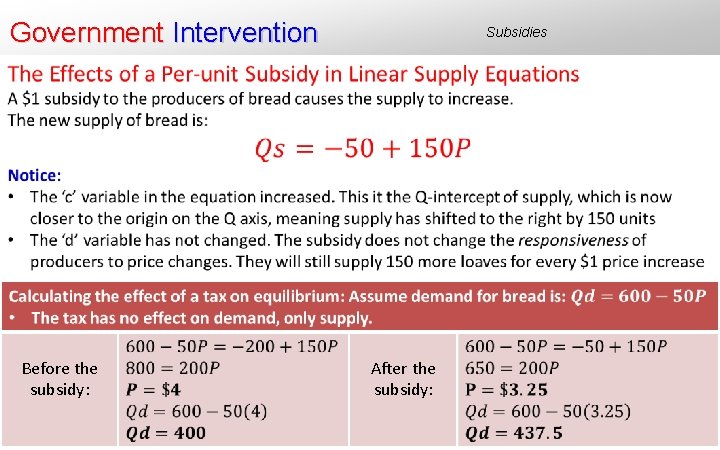
Government Intervention Before the subsidy: Subsidies After the subsidy:
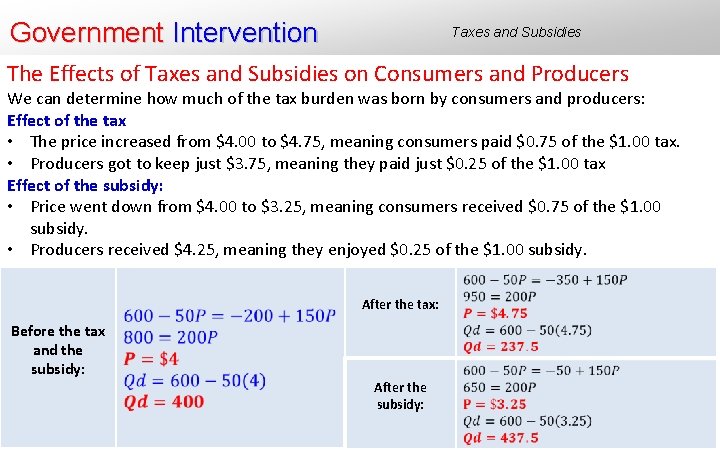
Government Intervention Taxes and Subsidies The Effects of Taxes and Subsidies on Consumers and Producers We can determine how much of the tax burden was born by consumers and producers: Effect of the tax • The price increased from $4. 00 to $4. 75, meaning consumers paid $0. 75 of the $1. 00 tax. • Producers got to keep just $3. 75, meaning they paid just $0. 25 of the $1. 00 tax Effect of the subsidy: • Price went down from $4. 00 to $3. 25, meaning consumers received $0. 75 of the $1. 00 subsidy. • Producers received $4. 25, meaning they enjoyed $0. 25 of the $1. 00 subsidy. After the tax: Before the tax and the subsidy: After the subsidy:
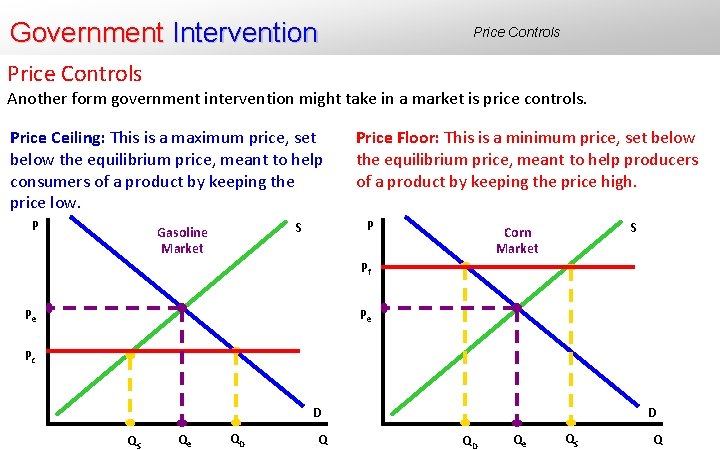
Government Intervention Price Controls Another form government intervention might take in a market is price controls. Price Ceiling: This is a maximum price, set below the equilibrium price, meant to help consumers of a product by keeping the price low. P P S Gasoline Market Price Floor: This is a minimum price, set below the equilibrium price, meant to help producers of a product by keeping the price high. S Corn Market Pf Pe Pe Pc D QS Qe QD Q D QD Qe QS Q
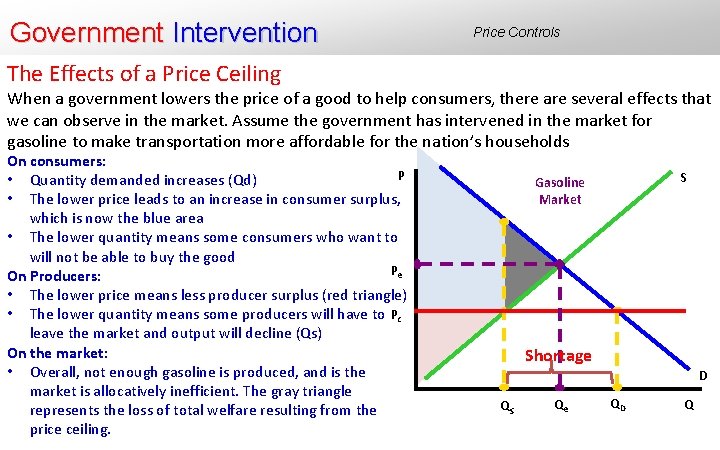
Government Intervention Price Controls The Effects of a Price Ceiling When a government lowers the price of a good to help consumers, there are several effects that we can observe in the market. Assume the government has intervened in the market for gasoline to make transportation more affordable for the nation’s households On consumers: P • Quantity demanded increases (Qd) • The lower price leads to an increase in consumer surplus, which is now the blue area • The lower quantity means some consumers who want to will not be able to buy the good Pe On Producers: • The lower price means less producer surplus (red triangle) • The lower quantity means some producers will have to Pc leave the market and output will decline (Qs) On the market: • Overall, not enough gasoline is produced, and is the market is allocatively inefficient. The gray triangle represents the loss of total welfare resulting from the price ceiling. S Gasoline Market Shortage D QS Qe QD Q
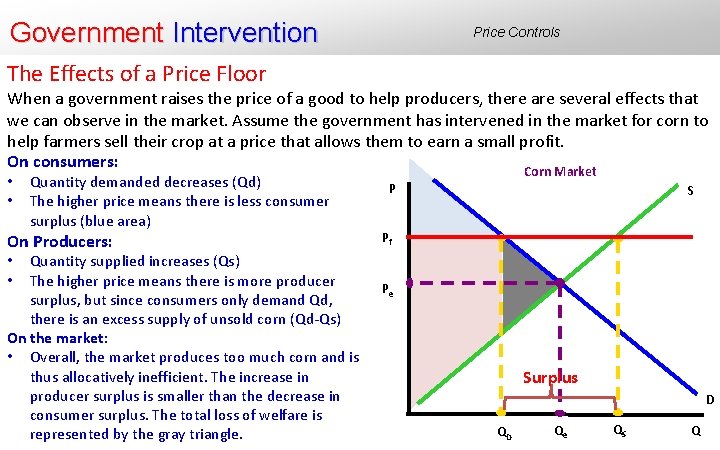
Government Intervention Price Controls The Effects of a Price Floor When a government raises the price of a good to help producers, there are several effects that we can observe in the market. Assume the government has intervened in the market for corn to help farmers sell their crop at a price that allows them to earn a small profit. On consumers: Corn Market • • Quantity demanded decreases (Qd) The higher price means there is less consumer surplus (blue area) On Producers: Quantity supplied increases (Qs) The higher price means there is more producer surplus, but since consumers only demand Qd, there is an excess supply of unsold corn (Qd-Qs) On the market: • Overall, the market produces too much corn and is thus allocatively inefficient. The increase in producer surplus is smaller than the decrease in consumer surplus. The total loss of welfare is represented by the gray triangle. • • P S Pf Pe Surplus D QD Qe QS Q
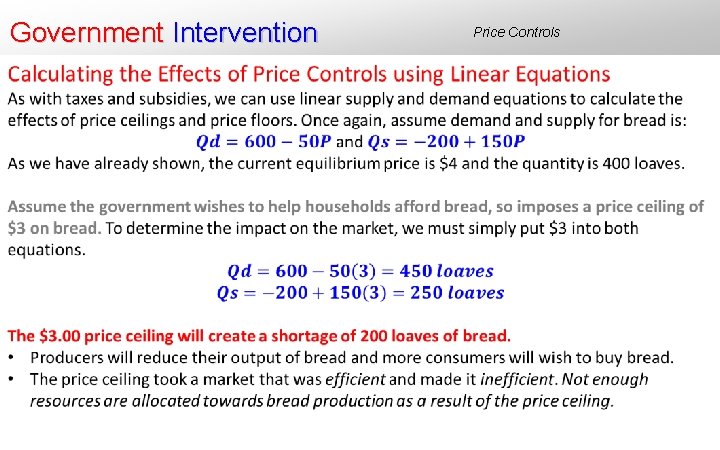
Government Intervention Price Controls
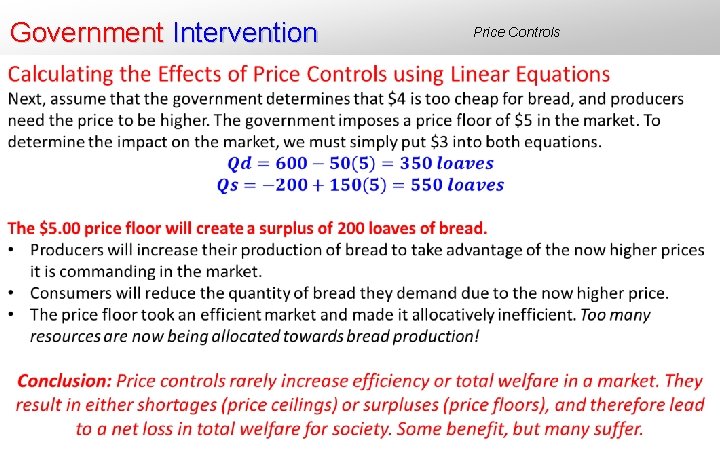
Government Intervention Price Controls
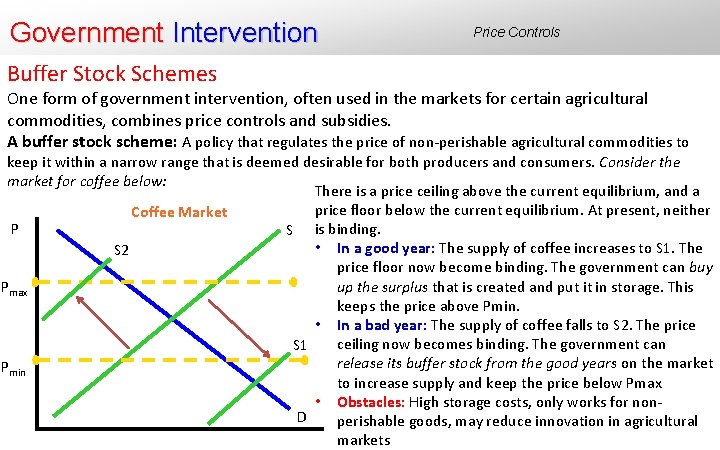
Government Intervention Price Controls Buffer Stock Schemes One form of government intervention, often used in the markets for certain agricultural commodities, combines price controls and subsidies. A buffer stock scheme: A policy that regulates the price of non-perishable agricultural commodities to keep it within a narrow range that is deemed desirable for both producers and consumers. Consider the market for coffee below: There is a price ceiling above the current equilibrium, and a price floor below the current equilibrium. At present, neither Coffee Market P S is binding. • In a good year: The supply of coffee increases to S 1. The S 2 price floor now become binding. The government can buy up the surplus that is created and put it in storage. This Pmax keeps the price above Pmin. • In a bad year: The supply of coffee falls to S 2. The price ceiling now becomes binding. The government can S 1 release its buffer stock from the good years on the market Pmin to increase supply and keep the price below Pmax • Obstacles: High storage costs, only works for non. D perishable goods, may reduce innovation in agricultural markets