
Government EA Modeling Method Learning Purpose Understand the
- Slides: 50
Government EA Modeling Method
Learning Purpose Understand the structure and contents of the Government EA Reference Models, and use them for developing an agency EA Understand the structure and contents of the Government EA Metamodel, and use them for developing an agency metamodel and profiling agency’s architectural information Understand the structure and contents of the EA Maturity Model, and learn how to increase an agency’s EA maturity level Understand the functions of the Government EA Management System, and learn how to utilize an agency EA management system. 1
Contents 1. Government EA Standards/Tools Overview 2. Government EA Reference Model 3. Government EA Metamodel 4. Government EA Maturity Model 5. Government EA Management System
Contents 1. Government EA Standards/Tools Overview 2. Government EA Reference Model 3. Government EA Metamodel 4. Government EA Maturity Model 5. Government EA Management System
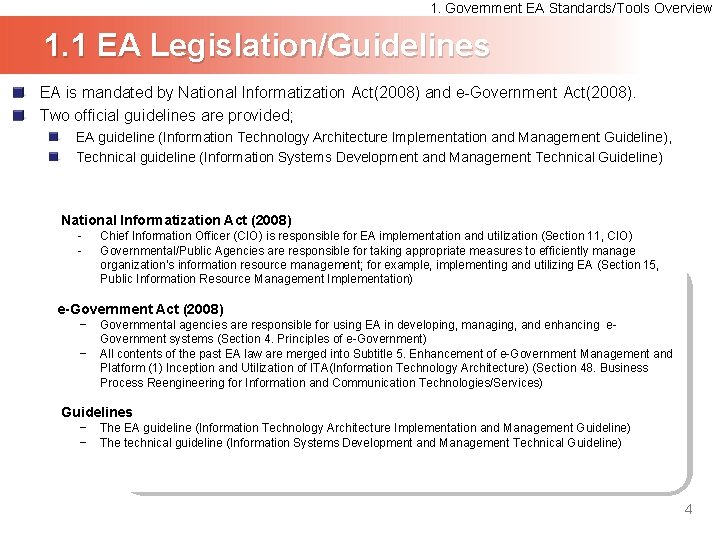
1. Government EA Standards/Tools Overview 1. 1 EA Legislation/Guidelines EA is mandated by National Informatization Act(2008) and e-Government Act(2008). Two official guidelines are provided; EA guideline (Information Technology Architecture Implementation and Management Guideline), Technical guideline (Information Systems Development and Management Technical Guideline) National Informatization Act (2008) - Chief Information Officer (CIO) is responsible for EA implementation and utilization (Section 11, CIO) Governmental/Public Agencies are responsible for taking appropriate measures to efficiently manage organization’s information resource management; for example, implementing and utilizing EA (Section 15, Public Information Resource Management Implementation) e-Government Act (2008) - Governmental agencies are responsible for using EA in developing, managing, and enhancing e. Government systems (Section 4. Principles of e-Government) All contents of the past EA law are merged into Subtitle 5. Enhancement of e-Government Management and Platform (1) Inception and Utilization of ITA(Information Technology Architecture) (Section 48. Business Process Reengineering for Information and Communication Technologies/Services) Guidelines - The EA guideline (Information Technology Architecture Implementation and Management Guideline) The technical guideline (Information Systems Development and Management Technical Guideline) 4
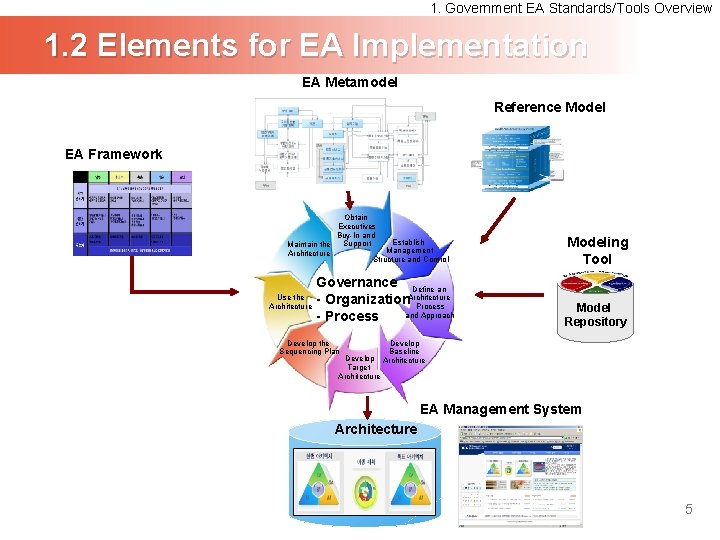
1. Government EA Standards/Tools Overview 1. 2 Elements for EA Implementation EA Metamodel Reference Model EA Framework Obtain Executives Buy-In and Establish Support Maintain the Management Architecture Structure and Control Use the Architecture Governance Define an - Organization. Architecture Process and Approach - Process Develop the Sequencing Plan Develop Target Architecture Modeling Tool Model Repository Develop Baseline Architecture EA Management System Architecture 5
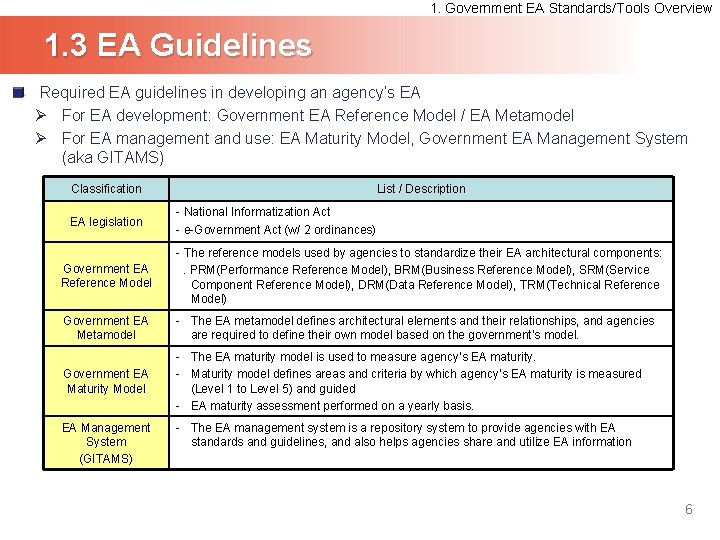
1. Government EA Standards/Tools Overview 1. 3 EA Guidelines Required EA guidelines in developing an agency’s EA Ø For EA development: Government EA Reference Model / EA Metamodel Ø For EA management and use: EA Maturity Model, Government EA Management System (aka GITAMS) Classification EA legislation List / Description - National Informatization Act - e-Government Act (w/ 2 ordinances) Government EA Reference Model - The reference models used by agencies to standardize their EA architectural components: . PRM(Performance Reference Model), BRM(Business Reference Model), SRM(Service Component Reference Model), DRM(Data Reference Model), TRM(Technical Reference Model) Government EA Metamodel - The EA metamodel defines architectural elements and their relationships, and agencies are required to define their own model based on the government’s model. Government EA Maturity Model - The EA maturity model is used to measure agency’s EA maturity. - Maturity model defines areas and criteria by which agency’s EA maturity is measured (Level 1 to Level 5) and guided - EA maturity assessment performed on a yearly basis. EA Management System (GITAMS) - The EA management system is a repository system to provide agencies with EA standards and guidelines, and also helps agencies share and utilize EA information 6
Contents 1. Government EA Standards/Tools Overview 2. Government EA Reference Model 3. Government EA Metamodel 4. Government EA Maturity Model 5. Government EA Management System
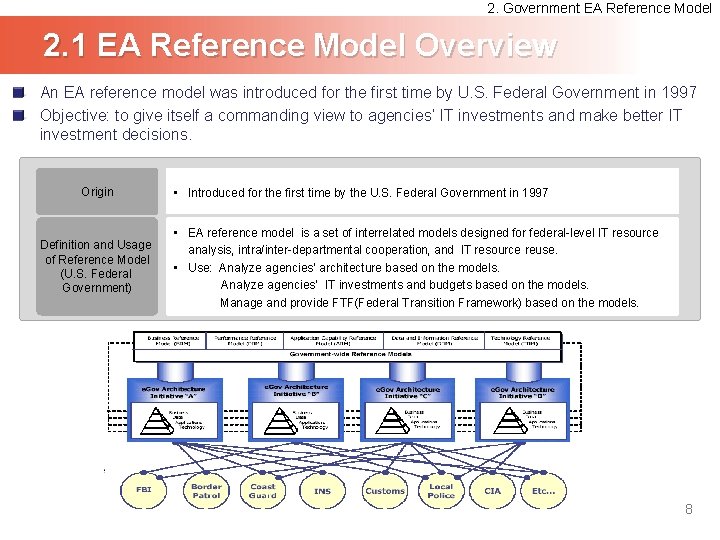
2. Government EA Reference Model 2. 1 EA Reference Model Overview An EA reference model was introduced for the first time by U. S. Federal Government in 1997 Objective: to give itself a commanding view to agencies’ IT investments and make better IT investment decisions. Origin Definition and Usage of Reference Model (U. S. Federal Government) • Introduced for the first time by the U. S. Federal Government in 1997 • EA reference model is a set of interrelated models designed for federal-level IT resource analysis, intra/inter-departmental cooperation, and IT resource reuse. • Use: Analyze agencies’ architecture based on the models. Analyze agencies’ IT investments and budgets based on the models. Manage and provide FTF(Federal Transition Framework) based on the models. 8
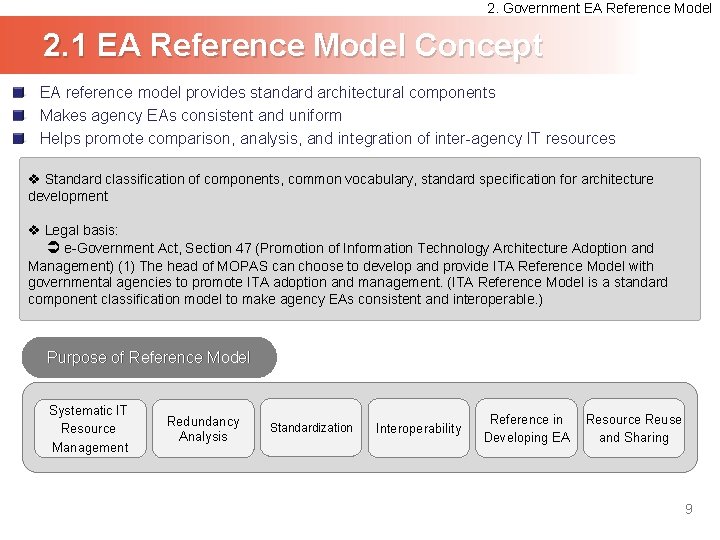
2. Government EA Reference Model 2. 1 EA Reference Model Concept EA reference model provides standard architectural components Makes agency EAs consistent and uniform Helps promote comparison, analysis, and integration of inter-agency IT resources v Standard classification of components, common vocabulary, standard specification for architecture development v Legal basis: e-Government Act, Section 47 (Promotion of Information Technology Architecture Adoption and Management) (1) The head of MOPAS can choose to develop and provide ITA Reference Model with governmental agencies to promote ITA adoption and management. (ITA Reference Model is a standard component classification model to make agency EAs consistent and interoperable. ) Purpose of Reference Model Systematic IT Resource Management Redundancy Analysis Standardization Interoperability Reference in Developing EA Resource Reuse and Sharing 9
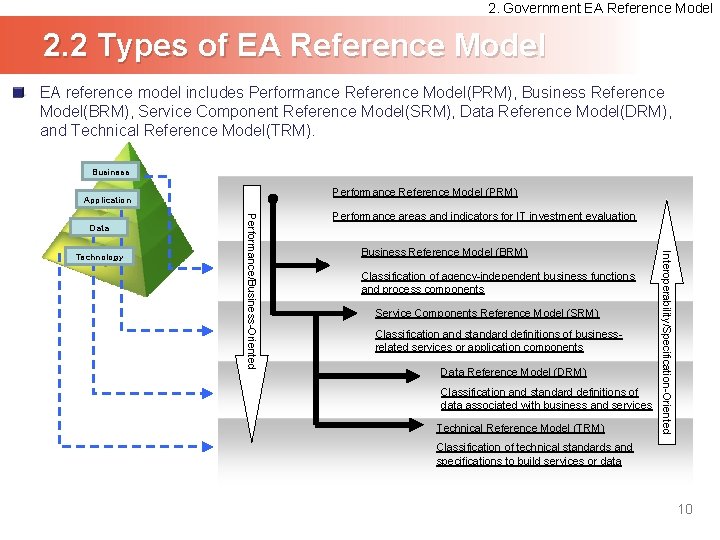
2. Government EA Reference Model 2. 2 Types of EA Reference Model EA reference model includes Performance Reference Model(PRM), Business Reference Model(BRM), Service Component Reference Model(SRM), Data Reference Model(DRM), and Technical Reference Model(TRM). Business Application Classification of agency-independent business functions and process components Service Components Reference Model (SRM) Classification and standard definitions of businessrelated services or application components Data Reference Model (DRM) Classification and standard definitions of data associated with business and services Technical Reference Model (TRM) Interoperability/Specification-Oriented Technology Performance/Business-Oriented Data Performance Reference Model (PRM) 성과참조모형(PRM) Performance areas and indicators for IT investment evaluation 입력물, 산출물 및 결과 물 Business Reference Model (BRM) 특화된 성과 지표 Classification of technical standards and specifications to build services or data 10
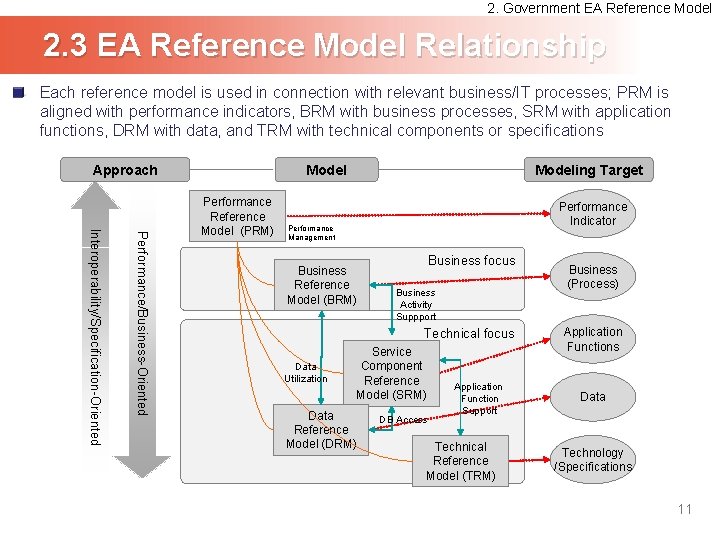
2. Government EA Reference Model 2. 3 EA Reference Model Relationship Each reference model is used in connection with relevant business/IT processes; PRM is aligned with performance indicators, BRM with business processes, SRM with application functions, DRM with data, and TRM with technical components or specifications Approach Model Performance/Business-Oriented Interoperability/Specification-Oriented Performance Reference Model (PRM) Modeling Target Performance Indicator Performance Management Business Reference Model (BRM) Business focus Business Activity Suppport Technical focus Data Utilization Service Component Reference Model (SRM) Data Reference Model (DRM) DB Access Application Function Support Technical Reference Model (TRM) Business (Process) Application Functions Data Technology /Specifications 11
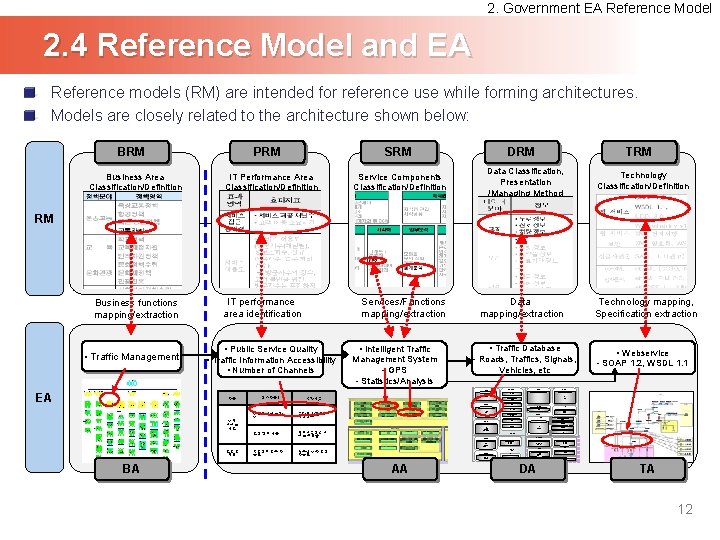
2. Government EA Reference Model 2. 4 Reference Model and EA Reference models (RM) are intended for reference use while forming architectures. Models are closely related to the architecture shown below: BRM Business Area Classification/Definition PRM SRM IT Performance Area Classification/Definition DRM TRM Service Components Classification/Definition Data Classification, Presentation /Managing Method Services/Functions mapping/extraction Data mapping/extraction Technology Classification/Definition RM Business functions mapping/extraction • Traffic Management IT performance area identification • Public Service Quality • Traffic Information Accessibility • Number of Channels • Intelligent Traffic Management System - GPS - Statistics/Analysis • Traffic Database - Roads, Traffics, Signals, Vehicles, etc 전자민원 EA Technology mapping, Specification extraction KMS 통합전파방송 • Webservice - SOAP 1. 2, WSDL 1. 1 인사정책 무선허가 항목 평가항목 l 민원지원 성과지표 인사 급정 전 전파민원 정책관리 전파감시 문서관리 주파수사용료 대민 서비스 제고 대국민 서비스 확 대 온라인 완전처리 민원건수 전문가 정책 공통지식 업무지식 공통기능 주파수관리 ERP 원가계산 통계 정책고객 경영성과 품질인증 고객 편의 제공 뉴스 서베이 홍보메일 정책고객관리 인터넷우체국 서 비스 이용률 세입 세출 물품관리 EIS 통신재난관리 통신재난 법령 개정정보 관련문서/서식 임직원의 직무 만 족도 카드발급 카드활용 복구물자충원 자원현황 PNIO 서비스제공 지원 업무에 대한 직원 만족도 전자업무편람 업무표준 개인업무 해외출장 제안 출장정보 출장평가 AA 감사 감사통계 감사결과 뉴스관리 뉴스 뉴스정보 자료관 제안 외부연계 BA 경영DW 본원적 기능 법령정보 조직 및 인력 ITOK 전자문서 DA 자료관 TA 12
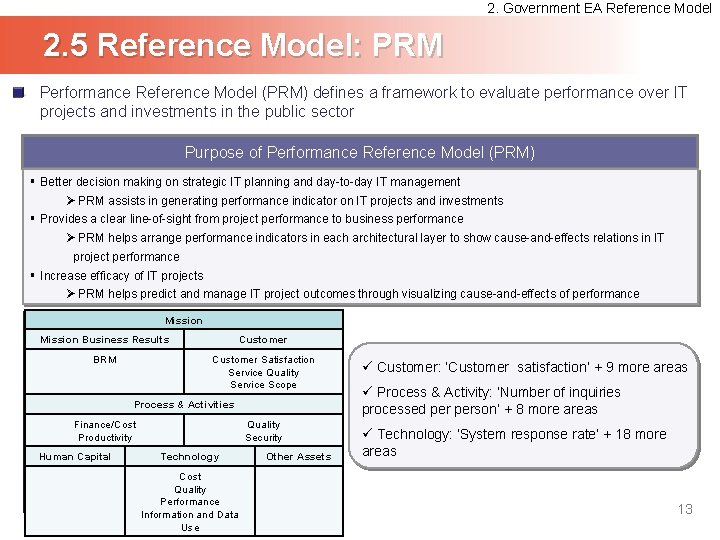
2. Government EA Reference Model 2. 5 Reference Model: PRM Performance Reference Model (PRM) defines a framework to evaluate performance over IT projects and investments in the public sector Purpose of Performance Reference Model (PRM) § Better decision making on strategic IT planning and day-to-day IT management Ø PRM assists in generating performance indicator on IT projects and investments § Provides a clear line-of-sight from project performance to business performance Ø PRM helps arrange performance indicators in each architectural layer to show cause-and-effects relations in IT project performance § Increase efficacy of IT projects Ø PRM helps predict and manage IT project outcomes through visualizing cause-and-effects of performance Mission Business Results Customer BRM Customer Satisfaction Service Quality Service Scope Process & Activities Finance/Cost Productivity Human Capital Quality Security Technology Cost Quality Performance Information and Data Use Other Assets ü Customer: ‘Customer satisfaction’ + 9 more areas ü Process & Activity: ‘Number of inquiries processed person’ + 8 more areas ü Technology: ‘System response rate’ + 18 more areas 13
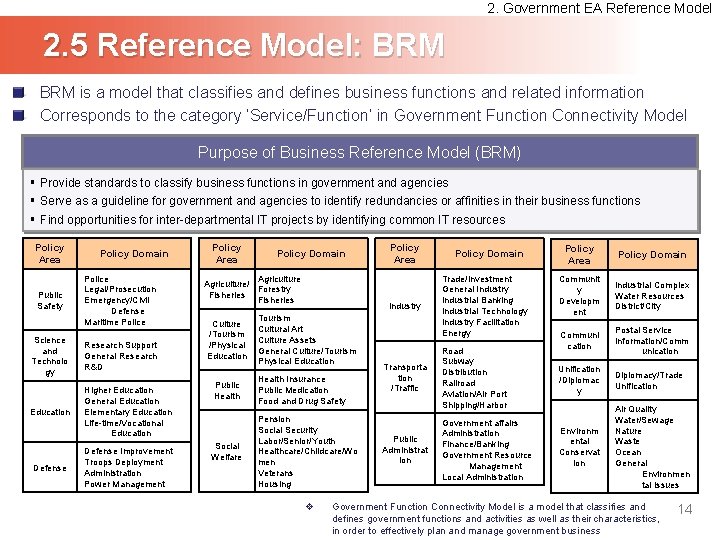
2. Government EA Reference Model 2. 5 Reference Model: BRM is a model that classifies and defines business functions and related information Corresponds to the category ‘Service/Function’ in Government Function Connectivity Model Purpose of Business Reference Model (BRM) § Provide standards to classify business functions in government and agencies § Serve as a guideline for government and agencies to identify redundancies or affinities in their business functions § Find opportunities for inter-departmental IT projects by identifying common IT resources Policy Area Public Safety Science and Technolo gy Education Defense Policy Domain Police Legal/Prosecution Emergency/Civil Defense Maritime Police Research Support General Research R&D Higher Education General Education Elementary Education Life-time/Vocational Education Defense Improvement Troops Deployment Administration Power Management Policy Area Policy Domain Agriculture/ Forestry Fisheries Culture /Tourism /Physical Education Policy Area Policy Domain Communit y Developm ent Industrial Complex Water Resources District/City Postal Service Information/Comm unication Transporta tion /Traffic Road Subway Distribution Railroad Aviation/Air Port Shipping/Harbor Communi cation Unification /Diplomac y Diplomacy/Trade Unification Public Administrat ion Government affairs Administration Finance/Banking Government Resource Management Local Administration Environm ental Conservat ion Air Quality Water/Sewage Nature Waste Ocean General Environmen tal Issues Industry Tourism Cultural Art Culture Assets General Culture/Tourism Physical Education Public Health Insurance Public Medication Food and Drug Safety Social Welfare Pension Social Security Labor/Senior/Youth Healthcare/Childcare/Wo men Veterans Housing v Policy Domain Trade/Investment General Industry Industrial Banking Industrial Technology Industry Facilitation Energy Government Function Connectivity Model is a model that classifies and defines government functions and activities as well as their characteristics, in order to effectively plan and manage government business 14
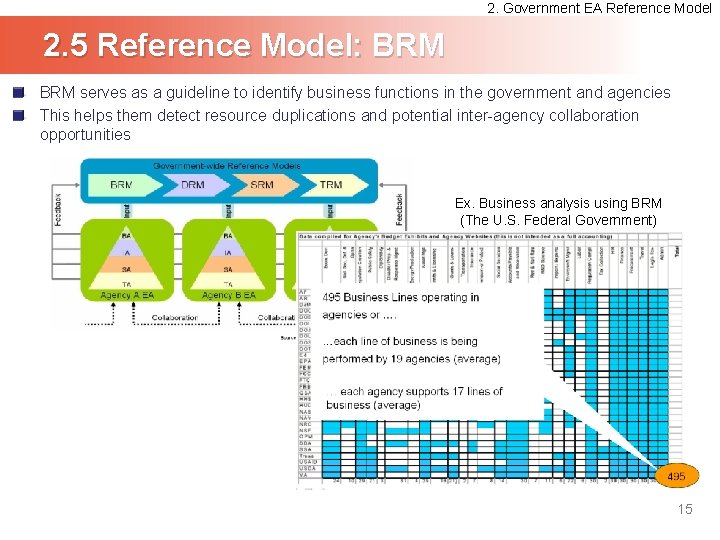
2. Government EA Reference Model 2. 5 Reference Model: BRM serves as a guideline to identify business functions in the government and agencies This helps them detect resource duplications and potential inter-agency collaboration opportunities Ex. Business analysis using BRM (The U. S. Federal Government) 15
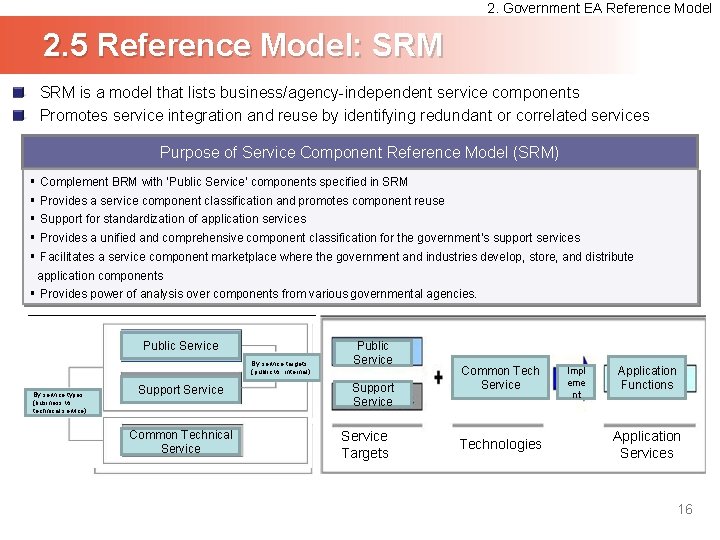
2. Government EA Reference Model 2. 5 Reference Model: SRM is a model that lists business/agency-independent service components Promotes service integration and reuse by identifying redundant or correlated services Purpose of Service Component Reference Model (SRM) § Complement BRM with ‘Public Service’ components specified in SRM § Provides a service component classification and promotes component reuse § Support for standardization of application services § Provides a unified and comprehensive component classification for the government’s support services § Facilitates a service component marketplace where the government and industries develop, store, and distribute application components § Provides power of analysis over components from various governmental agencies. Public Service By service targets (public vs. internal) By service types (business vs. technical service) Support Service Common Technical Service Public Service Support Service Targets Common Tech Service Technologies Impl eme nt Application Functions Application Services 16
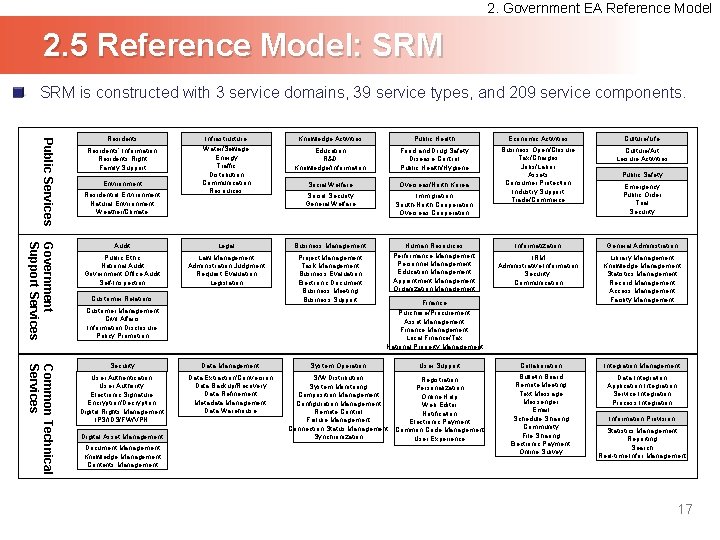
2. Government EA Reference Model 2. 5 Reference Model: SRM is constructed with 3 service domains, 39 service types, and 209 service components. Public Services Residents’ Information Residents Right Family Support Environment Residential Environment Natural Environment Weather/Climate Infrastructure Water/Sewage Energy Traffic Distribution Communication Resources Government Support Services Knowledge Activities Public Health Education R&D Knowledge/Information Food and Drug Safety Disease Control Public Health/Hygiene Social Welfare Overseas/North Korea Social Security General Welfare Immigration South-North Cooperation Overseas Cooperation Human Resources Performance Management Personnel Management Education Management Appointment Management Organization Management Audit Legal Business Management Public Ethic National Audit Government Office Audit Self-Inspection Law Management Administration Judgment Request Evaluation Legislation ) Project Management Task Management Business Evaluation Electronic Document Business Meeting Business Support Customer Relations Customer Management Civil Affairs Information Disclosure Policy Promotion Common Technical Services Security Data Management User Authentication User Authority Electronic Signature Encryption/Decryption Digital Rights Management IPS/IDS/FW/VPN Data Extraction/Conversion Data Backup/Recovery Data Refinement Metadata Management Data Warehouse Digital Asset Management Document Management Knowledge Management Contents Management System Operation Economic Activities Business Open/Closure Tax/Charges Jobs/Labor Assets Consumer Protection Industry Support Trade/Commerce S/W Distribution Registration System Monitoring Personalization Composition Management Online Help Configuration Management Web Editor Remote Control Notification Failure Management Electronic Payment Connection Status Management Common Code Management Synchronization User Experience Culture/Art Leisure Activities Public Safety Emergency Public Order Trial Security Informatization General Administration IRM Administrative Information Security Communication Library Management Knowledge Management Statistics Management Record Management Access Management Facility Management Finance Purchase/Procurement Asset Management Finance Management Local Finance/Tax National Property Management User Support Culture/Life Collaboration Integration Management Bulletin Board Remote Meeting Text Message Messenger Email Schedule Sharing Community File Sharing Electronic Payment Online Survey Data Integration Application Integration Service Integration Process Integration Information Provision Statistics Management Reporting Search Real-time Infor Management 17
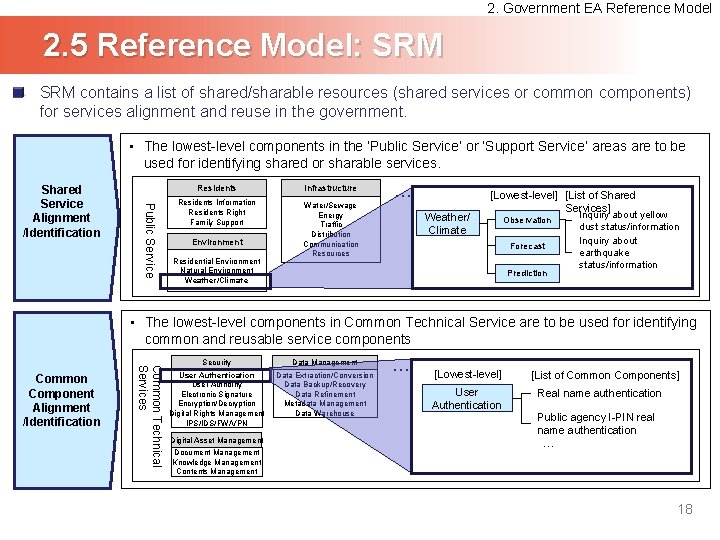
2. Government EA Reference Model 2. 5 Reference Model: SRM contains a list of shared/sharable resources (shared services or common components) for services alignment and reuse in the government. • The lowest-level components in the ‘Public Service’ or ‘Support Service’ areas are to be used for identifying shared or sharable services. Public Service Shared Service Alignment /Identification Residents Infrastructure Residents Information Residents Right Family Support Water/Sewage Energy Traffic Distribution Communication Resources Environment Residential Environment Natural Environment Weather/Climate … Weather/ Climate [Lowest-level] [List of Shared Services] Inquiry about yellow Observation Forecast Prediction dust status/information Inquiry about earthquake status/information • The lowest-level components in Common Technical Service are to be used for identifying common and reusable service components Common Technical Services Common Component Alignment /Identification Security Data Management User Authentication User Authority Electronic Signature Encryption/Decryption Digital Rights Management IPS/IDS/FW/VPN Data Extraction/Conversion Data Backup/Recovery Data Refinement Metadata Management Data Warehouse Digital Asset Management Document Management Knowledge Management Contents Management … [Lowest-level] User Authentication [List of Common Components] Real name authentication Public agency I-PIN real name authentication … 18
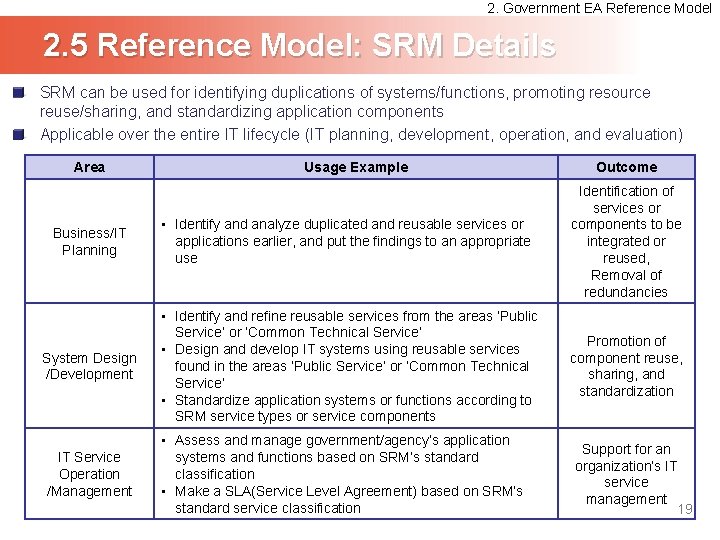
2. Government EA Reference Model 2. 5 Reference Model: SRM Details SRM can be used for identifying duplications of systems/functions, promoting resource reuse/sharing, and standardizing application components Applicable over the entire IT lifecycle (IT planning, development, operation, and evaluation) Area Usage Example Outcome Business/IT Planning • Identify and analyze duplicated and reusable services or applications earlier, and put the findings to an appropriate use Identification of services or components to be integrated or reused, Removal of redundancies System Design /Development • Identify and refine reusable services from the areas ‘Public Service’ or ‘Common Technical Service’ • Design and develop IT systems using reusable services found in the areas ‘Public Service’ or ‘Common Technical Service’ • Standardize application systems or functions according to SRM service types or service components Promotion of component reuse, sharing, and standardization IT Service Operation /Management • Assess and manage government/agency’s application systems and functions based on SRM’s standard classification • Make a SLA(Service Level Agreement) based on SRM’s standard service classification Support for an organization’s IT service management 19
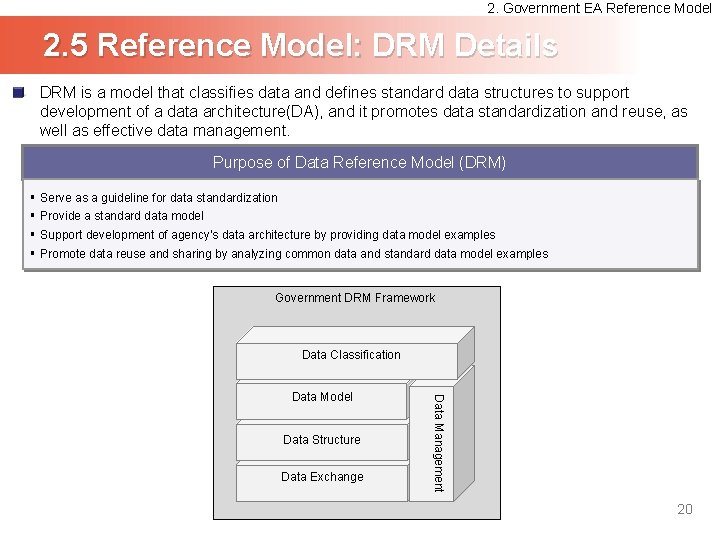
2. Government EA Reference Model 2. 5 Reference Model: DRM Details DRM is a model that classifies data and defines standard data structures to support development of a data architecture(DA), and it promotes data standardization and reuse, as well as effective data management. Purpose of Data Reference Model (DRM) § Serve as a guideline for data standardization § Provide a standard data model § Support development of agency’s data architecture by providing data model examples § Promote data reuse and sharing by analyzing common data and standard data model examples Government DRM Framework Data Classification Data Structure Data Exchange Data Management Data Model 20
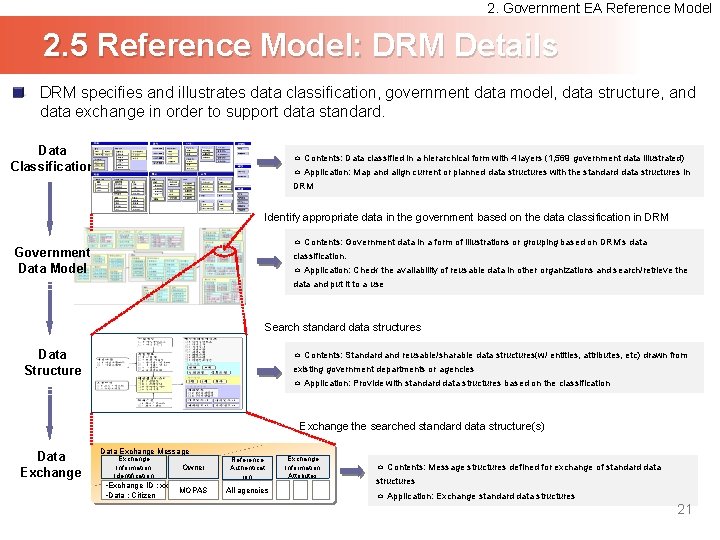
2. Government EA Reference Model 2. 5 Reference Model: DRM Details DRM specifies and illustrates data classification, government data model, data structure, and data exchange in order to support data standard. Data Classification ㅇ Contents: Data classified in a hierarchical form with 4 layers (1, 569 government data illustrated) ㅇ Application: Map and align current or planned data structures with the standard data structures in DRM Identify appropriate data in the government based on the data classification in DRM ㅇ Contents: Government data in a form of illustrations or grouping based on DRM’s data Government Data Model classification. ㅇ Application: Check the availability of reusable data in other organizations and search/retrieve the data and put it to a use Search standard data structures Data Structure ㅇ Contents: Standard and reusable/sharable data structures(w/ entities, attributes, etc) drawn from existing government departments or agencies ㅇ Application: Provide with standard data structures based on the classification Exchange the searched standard data structure(s) Data Exchange Message Exchange Information Identification Owner • Exchange ID : xxxxx MOPAS • Data : Citizen Reference Authenticat ion All agencies Exchange Information Attributes ㅇ Contents: Message structures defined for exchange of standard data structures ㅇ Application: Exchange standard data structures 21
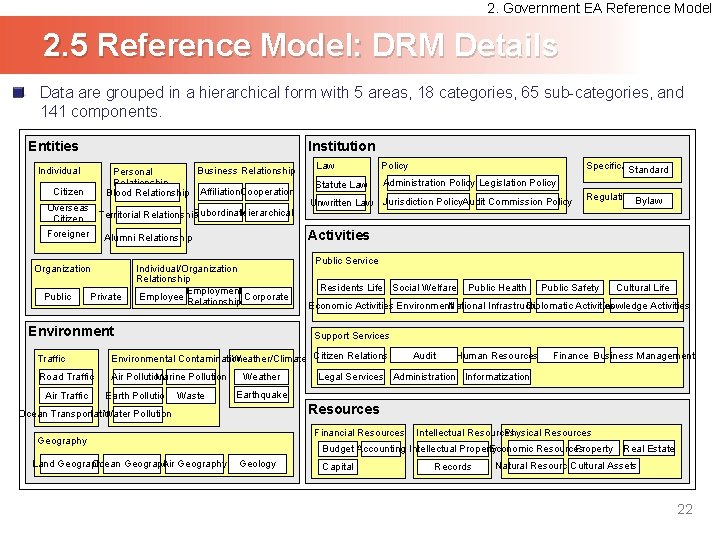
2. Government EA Reference Model 2. 5 Reference Model: DRM Details Data are grouped in a hierarchical form with 5 areas, 18 categories, 65 sub-categories, and 141 components. Institution Entities Individual Business Relationship Personal Relationship Blood Relationship Affiliation. Cooperation Citizen Overseas Hierarchical Territorial Relationship. Subordinate Citizen Foreigner Public Private Policy Statute Law Administration Policy Legislation Policy Unwritten Law Individual/Organization Relationship Employment Employee Corporate Relationship Environment Jurisdiction Policy. Audit Commission Policy Residents Life Social Welfare Public Safety Cultural Life Support Services Road Traffic Air Pollution Marine Pollution Weather Audit Human Resources Finance Business Management Legal Services Administration Informatization Earthquake Resources Ocean Transportation Water Pollution Financial Resources Geography Land Geography Ocean Geography Air Geography Public Health Diplomatic Activities Knowledge Activities Economic Activities Environment. National Infrastructure Environmental Contamination Weather/Climate Citizen Relations Earth Pollution Waste Regulation Bylaw Public Service Traffic Air Traffic Specification Standard Activities Alumni Relationship Organization Law Intellectual Resources Physical Resources Economic Resources Property Budget Accounting Intellectual Property Geology Capital Records Real Estate Natural Resources Cultural Assets 22
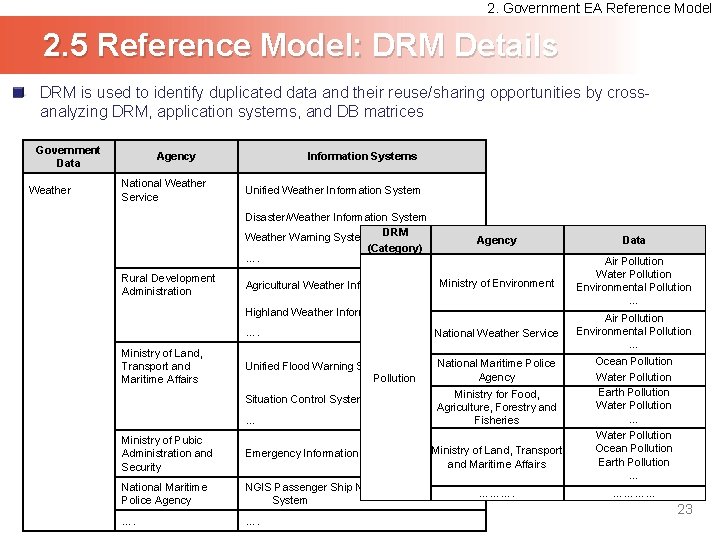
2. Government EA Reference Model 2. 5 Reference Model: DRM Details DRM is used to identify duplicated data and their reuse/sharing opportunities by crossanalyzing DRM, application systems, and DB matrices Government Data Weather Agency National Weather Service Information Systems Unified Weather Information System Disaster/Weather Information System DRM Weather Warning System (Category) …. Rural Development Administration Agency Agricultural Weather Information System. Ministry of Environment Highland Weather Information System Ministry of Land, Transport and Maritime Affairs …. National Weather Service Unified Flood Warning System Pollution National Maritime Police Agency Situation Control System … Ministry for Food, Agriculture, Forestry and Fisheries Ministry of Pubic Administration and Security Emergency Information System National Maritime Police Agency NGIS Passenger Ship Navigation Management ………. System …. Ministry of Land, Transport and Maritime Affairs Data Air Pollution Water Pollution Environmental Pollution … Air Pollution Environmental Pollution … Ocean Pollution Water Pollution Earth Pollution Water Pollution … Water Pollution Ocean Pollution Earth Pollution … ………… 23
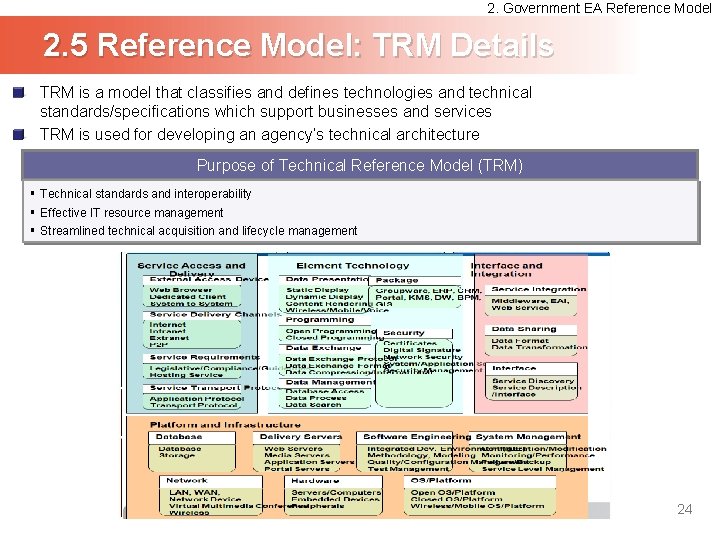
2. Government EA Reference Model 2. 5 Reference Model: TRM Details TRM is a model that classifies and defines technologies and technical standards/specifications which support businesses and services TRM is used for developing an agency’s technical architecture Purpose of Technical Reference Model (TRM) § Technical standards and interoperability § Effective IT resource management § Streamlined technical acquisition and lifecycle management 24
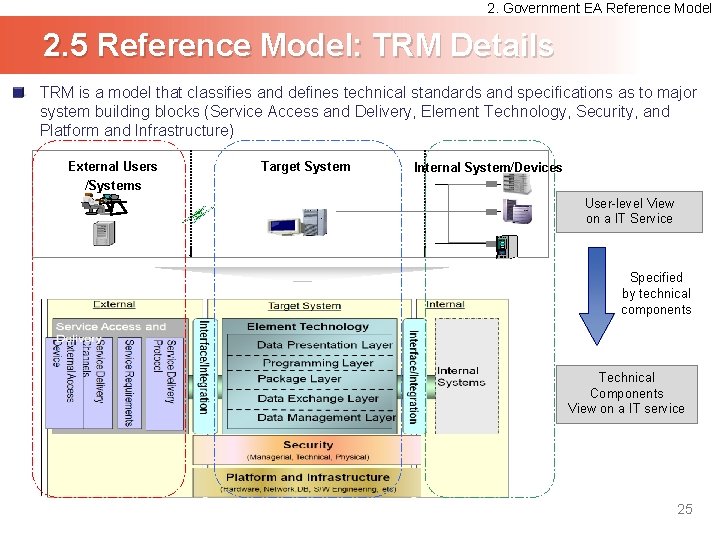
2. Government EA Reference Model 2. 5 Reference Model: TRM Details TRM is a model that classifies and defines technical standards and specifications as to major system building blocks (Service Access and Delivery, Element Technology, Security, and Platform and Infrastructure) External Users /Systems Target System Internal System/Devices User-level View on a IT Service Specified by technical components Technical Components View on a IT service 25
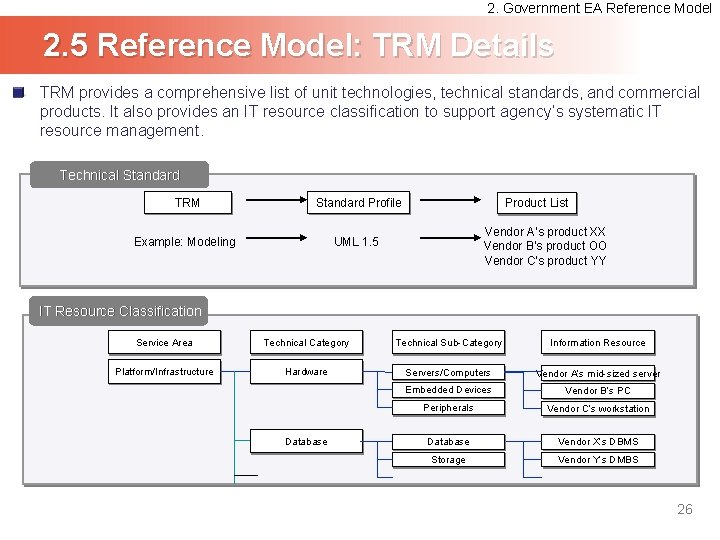
2. Government EA Reference Model 2. 5 Reference Model: TRM Details TRM provides a comprehensive list of unit technologies, technical standards, and commercial products. It also provides an IT resource classification to support agency’s systematic IT resource management. Technical Standard TRM Standard Profile Example: Modeling UML 1. 5 Product List Vendor A’s product XX Vendor B’s product OO Vendor C’s product YY IT Resource Classification Service Area Technical Category Technical Sub-Category Information Resource Platform/Infrastructure Hardware Servers/Computers Vendor A’s mid-sized server Embedded Devices Vendor B’s PC Peripherals Vendor C’s workstation Database Vendor X’s DBMS Storage Vendor Y’s DMBS Database 26
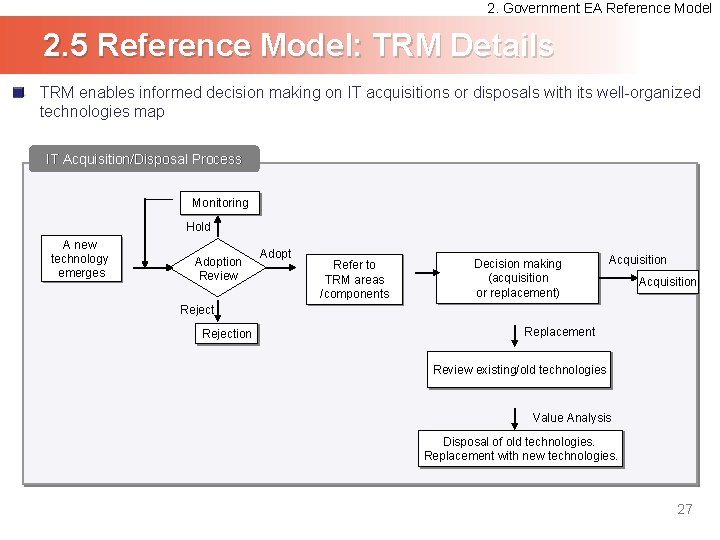
2. Government EA Reference Model 2. 5 Reference Model: TRM Details TRM enables informed decision making on IT acquisitions or disposals with its well-organized technologies map IT Acquisition/Disposal Process Monitoring Hold A new technology emerges Adoption Review Adopt Refer to TRM areas /components Decision making (acquisition or replacement) Acquisition Rejection Replacement Review existing/old technologies Value Analysis Disposal of old technologies. Replacement with new technologies. 27
Contents 1. Government EA Standards/Tools Overview 2. Government EA Reference Models 3. Government EA Metamodel 4. Government EA Maturity Model 5. Government EA Management System
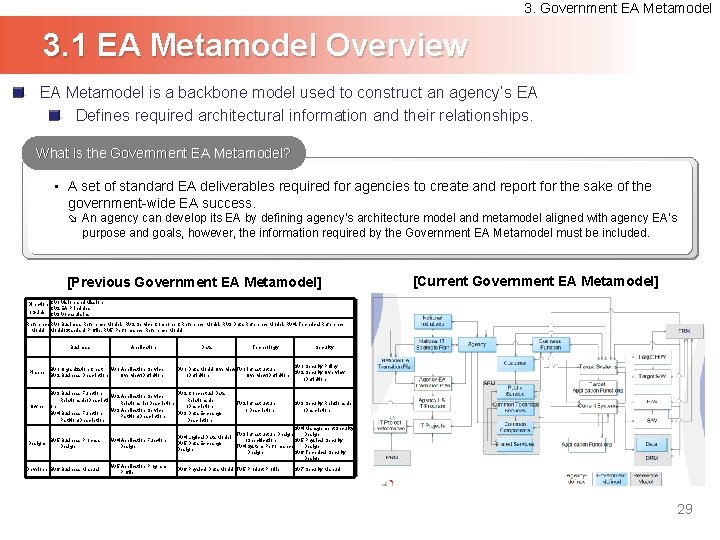
3. Government EA Metamodel 3. 1 EA Metamodel Overview EA Metamodel is a backbone model used to construct an agency’s EA Defines required architectural information and their relationships. What is the Government EA Metamodel? • A set of standard EA deliverables required for agencies to create and report for the sake of the government-wide EA success. ø An agency can develop its EA by defining agency’s architecture model and metamodel aligned with agency EA’s purpose and goals, however, the information required by the Government EA Metamodel must be included. [Previous Government EA Metamodel] [Current Government EA Metamodel] Direction CV 1 Vision and Mission CV 2 EA Principles /Guide CV 3 Vocabularies Reference RV 1 Business Reference Model, RV 2 Service Component Reference Model, RV 3 Data Reference Model, RV 4, Technical Reference Model/Standard Profile, RV 5 Performance Reference Model Business Planner Application BV 1 Organization Chart AV 1 Application Service BV 2 Business Description Overview/Definition Data Technology DV 1 Data Model Overview TV 1 Infrastructure /Definition Overview/Definition BV 3 Business Function DV 2 Conceptual Data AV 2 Application Service Relationship/Description Owner on /Description AV 3 Application Service BV 4 Business Function DV 3 Data Exchange Partition/Description TV 2 Infrastructure / Description Security SV 1 Security Policy SV 2 Security Overview /Definition SV 3 Security Relationship /Description SV 4 Management Security TV 3 Infrastructure Design /Specification SV 5 Physical Security TV 4 System Performance Design SV 6 Technical Security Design BV 5 Business Process Designer Design AV 4 Application Function Design DV 4 Logical Data Model DV 5 Data Exchange Design Developer BV 6 Business Manual AV 5 Application Program Profile DV 6 Physical Data Model TV 5 Product Profile SV 7 Security Manual 29
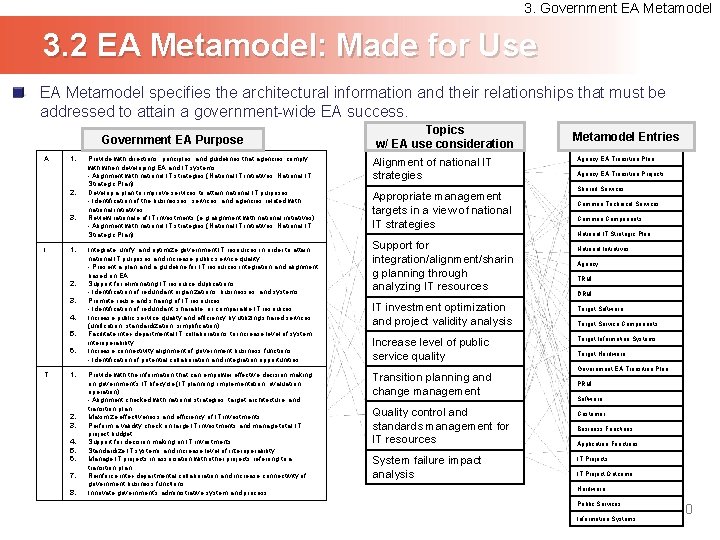
3. Government EA Metamodel 3. 2 EA Metamodel: Made for Use EA Metamodel specifies the architectural information and their relationships that must be addressed to attain a government-wide EA success. Government EA Purpose A 1. 2. 3. I 1. 2. 3. 4. 5. 6. T 1. 2. 3. 4. 5. 6. 7. 8. Provide with directions, principles, and guidelines that agencies comply with when developing EA and IT systems - Alignment with national IT strategies (National IT initiatives, National IT Strategic Plan) Develop a plan to improve services to attain national IT purposes - Identification of the businesses, services, and agencies related with national initiatives Review rationale of IT investments (e. g alignment with national initiatives) - Alignment with national IT strategies (National IT initiatives, National IT Strategic Plan) Integrate, unify, and optimize government IT resources in order to attain national IT purposes and increase public service quality - Present a plan and a guideline for IT resources integration and alignment based on EA Support for eliminating IT resource duplications. - Identification of redundant organizations, businesses, and systems Promote reuse and sharing of IT resources - Identification of redundant, sharable, or comparable IT resources Increase public service quality and efficiency by utilizing shared services (unification, standardization, simplification) Facilitate inter-departmental IT collaborations to increase level of system interoperability Increase connectivity alignment of government business functions - Identification of potential collaboration and integration opportunities Provide with the information that can empower effective decision making on government’s IT lifecycle (IT planning, implementation, evaluation, operation) - Alignment checked with national strategies, target architecture, and transition plan. Maximize effectiveness and efficiency of IT investments Perform a validity check on large IT investments and manage total IT project budget. Support for decision making on IT investments Standardize IT systems and increase level of interoperability Manage IT projects in association with other projects referring to a transition plan Reinforce inter-departmental collaboration and increase connectivity of government business functions Innovate government’s administrative system and process Topics w/ EA use consideration Alignment of national IT strategies Appropriate management targets in a view of national IT strategies Support for integration/alignment/sharin g planning through analyzing IT resources IT investment optimization and project validity analysis Increase level of public service quality Transition planning and change management Quality control and standards management for IT resources System failure impact analysis Metamodel Entries Agency EA Transition Plan Agency EA Transition Projects Shared Services Common Technical Services Common Components National IT Strategic Plan National Initiatives Agency TRM DRM Target Software Target Service Components Target Information Systems Target Hardware Government EA Transition Plan PRM Software Customer Business Functions Application Functions IT Project Outcome Hardware Public Services Information Systems 30
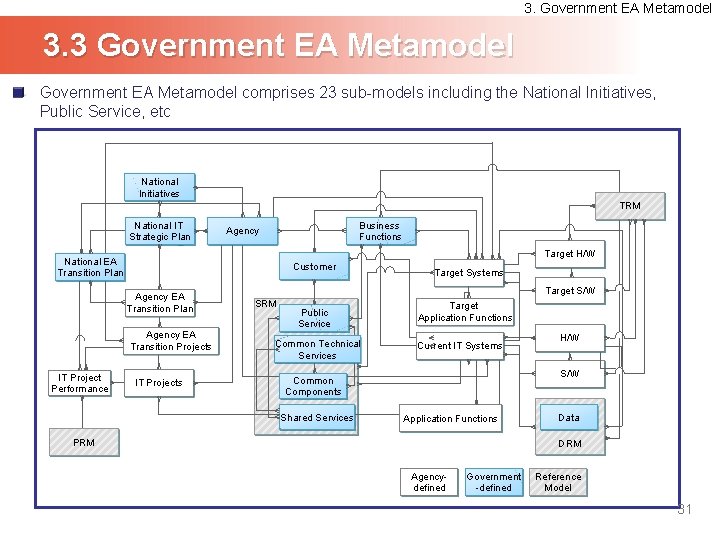
3. Government EA Metamodel 3. 3 Government EA Metamodel comprises 23 sub-models including the National Initiatives, Public Service, etc National Initiatives TRM National IT Strategic Plan Business Functions Agency Target H/W National EA Transition Plan Customer Agency EA Transition Plan Agency EA Transition Projects IT Project Performance IT Projects Target Systems Target S/W SRM Public Service Common Technical Services Target Application Functions Current IT Systems S/W Common Components Shared Services H/W Application Functions PRM Data DRM Agencydefined Government -defined Reference Model 31
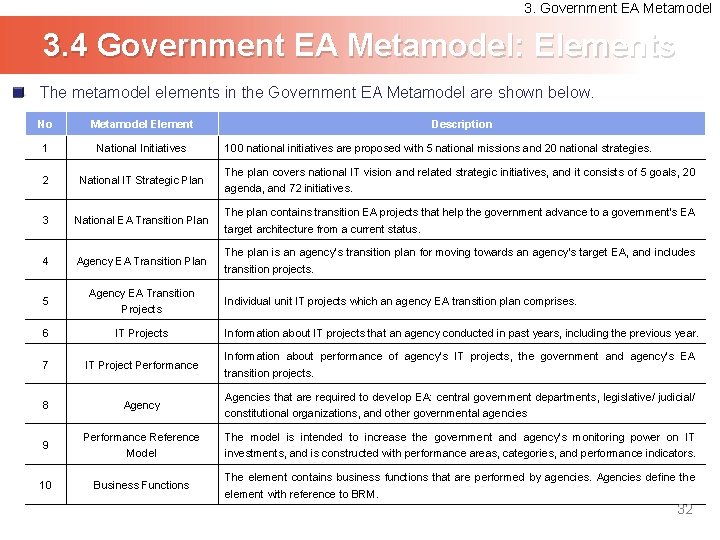
3. Government EA Metamodel 3. 4 Government EA Metamodel: Elements The metamodel elements in the Government EA Metamodel are shown below. No Metamodel Element 1 National Initiatives 2 National IT Strategic Plan 3 National EA Transition Plan 4 Agency EA Transition Plan 5 Agency EA Transition Projects 6 IT Projects 7 IT Project Performance 8 Agency 9 10 Description 100 national initiatives are proposed with 5 national missions and 20 national strategies. The plan covers national IT vision and related strategic initiatives, and it consists of 5 goals, 20 agenda, and 72 initiatives. The plan contains transition EA projects that help the government advance to a government’s EA target architecture from a current status. The plan is an agency’s transition plan for moving towards an agency’s target EA, and includes transition projects. Individual unit IT projects which an agency EA transition plan comprises. Information about IT projects that an agency conducted in past years, including the previous year. Information about performance of agency’s IT projects, the government and agency’s EA transition projects. Agencies that are required to develop EA: central government departments, legislative/ judicial/ constitutional organizations, and other governmental agencies Performance Reference The model is intended to increase the government and agency’s monitoring power on IT Model investments, and is constructed with performance areas, categories, and performance indicators. Business Functions The element contains business functions that are performed by agencies. Agencies define the element with reference to BRM. 32
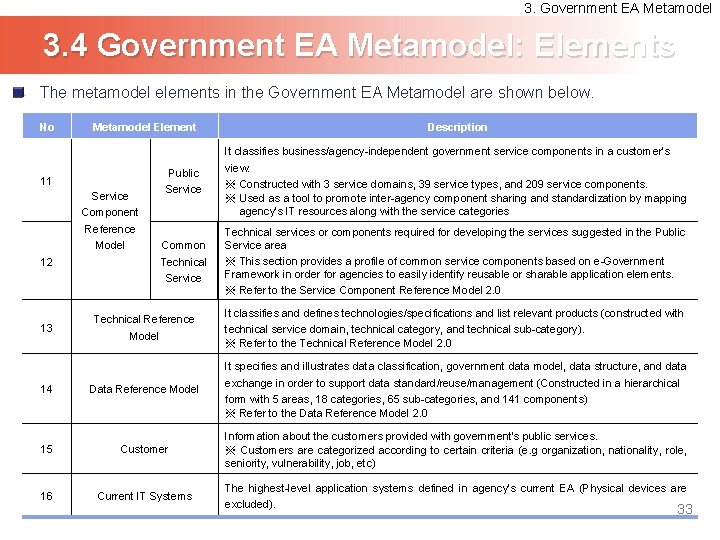
3. Government EA Metamodel 3. 4 Government EA Metamodel: Elements The metamodel elements in the Government EA Metamodel are shown below. No Metamodel Element Description It classifies business/agency-independent government service components in a customer’s 11 Service Component Reference Model 12 13 Public Service Common Technical Service Technical Reference Model view. ※ Constructed with 3 service domains, 39 service types, and 209 service components. ※ Used as a tool to promote inter-agency component sharing and standardization by mapping agency’s IT resources along with the service categories Technical services or components required for developing the services suggested in the Public Service area ※ This section provides a profile of common service components based on e-Government Framework in order for agencies to easily identify reusable or sharable application elements. ※ Refer to the Service Component Reference Model 2. 0 It classifies and defines technologies/specifications and list relevant products (constructed with technical service domain, technical category, and technical sub-category). ※ Refer to the Technical Reference Model 2. 0 It specifies and illustrates data classification, government data model, data structure, and data 14 Data Reference Model 15 Customer 16 Current IT Systems exchange in order to support data standard/reuse/management (Constructed in a hierarchical form with 5 areas, 18 categories, 65 sub-categories, and 141 components) ※ Refer to the Data Reference Model 2. 0 Information about the customers provided with government’s public services. ※ Customers are categorized according to certain criteria (e. g organization, nationality, role, seniority, vulnerability, job, etc) The highest-level application systems defined in agency’s current EA (Physical devices are excluded). 33
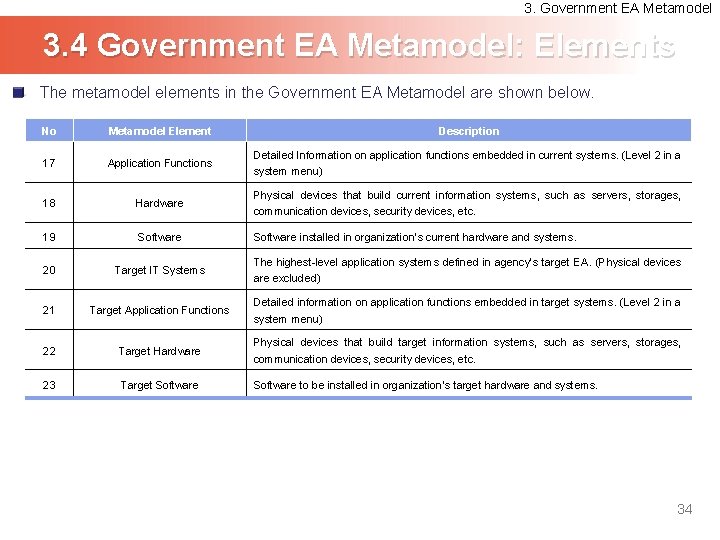
3. Government EA Metamodel 3. 4 Government EA Metamodel: Elements The metamodel elements in the Government EA Metamodel are shown below. No Metamodel Element 17 Application Functions 18 Hardware 19 Software 20 Target IT Systems 21 Target Application Functions 22 Target Hardware 23 Target Software Description Detailed Information on application functions embedded in current systems. (Level 2 in a system menu) Physical devices that build current information systems, such as servers, storages, communication devices, security devices, etc. Software installed in organization’s current hardware and systems. The highest-level application systems defined in agency’s target EA. (Physical devices are excluded) Detailed information on application functions embedded in target systems. (Level 2 in a system menu) Physical devices that build target information systems, such as servers, storages, communication devices, security devices, etc. Software to be installed in organization’s target hardware and systems. 34
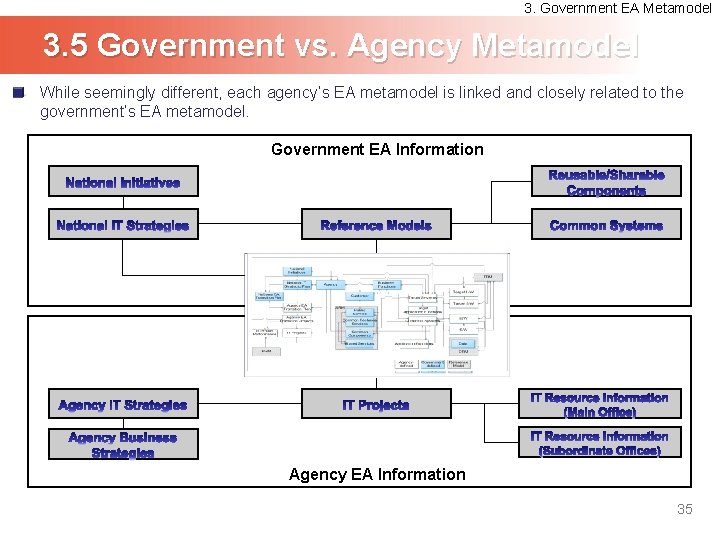
3. Government EA Metamodel 3. 5 Government vs. Agency Metamodel While seemingly different, each agency’s EA metamodel is linked and closely related to the government’s EA metamodel. Government EA Information Agency EA Information 35
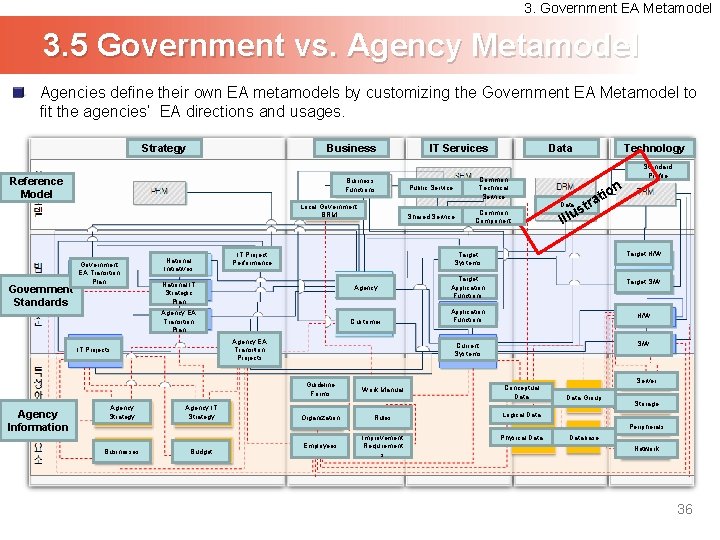
3. Government EA Metamodel 3. 5 Government vs. Agency Metamodel Agencies define their own EA metamodels by customizing the Government EA Metamodel to fit the agencies’ EA directions and usages. Strategy Business Reference Model Business Functions Local Government BRM Government Standards Government EA Transition Plan National Initiatives Agency EA Transition Plan Customer Agency EA Transition Projects IT Projects Agency Information Agency IT Strategy Public Service Common Component Work Manual Technology Standard Profile ion t a str l. I lu Data Target Systems Target H/W Target Application Functions Target S/W Application Functions H/W S/W Current Systems Guideline Forms Agency Strategy Data Common Technical Service Shared Service IT Project Performance National IT Strategic Plan IT Services Conceptual Data Organization Rules Logical Data Physical Data Employees Improvement Requirement s Server Data Group Storage Peripherals Businesses Budget Database Network 36
Contents 1. Government EA Standards/Tools Overview 2. Government EA Reference Models 3. Government EA Metamodel 4. Government EA Maturity Model 5. Government EA Management System
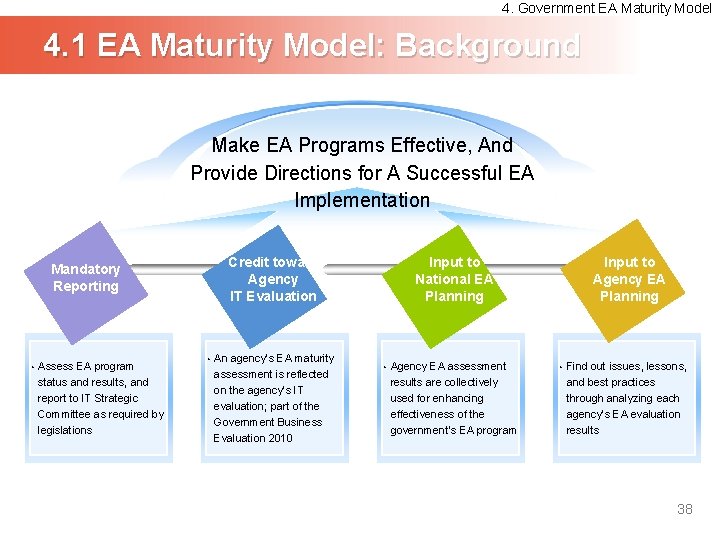
4. Government EA Maturity Model 4. 1 EA Maturity Model: Background Make EA Programs Effective, And Provide Directions for A Successful EA Implementation Mandatory Reporting • Assess EA program status and results, and report to IT Strategic Committee as required by legislations Credit toward Agency IT Evaluation • An agency’s EA maturity assessment is reflected on the agency’s IT evaluation; part of the Government Business Evaluation 2010 Input to National EA Planning • Agency EA assessment results are collectively used for enhancing effectiveness of the government’s EA program Input to Agency EA Planning • Find out issues, lessons, and best practices through analyzing each agency’s EA evaluation results 38
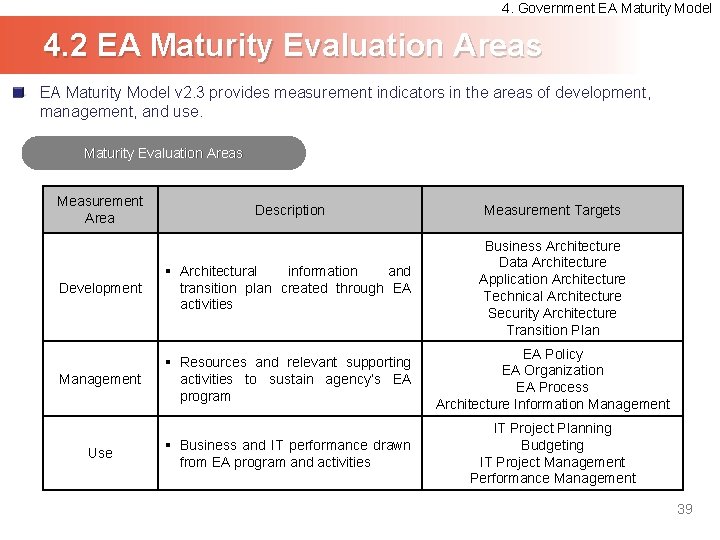
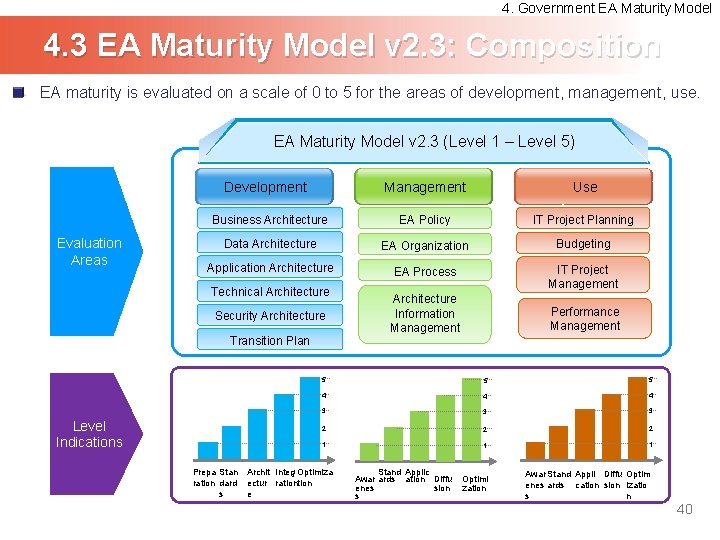
4. Government EA Maturity Model 4. 2 EA Maturity Evaluation Areas EA Maturity Model v 2. 3 provides measurement indicators in the areas of development, management, and use. Maturity Evaluation Areas Measurement Area Description Measurement Targets Development § Architectural information and transition plan created through EA activities Business Architecture Data Architecture Application Architecture Technical Architecture Security Architecture Transition Plan Management § Resources and relevant supporting activities to sustain agency’s EA program EA Policy EA Organization EA Process Architecture Information Management § Business and IT performance drawn from EA program and activities IT Project Planning Budgeting IT Project Management Performance Management Use 39
4. Government EA Maturity Model 4. 3 EA Maturity Model v 2. 3: Composition EA maturity is evaluated on a scale of 0 to 5 for the areas of development, management, use. EA Maturity Model v 2. 3 (Level 1 – Level 5) Development Evaluation Areas Management Use Business Architecture EA Policy IT Project Planning Data Architecture EA Organization Budgeting Application Architecture EA Process IT Project Management Architecture Information Management Performance Management Technical Architecture Security Architecture Transition Plan Level Indications 5 5 5 4 4 4 3 3 3 2 2 2 1 1 1 Prepa Stan Archit Integ Optimiza ration dard ectur ration s e Stand Applic Awar ards ation Diffu enes sion s Optimi zation Awar Stand Appli Diffu Optim enes ards cation sion izatio s n 40
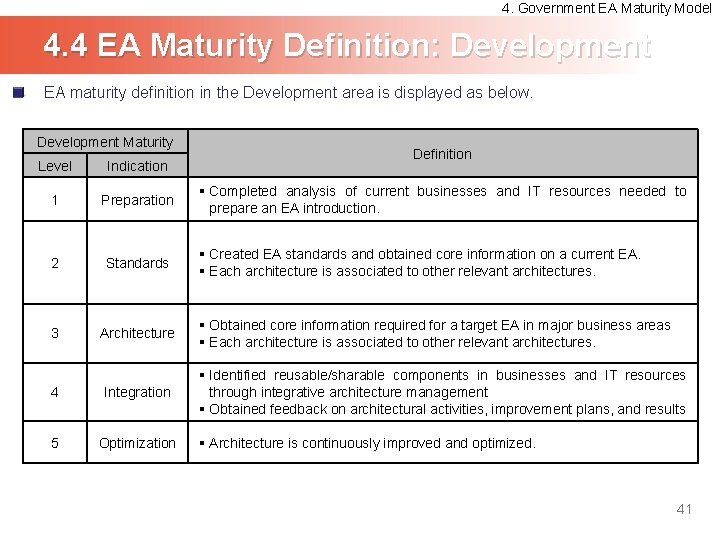
4. Government EA Maturity Model 4. 4 EA Maturity Definition: Development EA maturity definition in the Development area is displayed as below. Development Maturity Level Indication 1 Preparation 2 Standards 3 Architecture 4 Integration 5 Optimization Definition § Completed analysis of current businesses and IT resources needed to prepare an EA introduction. § Created EA standards and obtained core information on a current EA. § Each architecture is associated to other relevant architectures. § Obtained core information required for a target EA in major business areas § Each architecture is associated to other relevant architectures. § Identified reusable/sharable components in businesses and IT resources through integrative architecture management § Obtained feedback on architectural activities, improvement plans, and results § Architecture is continuously improved and optimized. 41
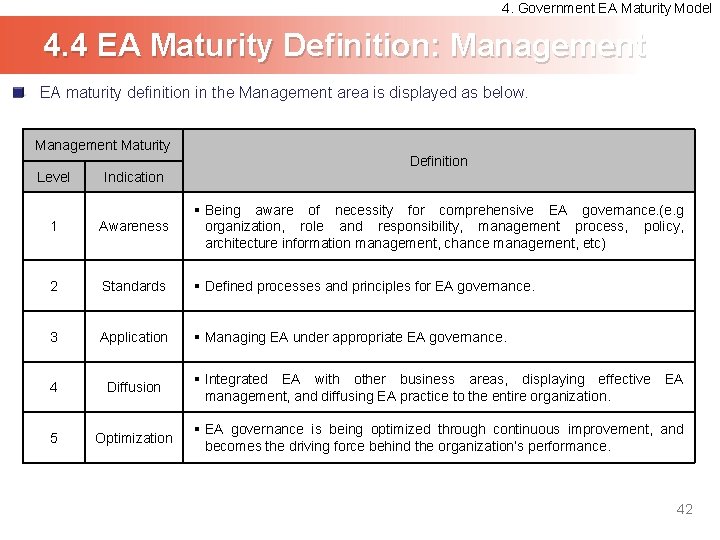
4. Government EA Maturity Model 4. 4 EA Maturity Definition: Management EA maturity definition in the Management area is displayed as below. Management Maturity Definition Level Indication 1 Awareness § Being aware of necessity for comprehensive EA governance. (e. g organization, role and responsibility, management process, policy, architecture information management, chance management, etc) 2 Standards § Defined processes and principles for EA governance. 3 Application § Managing EA under appropriate EA governance. 4 Diffusion § Integrated EA with other business areas, displaying effective EA management, and diffusing EA practice to the entire organization. 5 Optimization § EA governance is being optimized through continuous improvement, and becomes the driving force behind the organization’s performance. 42
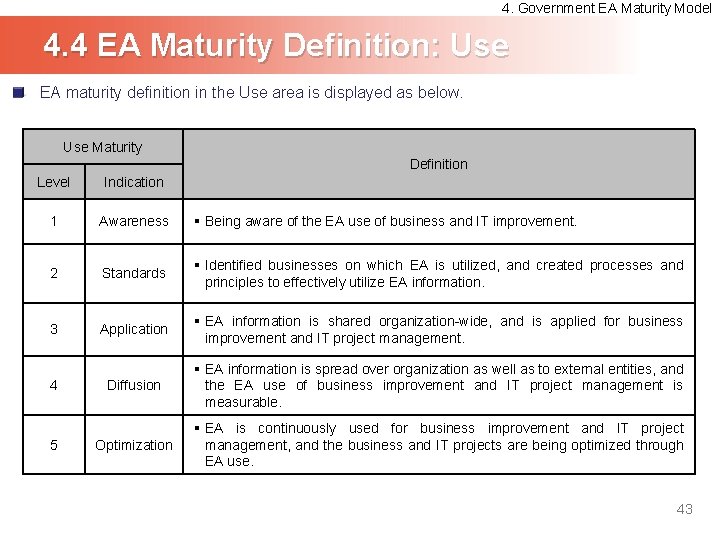
4. Government EA Maturity Model 4. 4 EA Maturity Definition: Use EA maturity definition in the Use area is displayed as below. Use Maturity Definition Level Indication 1 Awareness § Being aware of the EA use of business and IT improvement. 2 Standards § Identified businesses on which EA is utilized, and created processes and principles to effectively utilize EA information. 3 Application § EA information is shared organization-wide, and is applied for business improvement and IT project management. Diffusion § EA information is spread over organization as well as to external entities, and the EA use of business improvement and IT project management is measurable. Optimization § EA is continuously used for business improvement and IT project management, and the business and IT projects are being optimized through EA use. 4 5 43
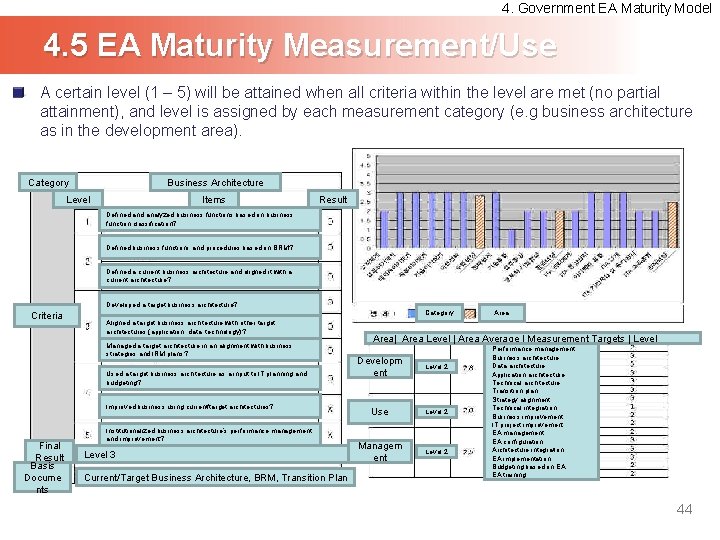
4. Government EA Maturity Model 4. 5 EA Maturity Measurement/Use A certain level (1 – 5) will be attained when all criteria within the level are met (no partial attainment), and level is assigned by each measurement category (e. g business architecture as in the development area). Category Business Architecture Level Items Result Defined analyzed business functions based on business function classification? Defined business functions and procedures based on BRM? Defined a current business architecture and aligned it with a current architecture? Developed a target business architecture? Criteria Category Aligned a target business architecture with other target architectures (application, data, technology)? Managed a target architecture in an alignment with business strategies and IRM plans? Used a target business architecture as a input to IT planning and budgeting? Improved business using current/target architectures? Final Result Basis Docume nts Institutionalized business architecture’s performance management and improvement? Level 3 Current/Target Business Architecture, BRM, Transition Plan Area| Area Level | Area Average | Measurement Targets | Level Developm ent Level 2 Use Level 2 Managem ent Level 2 Performance management Business architecture Data architecture Application architecture Technical architecture Transition plan Strategy alignment Technical integration Business improvement IT project improvement EA management EA configuration Architecture integration EA implementation Budgeting based on EA EA training 44
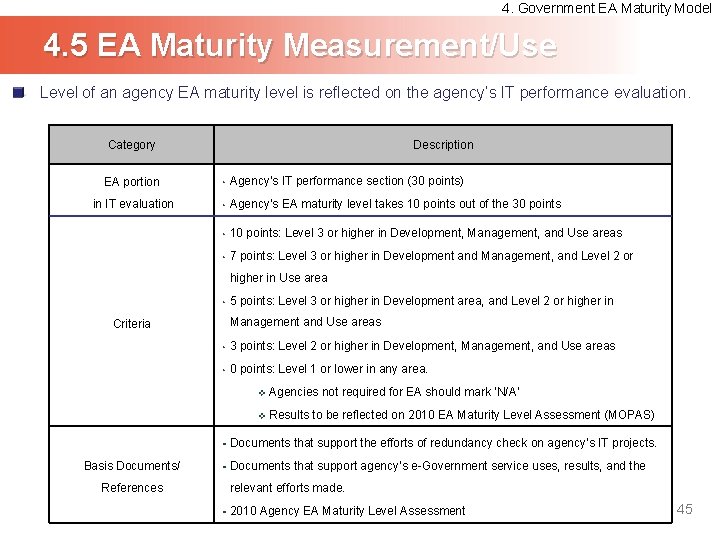
4. Government EA Maturity Model 4. 5 EA Maturity Measurement/Use Level of an agency EA maturity level is reflected on the agency’s IT performance evaluation. Category Description EA portion • Agency’s IT performance section (30 points) in IT evaluation • Agency’s EA maturity level takes 10 points out of the 30 points • 10 points: Level 3 or higher in Development, Management, and Use areas • 7 points: Level 3 or higher in Development and Management, and Level 2 or higher in Use area • Management and Use areas Criteria Basis Documents/ 5 points: Level 3 or higher in Development area, and Level 2 or higher in • 3 points: Level 2 or higher in Development, Management, and Use areas • 0 points: Level 1 or lower in any area. v Agencies not required for EA should mark ‘N/A’ v Results to be reflected on 2010 EA Maturity Level Assessment (MOPAS) § Documents that support the efforts of redundancy check on agency’s IT projects. § Documents that support agency’s e-Government service uses, results, and the relevant efforts made. References § 2010 Agency EA Maturity Level Assessment 45
Contents 1. Government EA Standards/Tools Overview 2. Government EA Reference Models 3. Government EA Metamodel 4. Government EA Maturity Model 5. Government EA Management System
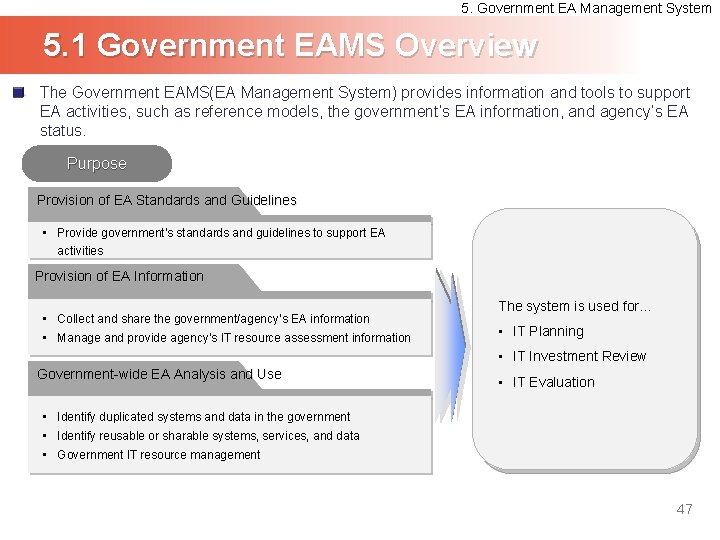
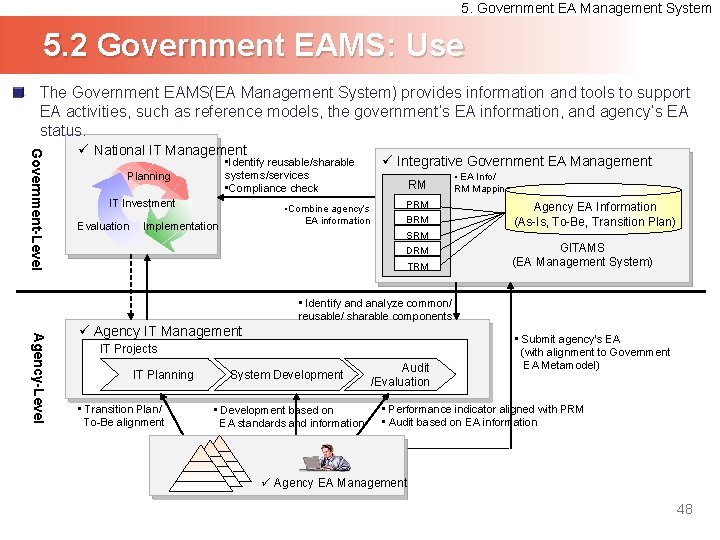
5. Government EA Management System 5. 1 Government EAMS Overview The Government EAMS(EA Management System) provides information and tools to support EA activities, such as reference models, the government’s EA information, and agency’s EA status. Purpose Provision of EA Standards and Guidelines • Provide government’s standards and guidelines to support EA activities Provision of EA Information • Collect and share the government/agency’s EA information • Manage and provide agency’s IT resource assessment information The system is used for… • IT Planning • IT Investment Review Government-wide EA Analysis and Use • IT Evaluation • Identify duplicated systems and data in the government • Identify reusable or sharable systems, services, and data • Government IT resource management 47
5. Government EA Management System 5. 2 Government EAMS: Use The Government EAMS(EA Management System) provides information and tools to support EA activities, such as reference models, the government’s EA information, and agency’s EA status. Government-Level ü National IT Management • Identify reusable/sharable systems/services • Compliance check Planning IT Investment Evaluation • Combine agency’s EA information Implementation ü Integrative Government EA Management RM PRM BRM SRM DRM TRM • EA Info/ RM Mapping Agency EA Information (As-Is, To-Be, Transition Plan) GITAMS (EA Management System) • Identify and analyze common/ reusable/ sharable components Agency-Level ü Agency IT Management IT Projects IT Planning • Transition Plan/ To-Be alignment System Development • Development based on EA standards and information Audit /Evaluation • Submit agency’s EA (with alignment to Government EA Metamodel) • Performance indicator aligned with PRM • Audit based on EA information ü Agency EA Management 48
Q&A Thank You! 49