
Government Degree College Kulgam Department Of History Topic

- Slides: 16
Government Degree College Kulgam Department Of History Topic : - Sources Of Ancient India Prepared By Mr. Shahid Shafi Assistant Professor History
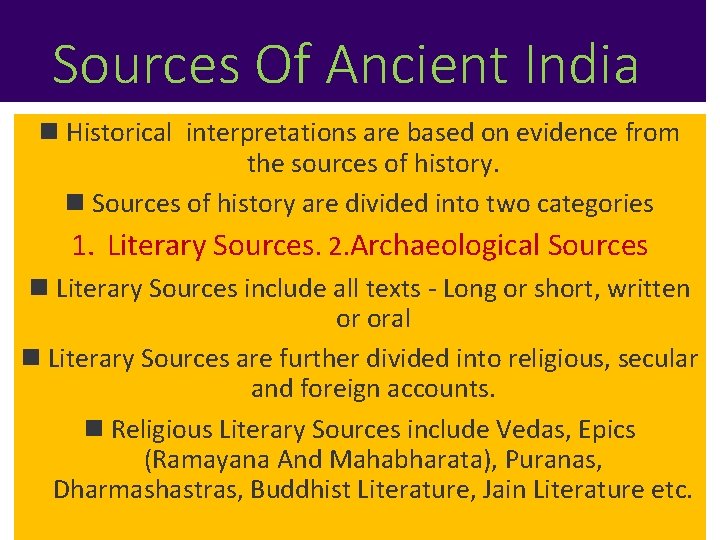
Sources Of Ancient India n Historical interpretations are based on evidence from the sources of history. n Sources of history are divided into two categories 1. Literary Sources. 2. Archaeological Sources n Literary Sources include all texts - Long or short, written or oral n Literary Sources are further divided into religious, secular and foreign accounts. n Religious Literary Sources include Vedas, Epics (Ramayana And Mahabharata), Puranas, Dharmashastras, Buddhist Literature, Jain Literature etc.
Vedas n. Four in number 1. Rig Veda 2. Sama Veda 3. Yajur Veda 4. Atharva Vedas n. Though religious in nature, Vedas contain references of historical events as well.
Epics (Mahabharata & Ramayana) n According to tradition Mahabharata was composed by Vyasa n Core story is about the conflict between Kaurvas and Pandavas n Valmiki is said to have composed Ramayana n Basic story is about Rama The Prince of Kosala n Epics give us information about Polity, culture, religion etc.
Puranas n Composed by vyasa according to tradition n Deal with 5 topis 1. Creation of the world (Sarga) 2. Recreation (Prati Sarga) 3. Periods of various Manus ( Manvantras) 4. Geneologies of gods and rishis (Vamsha) 5. Account of royal dynasties (Vamshanucharira) n Puranas give information about Ancient political history n Provide information about ancient historical geography n Information about emergence of religious cults n Information about emergence and development of Hindu religious practices
Dharmashastras n Texts specifically dealing with dharma are known as Dharmashastras n Information about norms of social behaviour n Important for studying personal, civil and criminal law.
Buddhist Literature n Includes Tipitika - Sutta, Abhidhamma and Vinaya n Important for the history of Buddhism, it's doctrines, monastic order etc. n Information about royal patrons such as A shoky n Information about Polity, society and economy of their times n Offers non Brahmanical perspective about ancient india.
Jain Literature n. Jain canonical texts are collectively known as Siddhanta or Agama n. Provide information about history and doctrins of Jainism n. Life stories of saints, monks and nuns.
Secular Literary Sources n. Includes works of Ashvaghosha, Bhasa, Kalidasa, Bana etc. n. Ashvaghosha wrote Buddhacharita, Saundarananda etc. n. Bhasa wrote Pancharatra, Balacharita etc. n. Kalidasa wrote Abhijanana Shakuntala, Malavikagnimitra etc. n. Mudrarakshasa by Vishakadatta about Nandas and Maurya's. n. Devichandragupta by Vishakadatta about Gupta king Ramagupta n. Panini's Ashtadayayi and Patanjalis Mahabhashya are grammatical works n. Kautilyas Arthashastra is a major work on statecraft
n Aryabhatta's Aryabhattiya and varahamira's Brihatsamhita are astronomical texts n Vatsyayanas Kamasutra about sensual pleasures n Charaka samhita and Sushruta Samhita on medicine n Natyashastra on theatre and performing arts n Banabhattas Harshacharita about king Harsha n Rajatarangni of Kalhana gives historical account of Kashmir
Foregin Accounts n. Since early times traders, Travelers, pilgrims etc. Came to India n. Indica by Megasthenes gives information about Mauryan period n. Other Greaco Roman texts include Bibliothica Historical by Diodorus, Geography by Strabo, Anabassis by Arrian, Natural History by Pliny n. Chinese travellers Family Hien, Hiuen Tsang and Yi Jing also provide information about India n. Foreign accounts reveal how people from other lands viewed India and it's people
Archaeological Sources n. Archaeology - the study of the human past through material remains is closely connected with history n. Two main categories of Archaeological sources are Epigraphy and Numismatics
Epigraphy: - The Study Of Inscriptions n. Inscription is any writing that is engraved on something n. Inscriptions are usually contemporaneous to the events they speak of n. Valuable for political history e. g, Ashokan Inscriptions, Allahabad Pillar Inscription of Samudragupta n. Provide information about administrative and revenue systems n. Provide dateable information on the history of religious sects, institutions & practices
Numismatics: - The Study Of Coins n. Linked to monetary history n. Information about exchange and trade n. Legends on coins give information on the history of languages and scripts n. Important for political history & political systems n. Provide important details about kings n. Depiction of deities provides information about personal religious preferences of kings, royal religious policy, and the history of religious cults
Conclusion: - A meticulous and skilful analysis of the sources is the foundation of history. Various literary and archaeological sources have their own specific potential.
Thank you