
GOVERNMENT COLLEGE FOR WOMEN AUTONOMOUS KUMBAKONAM DEPARTMENT OF
GOVERNMENT COLLEGE FOR WOMEN (AUTONOMOUS) KUMBAKONAM DEPARTMENT OF GEOGRAPHY I – M. Sc - GEOGRAPHY APPLIED GEOMORPHOLOGY FAULTS Dr. B. ANUSUYA, Assistant Professor & Head, Department of Geography, Government College for Women (A), Kumbakonam.
UNIT: II APPLIED GEOMORPHOLOGY FAULTS Definition of FAULTS: A fault is a fracture or zone of fractures between two blocks of rock. Faults allow the blocks to move relative to each other. This movement may occur rapidly, in the form of an earthquake - or may occur slowly, in the form of creep. Faults may range in length from a few millimeters to thousands of kilometers.
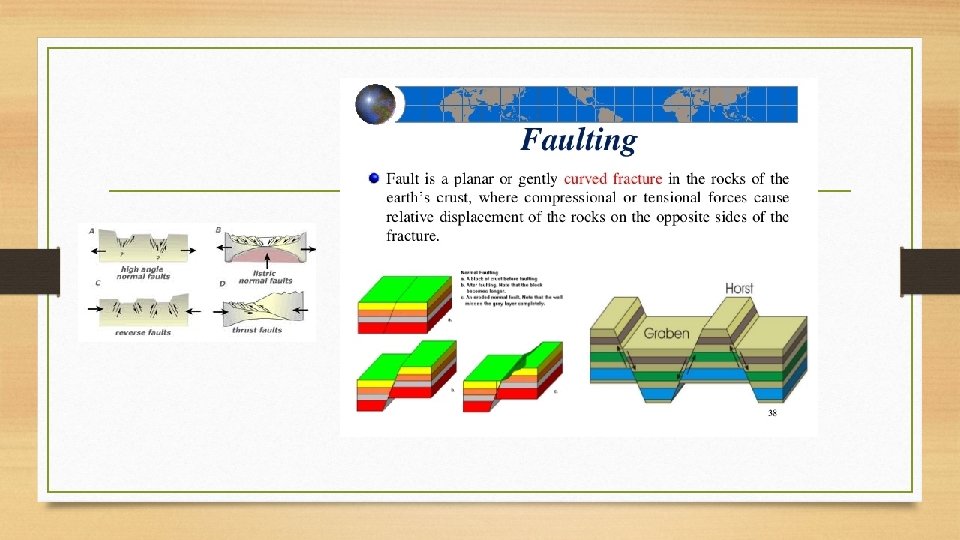
What is the definition of Faulting? • Faulting - (geology) a crack in the earth's crust resulting from the displacement of one side with respect to the other; "they built it right over a geological fault"; “the faulting of the earth's crust" geological fault, fracture, break, fault, shift. In geology, a fault is a planar fracture or discontinuity in a volume of rock across which there has been significant displacement as a result of rock-mass movement. . Energy release associated with rapid movement on active faults is the cause of most earthquakes. Faults may also displace slowly, by aseismic creep.
What are the causes of faulting? Faults are generally caused under the influence of stresses acting upon the rocks of the crust of the earth from within. Any rock on or below the crust may withstand all the operating stresses up to a limit, which depends upon its cohesive strength and internal friction. What is the process of faulting? Faults form in rocks when the stresses overcome the internal strength of the rock resulting in a fracture. A fault can be defined as the displacement of once connected blocks of rock along a fault plane. This can occur in any direction with the blocks moving away from each other.
• What is an example of a normal fault? • A normal fault is a fault in which the hanging wall moves down relative to the footwall. . An example of a normal fault is the infamous San Andreas Fault in California. The opposite is a reverse fault, in which the hanging wall moves up instead of down. A normal fault is a result of the earth's crust spreading apart. • What is the process of folding? • The process of folding occurs when rock is compressed, as it is along colliding plate boundaries. Upturned folds are called anticlines and down turned folds are called synclines. . Anticlines and synclines are geologic structures, that is, they are folds in rock material.
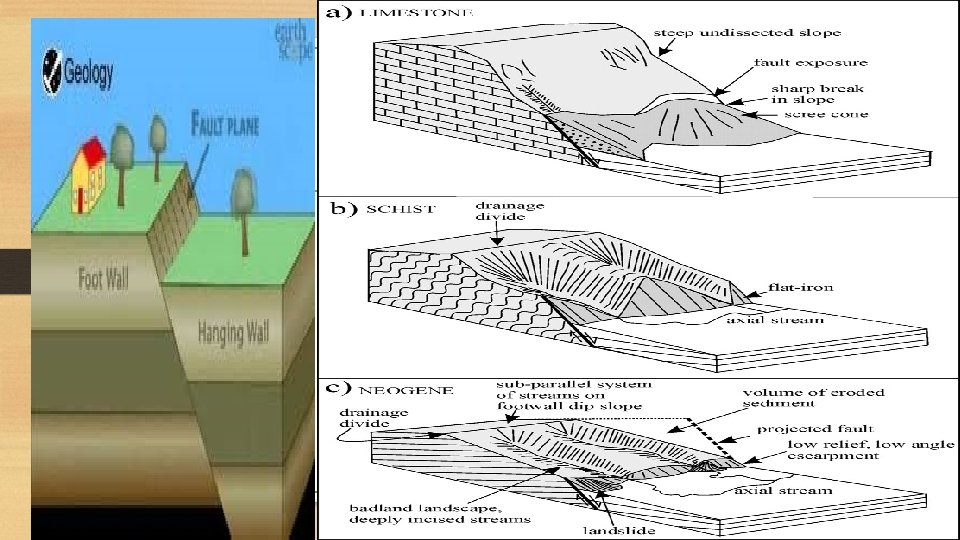
• Is a normal fault vertical or horizontal? • In normal and reverse faulting, rock masses slip vertically past each other. In strike-slip faulting, the rocks slip past each other horizontally. Encyclopædia Britannica, Inc. A block that has dropped relatively downward between two normal faults dipping toward each other is called a graben. • What is an example of a reverse fault? • In a reverse fault, the block above the fault moves up relative to the block below the fault. . A reverse fault is called a thrust fault if the dip of the fault plane is small. Other names: thrust fault, reverse-slip fault or compressional fault. Examples: Rocky Mountains, Himalayas.
What is difference between folding and faulting? The difference between folding and faulting is that folding is the pressure of converging plates causing the crust to fold and buckle, resulting in the creation of mountains and hills and faulting is where cracks in the earth's rock are created because of different movement of tectonic plates. What are three types of faults? There are three kinds of faults: strike-slip, normal and thrust (reverse) faults, said Nicholas van der Elst, a seismologist at Columbia University's Lamont-Doherty Earth Observatory in Palisades, New York.
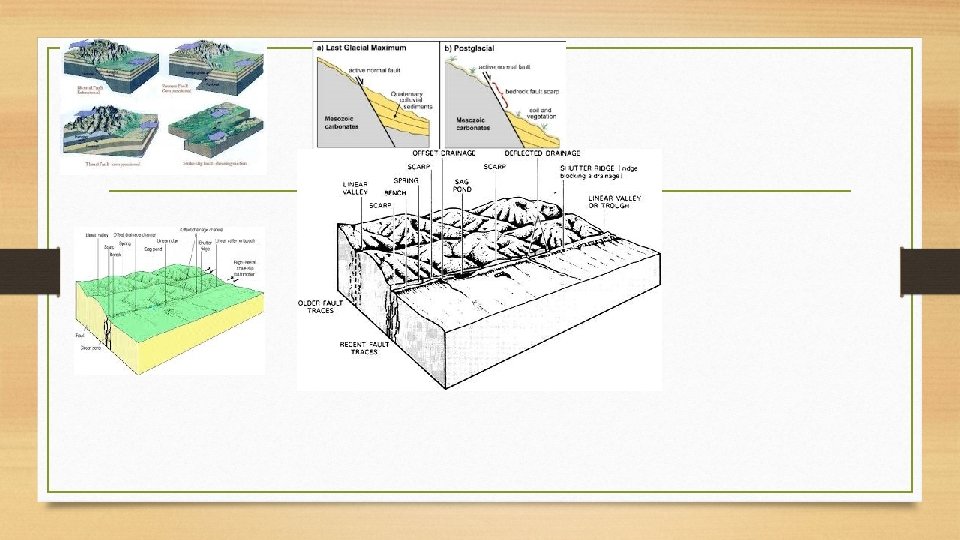
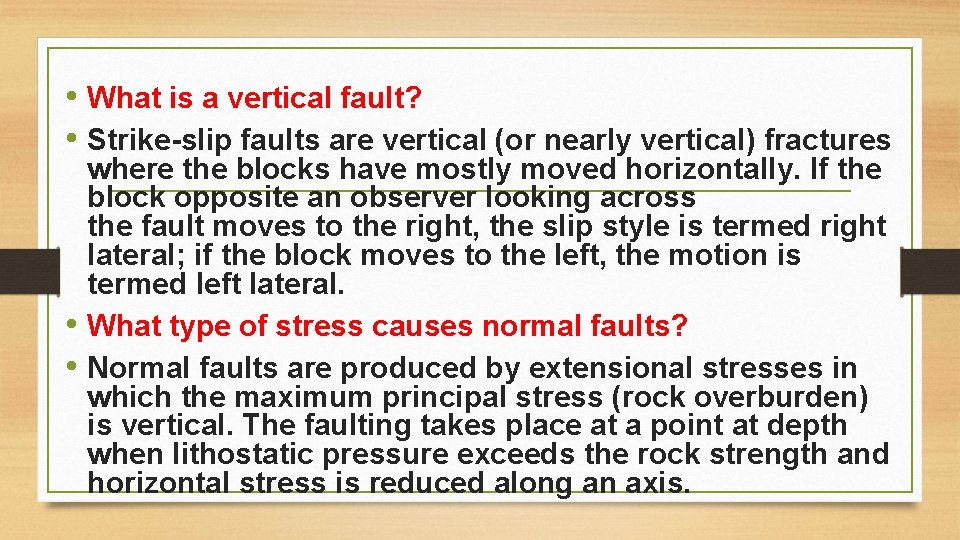
• What is a vertical fault? • Strike-slip faults are vertical (or nearly vertical) fractures where the blocks have mostly moved horizontally. If the block opposite an observer looking across the fault moves to the right, the slip style is termed right lateral; if the block moves to the left, the motion is termed left lateral. • What type of stress causes normal faults? • Normal faults are produced by extensional stresses in which the maximum principal stress (rock overburden) is vertical. The faulting takes place at a point at depth when lithostatic pressure exceeds the rock strength and horizontal stress is reduced along an axis.
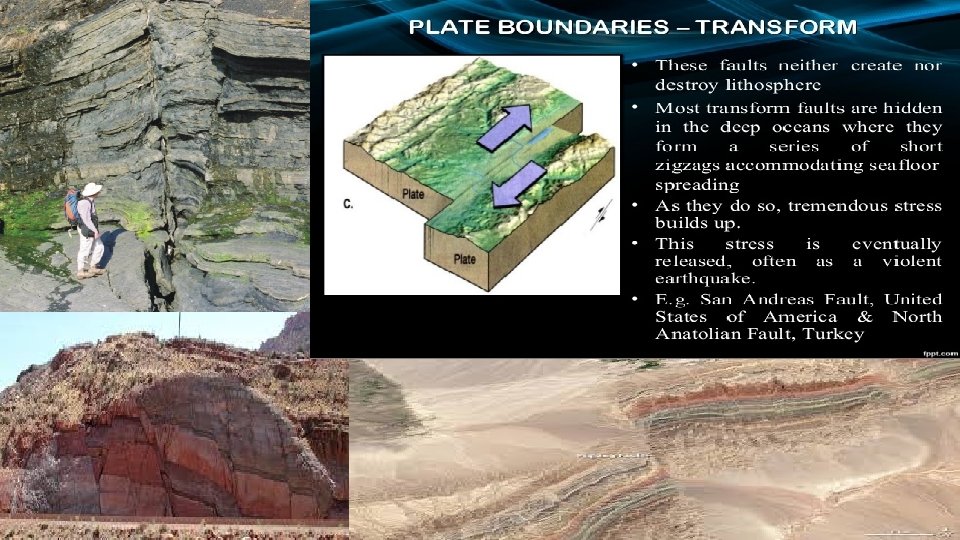
• How folds and faults are formed? • Rocks that were originally deposited in horizontal layers can subsequently deform by tectonic forces into folds and faults. Folds constitute the twists and bends in rocks. Faults are planes of detachment resulting when rocks on either side of the displacement slip past one another. • What is the difference between a normal fault a reverse fault and a strike slip fault? • [Other names: normal-slip fault, tensional fault or gravity fault] Examples include Basin & Range faults. Reverse fault—the block above the inclined fault moves up relative to the block below the fault. . Strike-slip fault—movement of blocks along a fault is horizontal and the fault plane is nearly vertical.
• What is the importance of folds and faults? • The folds and faults and other geologic structures also help us to make geologic maps, which we use to infer underground structures where we can't see the rocks and to help us to understand the formation of geologic resources to locate and manage them.
• How the movement of plates leads to the formation of folds and faults? • Rift valleys are distinguishable by the sharp, declining sides. In conclusion, the movement of the Earth's plates results in the folding and faulting of the Earth's surface due to processes such as compression, tension and shearing, and in doing so, deform and rearrange the Earth's crust. • How are faults formed by plate tectonics? • A fault is formed in the Earth's crust as a brittle response to stress. Generally, the movement of the tectonic plates provides the stress, and rocks at the surface break in response to this. . If you whack a hand-sample-sized piece of rock with a hammer, the cracks and breakages you make are faults.
Reverse Faults • Reverse fault displacements combine vertical and compressional displacements. Reverse faults typically have a wide range of dip angles. Reverse faults with low dips exhibit a sinuous surface expression over hilly to flat terrain. Reverse fault scarps are often difficult to locate precisely due to widespread landslides which cover the fault trace. Surface fracturing is characterized by folding or distortion and displacements along subsidiary faults and fractures within the hanging wall. •
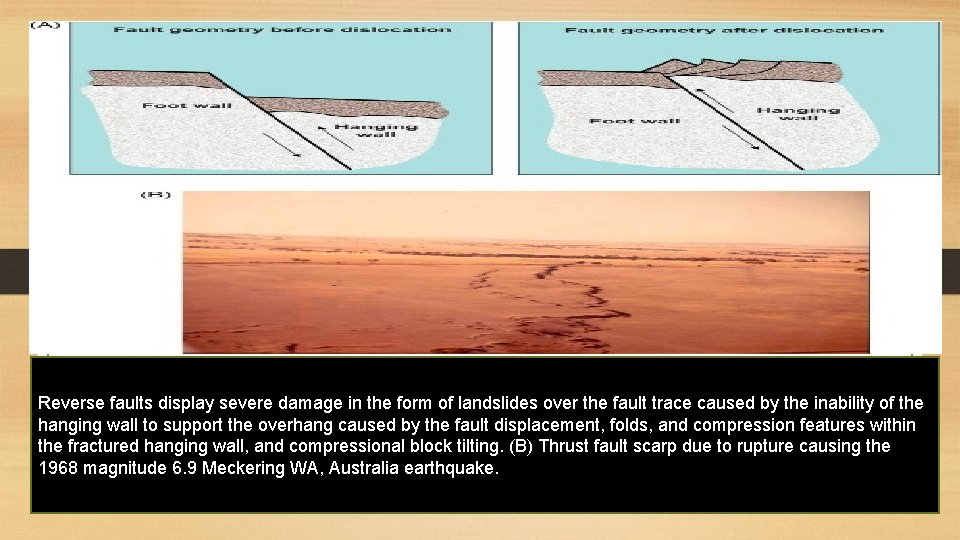
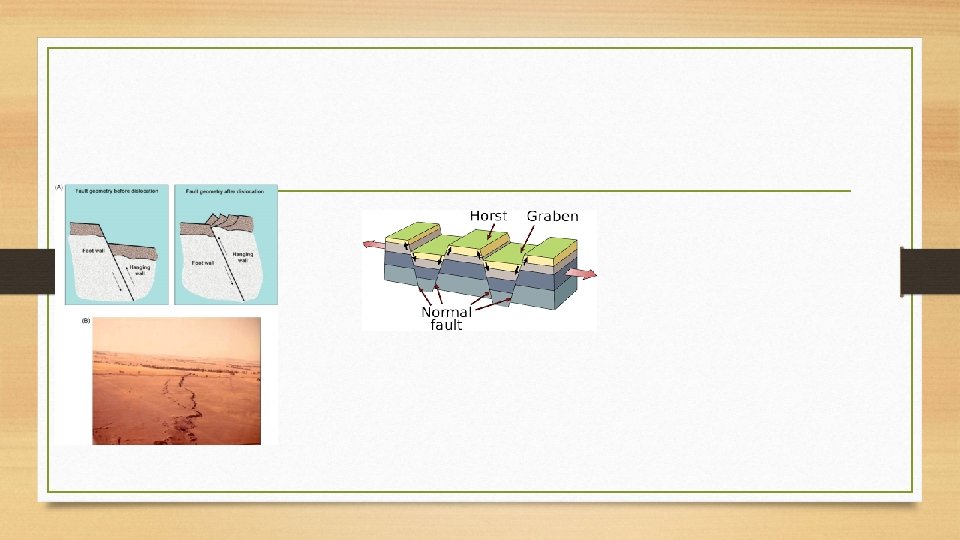
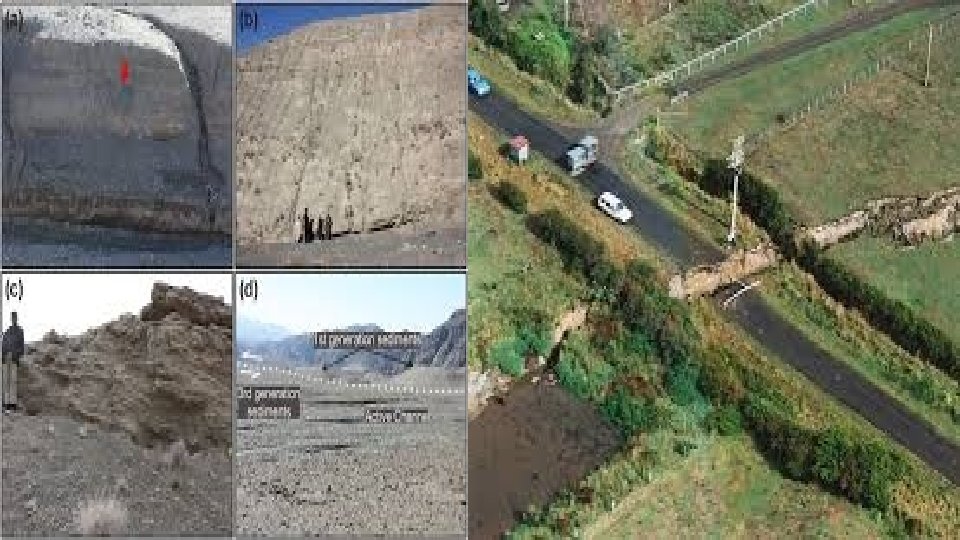
Reverse faults display severe damage in the form of landslides over the fault trace caused by the inability of the hanging wall to support the overhang caused by the fault displacement, folds, and compression features within the fractured hanging wall, and compressional block tilting. (B) Thrust fault scarp due to rupture causing the 1968 magnitude 6. 9 Meckering WA, Australia earthquake.
• Fracturing and ground instability on the hanging wall of a reverse fault is commonly spread over a wide area (tens of miles in some cases), more than is common with normal-slip and strike-slip faults due mostly to the amount of frictional forces involved, which in turn partition or disperse stresses over greater distances depending generally on rates of movement, the rock types involved, and the presence or absence of fluids. • A thrust fault rupture resulting in the 1968 magnitude 6. 9 Meckering WA, Australia (approximately 130 km east of Perth) earthquake. Note on Figure 5. 12 B the wide area of damage due to secondary scarps and slumps on the hanging wall of the fault (left on the photograph). The earthquake caused ground rupture of nearly 40 km, with a 2. 4 m vertical offset and a 1. 5 m horizontal offset. Although the town of Meckering was destroyed during the earthquake, none of its citizens was killed.

Thank you
- Slides: 22