
Government and the Economy 16 Sociology in Modules

- Slides: 44
Government and the Economy 16 Sociology in Modules 3 rd edition Richard T. Schaefer Copyright © 2016 Mc. Graw-Hill Education. All rights reserved. No reproduction or distribution without the prior written consent of Mc. Graw-Hill Education.
Government, Power, and Authority • Power and Authority – One cultural universal is the exercise of power and authority – Politics: “who gets what, when, and how” (Lasswell) Slide 2 Copyright © 2016 Mc. Graw-Hill Education. All rights reserved. No reproduction or distribution without the prior written consent of Mc. Graw-Hill Education.
Government, Power, and Authority • Political and economic systems intertwined – Political system: unique to each country; founded on a recognized set of procedures – Economic system: social institution through which goods and services, are produced, distributed, and consumed Slide 3 Copyright © 2016 Mc. Graw-Hill Education. All rights reserved. No reproduction or distribution without the prior written consent of Mc. Graw-Hill Education.
Power • Power: ability to exercise one’s will over others (Weber) – Sources of power in political systems: • Force: actual or threatened use of coercion to impose one’s will on others • Influence: exercise of power through process of persuasion • Authority: institutionalized power recognized by the people over whom it is exercised Slide 4 Copyright © 2016 Mc. Graw-Hill Education. All rights reserved. No reproduction or distribution without the prior written consent of Mc. Graw-Hill Education.
Types of Authority • Three ideal types of authority (Weber) – Traditional authority: legitimate power conferred by custom and accepted practice – Rational-legal authority: power made legitimate by law – Charismatic authority: power made legitimate by leader’s exceptional personal or emotional appeal to his or her followers Slide 5 Copyright © 2016 Mc. Graw-Hill Education. All rights reserved. No reproduction or distribution without the prior written consent of Mc. Graw-Hill Education.
Types of Government • Monarchy – Form of government headed by a single member of a royal family • Oligarchy – Form of government in which a few individuals rule Slide 6 Copyright © 2016 Mc. Graw-Hill Education. All rights reserved. No reproduction or distribution without the prior written consent of Mc. Graw-Hill Education.
Types of Government • Dictatorship and Totalitarianism – Dictatorship: government in which one person has nearly total power to make and enforce laws – Totalitarianism: involves virtually complete government control and surveillance over all aspects of a society’s social and political life Slide 7 Copyright © 2016 Mc. Graw-Hill Education. All rights reserved. No reproduction or distribution without the prior written consent of Mc. Graw-Hill Education.
Types of Government • Democracy – Government by the people – Representative democracy: certain individuals elected to speak for the people • U. S. is representative democracy • Critics question whether U. S. democracy is truly representative Slide 8 Copyright © 2016 Mc. Graw-Hill Education. All rights reserved. No reproduction or distribution without the prior written consent of Mc. Graw-Hill Education.
War and Peace • War: conflict between organizations that possess trained combat forces equipped with deadly weapons (Caplow and Hicks) – Legal definition typically requires formal declaration of hostilities Slide 9 Copyright © 2016 Mc. Graw-Hill Education. All rights reserved. No reproduction or distribution without the prior written consent of Mc. Graw-Hill Education.
War • Three sociological approaches: – Global view studies how and why nations become engaged in military conflict – Nation-state view stresses interaction of internal political, socioeconomic, and cultural forces – Micro view focuses on social impact on individuals and their groups Slide 10 Copyright © 2016 Mc. Graw-Hill Education. All rights reserved. No reproduction or distribution without the prior written consent of Mc. Graw-Hill Education.
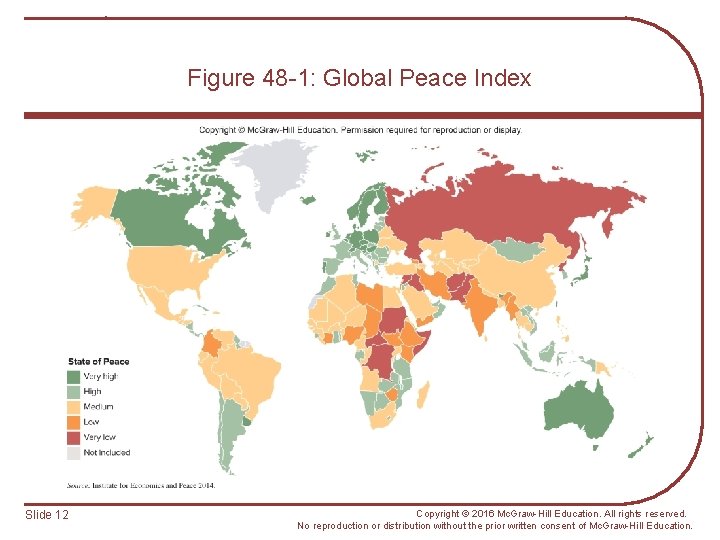
Peace • Peace: absence of war, and proactive effort to develop cooperative relations among nations – Since 1990 s, 90% of armed conflicts occurred within states – Global Peace Index: U. S. ranked 99 on list of 162 nations – Nations cannot maintain security through threatening violence Slide 11 Copyright © 2016 Mc. Graw-Hill Education. All rights reserved. No reproduction or distribution without the prior written consent of Mc. Graw-Hill Education.
Figure 48 -1: Global Peace Index Slide 12 Copyright © 2016 Mc. Graw-Hill Education. All rights reserved. No reproduction or distribution without the prior written consent of Mc. Graw-Hill Education.
Terrorism • Terrorism: use or threat of violence against random or symbolic targets in pursuit of political aims – Hope to intimidate society and bring about a new political order – Essential aspect of contemporary terrorism involves use of the media – Governments becoming concerned about malicious cyberattacks Slide 13 Copyright © 2016 Mc. Graw-Hill Education. All rights reserved. No reproduction or distribution without the prior written consent of Mc. Graw-Hill Education.
Political Behavior and Power in the United States • Many aspects of political system taken for granted by U. S. citizens – Bill of Rights – Two major political parties – Secret ballot – Elected president – Distinct state and local governments • Different expectations in other nations Slide 14 Copyright © 2016 Mc. Graw-Hill Education. All rights reserved. No reproduction or distribution without the prior written consent of Mc. Graw-Hill Education.
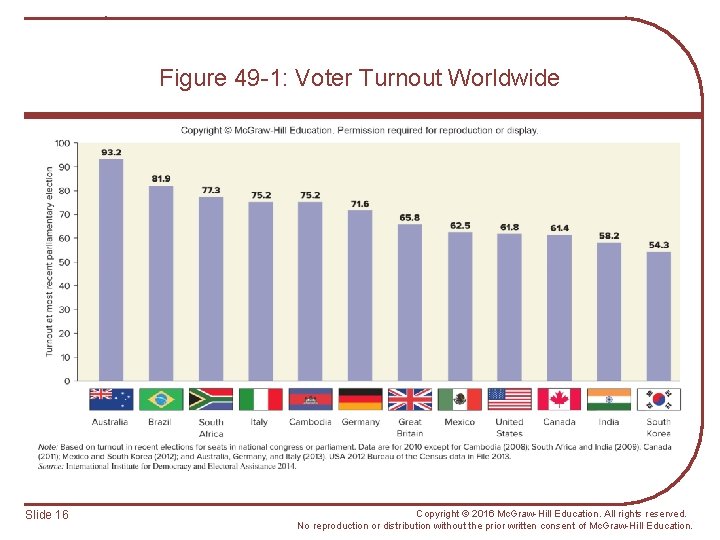
Participation and Apathy • In U. S. , only small minority of citizens, often from higher social classes, participate in political organizations on local or national level • In 2012 election, voter turnout only 61. 8% of eligible voters – Political participation makes government accountable to voters Slide 15 Copyright © 2016 Mc. Graw-Hill Education. All rights reserved. No reproduction or distribution without the prior written consent of Mc. Graw-Hill Education.
Figure 49 -1: Voter Turnout Worldwide Slide 16 Copyright © 2016 Mc. Graw-Hill Education. All rights reserved. No reproduction or distribution without the prior written consent of Mc. Graw-Hill Education.
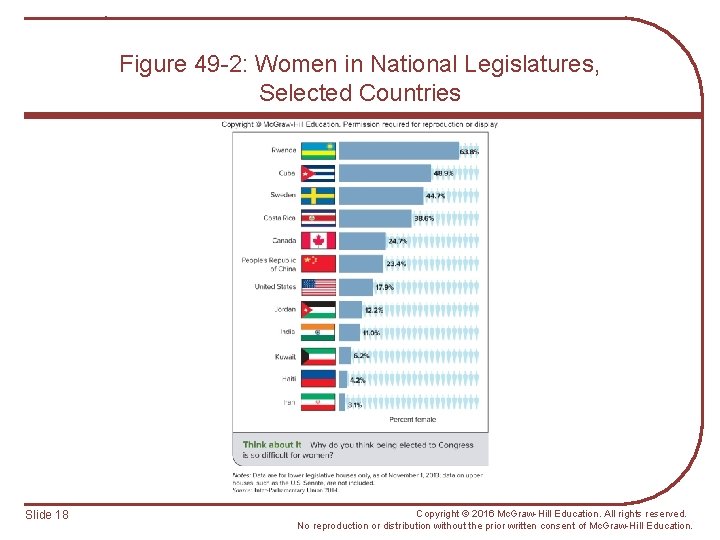
Race and Gender in Politics • In U. S. , political strength lacking in such marginalized groups as women and racial and ethnic minorities – Progress toward inclusion of minority groups in government has been slow – Female politicians enjoying more electoral success, but evidence that media cover them differently Slide 17 Copyright © 2016 Mc. Graw-Hill Education. All rights reserved. No reproduction or distribution without the prior written consent of Mc. Graw-Hill Education.
Figure 49 -2: Women in National Legislatures, Selected Countries Slide 18 Copyright © 2016 Mc. Graw-Hill Education. All rights reserved. No reproduction or distribution without the prior written consent of Mc. Graw-Hill Education.
Models of Power Structure in the United States • Who really holds power in the U. S. ? Two basic views: – Power elite model – Pluralist model Slide 19 Copyright © 2016 Mc. Graw-Hill Education. All rights reserved. No reproduction or distribution without the prior written consent of Mc. Graw-Hill Education.
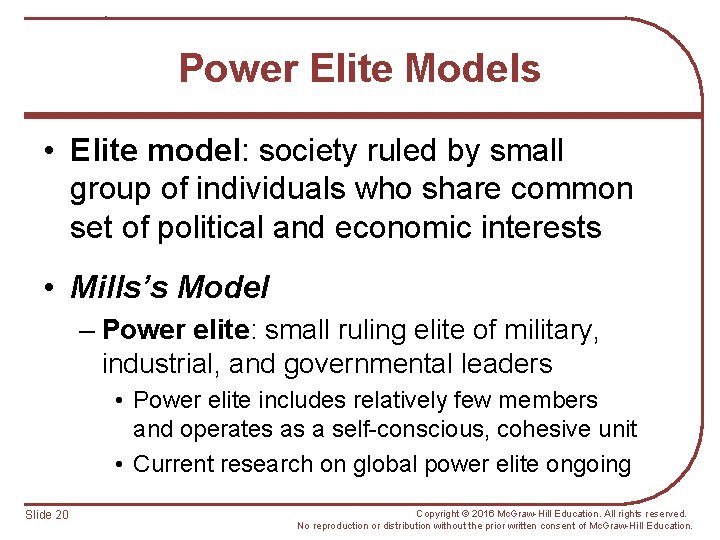
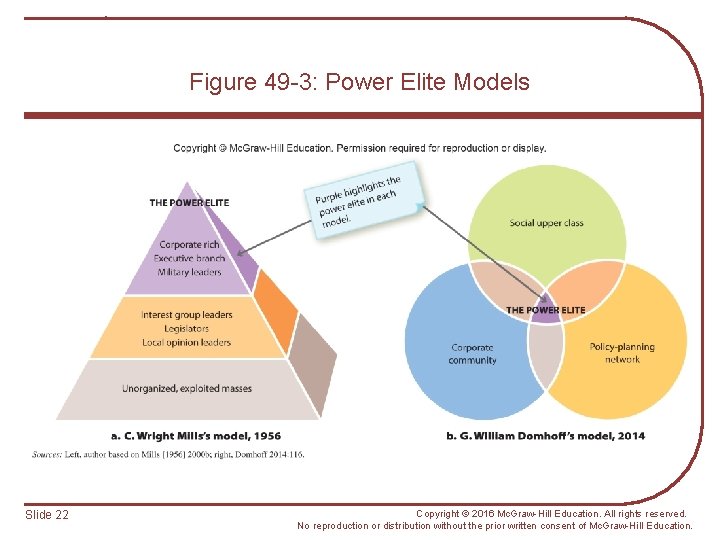
Power Elite Models • Elite model: society ruled by small group of individuals who share common set of political and economic interests • Mills’s Model – Power elite: small ruling elite of military, industrial, and governmental leaders • Power elite includes relatively few members and operates as a self-conscious, cohesive unit • Current research on global power elite ongoing Slide 20 Copyright © 2016 Mc. Graw-Hill Education. All rights reserved. No reproduction or distribution without the prior written consent of Mc. Graw-Hill Education.
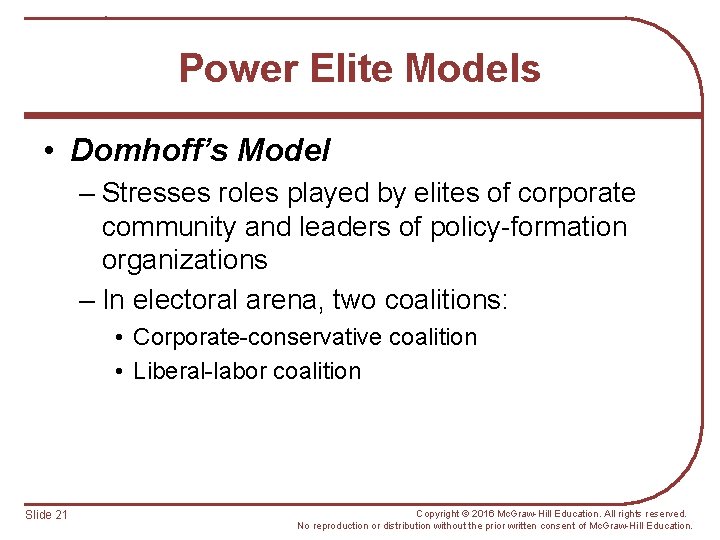
Power Elite Models • Domhoff’s Model – Stresses roles played by elites of corporate community and leaders of policy-formation organizations – In electoral arena, two coalitions: • Corporate-conservative coalition • Liberal-labor coalition Slide 21 Copyright © 2016 Mc. Graw-Hill Education. All rights reserved. No reproduction or distribution without the prior written consent of Mc. Graw-Hill Education.
Figure 49 -3: Power Elite Models Slide 22 Copyright © 2016 Mc. Graw-Hill Education. All rights reserved. No reproduction or distribution without the prior written consent of Mc. Graw-Hill Education.
Pluralist Model • Pluralist model: competing groups within community have access to government, so no single group can dominate – Variety of groups play significant roles in decisions • Fails to address potential power of elites to keep matters out of government debate • Acknowledges uneven distribution of power in United States Slide 23 Copyright © 2016 Mc. Graw-Hill Education. All rights reserved. No reproduction or distribution without the prior written consent of Mc. Graw-Hill Education.
Economic Systems • Industrial society: society that depends on mechanization to produce its goods and services – Capitalism – Socialism Slide 24 Copyright © 2016 Mc. Graw-Hill Education. All rights reserved. No reproduction or distribution without the prior written consent of Mc. Graw-Hill Education.
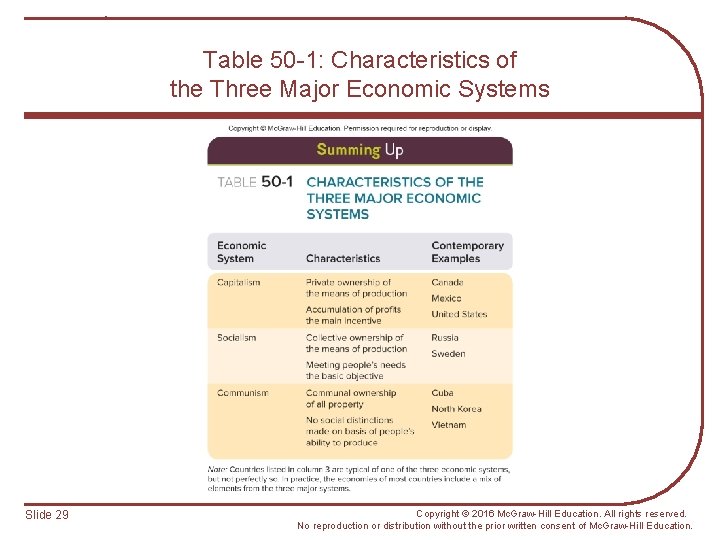
Capitalism • Capitalism: economic system in which means of production are held largely in private hands – Main incentive for economic activity is accumulation of profits – Laissez-faire: businesses compete with minimal government intervention – Monopoly: exists when a single firm controls the market • Monopolies tolerated in contemporary capitalism Slide 25 Copyright © 2016 Mc. Graw-Hill Education. All rights reserved. No reproduction or distribution without the prior written consent of Mc. Graw-Hill Education.
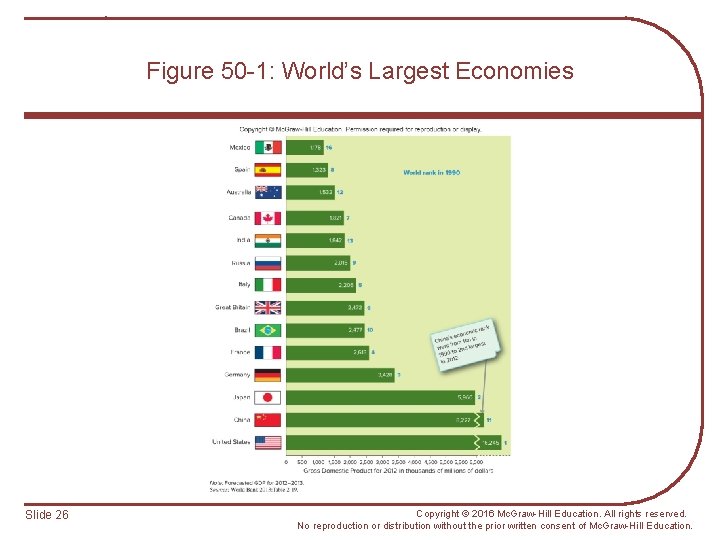
Figure 50 -1: World’s Largest Economies Slide 26 Copyright © 2016 Mc. Graw-Hill Education. All rights reserved. No reproduction or distribution without the prior written consent of Mc. Graw-Hill Education.
Socialism • Socialism: means of production and distribution owned collectively rather than privately owned – Wide variation in toleration of private ownership – Communism: economic system under which all property is communally owned and no social distinctions are made on the basis of people’s ability to produce Slide 27 Copyright © 2016 Mc. Graw-Hill Education. All rights reserved. No reproduction or distribution without the prior written consent of Mc. Graw-Hill Education.
The Informal Economy • Informal economy: transfer of money, goods, or services is not reported to the government – Difficult to measure – In developing nations, informal economy represents 40– 60% of economic activity and often is unmeasured Slide 28 Copyright © 2016 Mc. Graw-Hill Education. All rights reserved. No reproduction or distribution without the prior written consent of Mc. Graw-Hill Education.
Table 50 -1: Characteristics of the Three Major Economic Systems Slide 29 Copyright © 2016 Mc. Graw-Hill Education. All rights reserved. No reproduction or distribution without the prior written consent of Mc. Graw-Hill Education.
Changing Economies • Advocates of power elite model: trend in capitalist societies toward concentration of ownership by giant corporations – Especially multinational corporations – Four outgrowths of this trend: • • Slide 30 Changing workforce Deindustrialization Temporary workforce Offshoring Copyright © 2016 Mc. Graw-Hill Education. All rights reserved. No reproduction or distribution without the prior written consent of Mc. Graw-Hill Education.
The Changing Face of the Workforce • U. S. workforce constantly changing – Sociologists and labor specialists foresee workforce increasingly composed of women and racial and ethnic minorities • From 1988 to 2018, 52% of new workers expected to be women – More diverse workforce means relationships between workers more likely to cross gender, racial, and ethnic lines Slide 31 Copyright © 2016 Mc. Graw-Hill Education. All rights reserved. No reproduction or distribution without the prior written consent of Mc. Graw-Hill Education.
Deindustrialization • Deindustrialization: systematic, widespread withdrawal of investment in basic aspects of productivity – Can take the form of corporate restructuring – Downsizing: reductions in a company’s workforce as part of deindustrialization – Social costs cannot be overemphasized Slide 32 Copyright © 2016 Mc. Graw-Hill Education. All rights reserved. No reproduction or distribution without the prior written consent of Mc. Graw-Hill Education.
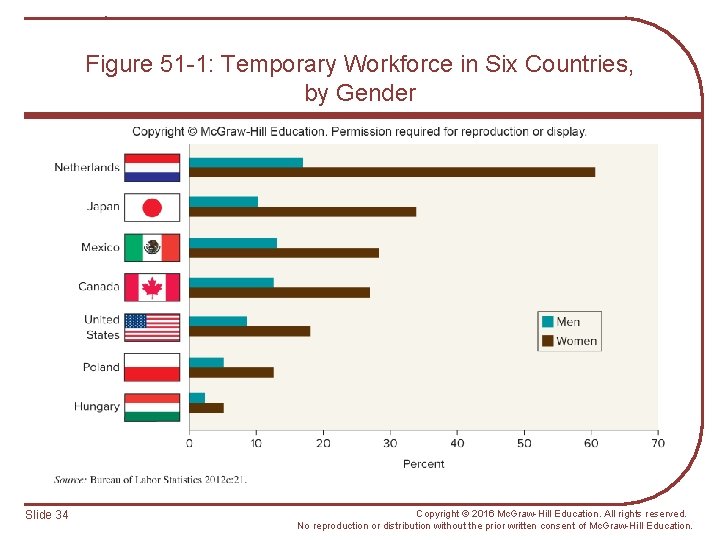
The Temporary Workforce • Increasing reliance on part-time workforce – Workers are temporary or seasonal; and lack benefits – Some workers seek out part-time jobs – Increase in precarious work: employment that is poorly paid, and from the worker’s perspective insecure and unprotected Slide 33 Copyright © 2016 Mc. Graw-Hill Education. All rights reserved. No reproduction or distribution without the prior written consent of Mc. Graw-Hill Education.
Figure 51 -1: Temporary Workforce in Six Countries, by Gender Slide 34 Copyright © 2016 Mc. Graw-Hill Education. All rights reserved. No reproduction or distribution without the prior written consent of Mc. Graw-Hill Education.
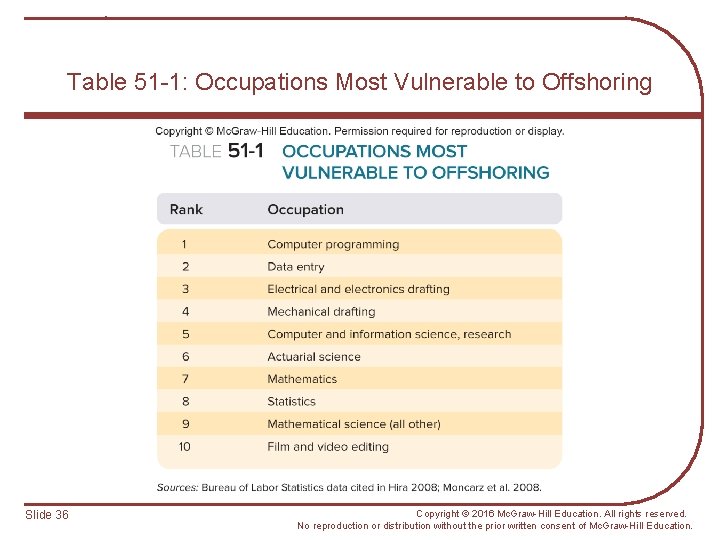
Offshoring • Offshoring: transferring work to foreign contractors – Latest tactic in raising profits by reducing costs – Conflict theorists: this aspect of globalization furthers social inequality – Not inevitable; some reshoring occurs Slide 35 Copyright © 2016 Mc. Graw-Hill Education. All rights reserved. No reproduction or distribution without the prior written consent of Mc. Graw-Hill Education.
Table 51 -1: Occupations Most Vulnerable to Offshoring Slide 36 Copyright © 2016 Mc. Graw-Hill Education. All rights reserved. No reproduction or distribution without the prior written consent of Mc. Graw-Hill Education.
Social Policy and the Economy: Microfinancing • Looking at the Issue – Microfinancing: lending small sums of money to poor so they can work their way out of poverty – Developed by Muhammad Yunus in Bangladesh • Idea has been underwritten by over a thousand for-profit banks and multinational organizations • Some lenders are taking advantage of the poor Slide 37 Copyright © 2016 Mc. Graw-Hill Education. All rights reserved. No reproduction or distribution without the prior written consent of Mc. Graw-Hill Education.
Social Policy and the Economy: Microfinancing • Applying Sociology – Poor people can significantly improve their circumstances through mutual support (Collins) – Women comprise 90% of microcredit recipients • Women’s economic status critical to well-being of children and a healthy household environment – Critics: creation of small home-based industries reduces demand formal employment opportunities Slide 38 Copyright © 2016 Mc. Graw-Hill Education. All rights reserved. No reproduction or distribution without the prior written consent of Mc. Graw-Hill Education.
Social Policy and the Economy: Microfinancing • Initiating Policy – Need to reduce overlending and monitor success of small loans in helping borrowers escape poverty – Lenders need to work with political leaders to ensure they do not regard one another as competitors for political support from the poor • Development of this type of government policy a major undertaking Slide 39 Copyright © 2016 Mc. Graw-Hill Education. All rights reserved. No reproduction or distribution without the prior written consent of Mc. Graw-Hill Education.
Sociology in the Global Community 48 -1: Sovereignty in the Aloha State – From a mainstream point of view, what might be the advantages and disadvantages of extending sovereignty to an indigenous group? Discuss using sociological concepts. – Do some research on the legal basis for tribal sovereignty. How did American Indian tribes gain the status of separate nations? Slide 40 Copyright © 2016 Mc. Graw-Hill Education. All rights reserved. No reproduction or distribution without the prior written consent of Mc. Graw-Hill Education.
Research Today 49 -1: Why Don’t More Young People Vote? – How often do you vote? If you do not vote, what accounts for your apathy? Are you too busy to register? Are community issues uninteresting to you? – Do you think voter apathy is a serious social problem? What might be done to increase voter participation in your age group and community? Slide 41 Copyright © 2016 Mc. Graw-Hill Education. All rights reserved. No reproduction or distribution without the prior written consent of Mc. Graw-Hill Education.
Our Wired World 49 -2: Politicking Online – Do you use the Internet or social media for political purposes? If so, do those in your social network affect your political views or participation? – What might be some drawbacks of online political activity? Slide 42 Copyright © 2016 Mc. Graw-Hill Education. All rights reserved. No reproduction or distribution without the prior written consent of Mc. Graw-Hill Education.
Research Today 51 -1: Affirmative Action – Is affirmative action part of the admissions policy at the college or university you attend? If so, do you think the policy has helped to level the playing field? Might it have excluded some qualified White applicants? – Take a poll of your classmates. What percentage of the class supports affirmative action in hiring and college admissions? How does that group break down in terms of gender, race, and ethnicity? Slide 43 Copyright © 2016 Mc. Graw-Hill Education. All rights reserved. No reproduction or distribution without the prior written consent of Mc. Graw-Hill Education.
Taking Sociology to Work Joseph W. Drummond, Management Analyst, U. S. Army Space and Missile Defense Command – Have you ever considered a career in national defense? Do you know anyone with a college degree who works in the field? – Why do you think quantitative analysis is such an important skill to employers? How might you use it in your career? Slide 44 Copyright © 2016 Mc. Graw-Hill Education. All rights reserved. No reproduction or distribution without the prior written consent of Mc. Graw-Hill Education.