
Government and Politics Introduction to Sociology Authority refers
- Slides: 13
Government and Politics Introduction to Sociology
Authority refers to accepted power—that is, power that people agree to follow
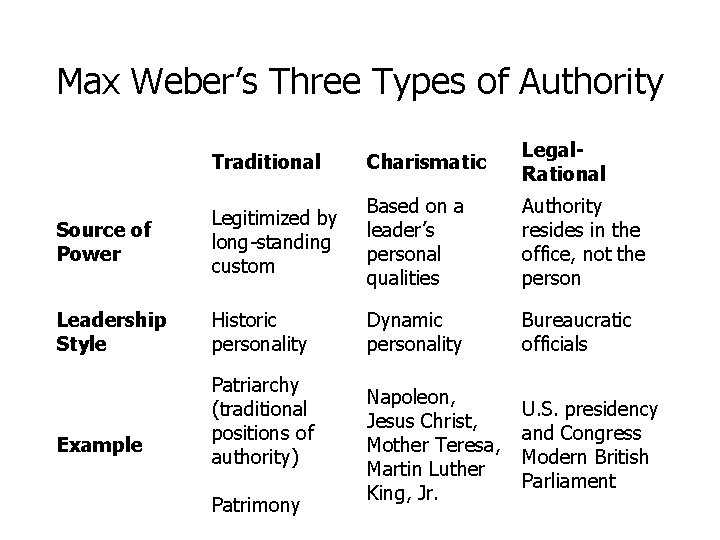
Max Weber’s Three Types of Authority Traditional Charismatic Legal. Rational Source of Power Legitimized by long-standing custom Based on a leader’s personal qualities Authority resides in the office, not the person Leadership Style Historic personality Dynamic personality Bureaucratic officials Napoleon, Jesus Christ, Mother Teresa, Martin Luther King, Jr. U. S. presidency and Congress Modern British Parliament Example Patriarchy (traditional positions of authority) Patrimony
Anarchy and Oligarchy • Anarchy is the absence of any organized government • Oligarchy is a form of government in which power is held by a small, elite group
Types of Monarchies Monarchy is a form of government in which a single person (a monarch) rules until that individual dies or abdicates the throne • Absolute monarchies are governments wherein a monarch has absolute or unmitigated power • Constitutional monarchies are national governments that recognize monarchs but require these figures to abide by the laws of a greater constitution
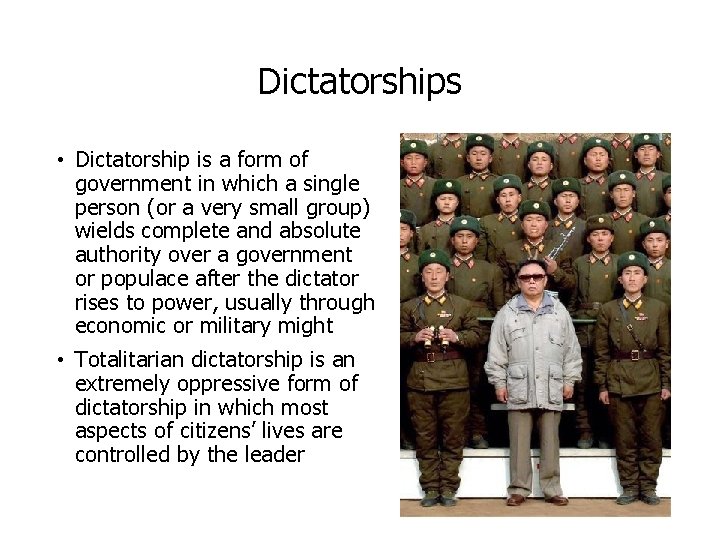
Dictatorships • Dictatorship is a form of government in which a single person (or a very small group) wields complete and absolute authority over a government or populace after the dictator rises to power, usually through economic or military might • Totalitarian dictatorship is an extremely oppressive form of dictatorship in which most aspects of citizens’ lives are controlled by the leader
Democracies Democracy is a form of government that provides all citizens with an equal voice or vote in determining state policy • Representative democracy is a government wherein citizens elect officials to represent their interests
Politics in the United States • The U. S. is a representative democracy • Many sociologists argue that Americans’ desire to promote equality and democracy on a theoretical level is at odds with the nation’s real-life capitalism, white supremacy, and patriarchy
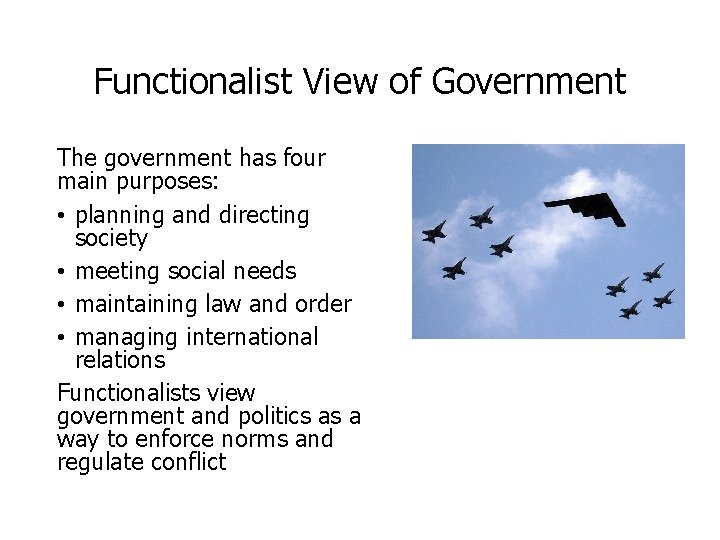
Functionalist View of Government The government has four main purposes: • planning and directing society • meeting social needs • maintaining law and order • managing international relations Functionalists view government and politics as a way to enforce norms and regulate conflict
Conflict Theory View of Government • the power elite use government to develop social policies that allow them to keep their wealth and power
Symbolic-Interactionist View of Government • Focus on symbols and how people define American values and identity • Study micro-level interactions of people and elected officials
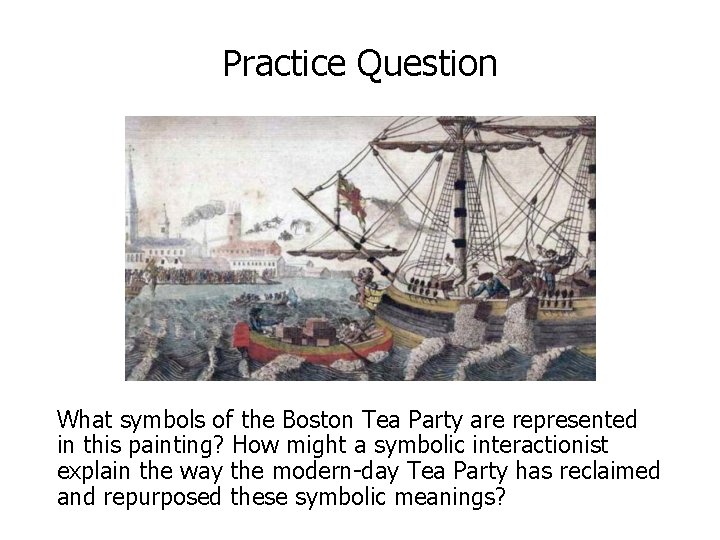
Practice Question What symbols of the Boston Tea Party are represented in this painting? How might a symbolic interactionist explain the way the modern-day Tea Party has reclaimed and repurposed these symbolic meanings?
Quick Review • What are power and authority? • What are the different forms of government? What form is practiced in the United States? • How do the three main theoretical perspectives view government and power?