
Governing Patient Centered Medical Homes Designed for Board
Governing Patient Centered Medical Homes: Designed for Board and Senior Leadership Tess Kuenning, CNS, MS, RN President and Chief Executive Officer Bi-State Primary Care Association David Reynolds, Dr. PH Health Policy Analyst and Founder of Vermont’s First Federally Qualified Health Center Sharon Winn, Esq. , MPH Director, Vermont Public Policy Bi-State Primary Care Association 1 ~ May 12, 2015 ~
Session Description and Learning Objectives l l Community Boards need access to reliable and timely resources re state/federal policy and regulatory Governance updates and changes Boards need to understand the emerging state and federal health policy and regulatory environments As state and federal governments shape new payment models and delivery systems, it is imperative Boards understand these changes Session learning objectives – – – 2 Understand key state and national reform efforts that affect your role as a Board member Understand where to find resources that will support your understanding of the legal, administrative, financial and clinical requirements of the Community Health Center program Understand the emerging trends in Board responsibilities within the context of health care reform Bi-State Primary Care Association’s 2015 Primary Care Conference ~ May 12, 2015
Agenda l l l l 3 Session description and learning objectives Overview of the Bureau of Primary Health Care (BPHC) and National Association of Community Health Center (NACHC) resources and updates as it relates to Health Center Boards Overview of national health care reform Overview of VT and NH state health care reform and its relationship to primary care and the Board’s role Putting the pieces together and meeting the challenges for both states Conversation about what you have heard: Q&A Wrap up and session evaluation Bi-State Primary Care Association’s 2015 Primary Care Conference ~ May 12, 2015
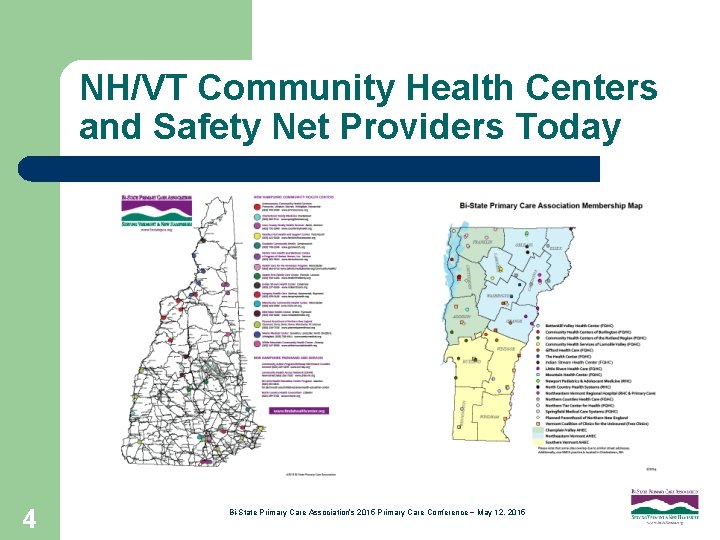
NH/VT Community Health Centers and Safety Net Providers Today 4 Bi-State Primary Care Association’s 2015 Primary Care Conference ~ May 12, 2015
BPHC: Health Center Program Board Governance: PIN 2014 -01 l PIN 2014 -01: Primary Health Resources and Services Administration (HRSA) policy source for information on Health Center program governance 5 Bi-State Primary Care Association’s 2015 Primary Care Conference ~ May 12, 2015
BPHC: Board Governance Expectations l Governance requirements (PIN 2014 -01) – – – 6 Governance requirements for Health Centers have been set forth in statute, regulations and through various HRSA policies PIN 2014 -01 clarifies HRSA’s policies in implementing the statutory and regulatory governance requirements of the Health Center program Must demonstrate the establishment of an independent governing Board that assumes full authority and oversight responsibility for the Health Center Bi-State Primary Care Association’s 2015 Primary Care Conference ~ May 12, 2015
BPHC: Board Governance Expectations l Statutory governance (PIN 2014 -01) – – l General Board oversight – – – 7 Governing Board size Board composition Organization/corporate By-Laws Board authority, functions and responsibilities Duty of care Duty of loyalty (conflict of interest) Duty of obedience Bi-State Primary Care Association’s 2015 Primary Care Conference ~ May 12, 2015
BPHC: Board Governance Expectations l Additional considerations for Health Center governance – l Examples include: – – – 8 All Health Centers with existing affiliation agreements or considering new affiliation agreements should examine their arrangements to assure their governing Board remains in compliance with all governance requirements described in the PIN Mergers Acquisitions Parent-subsidiary arrangements Subrecipient arrangements Contracts for a substantial portion of the project Bi-State Primary Care Association’s 2015 Primary Care Conference ~ May 12, 2015
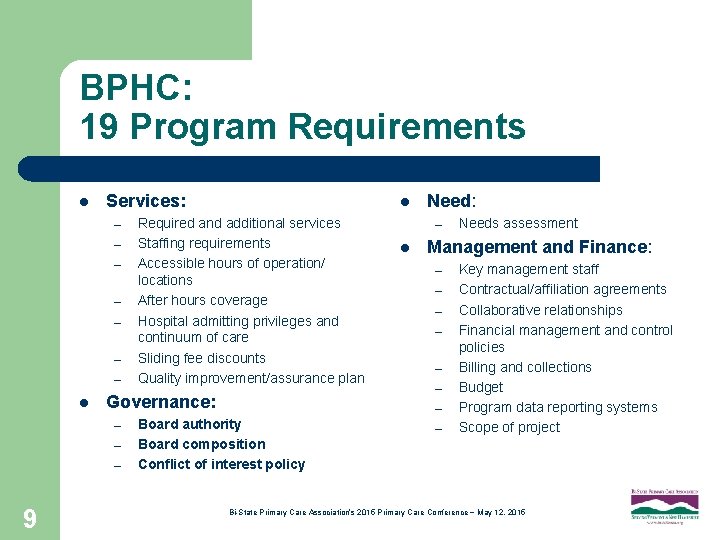
BPHC: 19 Program Requirements l Services: – – – – l Required and additional services Staffing requirements Accessible hours of operation/ locations After hours coverage Hospital admitting privileges and continuum of care Sliding fee discounts Quality improvement/assurance plan Governance: – – – 9 l Need: – l Management and Finance: – – – – Board authority Board composition Conflict of interest policy Needs assessment – Key management staff Contractual/affiliation agreements Collaborative relationships Financial management and control policies Billing and collections Budget Program data reporting systems Scope of project Bi-State Primary Care Association’s 2015 Primary Care Conference ~ May 12, 2015
BPHC: Operational Site Visit l l l l 10 Objective assessment and verification of Health Center compliance with statutory and regulatory requirements Review of administration, governance, fiscal and clinical programs Review of progress on clinical and financial performance Assistance with areas of non-compliance Assistance with identification and implementation of best practices At least once per project period or at least once every 3 years http: //bphc. hrsa. gov/programrequirements/centerguide. html Bi-State Primary Care Association’s 2015 Primary Care Conference ~ May 12, 2015
Board Resource Guide l NACHC resources: – – – – – 11 Health Center Program Governance Requirements: Governing Board Responsibilities and How to Do Them Health Center Board Education Video Series: Discussion and Resource Guide Health Center Advocacy: Legal Do’s and Don’ts Health Center Program Governance Series: Information Bulletins #1 -19 Accountable Care organizations Primer Affordable Care Act Primer Health Centers and Payment Reform Primer High Performing Health Center Governance Characteristics of High Performing Boards l US DHHS/HRSA/BPHC/resources: – – l Health Center Program Board Governance (PIN 2014 -01) 19 Program Requirements Operational Site Visit Guide Governing Board Handbook Other resources: – – Supercircular (OMB condensed Circulars) Federally Qualified Health Center (FQHC) Frequently Asked Questions Community Health Centers: A Movement and the People Who Made It Happen Community Health Forum: Moving Behavioral Health into the Mainstream of Primary Care Bi-State Primary Care Association’s 2015 Primary Care Conference ~ May 12, 2015
High Performing Boards and Board Members l Does the Board meet these attributes? – – – – 12 Understanding of organizational mission Understanding of their role Board work done outside of meetings Shared vision Listening skills Shared respect Trust Deliberate succession planning Bi-State Primary Care Association’s 2015 Primary Care Conference ~ May 12, 2015
High Performance Health Center Governance: Stewardship l Ability to ensure that high quality, relevant and accountable care is provided to meet the needs of the community; the Board of the Health Centers exercises its legally required responsibilities of oversight, compliance, stewardship to ensure adherence to Health Center program requirements, state and federal laws and regulations and accreditation standards l Move from Novice: – – – – – 13 l Basic knowledge of health delivery system History or Health Centers Patient Board of Directors By-Laws and Conflict of Interest Policy Board’s legal authority/responsibilities Health Center quality assurance/quality improvement and oversight Board’s role in hiring/supporting CEO Board’s role in credentialing medical staff; workforce challenges/issues Basic knowledge of financial management/ budgeting concepts; risk/compliance; data To Leadership: – – Ask “generative” questions and facilitate discussions to advance the Board’s thinking Drive improvement on critical priorities (including quality, cost, experience, efficiency and access) through development of performance metrics and ongoing monitoring Ask strategic questions Take lead in assessing CEO performance Bi-State Primary Care Association’s 2015 Primary Care Conference ~ May 12, 2015
High Performance Health Center Governance: Strategic Thinking l Partners with management to create a compelling vision of the future and to think, act and influence in ways that promote a vibrant, sustainable and successful organization; particularly during times of rapid change. Acts on management recommendations regarding big decisions on resources, services and programs l Move from Novice: – – 14 l Understand Health Center’s future vision flows from Health Center’s mission Distinction between governance and management Aware of the Health Center’s recent needs assessment Review and assess progress in achieving strategic priorities To Leadership: – – – Questions to create new thinking Demonstrates “big picture” thinking by conceptualizing and clarifying all of the forces, events, entities and people that are affecting (or being affected by) the situation at hand Demonstrates “system thinking” by rigorously and systemically connecting processes, events and systems; able to sort through alternatives to turn ideas into action Bi-State Primary Care Association’s 2015 Primary Care Conference ~ May 12, 2015
High Performance Health Center Governance: Culture l Ability to collaborate in creating and sustaining an environment in which there is trust, mutual respect, effective dialogue, commitment, accountability for the sake of meeting the mission, vision, goals of the Health Center; ability to create and sustain a partnership between the Board and CEO to foster a positive Board culture l Move from Novice: – – – l Honest, ethical behavior and respect for other Board and staff members Listens carefully and clarifies information as needed Is prepared and actively participates To Leadership: – – 15 Striking the right balance between scrutiny, challenge and respect with management partners Gain personal commitment and energy to support Board goals and inspire individual and organizational excellence Ensures that there is explicit, mutual and reciprocal understanding of leadership expectations and role responsibilities to ensure successful Board/Board Chair/CEO relationships Able to inspire and stretch Bi-State Primary Care Association’s 2015 Primary Care Conference ~ May 12, 2015
High Performance Health Center Governance: Personal Leadership l Ability to engage in lifelong learning; value and act on feedback and learn from failures, as well successes; able to seek mentorship from Board member colleagues and CEO; willing to assess personal development needs and engage in targeted activities to build competence over time l Move from Novice: – – – 16 l Time necessary for Board work, including Board orientation Willingness to receive feedback from others Constructive interactions Demonstrates conduct that is aligned with ethical and governance standards Personal leadership Gains trust To Leadership: – – – Inspires dedication to the organization’s mission, values and goals through visible actions Serves as a mentor and coach to Board members; helps others to recognize and work through barriers to personal effectiveness Pushes Board to adopt best practices in effective governance Bi-State Primary Care Association’s 2015 Primary Care Conference ~ May 12, 2015
High Performance Health Center Governance: Advocacy l Ability to influence Health Center health policy through involvement with stakeholders l Move from Novice: – – – 17 l Commitment to mission, vision, values and ethical responsibilities of the Health Center Brings the voice of the diverse community served into the Board room Understands how state and federal lawmakers impact financial resources available for Health Centers To Leadership: – – Articulate the value equation (improving care and lowering costs) for Health Centers – nationally and locally Suggests and/or initiates creative solutions to enhance the reach and impact of the Health Center to all stakeholders; including funding or developing innovative care delivery models or alternatives to established delivery mechanisms Bi-State Primary Care Association’s 2015 Primary Care Conference ~ May 12, 2015
The Health Care Conundrum: WHY We Needed to Change l Before the Affordable Care Act (ACA): Abundant need for change: – – – – 18 National uninsured rates ranging 45 -55 million Exploding health care costs US GDP 17% vs. 8 -10% major industrialized nations Insurance premiums too expensive; rising faster than earnings Employer sponsored insurance: Most insurance is from employer; loss of job=loss of insurance Lack of affordability of premiums, deductibles, co-pays, coinsurance, out-of-pocket expenses Lack of “system” relative to accountability to care for the whole person Bi-State Primary Care Association’s 2015 Primary Care Conference ~ May 12, 2015
Life Expectancy in Years Life Expectancy and Health Care Spending/Person 19 Bi-State Primary Care Association’s 2015 Primary Care Conference ~ May 12, 2015
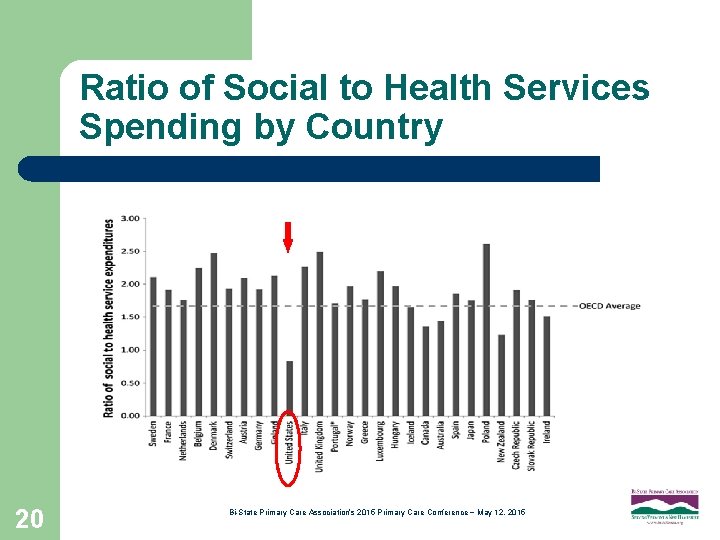
Ratio of Social to Health Services Spending by Country 20 Bi-State Primary Care Association’s 2015 Primary Care Conference ~ May 12, 2015
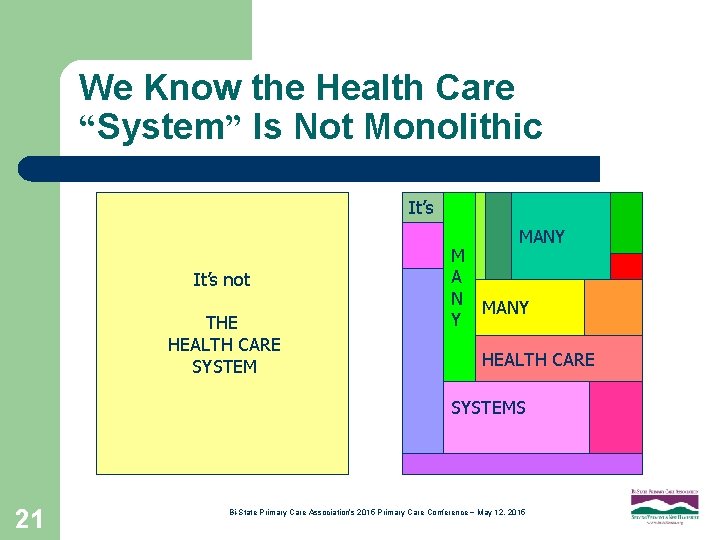
We Know the Health Care “System” Is Not Monolithic It’s MANY It’s not THE HEALTH CARE SYSTEM M A N MANY Y HEALTH CARE SYSTEMS 21 Bi-State Primary Care Association’s 2015 Primary Care Conference ~ May 12, 2015
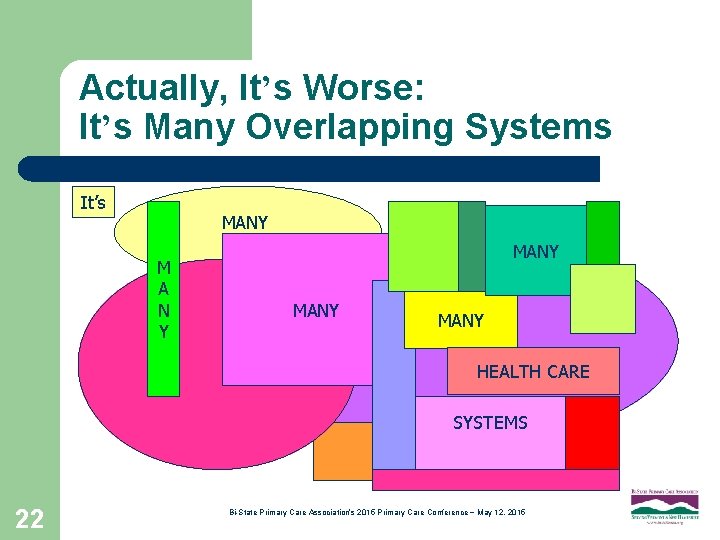
Actually, It’s Worse: It’s Many Overlapping Systems It’s MANY M A N Y MANY HEALTH CARE SYSTEMS 22 Bi-State Primary Care Association’s 2015 Primary Care Conference ~ May 12, 2015
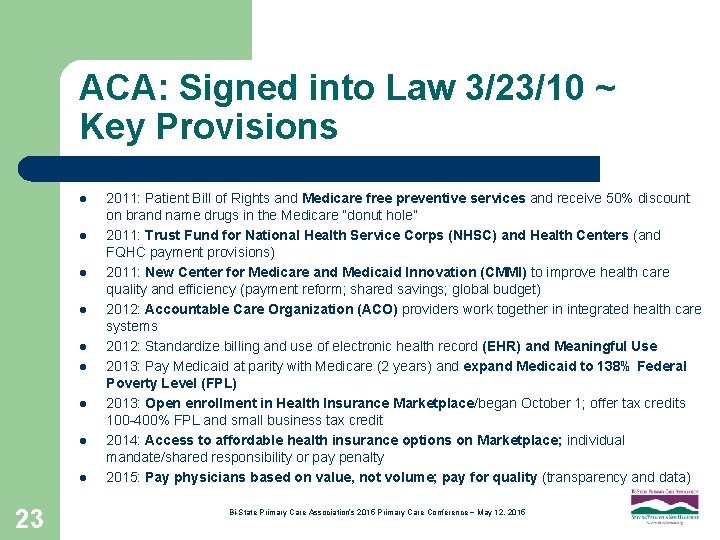
ACA: Signed into Law 3/23/10 ~ Key Provisions l l l l l 23 2011: Patient Bill of Rights and Medicare free preventive services and receive 50% discount on brand name drugs in the Medicare “donut hole” 2011: Trust Fund for National Health Service Corps (NHSC) and Health Centers (and FQHC payment provisions) 2011: New Center for Medicare and Medicaid Innovation (CMMI) to improve health care quality and efficiency (payment reform; shared savings; global budget) 2012: Accountable Care Organization (ACO) providers work together in integrated health care systems 2012: Standardize billing and use of electronic health record (EHR) and Meaningful Use 2013: Pay Medicaid at parity with Medicare (2 years) and expand Medicaid to 138% Federal Poverty Level (FPL) 2013: Open enrollment in Health Insurance Marketplace/began October 1; offer tax credits 100 -400% FPL and small business tax credit 2014: Access to affordable health insurance options on Marketplace; individual mandate/shared responsibility or pay penalty 2015: Pay physicians based on value, not volume; pay for quality (transparency and data) Bi-State Primary Care Association’s 2015 Primary Care Conference ~ May 12, 2015
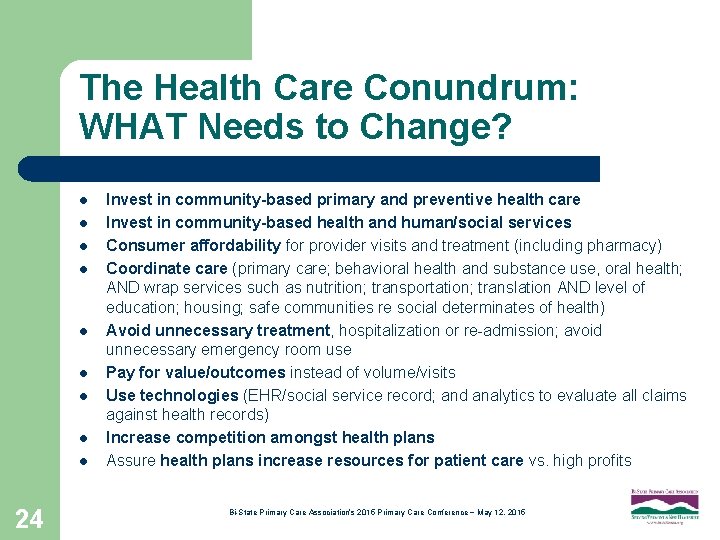
The Health Care Conundrum: WHAT Needs to Change? l l l l l 24 Invest in community-based primary and preventive health care Invest in community-based health and human/social services Consumer affordability for provider visits and treatment (including pharmacy) Coordinate care (primary care; behavioral health and substance use, oral health; AND wrap services such as nutrition; transportation; translation AND level of education; housing; safe communities re social determinates of health) Avoid unnecessary treatment, hospitalization or re-admission; avoid unnecessary emergency room use Pay for value/outcomes instead of volume/visits Use technologies (EHR/social service record; and analytics to evaluate all claims against health records) Increase competition amongst health plans Assure health plans increase resources for patient care vs. high profits Bi-State Primary Care Association’s 2015 Primary Care Conference ~ May 12, 2015
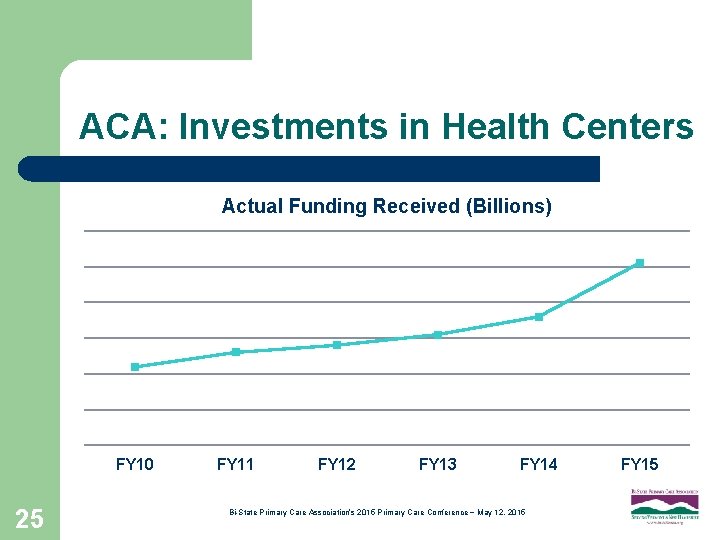
ACA: Investments in Health Centers Actual Funding Received (Billions) FY 10 25 FY 11 FY 12 FY 13 FY 14 Bi-State Primary Care Association’s 2015 Primary Care Conference ~ May 12, 2015 FY 15
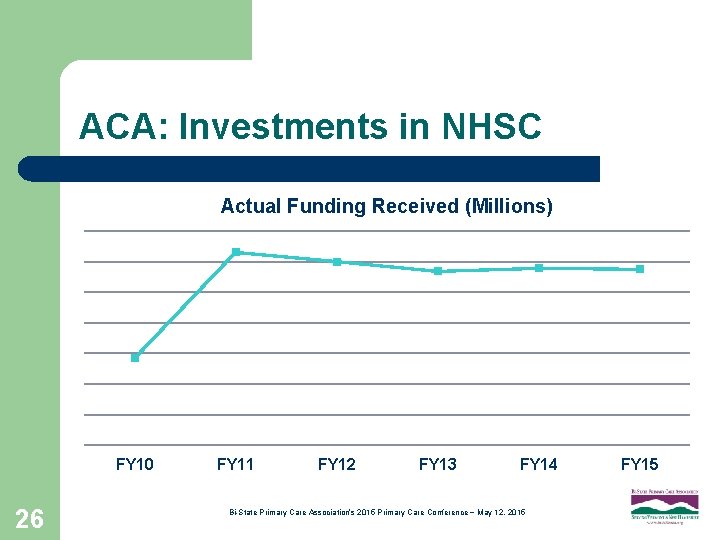
ACA: Investments in NHSC Actual Funding Received (Millions) FY 10 26 FY 11 FY 12 FY 13 FY 14 Bi-State Primary Care Association’s 2015 Primary Care Conference ~ May 12, 2015 FY 15
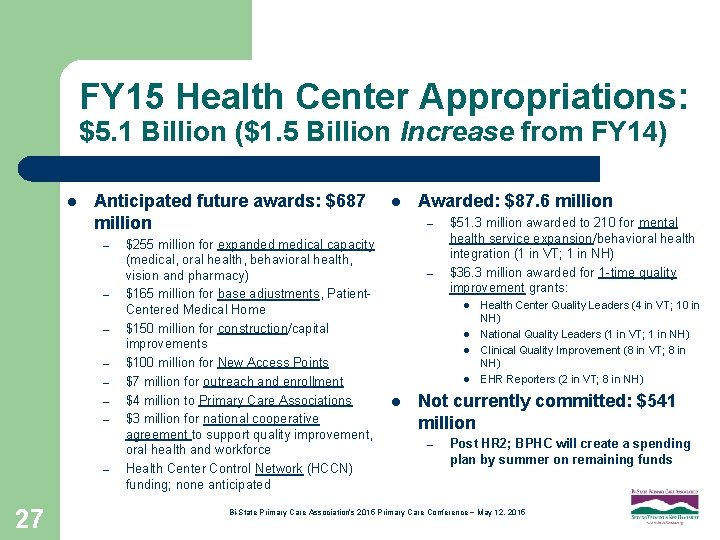
FY 15 Health Center Appropriations: $5. 1 Billion ($1. 5 Billion Increase from FY 14) l Anticipated future awards: $687 million – – – – 27 $255 million for expanded medical capacity (medical, oral health, behavioral health, vision and pharmacy) $165 million for base adjustments, Patient. Centered Medical Home $150 million for construction/capital improvements $100 million for New Access Points $7 million for outreach and enrollment $4 million to Primary Care Associations $3 million for national cooperative agreement to support quality improvement, oral health and workforce Health Center Control Network (HCCN) funding; none anticipated l Awarded: $87. 6 million – – $51. 3 million awarded to 210 for mental health service expansion/behavioral health integration (1 in VT; 1 in NH) $36. 3 million awarded for 1 -time quality improvement grants: l l l Health Center Quality Leaders (4 in VT; 10 in NH) National Quality Leaders (1 in VT; 1 in NH) Clinical Quality Improvement (8 in VT; 8 in NH) EHR Reporters (2 in VT; 8 in NH) Not currently committed: $541 million – Post HR 2; BPHC will create a spending plan by summer on remaining funds Bi-State Primary Care Association’s 2015 Primary Care Conference ~ May 12, 2015
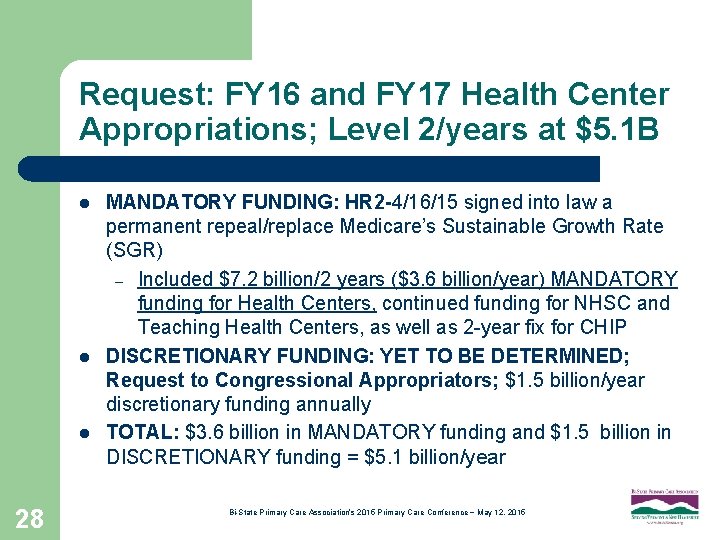
Request: FY 16 and FY 17 Health Center Appropriations; Level 2/years at $5. 1 B l l l 28 MANDATORY FUNDING: HR 2 -4/16/15 signed into law a permanent repeal/replace Medicare’s Sustainable Growth Rate (SGR) – Included $7. 2 billion/2 years ($3. 6 billion/year) MANDATORY funding for Health Centers, continued funding for NHSC and Teaching Health Centers, as well as 2 -year fix for CHIP DISCRETIONARY FUNDING: YET TO BE DETERMINED; Request to Congressional Appropriators; $1. 5 billion/year discretionary funding annually TOTAL: $3. 6 billion in MANDATORY funding and $1. 5 billion in DISCRETIONARY funding = $5. 1 billion/year Bi-State Primary Care Association’s 2015 Primary Care Conference ~ May 12, 2015
FY 16 Other Appropriations l l l 29 Health Centers: Bi-State’s ask is $5. 1 billion NHSC: Bi-State’s ask is $810 million AHEC (Base): Bi-State’s ask is $75 million MCH Title V: Bi-State’s ask is $637 million Title X: Bi-State’s ask is $327 million WIC: Bi-State’s ask is $6. 684 billion Bi-State Primary Care Association’s 2015 Primary Care Conference ~ May 12, 2015
ACA: Supreme Court (SCOTUS) Decision l On June 28, 2012, SCOTUS upheld the constitutionality of the ACA – Four discrete issues the Justices viewed: l l l In June 2015, SCOTUS will decide King vs. Burwell – 30 If SCOTUS should hear the case at all, as there is no “standing” since SCOTUS does not usually hear theoretical cases [heard the case] Whether the individual mandate is constitutional [upheld] What will happen if they strike down the mandate [no longer an issue] Whether Congress exceeded its Constitutional authority in expanding the eligibility and coverage thresholds that states must adopt to remain eligible for Medicaid [upheld the ability of the states to expand Medicaid but gave states the ability to choose or not choose expansion without losing their existing Medicaid funding; ultimately creating an option vs. a mandate] The contention is that residents of states that use the federal Exchange Market have wrongfully been subsiding people to purchase insurance Bi-State Primary Care Association’s 2015 Primary Care Conference ~ May 12, 2015

Questions and Answers Period 31 Bi-State Primary Care Association’s 2015 Primary Care Conference ~ May 12, 2015
115 th Congress: Administrative and Regulatory Priorities l l 32 Keep the gains made in HR 2: Successful fix to the longstanding Medicare SGR payment issue; reauthorized CHIP; and provided a 2 -year short-term fix for the mandatory funding for Health Centers Secure appropriations: Health Centers and NHSC discretionary; AHEC; Family Planning Title X; MCH Title V; and WIC Protect entitlement programs: Medicaid program changes in House and Senate budgets Favorable outcome: SCOTUS: King vs. Burwell Bi-State Primary Care Association’s 2015 Primary Care Conference ~ May 12, 2015
Pre-ACA VT Environment l 20+ year history of health reform – – l Governor’s Blueprint for Health (2003) – l – 33 Patient-Centered Medical Home and community-oriented collaboration VT Coalition 21 (2004) – – 1115 Waivers to expand Medicaid Insurance market reforms 28 organizations: Forge consensus to transform health care system Adopted 6 principles to implement state health care reform; springboard for reform Act 128 (2010): Health care financing and universal access bill Bi-State Primary Care Association’s 2015 Primary Care Conference ~ May 12, 2015
Post-ACA VT Environment l Legislative Reform: – Act 48 (2011): 3 primary areas (universal and unified health systems): l l l – l Act 171 (2012): health care reform implementation Administrative Decision: – December 2014 Governor Shumlin Announcement l 34 Established the Green Mountain Care Board Authorized Vermont Health Connect (the VT Exchange) Envisioned a universal and unified system to cover all VT residents by 2017 VT not ready for a “single payer” Bi-State Primary Care Association’s 2015 Primary Care Conference ~ May 12, 2015
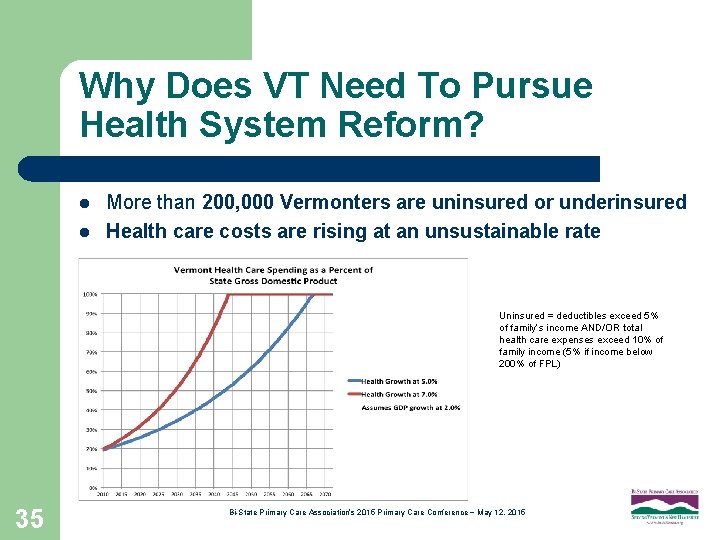
Why Does VT Need To Pursue Health System Reform? l l More than 200, 000 Vermonters are uninsured or underinsured Health care costs are rising at an unsustainable rate Uninsured = deductibles exceed 5% of family’s income AND/OR total health care expenses exceed 10% of family income (5% if income below 200% of FPL) 35 Bi-State Primary Care Association’s 2015 Primary Care Conference ~ May 12, 2015
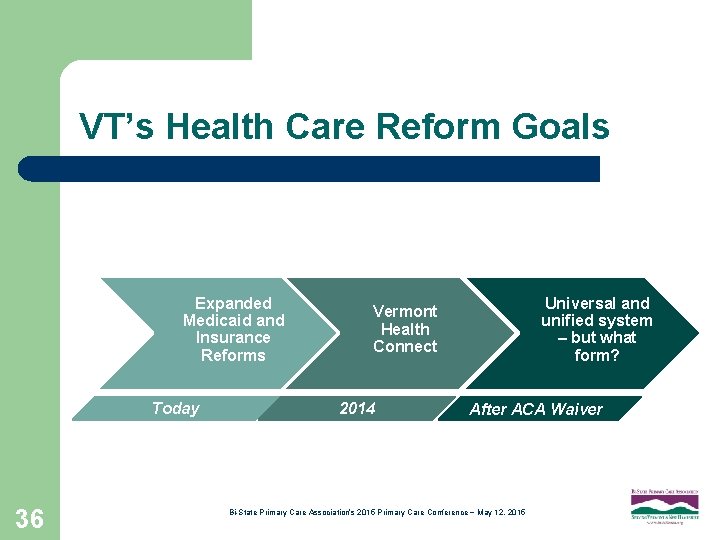
VT’s Health Care Reform Goals Expanded Medicaid and Insurance Reforms Today 36 Universal and unified system – but what form? Vermont Health Connect 2014 After ACA Waiver Bi-State Primary Care Association’s 2015 Primary Care Conference ~ May 12, 2015
VT’s Progress: Green Mountain Care Board’s Broad Powers l l l l 37 Payment and delivery system reform oversight Rate-setting authority (i. e. , system payment to providers) Health Information Technology plan approval Workforce plan approval Health resource allocation plan approval Approval of hospital budgets, Certificates of Need (CON) and insurance rates Quality measurement and evaluation Benefit package approval of Vermont Health Connect Bi-State Primary Care Association’s 2015 Primary Care Conference ~ May 12, 2015
VT’s Progress and Next Steps: Unique features: Vermont Health Connect l l l l l 38 Knowledge and tools to compare and choose a quality, affordable and comprehensive plan Participation in Vermont Health Connect is mandatory for individuals and small businesses (with 50 or fewer employees); no separate SHOP market For these individuals and businesses, plans will not be sold outside Vermont Health Connect Standard plans across individuals and employers for portability Vermont Health Connect is located within VT’s Medicaid office; facilitating both Medicaid and Vermont Health Connect enrollment Wrap-around funding to increase federal tax credits and cost-sharing subsidies Open enrollment for 2014 -2015 (November 15, 2014 -February 15, 2015) time period was shorter than initial open enrollment period of 6 months (October 1, 2013 -March 30, 2014) Open enrollment period for 2015 -2016 time period is expected to be even shorter; mimicking open enrollment periods offered by insurance carriers in past Portal went live on November 15; it was live for open enrollment, but delayed for several weeks Bi-State Primary Care Association’s 2015 Primary Care Conference ~ May 12, 2015
Post-ACA VT Environment: State Innovation Model (SIM) Grant l 3 ACOs – – – l CMS SIM funding: $45 Million – l 39 Community Health Accountable Care, LLC (CHAC): Medicare, Medicaid and Commercial Shared Savings VT Collaborative Physicians: Commercial Shared Savings One Care Vermont: Medicare, Medicaid and Commercial Shared Savings In February 2013, CMMI awarded $45 million over 4 -year project period (Bi. State received ~$1 million over 3 years to develop CHAC capacity, care model and quality reporting) State infrastructure for SIM (coming slide) Bi-State Primary Care Association’s 2015 Primary Care Conference ~ May 12, 2015
Participating in Effective Change in VT: Community Health Accountable Care, LLC l l l 40 Community Health Accountable Care, LLC (CHAC) organized in VT in June 2012 by founding membership comprised of 9 VT FQHCs and Bi-State (currently has 100% VT FQHCs as members) CHAC’s purpose based on Patient-Centered Medical Home model of primary care delivery CHAC is an extension of the ongoing mission of member FQHCs CHAC has entered into ACO health reform programs made available on behalf of Medicaid, Medicare and Commercial insured populations Reinvestments are intended to evolve CHAC and its Patient. Centered Medical Home model of care delivery CHAC has a Management Services Agreement with Bi-State Primary Care Association’s 2015 Primary Care Conference ~ May 12, 2015
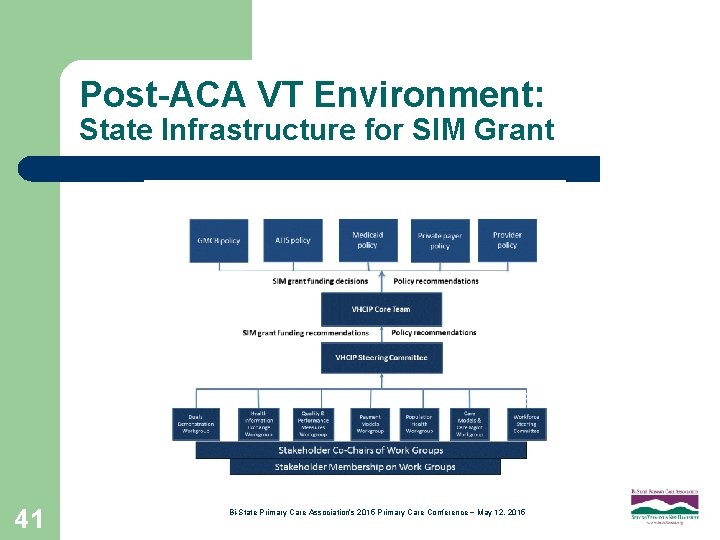
Post-ACA VT Environment: State Infrastructure for SIM Grant 41 Bi-State Primary Care Association’s 2015 Primary Care Conference ~ May 12, 2015
Post-ACA VT Environment: “All-Payer Waiver” – An Idea in the Works l l 42 A negotiated agreement with CMS/CMMI to waive Medicare payment rules Locks in a 3 -5 year agreed upon health expenditure trend for VT Meeting the trend requires cooperation from Medicaid and commercial payers, and providers (thus the term “all-payer model”) Responds to Secretary Burwell’s commitment to paying-for-value Bi-State Primary Care Association’s 2015 Primary Care Conference ~ May 12, 2015
Post-ACA VT Environment: “Next Generation ACO” – Another Idea in the Works l l l l 43 CMS’ newest ACO model that emerges from CMS’ Pioneer and Shared Savings ACO models CMS will make 15 -20 awards over next 2 years – competitive process One Care Vermont submitted a letter of intent for 1/1/16 start Aligns with Secretary Burwell’s focus on paying for value Requires “down-side” risk at the ACO level Offers several options for payments to providers within the ACO If awarded, contributes to VT goals of managing costs within allpayer model Bi-State Primary Care Association’s 2015 Primary Care Conference ~ May 12, 2015
Post-ACA NH Environment: Responses to Health Care Reform-Medicaid l NH SHIFTS TO MEDICAID CARE MANAGEMENT – l Traditional Medicaid population-SB 147 -June 2011 Medicaid Care Management: Current lives-155, 873 – – Delay regarding hospital lawsuit/Medicaid rates Resolved: l l – – Ongoing enrollment Mandatory Medicaid Care Management l 44 First stage began December 1, 2013 Second phase – Department of Health and Human Services must submit a 1915(b) and 1915(c) waivers to bring all populations into managed care Began with 3 Carriers (Centene/BMC-Health Plan-Meridian left the market) Bi-State Primary Care Association’s 2015 Primary Care Conference ~ May 12, 2015
Post-ACA NH Environment: Responses to Health Care Reform-Medicaid l NH General Court: NH PASSES MEDICAID EXPANSION – – Newly Expanded Medicaid Population Medicaid Expansion compromise; Medicaid Study Commission (Report: October 15, 2013) Special session; Expansion defeated (November 2013) General session (March 2014) l l l Signed into law March 27, 2014; NH HEALTH PROTECTION PROGRAM Open enrollment began July 1, 2014 and coverage began August 15, 2014 Over 38, 000 enrollees – – 45 Utilize 100% federal funds (provisions sunset after 2. 5 years-December 2016) Utilizes Health Insurance Premium Program (assess employer coverage for cost) Utilizes Voluntary Bridge into Marketplace (Medicaid Care Management option 1. 5 years started July 1, 2014 through December 31, 2015) Utilizes Marketplace Premium Assistance Programs; into Qualified Health Plans (1 year starting January 1, 2016 -December 31, 2016) Bi-State Primary Care Association’s 2015 Primary Care Conference ~ May 12, 2015
Post-ACA NH Environment: Responses to Health Care Reform-Marketplace l 2014 Qualified Health Plan (NH Marketplace) – 1 Qualified Health Plan (Anthem) l l l 2015 Qualified Health Plan (NH Marketplace) – 4 new Qualified Health Plans l l 46 Contracting with reduced rates Anthem’s Pathway Network: Narrow network in exchange for volume Market shift: 11 of 26 hospitals have no contract 40, 262 individuals selected a Marketplace plan (around 8, 800 additional eligible for Medicaid so shifted to Medicaid Managed Care) Assurant Health Harvard Pilgrim Maine Community Health Options Minuteman Health Bi-State Primary Care Association’s 2015 Primary Care Conference ~ May 12, 2015
Post-ACA NH Environment: Responses to Health Care Reform-Outreach l 2015 Outreach and Enrollment: Navigating the system – – – 47 Maximize coverage opportunities and support enrollment of individuals Bi-State Navigator (collaboration with Health Centers) Greater Derry Community Health Services Navigator Certificated Application Councilors NH/National website: www. healthcare. gov Bi-State Primary Care Association’s 2015 Primary Care Conference ~ May 12, 2015
Post-ACA NH Environment: Responses to Health Care Reform-ACO/MSO l l 48 ACO: North Country FQHCs-ACO-Medicare Shared Savings – Medicare Shared Savings ACO – Shared savings opportunity: Clinical and financial integration – Collective efficiencies Management Services Organization (MSO): Down State FQHCs-Primary Health Care Partners, LLC – Medicaid Care Management/Quality Health Plan contract negotiation – Shared savings opportunity: Clinical and financial – Collective efficiencies Bi-State Primary Care Association’s 2015 Primary Care Conference ~ May 12, 2015
NH Administrative and Legislative Priorities l l l Building capacity for transformation: Next steps for NH’s Transformational Waiver (1115 waiver) Retain Primary Care Funding Reauthorization of NH Health Protection Program (Medicaid Expansion population) Medicaid Care Management (Medicaid traditional population) Health Insurance Marketplace – – 49 https: //www. healthcare. gov/ www. nheasy. nh. gov Bi-State Primary Care Association’s 2015 Primary Care Conference ~ May 12, 2015

Questions and Answers Period 50 Bi-State Primary Care Association’s 2015 Primary Care Conference ~ May 12, 2015
Health Centers: Meeting Organizational Challenges l l l Responding to changes: Complexity of health reform; demanding efforts Positioning in the new health care Marketplace; requires added time and expertise Future expectations: – – l 51 Financial and/or clinical risk; think of clinical and financial outcomes data as your new “currency” Pay for Performance; Value Based Purchasing Policy and political engagement; requires added government relations time l l l Responsive to expanded state and federal changing systems re -design like ACO/MSO model; corporate compliance; transparency; changes to financial reimbursement Stresses on improving financial stability; state and federal financial fragility; create downward pressure on grantees Patient population is highly complex and receive their care through many differing organizations Bi-State Primary Care Association’s 2015 Primary Care Conference ~ May 12, 2015
Market Changes: Forecasting l l l l l 52 Moving to consumer oriented market Moving away from employer sponsored health insurance Consumers purchasing low premium, high deductible and high out-of-pocket coverage Organizations moving the needle on population health; reduce Total Medical Expense Moving to a digital world/high tech interfaces; consumer will accept tele-health/telemedicine Data are our new currency; must demonstrate value to consumer and payer Competition will not have traditional borders ACOs will eventually move to “community accountability; ” all inclusive of continuum of care Sequestration foreshadowing: A few sequential changes to federal/state law could create significant changes/Possible Sea Changes to Medicare/Medicaid Programs Boards need a strong understanding of the fundamental health and social service changes Bi-State Primary Care Association’s 2015 Primary Care Conference ~ May 12, 2015
Health Center Board Member: Lessons Learned Health care reform is hard! It takes time! Years l It takes financial investments l It takes leadership and a clear vision l l 53 It takes political influence Without leadership and vision, you can waste years and money and accomplish nothing Even with leadership and vision, constant vigilance, community education and communication is essential Bi-State Primary Care Association’s 2015 Primary Care Conference ~ May 12, 2015
Health Center Board Member: Lessons Learned l Keep your eye on your mission and community – l Take time to promote achievements and progress – l 54 Flexibility is crucial, as long as it doesn’t subvert attaining the ultimate goal It reminds people why we are doing this Data are critical for measuring success and for evaluation Bi-State Primary Care Association’s 2015 Primary Care Conference ~ May 12, 2015
Health Center Board Member: Lessons Learned l Ultimately, health care is not a system, it is a human enterprise – – 55 Change is best achieved and sustained when those affected by it are included in the making of it (Your Health Center Board role!) All stakeholders must be partners in the enterprise (Your Health Center Board role!) Bi-State Primary Care Association’s 2015 Primary Care Conference ~ May 12, 2015

Questions and Answers Period 56 Bi-State Primary Care Association’s 2015 Primary Care Conference ~ May 12, 2015
Contact Tess Stack Kuenning, CNS, MS, RN President and Chief Executive Officer of Bi-State Primary Care Association (603) 228 -2830, extension 112 tkuenning@bistatepca. org www. bistatepca. org David Reynolds, Dr. PH Health Policy Analyst and Founder of Vermont’s First Federally Qualified Health Center (802) 743 -3443 davidreynolds 2013@yahoo. com Sharon Winn, Esq. , MPH Director, Vermont Public Policy of Bi-State Primary Care Association (802) 229 -0002, extension 218 swinn@bistatepca. org 57 Bi-State Primary Care Association’s 2015 Primary Care Conference ~ May 12, 2015
- Slides: 57