
Governance diversity From Durban to Sydney towards a
Governance diversity From Durban to Sydney – towards a Copernican revolution for protected areas? Dr. Grazia Borrini. Feyerabend gbf@iccaconsortium. org
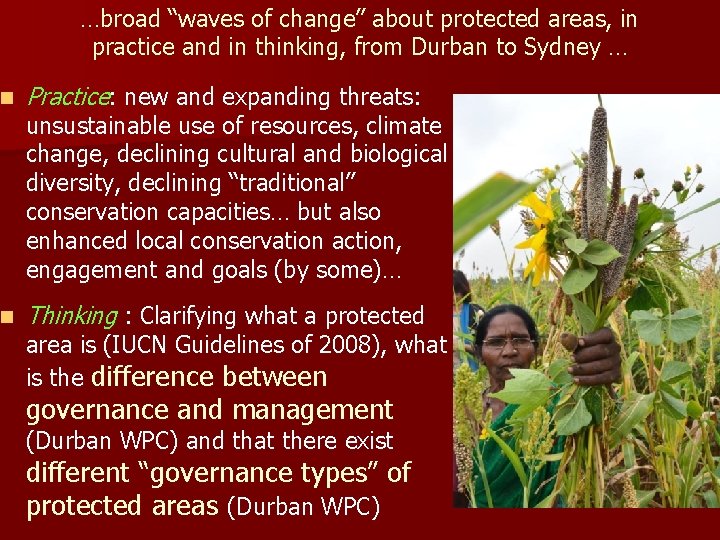
…broad “waves of change” about protected areas, in practice and in thinking, from Durban to Sydney … n Practice: new and expanding threats: n Thinking : Clarifying what a protected unsustainable use of resources, climate change, declining cultural and biological diversity, declining “traditional” conservation capacities… but also enhanced local conservation action, engagement and goals (by some)… area is (IUCN Guidelines of 2008), what is the difference between governance and management (Durban WPC) and that there exist different “governance types” of protected areas (Durban WPC)
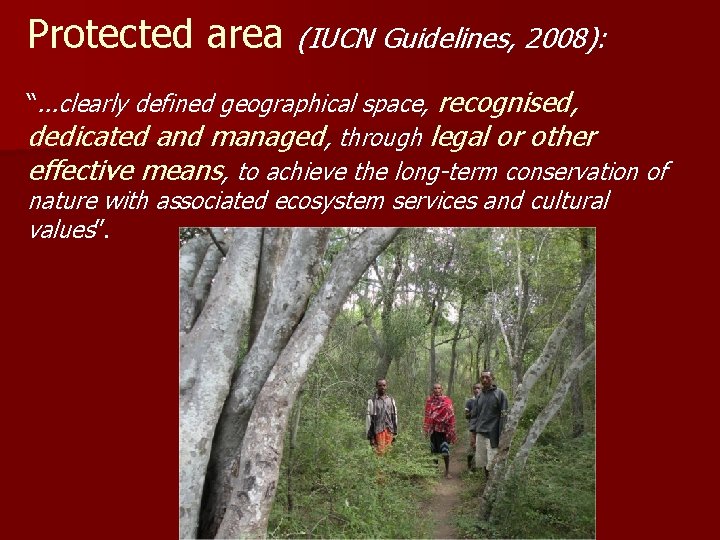
Protected area (IUCN Guidelines, 2008): recognised, dedicated and managed, through legal or other effective means, to achieve the long-term conservation of “. . . clearly defined geographical space, nature with associated ecosystem services and cultural values”.
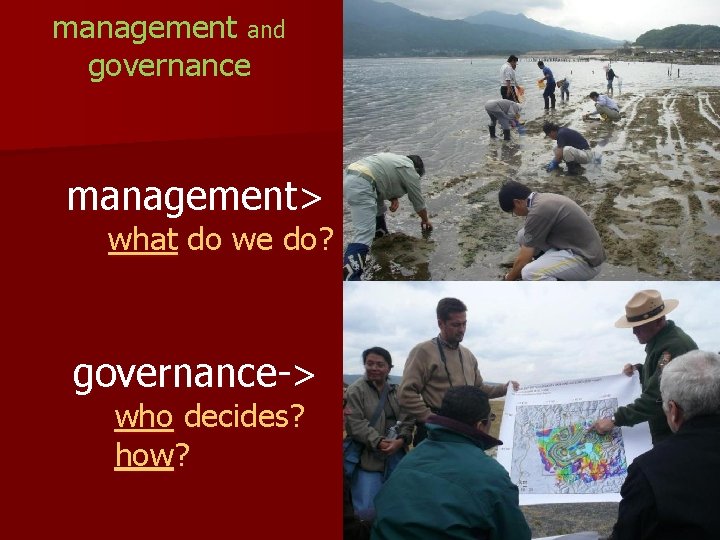
management and governance management> what do we do? governance-> who decides? how?
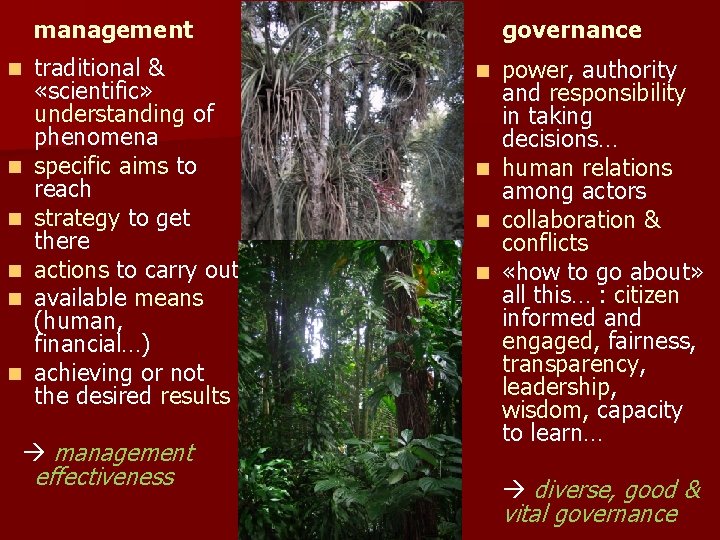
management n n n traditional & «scientific» understanding of phenomena specific aims to reach strategy to get there actions to carry out available means (human, financial…) achieving or not the desired results management effectiveness governance n n power, authority and responsibility in taking decisions… human relations among actors collaboration & conflicts «how to go about» all this… : citizen informed and engaged, fairness, transparency, leadership, wisdom, capacity to learn… diverse, good & vital governance
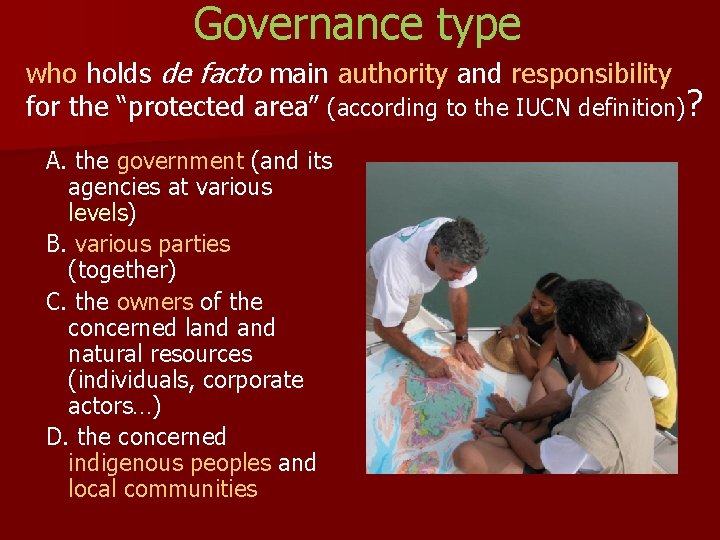
Governance type who holds de facto main authority and responsibility for the “protected area” (according to the IUCN definition)? A. the government (and its agencies at various levels) B. various parties (together) C. the owners of the concerned land natural resources (individuals, corporate actors…) D. the concerned indigenous peoples and local communities
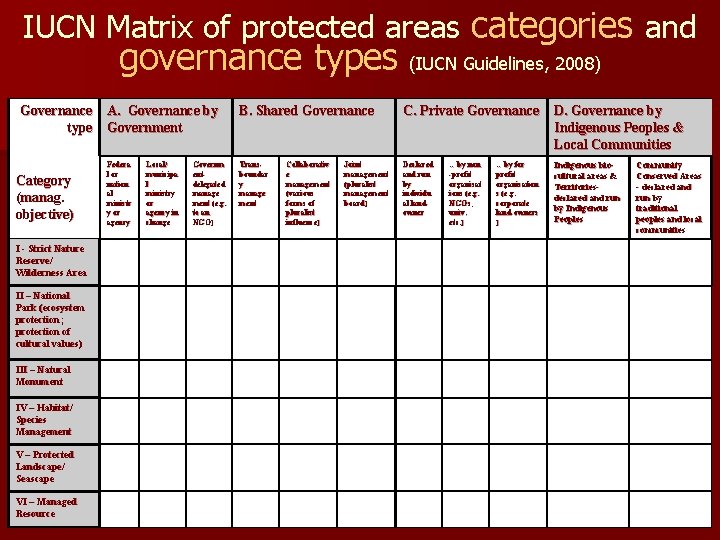
IUCN Matrix of protected areas categories and governance types (IUCN Guidelines, 2008) Governance A. Governance by type Government Category (manag. objective) I - Strict Nature Reserve/ Wilderness Area II – National Park (ecosystem protection; protection of cultural values) III – Natural Monument IV – Habitat/ Species Management V – Protected Landscape/ Seascape VI – Managed Resource Federa l or nation al ministr y or agency Local/ municipa l ministry or agency in change Governm entdelegated manage ment (e. g. to an NGO) B. Shared Governance C. Private Governance D. Governance by Indigenous Peoples & Local Communities Transboundar y manage ment Declared and run by individu al landowner Indigenous biocultural areas & Territoriesdeclared and run by Indigenous Peoples Collaborativ e management (various forms of pluralist influence) Joint management (pluralist management board) …by non -profit organisat ions (e. g. NGOs, univ. etc. ) …by for profit organisation s (e. g. corporate land-owners ) Community Conserved Areas - declared and run by traditional peoples and local communities
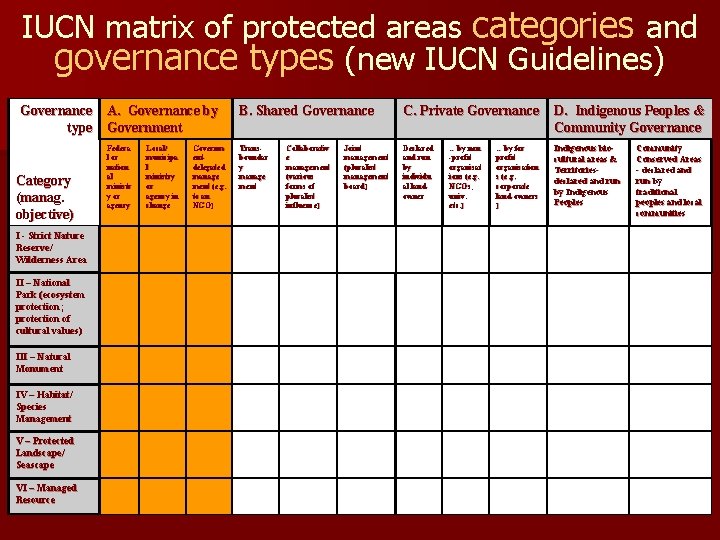
IUCN matrix of protected areas categories and governance types (new IUCN Guidelines) Governance A. Governance by type Government Category (manag. objective) I - Strict Nature Reserve/ Wilderness Area II – National Park (ecosystem protection; protection of cultural values) III – Natural Monument IV – Habitat/ Species Management V – Protected Landscape/ Seascape VI – Managed Resource Federa l or nation al ministr y or agency Local/ municipa l ministry or agency in change Governm entdelegated manage ment (e. g. to an NGO) B. Shared Governance C. Private Governance D. Indigenous Peoples & Community Governance Transboundar y manage ment Declared and run by individu al landowner Indigenous biocultural areas & Territoriesdeclared and run by Indigenous Peoples Collaborativ e management (various forms of pluralist influence) Joint management (pluralist management board) …by non -profit organisat ions (e. g. NGOs, univ. etc. ) …by for profit organisation s (e. g. corporate land-owners ) Community Conserved Areas - declared and run by traditional peoples and local communities

IUCN matrix of protected areas categories and governance types (new IUCN Guidelines) Governance A. Governance by type Government Category (manag. objective) I - Strict Nature Reserve/ Wilderness Area II – National Park (ecosystem protection; protection of cultural values) III – Natural Monument IV – Habitat/ Species Management V – Protected Landscape/ Seascape VI – Managed Resource Federa l or nation al ministr y or agency Local/ municipa l ministry or agency in change Governm entdelegated manage ment (e. g. to an NGO) B. Shared Governance C. Private Governance D. Indigenous Peoples & Community Governance Transboundar y manage ment Declared and run by individu al landowner Indigenous biocultural areas & Territoriesdeclared and run by Indigenous Peoples Collaborativ e management (various forms of pluralist influence) Joint management (pluralist management board) …by non -profit organisat ions (e. g. NGOs, univ. etc. ) …by for profit organisation s (e. g. corporate land-owners ) Community Conserved Areas - declared and run by traditional peoples and local communities
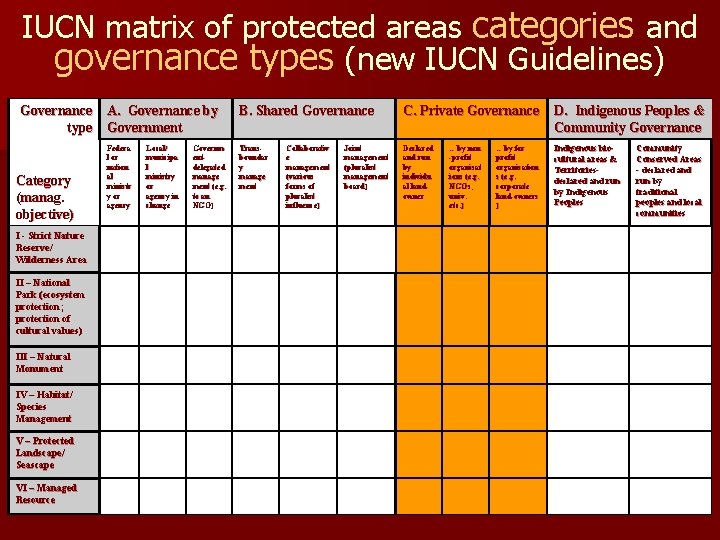
IUCN matrix of protected areas categories and governance types (new IUCN Guidelines) Governance A. Governance by type Government Category (manag. objective) I - Strict Nature Reserve/ Wilderness Area II – National Park (ecosystem protection; protection of cultural values) III – Natural Monument IV – Habitat/ Species Management V – Protected Landscape/ Seascape VI – Managed Resource Federa l or nation al ministr y or agency Local/ municipa l ministry or agency in change Governm entdelegated manage ment (e. g. to an NGO) B. Shared Governance C. Private Governance D. Indigenous Peoples & Community Governance Transboundar y manage ment Declared and run by individu al landowner Indigenous biocultural areas & Territoriesdeclared and run by Indigenous Peoples Collaborativ e management (various forms of pluralist influence) Joint management (pluralist management board) …by non -profit organisat ions (e. g. NGOs, univ. etc. ) …by for profit organisation s (e. g. corporate land-owners ) Community Conserved Areas - declared and run by traditional peoples and local communities
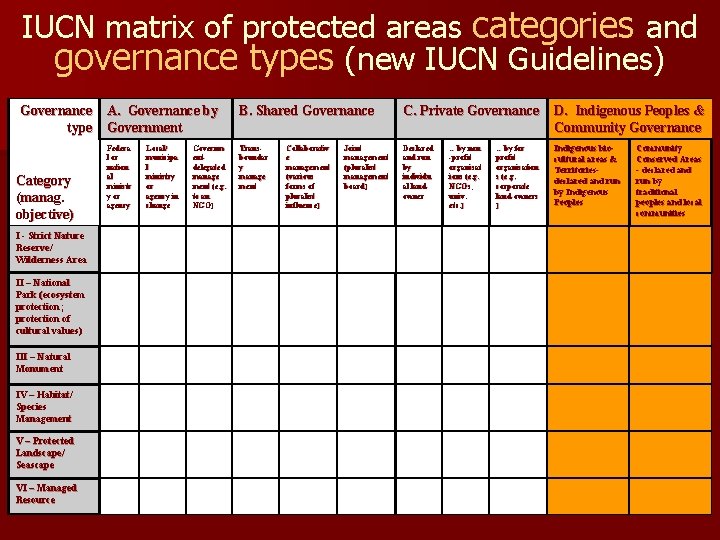
IUCN matrix of protected areas categories and governance types (new IUCN Guidelines) Governance A. Governance by type Government Category (manag. objective) I - Strict Nature Reserve/ Wilderness Area II – National Park (ecosystem protection; protection of cultural values) III – Natural Monument IV – Habitat/ Species Management V – Protected Landscape/ Seascape VI – Managed Resource Federa l or nation al ministr y or agency Local/ municipa l ministry or agency in change Governm entdelegated manage ment (e. g. to an NGO) B. Shared Governance C. Private Governance D. Indigenous Peoples & Community Governance Transboundar y manage ment Declared and run by individu al landowner Indigenous biocultural areas & Territoriesdeclared and run by Indigenous Peoples Collaborativ e management (various forms of pluralist influence) Joint management (pluralist management board) …by non -profit organisat ions (e. g. NGOs, univ. etc. ) …by for profit organisation s (e. g. corporate land-owners ) Community Conserved Areas - declared and run by traditional peoples and local communities
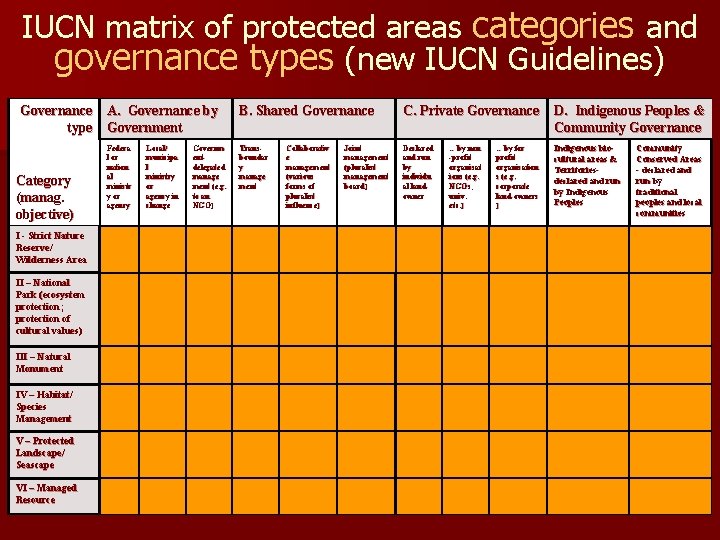
IUCN matrix of protected areas categories and governance types (new IUCN Guidelines) Governance A. Governance by type Government Category (manag. objective) I - Strict Nature Reserve/ Wilderness Area II – National Park (ecosystem protection; protection of cultural values) III – Natural Monument IV – Habitat/ Species Management V – Protected Landscape/ Seascape VI – Managed Resource Federa l or nation al ministr y or agency Local/ municipa l ministry or agency in change Governm entdelegated manage ment (e. g. to an NGO) B. Shared Governance C. Private Governance D. Indigenous Peoples & Community Governance Transboundar y manage ment Declared and run by individu al landowner Indigenous biocultural areas & Territoriesdeclared and run by Indigenous Peoples Collaborativ e management (various forms of pluralist influence) Joint management (pluralist management board) …by non -profit organisat ions (e. g. NGOs, univ. etc. ) …by for profit organisation s (e. g. corporate land-owners ) Community Conserved Areas - declared and run by traditional peoples and local communities
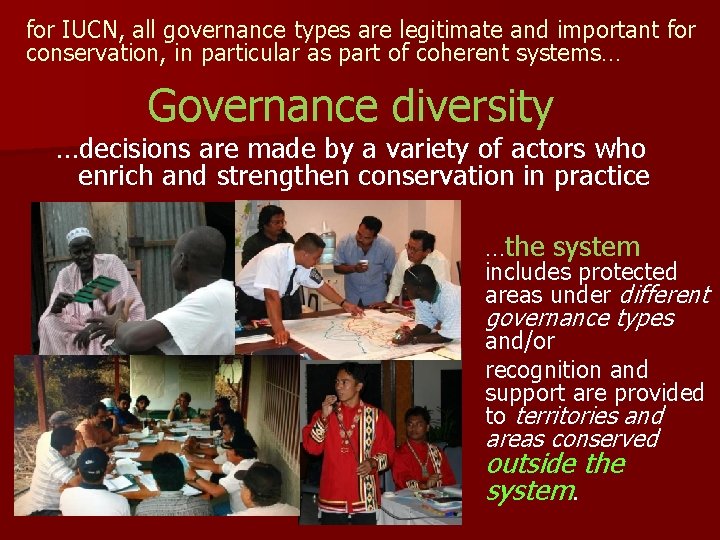
for IUCN, all governance types are legitimate and important for conservation, in particular as part of coherent systems… Governance diversity …decisions are made by a variety of actors who enrich and strengthen conservation in practice …the system includes protected areas under different governance types and/or recognition and support are provided to territories and areas conserved outside the system.
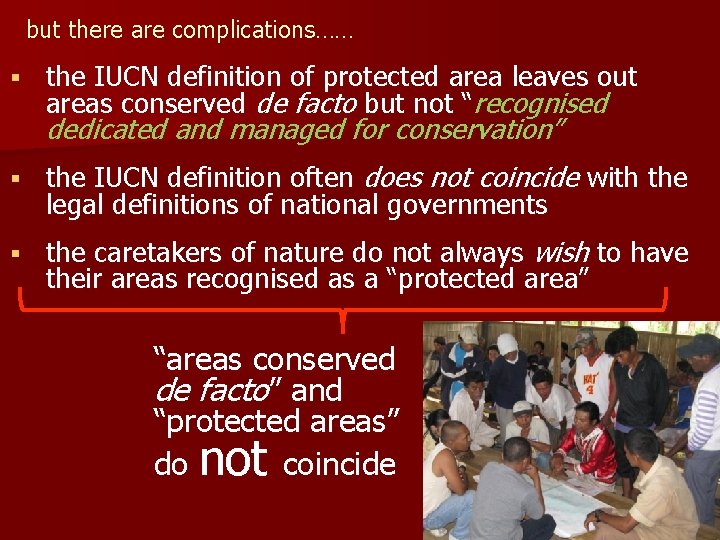
but there are complications…… § the IUCN definition of protected area leaves out areas conserved de facto but not “recognised dedicated and managed for conservation” § the IUCN definition often does not coincide with the legal definitions of national governments § the caretakers of nature do not always wish to have their areas recognised as a “protected area” “areas conserved de facto” and “protected areas” do not coincide
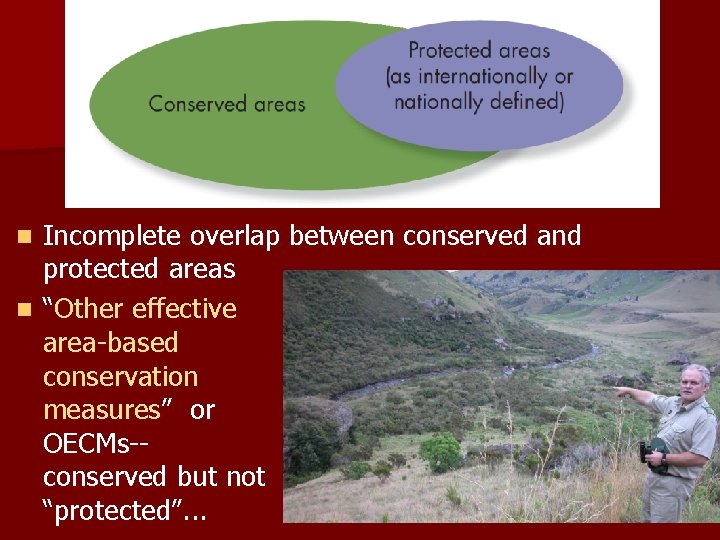
Incomplete overlap between conserved and protected areas n “Other effective area-based conservation measures” or OECMs-conserved but not “protected”. . . n
n OECMs: – Not “protected” but conserved de facto – Permanence / long term – Regardless of can recognition, include: dedication… Ø Primary voluntary conservation that the national government does not recognise as a protected area Ø Primary voluntary conservation refuses the protected area label and/or inclusion in that the national system (e. g. because of self-determination and selfgovernance issues) Ø Secondary voluntary conservation Ø Ancillary conservation with a reasonable expectation to be maintained in the long-term
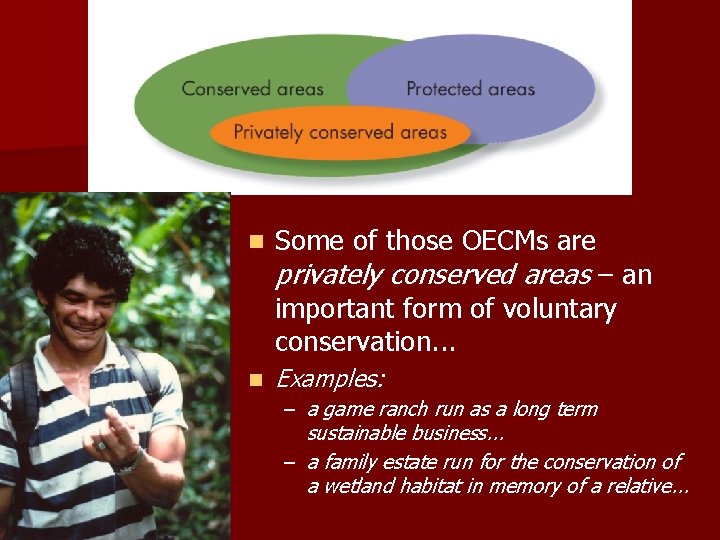
n Some of those OECMs are privately conserved areas – an important form of voluntary conservation. . . n Examples: – a game ranch run as a long term sustainable business. . . – a family estate run for the conservation of a wetland habitat in memory of a relative. . .
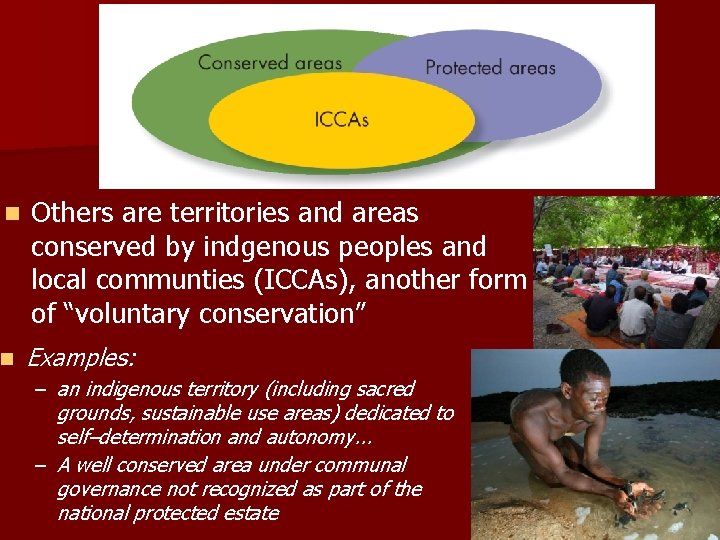
n Others are territories and areas conserved by indgenous peoples and local communties (ICCAs), another form of “voluntary conservation” n Examples: – an indigenous territory (including sacred grounds, sustainable use areas) dedicated to self–determination and autonomy. . . – A well conserved area under communal governance not recognized as part of the national protected estate
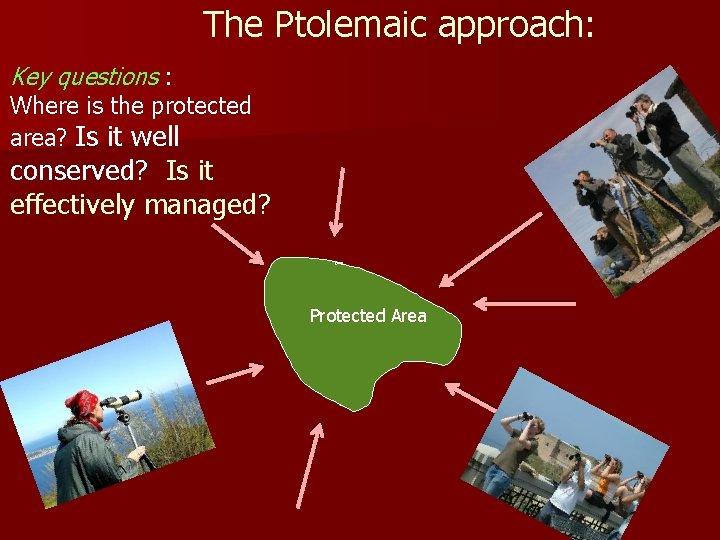
The Ptolemaic approach: Key questions : Where is the protected area? Is it well conserved? Is it effectively managed? Protected Area
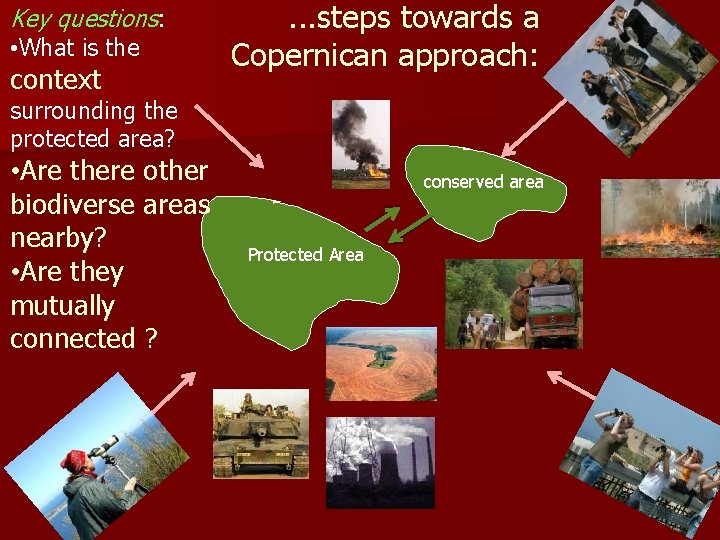
Key questions: • What is the context . . . steps towards a Copernican approach: surrounding the protected area? • Are there other biodiverse areas nearby? • Are they mutually connected ? conserved area Protected Area
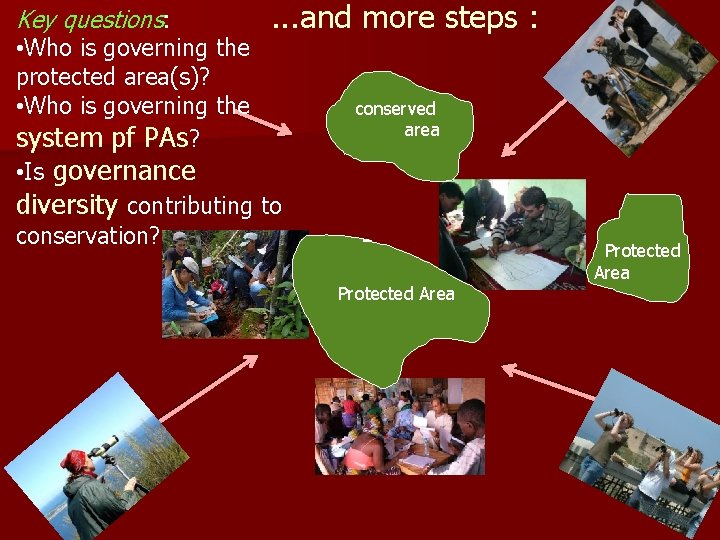
Key questions: • Who is governing the . . . and more steps : protected area(s)? • Who is governing the system pf PAs? • Is governance diversity contributing to conservation? conserved area Protected Area
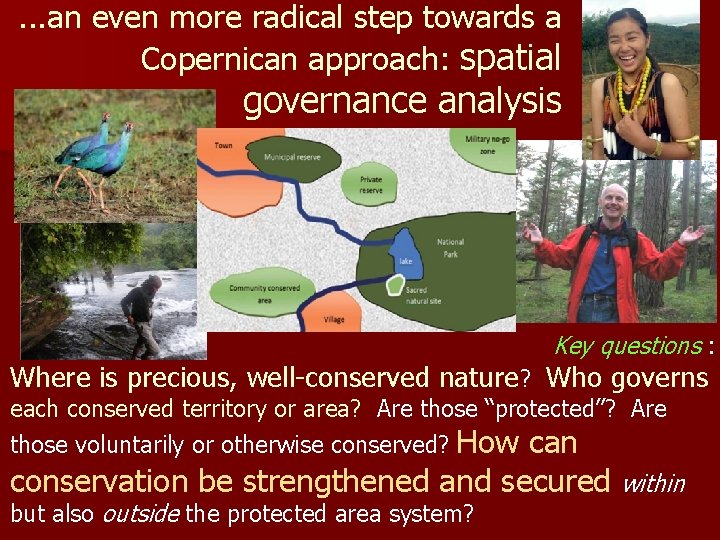
. . . an even more radical step towards a Copernican approach: spatial governance analysis Key questions : Where is precious, well-conserved nature? Who governs each conserved territory or area? Are those “protected”? Are those voluntarily or otherwise conserved? How can conservation be strengthened and secured within but also outside the protected area system?
- Slides: 22