
Governance Convention on tripartite consultation and related Recommendation

- Slides: 18
Governance Convention on tripartite consultation (and related Recommendation) 28 November 2016 Evelin Toth Mucciaro, ACTRAV ITC-ILO 1
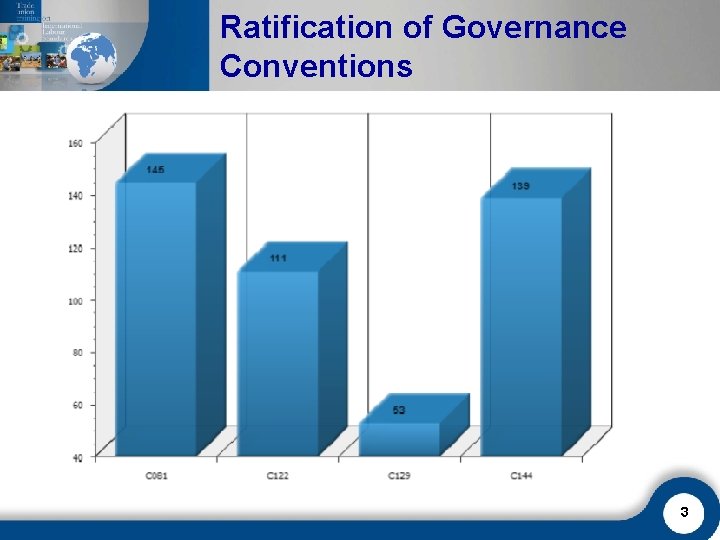
Governance Conventions Tripartite Consultation (International Labour Standards) Convention, 1976 (No. 144) Labour Inspection Convention, 1947 (No. 81) Labour Inspection (Agriculture) Convention, 1969 (No. 129) Employment Policy Convention, 1964 (No. 122) 2
Ratification of Governance Conventions 3
International Labour Standards on Tripartite Consultation § The ILO is based on the principle of tripartism – dialogue and cooperation between governments, employers, and workers - in the formulation of standards and policies dealing with labour matters § International labour standards are created and supervised through a tripartite structure that makes the ILO unique in the United Nations system § The tripartite approach to adopting standards ensures that they have broad support from all ILO constituents 4
International Labour Standards on Tripartite Consultation § Tripartism with regard to ILO standards is also important at the national level § Through regular tripartite consultations, governments can ensure that ILO standards are formulated, applied and supervised with the participation of employers and workers § ILO standards on tripartite consultation set forth the framework for effective national tripartite consultations § Such consultations can ensure greater cooperation among the social partners and stronger awareness and participation in matters relating to international labour standards, and can lead to better governance and a greater culture of social dialogue on wider social and economic issues. 5
Because of the importance of tripartism, the ILO has made the ratification and implementation of the Tripartite Consultation (International Labour Standards) Convention, 1976 (No. 144) a priority 6
C 144: Art. 1 § the term representative organisations means the most representative organisations of employers and workers enjoying the right of freedom of association 7
C 144: Art. 2 and Art. 5 Each State party to the Convention undertakes to operate procedures which ensure effective consultations between representatives of the government, of employers and of workers with respect to the following activities of the ILO: a) government replies to questionnaires concerning items on the agenda of the Conference and government comments on proposed texts to be discussed by the Conference; b) submission of Conventions and Recommendations to the competent authorities pursuant to article 19 of the Constitution; 8
C 144: Art. 2 and Art. 5 re-examination of unratified Conventions and of Recommendations to which effect has not yet been given, to consider what measures might be taken to promote their implementation and ratification as appropriate; d) questions arising out of reports to be made to the International Labour Office under Article 22 of the Constitution of ILO (reports on the application of ratified Conventions). e) proposals for the denunciation of ratified Conventions. c) § These consultations shall be undertaken at appropriate intervals fixed by agreement, but at least once a year. 9
C 144: Art. 3 § The representatives of employers and workers for the purposes of the procedures provided for in this Convention shall be freely chosen by their representative organisations, where such organisations exist. (Art. 3) § Employers and workers shall be represented on an equal footing on any bodies through which consultations are undertaken. (Art. 3) 10
The competent authority shall § assume responsibility for the administrative support of the procedures provided for in this Convention (Art. 4) § make appropriate arrangements with the representative organizations, for the financing of any necessary training of participants in these procedures (Art. 4) § issue an annual report on the working of the procedures, when this is considered appropriate after consultation with the representative organizations (Art. 6) 11
Tripartite Consultation (Activities of the ILO) Recommendation No. 152, 1976 12
R 152 General Provisions Employers and workers should be represented on an equal footing on any bodies through which consultations are undertaken. • The Recommendation enumerates various procedures through which tripartite consultations may be held, including: • a committee specifically constituted for questions concerning the activities of the ILO; • a body with general competence in the economic, social or labour fields; • a number of bodies with special responsibility for particular subject areas; or • written communications, where those involved in the consultative procedures are agreed that they are 13 •
R 152 General Provisions § Each State should operate procedures which ensure effective consultations between representatives of the government, of employers and of workers on the preparation and implementation of the measures to give effect to ILO Conventions and Recommendations, in particular to ratified Conventions. 14
R 152 General Provisions • The competent national authority, after consultation with the representative organizations of employers and workers, should determine the extent to which these procedures should be used for other matters of mutual concern, such as: • the preparation, implementation and evaluation of ILO technical cooperation activities; • the action to be taken in respect of resolutions and conclusions adopted by the Conference, regional conferences and other meetings convened by the ILO; • the measures to be taken to promote a better knowledge of ILO activities. 15
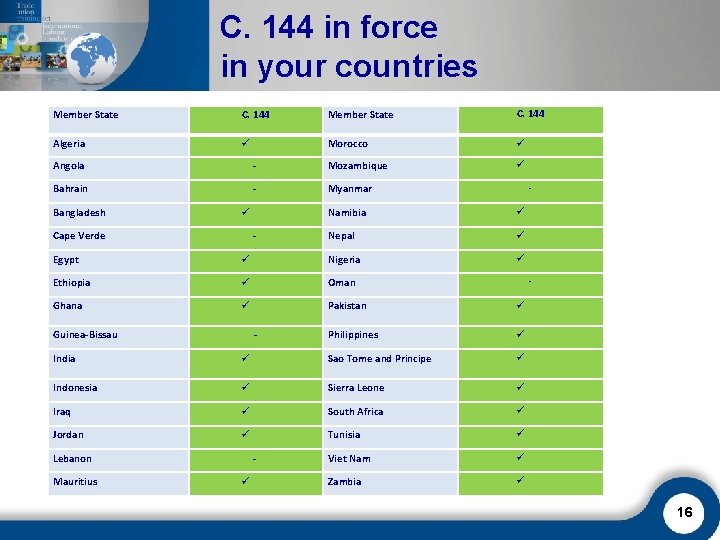
C. 144 in force in your countries Member State C. 144 Algeria Morocco Angola - Mozambique Bahrain - Myanmar Bangladesh Cape Verde - - Namibia Nepal Egypt Nigeria Ethiopia Oman Ghana Pakistan Philippines Guinea-Bissau - - India Sao Tome and Principe Indonesia Sierra Leone Iraq South Africa Jordan Tunisia Viet Nam Zambia Lebanon Mauritius - 16
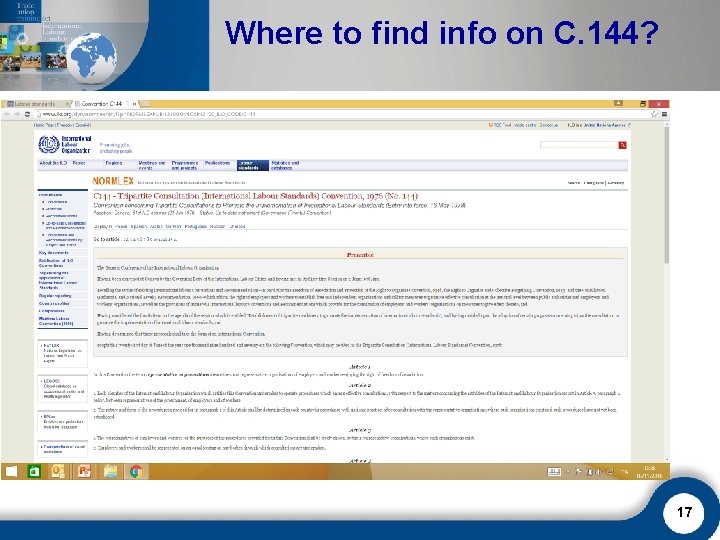
Where to find info on C. 144? 17
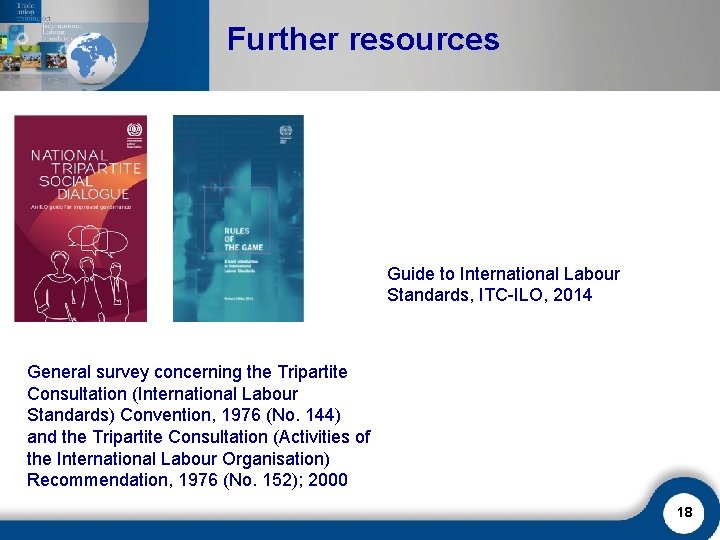
Further resources Guide to International Labour Standards, ITC-ILO, 2014 General survey concerning the Tripartite Consultation (International Labour Standards) Convention, 1976 (No. 144) and the Tripartite Consultation (Activities of the International Labour Organisation) Recommendation, 1976 (No. 152); 2000 18