
Governance and Management in FPOs Challenges and Ways

- Slides: 18
Governance and Management in FPOs: Challenges and Ways to Resolve 12 th July 2019, Hyderabad
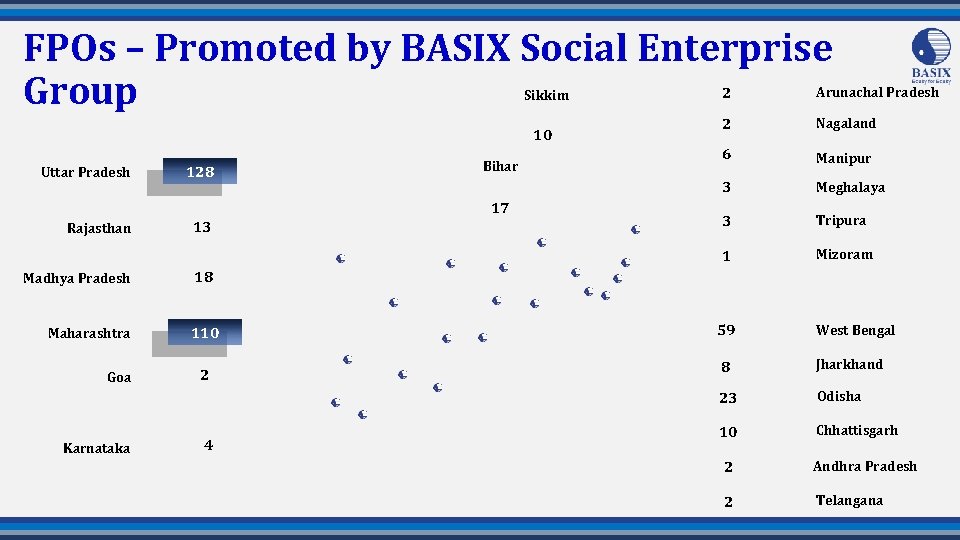
FPOs – Promoted by BASIX Social Enterprise Group Sikkim 10 Uttar Pradesh 128 Bihar 17 Rajasthan Madhya Pradesh Maharashtra Goa Karnataka 13 2 Arunachal Pradesh 2 Nagaland 6 Manipur 3 Meghalaya 3 Tripura 1 Mizoram 18 110 59 West Bengal 2 8 Jharkhand 23 Odisha 10 Chhattisgarh 4 2 Andhra Pradesh 2 Telangana
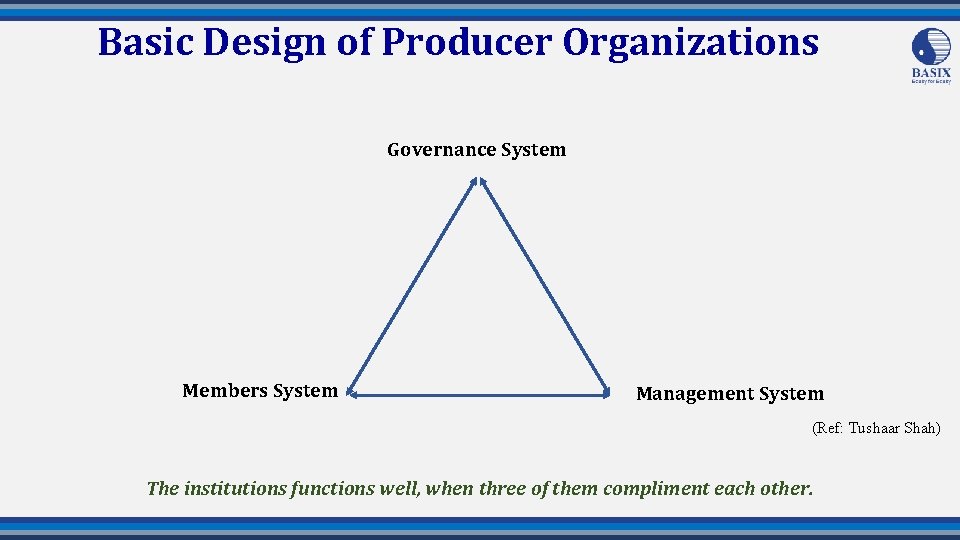
Basic Design of Producer Organizations Governance System Members System Management System (Ref: Tushaar Shah) The institutions functions well, when three of them compliment each other.
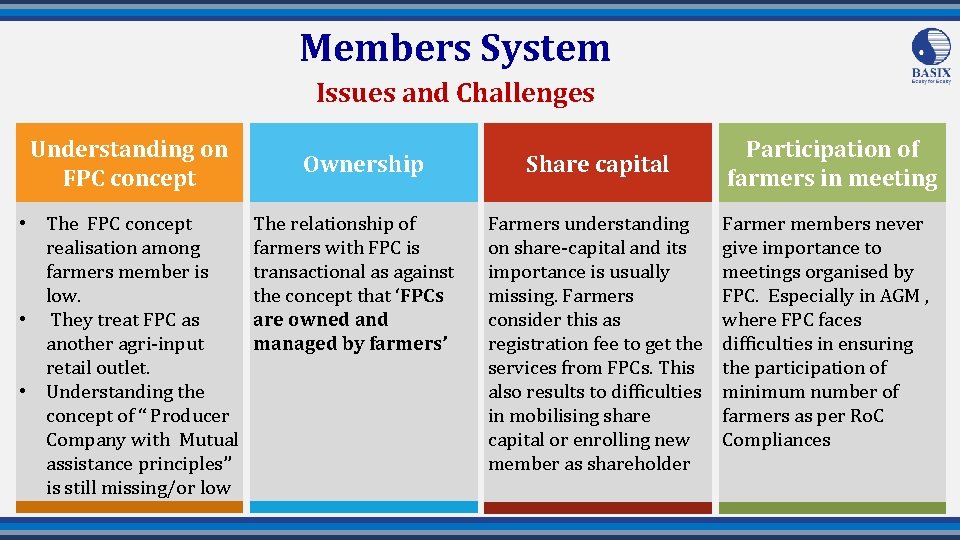
Members System Issues and Challenges Understanding on FPC concept • The FPC concept realisation among farmers member is low. • They treat FPC as another agri-input retail outlet. • Understanding the concept of “ Producer Company with Mutual assistance principles” is still missing/or low Ownership The relationship of farmers with FPC is transactional as against the concept that ‘FPCs are owned and managed by farmers’ Share capital Farmers understanding on share-capital and its importance is usually missing. Farmers consider this as registration fee to get the services from FPCs. This also results to difficulties in mobilising share capital or enrolling new member as shareholder Participation of farmers in meeting Farmer members never give importance to meetings organised by FPC. Especially in AGM , where FPC faces difficulties in ensuring the participation of minimum number of farmers as per Ro. C Compliances
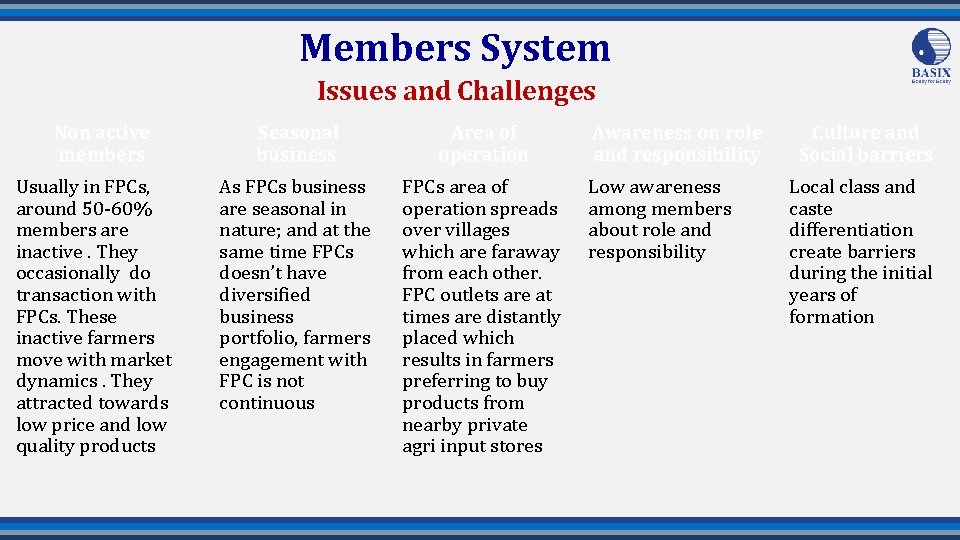
Members System Issues and Challenges Non active members Usually in FPCs, around 50 -60% members are inactive. They occasionally do transaction with FPCs. These inactive farmers move with market dynamics. They attracted towards low price and low quality products Seasonal business Area of operation As FPCs business are seasonal in nature; and at the same time FPCs doesn’t have diversified business portfolio, farmers engagement with FPC is not continuous FPCs area of operation spreads over villages which are faraway from each other. FPC outlets are at times are distantly placed which results in farmers preferring to buy products from nearby private agri input stores Awareness on role and responsibility Low awareness among members about role and responsibility Culture and Social barriers Local class and caste differentiation create barriers during the initial years of formation
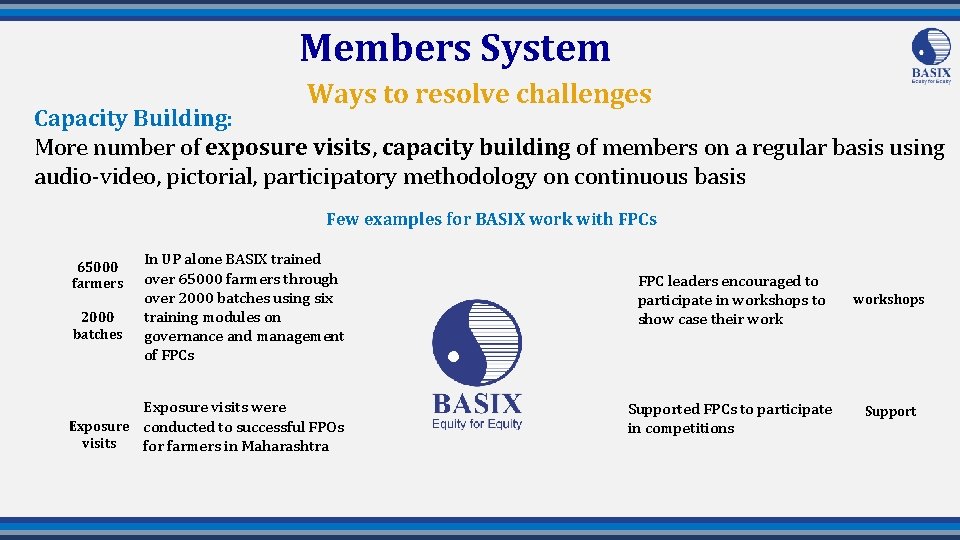
Members System Ways to resolve challenges Capacity Building: More number of exposure visits, capacity building of members on a regular basis using audio-video, pictorial, participatory methodology on continuous basis Few examples for BASIX work with FPCs 65000 farmers 2000 batches In UP alone BASIX trained over 65000 farmers through over 2000 batches using six training modules on governance and management of FPCs Exposure visits were Exposure conducted to successful FPOs visits for farmers in Maharashtra FPC leaders encouraged to participate in workshops to show case their work Supported FPCs to participate in competitions workshops Support
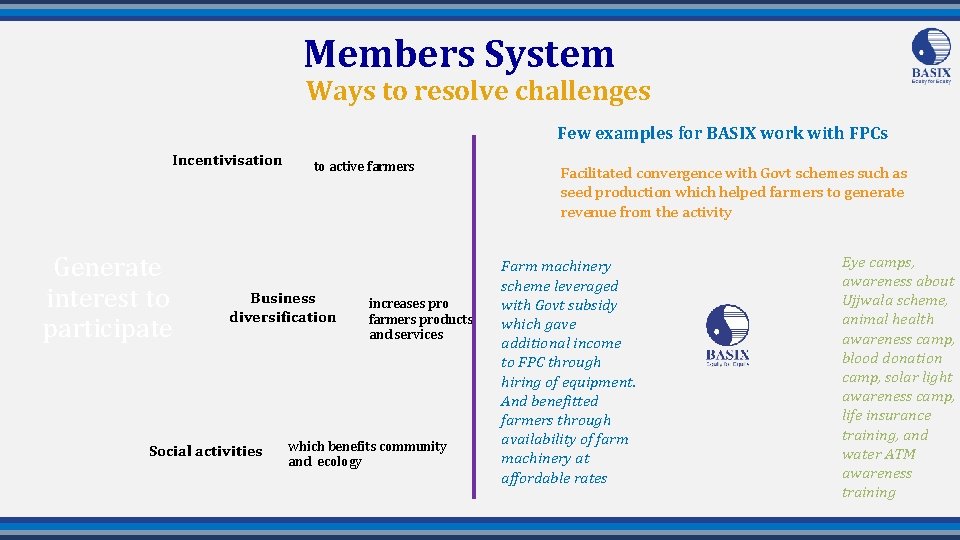
Members System Ways to resolve challenges Few examples for BASIX work with FPCs Incentivisation Generate interest to participate to active farmers Business diversification Social activities increases pro farmers products and services which benefits community and ecology Facilitated convergence with Govt schemes such as seed production which helped farmers to generate revenue from the activity Farm machinery scheme leveraged with Govt subsidy which gave additional income to FPC through hiring of equipment. And benefitted farmers through availability of farm machinery at affordable rates Eye camps, awareness about Ujjwala scheme, animal health awareness camp, blood donation camp, solar light awareness camp, life insurance training, and water ATM awareness training
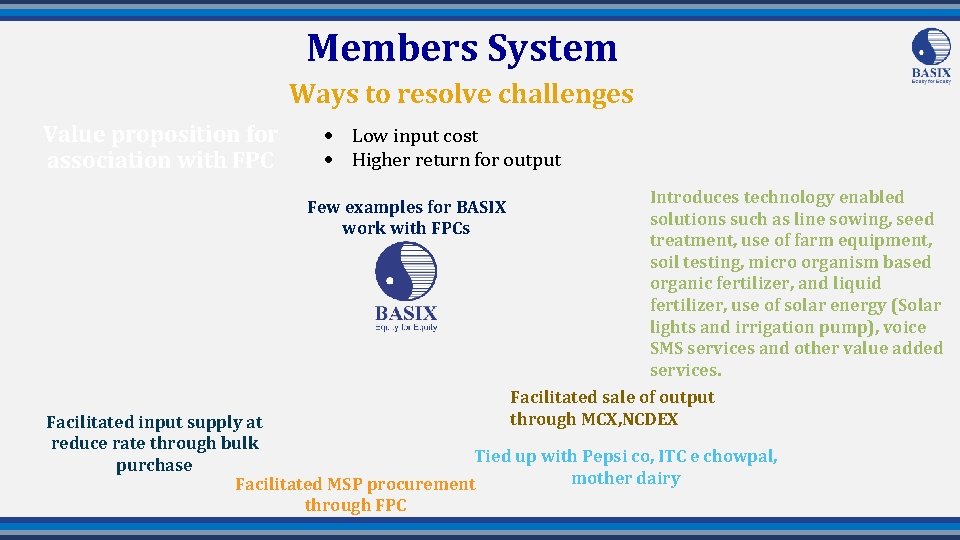
Members System Ways to resolve challenges Value proposition for association with FPC Low input cost Higher return for output Few examples for BASIX work with FPCs Introduces technology enabled solutions such as line sowing, seed treatment, use of farm equipment, soil testing, micro organism based organic fertilizer, and liquid fertilizer, use of solar energy (Solar lights and irrigation pump), voice SMS services and other value added services. Facilitated sale of output through MCX, NCDEX Facilitated input supply at reduce rate through bulk Tied up with Pepsi co, ITC e chowpal, purchase mother dairy Facilitated MSP procurement through FPC
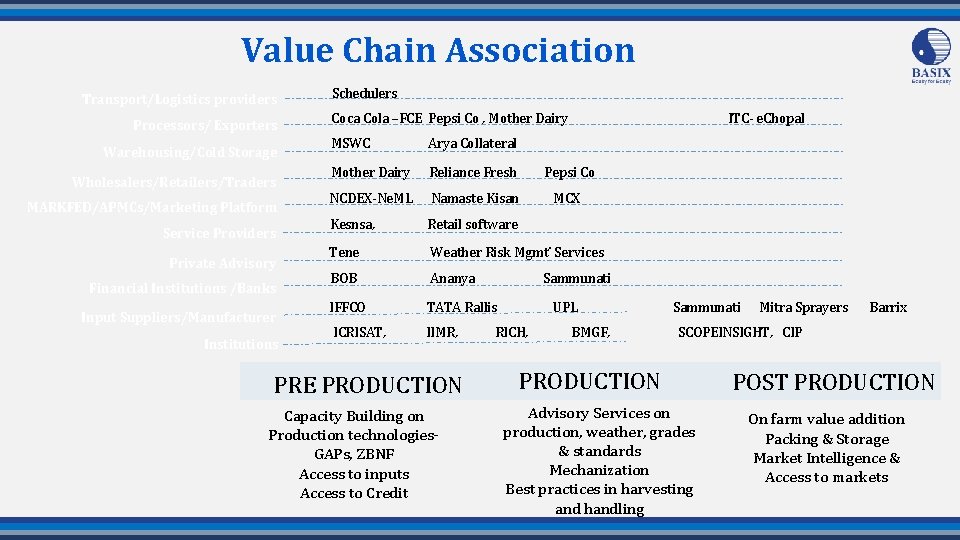
Value Chain Association Transport/Logistics providers Processors/ Exporters Warehousing/Cold Storage Wholesalers/Retailers/Traders MARKFED/APMCs/Marketing Platform Service Providers Private Advisory Financial Institutions /Banks Input Suppliers/Manufacturer Institutions Schedulers Coca Cola –FCE Pepsi Co , Mother Dairy ITC- e. Chopal MSWC Arya Collateral Mother Dairy Reliance Fresh Pepsi Co NCDEX-Ne. ML Namaste Kisan MCX Kesnsa, Retail software Tene Weather Risk Mgmt’ Services BOB Ananya IFFCO TATA Rallis ICRISAT, IIMR, PRE PRODUCTION Capacity Building on Production technologies. GAPs, ZBNF Access to inputs Access to Credit Sammunati UPL RICH, BMGF, Sammunati Mitra Sprayers Barrix SCOPEINSIGHT, CIP PRODUCTION Advisory Services on production, weather, grades & standards Mechanization Best practices in harvesting and handling POST PRODUCTION On farm value addition Packing & Storage Market Intelligence & Access to markets
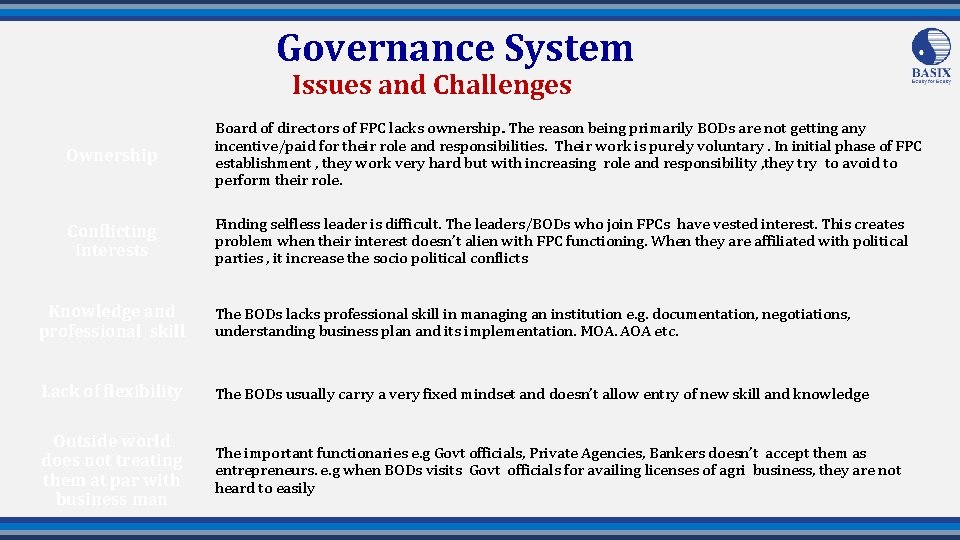
Governance System Issues and Challenges Ownership Board of directors of FPC lacks ownership. The reason being primarily BODs are not getting any incentive/paid for their role and responsibilities. Their work is purely voluntary. In initial phase of FPC establishment , they work very hard but with increasing role and responsibility , they try to avoid to perform their role. Conflicting interests Finding selfless leader is difficult. The leaders/BODs who join FPCs have vested interest. This creates problem when their interest doesn’t alien with FPC functioning. When they are affiliated with political parties , it increase the socio political conflicts Knowledge and professional skill The BODs lacks professional skill in managing an institution e. g. documentation, negotiations, understanding business plan and its implementation. MOA. AOA etc. Lack of flexibility The BODs usually carry a very fixed mindset and doesn’t allow entry of new skill and knowledge Outside world does not treating them at par with business man The important functionaries e. g Govt officials, Private Agencies, Bankers doesn’t accept them as entrepreneurs. e. g when BODs visits Govt officials for availing licenses of agri business, they are not heard to easily
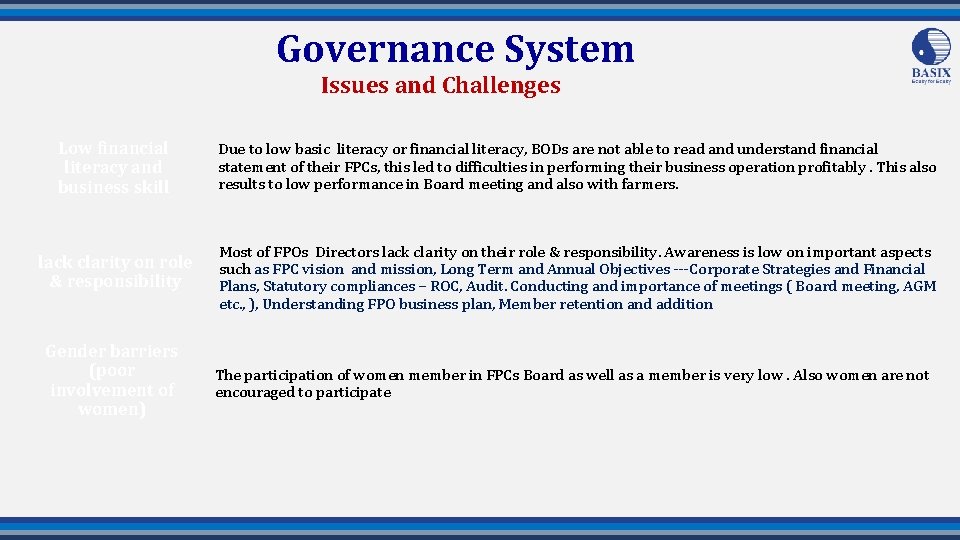
Governance System Issues and Challenges Low financial literacy and business skill Due to low basic literacy or financial literacy, BODs are not able to read and understand financial statement of their FPCs, this led to difficulties in performing their business operation profitably. This also results to low performance in Board meeting and also with farmers. lack clarity on role & responsibility Most of FPOs Directors lack clarity on their role & responsibility. Awareness is low on important aspects such as FPC vision and mission, Long Term and Annual Objectives ---Corporate Strategies and Financial Plans, Statutory compliances – ROC, Audit. Conducting and importance of meetings ( Board meeting, AGM etc. , ), Understanding FPO business plan, Member retention and addition Gender barriers (poor involvement of women) The participation of women member in FPCs Board as well as a member is very low. Also women are not encouraged to participate
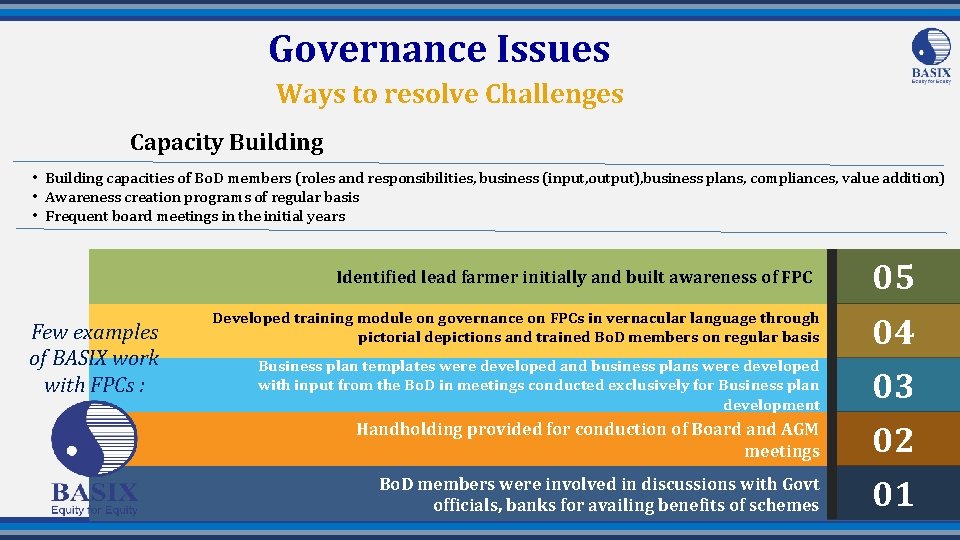
Governance Issues Ways to resolve Challenges Capacity Building • Building capacities of Bo. D members (roles and responsibilities, business (input, output), business plans, compliances, value addition) • Awareness creation programs of regular basis • Frequent board meetings in the initial years Identified lead farmer initially and built awareness of FPC Few examples of BASIX work with FPCs : 05 Developed training module on governance on FPCs in vernacular language through pictorial depictions and trained Bo. D members on regular basis 04 Business plan templates were developed and business plans were developed with input from the Bo. D in meetings conducted exclusively for Business plan development 03 Handholding provided for conduction of Board and AGM meetings 02 Bo. D members were involved in discussions with Govt officials, banks for availing benefits of schemes 01
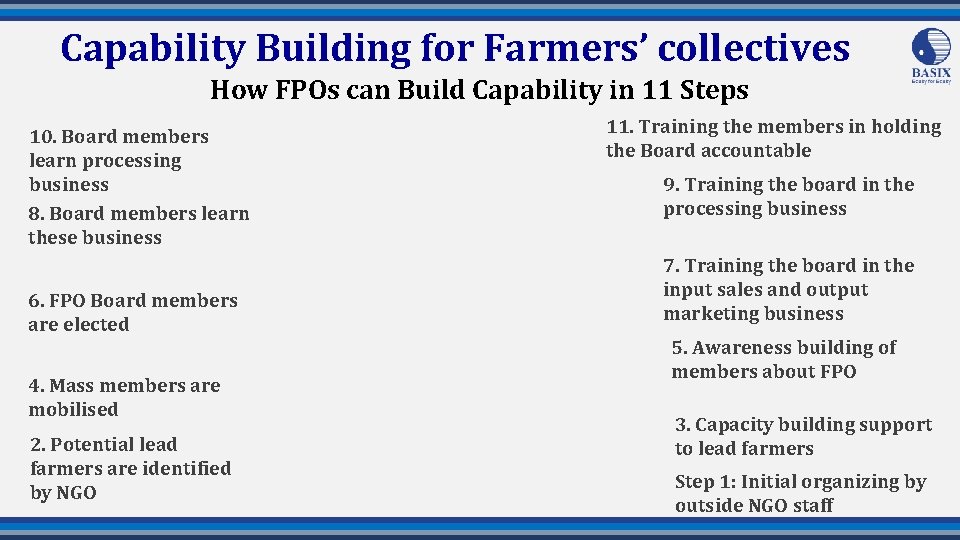
Capability Building for Farmers’ collectives How FPOs can Build Capability in 11 Steps 10. Board members learn processing business 8. Board members learn these business 6. FPO Board members are elected 4. Mass members are mobilised 2. Potential lead farmers are identified by NGO 11. Training the members in holding the Board accountable 9. Training the board in the processing business 7. Training the board in the input sales and output marketing business 5. Awareness building of members about FPO 3. Capacity building support to lead farmers Step 1: Initial organizing by outside NGO staff
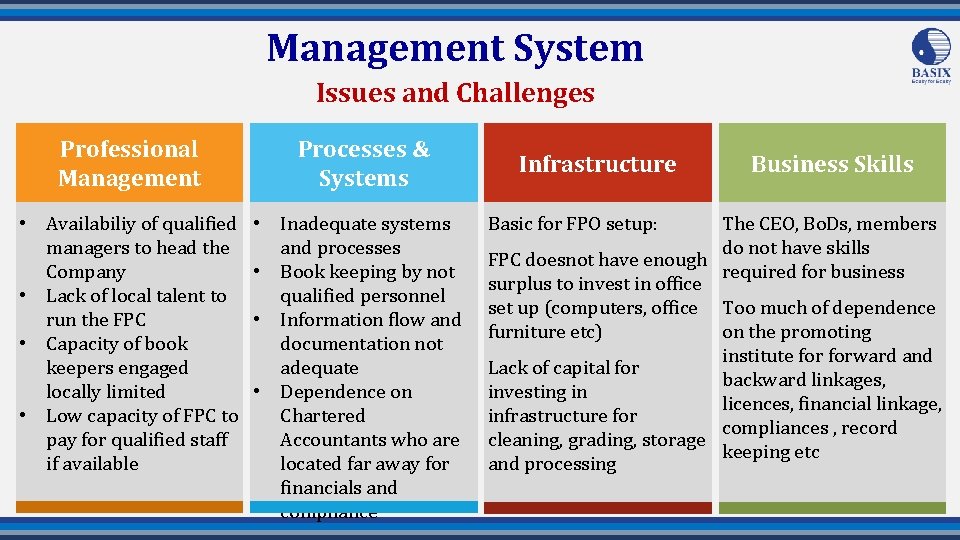
Management System Issues and Challenges Professional Management • Availabiliy of qualified managers to head the Company • Lack of local talent to run the FPC • Capacity of book keepers engaged locally limited • Low capacity of FPC to pay for qualified staff if available Processes & Systems • Inadequate systems and processes • Book keeping by not qualified personnel • Information flow and documentation not adequate • Dependence on Chartered Accountants who are located far away for financials and compliance Infrastructure Basic for FPO setup: Business Skills The CEO, Bo. Ds, members do not have skills FPC doesnot have enough required for business surplus to invest in office set up (computers, office Too much of dependence furniture etc) on the promoting institute forward and Lack of capital for backward linkages, investing in licences, financial linkage, infrastructure for compliances , record cleaning, grading, storage keeping etc and processing
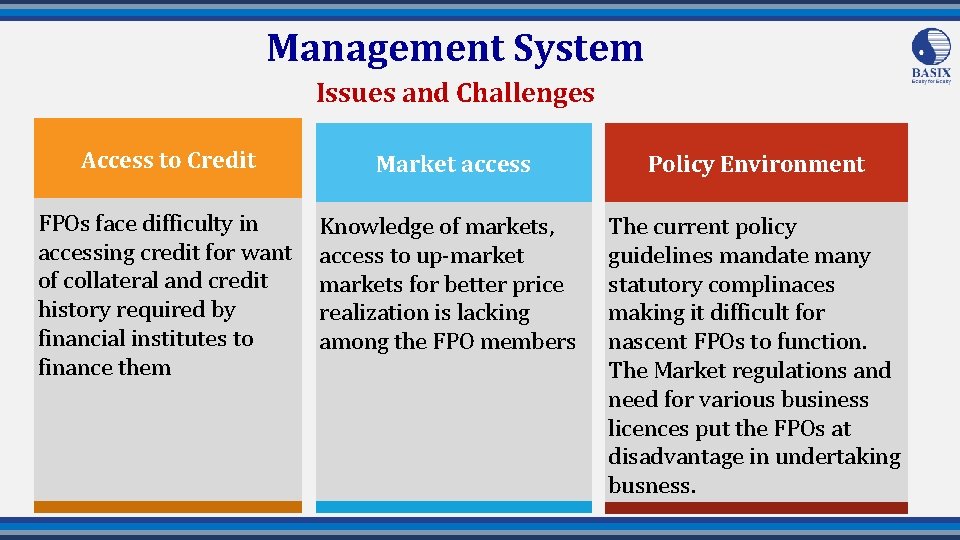
Management System Issues and Challenges Access to Credit Market access Policy Environment FPOs face difficulty in accessing credit for want of collateral and credit history required by financial institutes to finance them Knowledge of markets, access to up-markets for better price realization is lacking among the FPO members The current policy guidelines mandate many statutory complinaces making it difficult for nascent FPOs to function. The Market regulations and need for various business licences put the FPOs at disadvantage in undertaking busness.
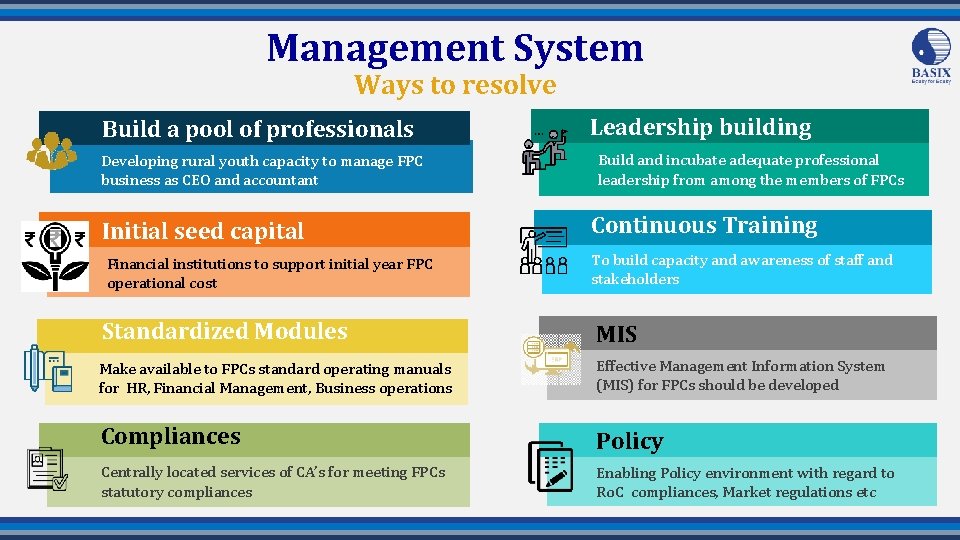
Management System Ways to resolve Build a pool of professionals Developing rural youth capacity to manage FPC business as CEO and accountant Initial seed capital Financial institutions to support initial year FPC operational cost Leadership building Build and incubate adequate professional leadership from among the members of FPCs Continuous Training To build capacity and awareness of staff and stakeholders Standardized Modules MIS Make available to FPCs standard operating manuals for HR, Financial Management, Business operations Effective Management Information System (MIS) for FPCs should be developed Compliances Policy Centrally located services of CA’s for meeting FPCs statutory compliances Enabling Policy environment with regard to Ro. C compliances, Market regulations etc
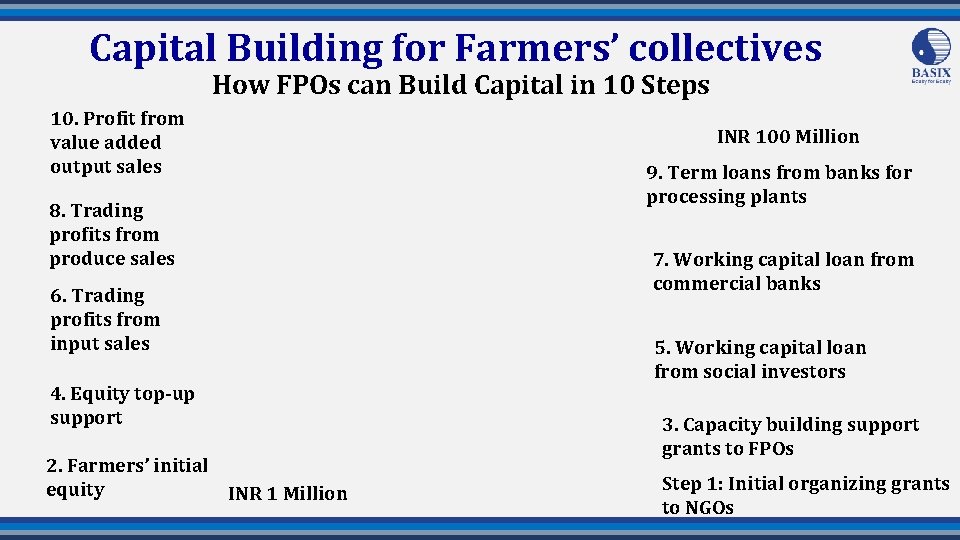
Capital Building for Farmers’ collectives How FPOs can Build Capital in 10 Steps 10. Profit from value added output sales 8. Trading profits from produce sales 6. Trading profits from input sales 4. Equity top-up support 2. Farmers’ initial equity INR 1 Million INR 100 Million 9. Term loans from banks for processing plants 7. Working capital loan from commercial banks 5. Working capital loan from social investors 3. Capacity building support grants to FPOs Step 1: Initial organizing grants to NGOs