
GOVERNANCE AND CORRUPTION WHY DO THEY MATTER AND
- Slides: 10
GOVERNANCE AND CORRUPTION WHY DO THEY MATTER AND WHAT DO THEY REALLY MEAN? Helen Sutch, PRMPS, April 21, 2003
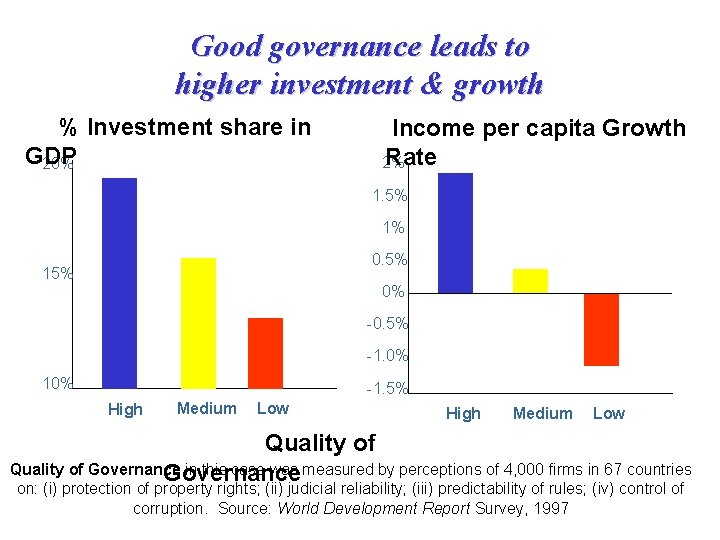
Good governance leads to higher investment & growth % Investment share in GDP 20% Income per capita Growth Rate 2% 1. 5% 1% 0. 5% 15% 0% -0. 5% -1. 0% 10% -1. 5% High Medium Low Quality of Governance in this case was measured by perceptions of 4, 000 firms in 67 countries Governance on: (i) protection of property rights; (ii) judicial reliability; (iii) predictability of rules; (iv) control of corruption. Source: World Development Report Survey, 1997
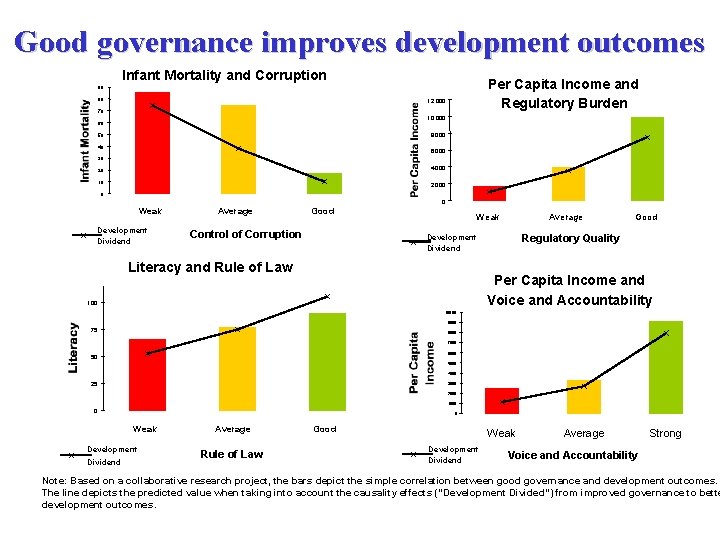
Good governance improves development outcomes Infant Mortality and Corruption Per Capita Income and Regulatory Burden 90 80 12, 000 70 10, 000 60 8, 000 50 40 6, 000 30 20 4, 000 10 2, 000 0 0 Weak Development Dividend x Average Good Control of Corruption Weak x Average Regulatory Quality Development Dividend Literacy and Rule of Law Good Per Capita Income and Voice and Accountability 10000 9000 75 8000 7000 6000 50 5000 4000 25 3000 2000 1000 0 0 Weak x Development Dividend Average Rule of Law Good Weak x Development Dividend Average Strong Voice and Accountability Note: Based on a collaborative research project, the bars depict the simple correlation between good governance and development outcomes. The line depicts the predicted value when taking into account the causality effects (“Development Divided”) from improved governance to bette development outcomes.
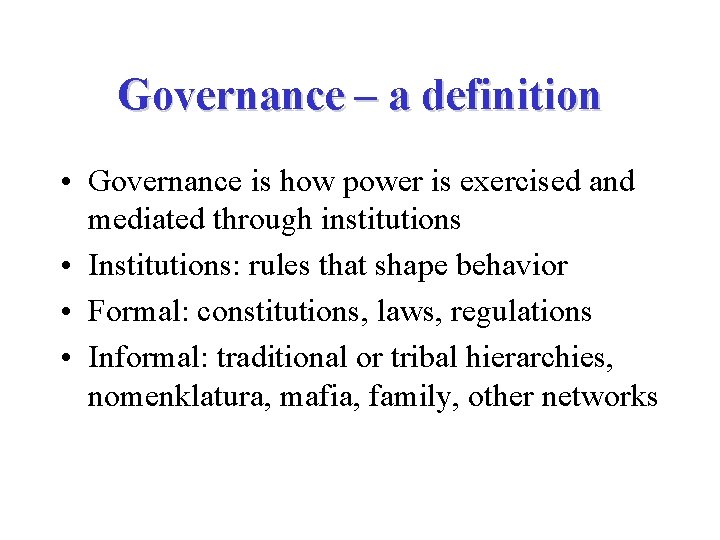
Governance – a definition • Governance is how power is exercised and mediated through institutions • Institutions: rules that shape behavior • Formal: constitutions, laws, regulations • Informal: traditional or tribal hierarchies, nomenklatura, mafia, family, other networks
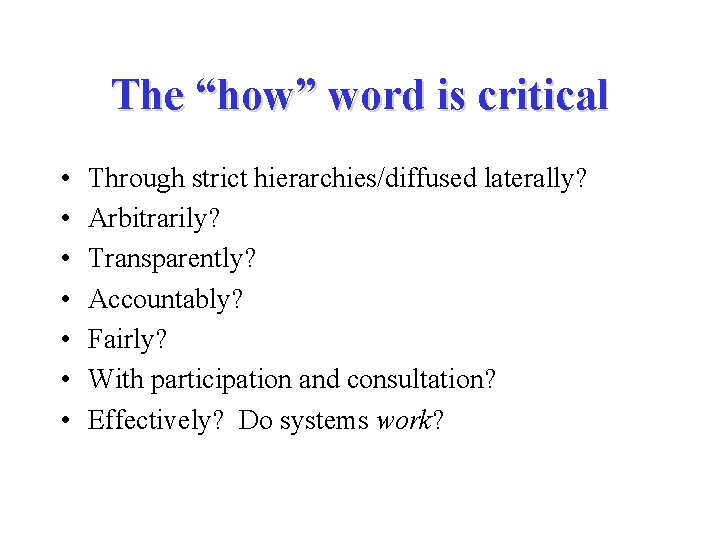
The “how” word is critical • • Through strict hierarchies/diffused laterally? Arbitrarily? Transparently? Accountably? Fairly? With participation and consultation? Effectively? Do systems work?
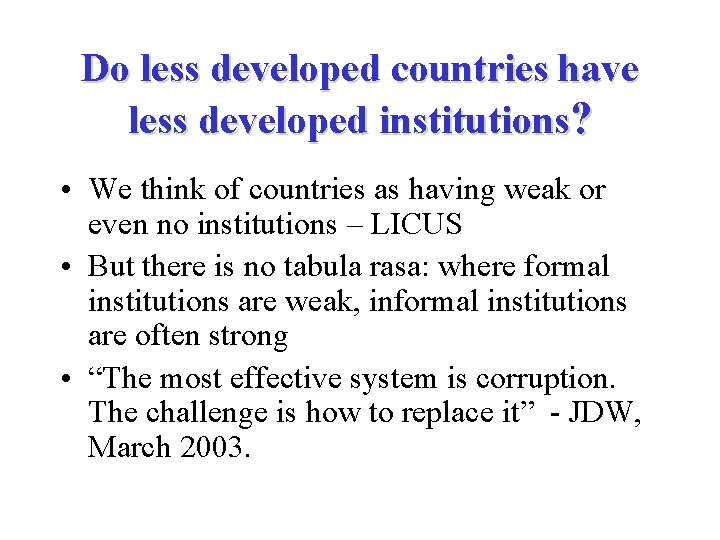
Do less developed countries have less developed institutions? • We think of countries as having weak or even no institutions – LICUS • But there is no tabula rasa: where formal institutions are weak, informal institutions are often strong • “The most effective system is corruption. The challenge is how to replace it” - JDW, March 2003.
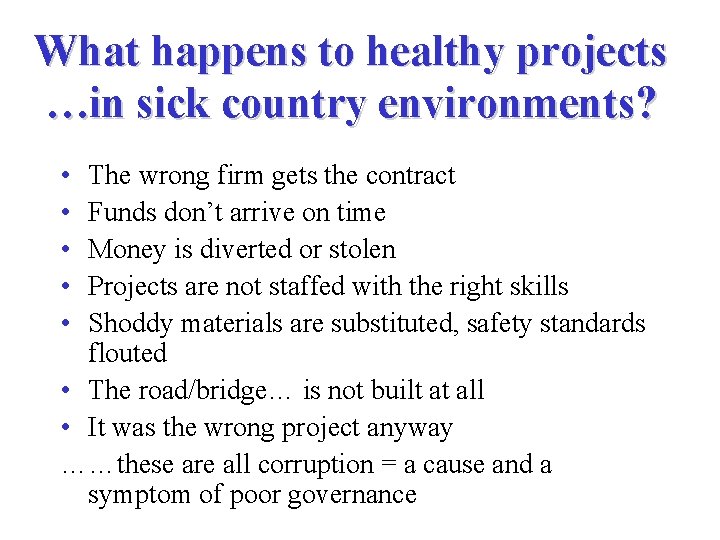
What happens to healthy projects …in sick country environments? • • • The wrong firm gets the contract Funds don’t arrive on time Money is diverted or stolen Projects are not staffed with the right skills Shoddy materials are substituted, safety standards flouted • The road/bridge… is not built at all • It was the wrong project anyway ……these are all corruption = a cause and a symptom of poor governance
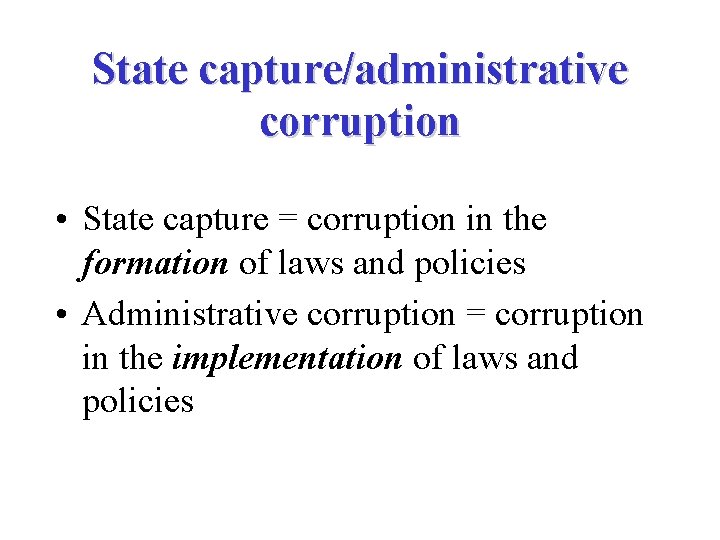
State capture/administrative corruption • State capture = corruption in the formation of laws and policies • Administrative corruption = corruption in the implementation of laws and policies
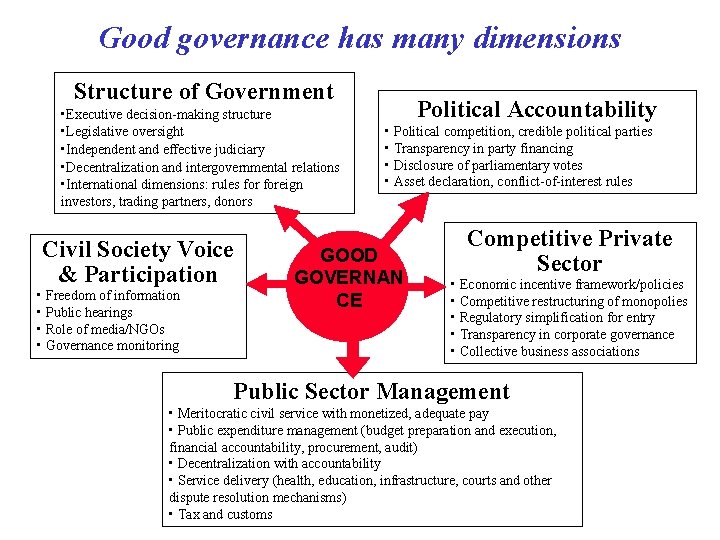
Good governance has many dimensions Structure of Government • Executive decision-making structure • Legislative oversight • Independent and effective judiciary • Decentralization and intergovernmental relations • International dimensions: rules foreign investors, trading partners, donors Civil Society Voice & Participation • Freedom of information • Public hearings • Role of media/NGOs • Governance monitoring Political Accountability • Political competition, credible political parties • Transparency in party financing • Disclosure of parliamentary votes • Asset declaration, conflict-of-interest rules GOOD GOVERNAN CE Competitive Private Sector • Economic incentive framework/policies • Competitive restructuring of monopolies • Regulatory simplification for entry • Transparency in corporate governance • Collective business associations Public Sector Management • Meritocratic civil service with monetized, adequate pay • Public expenditure management (budget preparation and execution, financial accountability, procurement, audit) • Decentralization with accountability • Service delivery (health, education, infrastructure, courts and other dispute resolution mechanisms) • Tax and customs
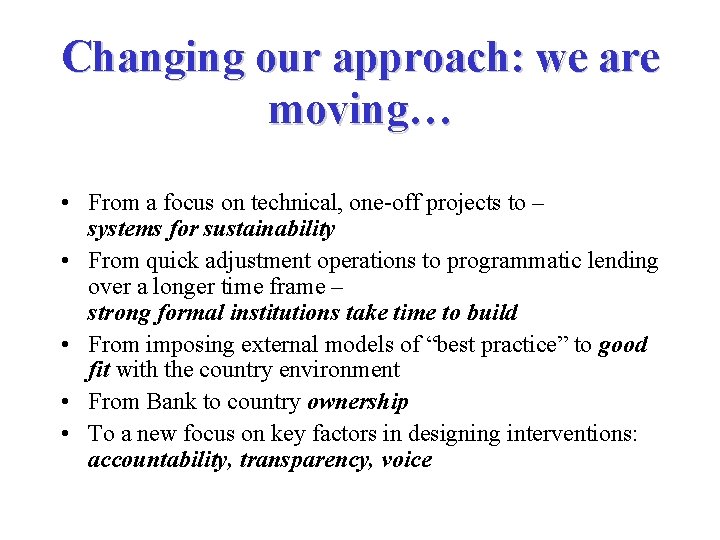
Changing our approach: we are moving… • From a focus on technical, one-off projects to – systems for sustainability • From quick adjustment operations to programmatic lending over a longer time frame – strong formal institutions take time to build • From imposing external models of “best practice” to good fit with the country environment • From Bank to country ownership • To a new focus on key factors in designing interventions: accountability, transparency, voice