
Gout SCOTT SMITH PGY1 1112018 Gout Acute inflammatory

- Slides: 27
Gout SCOTT SMITH PGY-1 1/11/2018
Gout Acute inflammatory arthritis caused by accumulation of monosodium urate
Typical Features • MONOARTICULAR • RAPID ONSET W/I 24 HRS • INCAPACITATING PAIN
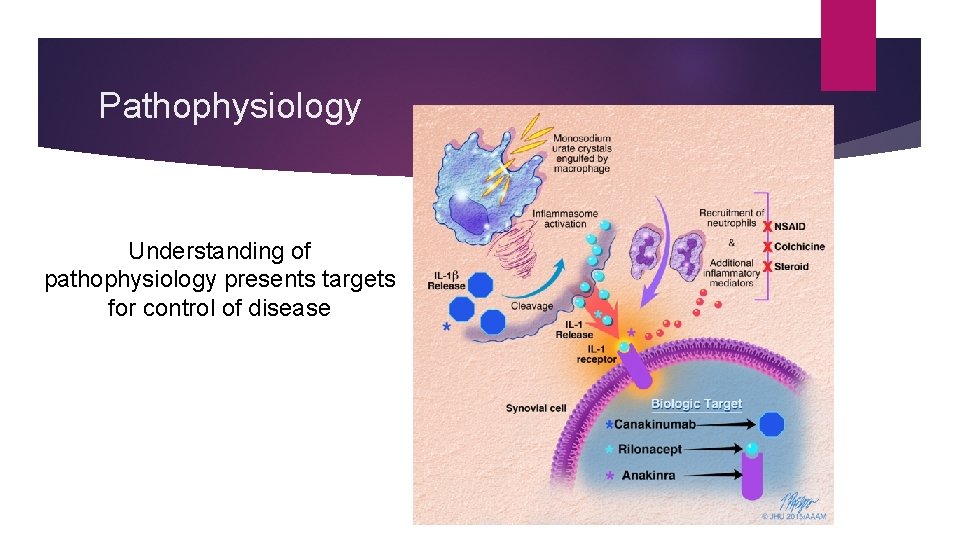
Pathophysiology Uric Acid (product of purine degradation) accumulates to the point of precipitating into the joint Precipitation of uric acid can be affected by variety of factors, including body p. H and temperature Hyperuricemia (serum urate >7 mg/d. L in men >6 mg/d. L in women) is the major risk factor Precipitated urate crystals phagocytosed by macrophages Crystals bins to cellular NLRP 3 inflammasome Secretion of IL-1 binds IL-1 receptor on synovial cells, secreting proinflammatory factors Arrival of neutrophils and secretion of additional inflammatory factors causes inflammation and pain
Pathophysiology Understanding of pathophysiology presents targets for control of disease
Clinical Manifestations Early gout is typically monoarticular, most frequently the MTP joint of 1 st toe (Podagra) Develops rapidly from asymptomatic to incapacitating pain in <25 hrs Joint is red, warm, swollen and exquisitely tender Common sites 1 st toe > arch of foot > ankle > knee Wrist, elbow and shoulder involvement is more characteristic of more advanced gout
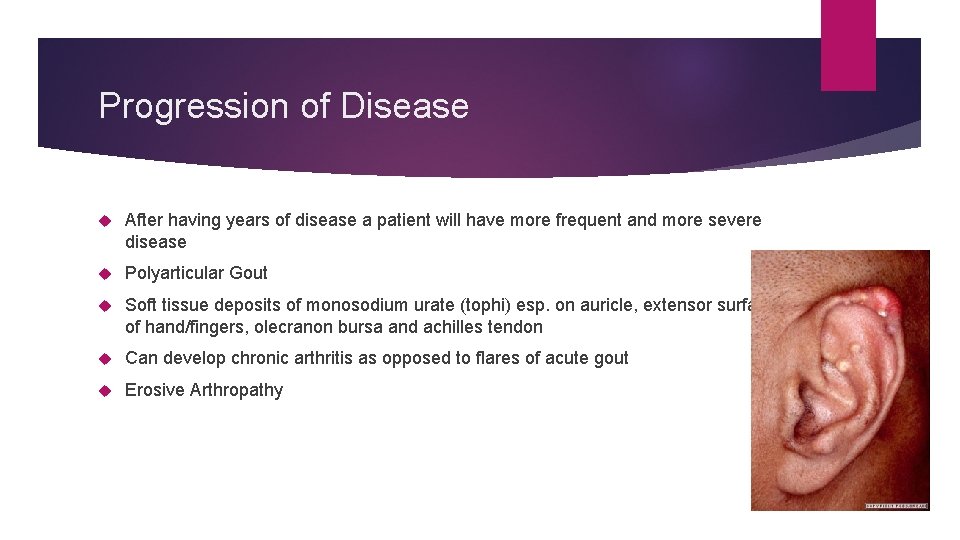
Progression of Disease After having years of disease a patient will have more frequent and more severe disease Polyarticular Gout Soft tissue deposits of monosodium urate (tophi) esp. on auricle, extensor surface of hand/fingers, olecranon bursa and achilles tendon Can develop chronic arthritis as opposed to flares of acute gout Erosive Arthropathy
Gout Stages 1. 2. 3. 4. Asymptomatic hyperuricemia: majority never develop This usually lasts for years-decades before developing acute gouty arthritis Acute gouty arthritis: monoarticular pain (podagra, ankle, etc. ); attacks last hours-2 week Intercritical gout: completely asymptomatic between acute attacks ~65% will have another acute attack within 1 -2 years Presence of asymptomatic periods between monoarthritic attacks is almost unique to gout and used as a diagnostic criterion Chronic tophaceous gout: intercritical periods are now symptomatic (chronic swelling and worsening pain) & develop subcutaneous tophaceous deposits of MSU; usually after >10 y of acute intermittent gout
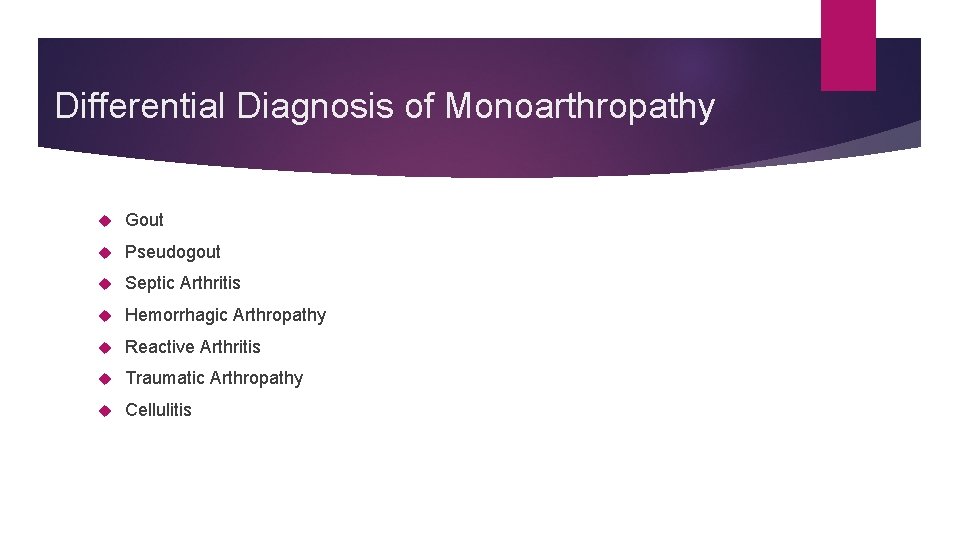
Differential Diagnosis of Monoarthropathy Gout Pseudogout Septic Arthritis Hemorrhagic Arthropathy Reactive Arthritis Traumatic Arthropathy Cellulitis
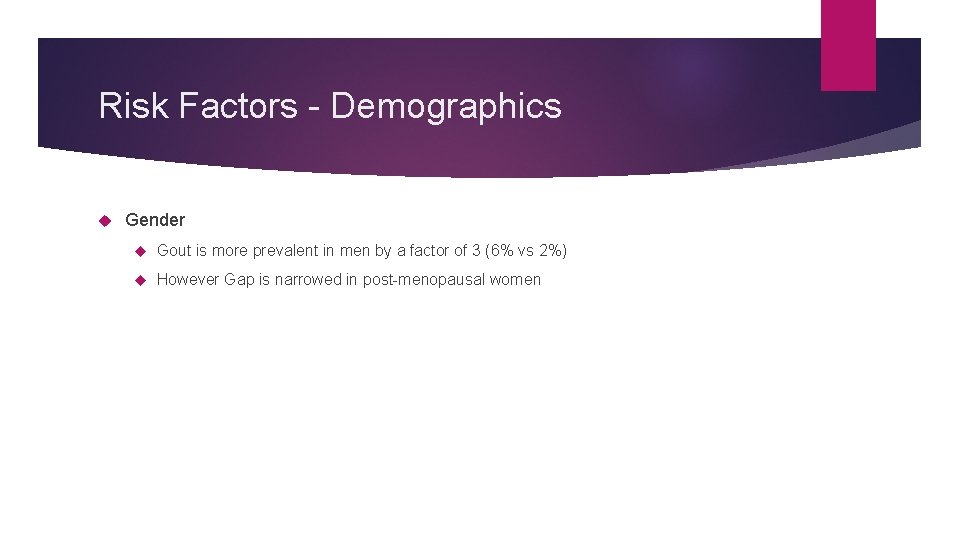
Risk Factors - Demographics Gender Gout is more prevalent in men by a factor of 3 (6% vs 2%) However Gap is narrowed in post-menopausal women
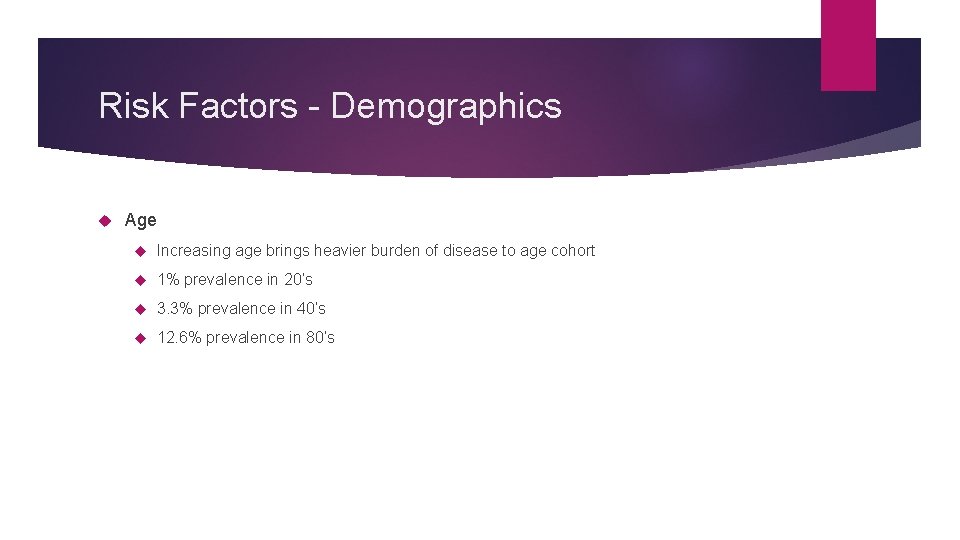
Risk Factors - Demographics Age Increasing age brings heavier burden of disease to age cohort 1% prevalence in 20’s 3. 3% prevalence in 40’s 12. 6% prevalence in 80’s
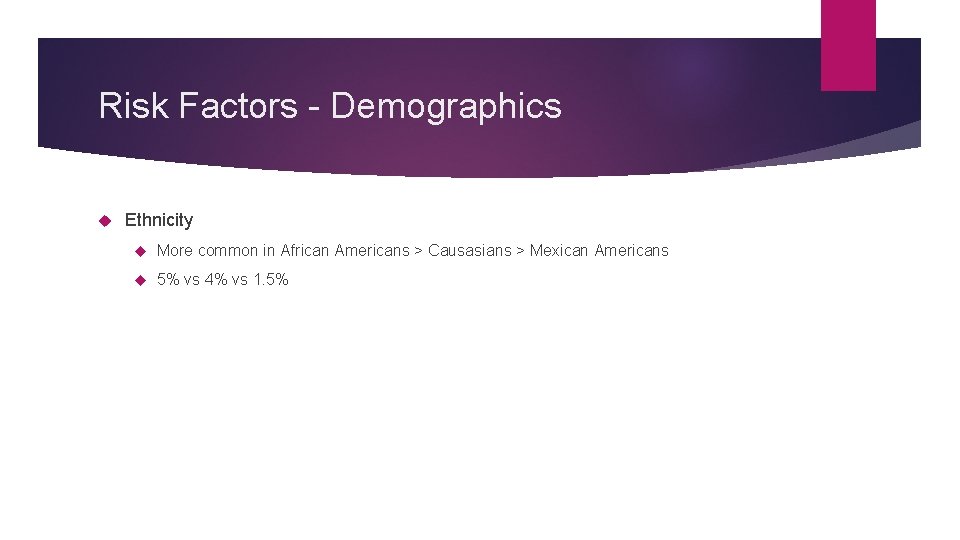
Risk Factors - Demographics Ethnicity More common in African Americans > Causasians > Mexican Americans 5% vs 4% vs 1. 5%
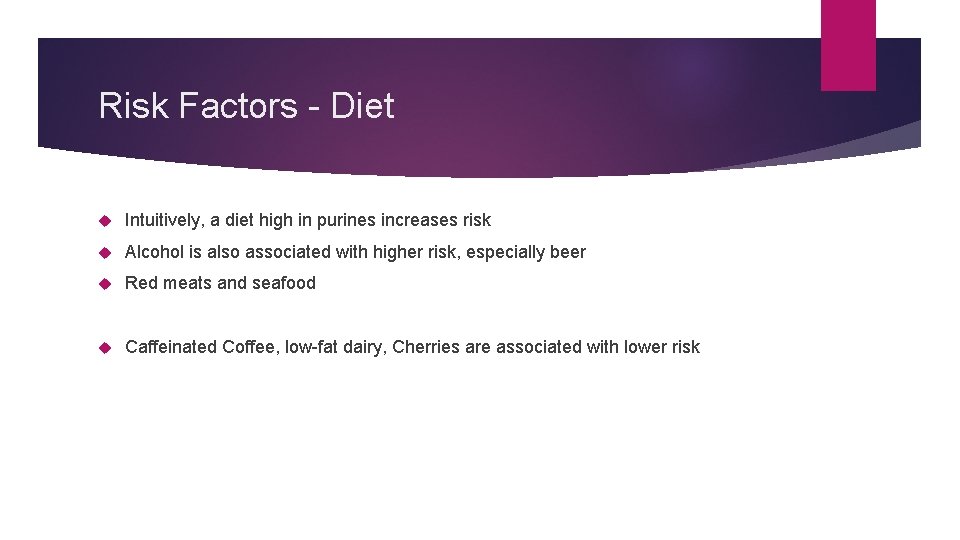
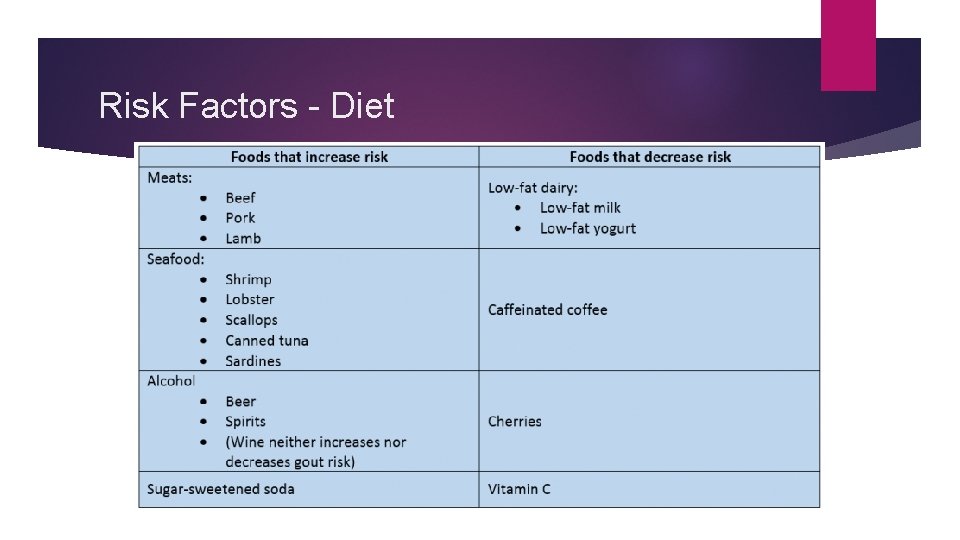
Risk Factors - Diet Intuitively, a diet high in purines increases risk Alcohol is also associated with higher risk, especially beer Red meats and seafood Caffeinated Coffee, low-fat dairy, Cherries are associated with lower risk
Risk Factors - Diet
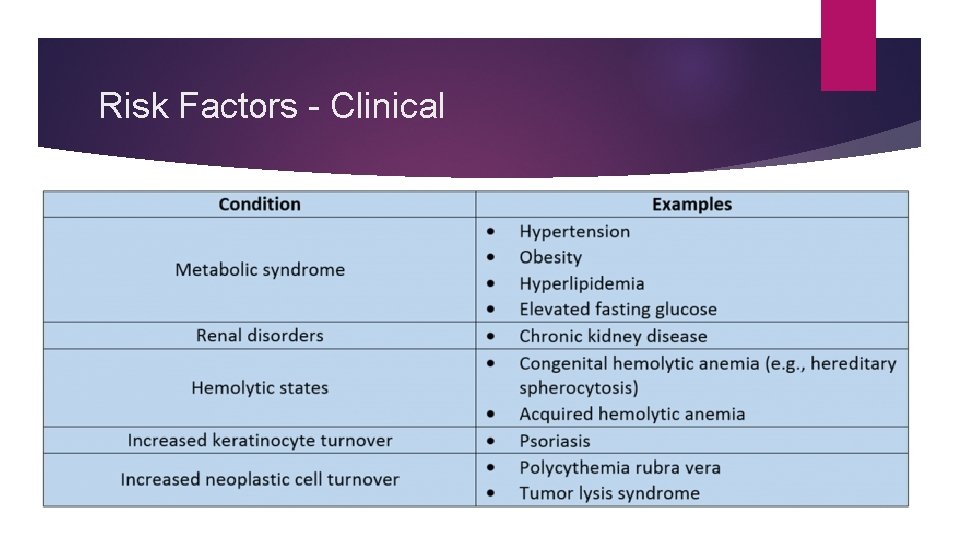
Risk Factors - Clinical
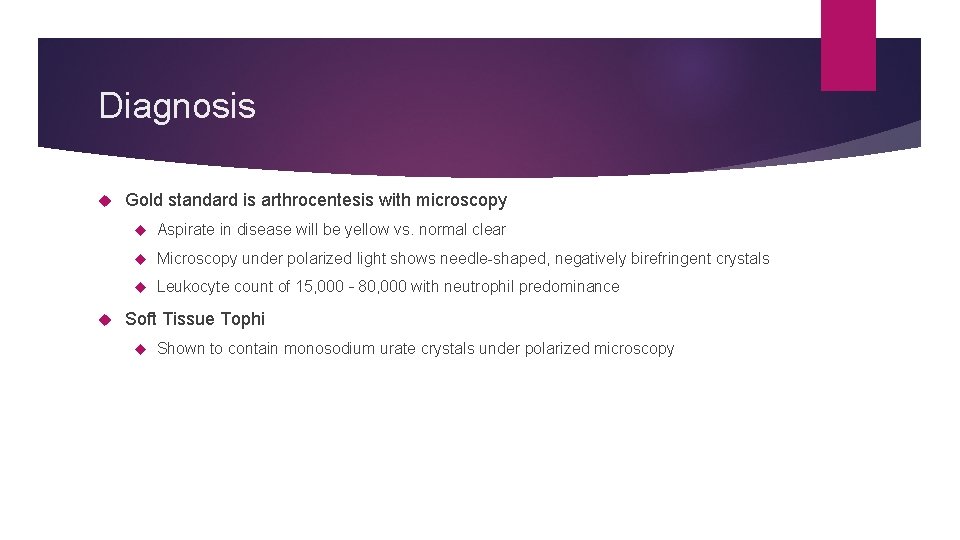
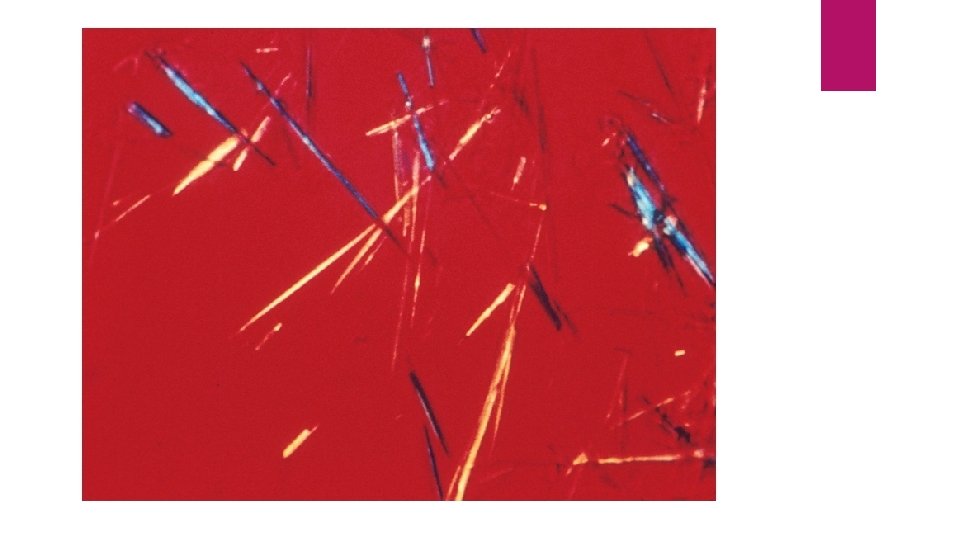
Diagnosis Gold standard is arthrocentesis with microscopy Aspirate in disease will be yellow vs. normal clear Microscopy under polarized light shows needle-shaped, negatively birefringent crystals Leukocyte count of 15, 000 – 80, 000 with neutrophil predominance Soft Tissue Tophi Shown to contain monosodium urate crystals under polarized microscopy
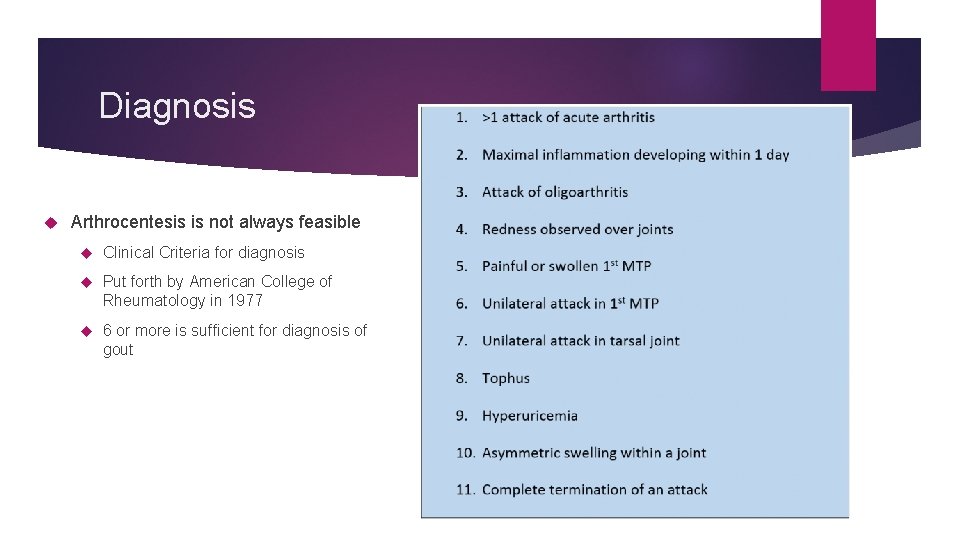
Diagnosis Arthrocentesis is not always feasible Clinical Criteria for diagnosis Put forth by American College of Rheumatology in 1977 6 or more is sufficient for diagnosis of gout
Treatment of Acute Gout Corticosteroids Can be administered orally, IV or intraarticularly Rapid relief of symptoms 1 -5 hours Methylprednisolone dose pack (starting 24 mg daily, reducing 4 mg daily) Prednisone starting 20 -30 mg daily, tapering in 1 -2 weeks Intra-articular injection of triamcinolone in monoarticular gout attack
Treatment of Acute Gout NSAID’s Indomethacin most commonly used Limited in many patients PUD CKD Anticoagulation
Treatment of Acute Gout Colchicine Commonly prescribed as 0. 6 mg tablets Old Therapy included 1 tablet per hour until gout attack is improved or until diarrhea develops New Standard of 1. 2 mg dose followed by 0. 6 mg dose after an hour shown to be equal and less toxic Can Impair Hematopoiesis, induce neuromyotoxicity, and is contraindicated in CKD
Prevention of Gout Attacks Eliminating precipitants Certain Medications can increase serum Uric Acid HCTZ Immunosuppressant medications (Tacrolimus, Cyclosporine) Low Dose aspirin
Gout Prophylaxis Criteria for prophylaxis Based on clinical picture, not lab values More than one gout flare per year Presence of tophaceous gout
Gout Prophylaxis – Xanthine Oxidase Inhibitors Allopurinol Typically started at 300 mg daily but can be lower at 50 -100 mg daily Maximum dose of 600 -800 mg daily Patients can rarely develop allopurinol hypersensitivity syndrome, more common in patients with impaired renal function Feboxistat Relative indication is impaired renal function or other situation where allopurinol cannot be used Metabolized by liver instead of kidney Starting dose of 40 mg daily maximum dose of 80 mg daily Should treat to goal serum uric acid level of <6 mg/d. L Both can precipitate new gout attack, so treatment should be started in conjunction with colchicine 0. 6 mg daily or naproxen 250 mg 2 x daily until steady dose is achieved
Gout Prophylaxis – Colchicine Can be used for prophylaxis at different dosage 0. 6 or 1. 2 mg daily Lower dosage should be considered in those with impaired renal function Must monitor for drug-induced myopathy and neuropathy
Gout Prophylaxis – Probenecid Uricosuric Agent Inhibits reabsorption of uric acid in proximal renal tubule Starting dose of 250 mg 2 x daily increased to 500 mg 2 x daily in one week Ineffective in impaired renal function Contraindicated in patient with prior urate nephrolithiasis
Thank you!