
Gout Definition Gout is a metabolic disease characterized

Gout
Definition � Gout is a metabolic disease characterized by deposition of urates on the surfaces of various internal organs, or various joints � Both in broiler and layer chicks, gout can be seen from 4 th day onwards and can be a serious problem between 2 nd and 3 rd week � Birds usually die from kidney failure
Etiology � Causes: Visceral urate deposition is usually due to a failure of urinary excretion. 2. obstruction of ureters, renal damage, or dehydration. 3. Dehydration due to water deprivation is a common cause of visceral gout in poultry. Other causes include 1. vitamin A deficiency 2. mycotoxins such as oosporein 3. secondary to urolithiasis 4. treatment with sodium bicarbonate. 1.
Pathogenesis � Birds are prone to gout because they are uricotelic. � That is, in them, the waste product of protein metabolism ( � excretion of nitrogen) is mainly in the form of uric acid. This is because they lack the enzyme uricase, which converts uric acid into allantoin. � Moreover, uric acid is water insoluble. Therefore, any injury or damage to bird's kidney, from whatever cause, interferes with elimination of uric acid, which then accumulates in the blood (hyperuricaemia) and leads to visceral gout, that is, deposition of urate crystals on the surfaces of internal organs.

Types of gout � Visceral gout – � deposition of uric acid crystals in visceral organs like kidney, liver, heart and gut. � It is observed in young poultry Visceral gout is a common � finding during necropsy of poultry. It is characterized by precipitation (deposition) of urates in the kidneys and on serous surfaces of the heart, liver, mesentery, airsacs, or peritoneum. � In severe cases synovial sheaths of tendons and joints and surfaces of muscles may be involved, �
Cont. . � Articular gout – � deposition of uric acid crystals in joints, ligaments and tendon sheath. � It is chronic form of gout and has some genetic predisposition. � It is rarely seen in poultry � Clinically, � It is characterized by – � leg shifting, lameness, and inability to bend the toes. � Articular gout is characterized by tophi. � The joints are enlarged, and the feet appear deformed.
Postmortem Findings � Macroscopically, � Kidneys are swollen, congested, and typically gouty (greyish white in colour). � One or both ureters may be distended with white material. � the deposits on serous surfaces appear as white chalky coating, and those within viscera may be recognized only
lesions � Microscopically, � the clusters of urate crystals appear as pale, elongated, needle-shaped structures in tissue sections. � The crystals are surrounded by an inflammatory reaction of macrophages, lymphocytes, fibroblasts, and foreign-body giant cells.
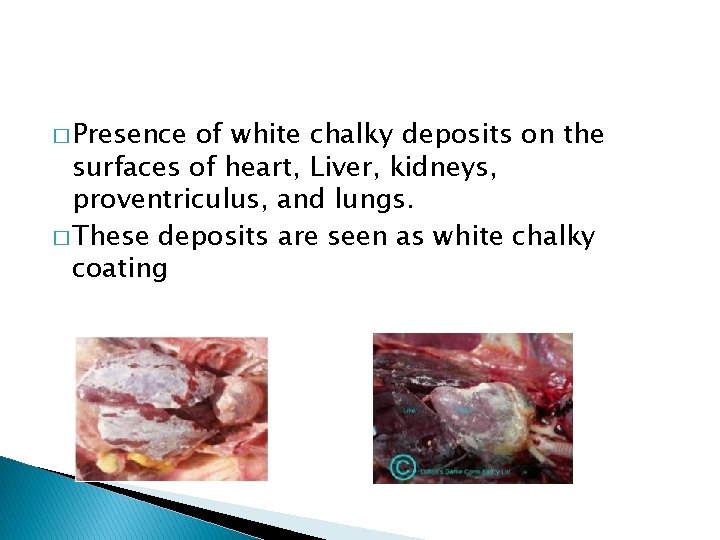
� Presence of white chalky deposits on the surfaces of heart, Liver, kidneys, proventriculus, and lungs. � These deposits are seen as white chalky coating
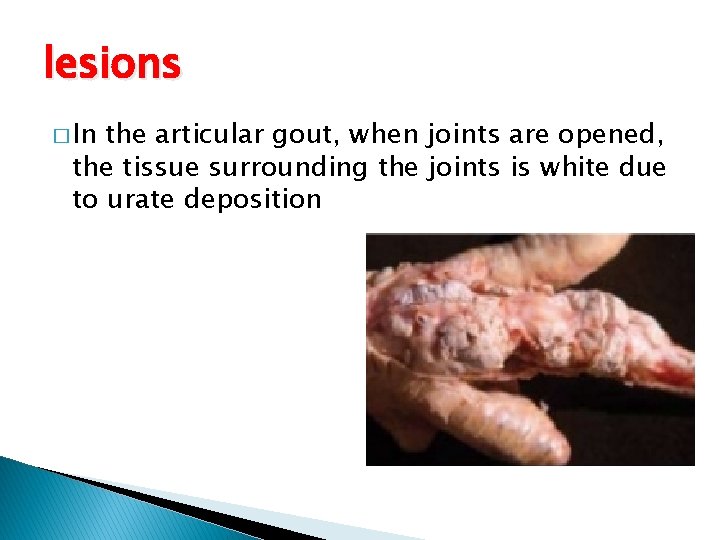
lesions � In the articular gout, when joints are opened, the tissue surrounding the joints is white due to urate deposition
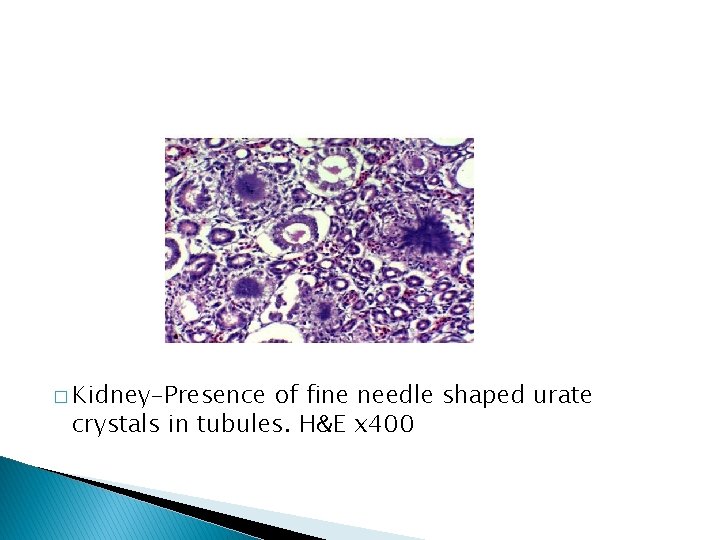
� Kidney-Presence of fine needle shaped urate crystals in tubules. H&E x 400

THANKS
- Slides: 12