
Gotta Go The Urinary system The urinary system


- Slides: 21
Gotta Go…. The Urinary system
The urinary system 1. Quick review of the systems 2. Sweat glands 3. Urinary system A) Function B) Anatomy C) Physiology D) Urine composition E) Concentration F) Diagnosing disease
1. Quick review of the system
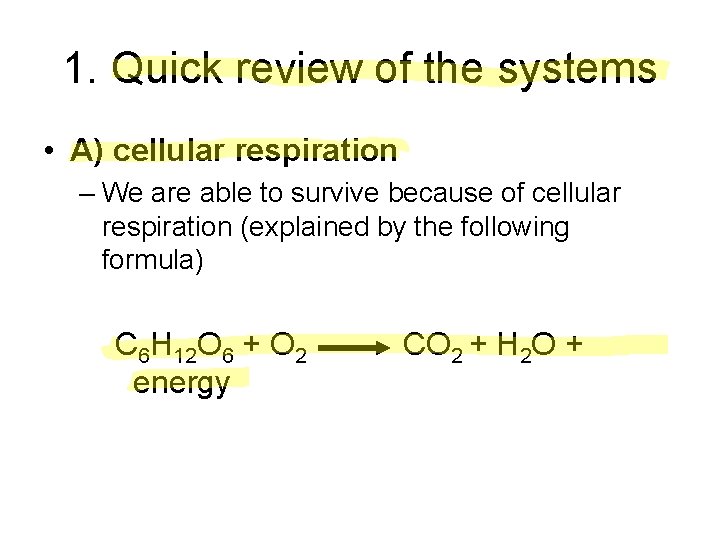
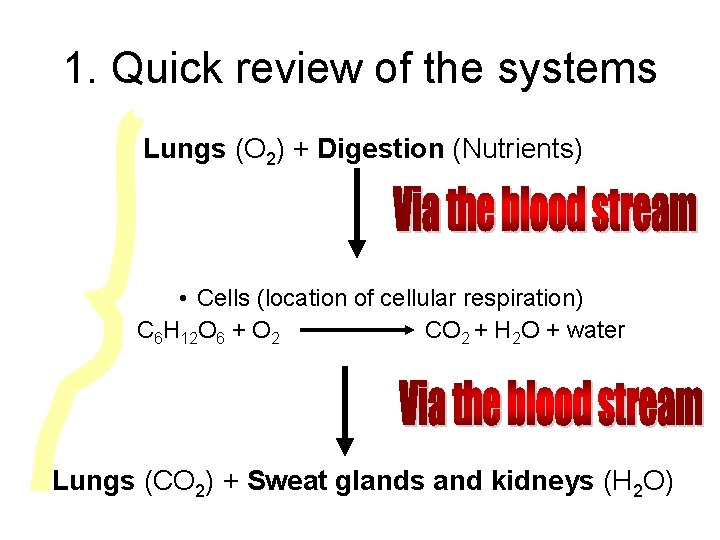
1. Quick review of the systems • A) cellular respiration – We are able to survive because of cellular respiration (explained by the following formula) C 6 H 12 O 6 + O 2 energy CO 2 + H 2 O +
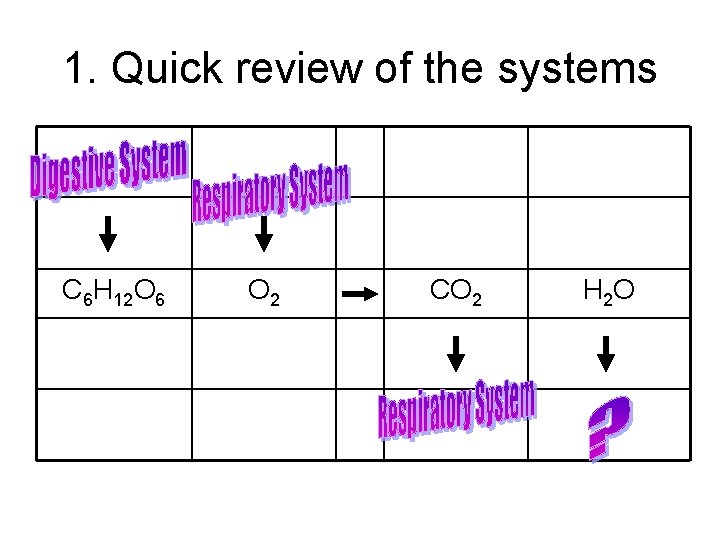
1. Quick review of the systems C 6 H 12 O 6 O 2 CO 2 H 2 O
1. Quick review of the systems Lungs (O 2) + Digestion (Nutrients) • Cells (location of cellular respiration) C 6 H 12 O 6 + O 2 CO 2 + H 2 O + water Lungs (CO 2) + Sweat glands and kidneys (H 2 O)
2. Sweat Glands Not only for eliminating excess water
2. Sweat Glands A) Function: - Regulates the internal body temperature Sweat can be produced as a result of stress, heat or exercise B) Anatomy: - Sweat glands are located in the dermis of the skin (inner most layer) Long coiled tube that connects to pores on the skins surface
2. Sweat Glands C) Types: 1. Eccrine sweat glands: - Located all over, especially hands, feet and forehead 2. Apocrine sweat glands : - Usually ends with a hair - Larger and sweat produced contains fatty acids and proteins - When bacteria on the persons hair and skin metabolizes the fatty acids an odor is produced
2. Sweat Glands • Fun Facts: – We have about 2. 6 million sweat glands – Dogs and cats do not sweat: They pant to regulate their temperature
3. Urinary System
3. Urinary System A) Function - Produces and expulses urine and other waste products from the body Ensures that the volume of the blood and its concentration remain constant B) Anatomy 1. 2. 3. 4. Kidneys Ureters Bladder Urethra
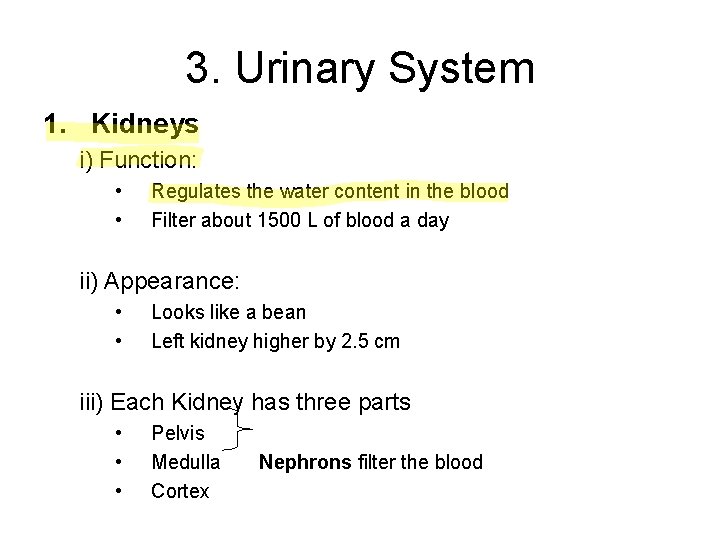
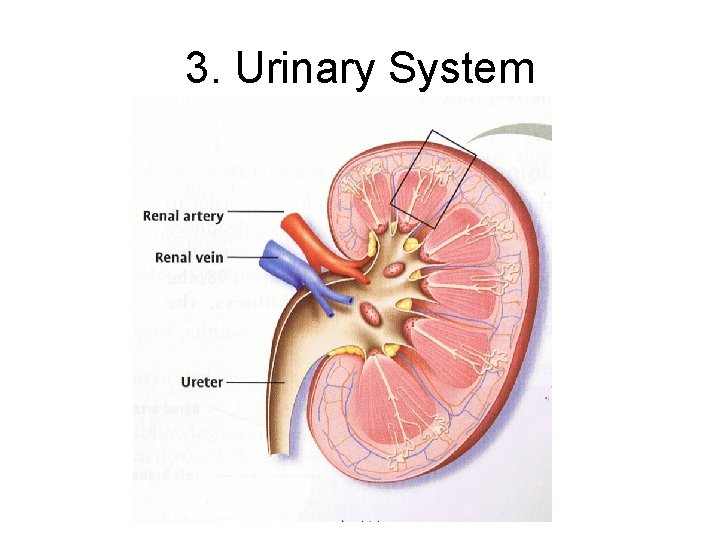
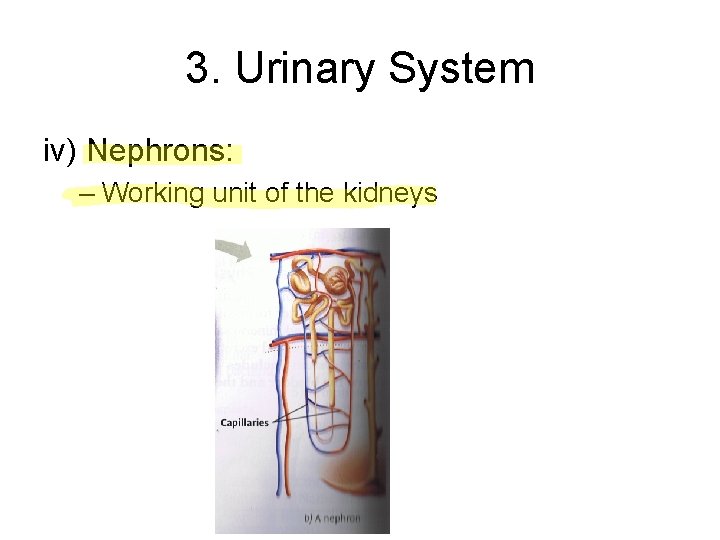
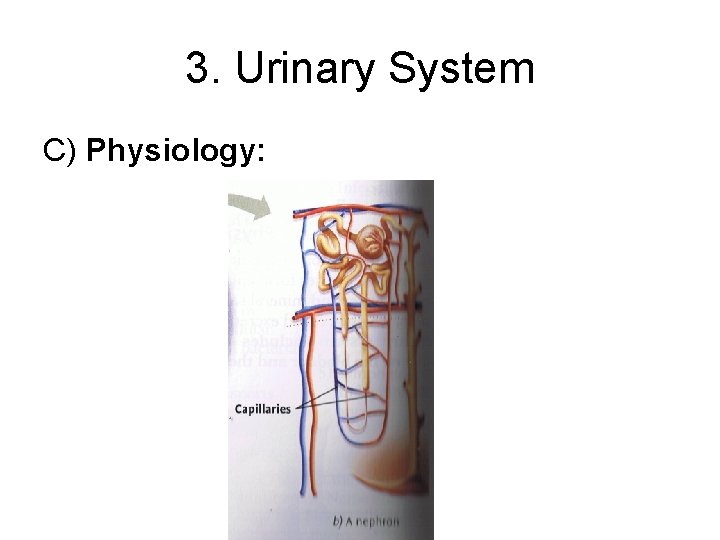
3. Urinary System 1. Kidneys i) Function: • • Regulates the water content in the blood Filter about 1500 L of blood a day ii) Appearance: • • Looks like a bean Left kidney higher by 2. 5 cm iii) Each Kidney has three parts • • • Pelvis Medulla Cortex Nephrons filter the blood
3. Urinary System
3. Urinary System iv) Nephrons: – Working unit of the kidneys
3. Urinary System 2. Ureter - 25 cm long tubes that brings the urine from the kidneys to the bladder 3. Bladder - Expandable reservoir (1 L) 4. Urethra - 3 -4 cm long for women: 20 cm long for men Brings urine out of the body
3. Urinary System C) Physiology:
3. Urinary System D) Urine Composition – Urine is a homogeneous mixture: • 95% of water • 2. 5% urea (made from the oxidation of amino acids) • Minerals • Excess substances – Drugs and medications – Proteins, glucose, lipids, blood cells (presence of these components indicates a health problem)
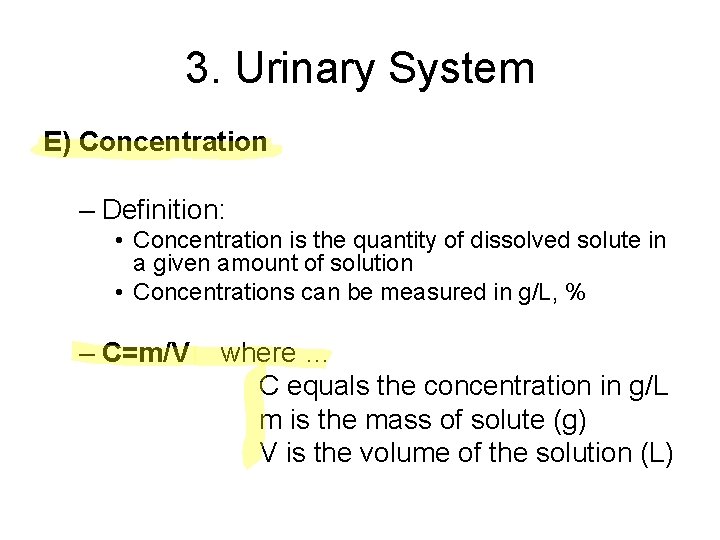
3. Urinary System E) Concentration – Definition: • Concentration is the quantity of dissolved solute in a given amount of solution • Concentrations can be measured in g/L, % – C=m/V where … C equals the concentration in g/L m is the mass of solute (g) V is the volume of the solution (L)
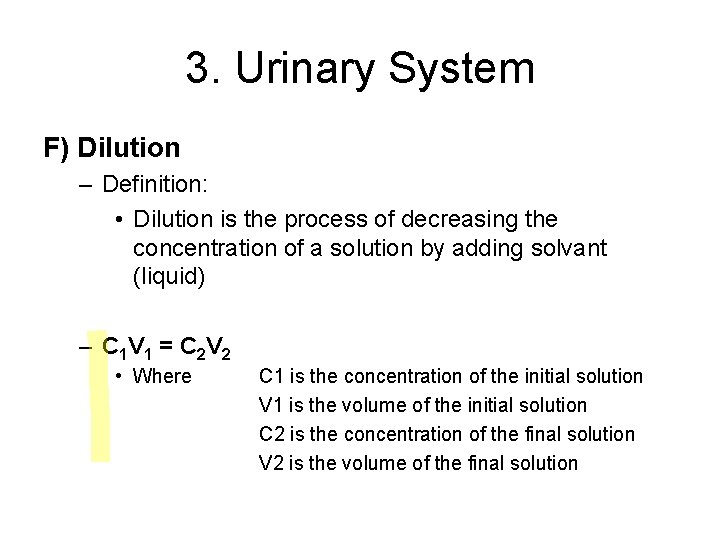
3. Urinary System F) Dilution – Definition: • Dilution is the process of decreasing the concentration of a solution by adding solvant (liquid) – C 1 V 1 = C 2 V 2 • Where C 1 is the concentration of the initial solution V 1 is the volume of the initial solution C 2 is the concentration of the final solution V 2 is the volume of the final solution
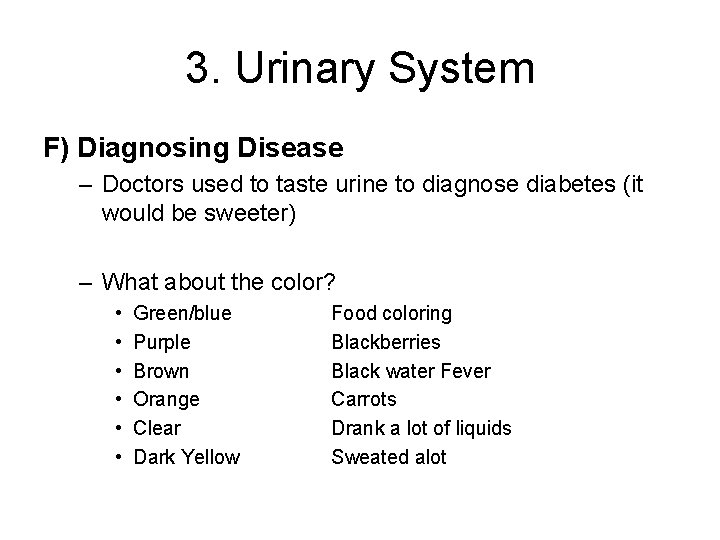
3. Urinary System F) Diagnosing Disease – Doctors used to taste urine to diagnose diabetes (it would be sweeter) – What about the color? • • • Green/blue Purple Brown Orange Clear Dark Yellow Food coloring Blackberries Black water Fever Carrots Drank a lot of liquids Sweated alot