
Gothic Literature Edgar Allan Poe Father of Gothic

- Slides: 11
Gothic Literature
Edgar Allan Poe “Father” of Gothic Literature in America 1809 -1849 Lived with foster parents (Allans) since age 3 His mom, foster mom & wife died of TB Expelled from West Point for deliberately misbehaving • At 22, he moved in with Aunt & cousin • Married cousin in 1836 (he was 27, she was 13) • •
Poe’s Legacy • He reached popularity while alive, but lived most of his life in poverty • Considered the “founder” of the modern short story • Originator of the detective story • Collapsed in a Baltimore street; died in the hospital a few days later
Poe’s Unique Style • Use of dashes or other interrupters in sentences to suggest hurried or excited speech • Strong rhythm, produced by repetition of phrases and word patterns • Frequent use of figurative language (similes & metaphors) • Formal language suited to upper-class settings and/or intellectual characters
Works by Poe • “The Masque of the Red Death” • “The Raven” • “The Black Cat”
Nathanial Hawthorne • 1804 -1864 • Born in Salem, Massachusetts • Had an unhappy childhood, and became reclusive, like his mother • Good friend of writers Longfellow & Emerson • Like Poe, he was successful in his life, but made little money
Hawthorne, Continued • Died while visiting Former President Franklin Pierce • Best known/most successful work was a novel called The Scarlet Letter • Wrote “Dr. Heidegger’s Experiment” an allegory
Hawthorne’s Style • Like Poe, Hawthorne used formal language • He used foreshadowing, to give clues about what is to come • He used imagery and figurative to create a creepy “mood” or atmosphere in his works
Southern Gothic • A modern offshoot of Gothic literature, inspired by Poe and Hawthorne • Popular in the early to middle 1900’s • Writers still used creepy characters and strange situations, but not to scare audiences • Purpose was to comment on society
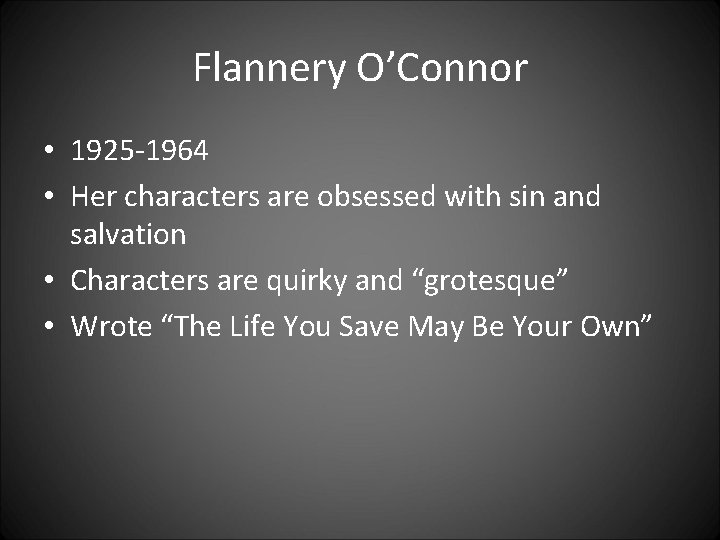
Flannery O’Connor • 1925 -1964 • Her characters are obsessed with sin and salvation • Characters are quirky and “grotesque” • Wrote “The Life You Save May Be Your Own”
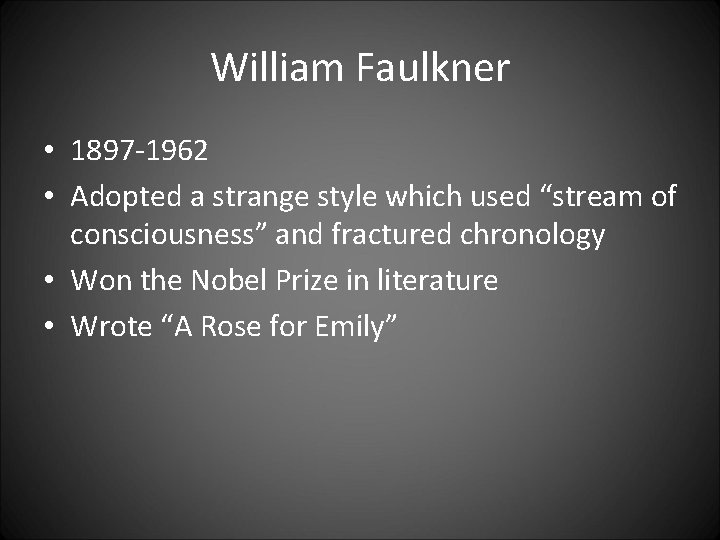
William Faulkner • 1897 -1962 • Adopted a strange style which used “stream of consciousness” and fractured chronology • Won the Nobel Prize in literature • Wrote “A Rose for Emily”