
Got Breaks Sara Frey JD BSN RN Overview

Got Breaks? Sara Frey JD BSN RN
Overview 2 Importance of breaks and background Break challenges Break legislation Staffing law WSNA wins Labor & Industries advances – Intermittent breaks Contract language
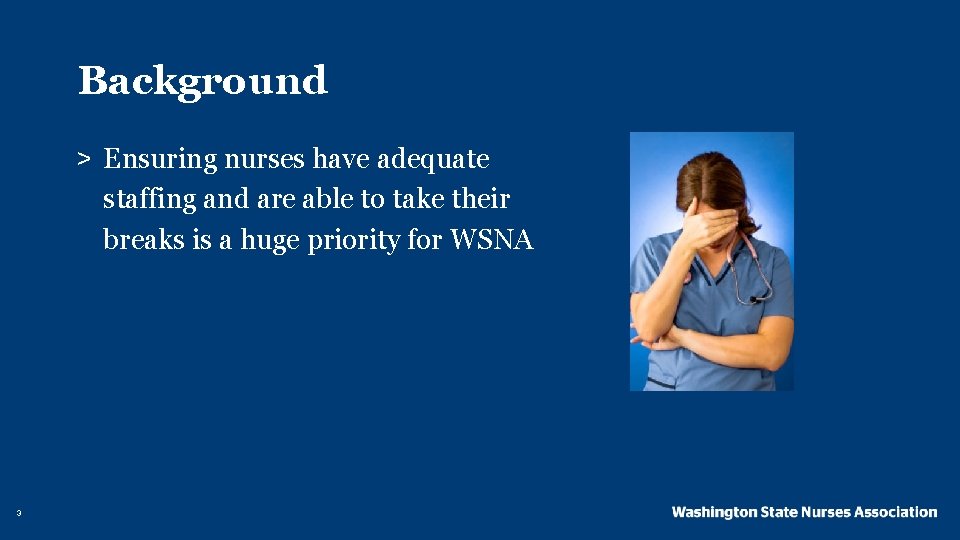
Background > Ensuring nurses have adequate staffing and are able to take their breaks is a huge priority for WSNA 3
Rest Breaks – Background > Crucial for patient safety > Crucial for nurses’ safety • Burnout • Fatigue • Needle sticks • Musculoskeletal injuries 4
Rest Breaks – Background > State law requires a break of ten minutes for every four hours worked. > The industry standard in Washington state for a unionized RN is a 15 minute break every four hours. • A longer rest break is necessary due to the physical and mental demands of patient care. • The extra five minutes of break time is a result of collective bargaining and is not guaranteed by law. 5
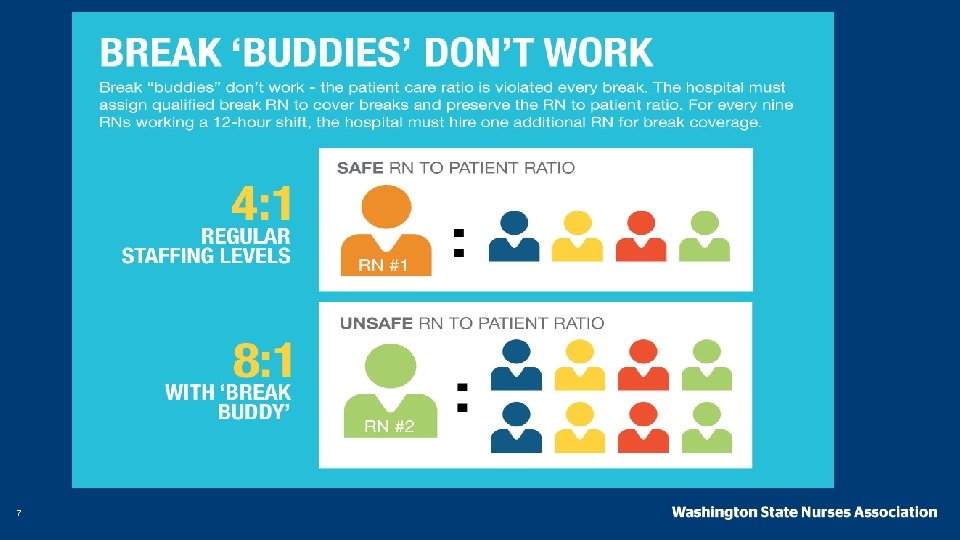
Rest Breaks - Challenges > Culture of Intimidation and Retaliation • Time management problem > Break buddies • Require nurse to double up on patient assignments • Does not allow the breaking nurse to completely hand off that patient assignment • Gap in patient care > Barriers to accurately recording missed breaks • e. g. missed break logs, written explanation, etc. • Should be easy to punch in a missed break 6
7
Rest Breaks – Challenges > Intermittent Break – small periods of break time where the nurse retains responsibility for his/her patient • Using the restroom • Getting a drink of water 8
Rest Breaks – Challenges/Issues > WA Nurse Practice Act • Fear of patient abandonment and licensure exposure • Standards of care/fear of harming patients • Inadequacy of leaving patients under supervision of a tech, LPN, etc. • Impossible situation of choosing to be unsafe v. insubordination 9
Approaches to ensuring nurses receive their breaks 10
Staffing Law – Background > WA Nurse Staffing Law • New law passed in 2017 (2019 implementation) requires: > Strategies to enable RN’s to take meal and rest periods > The hospital must implement the staffing plan and assign nursing personnel …in accordance with the plan. 11
Rest Break Legal Strategies > Lawsuits • Unions are able to sue in their “associational capacity” to advance the interests of their members. • Similar to a class action • Three part test: > Members would have standing to sue in their own right > Interests advanced are germane to organization’s purpose > Claim does not require the participation of the organization’s individual members 12
Rest Break Legal Strategies > WSNA has brought rest and meal break lawsuits at a number of WSNArepresented hospitals • Sacred Heart v. WSNA (2014): > Missed breaks count as “time worked” and may cause RNs to work overtime. > “Rest periods help ensure nurses can maintain the necessary awareness and focus required to provide safe and quality patient care. ” > “…the nature of the nurses’ work did not allow for intermittent breaks. ” 13
Rest Break Legal Strategies > Lawsuits • St. Joe’s v. WSNA (2016): Case settled on eve of trial for $5 million in damages, promise to provide block breaks house wide, and 26 new FTEs dedicated to providing rest break relief • WSNA v. Evergreen Hospital (2010 -2011): Settled with improved timekeeping and recording requirements, appropriate pay for missed breaks and entitlement to uninterrupted breaks. 14
Rest Break Legal Strategies > Lawsuits • WSNA v. Multi. Care Health Systems (2010 -2013): Required MHS to adopt mechanisms and policies that assure each nurse is completely relieved of patient care duties during rest breaks without violating the staffing plan, implementation of a system to track missed breaks and minimal requirements for nurses to document missed breaks. 15
Lawsuits • Chavez v. Our Lady of Lourdes Hospital (2018) • Nurses can proceed as a class action instead of individuals • “Individual nurses may be reluctant to sue their employers” and that “individual nurses likely do not have the bargaining power to achieve systemic victories” that change the employer’s conduct going forward. 16
Rest Break Legal Strategies > Arbitrations • WSNA has brought rest and meal break grievances/arbitrations at several WSNArepresented hospitals • Arbitrations have alleged that hospitals have failed to live up to rest break promises set out in CBA • Examples of successful outcomes: > Intermittent breaks do not fulfill contractual requirements, employer must provide “block breaks. ” > Breaks must be given at midpoint of shift, hospital cannot provide “end of shift” breaks. 17
An End to Intermittent Breaks > L&I Policy: Recently updated L&I administrative policy ES. C. 6 18 • The Court of Appeals has recognized that when the nature of work requires employees to engage in constant mental or physical exertion, intermittent rest periods are not permitted. • Employees must be given an uninterrupted 10 -minute rest period under these examples or other circumstances where the nature of the work requires constant mental or physical exertion.
Cont. – Labor and Industries > …. brief stops to run to the restroom or to grab food or drink to consume are too short and hurried to be considered intermittent rest periods because these stops do not provide a true break from work activity and an opportunity for relaxation. > Pellino v. Brink’s, 164 Wn. App. 668, 696, 267 P. 3 d 383 (2011). 19
HB 1715 > Nurses responsible for patients must maintain constant vigilance and mental exertion. Nurses must remain responsible for patients’ lives and must be alert to monitors, alarms, and call lights. • 20 Eliminates the use of intermittent breaks and require hospitals to give nurses and other health care workers uninterrupted breaks except in unforeseeable emergent circumstances or when necessary to avoid patient harm.

Contract Language > Ideal • Provides for uninterrupted “block” or “period” • Minimal recording requirements • No violation of staffing ratios • Expands state required 10 min to 15 min 21
Contract Language > No retaliation for recording missed breaks > 15 min for every 4 hours’ worked. 22
- Slides: 22